
An executioner sword is the one European sword built with no point on it. The blade is broad, straight and double edged, the edges run close to parallel with almost no taper, and the end is squared or rounded off. That is not damage and it is not an unfinished blade. The sword was never meant to thrust, unlike the rapiers, so a point would have been dead metal, and removing it puts the mass out near the end of the blade where the swing needs it.
The German term is Richtschwert, and the type appears in the sixteenth century and persists in parts of continental Europe into the nineteenth. It is two handed but short by two handed standards, because reach means nothing when the target is kneeling in front of you. Surviving examples are commonly engraved along the flats, sometimes with a wheel or a gallows, sometimes with a verse.
Nothing is listed on this page at the moment. The sections below explain the form and what separates it from a fighting sword, and point to the longswords and bastard swords worth looking at while this one is empty.
Free US shipping
On most pieces. Heavier and oversized ones carry a flat charge.
Hand Forged
Heated, hammered and ground by hand.
Engraving available
Names, dates or Norse runes on most pieces.
Ships from Chicago
Inspected and dispatched from our Chicago warehouse. No import duty, no customs delay on US orders.
Executioner Swords
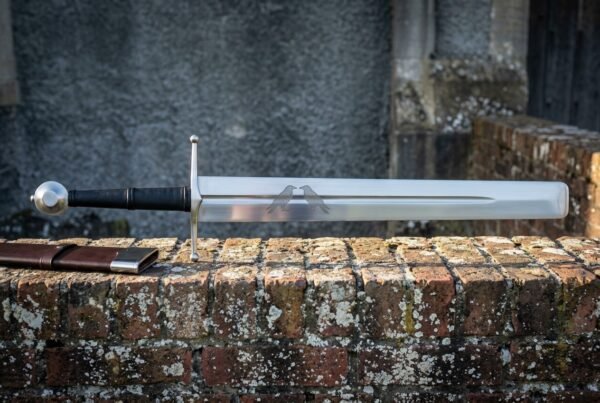
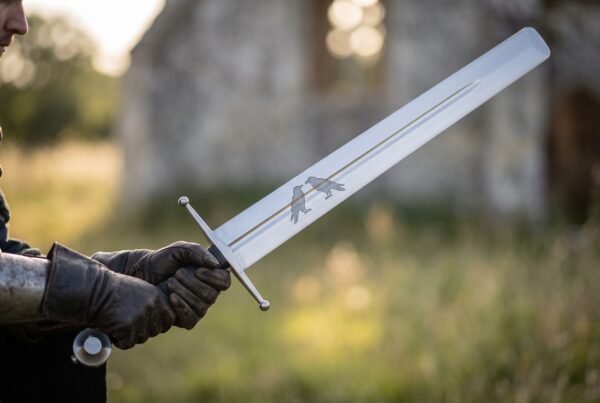
Duskwing Hand Forged 1095 Steel Executioner Sword with Twin Raven Etched Blade | 25 Inch Blade and 36 Inch Overall | Wheel Pommel and Brown Leather Scabbard | Norse Collector Gift | RK-1713
Original price was: $429.00.$364.65Current price is: $364.65.Nothing is listed here right now
This page is empty at the moment. Rather than fill it with numbers that do not describe anything we actually have, everything below is about the form itself, what separates it from a fighting sword, and where to look instead. If you were expecting stock, the broadswords and zweihanders pages are the nearest live categories.
We would rather say that plainly than pad a category page and waste your time.
The sword with no point
Almost every sword ever made is a compromise between cutting and thrusting. The taper of the blade, the shape of the tip, the distribution of mass along the length, all of it is somebody deciding how much of one to give up for the other. The executioner sword is the rare case where that argument does not happen, because one of the two jobs was never on the table.
The result is a blade that looks wrong to anyone used to fighting swords. It is broad. The edges run close to parallel from the guard almost to the end, with very little taper. And it stops in a squared or rounded end rather than coming to a point. People seeing one for the first time regularly assume it has been broken and reground. It has not. A point on this sword would have been metal doing nothing, and taking it off moves the balance further out along the blade, which is exactly where you want it when the entire function of the object is one heavy horizontal cut.
The German name is Richtschwert, from richten, to judge or to set right. The type is documented from roughly the sixteenth century and persisted in parts of the German speaking lands into the nineteenth. It replaced the axe across much of continental Europe for judicial beheading, which is worth knowing because the axe survived longer in England and that is why English language readers often picture the wrong tool.
It is also worth being clear about what these were not. They were not battlefield swords repurposed, and they were not ceremonial pieces that never left a wall. A Richtschwert is a purpose built tool for a specific legal function, made to a pattern, maintained by the man who used it, and often passed on within the office rather than within a family. Reading one as a fighting sword with an odd tip gets the object backwards.
Why it is two handed but short
These swords are gripped with both hands and they are still noticeably shorter than a zweihander or a battlefield great sword. That combination confuses people until you think about what the sword is for.
Reach is worthless here. Nobody is being kept at a distance and nobody is trying to close. What matters is that the swing is fast, level and heavy, and that it goes exactly where it is aimed. A shorter blade with the mass out at the end delivers all of that better than a longer one, and a long blade would only add wobble and a longer arc to control.
The two handed grip is there for the same reason a splitting axe has a long handle. It lets the whole body drive the movement rather than the arms, and it keeps the sword tracking straight rather than rolling off line.
Pommels on the type are usually plain and heavy, and they sit where they do to anchor the lower hand rather than to counterbalance the blade. That is another inversion of normal sword design, where a heavy pommel exists precisely to pull the balance back toward the hand.
How to tell one from a fighting sword
Since nothing on this page can be measured, the useful thing to describe is the shape itself. These are the features that identify the type when you see one in a museum case or a photograph.
| Feature | On an executioner sword | On a fighting sword of similar size |
|---|---|---|
| Tip | Squared off or rounded, no point at all | Tapered to a point for thrusting |
| Blade profile | Broad, edges close to parallel, almost no taper | Tapers steadily from the guard toward the tip |
| Balance | Mass carried well out along the blade | Balance pulled back toward the hand for recovery |
| Grip | Two handed, on a comparatively short overall length | Two handed grips come with much longer blades |
| Guard | Simple straight crossguard, sometimes with side rings | Often complex, with rings, bars or a full basket |
| Decoration | Engraving on the flats, frequently a wheel, a gallows or a verse | Maker marks and inlay, rarely narrative imagery |
Fullers are the other giveaway. A fighting blade of that width would usually carry a fuller, or a pair of them, ground down the centre to take weight out of the part of the section that does no cutting. On a sword where the mass is the whole point, that reasoning inverts, and surviving examples of the type are typically either unfullered or carry only a shallow one near the guard.
The tip is the one that settles it. Every other feature on that list appears somewhere on some fighting sword. A deliberately pointless blade of that width does not.
The holes near the end
A great many surviving examples carry two or three round holes pierced through the blade near the end, and they attract more speculation than any other detail. The usual claims are that they held lead for extra mass, or that they let air past the blade to speed the cut. Neither holds up well. Holes drilled through a blade remove metal rather than add it, and the aerodynamic argument does not survive contact with how fast a sword actually moves.
The likeliest answer is the boring one. They are decorative, they identify the type at a glance, and on some examples they carry rings or a tassel. It is worth knowing the debate exists so that you can recognise the confident wrong answer when somebody tells it to you.
The engraving, and what it was for
Executioner swords are among the most heavily decorated European swords, and the decoration is almost always about the job rather than about the owner. Surviving blades carry engraved wheels, gallows, scenes of a condemned figure kneeling, and verses in German asserting that the sword acts for justice rather than for the man holding it.
That is the point of it. The engraving is a public statement that the object is an instrument of a legal process, not a personal one. Judicial beheading by sword was also treated as a privileged death across much of Europe, faster and less degrading than hanging or the wheel, and often reserved for the condemned of higher rank. The most famous English instance is Anne Boleyn in 1536, executed with a sword by a specialist brought over from France rather than with the axe used on everyone else.
None of that makes these pleasant objects. It does make them historically specific in a way that a generic display sword is not, which is why collectors want them and why we would rather describe the type honestly than dress it up.
Steel and hardness, when we list one
We use two steels and there is no third. Plain 1095 high carbon is hardened to 54 to 58 HRC, which is the range that lets a long blade flex and return instead of taking a set or snapping. Damascus of 1095 and 15N20 is forge welded and acid etched, hardened to 58 to 60 HRC, which holds an edge slightly longer and carries a pattern.
On a broad blade with parallel edges, plain 1095 is the sensible choice. A wide flat is a large canvas for a Damascus pattern, but it is also a lot of blade to keep flexible, and the lower hardness range is the safer one at that width. Our steel and hardness page explains what an HRC figure actually measures, and this guide covers the trade between the two.
Care and storage of a blade like this
Neither of our steels is stainless and both will rust if neglected. The advice is the same for any large carbon steel blade. Wipe it after handling, because skin oil is mildly acidic and a fingerprint will etch into a polished flat within days. Leave a light film of camellia, mineral or any food safe oil on the steel.
A broad flat blade shows everything. Every fingerprint, every water spot and every wipe mark reads clearly across that much unbroken surface, far more than on a narrow fullered blade. That is worth knowing before you buy any wide bladed sword, because it means handling it in front of people costs you five minutes of cleaning afterwards.
Store it out of the scabbard if it will sit for months, since leather holds moisture against steel. Grey patina is stable and harmless. Orange spotting lifts with fine abrasive and oil, and our care guide covers the method.
Displaying one
A broad two handed blade is heavy and it needs mounting hardware that reflects that. Use two mounting points rather than one, fix both into something structural rather than into plasterboard alone, and check that the mounts hold the blade rather than gripping the guard. Our sword stands and wall mounts page carries the hardware, and our guide to displaying swords and axes covers placement.
One practical note about this particular type. The squared end means it will sit flat on a horizontal stand in a way a pointed sword will not, which makes a table stand a genuinely good option rather than a compromise.
Engraving
Broad flats take engraving better than any other blade shape we sell, which is exactly why the historical examples carry so much of it. Names, dates, mottos and Elder Futhark rune lines all sit well on a wide flat, and it is done in the US after a piece arrives. Text engraving is 19 dollars, a symbol is 39 dollars and a family crest is 49 dollars.
Elder Futhark is a phonetic alphabet rather than a cipher, so a name is transliterated by sound and not letter for letter, and there is no rune for the letter C. Read our guide to the runes before deciding on wording. Engraving is permanent and an engraved piece cannot be returned, so send the exact spelling and check it twice.
Where our pieces come from
Ransack Viking is a US company based in Chicago, Illinois. Our swords are forged, ground, fitted and finished by hand in the Czech Republic, then imported, inspected and shipped from Chicago. Engraving is done in the US after arrival.
Because everything is worked by hand, small differences in grind, polish and fitting between two pieces of the same name are normal and expected.
What to look at while this page is empty
If it is the broad straight double edged blade that appeals, the broadswords page is the closest live category. If it is the two handed grip and the scale, look at the zweihanders, which run 48 inches and above. If you want the historical specificity rather than the size, the arming swords and longswords pages carry the documented medieval types in quantity.
Browse related categories
- Swords, the full range
- Broadswords with straight double edged blades
- Zweihanders, the two handed swords
- Longswords
- Arming swords
- Damascus swords in forge welded 1095 and 15N20
- Sword stands and wall mounts
- Scabbards and sheaths
Guides worth reading first
- How to buy your first sword
- Display sword or battle ready, and what the terms mean
- Steel and hardness: what an HRC number tells you
- How to display swords and axes safely
- Care guide: blade, handle and scabbard
Frequently asked questions
Why does an executioner sword have no point?
Because it was never used to thrust. A point would have been metal doing nothing, and removing it pushes the balance further out along the blade, which is what a single heavy level cut wants. The squared or rounded end is deliberate, not damage.
Is the blade broken if it ends flat?
No. This is the most common assumption people make on seeing one, and it is wrong. Blunt ended broad blades of this type are a documented European form, and the flat end is one of the features that identifies it.
Why is it two handed but short?
Reach was irrelevant to the job, so length would only have added a longer arc to control. A shorter blade with the mass carried out toward the end gives a faster, heavier and more accurate swing, and the two handed grip lets the body drive it rather than the arms.
What are the holes near the end of the blade?
Most likely decorative, and on some examples they carry rings or a tassel. The popular claims that they held lead for weight or let air through to speed the cut do not hold up, since drilling a hole removes metal rather than adding it.
What is the German name for one?
Richtschwert, from richten, to judge or to set right. The type is documented from roughly the sixteenth century and persisted in parts of the German speaking lands into the nineteenth, having largely replaced the axe for judicial beheading across continental Europe.
Why are they so heavily engraved?
Because the decoration was a public statement about the process rather than about the owner. Surviving blades carry wheels, gallows, kneeling figures and German verses asserting that the sword acts for justice rather than for the man holding it.
Why is nothing listed on this page?
Because we have nothing to list at the moment, and we would rather say so than fill the page with figures that describe nothing. The broadswords and zweihanders pages are the nearest live categories.
What steel would one be made in?
One of two. Plain 1095 high carbon hardened to 54 to 58 HRC, which is the range that lets a long blade flex and return, or Damascus of 1095 and 15N20, forge welded and acid etched, hardened to 58 to 60 HRC. On a blade this broad, plain 1095 is the sensible choice.