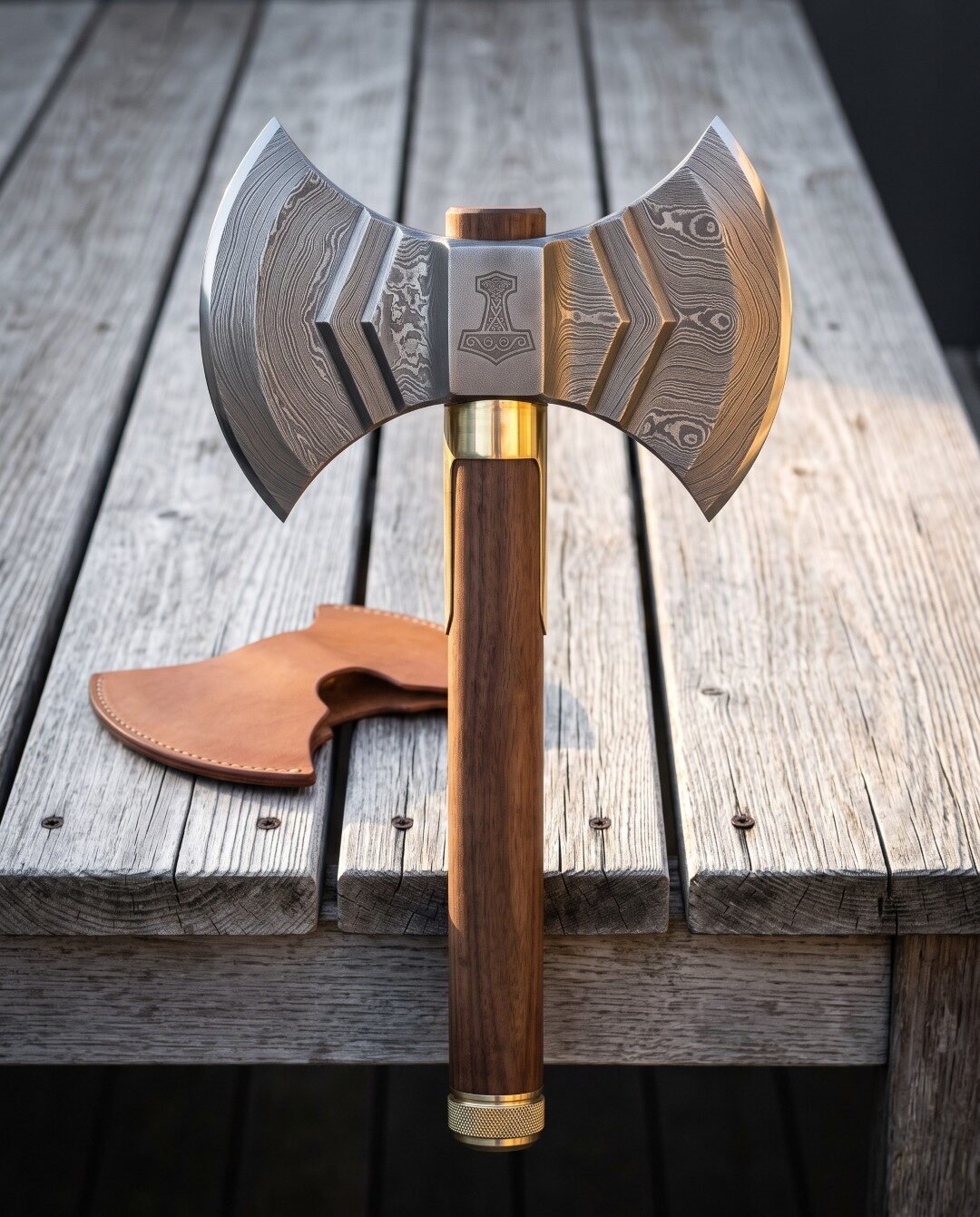
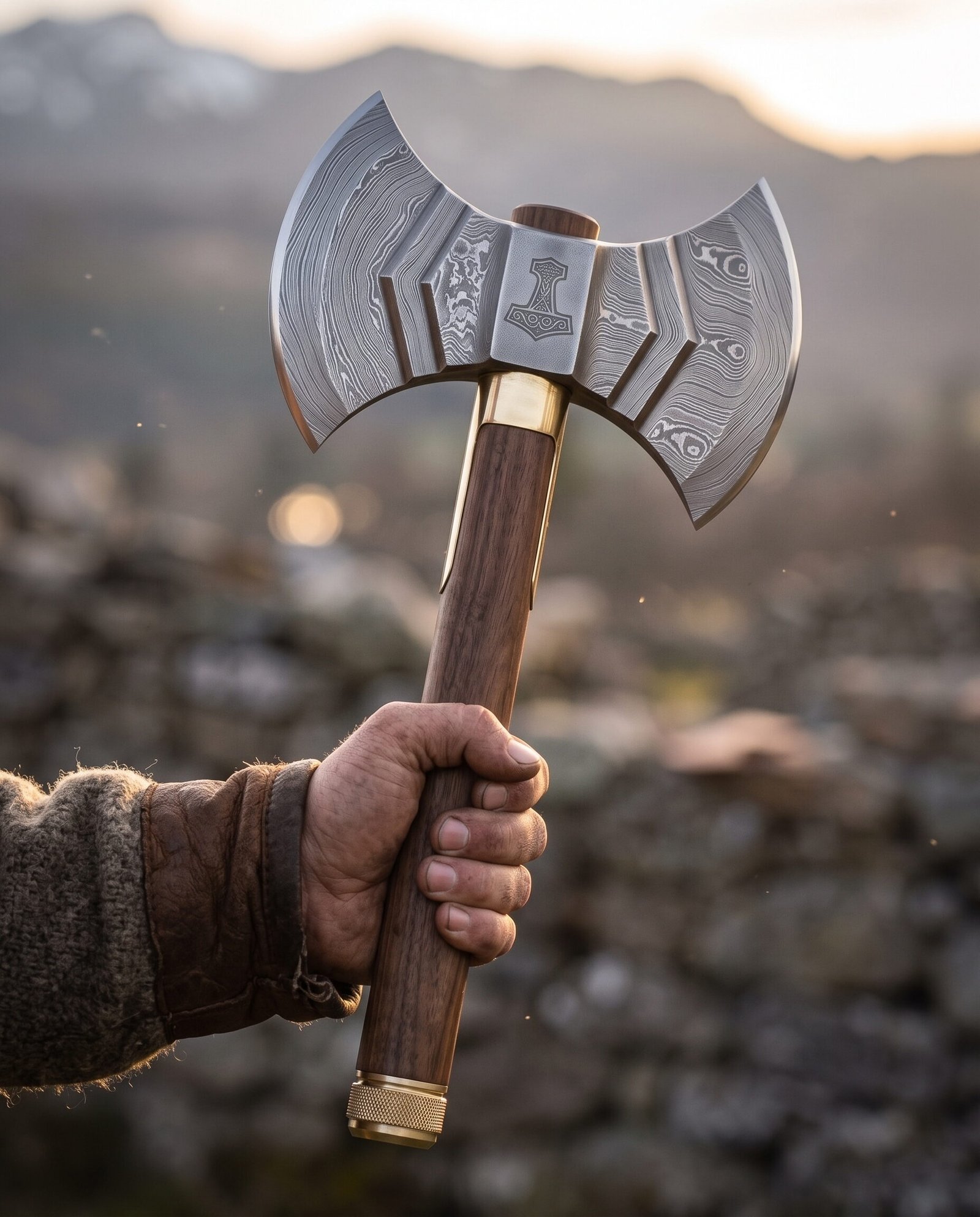
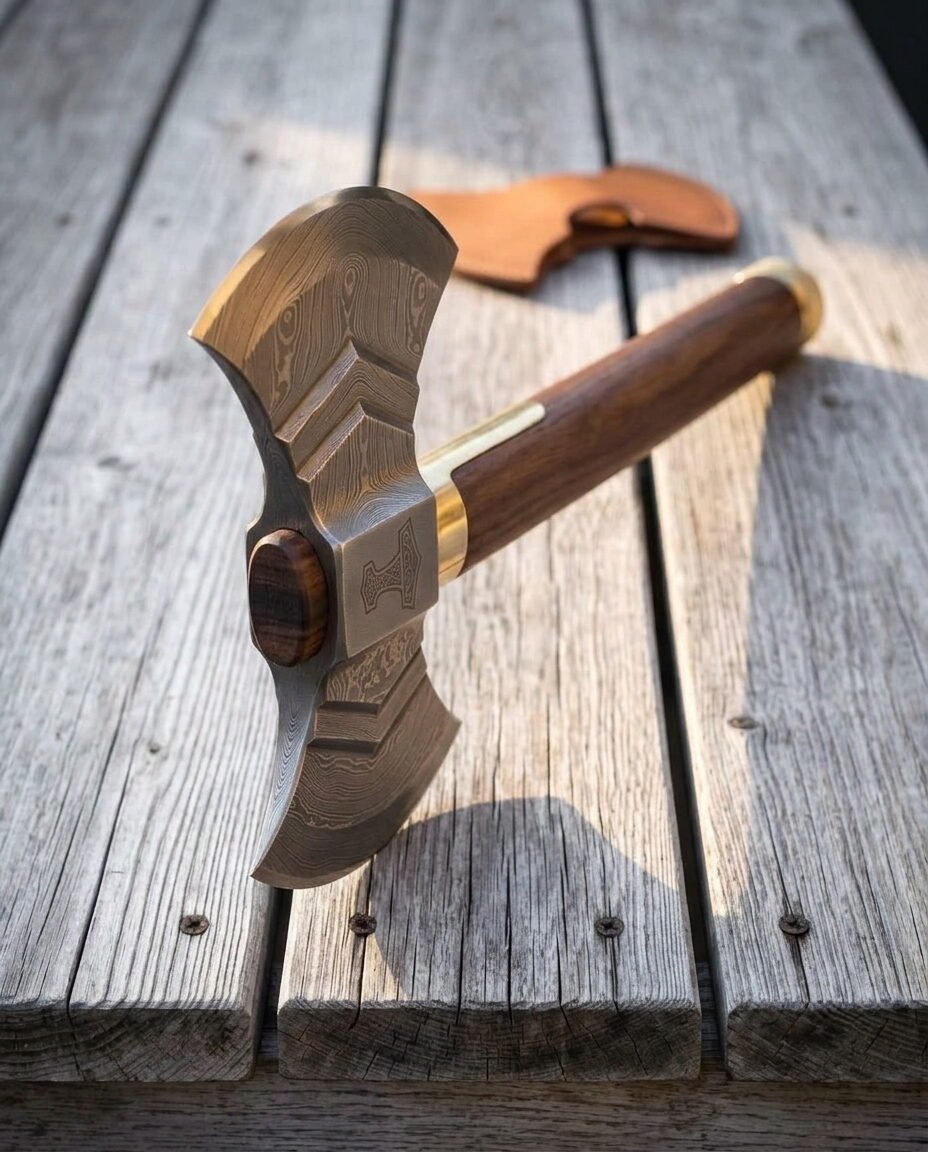
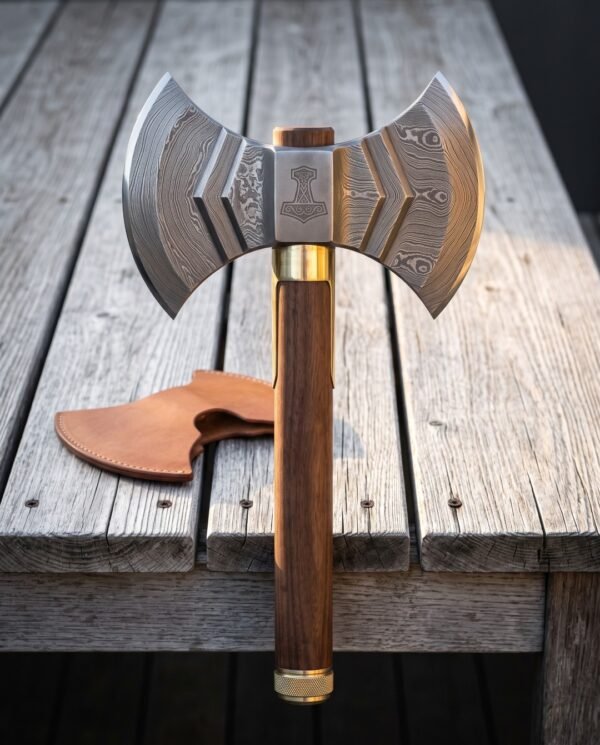
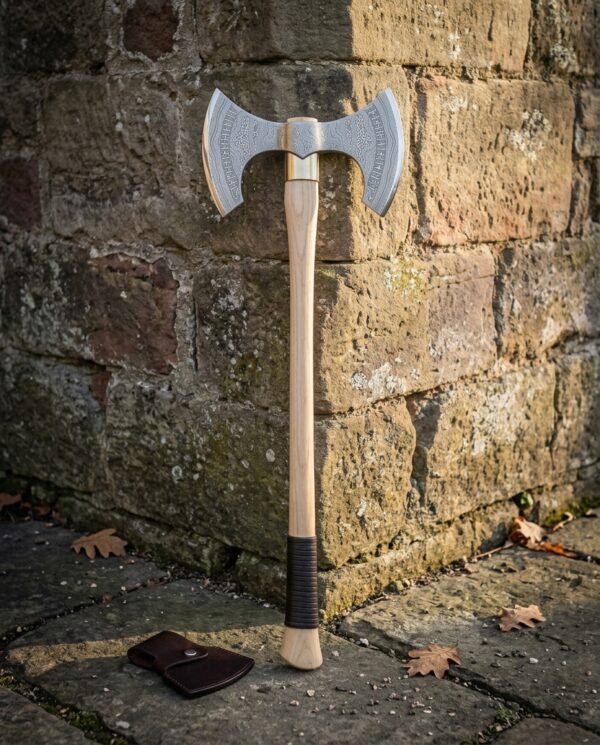
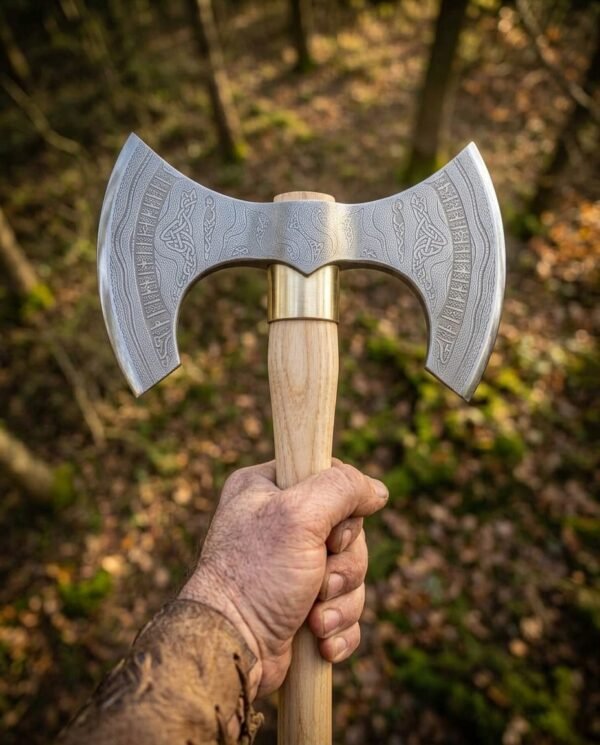
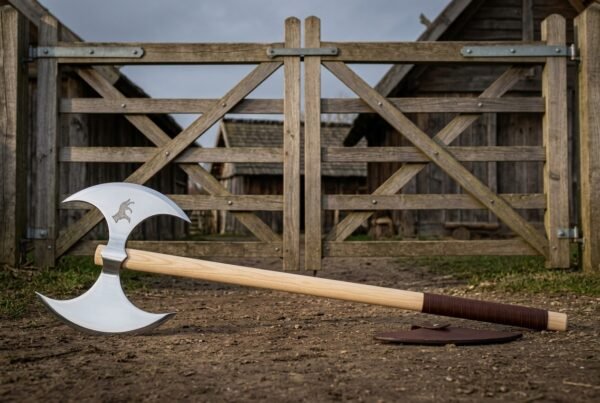
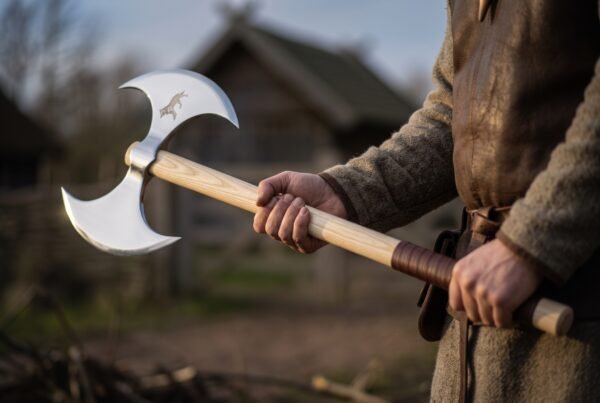
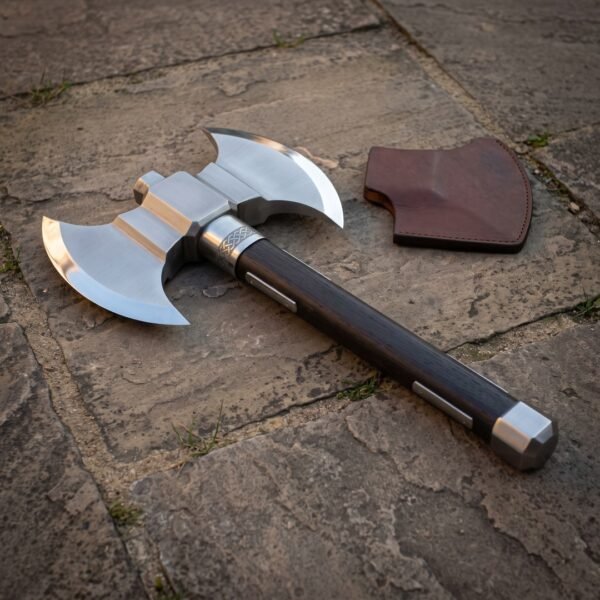
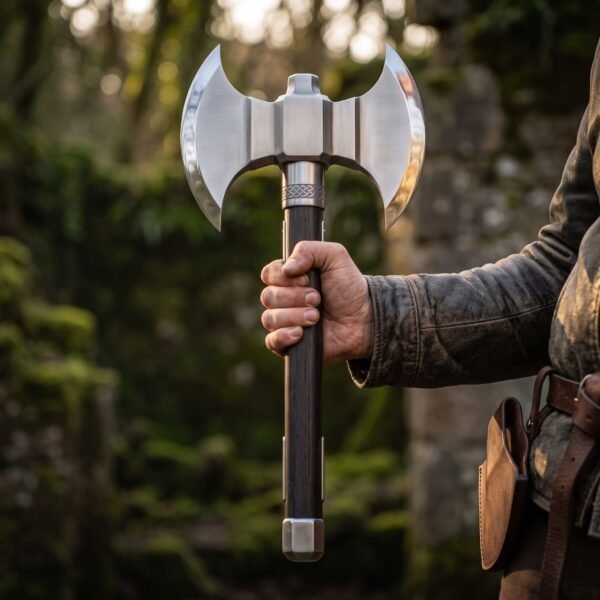
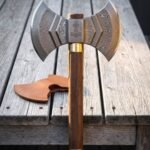
This is a double headed axe forged from layered Damascus steel, with two broad crescent bits carrying a strong flowing pattern and a set of chevrons stepped in towards the eye. The central block is left polished and carries an engraved Mjolnir on the cheek. The haft is walnut, collared in brass under the head, with a brass strip pinned down the face and a knurled brass cap at the butt. A tan leather cover is supplied for the edges.
Pattern welding was not originally decorative, and the Norse are the reason we know that. Bloomery iron came out of the furnace as an uneven spongy mass, some of it usefully carburised and some of it soft, and no smith could tell which was which by looking. The answer was to draw the material into rods, stack and twist them and forge weld the bundle, so that the good and the bad averaged out along the whole length of the blade instead of leaving one weak patch. The pattern on the surface was simply the visible evidence that the trick had worked, and Norse smiths eventually leaned into it, which is why so many sword blades from the period read like woven rope. This axe is forged, ground, etched and fitted in a Czech Republic workshop. It is part of the double headed axes, and the battle axes are put together the same way.
Specifications
| Head material | 1095 and 15N20 layered Damascus steel, acid etched |
|---|
| Hardness | 58 to 60 HRC |
|---|
| Head form | Twin crescent bits with stepped chevron panels and a polished square central block |
|---|
| Engraving | Mjolnir hammer cut into the polished cheek |
|---|
| Haft | Walnut, passing through the eye with the end grain showing above the head |
|---|
| Fittings | Brass collar under the head, pinned brass strip down the face of the haft and a knurled brass butt cap |
|---|
| Included | Tan leather edge cover |
|---|
| Intended use | Display, collection and ceremonial gift piece |
|---|
| SKU | RK-1644 |
|---|
How the chevrons get into the steel
The wavy banding you see across the bits is what a plain stacked billet gives you once it has been drawn out and ground. The chevrons stepped in beside the eye are something else, and they are worth understanding because they are the difference between a billet and a pattern.
Layers in a Damascus billet run like the pages of a book. If you grind straight down through the flat you cut across the pages and you see roughly parallel lines. If you instead press or cut a series of grooves into the surface and then forge the billet flat again, the layers underneath are pushed up into the grooves, and grinding the surface back reveals rings and waves where the disturbance was. Cut those grooves at an angle from both sides and the layers meet in the middle as a row of arrowheads. That is a chevron, and every one of them is a deliberate deformation put into the billet before the head was ever shaped. Get the depth wrong and the pattern either fails to appear or you cut clean through the outer layers into a flat centre.
The steel, the walnut and the brass
The billet is stacked from alternating layers of 1095 high carbon steel and 15N20, a nickel bearing steel, forge welded, drawn, folded and welded again. The nickel resists the acid etch while the 1095 darkens, and that difference is what makes the pattern visible. After the head is shaped it is normalised, quenched and tempered to 58 to 60 HRC, then etched, neutralised and oiled.
The haft is walnut, which is the classic choice for a piece meant to be looked at as well as held. It is stable, it takes a very fine finish, and its open grain carries a colour that runs from a mid chocolate to a warm reddish brown, so no two hafts read the same. Brass is used for the collar, the face strip and the butt cap because it is soft enough to be pinned and peened tight against wood, it never rusts, and it sits against the steel without setting up the corrosion you get from some other metal pairings.
Engraving, runes and your own design
Use the rune converter on this page to turn a name, a date or a short phrase into Elder Futhark and we will cut it into the steel, the leather or the wood. If you would rather have a Viking pattern than a rune line, choose your own design in the engraving option above the add to cart button and tell us where it goes. Where a piece already carries an engraved design, your chosen engraving replaces it rather than sitting alongside it. On this axe that means your rune line or your symbol is cut where the Mjolnir currently sits on the polished cheek, and the leather cover takes a name or a date. See the engraving page.
Handling and balance
Because the head is symmetrical about the haft, this axe hangs level and has no natural front. Held under the brass collar it feels planted and heavy in a satisfying way, and held at the butt it wants to swing itself, so most people who pick one up end up choking right up to the collar. The knurled brass cap at the bottom is not only a finish detail. The texture gives the little finger something to register against when the axe is held low, and it stops the end of the haft sliding through a relaxed hand.
Both bits carry a live edge and they are hardened Damascus, so treat this as a display, collection and ceremonial piece. Do not chop with it, do not throw it and do not spar with it. A hard blow into another hard object can chip a bit at 58 to 60 HRC, and a horn is the most exposed part of the whole piece. Keep the leather cover on the edges when it is off the wall.
Care
Damascus is high carbon steel and it will rust if it is left wet or handled and put away. Wipe the head after handling and keep a thin film of mineral oil or a light gun oil on the bits and around the engraved cheek, where fingerprints collect. Do not store it with the leather cover on for long stretches in a damp room, because leather holds moisture against steel and will draw a line of rust along the edge. Brass warms to a soft gold over time, which most owners prefer, and a little brass polish takes it back to bright. Wipe the walnut with a dry cloth and give it a coat of hardwood oil once a year. More is on the steel care page.
Made in the Czech Republic
This is a handmade piece from the Czech Republic, made in a workshop that still forges, grinds and finishes by hand instead of stamping parts out. The smiths there have kept the older way of working, and the wood, horn and leather are shaped and fitted by hand as well. Two pieces of the same design will never be identical, and that is part of what you are buying.
Ransack Viking is a United States company. We handle the import ourselves, look over every piece when it lands and ship from our warehouse in Chicago, Illinois. Engraving is done in the United States after the piece arrives, so your design goes on before we send it out.
A note on handmade variation
This axe is hand made, not machine made and not bulk produced, so what arrives will not be a pixel for pixel copy of the photograph. Every billet draws out differently under the hammer, so the flow of the pattern across the bits is unique to your axe and the chevrons sit at slightly different spacing. The etch takes with varying contrast, the walnut haft is natural timber that runs from mid chocolate to a warmer red brown with its own figure, and the brass carries the fine marks of being turned and polished by hand. The dimensions, the steel, the heat treat and the fittings are the same every time. The character is not. The long form of that is what the beard on an axe is for, with axe care next to it.
Frequently asked questions
Is the pattern real or etched on
Real. The head is forge welded from 1095 and 15N20 and then acid etched to reveal what is already in the steel. Grind the surface back and the pattern is still there in the cross section.
Is this a historical Viking axe
No. Viking age axes are all single bitted. The double bit is a Minoan ceremonial form and a modern forestry form, and we build this one as a display and collection piece rather than a reproduction.
Are both bits sharp
Yes, both carry a working edge. Keep the leather cover fitted when the axe is not being displayed and mount it out of walking reach.
Will the brass tarnish
Yes, slowly, to a deeper warmer gold. That is normal for solid brass and is not a fault. Brass polish takes it back to bright whenever you want it.
Can you put a name on it instead of the hammer
Yes. Your rune line or your own design is cut where the Mjolnir sits, and it replaces it rather than sitting next to it.
How long does shipping take
One to two weeks of processing in the shop, then free shipping inside the United States. Engraving usually adds a few days.
What is in the box
- Hand forged 1095 and 15N20 Damascus double headed axe
- Engraved Mjolnir on the polished cheek
- Walnut haft with a pinned brass face strip, brass collar and knurled brass butt cap
- Tan leather edge cover
- Care card for high carbon Damascus steel and walnut
- Lifetime warranty against defects in forging, grind, heat treat and fittings
- Forged and finished in the Czech Republic
Explore the range
See more in the double headed axes, the war axes and the Thors hammers, or read the guides on pattern welding and billet manipulation.
Worth a look beside this
Sitting beside it in the catalogue is the Northmark bearded axe, pattern welded Damascus. Another in the same line is the Prowshear bearded axe, pattern welded Damascus. Next along the rack is the Brasshelm bearded axe, pattern welded Damascus.
Fitting out further, the Thunderclad war axe belongs with it. Or start from a blank sheet on the custom Viking axe page.


Meh. Expected more. Leather sheath was thinner than shown in the pictures. Blade arrived with a couple small nicks in the edge. Might work for someone less picky than me.