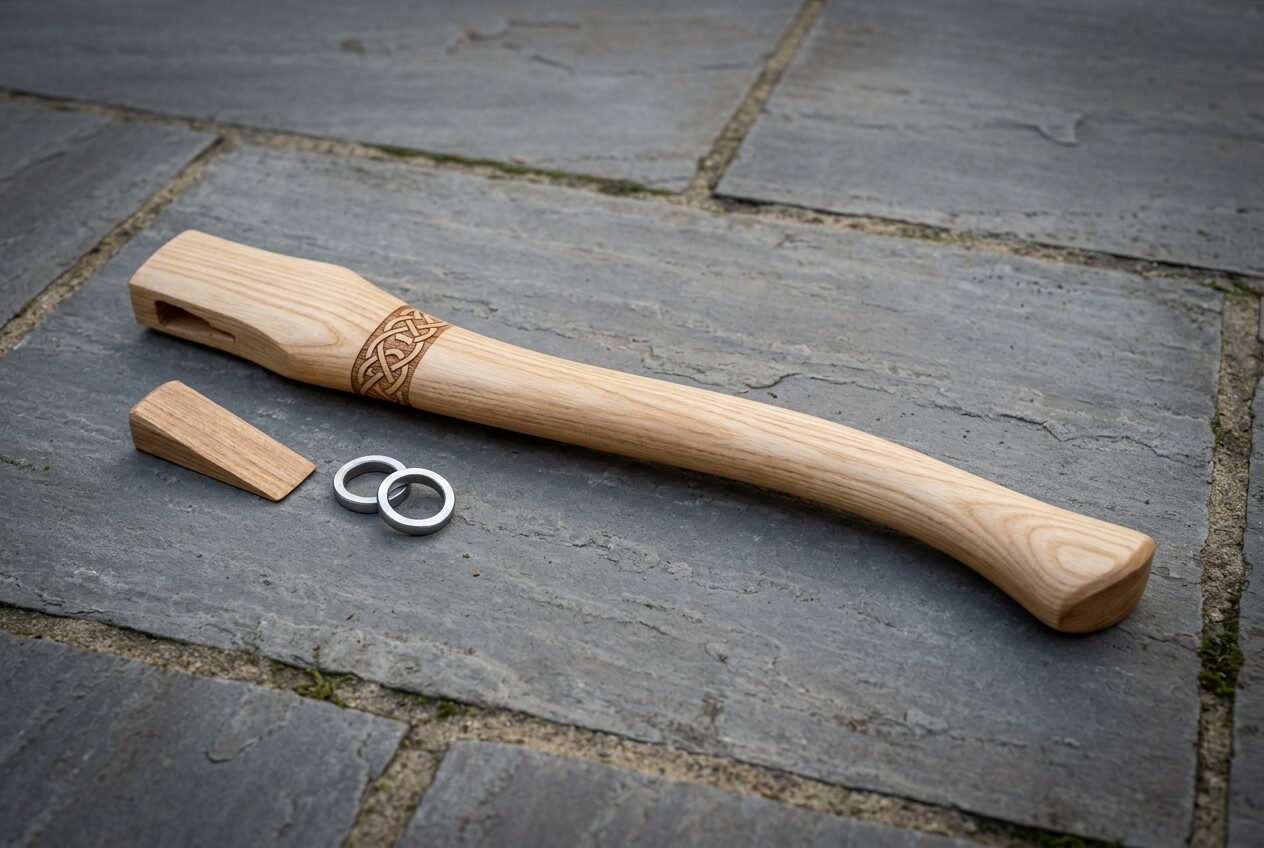
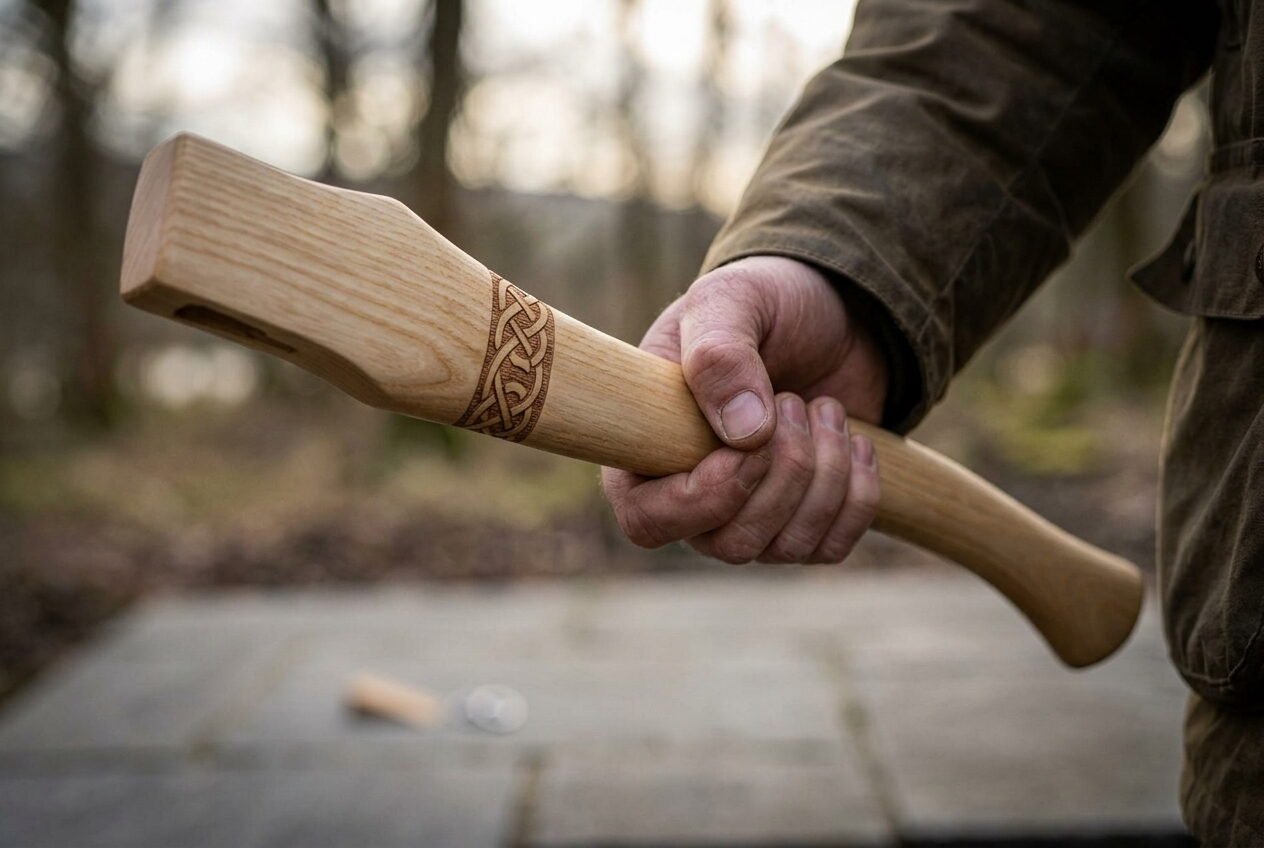
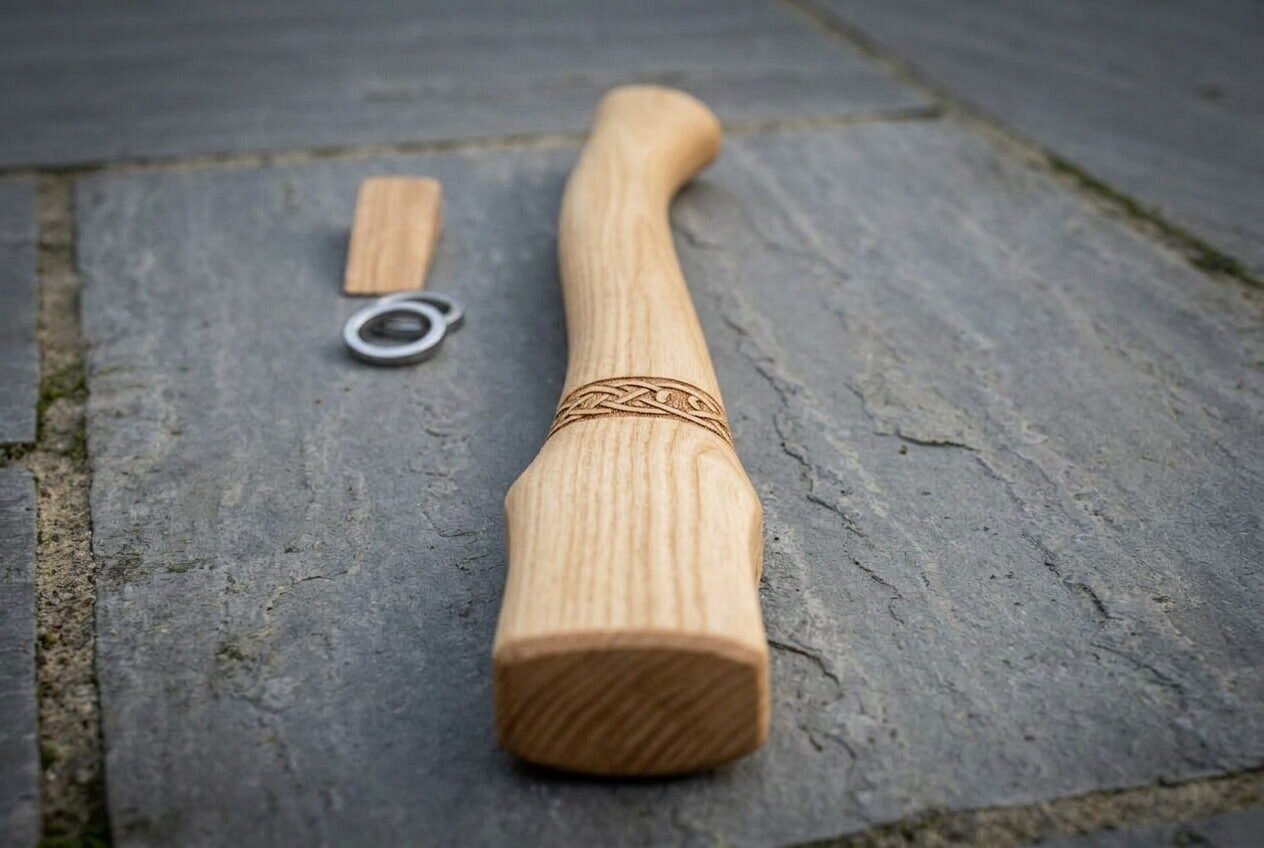
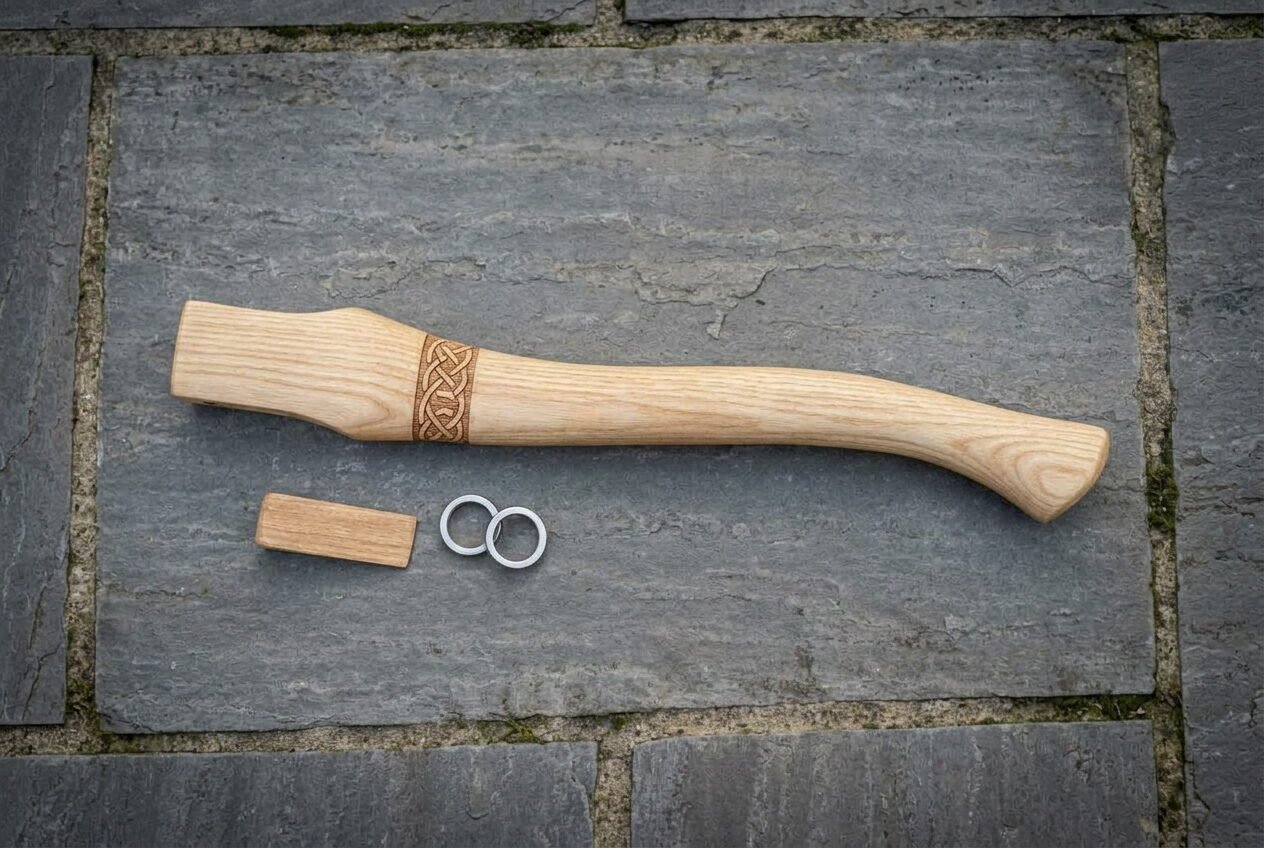
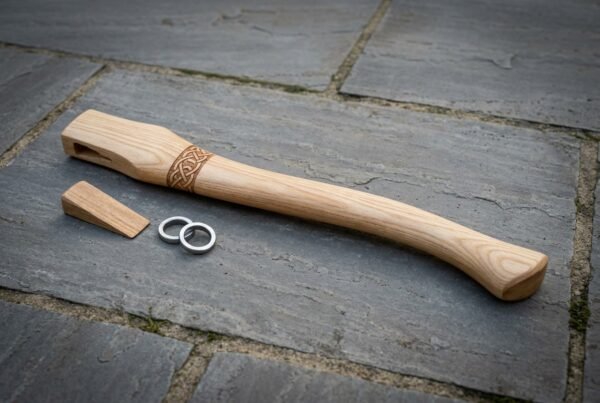
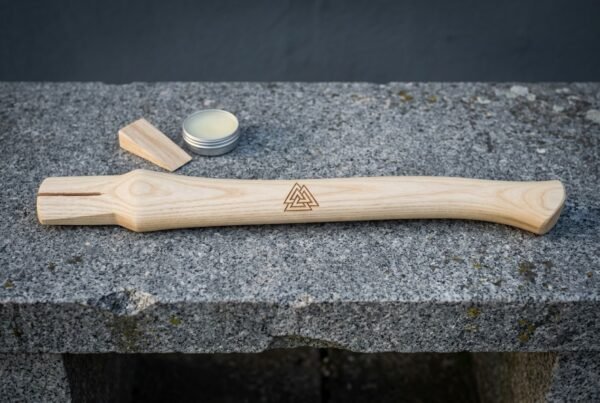
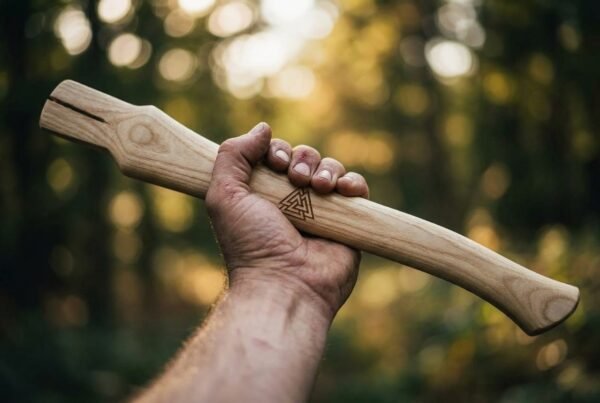
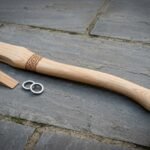
A replacement axe haft in American hickory at a one hand working length, with a band of Celtic knotwork cut around the shaft below the eye, a long straight run through the middle and a swept curve into the butt. It comes with the wooden wedge cut to match the kerf and two steel ring wedges, which is everything you need to hang a head properly. The axe head itself is not included.
The knotwork band is a real Insular pattern rather than a generic braid. Interlace of this kind is built from a single continuous line that passes over and under itself and returns to where it started, and the discipline of the form is that the line must never simply stop. It runs through the Book of Durrow and the Book of Kells, through the Pictish stones of eastern Scotland and the great crosses of Ireland, and it carried over into Norse ornament during the centuries the two worlds overlapped in the Irish Sea. On a tool it does something useful too, because a textured band under the head is exactly where a hand grips when you choke up for close work. This haft is sawn, shaped, engraved and finished in the Czech Republic. This one is kept with the Anglo Saxon and Celtic pieces, and the Norse pendants sit right beside it.
Specifications
| Material | American hickory, air dried, selected for straight grain |
|---|
| Overall length | Approximately 16 inches |
|---|
| Profile | Straight through the middle with a swept curve and a flared swell at the butt |
|---|
| Eye end | Shouldered and kerfed, the saw kerf open and ready for the wedge |
|---|
| Engraving | Cut Celtic knotwork band around the shaft just below the shoulder |
|---|
| Finish | Sanded and left bare of varnish or lacquer |
|---|
| Suits | Bearded, Dane and medieval pattern heads with a standard oval eye |
|---|
| Included | Haft, matched flat wooden wedge, two steel ring wedges |
|---|
| Not included | Axe head |
|---|
| SKU | RK-1742 |
|---|
Wooden wedge first, steel wedges across it
The two small steel rings in the box are cross wedges, and the order they go in matters more than most people realise. The wooden wedge goes first, driven down the saw kerf so that it spreads the top of the haft along the long axis of the eye. That is the wedge doing the real structural work, because it pushes the wood outwards along the direction the eye is longest and it does so over a large area.
The steel rings go in afterwards, driven across the wooden wedge at an angle to it. Their job is different. They spread the wood in the short direction of the eye, filling the last of the gaps at the sides where the wooden wedge cannot reach, and they lock the wooden wedge itself so it cannot creep back out. Two small ones set at opposite angles do the job better than one big one, because a single large steel wedge concentrates all the force in one place and can crush the fibres or even split the haft.
Do not skip the wooden wedge and use steel alone. That is the classic shortcut and it is why so many secondhand axes have hafts that are loose within a season. Once everything is driven, saw the proud wood off flush, take the sawn end back with a rasp, and seal the exposed end grain with oil or wax, because end grain moves moisture in and out far faster than the sides do and a dried out top is a loose head.
Hickory, length and why the haft is left bare
Hickory is used for striking handles because of its structure. It is ring porous, so each year of growth is a band of large open vessels followed by a band of dense fibre, and that alternation absorbs shock instead of transmitting it into your wrist. It also fails slowly rather than suddenly, which is worth a great deal on a tool swung near your own leg.
Sixteen inches is a one hand length, the size for a hatchet or a small carving and camp axe. It keeps the head close to your hand for short, accurate strokes and it packs down easily. For two handed splitting and felling you want a longer haft than this one. Choose by what the axe is for rather than by what the head looks like.
The haft is sanded and left bare rather than varnished. Varnish looks tidy in a shop and does three bad things in use: it raises blisters because the hand cannot grip, it cracks and then traps water underneath where it cannot dry, and it hides runout and short grain from anyone inspecting the wood. A bare haft tells you the truth about what you have, and it takes an oil or wax finish that you can renew yourself.
Engraving, runes and your own design
Use the rune converter on this page to turn a name, a date or a short phrase into Elder Futhark and we will cut it into the wood. If you would rather have a Viking pattern than a rune line, choose your own design in the engraving option above the add to cart button and tell us where it goes. Where a piece already carries an engraved design, your chosen engraving replaces it rather than sitting alongside it. On this haft that means your text takes the place of the knotwork band, or you can ask for it further down the shaft where the lower hand sits. See the engraving page.
Fit and sizing
Measure your axe head before ordering. Lay a rule across the top of the eye and take both dimensions, the long one and the short one. Bearded, Dane and medieval pattern heads generally fall around two and a quarter to two and a half inches by three quarters of an inch, and this haft is cut with material left on across that range so it can be fitted rather than forced.
Fitting is expected and it is not difficult. Offer the head up, mark where it binds, and take that wood off with a rasp and a coarse file, a little at a time, always from the flats rather than from the ends of the oval. The head should pass on from below and stop just before the shoulder seats, so that driving it home takes the last of the travel. If the haft drops through with no resistance it was cut too small and no amount of wedging will save it.
Check the growth rings on the butt end before you hang it. They should run in the same plane as the bit of the axe rather than across it, which puts the strength of the wood in line with the load. This haft is cut that way, so hang it with the bit following the rings.
Care
Oil or wax the haft when you hang it and once or twice a year after that, using boiled linseed oil or a wax and oil blend rubbed in with a cloth and buffed off. Give the end grain at both ends extra attention. Keep the axe out of a hot car and out of direct sunlight, since heat dries wood, dry wood shrinks, and a shrunken haft means a loose head.
Check the head for movement regularly during the first season. If it moves, do not just hammer the wedges harder, because a wedge with nothing left to bite on will crush the fibres and make the problem permanent. Pull the head, clean the eye, and rehang with a fresh wooden wedge. Never soak a loose axe in water. It swells the wood for a week and then leaves you with a rotted eye and a worse joint than you started with.
Made in the Czech Republic
The work behind this piece happens in a Czech Republic workshop that has kept to the old methods. Steel is forged and heat treated by hand, the grind is taken down by eye rather than by machine, and the handle, fittings and sheath are cut and finished one at a time. Because of that, every piece carries small marks of the hand that made it.
Ransack Viking is a United States company. We import direct, check each piece when it reaches us, and ship from our Chicago, Illinois warehouse. Engraving is added here in the United States after arrival, so the piece you receive is finished to your order.
A note on handmade variation
This haft is hand made, not machine made and not bulk produced, so what arrives will not be a pixel for pixel copy of the photograph. Hickory carries pale sapwood and darker heartwood and most hafts show both, so where the colour changes along your shaft and how sharp that line is will be its own. The figure through the curve at the butt varies board to board. The knotwork band is cut rather than printed, so the shadow it holds depends on the grain it crosses. The dimensions, the material and the build are the same every time. The character is not. Read axe care when you have a minute, and what the beard on an axe is for if you are still comparing.
Frequently asked questions
Does an axe head come with it
No. This is a replacement haft on its own, supplied with the wooden wedge and two steel ring wedges needed to hang a head you already have.
Why are there three wedges
The wooden one goes down the kerf and spreads the haft along the eye. The two steel rings go across it afterwards to fill the sides and lock the wooden wedge in place.
What length should I choose
This one is about sixteen inches, a one hand length for carving, camp work and a hatchet head. For two handed splitting and felling, pick a longer haft.
Will it fit a Dane axe head
It suits bearded, Dane and medieval pattern heads with a standard oval eye. Measure your eye first and expect to rasp the top of the haft to fit.
Why is it not varnished
Varnish causes blisters, cracks and traps water, and it hides grain faults. Bare wood with an oil or wax finish is stronger in service and honest about what you are buying.
Can I have runes cut instead of the knotwork
Yes. Your chosen engraving replaces the knotwork band. Use the rune converter above to see a name or a date in Elder Futhark.
What is in the box
- Knotgrain hickory axe haft with a cut Celtic knotwork band
- Matched wooden wedge, cut to the kerf
- Two steel ring cross wedges
- Lifetime warranty against defects in the timber selection, the shaping and the finish, with no end date and no receipt needed
- Made and finished in the Czech Republic
Explore the range
See the rest of the axe handles and hafts, the Anglo Saxon and Celtic pieces, the Dane axes and the guides.
If this one is not it
For a straight comparison, see the Haftmask haft. Worth putting side by side with this is the Bindwood haft.
From the same corner of the shop, there is the Frostbirch Viking axe. Pick the steel, the length and the fittings yourself on the custom Viking axe page.


Incredible craftsmanship on this one. The wood handle feels amazing and the balance is perfect. Love it.
Photos don’t do this axe justice at all. Edge retention has been great even after regular use. The wood handle feels amazing and the balance is perfect. So worth it.
Been eyeing this axe for months and it did not disappoint. Leather sheath is thick and well stitched. Not the cheap stuff you usually get. This will be a family heirloom for sure.