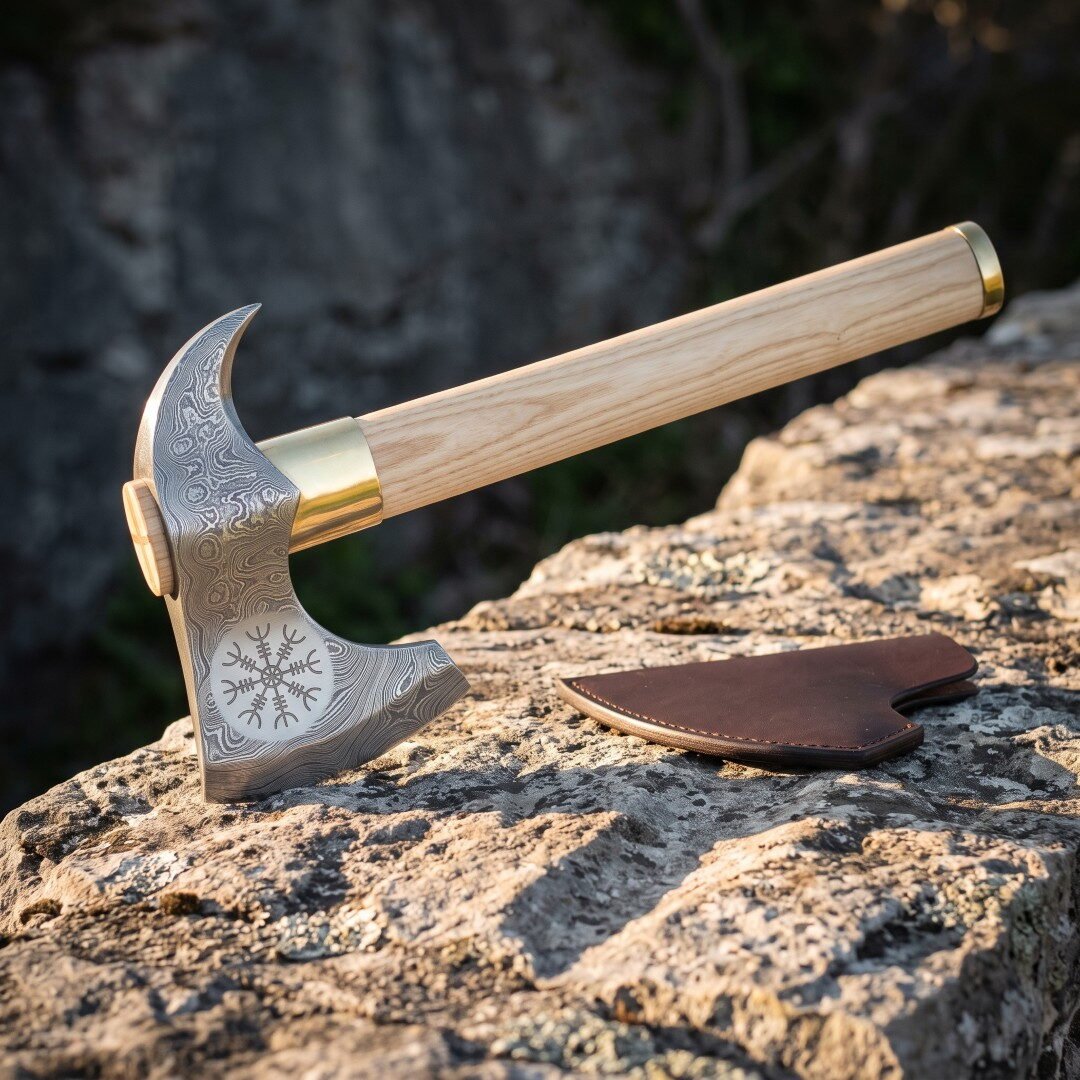
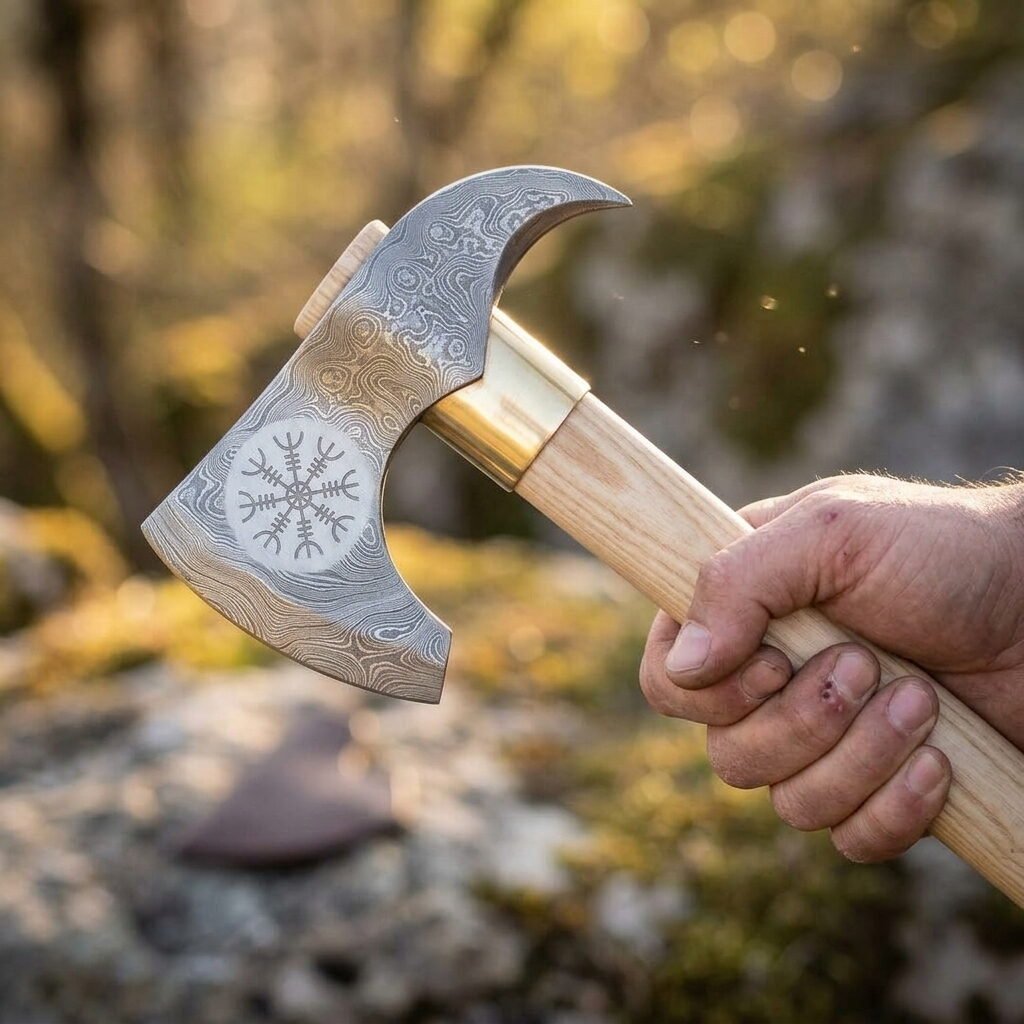
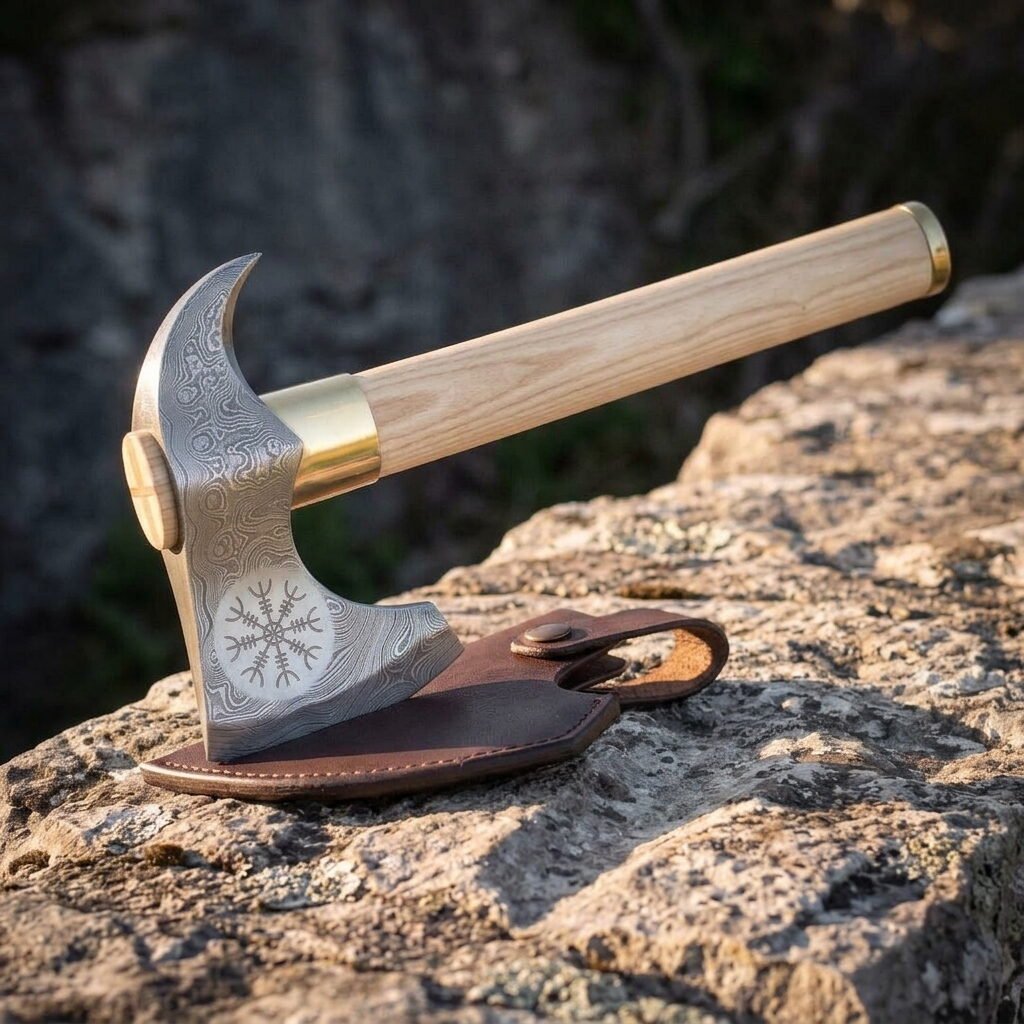
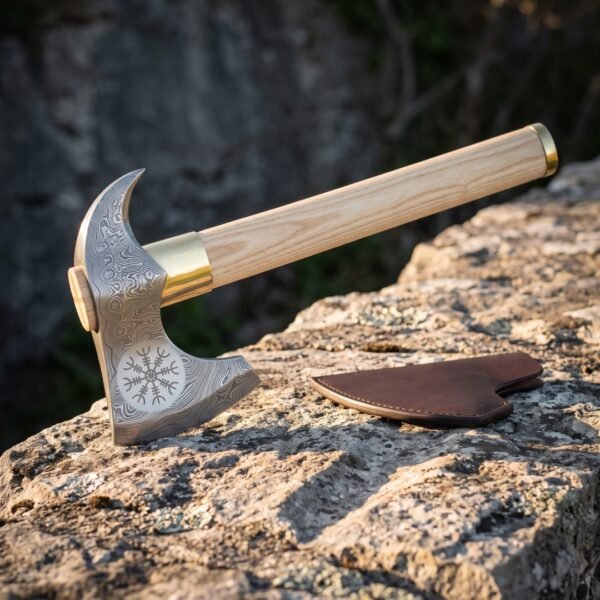
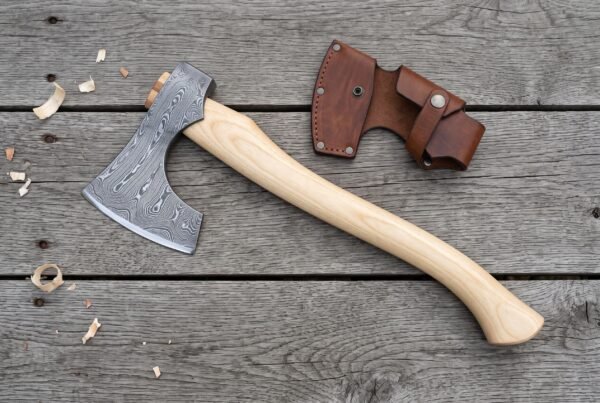
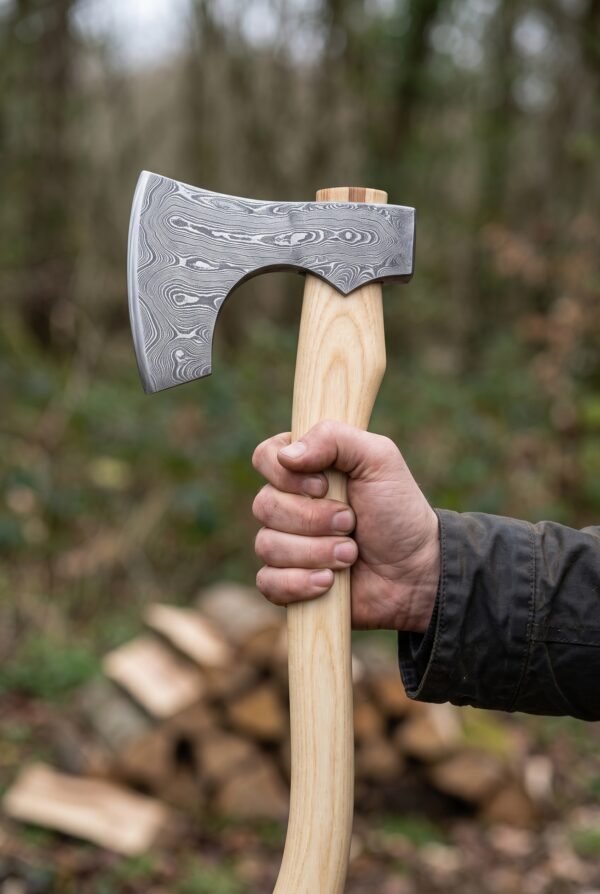
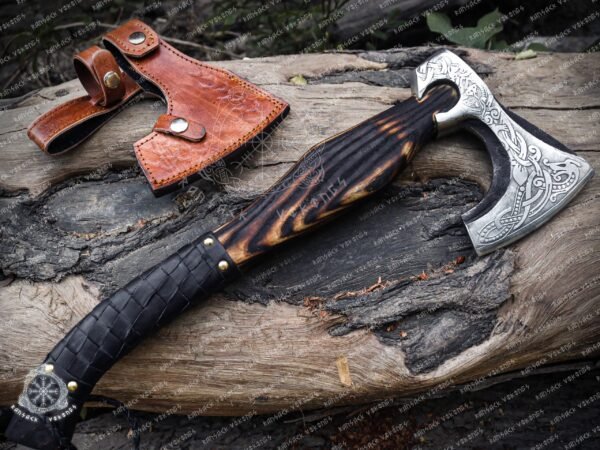
The Brasshelm is a bearded axe with a pattern welded head, and the way the pattern behaves is the reason to own it. The steel figure sweeps up over the horn, wraps round the eye where the haft passes through, and runs out into the beard, following the shape of the head instead of lying across it in straight lines. Set into the cheek is a Helm of Awe, polished back to bright steel inside a circular field so the eight armed stave reads as a clean silver disc against the dark etched pattern around it. The head sits on a pale ash haft with a wide brass collar under the eye and a brass ferrule capping the butt.
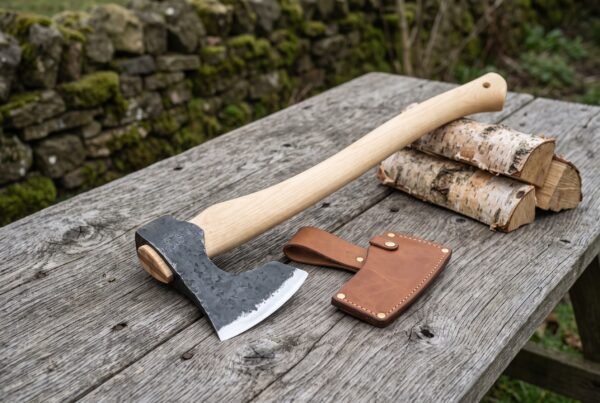
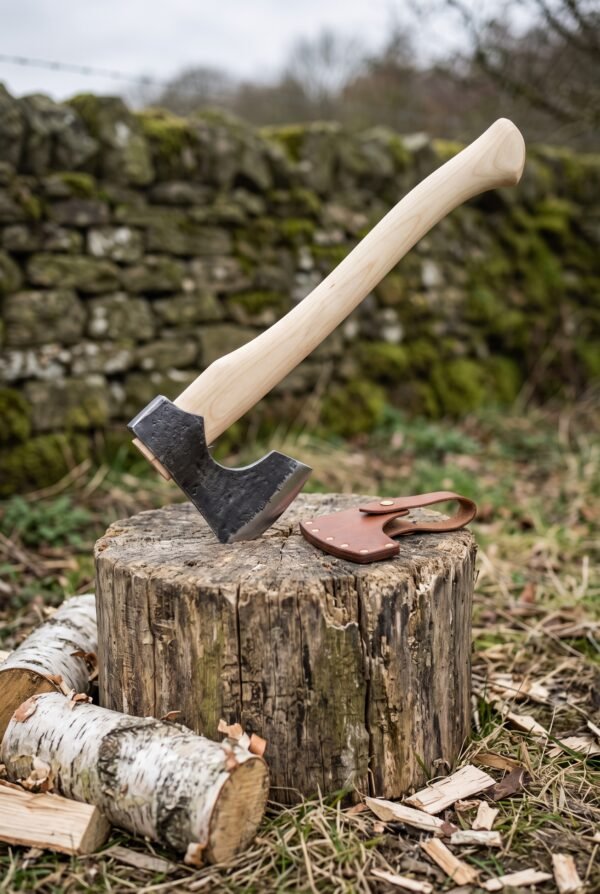
Pattern welding an axe head is harder work than pattern welding a knife, because the billet cannot simply be drawn out into a bar. It has to be folded round a drift to form the eye and then spread into a head, and every one of those movements drags the layers into new curves. That is why the figure here runs in long sweeps rather than parallel lines. This axe is hand made in the Czech Republic. Ransack Viking imports it, checks the head seating, the etch and the haft fit on arrival, and ships it from the Chicago warehouse. It comes with the fitted leather blade cover shown in the photographs.
If you are weighing this against something lighter to carry, a Viking axe against a tomahawk compares the two. The helm of awe belongs to the same late Icelandic tradition as the vegvisir, and the guide to Norse symbols puts it in order. Lighter heads meant for a target sit in the throwing axes.
Specifications
| Material | 1095 and 15N20 Damascus head, 58 to 60 HRC |
|---|
| Overall length | Approximately 19 inches |
|---|
| Head | Bearded profile with a sharpened upswept horn and a long lower beard |
|---|
| Haft | Pale ash, oval section, natural finish |
|---|
| Collar | Wide brass collar under the eye |
|---|
| Butt | Brass butt ferrule |
|---|
| Engraving | Helm of Awe polished bright into a circular field on the cheek |
|---|
| Finish | Acid etched Damascus with a wrapping figure round the eye |
|---|
| Cover | Fitted brown vegetable tanned leather blade cover with a snap strap |
|---|
| SKU | RK-2158 |
|---|
How the pattern gets round the eye
A pattern welded knife blade is straightforward in principle. Weld a stack of alternating bars together, fold it a few times, draw it out into a strip and grind a blade from it. The layers run more or less along the length and the pattern you see is a slice through them.
An axe head cannot be made that way. It needs a hole through the middle for the haft, and the traditional method is to take a bar, fold it in half around a shaped steel drift, weld the two halves together behind the drift and then spread the front into a blade. Every stage of that pushes the layers somewhere new. Folding round the drift bends them into a horseshoe, welding the tails together interleaves two sets of layers that were once one, and spreading the front stretches them out into the beard. The pattern you can see on the Brasshelm is a direct record of all of that, which is why it curves round the eye and fans out towards the edge. It also means the pattern is not decorative even in principle. It is the visible geometry of how the head was made.
The bright roundel carrying the Helm of Awe is made by masking that circle before the etch, or by polishing it back afterwards, so the eight identical trident tipped arms sit in clean silver against the darkened figure. Every arm is the same as every other, which is what makes it a Helm of Awe rather than a Vegvisir.
The steel, the ash and the brass
The head is 1095 and 15N20 forge welded and run to 58 to 60 HRC. The layering is what allows a carbon steel to sit at that hardness in a head that takes impact, because the alternating structure gives a crack far less of a straight path to run along than a single homogeneous bar would. Even so, this is a harder head than the plain carbon axes in the range and it holds an edge longer while asking to be kept away from nails, stone and frozen knots.
The haft is ash rather than oak. Ash is the classic tool handle timber because it is springy as well as strong, so it absorbs shock through the length rather than transmitting all of it straight into your hand, and it is pale enough to sit well against the grey of an etched head. The brass collar under the eye and the brass ferrule at the butt are both structural as well as decorative, the collar supporting the wood where the head bears on it and the ferrule protecting the end grain of the butt from splitting.
Engraving, runes and your own design
Use the rune converter on this page to turn a name, a date or a short phrase into Elder Futhark and we will cut it into the steel, the leather or the wood. If you would rather have a Viking pattern than a rune line, choose your own design in the engraving option above the add to cart button and tell us where it goes. Where a piece already carries an engraved design, your chosen engraving replaces it rather than sitting alongside it. On the Brasshelm the bright roundel already holds the Helm of Awe, so a new design goes there in its place. The ash haft is the other position, and a rune line cut into pale timber shows up better than one cut into an etched head. See the engraving page for the space in each spot.
Handling and balance
The beard is what makes this head useful. It carries the edge below the eye, which gives you a long cutting edge on a light head and leaves clear steel in front of your knuckles when you choke your grip right up under the brass collar. Use that grip for carving, notching and any close work. Take the haft near the brass butt ferrule for a full swing and let the beard lead into the cut, because the beard reaches furthest.
The horn at the top of the head is sharpened as well, so the whole sweep will cut and the leather cover should go back on whenever the axe is being carried or passed to somebody. This is a hand forged working and collecting axe. It is not built or intended for full contact use against another person.
Care
An etched Damascus head needs more attention than a plain polished one, because the etch leaves microscopic texture that traps moisture. Dry it after every use and wipe a thin film of light oil over the whole head before it goes back under the cover, and never leave a damp head shut inside leather. If a rust spot appears, take it off with fine steel wool and oil, and note that heavy abrasive work will lighten the etch contrast in that area, which a light re etch will restore. Give the ash haft boiled linseed oil once or twice a year so it does not dry and shrink away from the collar. Leave the brass alone unless you want it bright. Feed the leather cover with balm a few times a year. Our steel care guide has the full routine.
Damascus wants oil more than plain steel does, because the etch that shows the pattern also opens the surface, and caring for a Damascus pattern covers what to use.
Made in the Czech Republic
The Brasshelm is made by hand in the Czech Republic and imported by Ransack Viking. Nothing here is drop shipped from an importer catalogue. Every axe is opened in Chicago, checked for head seating, etch quality, edge condition and haft fit, then repacked and shipped free within the United States. Processing is one to two weeks because that check is real work, and a pattern welded head takes longer to inspect than a plain one. Returns stay open for seven days, and there is a lifetime warranty against defects in forging, grind, heat treat and fittings, with no end date and no receipt needed.
A note on handmade variation
This axe is hand made rather than machine made or bulk produced, so what arrives will not be a pixel for pixel copy of the photograph. The Damascus figure is unique to the billet that head was forged from and to the exact way it was folded round the drift, so no two heads carry the same pattern. Ash grain runs its own way and the tone of the haft shifts from near white to a pale straw, the brass will already sit at a slightly different colour from piece to piece, and the polished roundel varies a little in size and placement because it is worked by hand. The dimensions, the material and the build are the same every time. The character is not.
Frequently asked questions
Is the Damascus pattern real
Yes. The head is forge welded from alternating layers of 1095 and 15N20, formed round a drift to make the eye and then acid etched. The way the figure wraps the eye and fans into the beard is something a printed pattern cannot do.
Is the symbol on the cheek a Vegvisir
No, it is a Helm of Awe. All eight arms are identical, each with the same trident tip and cross bars. A Vegvisir has eight arms that differ from one another.
Can I actually use this axe or is it for display
It is a real axe with a sharpened edge and it will do camp work. Many owners keep a Damascus head for display and use a plain steel axe for the woodpile, mostly because an etched surface shows marks and wants more frequent oiling.
Why ash instead of hickory or oak
Ash is springy as well as stiff, so it takes shock out of a swing rather than sending it into your wrist, and it has been the standard tool handle timber in northern Europe for a very long time.
Will the brass collar loosen
Not in normal use. It supports the wood where the head bears on it. If the haft dries out in a heated room the fit can slacken slightly, and oiling the ash twice a year prevents that.
How long does shipping take
One to two weeks of processing while the axe is checked and any engraving is cut, then free shipping inside the United States.
What is in the box
- Brasshelm Damascus bearded axe with ash haft
- Fitted vegetable tanned leather blade cover
- Care card for etched Damascus, brass and oiled ash
- Hand made in the Czech Republic, shipped from our Chicago, Illinois warehouse
Explore the range
See the rest of the bearded axes, the wider Viking axes, the double headed axes and everything under engraved and personalised, or read the guides.
Also in this part of the catalogue
If this one is not quite right, there is the Knotwarden bearded axe, pattern welded Damascus. Also in this group is the Runebite bearded axe, high carbon steel. Sitting beside it in the catalogue is the Trinebeard bearded axe, pattern welded Damascus.
From the same corner of the shop, there is the Oakwarden Viking axe. Or start from a blank sheet on the custom Viking axe page.



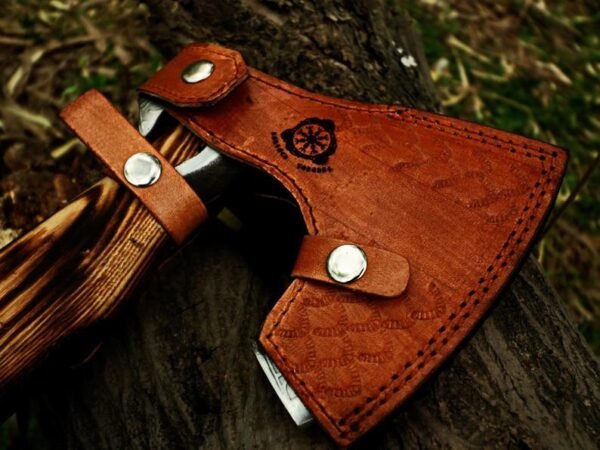
I collect stuff like this and this axe is on another level. Leather sheath is thick and well stitched. Not the cheap stuff you usually get. So worth it.