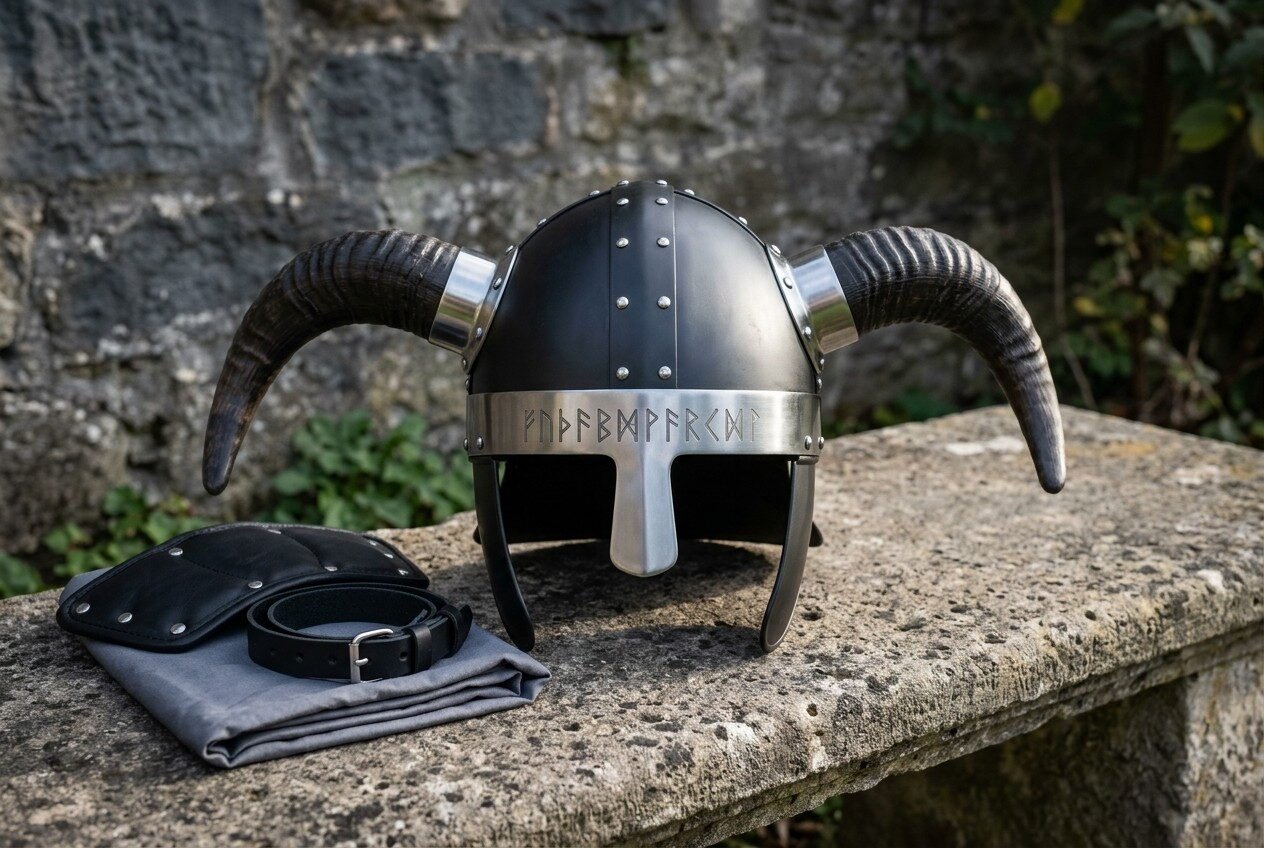
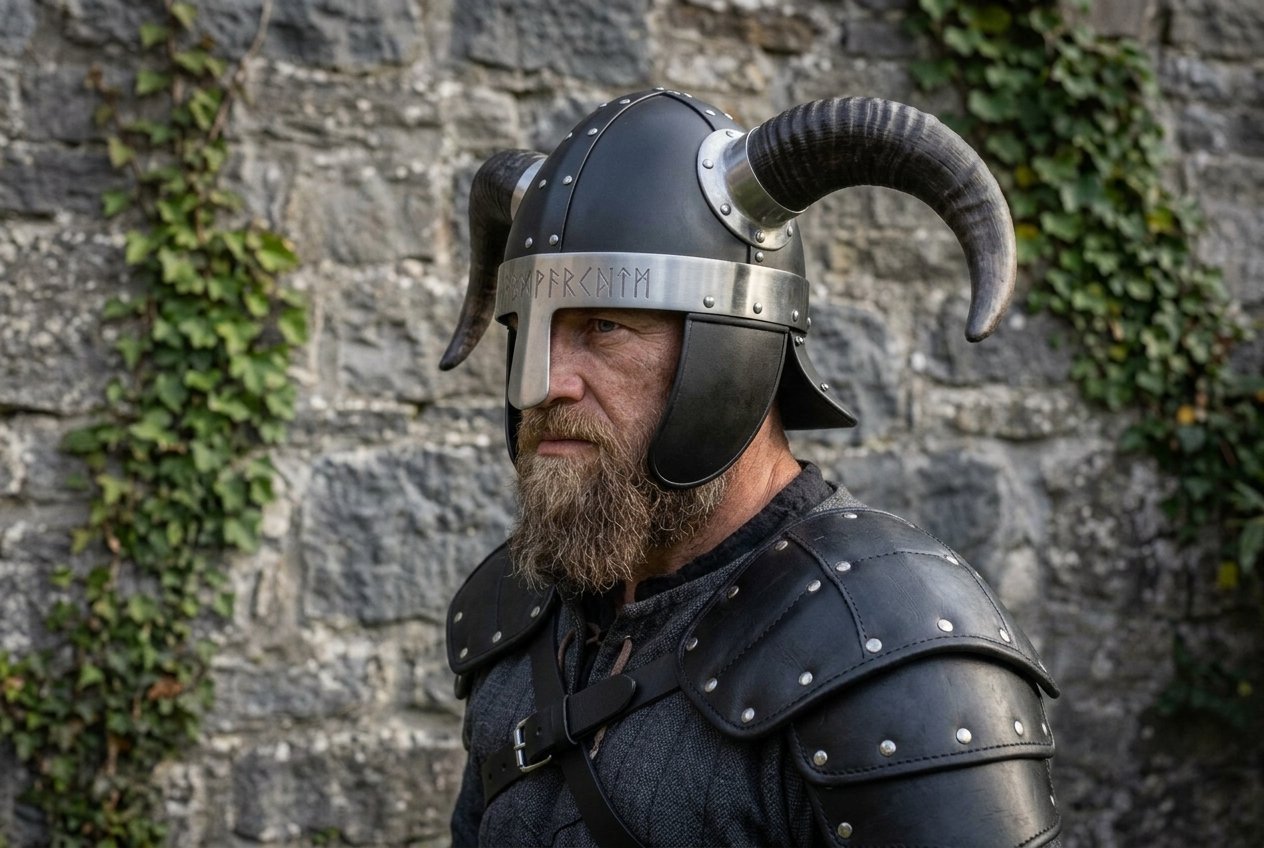
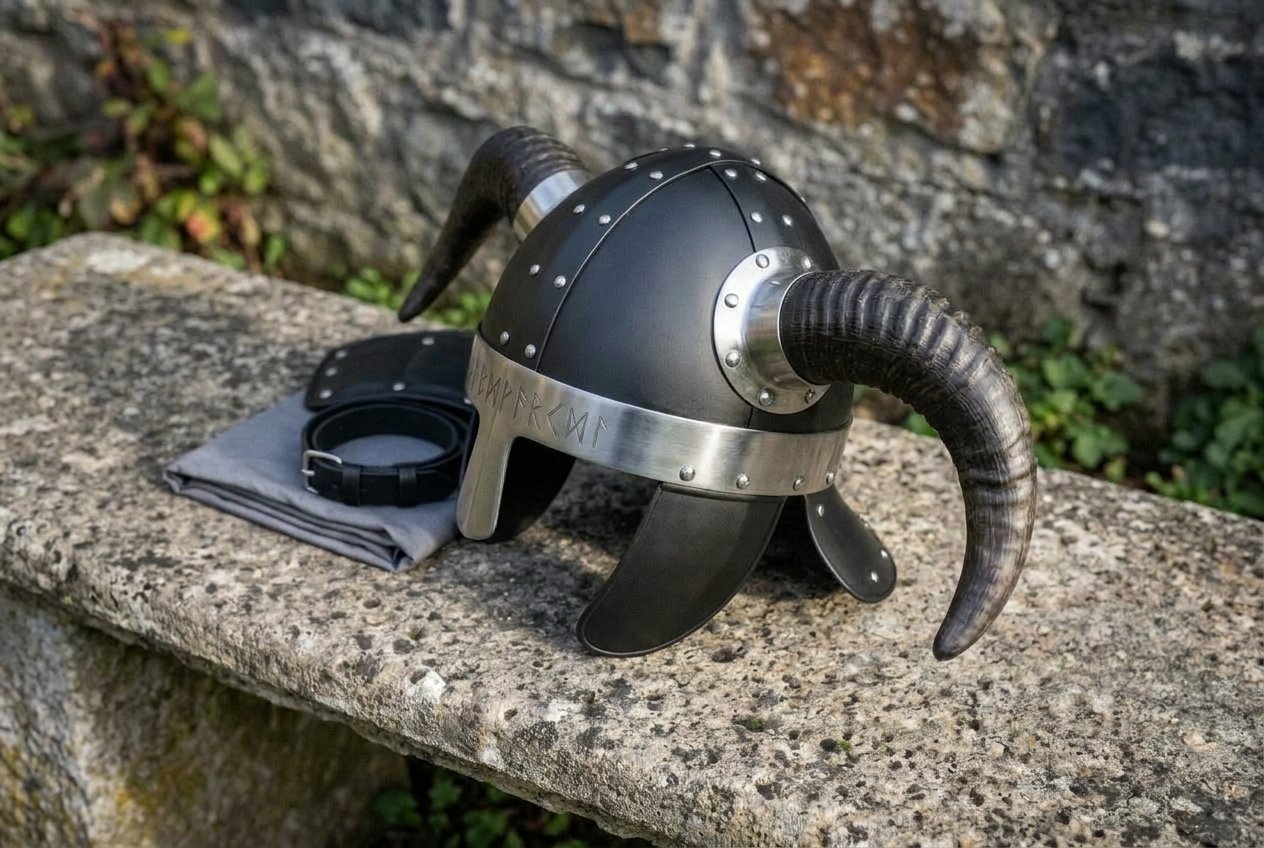
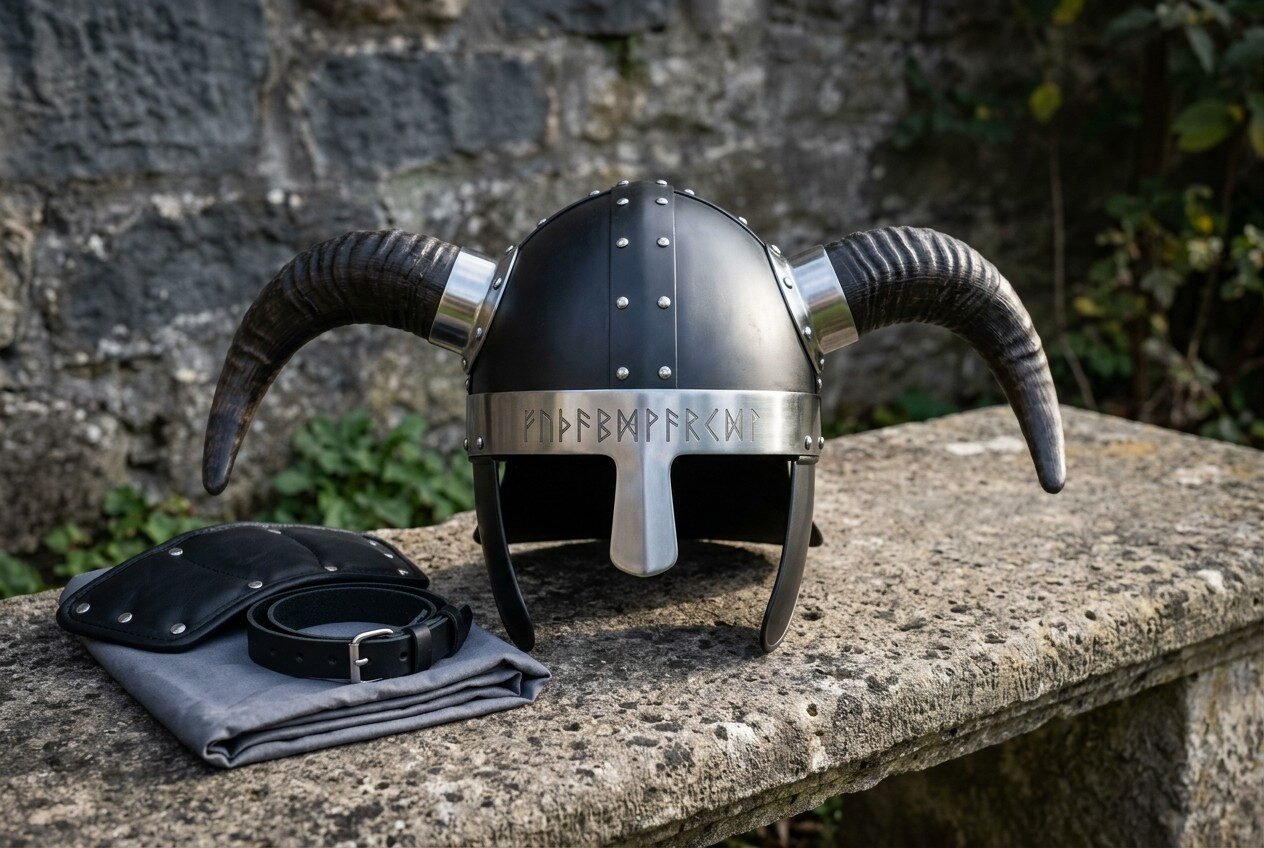
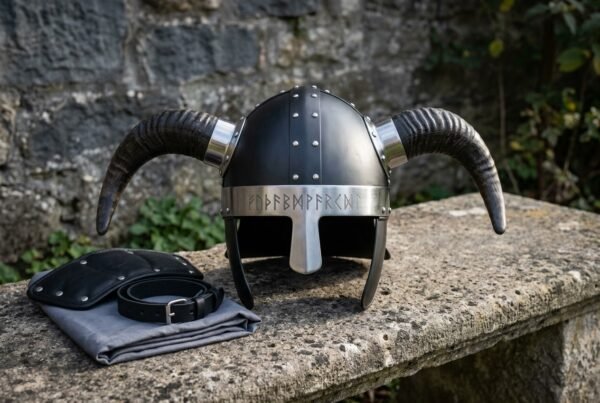
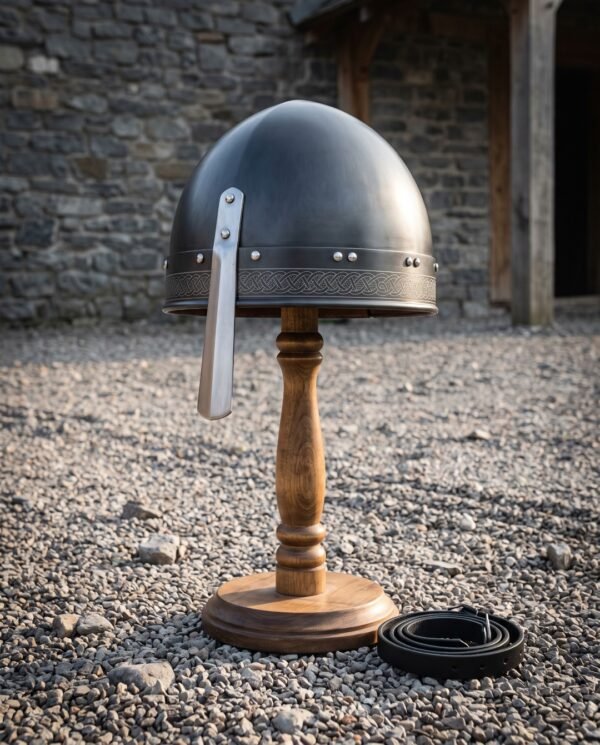
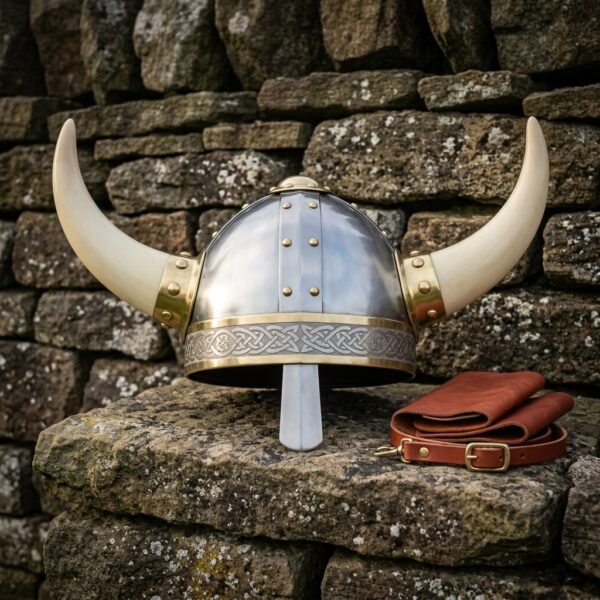
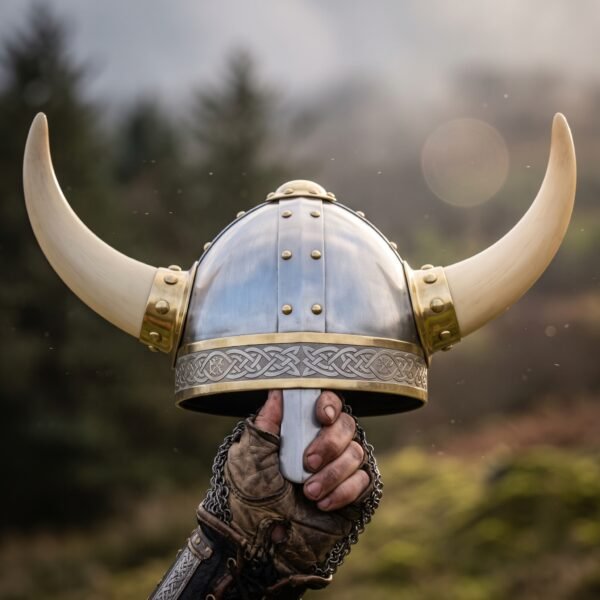
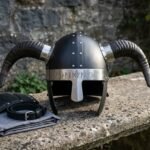
This is a horned helmet built the way a good festival and stage piece should be built, from an 18 gauge steel bowl riveted over a welded frame, with a bright brow band cut with an Elder Futhark rune line and a pair of real buffalo horns held in polished steel collars. It is a striking thing to own and it deserves an honest label. No Viking helmet with horns has ever been excavated. Not one. The only near complete helmet we have from the Viking Age is the Gjermundbu helmet, dug out of a burial mound in Norway in 1943, and it is a plain rounded iron cap with a spectacle eye guard and no horns anywhere on it.
The horned image does have roots, just not Norse ones. Horned helmets appear in Scandinavian archaeology in the Bronze Age, around 1,700 years before the raid on Lindisfarne, and the famous pair found at Veksoe in Denmark were almost certainly ritual objects rather than battlefield gear. The look was then fixed in the public mind by Carl Emil Doepler, who designed the costumes for the first full staging of the Ring cycle in 1876. So this helmet is honest Norse fantasy and costume, not reconstruction, and we would rather tell you that than sell you a myth. It is cut, formed, riveted and finished by hand in the Czech Republic, and it ships with the horns fitted and a padded suspension liner already inside the bowl. The leather pouch, the belt and the folded cloth in the photograph are studio props and are not included. Norsemen did not wear horns into a fight, and where that picture came from is a short and slightly embarrassing story.
Specifications
| Material | Mild steel bowl and brow band, natural buffalo horn, steel horn collars |
|---|
| Gauge | 18 gauge, approximately 1.2 mm |
|---|
| Construction | Segmented bowl joined by riveted vertical strips over a wide brow band |
|---|
| Finish | Blackened bowl and cheek guards, bright polished brow band, nasal bar and horn collars |
|---|
| Engraving | Elder Futhark rune line cut around the front of the brow band |
|---|
| Cheek guards | Two blackened steel cheek guards |
|---|
| Horns | Two dark natural buffalo horns in polished steel collars, removable |
|---|
| Size or fit | Made to a stated head circumference, standard build fits roughly 22 to 23 inches |
|---|
| Weight | Approximately 4 lb 8 oz with both horns fitted, around 3 lb 6 oz with the horns removed |
|---|
| Lining | Padded suspension liner on an adjustable cord, fitted before shipping |
|---|
| Fittings | Domed steel rivets, riveted nasal bar, threaded horn mounts, no chin strap fitted as standard |
|---|
| Intended use | Display, costume, film and photography, light reenactment. Not full contact combat rated |
|---|
| SKU | RK-1570 |
|---|
What the nasal bar and the brow band are actually doing
Strip the horns off and what is left is a genuinely functional shape. The brow band is the structural heart of a riveted helmet. It is a hoop of heavier stock rolled to your head size, and every other plate in the bowl is riveted to it, which means the band carries the load rather than the thin sheet of the skull. That is why the band on this helmet is wider and brighter than the bowl above it. It is not decoration, it is the frame, and the rune line sits there because that is the one part of the helmet a person standing in front of you actually reads.
The nasal bar is the other piece of real engineering. A sword or an axe coming down at an angle wants to slide off the curve of the bowl, and where it slides to is your face. A nasal takes that line and turns it away from the bridge of the nose and the eye sockets. It also stiffens the front edge of the helmet so the brow band cannot flex inward under a blow. On this build the nasal is riveted through the band rather than welded, which is how the originals were made and which means it can be replaced without cutting the helmet apart.
The horns themselves are mounted on threaded steel posts through the collars. Two spanners and about a minute of work take them off, and what you are left with is a clean blackened helm with a bright nasal bar and a rune band, which is a far more historically defensible thing to wear to an event. We mention this because a lot of buyers want the horns for photographs and conventions and want them gone for reenactment groups that enforce a period standard.
Steel, horn and finish
The bowl is 18 gauge mild steel, roughly 1.2 mm. That is display and light reenactment weight. It is stiff enough to hold its shape, take a knock and sit on a stand without sagging, and it is light enough to wear through a long day without a headache. It is not combat plate. Groups that run full contact steel combat generally require 14 gauge or heavier for head protection, and this helmet is not built to that standard and should not be taken into that kind of bout. We would rather you knew that before you ordered than after.
The blackening on the bowl is an applied oxide finish over bare steel, which gives the dark grey tone in the photographs and reads well under stage light. The brow band and the horn collars are left bright and polished for contrast. The horns are natural buffalo horn, hollowed, sanded and sealed.
Engraving, runes and your own design
Use the rune converter on this page to turn a name, a date or a short phrase into Elder Futhark and we will cut it into the steel or the leather. If you would rather have a Viking pattern than a rune line, choose your own design in the engraving option above the add to cart button and tell us where it goes. Where a piece already carries an engraved design, your chosen engraving replaces it rather than sitting alongside it. On this helmet the natural place is the brow band, and the standard rune line there will be replaced by yours. More detail is on the engraving page.
Fit and sizing
This helmet is made to a stated head size rather than adjusted after the fact, so measure before you order. Run a soft tape around your head about a finger width above the eyebrows and around the widest point at the back, and give us that number. The standard build suits roughly 22 to 23 inches of head circumference with the liner in place. If you plan to wear a padded arming cap or a mail coif under it, add an inch to an inch and a half to your measurement and tell us, because a coif eats interior space fast and a helmet that fits bare will not go on over one.
The liner is a padded suspension band on an adjustable cord, so there is some fine tuning available once it arrives, but that adjustment is for comfort and seating, not for turning one size into another. If your measurement sits between sizes, go up, since padding can fill a helmet that is slightly large and nothing can rescue one that is too small.
Care
Bare and blackened steel rusts if it is left damp. Wipe the helmet down after any event where it has been rained on or worn hard, and put a thin film of light oil on the inside of the bowl and along the brow band a few times a year. Do not store it inside a closed plastic tub, because condensation forms in there and sits against the steel. Buffalo horn should be kept out of direct sun and off radiators, since strong heat and dryness can cause it to check. A little neutral wax on the horn once a year keeps it dark and glossy. Our full guidance on rust, oils and long term storage for hand forged steel is on the steel care page. Fit, steel gauge and the shapes worth avoiding are covered in buying a Viking helmet.
Made in the Czech Republic
This is a handmade piece from the Czech Republic, made in a workshop that still forges, grinds and finishes by hand instead of stamping parts out. The smiths there have kept the older way of working, and the wood, horn and leather are shaped and fitted by hand as well. Two pieces of the same design will never be identical, and that is part of what you are buying.
Ransack Viking is a United States company. We handle the import ourselves, look over every piece when it lands and ship from our warehouse in Chicago, Illinois. Engraving is done in the United States after the piece arrives, so your design goes on before we send it out.
A note on handmade variation
This helmet is hand made, not machine made and not bulk produced, so what arrives will not be a pixel for pixel copy of the photograph. The hammer texture across the bowl, the exact tone of the blackening, the grain and curve of the horns and the precise spacing of the rivets vary because every one is worked by hand from natural materials. The dimensions, the material and the build are the same every time. The character is not, and that is the point of buying a hand made helmet rather than a stamped one.
Frequently asked questions
Did Vikings really wear horned helmets?
No. There is no archaeological evidence for it at all. The horned helmets found in Scandinavia are Bronze Age ritual pieces from centuries before the Viking Age, and the popular image comes from nineteenth century opera costume design. We sell this as Norse fantasy and costume rather than as a reconstruction.
Can I take the horns off?
Yes. They are mounted on threaded posts inside the steel collars and come off with two spanners in about a minute. Underneath you have a plain blackened helm with a bright nasal bar and a rune band, which is a much easier piece to take to a reenactment group with a period standard.
Is this safe for full contact combat?
No. At 18 gauge it is display and light reenactment weight only. Full contact steel combat groups usually require 14 gauge or heavier for the head, and this helmet does not meet that standard. Use it for display, costume, film, photography and non contact events.
How do I know what size to order?
Measure your head circumference a finger width above the eyebrows and around the widest part at the back, then send us that number with your order. Add an inch or more if you intend to wear an arming cap or a mail coif underneath, and tell us that you plan to.
Does it come with a chin strap?
Not as standard. The padded suspension liner holds the helmet in place for display and normal wear. If you want a leather chin strap fitted, say so in your order notes and we will rivet one in before it ships.
How long before it ships?
Processing is one to two weeks because each helmet is formed and riveted to order, and engraving adds a little to that. Shipping inside the United States is free. Returns are accepted within seven days.
What is in the box
- One horned Viking style helmet in 18 gauge steel with a runic brow band
- Two natural buffalo horns, fitted, with polished steel collars and threaded mounts
- Padded suspension liner on an adjustable cord, already installed
- Care card covering oiling, horn wax and storage
- Forged and finished in the Czech Republic
Explore the range
See the rest of the head gear in Viking helmets, the body pieces in Viking armor, the boards and bosses in round shields, and the rune and pattern work we can cut for you in engraved and personalised. Background reading on gauges, fit and finishes is in the guides.
Worth a look beside this
If this one is not quite right, there is the Hornkeep Viking helmet. Also in this group is the Vendelgaze Viking helmet. Sitting beside it in the catalogue is the Cairnhelm Viking helmet.
From the same corner of the shop, there is the Yggdrasil Viking shield. Or start from a blank sheet on the design your own page.

My husband was speechless when he opened this. Worth every penny.