
Blog
Are Horned Viking Helmets a Myth? Where the Picture Came From

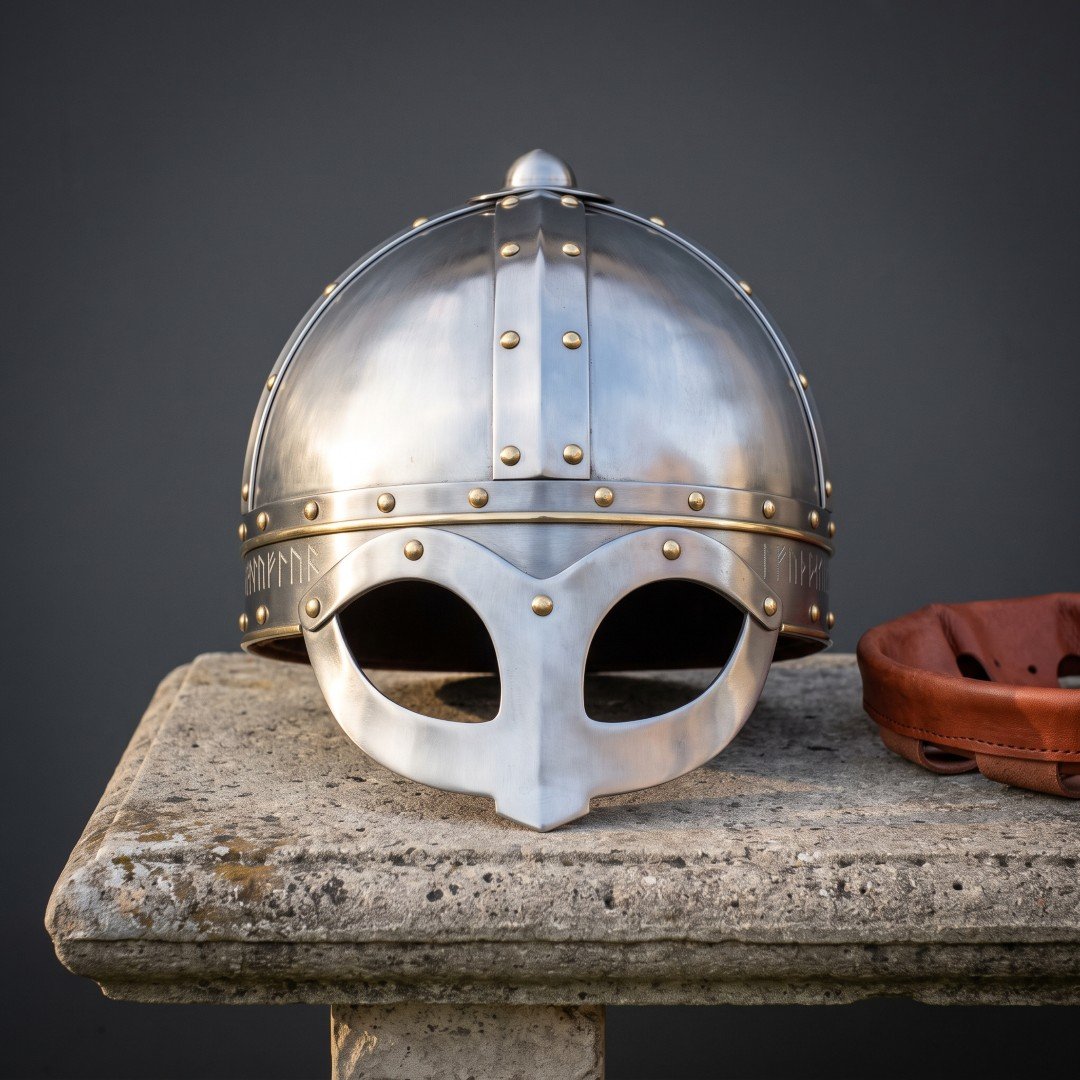
No. No Viking Age helmet with horns has ever been found, anywhere, in any grave, bog or harbour, and people have been digging for a century and a half. The picture comes out of nineteenth century opera costume and romantic illustration, which is a respectable pedigree for a stage and a poor one for history. The horned bronze helmets people offer as proof, the pair from Vekso in Denmark, are Bronze Age, roughly a thousand years older than the Vikings, and belong to a different culture entirely.
That is the short answer. The longer one is more interesting, because the myth was not invented out of nothing. It was assembled out of real objects that got attached to the wrong people.
What has actually been dug up
Gjermundbu
One helmet from the Viking Age is complete enough to reconstruct with confidence. It came out of a burial mound at the Gjermundbu farm in Ringerike, Norway, excavated in 1943, and it dates to the tenth century. It was found in pieces and put back together: a rounded iron cap built from four plates held by bands, with a spectacle guard covering the eyes and nose in one piece of shaped iron. A short spike sits at the crown. Fragments of a mail shirt came out of the same grave.
It has no horns. It has no wings. It looks like practical head protection made by someone who had thought about where a sword lands.
The fragments
Beyond Gjermundbu the material thins out fast. A find from Tjele in Denmark includes a piece long identified as a helmet mount with a nasal. A rusted iron cap found in Yarm in North Yorkshire in the 1950s sat unrecognised for decades and was published in 2020 with an argument that it is Anglo-Scandinavian work of the tenth century, which would make it a rare survival from the English side of the Norse world. Scattered fragments turn up at sites in Sweden and in the lands of the Rus. That is close to the whole inventory.
Why the record is so thin
Iron rusts to nothing in most soils, so the record is whatever the ground happened to keep. Helmets were expensive, so they were repaired, handed down and eventually recycled rather than buried. Most people in a Viking Age force had a shield, a spear and possibly an axe, and no head protection at all. A helmet marked a man with money. The absence of horns is not an argument from silence about a common object, because helmets themselves are rare finds, but the point still holds: out of everything recovered, and out of every contemporary carving and picture stone showing armed men, not one horned battle helmet exists.
The Vekso helmets, and why they keep coming up
In 1942 peat cutters at Vekso on Zealand in Denmark found two bronze helmets with large curved horns, eyes and a beak worked into the front. They are spectacular, they are Danish, and they turn up in article after article about Vikings, which is most of the problem.
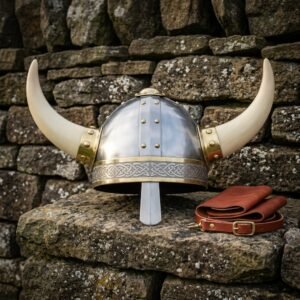 Hornkeep Hand Forged Steel Horned Viking Helmet | Riveted Dome with Brass Trim | Engraved Knotwork Browband Nasal Bar and Real Horns | Costume Display Gift | RK-1562
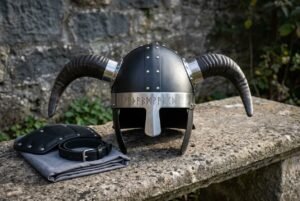 Hornreave Hand Forged Steel Horned Viking Helmet | 18 Gauge Blackened Bowl | Riveted Brow Band with Elder Futhark Runes | Norse Costume Gift | RK-1570
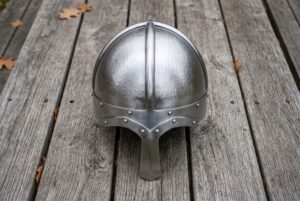 Ironcrown Handcrafted Viking Helmet | Medieval Norse Armour for Reenactment Cosplay and Wall Display | RK-628
They are Bronze Age. Later analysis of organic material associated with them placed them at around 900 BC, which puts roughly nineteen centuries between them and a raid on Lindisfarne. They were deposited in a bog, almost certainly as an offering, and they are far too thin and too elaborate to take a blow. Whatever they were for, it involved ceremony rather than fighting. Attaching them to Vikings is like attaching a Roman legionary’s helmet to a Napoleonic soldier and calling it continuity.
Where the modern picture came from
Nineteenth century painters and illustrators
Scandinavian national romanticism went looking for a heroic past and dressed it accordingly. The Swedish artist Gustav Malmstrom illustrated Esaias Tegner’s hugely popular poem Frithiofs saga in the 1820s, and his figures wear horned and winged headgear. Prints, book plates and history paintings across Germany, Britain and Scandinavia repeated the look until it became the default. Antiquarians of the period were also mixing periods freely, since Bronze Age, Iron Age and Viking Age finds sat side by side in the same cabinets, labelled with a confidence the dating did not support.
Bayreuth, 1876
The moment the image locked in place was the first complete staging of Wagner’s Ring cycle at Bayreuth in 1876. The costume designer, Carl Emil Doepler, put horned helmets on the stage. The production was an international event, the imagery was reproduced everywhere, and the connection between Norse material and horned headgear became fixed in the public eye. Wagner’s cycle draws on Norse and German legend, so audiences read the costumes as historical. They were theatre design, and they have outlived every correction issued since.
Older confusion underneath it
Classical writers describe northern peoples wearing horns and animal crests, and there are real objects behind that. The Waterloo Helmet, pulled from the Thames and now in the British Museum, is an Iron Age bronze piece with two conical horns. It is Celtic, it predates the Vikings by centuries, and its thin metal shows it was for display. Christian writers in the medieval period also liked to draw pagans with horns for obvious reasons. All of this fed the same picture.
The winged version
Horns are not the only invention from that period. Winged helmets, with a bird’s wing rising from each side, come from exactly the same romantic illustration tradition and have exactly the same amount of archaeological support, which is none. They tend to be attached to Valkyries in popular art. Bird imagery is genuinely present in Norse decoration, on helmet crests and eyebrow terminals, but as small worked detail rather than a pair of wings the size of the head.
Why the picture will not go away
Museums have been correcting this for over a century, with results you can measure by walking through any costume shop in October. The reason is simple. A horned helmet is a good piece of design. It reads instantly at any size, it works on a badge, a cartoon, a beer label or a stadium banner, and it tells an audience which people they are looking at before a word is spoken. Accuracy loses to legibility every time. Historians can point at Gjermundbu as often as they like; the plain iron cap does not signal anything on its own, and that is the whole problem.
Two questions also get blurred together here. Asking whether Vikings wore horned helmets is a question about the past, and the answer is no. Asking whether you can buy one is a question about what you want the piece for. Nobody is obliged to be a reenactor. But a shop that sells a horned helmet as a Viking helmet is selling you a costume and calling it history, and it is fair to expect the difference to be stated.
Horned figures in genuine Norse art
There is a real complication here, and leaving it out would be the same trick played from the other side. Viking Age and pre Viking Scandinavian art does show figures wearing headgear with two projections. The Torslunda plates from Oland in Sweden, and stamped panels on the Vendel and Valsgarde helmets, show a dancing man carrying two spears beside a figure in a wolf skin, and his headgear ends in two curved shapes tipped with bird heads.
Scholars read these as ritual figures, most often connected with Odin, appearing in ceremony rather than in a battle line. Nothing suggests ordinary fighters wore such things, and no physical example has ever been recovered. So the honest position is this: horned headgear existed as an idea in Norse imagery, in a religious context, and possibly as real ceremonial objects that have not survived. Horned combat helmets did not exist.
The practical case
Anyone who has worn a helmet in a reenactment line works this out in an afternoon. Horns give an opponent a handle. They catch a shield rim, a doorway, a low branch and the rigging of a ship. They add weight where you least want it and they turn a glancing blow that would have skidded off a smooth cap into a hit that wrenches your neck. Head protection works because it is round and slippery. Every Viking Age helmet we have is exactly that.
What they actually wore
Most men wore nothing on the head. Those who could afford protection wore a cap of iron, either raised from a single piece or, more often, built as a spangenhelm: several plates riveted to a frame of bands, cheaper to make and easy to repair. Two guard types appear. A nasal bar runs down over the nose. A spectacle guard covers the eyes and the bridge in one shaped plate, as at Gjermundbu, and is the most distinctively Norse feature of the lot.
Mail was worn by the wealthy and by professionals. Padding under a helmet is a practical necessity and shows up in later evidence, though soft materials rarely survive in the ground. Leather caps are often assumed and never found, which is a fair summary of most of what people believe about Viking clothing.
Choosing a helmet that matches the evidence
If you want gear that lines up with what has been excavated, our Viking helmets follow the spangenhelm construction with nasal or spectacle guards, riveted rather than welded, in the shapes the finds support. The medieval helmets cover the later nasal, kettle and visored types for anyone reenacting after the Norse period, and the wider Viking armor range holds mail, shields and shield bosses to go with them. Ransack Viking is a US company in Chicago, Illinois. Every piece is handmade in the Czech Republic the old way, then imported, inspected and shipped from Chicago. Engraving is done in the US after arrival, so a name, a rune row or a knotwork browband is cut here once the piece has landed and passed inspection. For the rest of the kit, our history of the Viking axe covers the most common piece a Norse fighter actually carried, and the steel glossary explains the hardness numbers on our listings.
What the archaeology does show is set out in what Viking helmets actually looked like, and if you want one, our guide to buying a helmet covers fit and padding. Screen versions are dealt with in how the television series handled Norse kit.
Questions people ask
Has a horned Viking helmet ever been found?
No. Not one, from any Viking Age site in Scandinavia, Britain, Ireland, Iceland or the east. The only near complete Viking Age helmet is the tenth century find from Gjermundbu in Norway, a riveted iron cap with a spectacle guard and no horns. Every contemporary carving of armed men shows plain caps too. A century and a half of excavation has turned up nothing else.
What about the horned helmets in Danish museums?
Those are the pair found in a bog at Vekso on Zealand in 1942. They are bronze, they date to around 900 BC, and they sit in the Bronze Age about nineteen centuries before the Viking Age. They are thin, ornate and almost certainly ceremonial, deposited as an offering rather than worn into a fight. Nobody sensible would have taken them near one.
Who invented the horned Viking?
Nineteenth century artists and stage designers. Gustav Malmstrom’s illustrations to Tegner’s Frithiofs saga in the 1820s used horned and winged headgear, and Carl Emil Doepler’s costumes for the first full staging of Wagner’s Ring at Bayreuth in 1876 fixed the image internationally. Romantic painting and careless museum labelling did the rest, and nothing since has managed to undo it.
Did Norse people ever wear horns at all?
Possibly in ritual. The Torslunda plates from Oland and panels on the Vendel and Valsgarde helmets show a dancing figure whose headgear ends in two curved shapes tipped with bird heads, usually read as connected with Odin. No such object has been excavated, and nothing suggests it was worn in combat.
Why would horns be a bad idea in a fight?
They give an opponent something to grab and lever against your neck. They snag on shield rims, doorways and rigging. They add weight high on the head, and they convert glancing blows that would slide off a smooth cap into hits that transfer force. Every surviving Viking Age helmet is smooth and rounded for that reason.
Did most Vikings even own a helmet?
Most did not. Iron was costly and a helmet marked a man of means. A typical fighter had a shield, a spear and often an axe, and went bareheaded or in a cap of cloth or leather. Mail and helmets belonged to chieftains, professional retainers and the wealthy farmers who followed them.
On the shelf
The catalogue carries the Hornreave horned Viking helmet and the Hornkeep horned Viking helmet. So do the Browhold Medieval nasal helmet and the Skyglass Viking spectacle helmet.
Shop the range
Hornkeep Hand Forged Steel Horned Viking Helmet | Riveted Dome with Brass Trim | Engraved Knotwork Browband Nasal Bar and Real Horns | Costume Display Gift | RK-1562Hornreave Hand Forged Steel Horned Viking Helmet | 18 Gauge Blackened Bowl | Riveted Brow Band with Elder Futhark Runes | Norse Costume Gift | RK-1570Ironcrown Handcrafted Viking Helmet | Medieval Norse Armour for Reenactment Cosplay and Wall Display | RK-628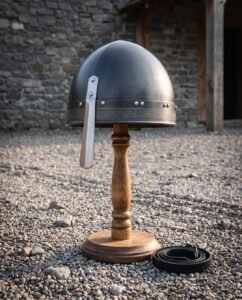 Browhold Hand Forged Steel Medieval Nasal Helmet | Rounded Skull | Knotwork Browband and Riveted Nasal Bar | Reenactment Display Gift | RK-1438
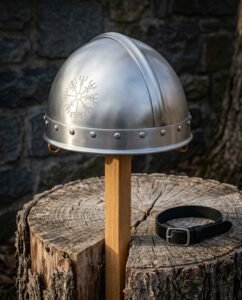 Vegcrown Hand Forged Steel Viking Spangenhelm | 16 Gauge Mild Steel | Riveted Brow Band Leather Liner and Chin Strap | Norse Reenactment Gift | RK-1539
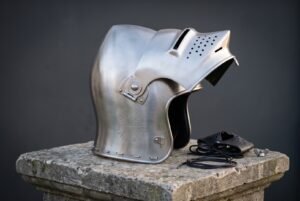 Ridgehelm Hand Forged Steel Sallet | 16 Gauge Visored Helmet | Hinged Temple Pivots, Flared Rear and Chased Vegvisir | Medieval Reenactment Gift | RK-1476