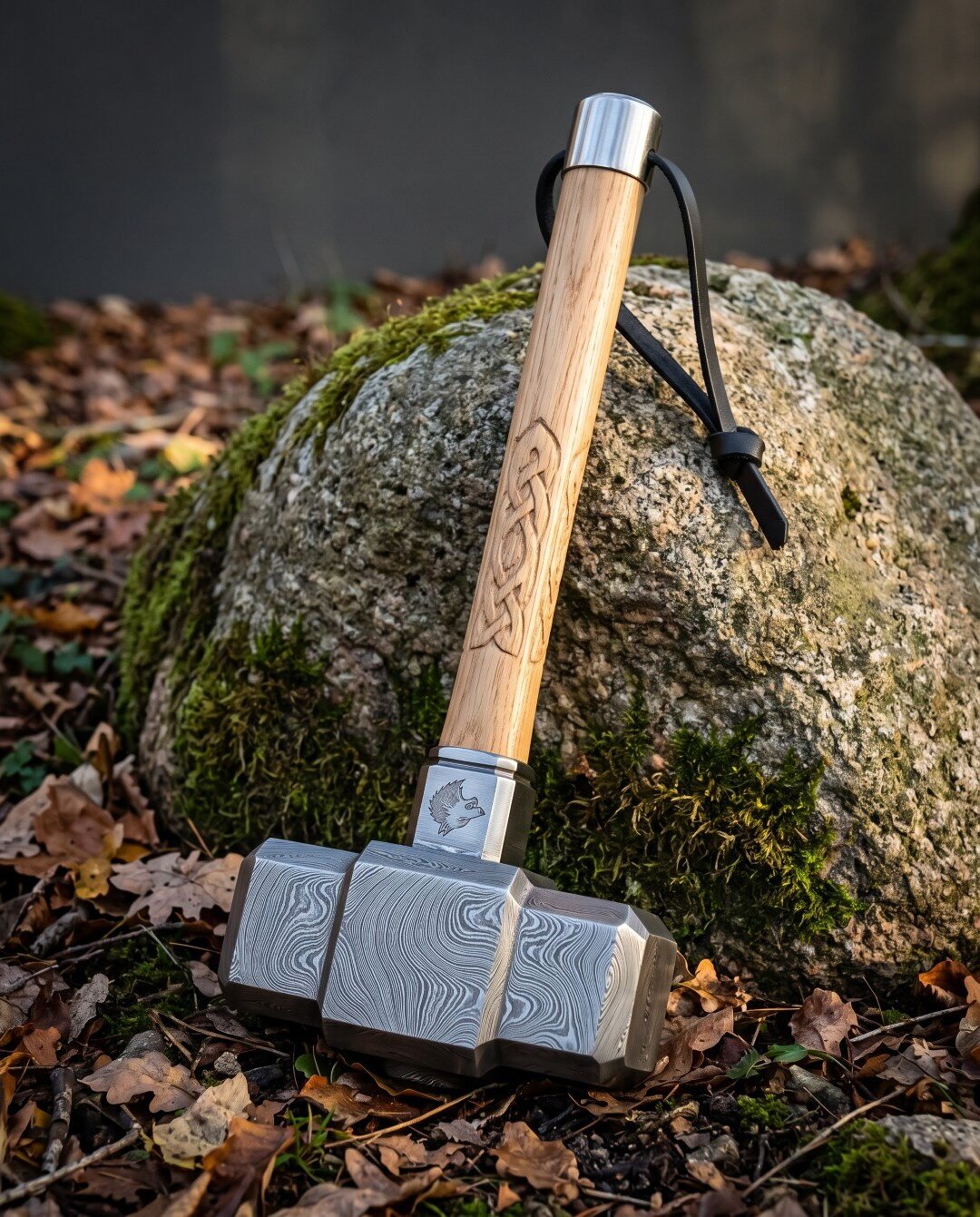
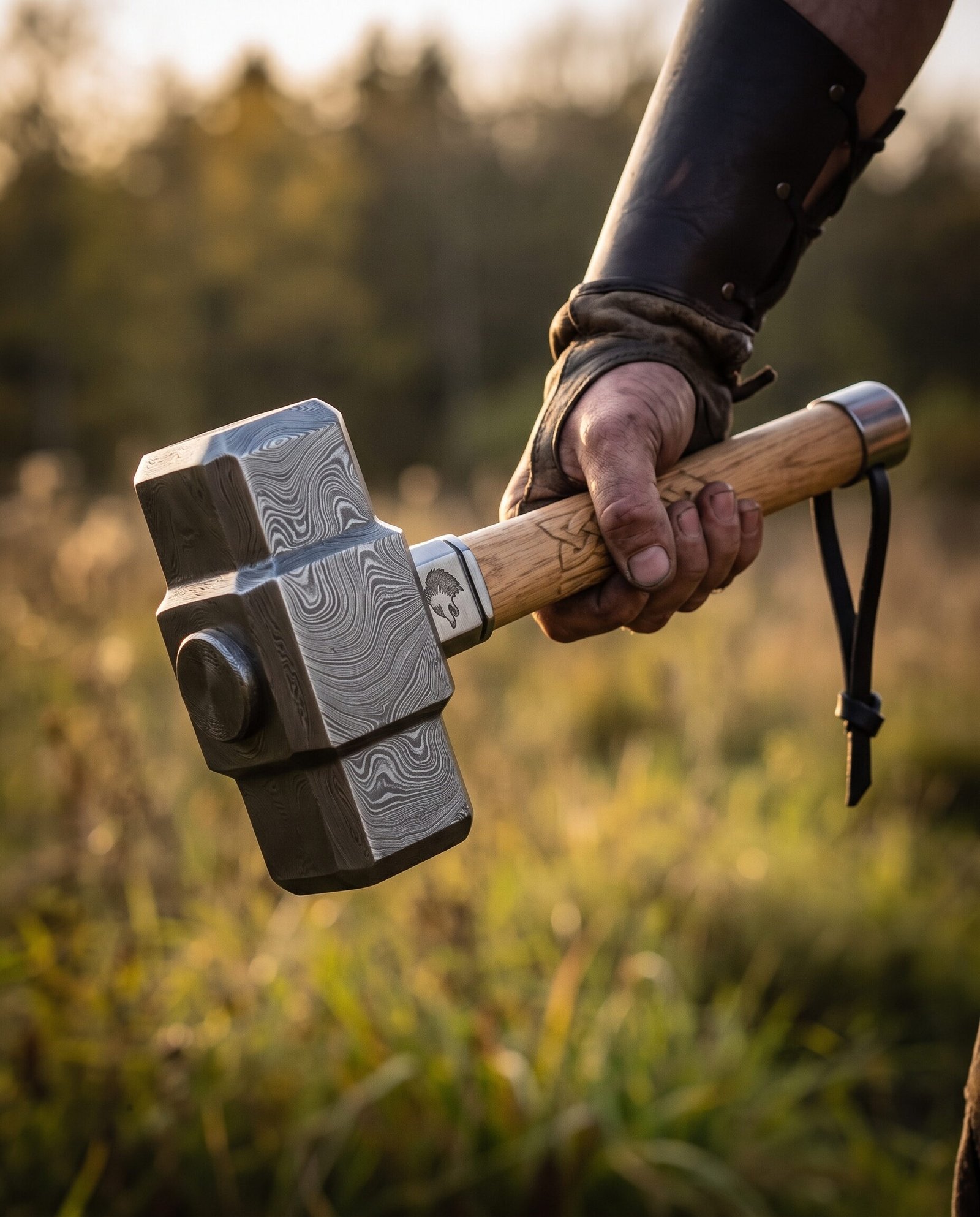
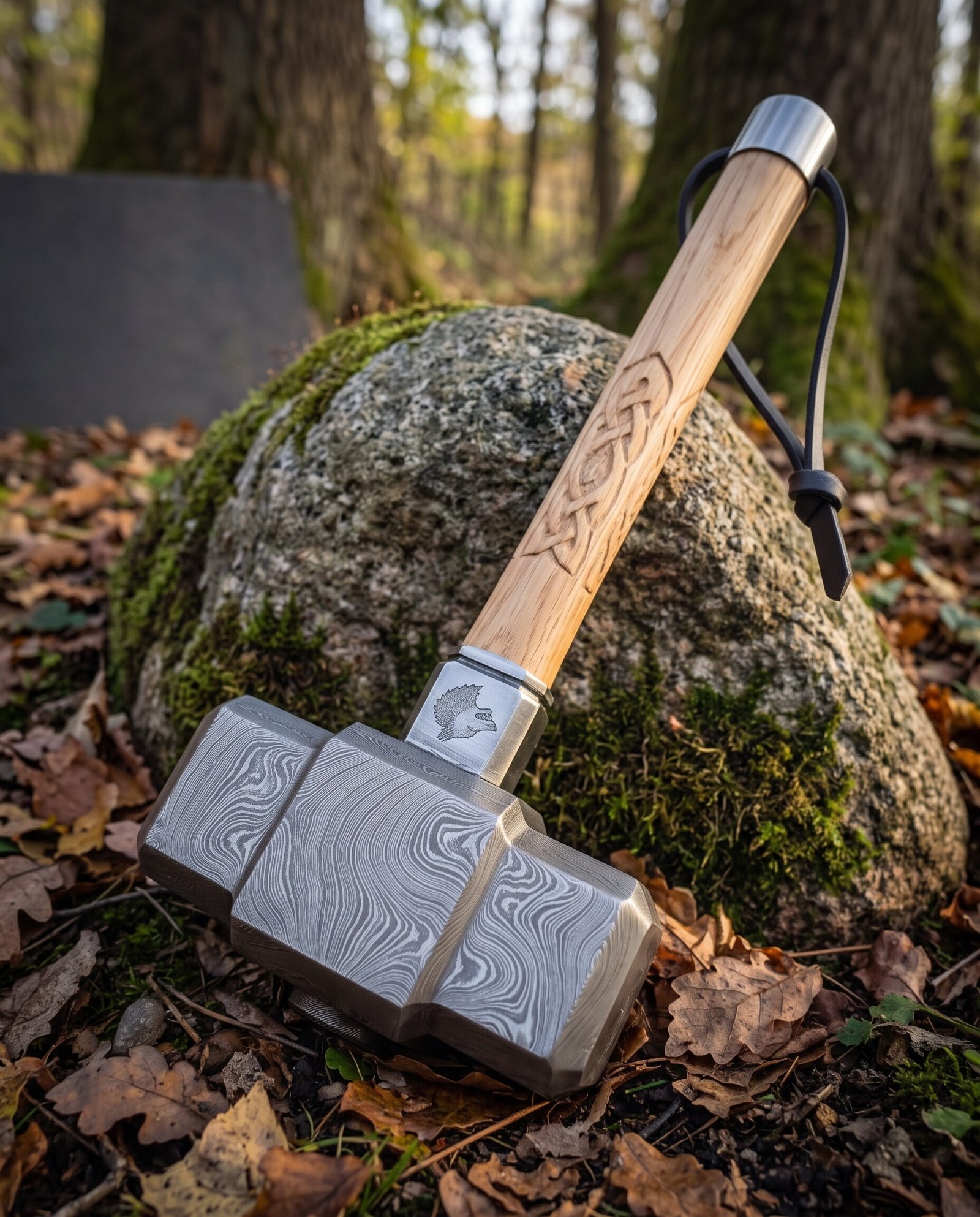
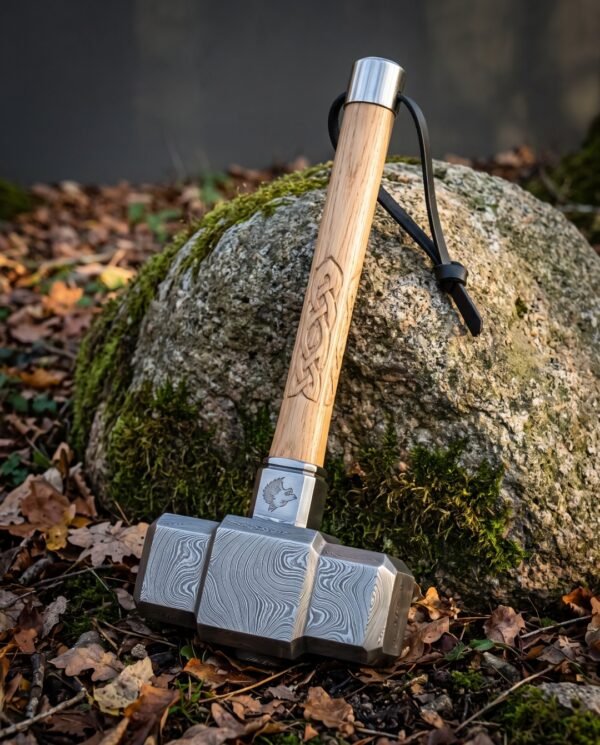
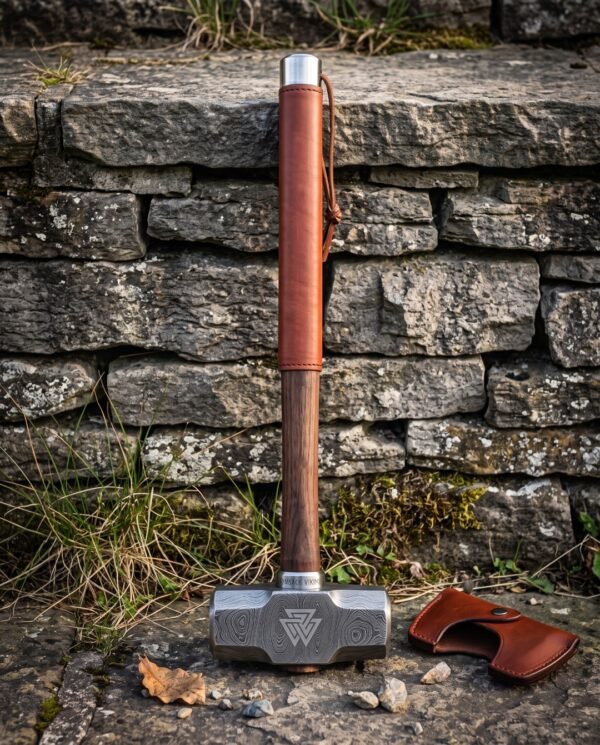
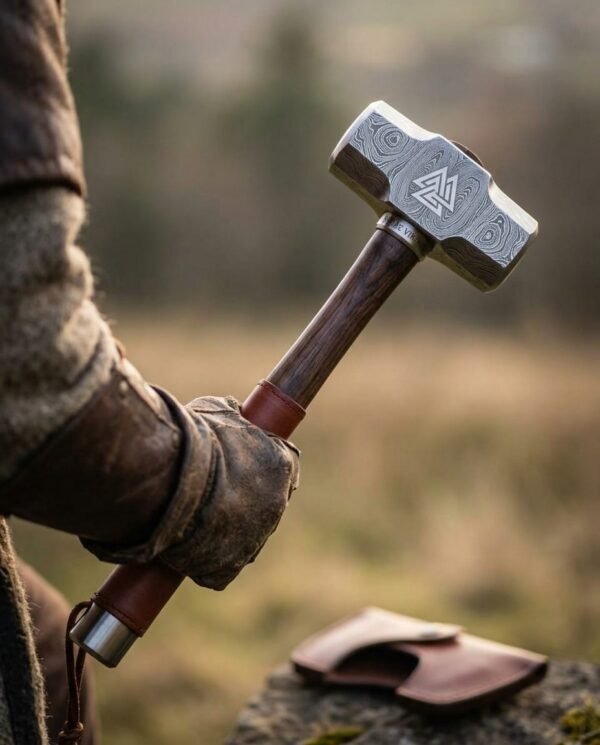
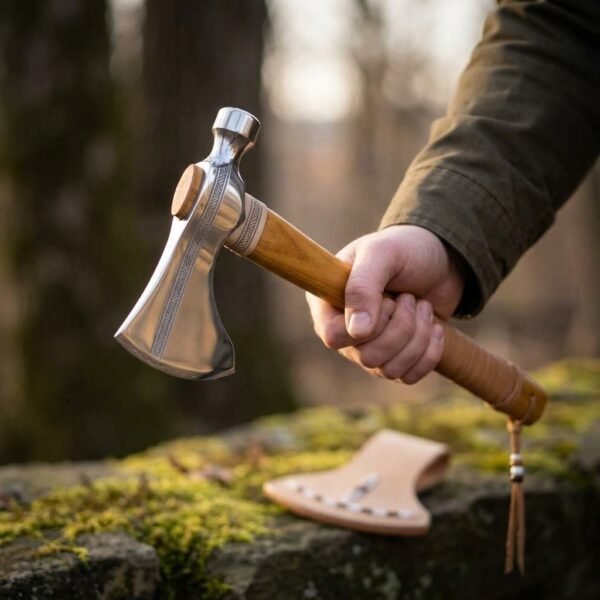
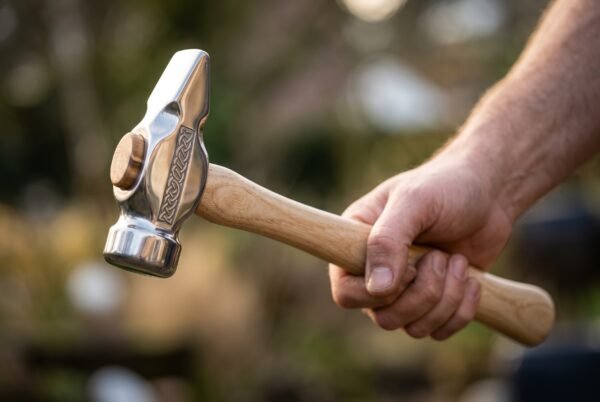
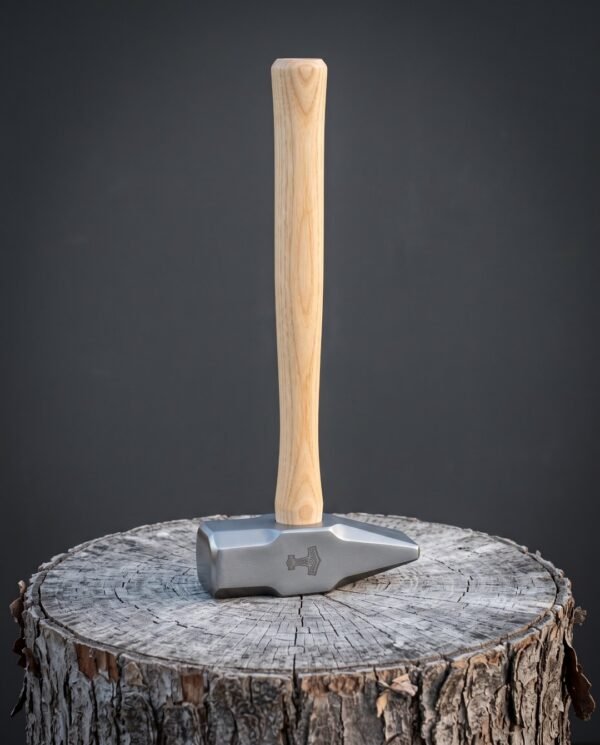
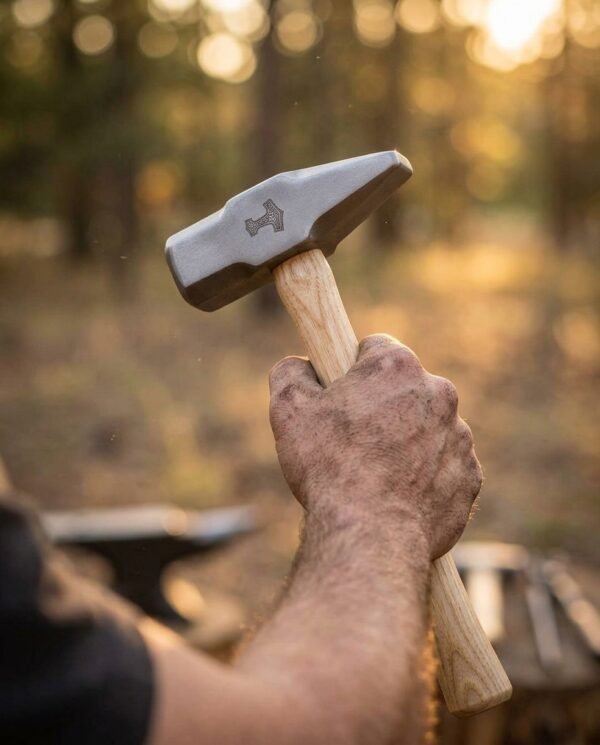
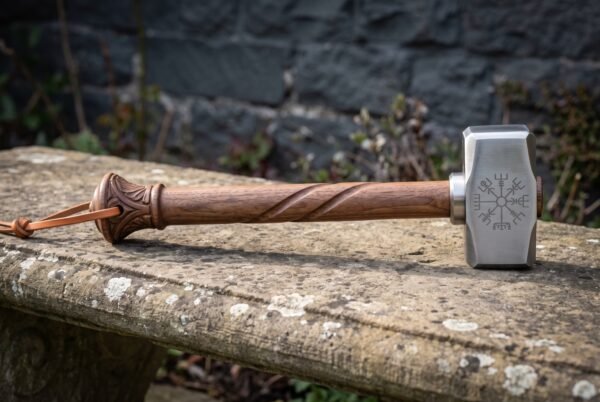
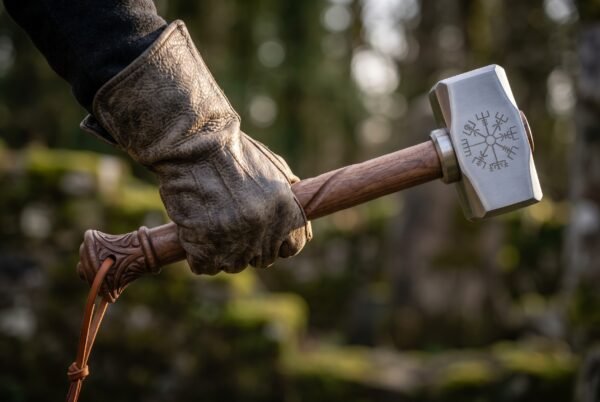
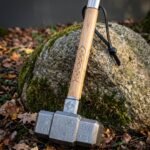
A blunt rectangular head with chamfered corners, two flat striking faces and a body covered in the flowing contour lines of pattern welded steel, hung on a carved ash handle with a leather thong through a polished steel collar. This is a Mjolnir style hammer, and the shape it copies has a story behind it. In Snorri Sturluson version of the myth in Skaldskaparmal, the dwarf brothers Brokkr and Sindri forged Mjolnir in a wager with Loki, who turned himself into a fly and bit Brokkr on the eyelid while he worked the bellows. The bellows faltered for a moment, and the hammer came out of the fire with a handle shorter than it should have been. That is the reason the mythological hammer is stubby, and it is why every Thor hammer pendant pulled out of a Viking grave has that same squat proportion. Well over a thousand of those pendants have been found across Scandinavia, the British Isles and the Baltic.
The head on this one is genuine pattern welded Damascus, forge welded from alternating layers of 1095 and 15N20 and then drawn, folded and shaped, which is why the pattern wraps continuously around the chamfers and over the faces instead of stopping at an edge the way a surface etch would. It is forged, ground, etched and hafted by hand in the Czech Republic. Be clear about what it is for. This is a ceremonial and display hammer, made for a shelf, a mantel, a hall table or a handfasting, and it is not a forge striking tool. Pattern welded steel is beautiful and it is not what you want to be swinging into hot stock or a hardened anvil face all day. Thor’s hammer was an amulet long before it was a shape on a tool, and the meaning of Mjolnir covers that.
Specifications
| Head material | Pattern welded Damascus, 1095 and 15N20, acid etched to raise the layer contrast |
|---|
| Head form | Rectangular Mjolnir profile, stepped down toward each end, with chamfered corners and two flat faces |
|---|
| Handle | Pale ash with a hand carved knotwork panel along the haft |
|---|
| Overall length | Approximately 17 inches |
|---|
| Weight | Approximately 3 lb 8 oz complete |
|---|
| Bolster | Polished steel bolster above the eye, engraved with a beast head |
|---|
| Butt cap | Polished steel cap on the end of the haft |
|---|
| Wrist thong | Black leather thong |
|---|
| Fittings | Wedged eye |
|---|
| Intended use | Display, ceremony, gifting and photography. Not a forge or striking tool |
|---|
| SKU | RK-1572 |
|---|
How the pattern gets into the steel
The stripes on this head are not printed, painted, laser marked or etched onto the surface. They are the edges of layers running all the way through the block. The smith stacks alternating bars of 1095 and 15N20, brings the stack to welding heat, sets the weld under the hammer, then draws it out and folds it back on itself repeatedly. Each fold doubles the layer count. Manipulating the billet after that, twisting it, punching into it or grinding waves into the surface before flattening it back, is what turns straight lines into the contour pattern you can see wrapping around the corners of this head.
The reason the light and dark bands appear at all comes down to nickel. 15N20 carries around two percent nickel and 1095 carries effectively none. When the finished piece goes into a mild acid, the 1095 layers darken and the nickel bearing layers resist and stay bright. Nothing is added at that stage. The acid simply reveals a structure that was already inside the steel. That is the honest test for real Damascus against a fake: the pattern has to continue across every ground and chamfered face, because it is a property of the metal and not a coating. Look at the corner chamfers on this head and you will see the lines carry straight over them.
Materials, hardness and honest limits
The head is 1095 and 15N20 pattern welded and heat treated to a tough hammer temper rather than a blade temper. On our blades this steel combination runs 58 to 60 HRC, which is right for holding a cutting edge and wrong for a hammer face, so this head is drawn back well below that to keep it tough and to keep it from chipping if it is knocked. Even so, we sell this as a display and ceremonial hammer and we will not pretend otherwise. Repeated hard striking on hardened steel is not what a forge welded decorative head is built for, and doing it will eventually open a weld line.
The handle is ash, chosen the way axe and hammer handles have always been chosen, for long straight grain that runs the length of the haft and flexes under shock rather than snapping. The knotwork panel is carved into the wood rather than burned or printed, so it has genuine depth and it holds a finish. The steel collar at the butt is there for balance and to protect the end grain, and the leather thong runs through it.
Engraving, runes and your own design
Use the rune converter on this page to turn a name, a date or a short phrase into Elder Futhark and we will cut it into the steel or the leather. If you would rather have a Viking pattern than a rune line, choose your own design in the engraving option above the add to cart button and tell us where it goes. Where a piece already carries an engraved design, your chosen engraving replaces it rather than sitting alongside it. On this hammer the bolster above the eye and the flat of the haft are the two places engraving reads best, and a wedding date or a pair of names on the bolster is by far the most common request we get for this piece. Details are on the engraving page.
Display and mounting
This hammer is meant to be seen. Laid flat on a mantel the etched faces catch side light and the pattern reads from across a room, which is the best way to show pattern welded steel. Hung by the wrist thong on a wall peg it hangs head down and stays put. If you want it on a horizontal rack, two simple wooden or leather cradle hooks under the head and under the haft will hold it without putting pressure on the etched faces. Keep it off masonry and off unsealed stone shelves, because both hold moisture against steel. Do not seal it behind glass with no airflow either, since a sealed case with a damp object inside it is the fastest way to spot a piece of bare steel.
Care
Etched Damascus is bare carbon steel and it will rust if you let it. Handle it and then wipe it. Fingerprints are mildly acidic and they will print themselves onto an etched face within a week in a humid room, and humid summers are damp enough that we know exactly how fast that happens. A light film of mineral oil, camellia oil or paste wax two or three times a year keeps it stable, and a wipe with an oiled cloth after handling is enough day to day. If a little surface rust does appear, a scrap of denim and some oil will lift it without hurting the etch. Never take an abrasive pad or a wire wheel to the pattern. The ash handle wants a coat of oil or wax once a year. Full guidance is on the steel care page. Etched steel wants its own routine, which is on the Damascus care page.
Made in the Czech Republic
Every piece we sell is made by hand in the Czech Republic. The smiths there work the way the trade has been worked for a long time, heating and hammering the steel, taking the bevels down by eye, and fitting the handle and the leather one at a time. There is no automated line anywhere in it, so small differences from one piece to the next are normal and expected.
Ransack Viking is a United States company based in Chicago, Illinois. We bring the pieces in ourselves, inspect them on arrival and ship them from our own warehouse. If you add engraving, that is carried out here in the United States before your order goes out.
A note on handmade variation
This hammer is hand made, not machine made and not bulk produced, so what arrives will not be a pixel for pixel copy of the photograph. The Damascus pattern is different on every single head, because it is the result of how that particular billet moved under the hammer, and it can never be repeated exactly. The ash grain, the tone of the wood, the depth of the carved knotwork and the exact chamfer on the corners all vary. The dimensions, the material and the build are the same every time. The character is not.
Frequently asked questions
Is this real Damascus or an etched pattern?
It is real pattern welded Damascus, forge welded from 1095 and 15N20. You can tell because the pattern runs continuously over the chamfered corners and the ground faces. A printed or surface etched pattern stops wherever the metal has been cut into.
Can I use it in my forge or workshop?
We do not recommend it. This is a display and ceremonial hammer. The head is drawn well back from blade hardness so it is tough rather than brittle, but repeated hard striking on hot stock or a hardened anvil face will eventually work a forge welded decorative head loose. Buy a plain 1095 forging hammer for that job.
What is a good occasion for this?
Handfastings and weddings, more than anything. Couples use it for the ring ceremony or for hammering a nail into a plank as part of the vows, and then it goes on a wall with the date cut into the bolster. It is also a common groomsman gift and a retirement gift for smiths.
Will the pattern fade?
The pattern is structural and cannot fade, but the contrast can dull if a film of oxidation builds over it. A wipe with an oiled cloth brings it straight back. If it ever goes flat after years on a wall, a light re etch will restore it and we can do that for you.
Can I get my own runes on it?
Yes. Use the rune converter on this page for Elder Futhark, or pick your own design in the engraving option. Your engraving replaces the beast head that is on the bolster as standard rather than sitting next to it.
How long until it ships?
One to two weeks of processing, because the billet has to be welded, drawn and shaped for each order and the handle is carved to fit that head. Engraving adds a few days. Shipping is free within the United States and returns are accepted within seven days.
What is in the box
- One pattern welded Damascus Mjolnir style hammer, head hung and wedged
- Carved ash handle with a knotwork panel and a polished steel butt collar
- Leather wrist thong fitted through the collar
- Light oil sachet and a care card for etched Damascus
- Forged and finished in the Czech Republic
Explore the range
More forge and hall pieces are in blacksmith tools, the edged Norse work is in Norse arms, the axes are in Viking axes, and everything we can cut a name into is in engraved and personalised. Pattern welding, etching and care are covered in the guides.
Near neighbours in the shop
Next along the rack is the Wayrune blacksmith tool, forged from 1095. For a straight comparison, see the Anvilsong blacksmith tool, pattern welded Damascus. Worth putting side by side with this is the Nailward blacksmith tool.
If you are putting a set together, the Thunderclasp Mjolnir pendant sits alongside it. You can have this made your way instead on the design your own page.


Reviews
There are no reviews yet