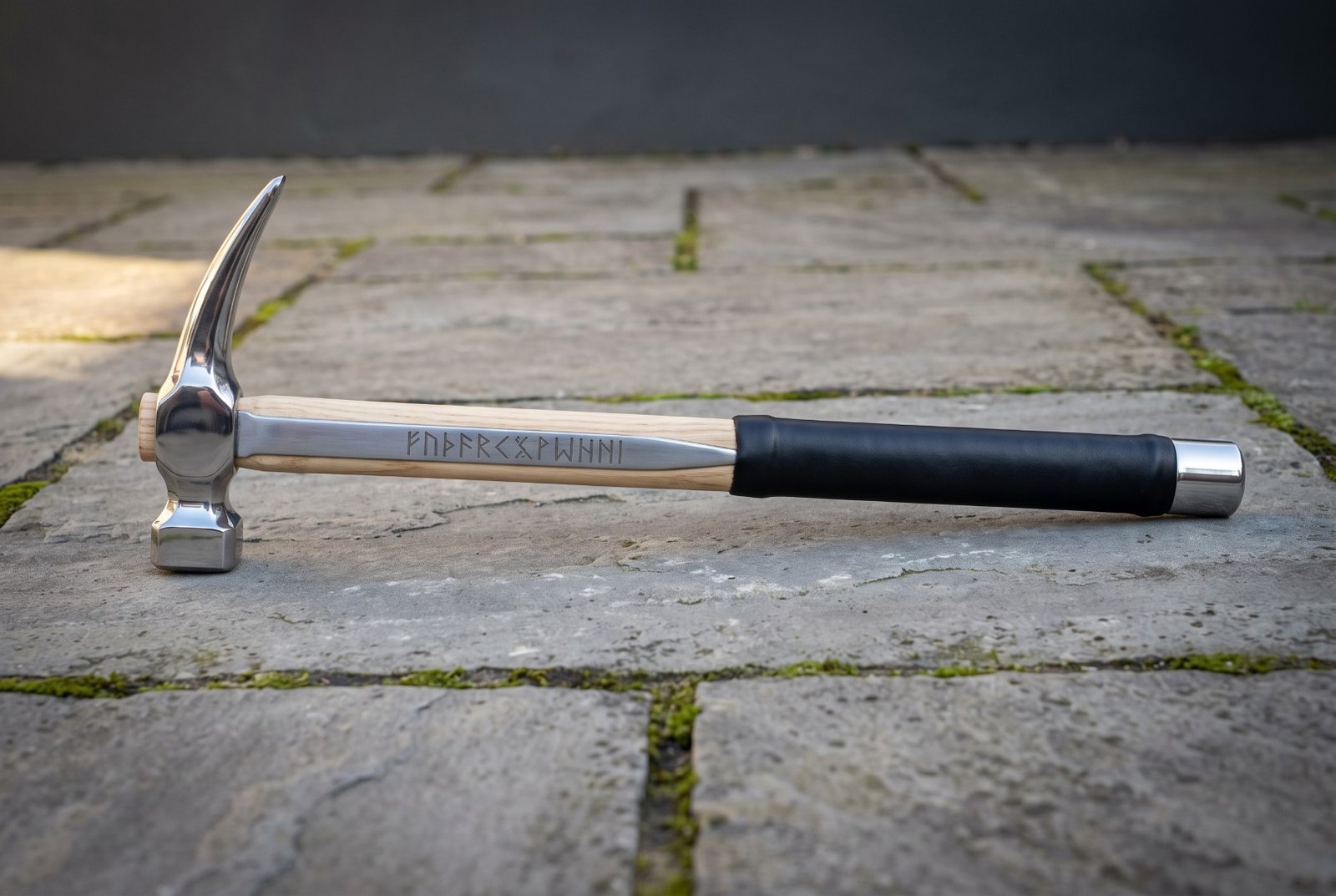
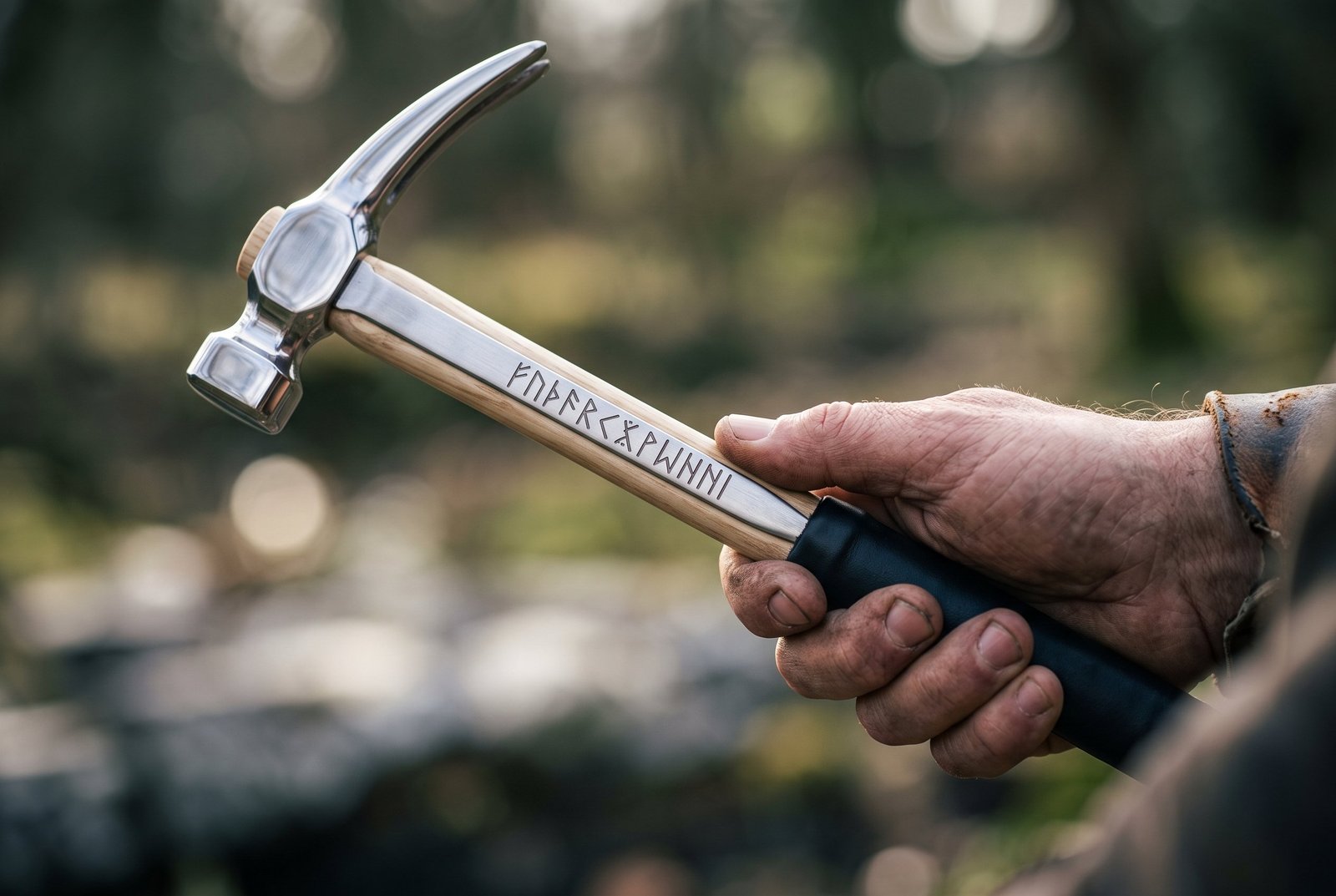
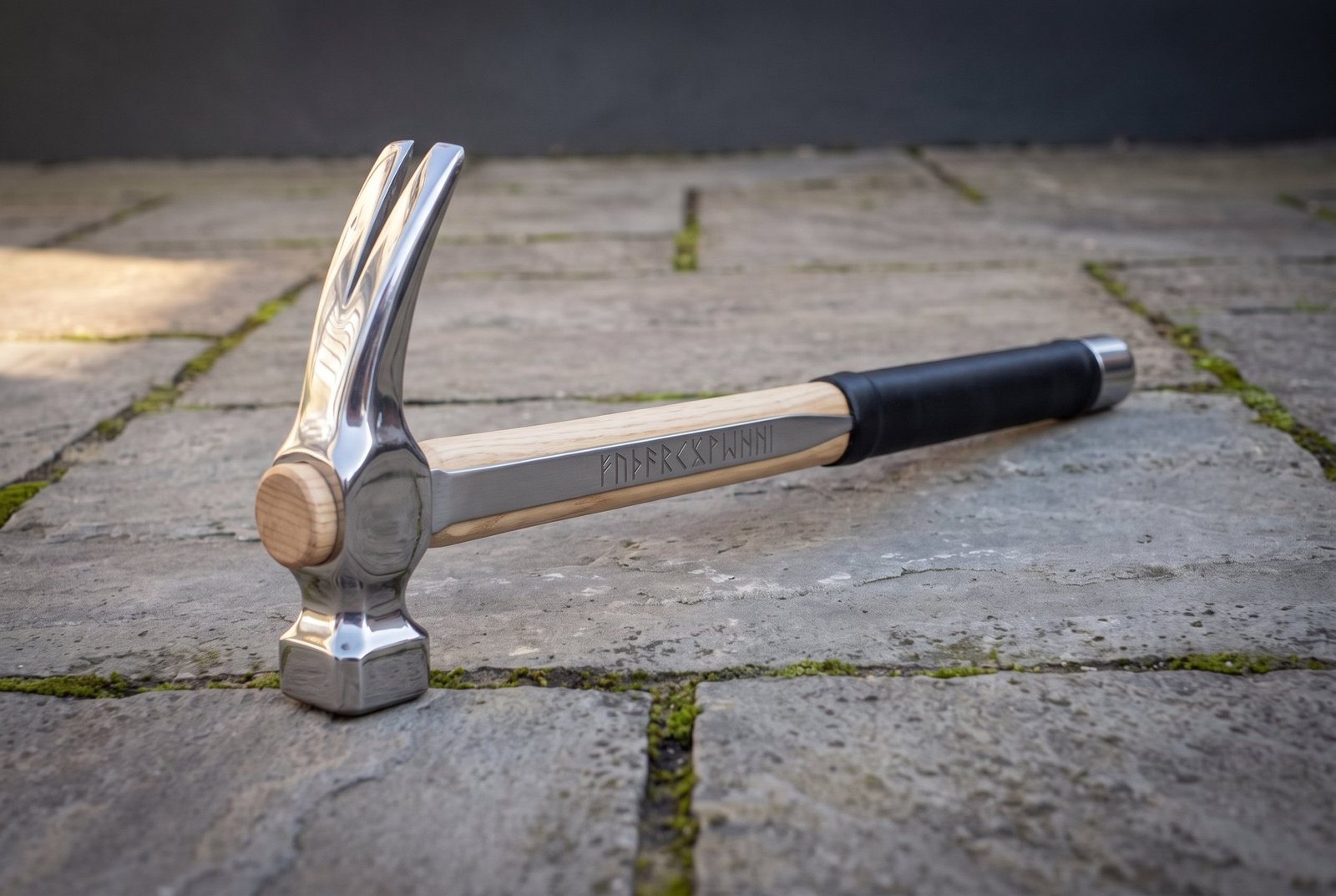
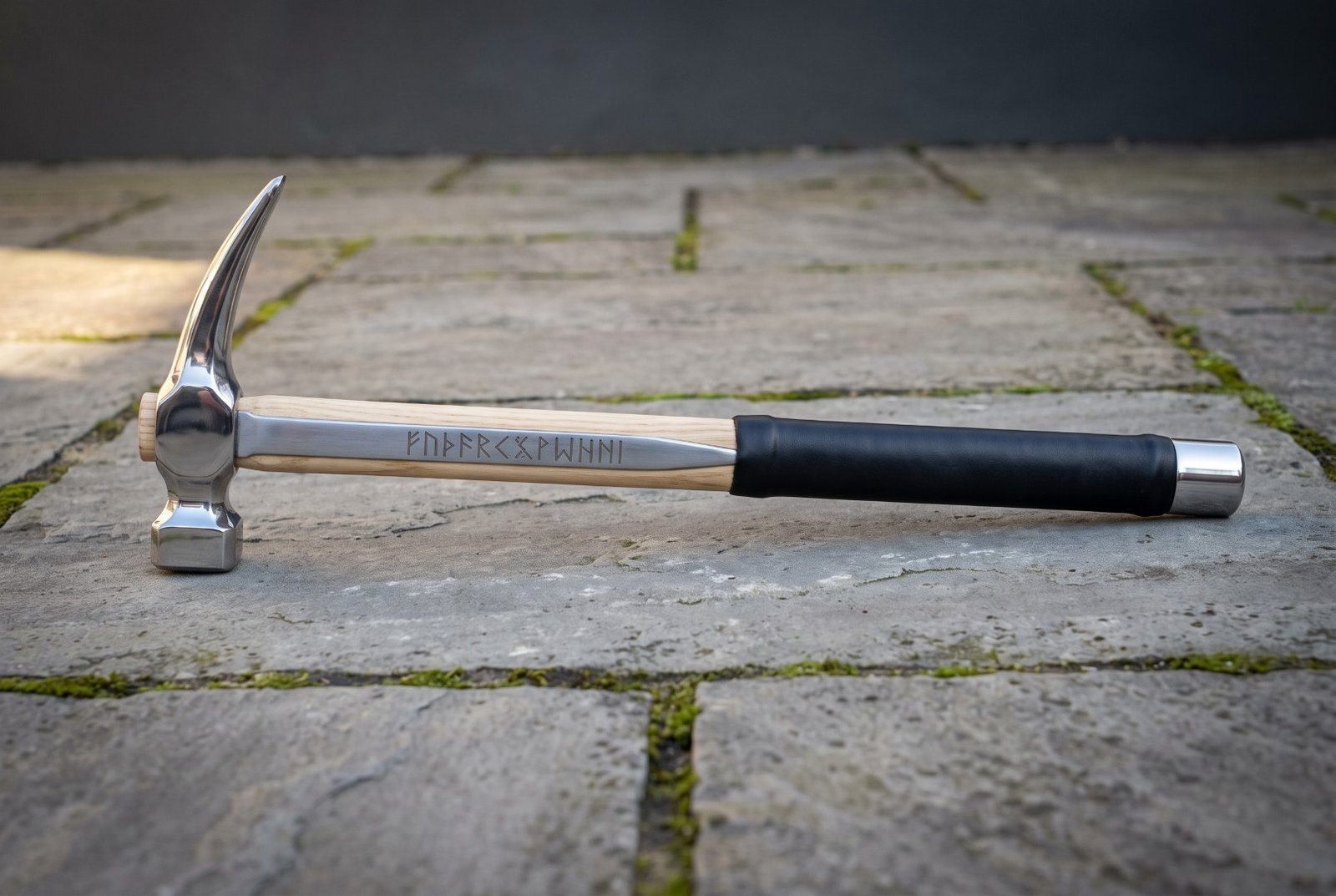
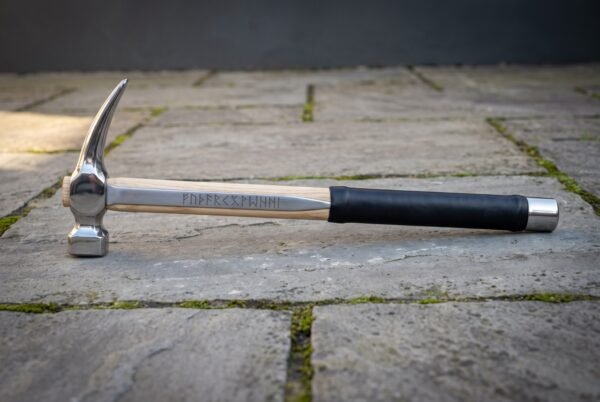
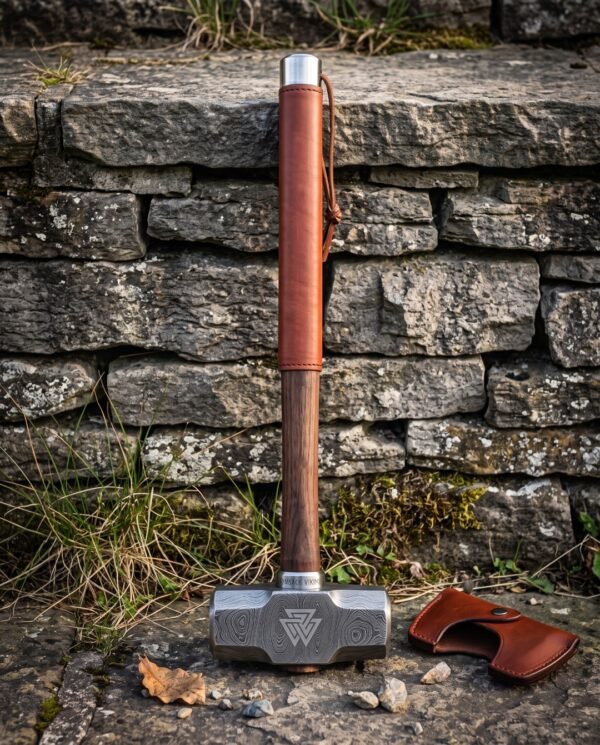
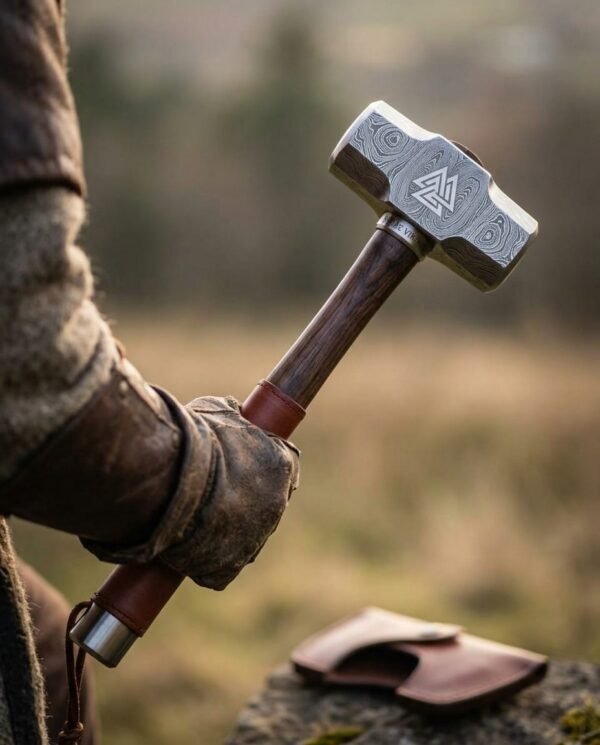
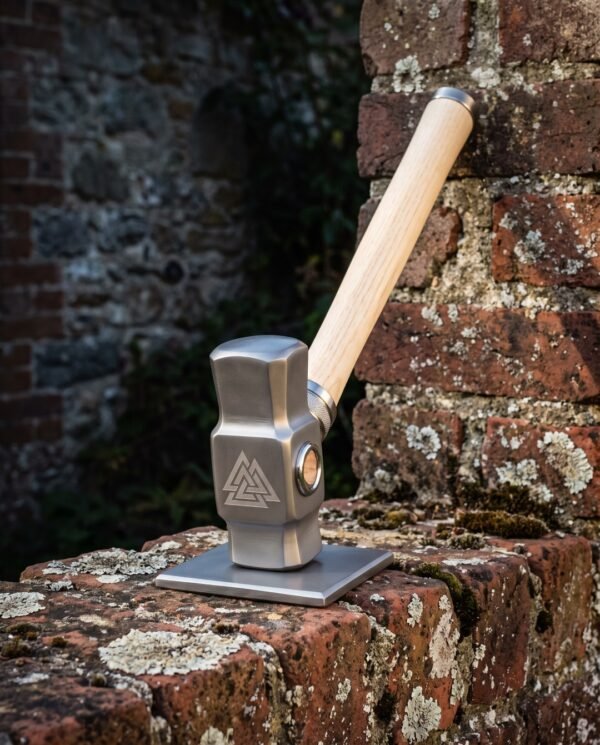
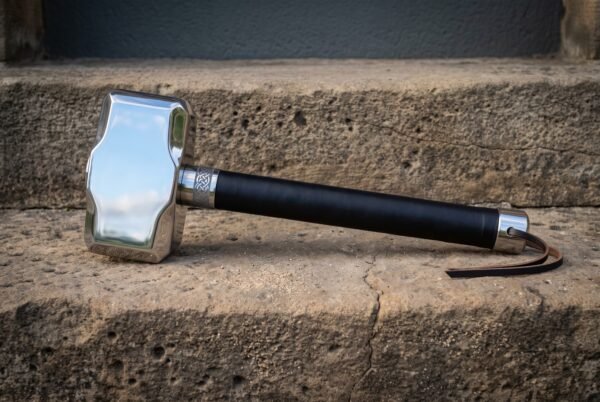
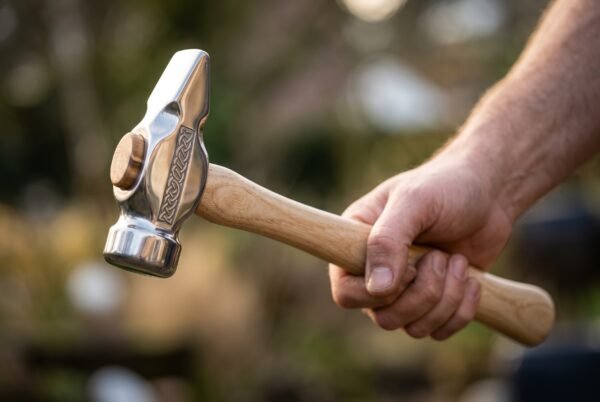
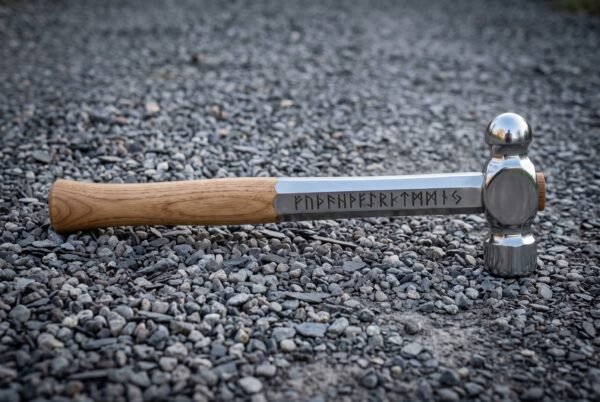
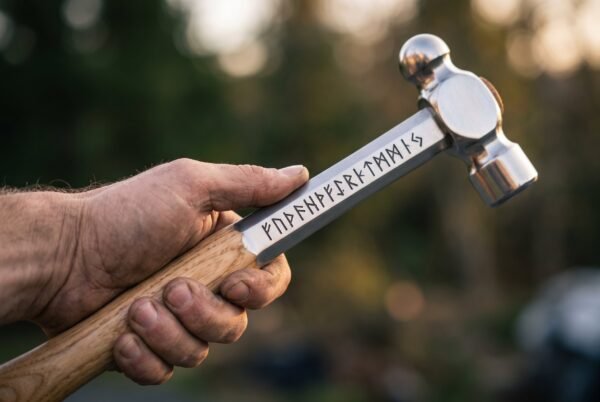
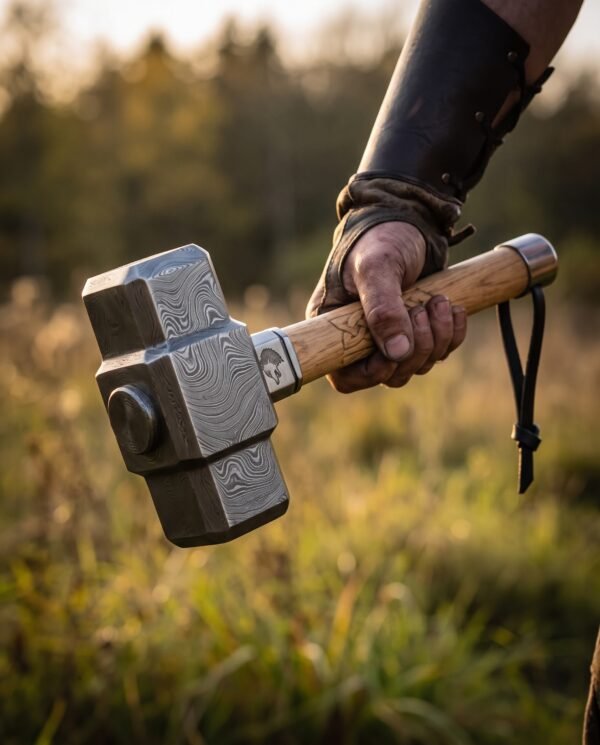
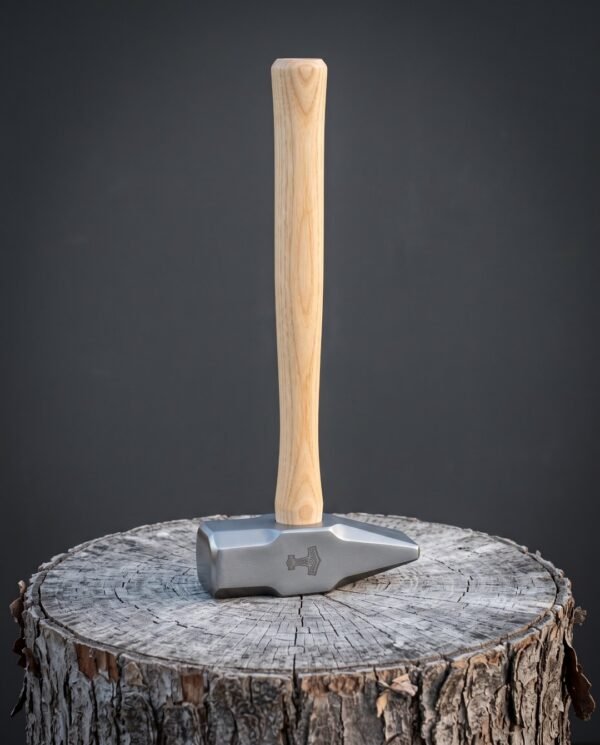
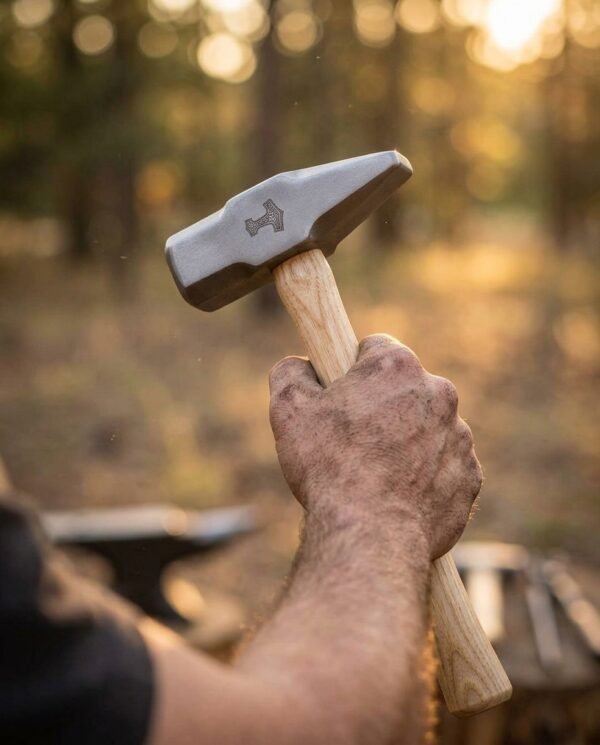
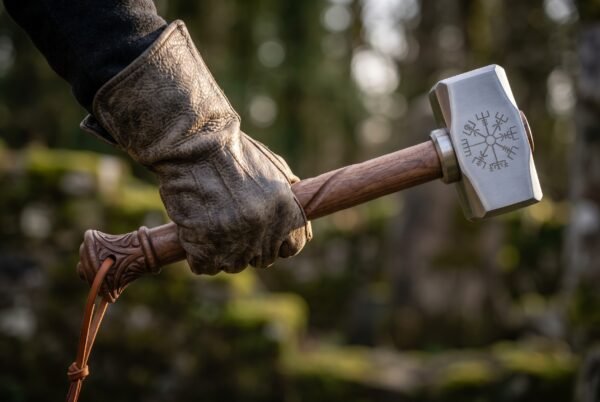
Nailward is a hand forged claw hammer, made as a tool rather than as an ornament that happens to be hammer shaped. The head is drawn out from 1095 high carbon steel, with a slightly domed striking face on one side and a curved claw on the other, and it sits on a straight grained hickory handle reinforced with polished steel langets, with a cut line of Elder Futhark runes along the steel at the shoulder. The lower half of the handle is wrapped in a black rubber over grip and finished with a steel end cap.
The claw hammer is older than most people assume. Roman carpenters were already using iron hammers with a forked claw for pulling nails, and examples turn up on sites across the empire. The shape barely changed for the next eighteen centuries because the problem it solves did not change. Ours is forged, ground, heat treated, hung and engraved in a Czech Republic workshop, and it ships ready to work. Every rune has a name and a sound of its own, all of them listed in the Elder Futhark.
Specifications
| Head material | 1095 high carbon steel, forged, heat treated and polished |
|---|
| Hardness | 54 to 58 HRC |
|---|
| Head type | Curved claw split into two tines, square striking face with chamfered corners |
|---|
| Handle | Straight grained hickory |
|---|
| Langets | Polished steel side straps running from the head down the handle shoulder |
|---|
| Grip | Black rubber over grip on the lower half |
|---|
| End cap | Polished steel butt cap |
|---|
| Engraving | Elder Futhark rune line cut into the steel langet at the handle shoulder |
|---|
| Hang | Wedged in the eye, wood wedge and steel cross wedge |
|---|
| Intended use | Carpentry, bench work, workshop display and gifting |
|---|
| SKU | RK-1436 |
|---|
Why the claw is curved and the face is domed
Look at a hammer head properly and every part of it is answering a question. The claw is split into two tines with a narrowing V between them, and the V is cut so that a nail shank wedges in it before the head of the nail can slip through. The curve matters as much as the fork. A curved claw gives you a rolling fulcrum, so as you lever the handle back the contact point travels along the curve and the mechanical advantage stays useful through the whole pull. A straight ripping claw does not roll like that. It is better for tearing boards apart and prying, and worse for drawing a long nail cleanly.
The face is slightly domed rather than dead flat, and the reason is that nobody swings perfectly square. With a flat face, any small tilt in the swing puts an edge of the face into the timber and leaves a crescent shaped bruise around the nail. A domed face lets you drive the last blow home and set the nail head just below the surface without printing the outline of the hammer into the wood. That is why the domed face is standard on finish hammers and why cheap flat faced hammers leave your work looking chewed.
The eye, the hole the handle passes through, is the third piece of engineering. It is not a parallel slot. It flares slightly toward the top so that the wedges driven into the end of the handle spread the wood outward and lock it against the taper. A properly hung hammer cannot come off the handle by swinging it, only by cutting it off.
The steel, the hardness and the hickory
The head is 1095 high carbon steel taken to 54 to 58 HRC. That is a deliberate window. Too soft and the face mushrooms and the claw bends the first time you put a real pull on a sunk nail. Too hard and the face chips, which on a hammer is genuinely dangerous because a chip leaves at high speed. The mid fifties is where a struck face stays flat and a claw stays springy, and it is where working hammers have sat for as long as anyone has been measuring hardness.
The handle is hickory, which has been the standard striking tool handle in North America for two centuries for a reason no synthetic has beaten. It is dense, it is stiff enough to transmit the blow, and it has an unusual ability to absorb the shock that comes back up the handle. Grain direction matters more than species here. The growth rings should run in line with the head, not across it, so the handle flexes in the plane of the swing. Ours are selected that way. The rubber over grip on the lower half is not traditional and we are not going to claim it is. It is there because it makes the hammer far more comfortable to hold with a wet or cold hand, and the steel cap on the butt protects the end grain if you set the hammer down hard.
Engraving, runes and your own design
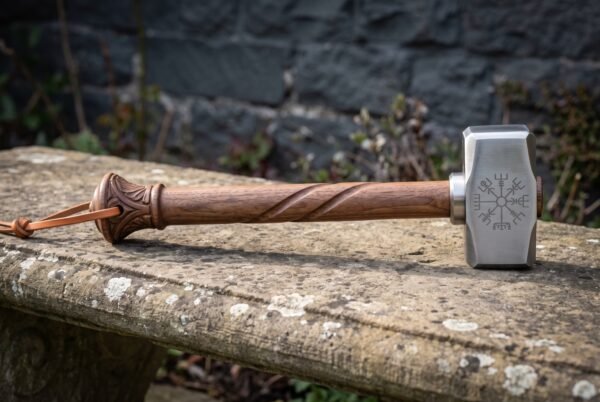
Use the rune converter on this page to turn a name, a date or a short phrase into Elder Futhark and we will cut it into the steel or the handle. If you would rather have a Viking pattern than a rune line, choose your own design in the engraving option above the add to cart button and tell us where it goes. Where a piece already carries an engraved design, your chosen engraving replaces it rather than sitting alongside it. On this hammer the handle shoulder is the engraving field, so your name, your date or your chosen design takes the place of the rune line shown. We can also cut a short mark into the cheek of the head if you would rather have it in the steel. More on the engraving page.
Handling, bench use and display
This is a hammer for carpentry and general bench work. Hold it near the end of the handle rather than choking up near the head, because the length is the whole point of the lever and choking up throws away most of the energy you are trying to deliver. Let the weight of the head do the work and keep your wrist loose.
If you are buying it as a gift or a workshop piece rather than a daily driver, it displays beautifully on a wall rack or a French cleat board with the runes turned outward, and the polished head will stay bright indoors with almost no attention. What we would ask is that you do not use it as a general purpose bashing tool on masonry or on hardened steel. A high carbon face driven into concrete or into another hardened head can chip, and hammer face chips are the classic workshop eye injury.
Care
Wipe the head down after use and put a light film of oil on it if it is going into a damp shop or a truck box. Polished 1095 will spot with rust quickly if it is left with sweat or damp sawdust on it. Any light rust comes off with fine steel wool worked with oil.
The hickory wants an occasional rub of boiled linseed oil, especially if the shop swings between damp and dry, because a handle that dries out shrinks in the eye and starts to loosen. If it ever does feel loose, drive the wedges rather than ignoring it. Do not soak a loose head in water to swell the wood. It works for a week and then leaves you with a rusted eye and a rotted handle. Our general steel notes are on the steel care page. Tool steel rusts like any other, and taking rust off a forged head covers the fix.
Made in the Czech Republic
Every piece we sell is made by hand in the Czech Republic. The smiths there work the way the trade has been worked for a long time, heating and hammering the steel, taking the bevels down by eye, and fitting the handle and the leather one at a time. There is no automated line anywhere in it, so small differences from one piece to the next are normal and expected.
Ransack Viking is a United States company based in Chicago, Illinois. We bring the pieces in ourselves, inspect them on arrival and ship them from our own warehouse. If you add engraving, that is carried out here in the United States before your order goes out.
A note on handmade variation
This is hand made rather than machine made or bulk produced, so what arrives will not be a pixel for pixel copy of the photograph. Hammer texture on the cheeks, the exact sweep of the claw, the figure and tone of the hickory and the depth of the cut runes all vary because each one is forged and hung by hand. The dimensions, the material and the build are the same every time. The character is not.
Frequently asked questions
Is this a working hammer or a display piece
It is a working hammer. The head is 1095 taken to 54 to 58 HRC and hung on a wedged hickory handle, which is how a real tool is built. It happens to look good on a wall, but nothing about it is decorative only.
Is this a blacksmith hammer
No, and we want to be clear about that. This is a carpenter pattern claw hammer for driving and drawing nails. A blacksmith wants a cross peen or a rounding hammer with no claw and a very different balance. Those are listed separately.
Curved claw or straight rip claw, which is this
This is the curved rip pattern, which is the better shape for drawing nails because the curve gives a rolling fulcrum through the pull. A straight claw is better for prying boards apart and worse for pulling a long nail out clean.
Can I put my own name on the handle
Yes. Use the rune converter on this page for Elder Futhark, or choose your own design in the engraving option. Your chosen engraving takes the place of the rune line shown rather than sitting next to it, and we can cut into the head cheek instead if you prefer.
Will the head come loose over time
It is wedged with a wood wedge and a steel cross wedge, which is the proper hang, so it should not. If a shop swings between very damp and very dry the hickory can shrink slightly. Drive the wedges a touch and oil the handle rather than soaking it in water.
How long does it take to ship
Processing is one to two weeks because each head is forged, treated and hung to order, then shipping is free within the United States. Returns are accepted within seven days. Custom engraving adds a few days.
What is in the box
- One hand forged 1095 steel rip claw hammer, hung and wedged
- Hickory handle with steel langets, rubber over grip and steel end cap
- Elder Futhark rune line cut into the steel langet at the handle shoulder
- Care card with oiling and handle notes
- Forged and finished in the Czech Republic
Explore the range
See more in blacksmith tools, splitting and felling axes and engraved and personalized, or read the guides.
Others in the same line
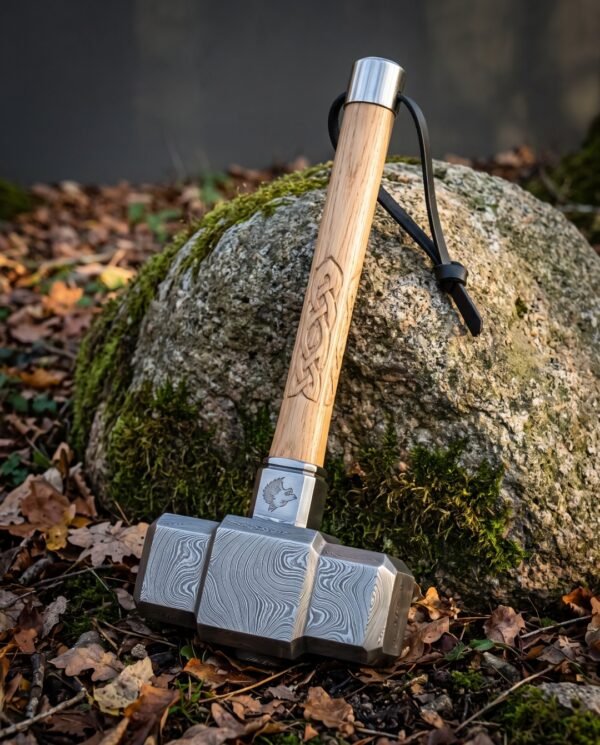
Next along the rack is the Anvilsong blacksmith tool, pattern welded Damascus. For a straight comparison, see the Emberfall blacksmith tool. Worth putting side by side with this is the Emberfall blacksmith tool, forged from 1095.
If you are putting a set together, the Hornmoot tankard sits alongside it. You can have this made your way instead on the design your own page.


Perfect gift. Perfect quality. No complaints. This is my third order from Ransack Viking and they never disappoint. Can’t recommend this enough.