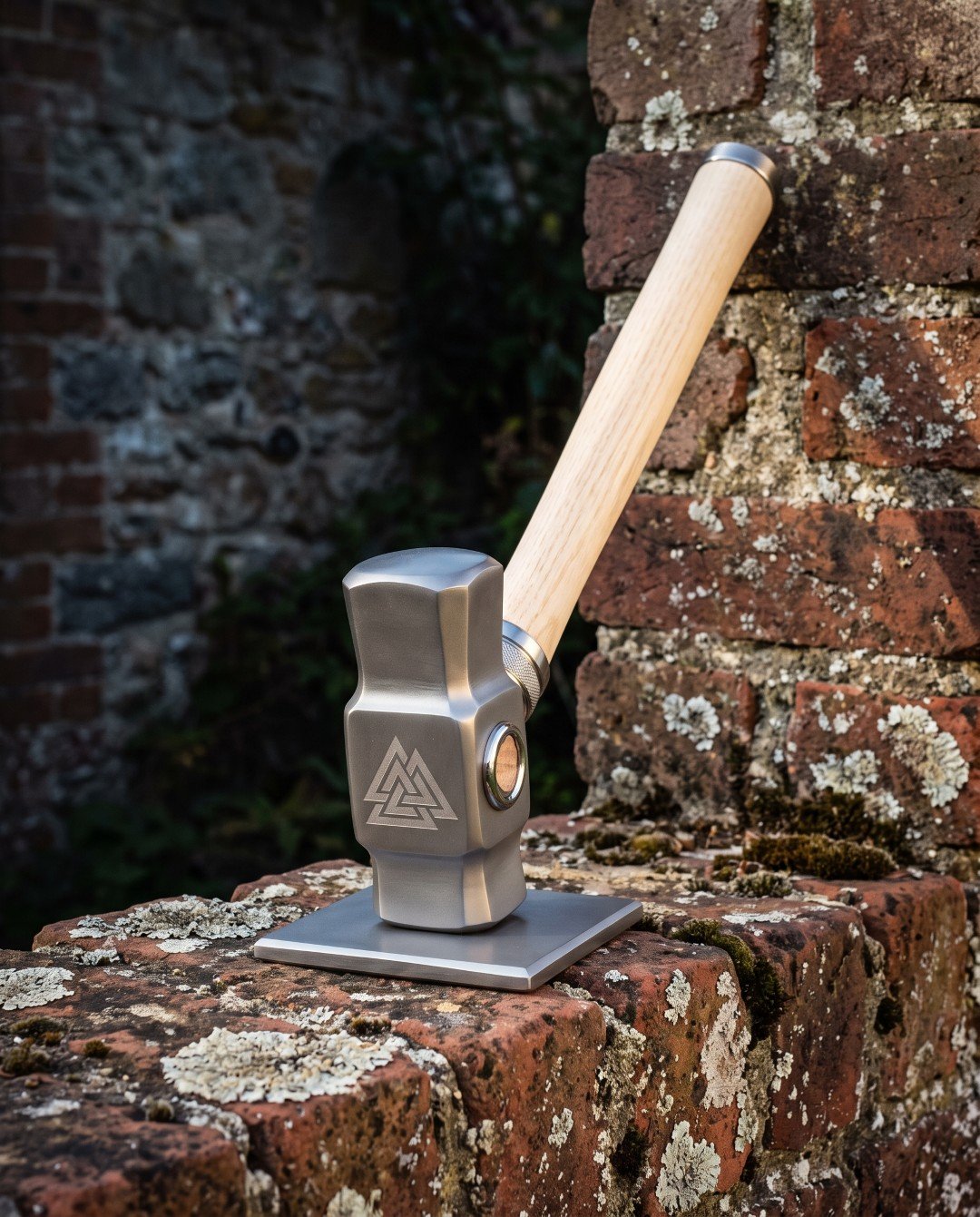
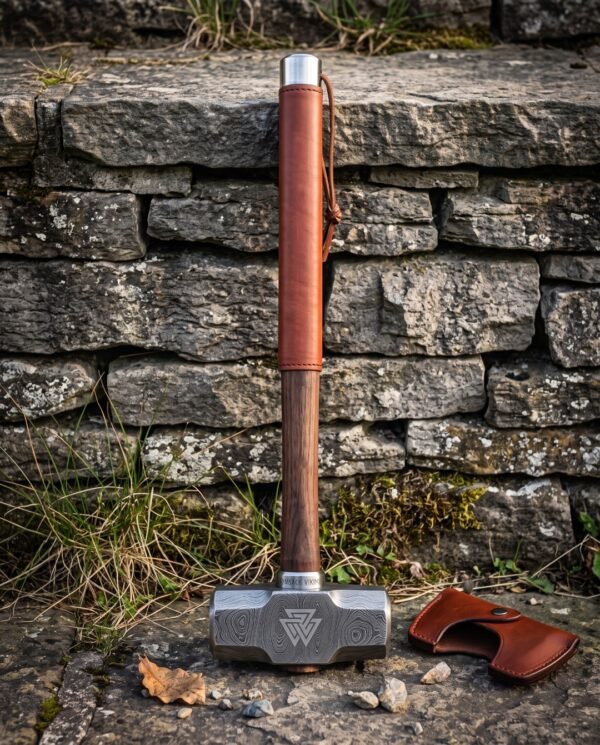
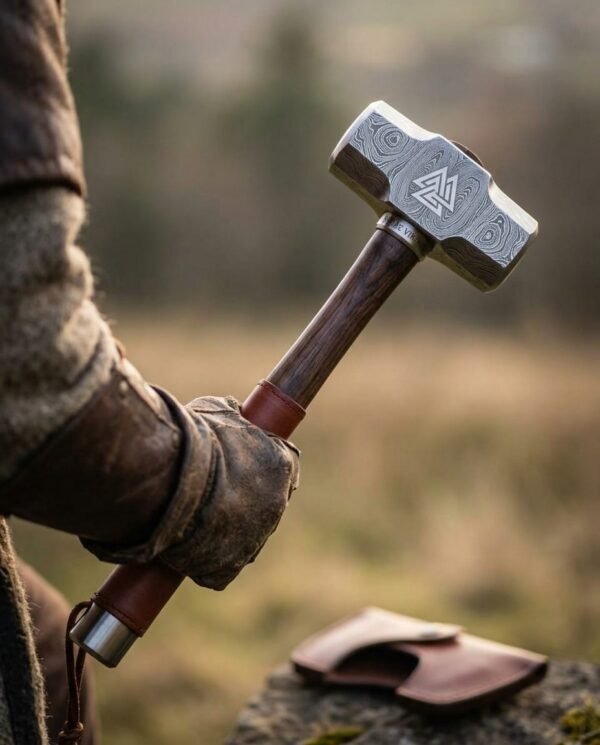
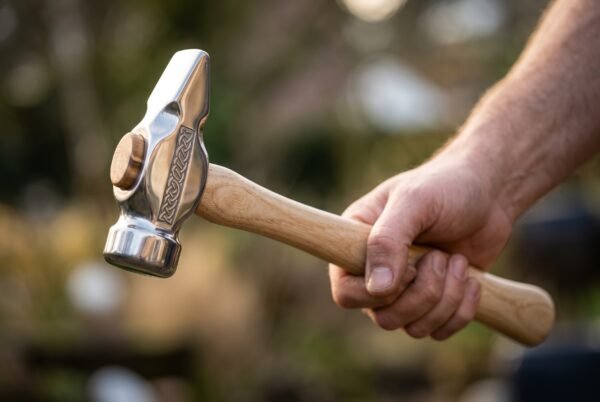
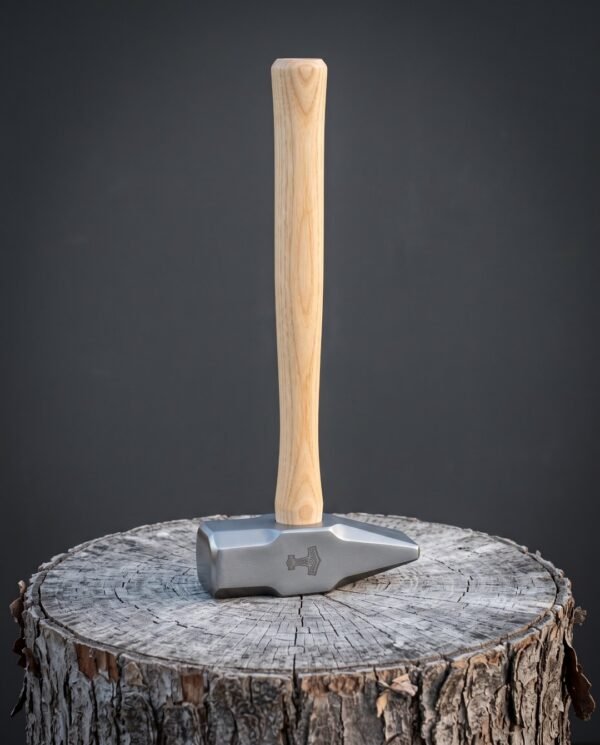
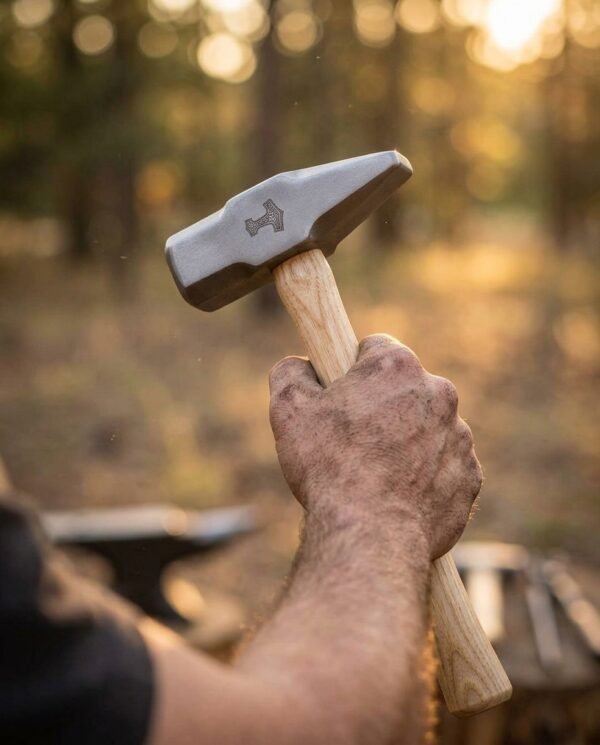
The Emberfall is a forging hammer with an octagonal head, one flat striking face, a brass ringed eye that shows the end grain of the handle, and a Valknut cut into the cheek. It is hand forged from 1095 carbon steel, the faces hardened and drawn back so they take repeated blows against hot stock and against the anvil without chipping or mushrooming. The handle is American ash, drawn thin at the throat so it flexes slightly with every stroke, which is the difference between a hammer you can swing for an hour and one that leaves your elbow aching after twenty minutes.
The octagonal head is not a style choice. A round faced hammer will roll on the anvil if you set it down and it gives you no reference for where the face is pointing. Flats let you feel the orientation of the head through the handle, and smiths who move a lot of metal will tell you that the ability to know exactly where your face is landing without looking is worth more than any other feature on a hammer. Every Emberfall is forged, dressed, hardened and hung in a Czech Republic workshop. The three locked triangles are the valknut, and where it appears and what we actually know is worth reading before you carry it.
Specifications
| Head material | Hand forged 1095 high carbon steel |
|---|
| Hardness | Faces hardened and tempered to 54 to 58 HRC, body left softer |
|---|
| Head weight | Approximately 3 pounds |
|---|
| Head form | Octagonal body, flat dressed striking face with a broken edge |
|---|
| Finish | Satin ground flats, engraved Valknut on the cheek |
|---|
| Eye | Brass ring set at the eye with the handle end visible, knurled steel ferrule at the throat |
|---|
| Handle | American ash, approximately 14 inches, oil finished |
|---|
| Hanging | Wedged, wooden wedge with a steel cross wedge |
|---|
| SKU | RK-1494 |
|---|
What a dressed face does and why it matters
Look at the striking face closely and you will see it is not a sharp edged flat. The face is very slightly crowned in the centre and the perimeter is rounded off into what smiths call a broken edge. Both details exist for the same reason. A sharp cornered face digs a crescent shaped mark into hot steel every time the hammer lands at even a few degrees off square, and no one lands square every time. A crowned and broken face lets the blow blend into the surface, so you move metal without printing tool marks that you then have to grind out.
The other half of the job is the heat treat. Both the face and the body cannot be the same hardness. A hammer hardened right through will crack, because a hammer is a beam that flexes in use. So the faces are hardened and drawn to the mid fifties on the Rockwell C scale, hard enough to resist mushrooming, and the middle of the head is left softer and tougher so the whole thing survives a lifetime of shock. This is the same logic as differential heat treatment on a blade, run for a different purpose.
The Valknut on the cheek is engraved into the surface of the steel. It is a decorative cut into a solid piece of 1095 rather than a pattern welded billet, and we call it what it is. The three interlocked triangles appear on Gotland picture stones and on the Oseberg ship burial, usually near scenes of death and offering, and it is the closest thing the Norse world has to a signature mark for Odin.
The steel and the handle
1095 is a plain high carbon steel with about one percent carbon and almost nothing else in it. In a hammer that plainness is an advantage. It hardens deeply and predictably in an oil quench, it can be drawn back accurately by colour, and it can be re dressed on a grinder for the rest of its working life without any special treatment. There is no exotic alloy here and there does not need to be.
The handle is American ash rather than hickory, and that is deliberate for a forging hammer. Hickory is denser and transmits more shock to the hand. Ash is springier for the same section, which is why it has been the traditional choice for striking tools that get swung all day. The grain runs along the length of the haft, the throat is slimmed so the handle can whip very slightly at the end of the stroke, and it is finished with oil rather than lacquer so it does not raise blisters.
The head is wedged rather than glued, so the hang can be maintained or the handle replaced when it eventually wears. The brass ring at the eye caps the wedged end neatly and the knurled ferrule at the throat gives a positive grip reference for your leading hand.
Engraving, runes and your own design
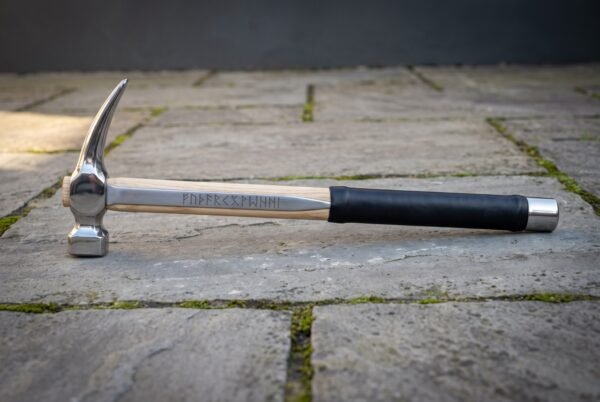
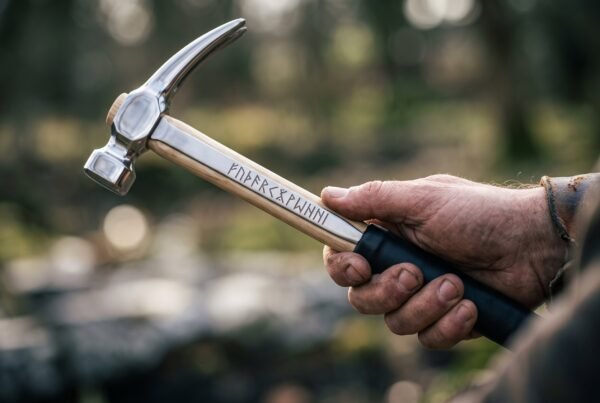
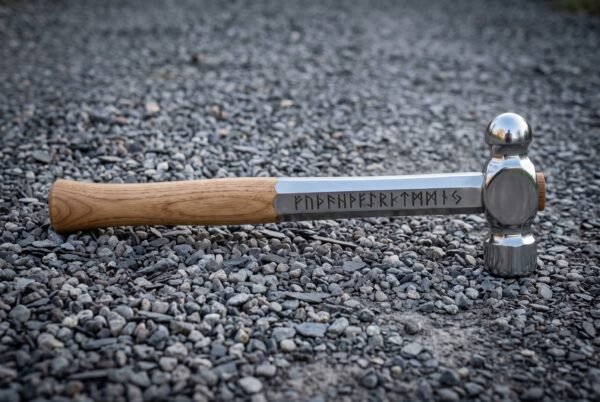
Use the rune converter on this page to turn a name, a date or a short phrase into Elder Futhark and we will cut it into the steel or the leather. If you would rather have a Viking pattern than a rune line, choose your own design in the engraving option above the add to cart button and tell us where it goes. Where a piece already carries an engraved design, your chosen engraving replaces it rather than sitting alongside it. On the Emberfall a rune line on the cheek takes the place of the Valknut, so if you want to keep the Valknut ask for your runes on the opposite cheek instead. Full detail is on the engraving page.
Using it and standing it up
A three pound hammer is a general purpose forging weight. It is heavy enough to move bar stock at a useful rate and light enough for controlled work at the anvil for an extended session. Hold it near the end of the handle rather than choking up on it, let the weight of the head do the work, and loosen your grip between blows. Gripping tight is the single most common cause of elbow trouble at the anvil.
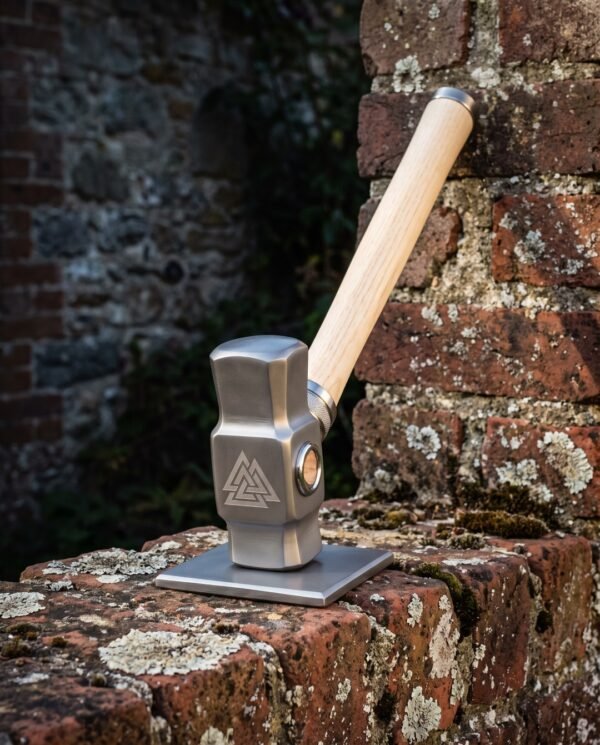
For storage, the head sits flat on a cheek or hangs from a peg or a magnetic bar. The small steel plate the hammer is standing on in the photograph is a display stand used for the shot and is not included, so if you want it to stand upright on a shelf use any flat steel offcut or a purpose made hammer stand.
Care
Keep the faces clean and lightly oiled when the hammer is not in use, because bare 1095 will spot with rust in a humid shop overnight. Scale from hot work builds up on the face and should be wiped off while the tool is still warm. If the face ever starts to spread at the edge, take it back on a belt or a stone and restore the crown and the broken edge rather than letting a mushroom form, because a mushroomed edge can spall and throw a fragment. Feed the ash handle with oil once or twice a year, and check the wedges each season. Our general notes on protecting bare carbon steel are on the steel care page. Tool steel rusts like any other, and taking rust off a forged head covers the fix.
Made in the Czech Republic
This piece is made by hand in the Czech Republic, in a workshop that still works the old way. The steel is forged, ground, heat treated and finished by smiths who learned the trade from the people before them, and the wood, horn and leather are cut and fitted by hand rather than pressed out on a line. That is also why no two pieces come out exactly the same.
Ransack Viking is a United States company. We import these pieces ourselves, check every one when it lands and ship from our warehouse in Chicago, Illinois. Engraving is done here in the United States after the piece arrives, so your runes or your own design go on before it leaves for you.
A note on handmade variation
This hammer is hand made, not machine made or bulk produced, so what arrives will not be a pixel for pixel copy of the photograph. The grain and tone of the ash, the exact width of the octagonal flats, the depth of the engraving and the fine texture left by the forging vary from one hammer to the next, because each one is worked by hand from natural materials. The dimensions, the material and the build are the same every time. The character is not.
Frequently asked questions
Is this a working hammer or a display piece
It is a working forging hammer. The faces are hardened and dressed and it is hung on a wedged ash handle. It will move hot steel at the anvil every day and it happens to look good on a shelf between sessions.
What weight is it and is that right for a beginner
About three pounds, which is the usual recommendation for a first serious forging hammer. Lighter hammers make you work harder for the same movement and heavier ones tire a new smith quickly.
Can I use it as a striking hammer on a chisel
Yes, on hot cuts, punches and drifts with soft struck ends. Never strike another hardened hammer face with it, because two hardened faces meeting can chip and throw fragments.
Is the base plate in the photo included
No. The small steel plate the hammer is standing on is a display stand used for photography and it does not ship with the hammer. You receive the hammer itself.
Will the Valknut wear off
No. It is engraved into the surface of the steel rather than printed on, so it stays. It will darken as the head takes on scale and patina from forge work, which most smiths prefer.
How soon will it ship
Processing is one to two weeks because each head is forged, heat treated and hung to order. Shipping is free within the United States.
What is in the box
- One Emberfall rounding hammer, approximately 3 pound 1095 carbon steel head
- American ash handle, wedged with a wooden and steel cross wedge
- Engraved Valknut on the cheek and a brass ring at the eye
- Care card covering face dressing, oiling and wedge checks
- Lifetime warranty against defects in forging, grind, heat treat and fittings
- Forged and finished in the Czech Republic
Explore the range
See more in blacksmith tools, splitting and felling axes and engraved and personalized pieces, or read the guides before you choose a head weight.
Other pieces in this group
For a straight comparison, see the Emberfall blacksmith tool. Worth putting side by side with this is the Runepein blacksmith tool, forged from 1095. In the same category sits the Thunderpein blacksmith tool, forged from 1095.
From the same corner of the shop, there is the Thornhelm sheath. Nothing here exactly right, build one to your own spec on the design your own page.


Happy with this one for the most part. Solid piece. Packaging could’ve been a bit sturdier. Good overall quality. Just a couple very minor details off. Would still tell others to give this a try.