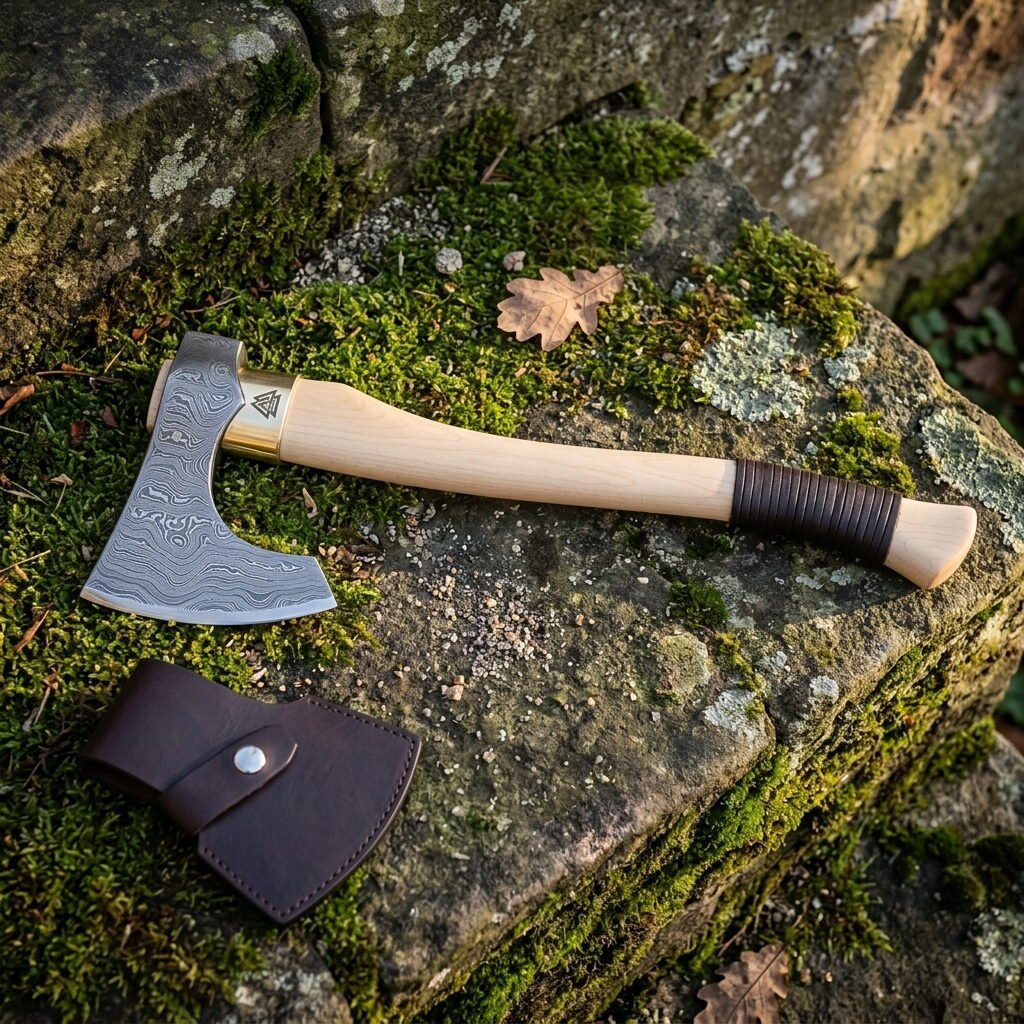
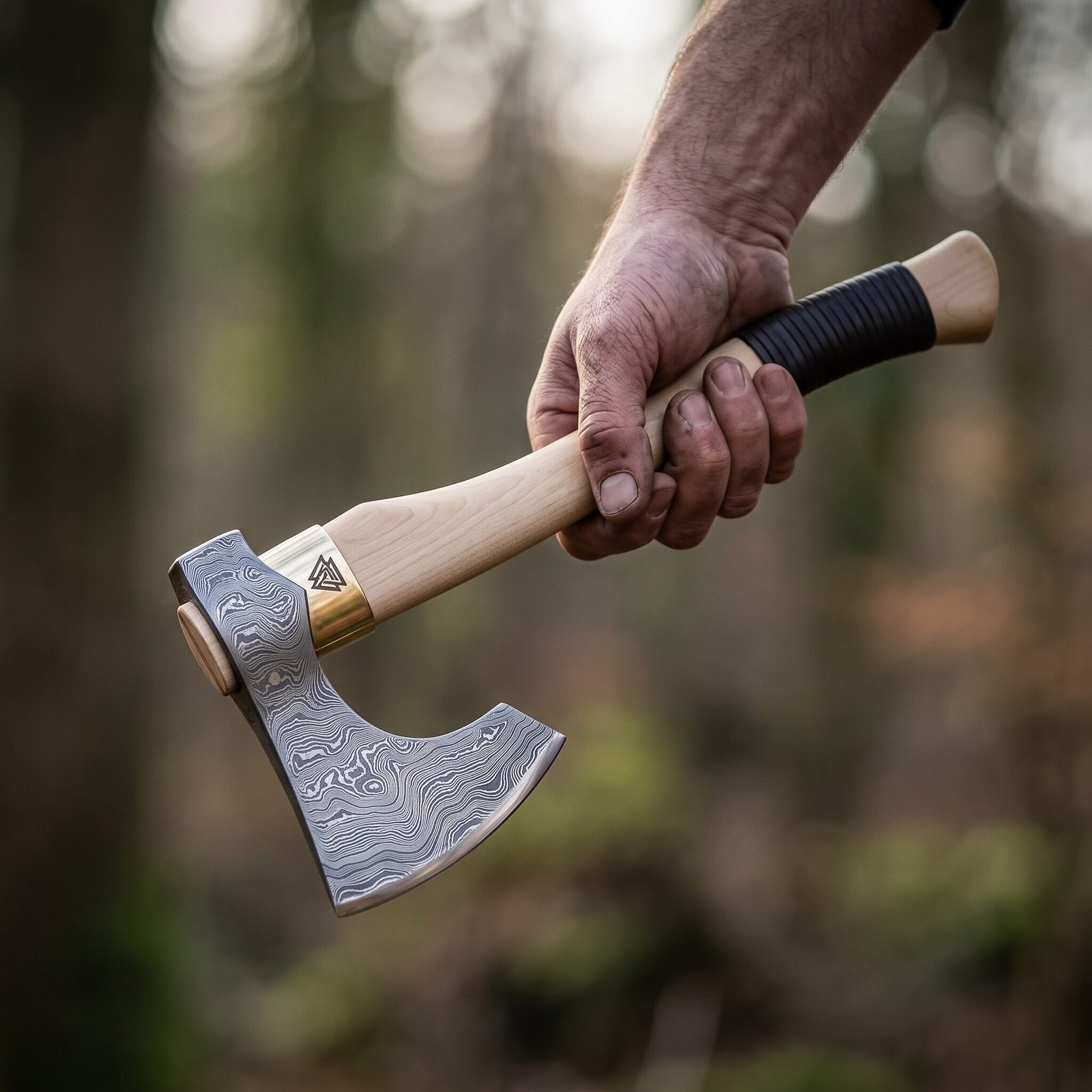
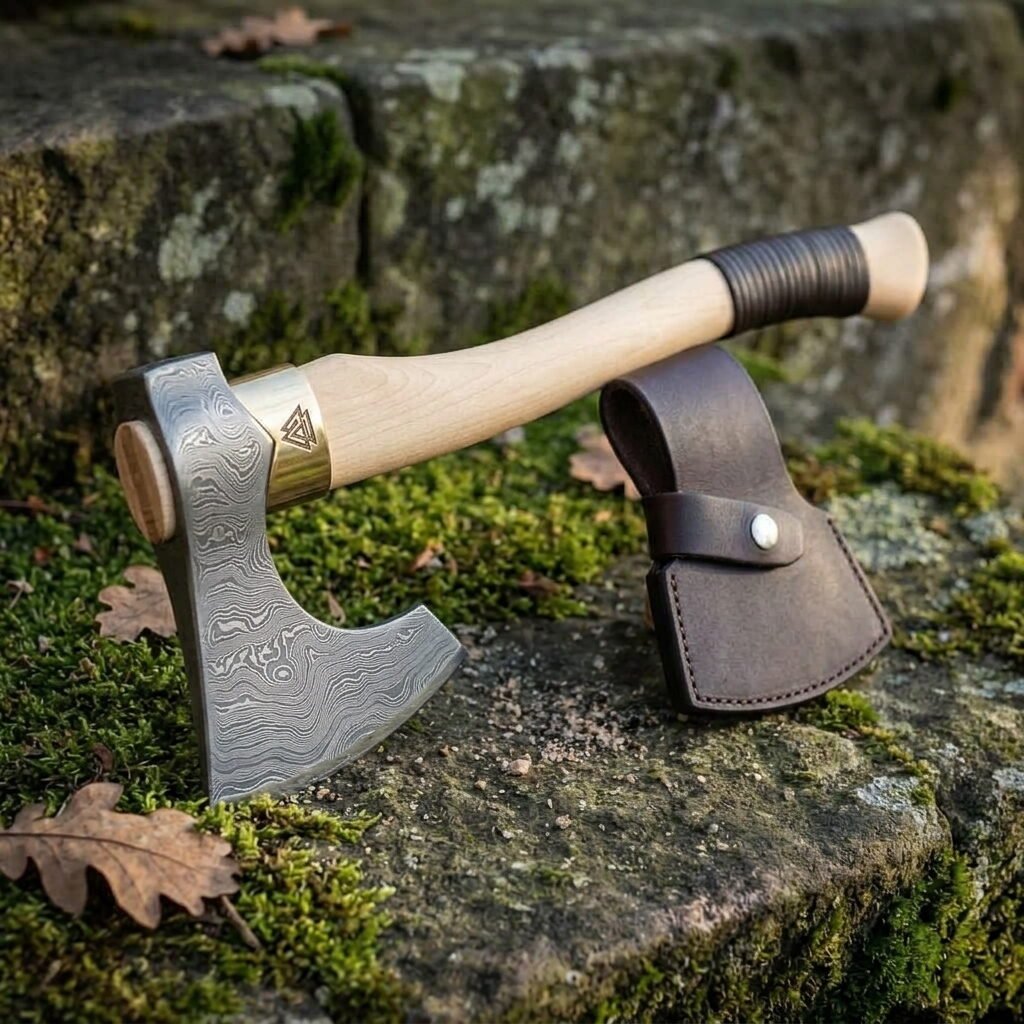
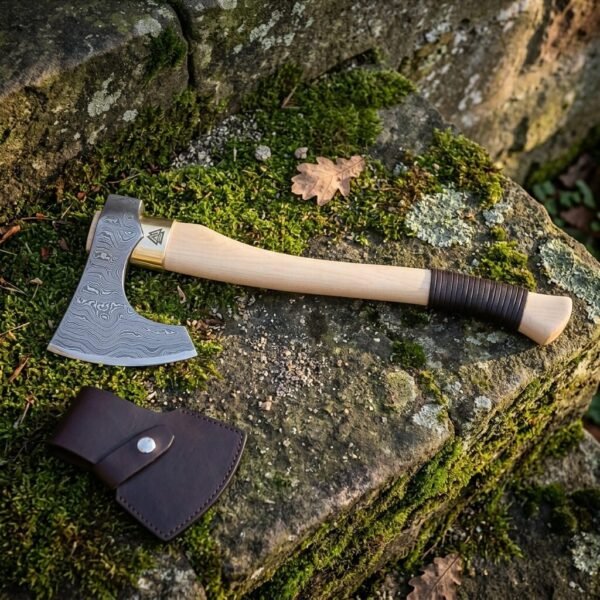
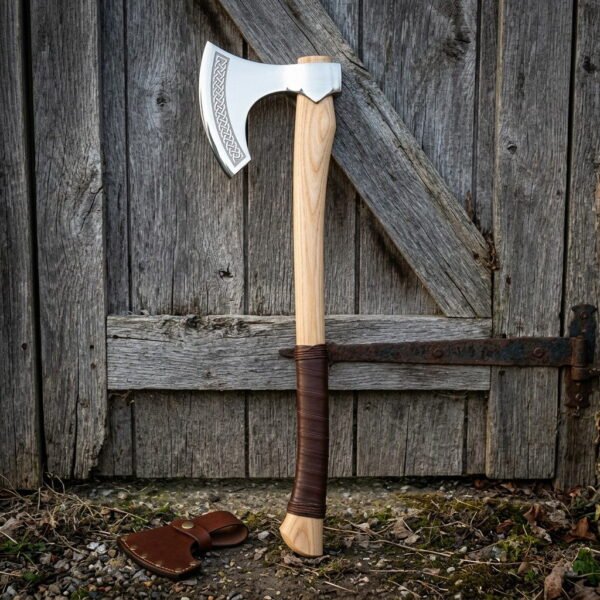
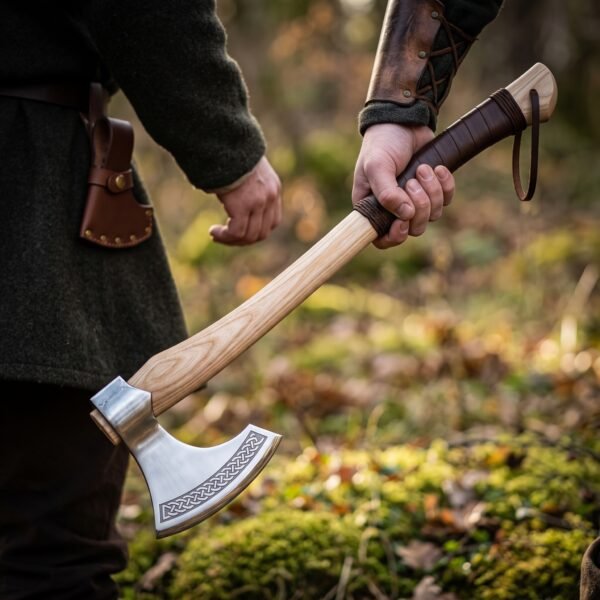
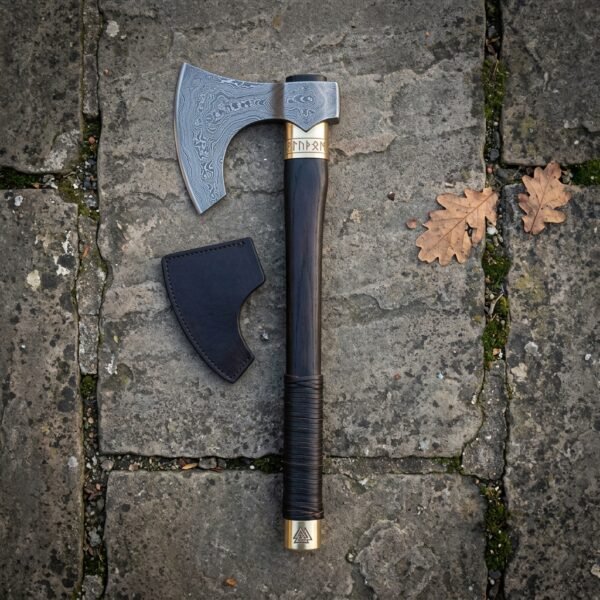
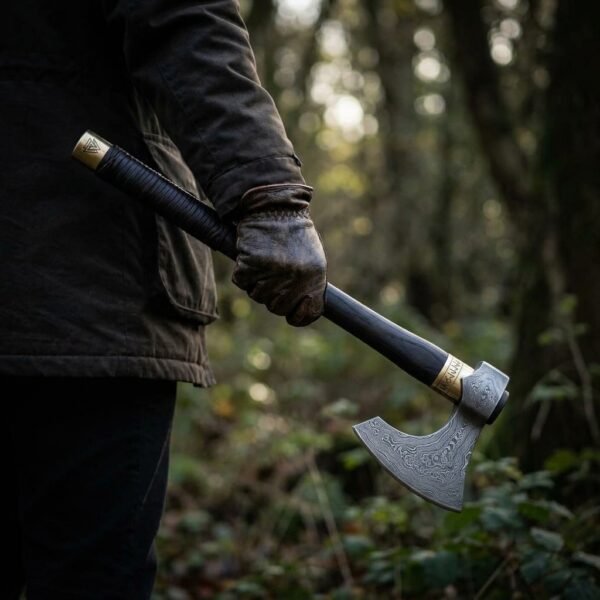
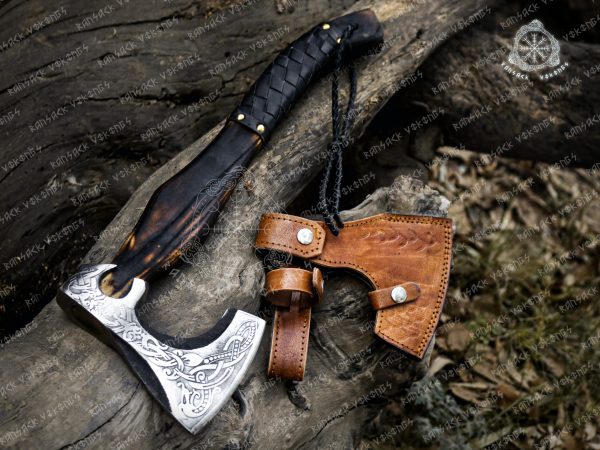
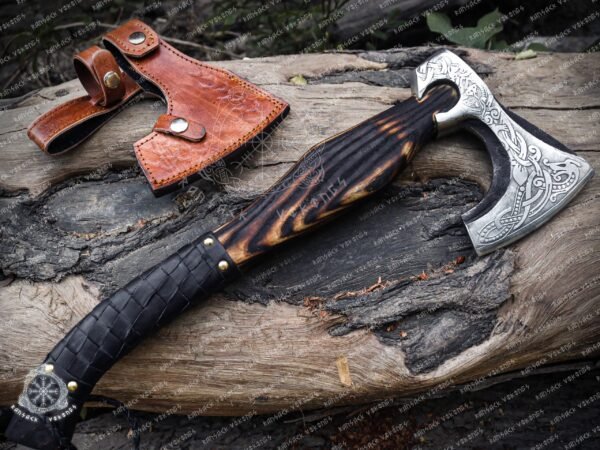
Pattern welded steel is older than the Viking age by several centuries, and by the time Norse smiths were making axes like this one it was a well understood craft rather than a novelty. Bars of two different steels are forge welded together, drawn out, folded and welded again until the stack holds hundreds of alternating layers. Etch the finished surface in acid and the two steels react at different rates, so the layer boundaries stand up as the flowing pattern you can see across this head. On a bearded axe the pattern follows the sweep of the beard, which is why the shape and the steel suit each other so well. Which of the two shapes suits you comes down to reach and mass, and the two shapes compared covers both.
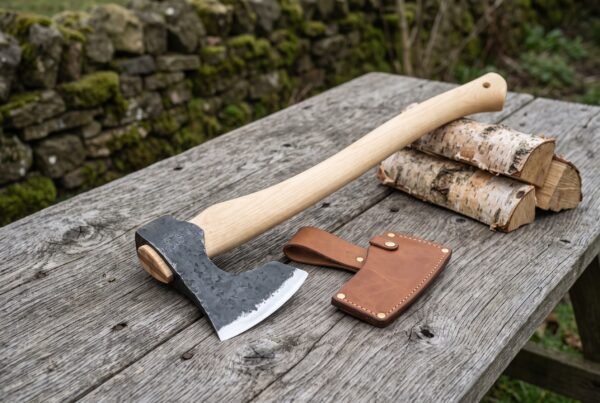
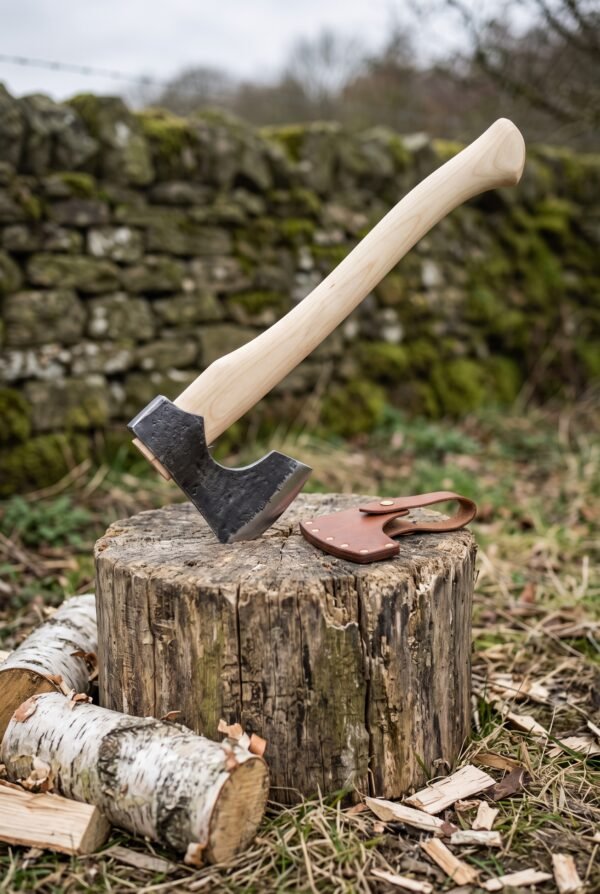
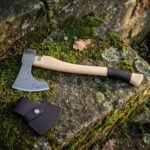
This is the Damascus version of our Birchskeg bearded axe, forged and finished in the Czech Republic. Same profile, same 19 inch birch haft, same fitted leather sheath, but the head is layered Damascus steel rather than a single carbon bar, hand ground and then etched to bring the pattern up, with a brass collar engraved with a valknut fitted below the head. Every head comes out of the fire with its own pattern, so no two are the same.
Specifications
| Steel | Hand forged Damascus, 1095 and 15N20 forge welded, acid etched |
|---|
| Layer count | Approximately 200 layers, varies by billet |
|---|
| Hardness | 58 to 60 HRC |
|---|
| Overall length | 19 inches |
|---|
| Cutting edge | 4.5 inches from horn to beard |
|---|
| Head weight | Approximately 1.5 lb |
|---|
| Head | Bearded Damascus head, haft end showing through the eye |
|---|
| Collar | Brass collar below the head, engraved with a valknut |
|---|
| Haft | Light birch, hand shaped, oil finished, wedged in the eye |
|---|
| Grip wrap | Dark brown leather wrap at the grip end |
|---|
| Sheath | Dark brown leather head sheath with a snap strap |
|---|
| SKU | RK-1211 |
|---|
How the beard and the layers work together
The beard is the long lower lug that drops below the cutting edge and gives the pattern its name. It exists to buy edge length without buying weight. Four and a half inches of cutting edge on a head of about a pound and a half is a ratio a wedge shaped head cannot match, and the hollow behind the beard lets you choke your hand up under the steel to carve with fine control. The upper horn hooks and pulls, which is why the shape shows up in both woodworking and fighting contexts in the archaeological record.
Damascus makes that outline legible. Because the layers were drawn out along the length of the bar before the head was shaped, the pattern runs with the curve of the beard rather than across it, and it tightens where the smith upset the steel around the eye. Hold the head to the light and you can read the forging history in the surface. That is the real appeal of pattern welded steel and it is why a Damascus head carries a higher price than the plain carbon version of the same axe.
Why Damascus and not stainless
Damascus is not a single alloy, it is a construction. The layers here are both carbon steels chosen because they harden well and because they take the etch differently. Stainless has neither property in a useful combination for this job. The chromium content that makes it corrosion resistant also makes it more brittle at axe hardness, and stainless layers etch flat and grey rather than resolving into contrast. An axe edge takes impact loads that no kitchen knife ever sees, and carbon steel absorbs those loads by deforming slightly instead of chipping. We compare the two properly on Damascus versus stainless.
The cost of that choice is the same as with any carbon steel. It will rust if you let it. Oil after handling and the problem never appears.
The birch haft and how to keep it
Birch is pale, stiff and close grained, and it sits under a Damascus head better than a dark wood because it lets the pattern carry the eye. The haft is hand shaped to an oval section aligned with the edge, so your hand knows where the edge is pointing without you looking. It is finished with oil rather than sealed under lacquer, so it grips when your hands are damp and it darkens gently with use.
Feed it once or twice a year with a rag and a little oil, keep it out of standing water and away from direct heat, and check the wedge occasionally. Our wooden handle care page goes through the routine in detail.
Engraving, runes and your own design
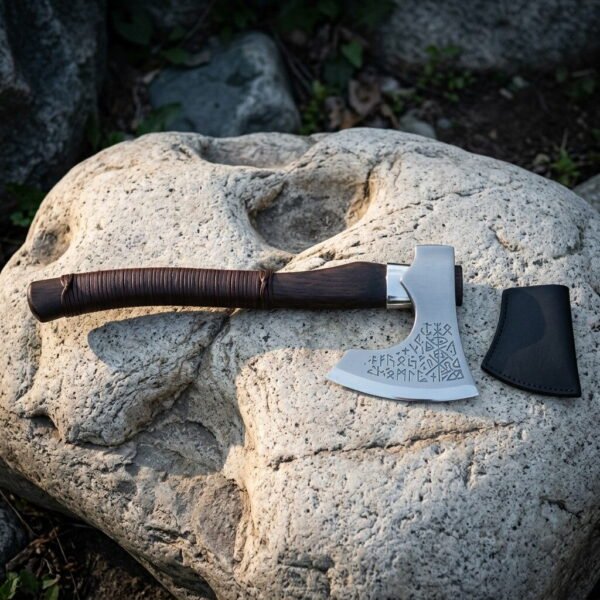
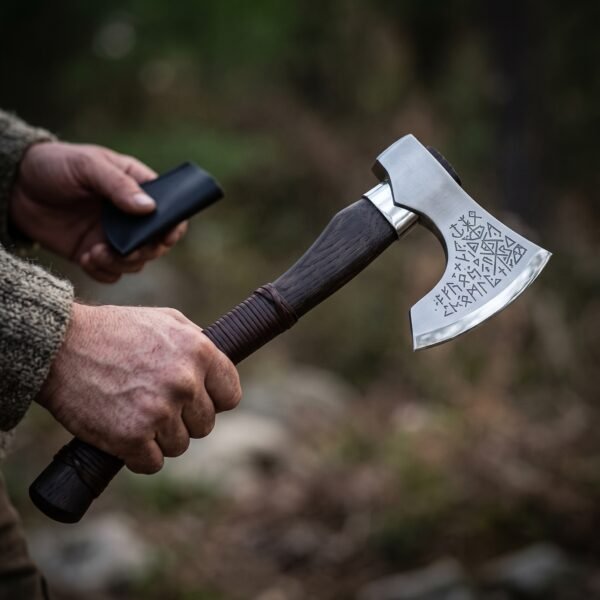
Use the rune converter on this page to turn a name, a date or a short phrase into Elder Futhark and we will cut it into the steel or the handle. If you would rather have a Viking pattern than a rune line, choose your own design in the engraving option above the add to cart button and tell us whether it goes on the blade or the handle. Where a piece already carries an engraved design, your chosen engraving replaces it rather than sitting alongside it. On this axe your rune line or artwork goes on the cheek of the head, cut through the etched surface so it reads clearly against the layers. See the engraving page for depth, placement and lead times.
Care and sharpening
Dry the head after use and wipe a thin film of oil across it before sheathing. Leather traps moisture, so putting a damp Damascus head away in its sheath is the fastest way to spot it. If rust does appear, do not attack it with a wire wheel, because aggressive abrasives flatten the etch contrast. Our steel care page sets out the gentle method that keeps the pattern intact.
Sharpen the convex bevel with a puck or coarse stone in small circles, follow the existing curve rather than flattening it, then refine and strop. The method in sharpening with a whetstone transfers directly, at a slightly more open angle than you would use on a knife.
Made in the Czech Republic
Every piece we sell is made by hand in the Czech Republic. The smiths there work the way the trade has been worked for a long time, heating and hammering the steel, taking the bevels down by eye, and fitting the handle and the leather one at a time. There is no automated line anywhere in it, so small differences from one piece to the next are normal and expected.
Ransack Viking is a United States company based in Chicago, Illinois. We bring the pieces in ourselves, inspect them on arrival and ship them from our own warehouse. If you add engraving, that is carried out here in the United States before your order goes out.
A note on handmade variation
This piece is hand forged. It is not machine made and it is not bulk produced, so what arrives will not be a pixel for pixel copy of the photograph. Grain, tone, pattern and exact profile vary because each one is worked by hand from natural materials, and this is more true of Damascus than of anything else we make. The layer pattern is a record of how that specific billet moved under the hammer, so yours will be recognisably the same style and unmistakably not the same surface. Dimensions, steel and build are the same every time. The character is not.
Frequently asked questions
Is the Damascus pattern real or printed on?
It is real forge welded Damascus. The pattern goes all the way through the steel, which is why it stays visible after sharpening. Printed and laser marked patterns sit on the surface and vanish the first time the edge is dressed.
Is it sharp, and can I use it?
It arrives with a working convex edge that cuts seasoned wood straight away, and it is heat treated and wedged for real use. Sharpening removes nothing from the pattern because the layers run through the body of the head.
Can I have runes engraved on the head?
Yes. Convert your text with the rune converter above and tell us whether it goes on the head or the haft. Your engraving is cut through the etched surface so it reads clearly against the layers.
Will my axe have the same pattern as the one photographed?
No, and that is the point. The style of pattern is the same, the flow across the beard is the same, the exact figure is unique to your billet.
What is the difference between this and the plain carbon steel version?
Identical geometry, haft and sheath. The difference is the steel. This head is built from a folded multi layer billet and etched to show it, which costs considerably more shop time and carries the higher price.
How long does shipping take?
United States shipping is free. A stock Damascus axe leaves the shop in three to five business days, and engraved orders add one to two weeks of forge time before they ship.
What is in the box
- One Wyrmskegg hand forged Damascus steel Viking bearded axe
- Fitted leather head sheath
- Damascus care and sharpening card
- Certificate of hand forging with the SKU recorded on it
- Forged and finished in the Czech Republic
Explore the range
Browse the full bearded axes range, the wider Viking axes selection, the Norse arms collection and our engraved and personalised pieces, or read the guides for Damascus care and sharpening.
Near neighbours in the shop
Sitting beside it in the catalogue is the Brasshelm bearded axe, pattern welded Damascus. Another in the same line is the Whorlbeard bearded axe, pattern welded Damascus. Next along the rack is the Grainbeard bearded axe, pattern welded Damascus.
Fitting out further, the Stormpoll Medieval axe belongs with it. You can have this made your way instead on the custom Viking axe page.


Best axe I’ve ever owned. Fit and finish is museum quality. You can tell real craftsmen made this by hand. Came in a nice gift box which made it feel even more special. Edge retention has been great even after regular use. If you’re on the fence just get it. You won’t regret it.
Did not expect this level of quality for the price. Weight and balance make it feel like a real functional piece not some cheap replica. Already telling my friends to check this out.
Pretty impressed. Just a couple minor things I’d tweak. Wood handle looks great though it’s a little smaller than I imagined. Glad I made this purchase.