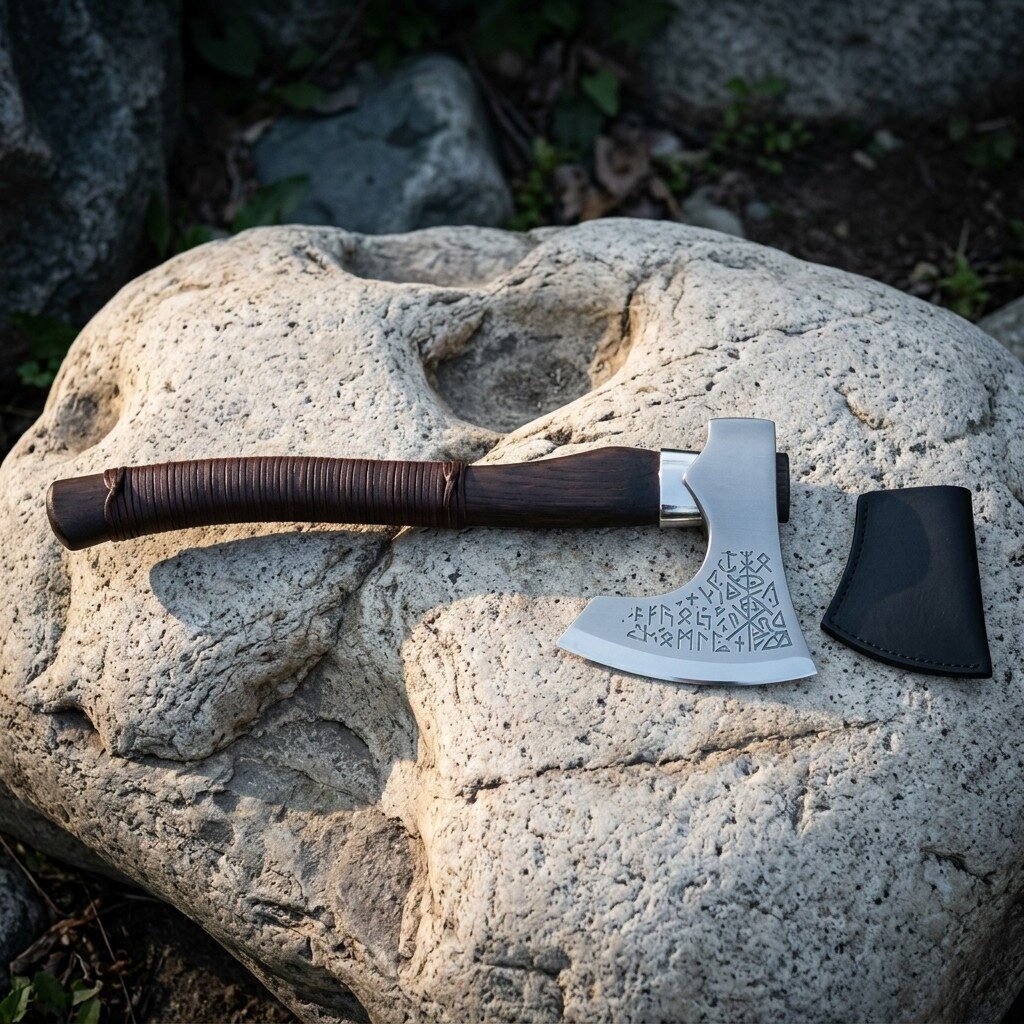
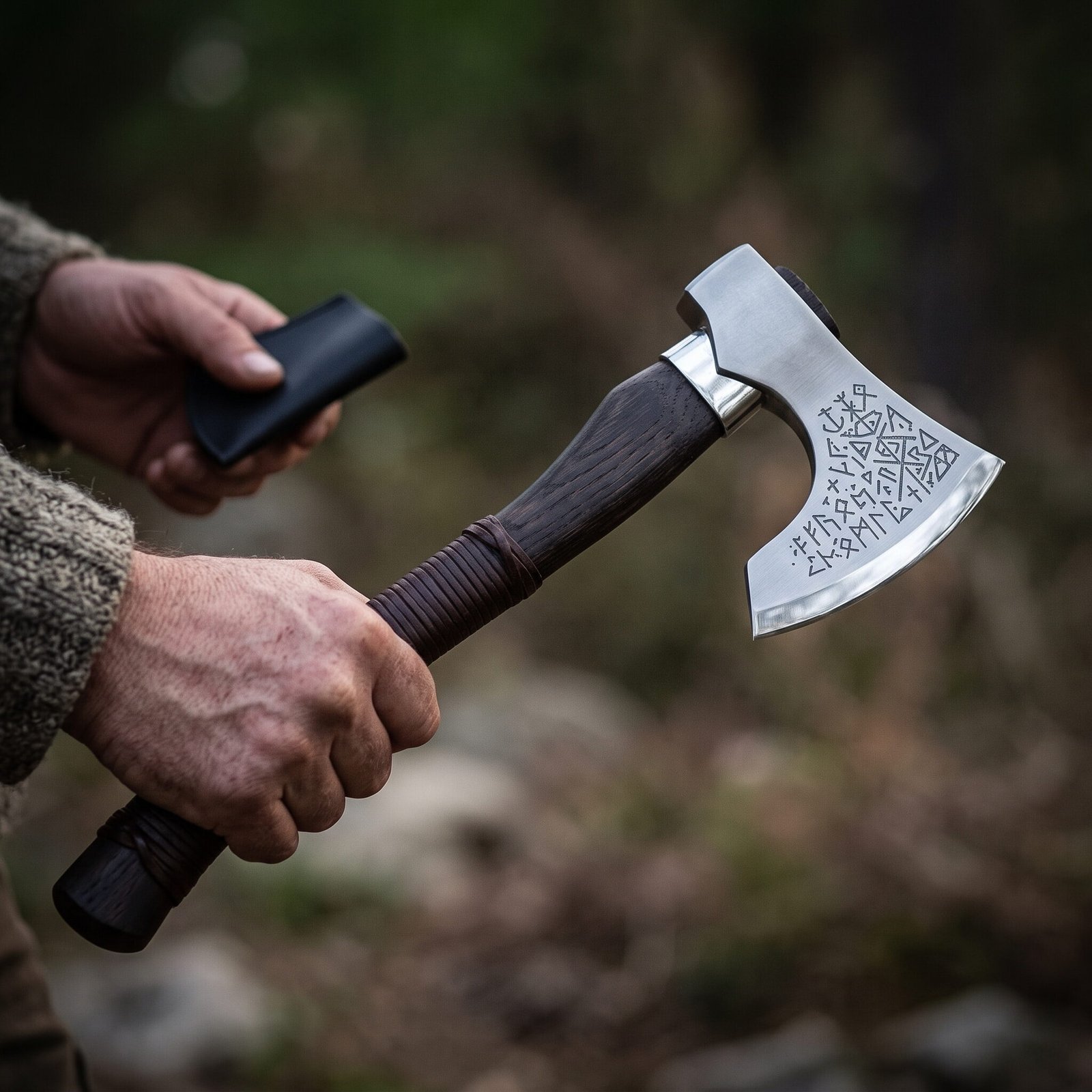
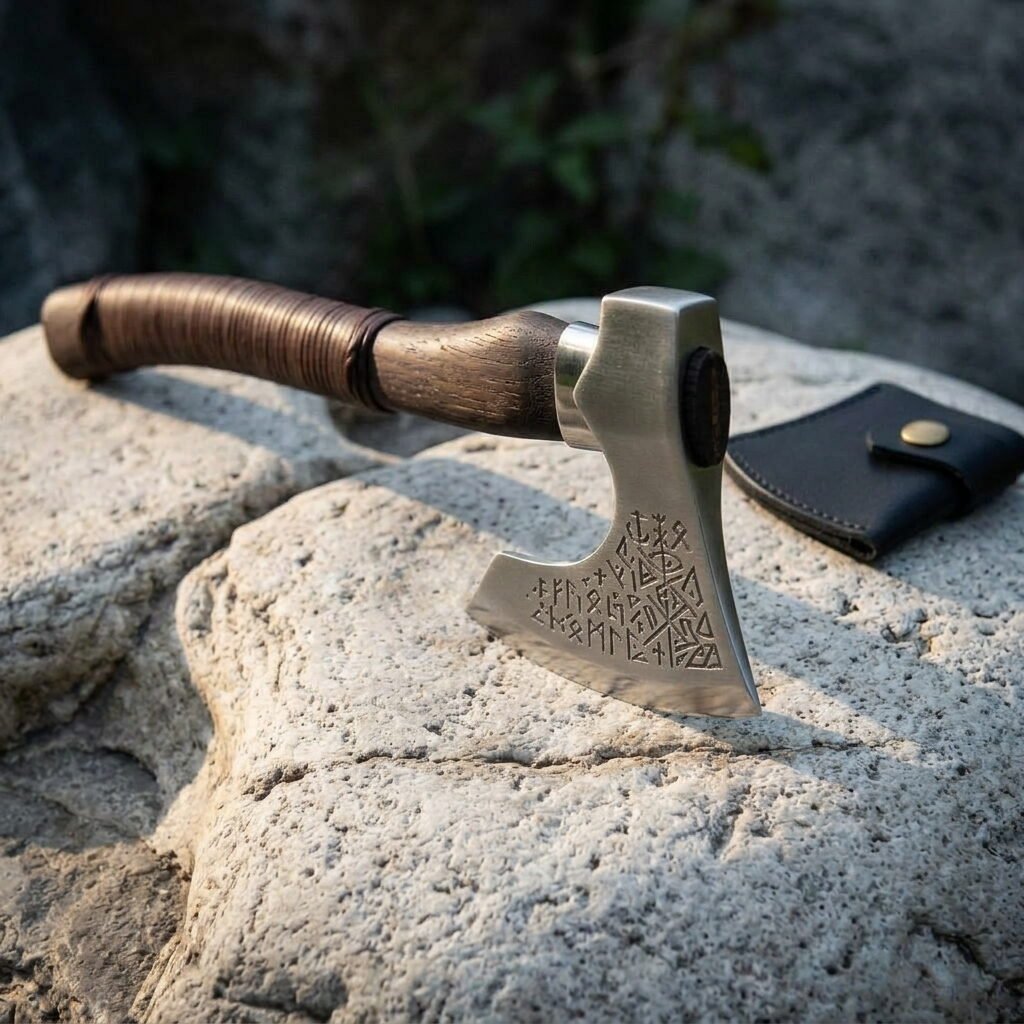
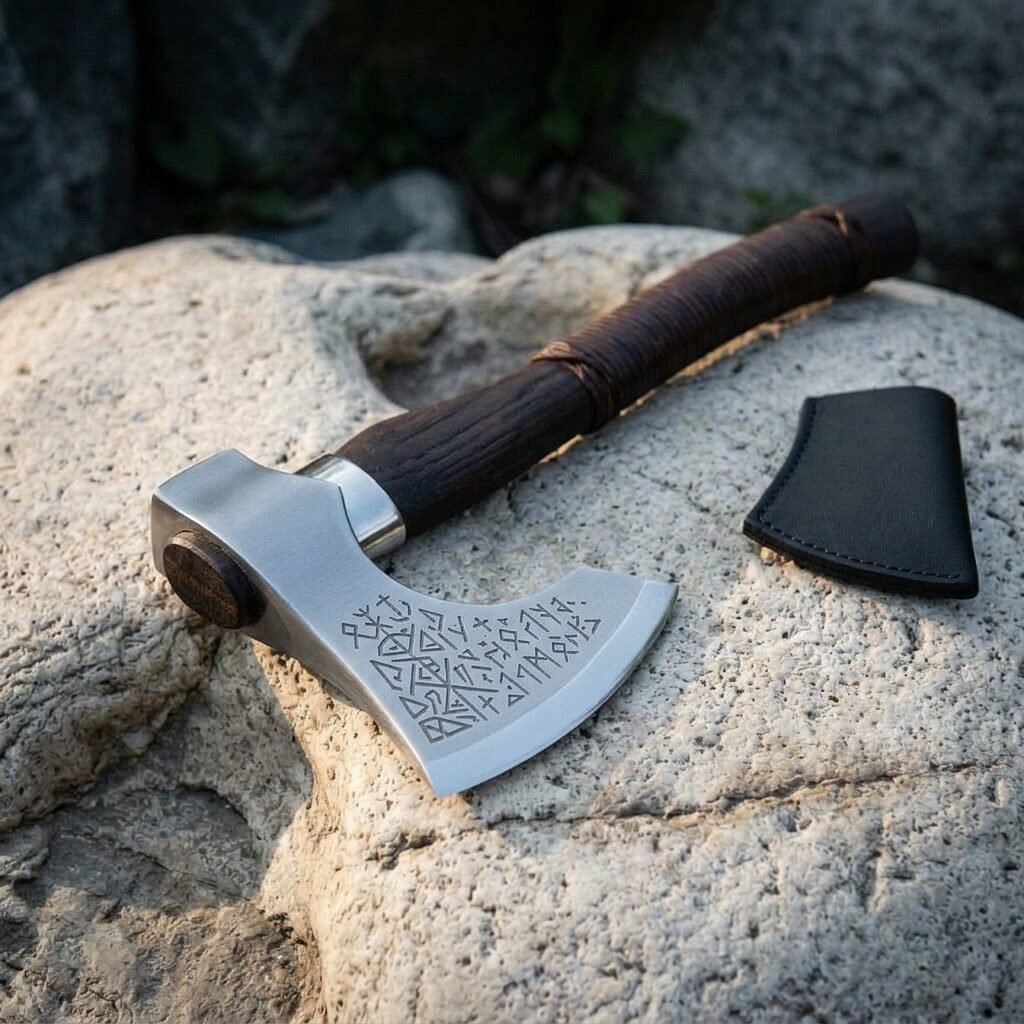
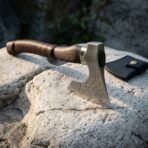
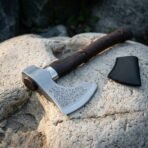
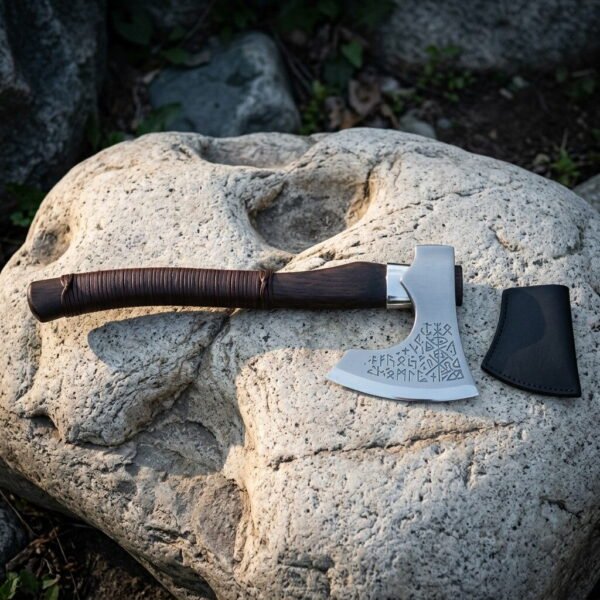
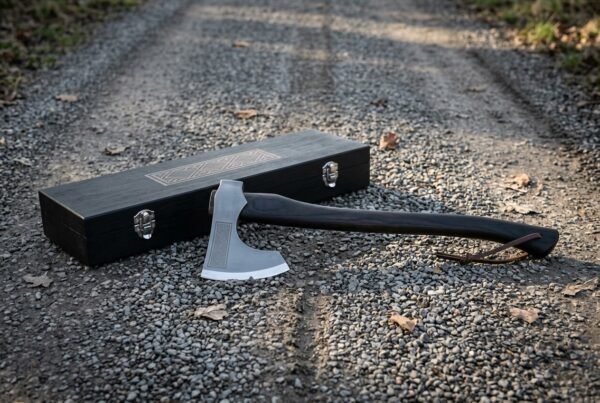
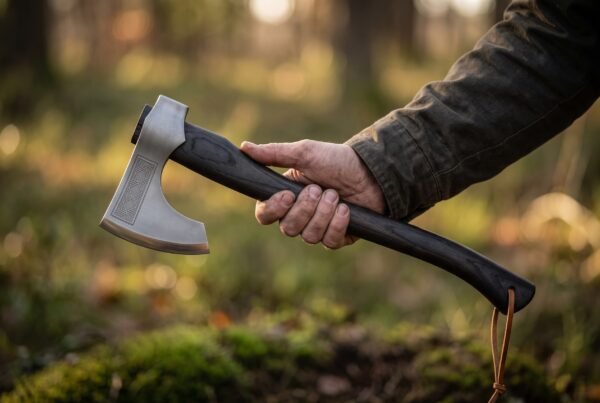
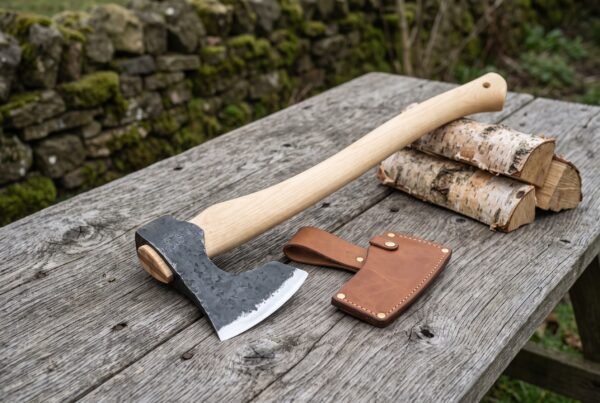
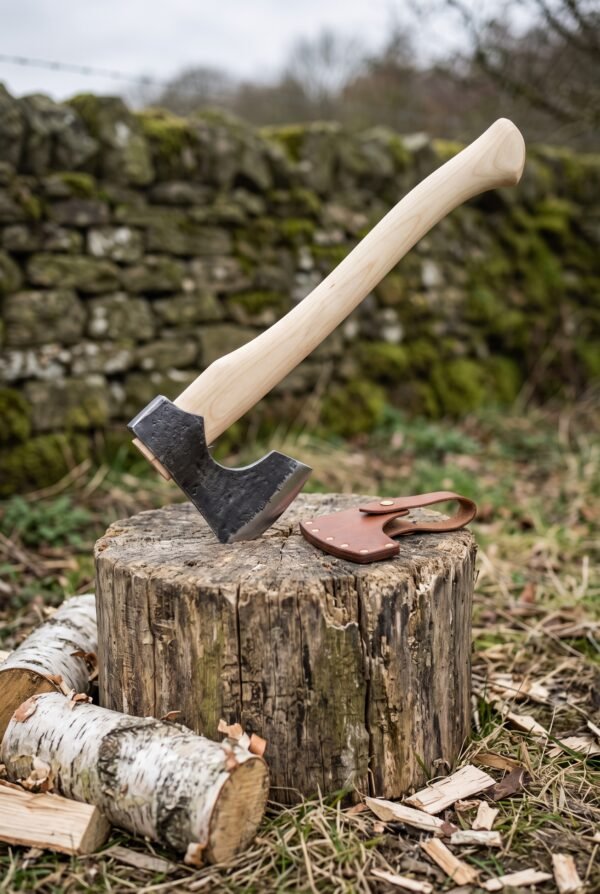
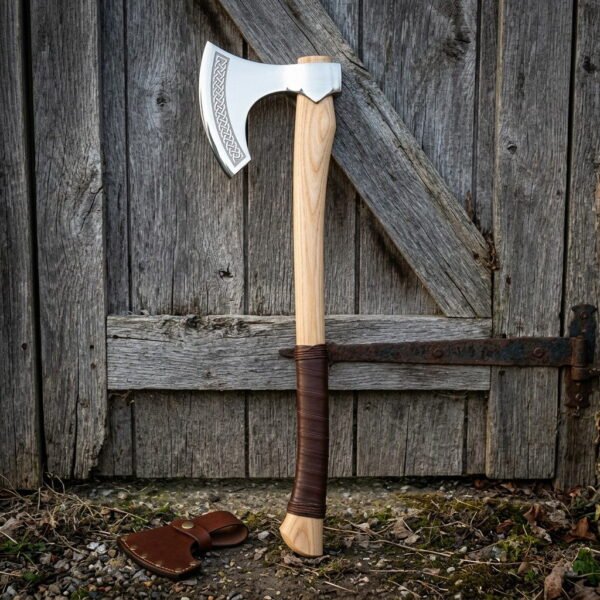
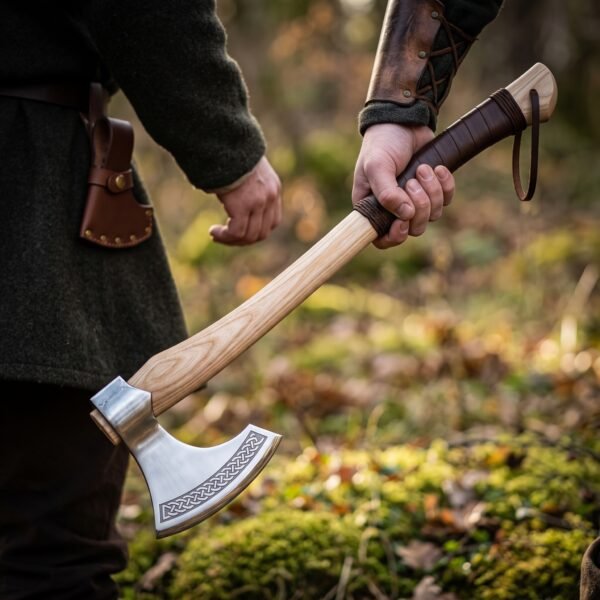
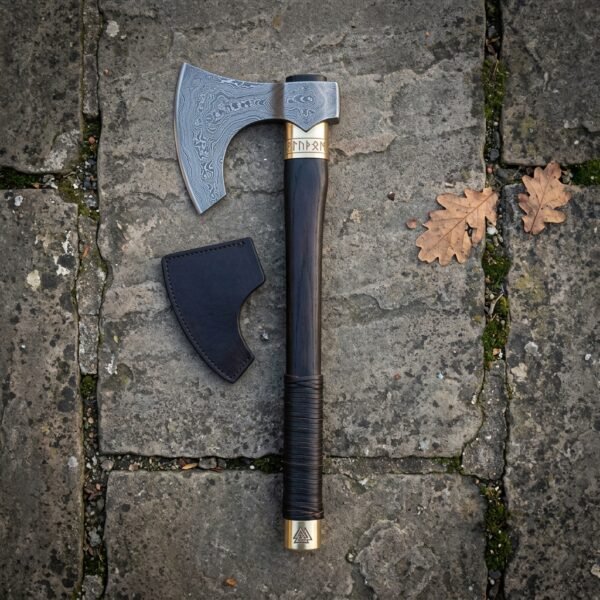
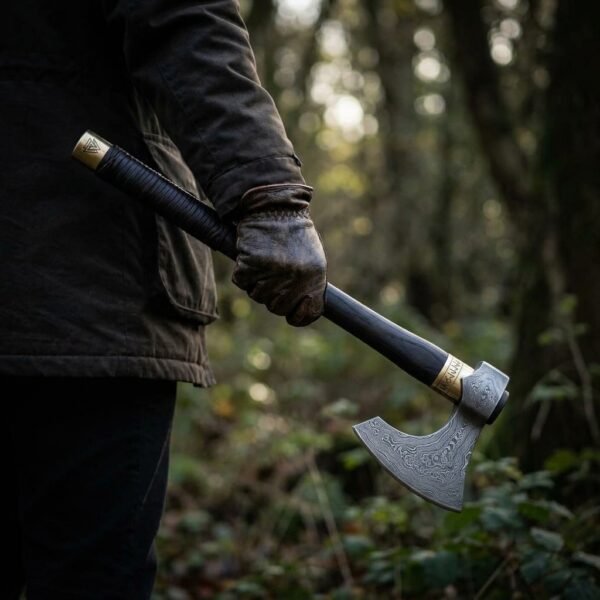
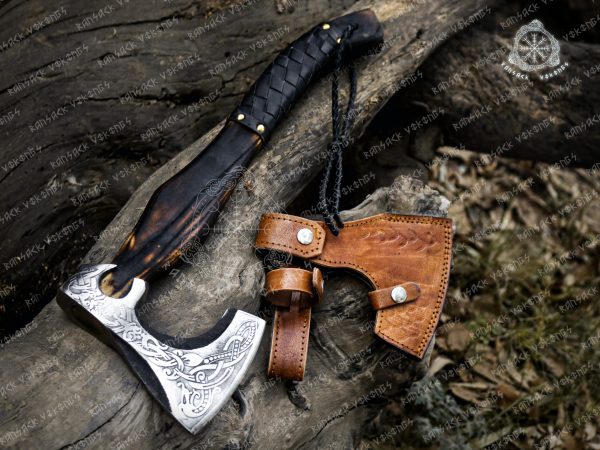
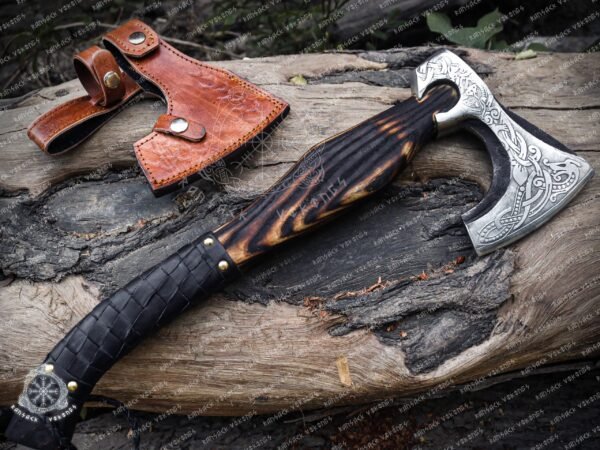
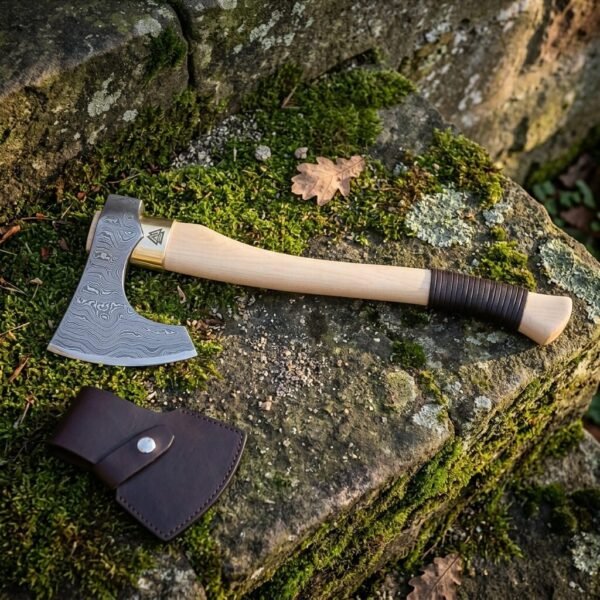
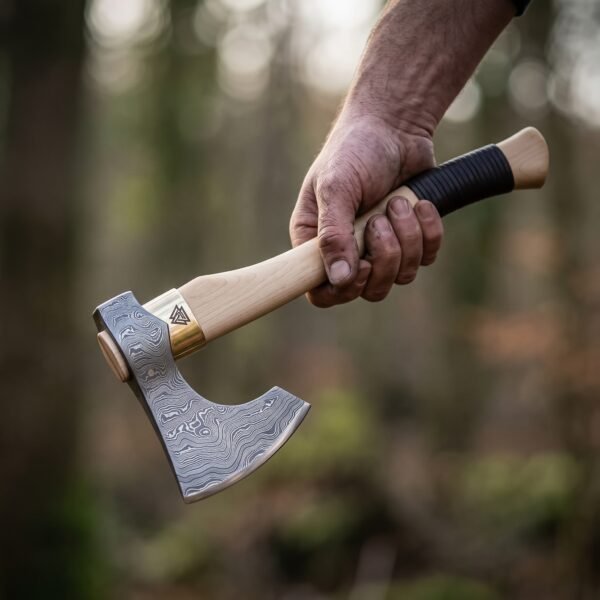
The Stavebeard is a bearded hand axe with a densely marked head. The polished 1095 face carries a field of Elder Futhark runes together with several of the bind figures known as staves, cut into the steel rather than printed on it. The haft is dark walnut with a leather cord wrap where the hand sits and a steel ferrule under the head. A black leather edge cover is included.
It is worth being straight about what those symbols are, because almost nobody selling them is. The runes are genuinely early. Elder Futhark was in use across Germanic Europe from around the second century and it is the alphabet you find on the Kylver stone and on hundreds of migration period objects. The staves are a different matter. Vegvisir, the Helm of Awe and the rest of the family come from Icelandic grimoires written down in the seventeenth, eighteenth and nineteenth centuries, long after the conversion, in a manuscript tradition mixing folk magic with borrowed Latin and Hebrew learning. The oldest known drawing of Vegvisir is from the Huld manuscript of 1860. They are not Viking age, they are Icelandic and early modern, and they are no less interesting for it: they are a record of what people in the north actually believed and drew for protection, written by the people who believed it. We put them on this axe because they belong to the same living tradition, not because we are pretending they came out of a ship burial. Forged, ground, hardened and etched by hand in the Czech Republic. It is catalogued with the bearded axes, and the battle axes sit one click away.
Specifications
| Steel | 1095 high carbon steel |
|---|
| Hardness | 54 to 58 HRC |
|---|
| Head pattern | Bearded, with a swept lower edge and a short upper horn |
|---|
| Decoration | Elder Futhark runes and Norse staves etched across the cheek |
|---|
| Cutting edge | Approximately 4 inches along the curve |
|---|
| Overall length | Approximately 19 inches |
|---|
| Haft | Dark walnut, wedged through the eye |
|---|
| Grip wrap | Brown leather cord wrap at the grip |
|---|
| Ferrule | Polished steel ferrule under the head |
|---|
| Finish | Bright polished head with etched decoration |
|---|
| Cover | Black leather edge cover with a snap strap |
|---|
| SKU | RK-1844 |
|---|
How a stave is put together and what it is meant to do
A stave is not a letter and it is not a picture. It is a constructed figure, built out of repeated arms radiating from a centre, with the ends of each arm terminated in a device: a fork, a cross bar, a circle, a trident. The construction is systematic. Aegishjalmur, the Helm of Awe, is eight identical arms at forty five degrees to each other, each ending in a trident with three cross bars. Vegvisir is eight arms too, but each one is different, and that difference is the whole point of it.
The uses recorded in the Icelandic manuscripts are extremely specific and rather domestic. Vegvisir is written up in the Huld manuscript with the line that a man carrying it will not lose his way in storms or bad weather even when the way is unknown. Others in the same books are for winning at wrestling, for finding a thief, for stopping a nosebleed. They were practical charms written down by farmers and clerks, not the secret symbols of a warrior cult, and reading them that way makes them far more human.
On this axe they are cut into the flat of the cheek where the steel is widest, sitting above the working part of the edge so sharpening never touches them.
The steel, the etch and the walnut
The head is 1095 high carbon steel taken to 54 to 58 HRC. That is a working axe hardness. Harder than that and a bit chips when it meets a knot, and a chipped axe is a repair job while a dull axe is five minutes with a stone.
The decoration is acid etched, which bites the design a little below the polished surface so that it holds its line as the axe is used and cleaned. A laser marked surface sits on top and burnishes away; an etched one is a shallow recess and survives.
The haft is walnut, chosen dark and close grained, with the grain running along the length of the eye as it must on any axe meant to be swung. Walnut is stiffer and denser than ash and it damps vibration well, which you notice in the hand on a hard strike. The leather cord wrap at the grip is there for purchase and to mark where the hand belongs, and it darkens with use.
Engraving, runes and your own design
Use the rune converter on this page to turn a name, a date or a short phrase into Elder Futhark and we will cut it into the steel, the leather or the wood. If you would rather have a Viking pattern than a rune line, choose your own design in the engraving option above the add to cart button and tell us where it goes. Where a piece already carries an engraved design, your chosen engraving replaces it rather than sitting alongside it, so on this axe your text or symbol takes the place of the rune and stave field shown. The engraving page shows how much fits on a cheek this size and how deep the etch sits.
Handling and balance
Nineteen inches is a proper one handed camp axe length. It is short enough to pack, long enough to generate real head speed from the elbow, and light enough at the head that you can work with it for an hour without your forearm giving out.
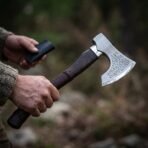
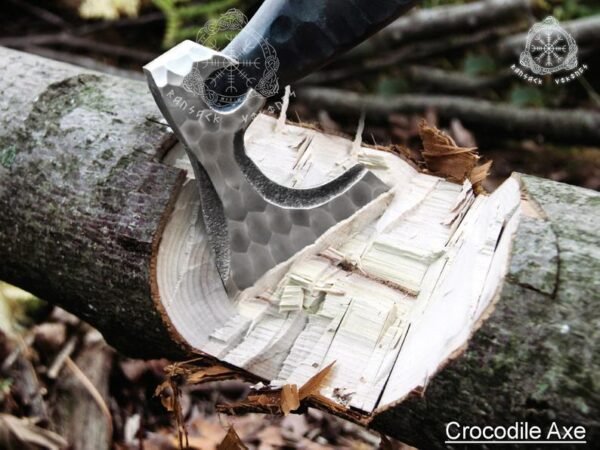
The gap behind the beard is what makes this a versatile tool rather than just a chopper. Slide your hand up under the head, hold the axe just behind the bit, and it becomes a carving tool for taking corners off a stake, shaping a tent peg or splitting kindling with control. Move back down to the wrap and it is a felling and limbing axe again. That change of grip is the reason the bearded pattern outlived every alternative in northern Europe.
Care
Wipe the head down after use and keep a light film of oil on the polished face, particularly in the etched recesses where moisture sits. Let the head dry fully before the leather cover goes back over it. Sharpen with a puck or a coarse stone worked along the bevel and finish on a strop, and keep the stone away from the etched decoration, which sits well above the edge anyway. Never touch it to a powered grinder, because the heat draws the temper out and it cannot be put back. Feed the leather wrap and the cover with a neutral conditioner once or twice a year. Oil the walnut haft with boiled linseed when it looks dry, which keeps the wood swollen in the eye and the head tight. Our page on steel care covers oiling, etched finishes and rust removal.
Made in the Czech Republic
Every piece we sell is made by hand in the Czech Republic. The smiths there work the way the trade has been worked for a long time, heating and hammering the steel, taking the bevels down by eye, and fitting the handle and the leather one at a time. There is no automated line anywhere in it, so small differences from one piece to the next are normal and expected.
Ransack Viking is a United States company based in Chicago, Illinois. We bring the pieces in ourselves, inspect them on arrival and ship them from our own warehouse. If you add engraving, that is carried out here in the United States before your order goes out.
A note on handmade variation
This axe is hand made rather than machine made or bulk produced, so what arrives will not be a pixel for pixel copy of the photograph. The etched field bites at its own depth and contrast on every head, so some read darker and crisper than others. The profile of the beard is drawn out by hand and no two curves are identical to the millimetre. Walnut is a natural material and its colour runs from mid brown to nearly black depending on the board, with the figure of the grain never repeating. Leather takes its own tone. The edge length, the steel, the heat treat and the build are the same every time. The character is not. If you want the longer version, look at the Dane axe and then at choosing a Viking axe.
Frequently asked questions
Are the symbols authentic Viking
The runes are Elder Futhark and genuinely early. The staves are Icelandic and come from grimoires written down between the seventeenth and nineteenth centuries, so they are post Viking. We think that is worth knowing rather than glossing over.
Is it sharp enough to use
Yes. It arrives with a working edge and it is built as a tool. Split kindling with it, carve with it, take it out.
Will sharpening damage the engraving
No. The decoration sits on the cheek well above the bevel, so a stone on the edge never reaches it.
Can I throw it
We would rather you did not. A walnut haft with a leather wrap is not made to take repeated overrotations onto a hard target. Use a dedicated throwing axe.
Can I replace the symbols with my own runes
Yes. Your chosen line replaces the field shown rather than being added next to it. Around twenty five characters fit on a cheek this size.
How long does shipping take
One to two weeks of processing, then free shipping inside the United States. Engraved orders take a few days longer.
What is in the box
- Stavebeard bearded axe with a 1095 high carbon steel head
- Dark walnut haft with a leather cord wrap and a steel ferrule
- Fitted black leather edge cover
- Care card covering oiling, sharpening and haft maintenance
- Lifetime warranty against defects in forging, grind, heat treat and fittings
- Forged and finished in the Czech Republic
Explore the range
See the rest of the Viking axes, the other bearded axes, the engraved and personalised pieces, or read the guides for what the Norse staves actually mean.
Near neighbours in the shop
Next along the rack is the Caskbeard bearded axe, forged from 1095. For a straight comparison, see the Ravenhaft bearded axe, forged from 1095. Worth putting side by side with this is the Hammerbeard bearded axe, forged from 1095.
If you are putting a set together, the Runecask Dane axe sits alongside it. You can have this made your way instead on the custom Viking axe page.


Absolutely blown away by this axe.