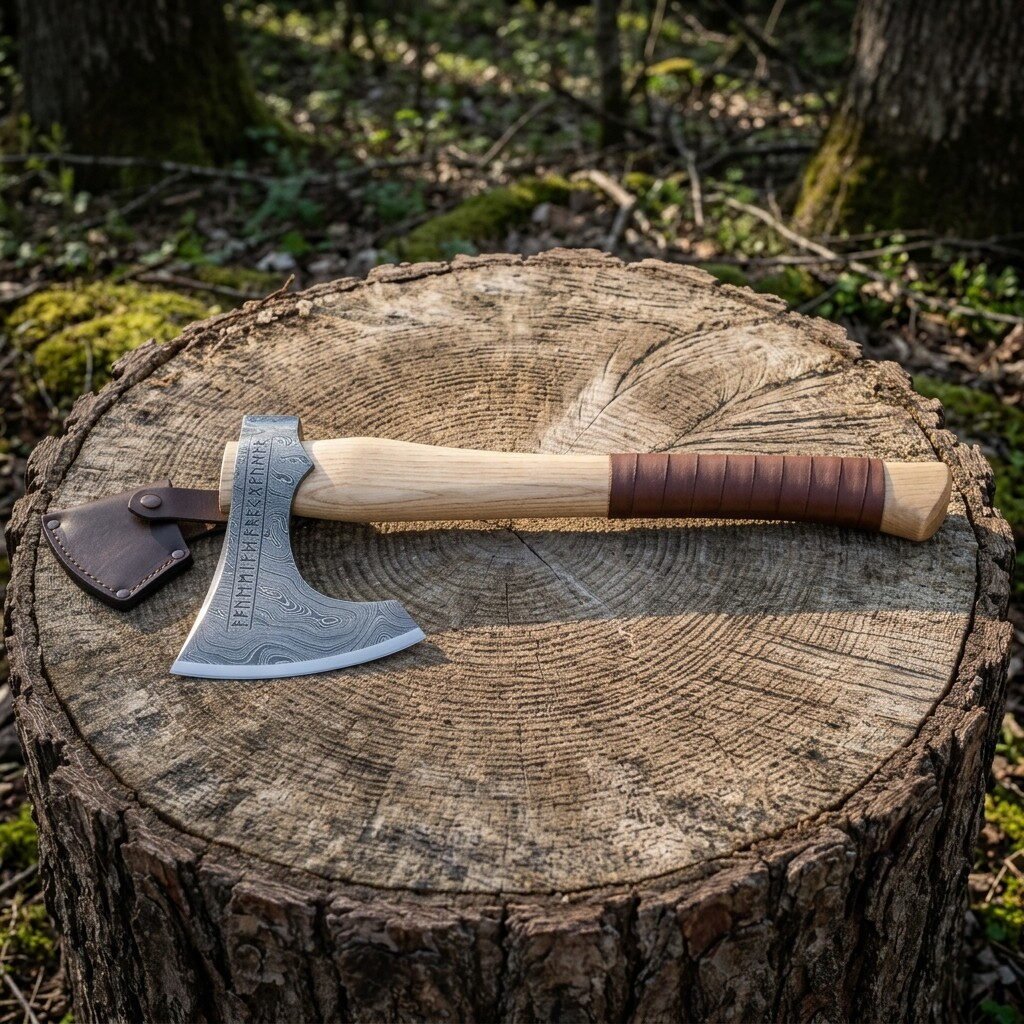
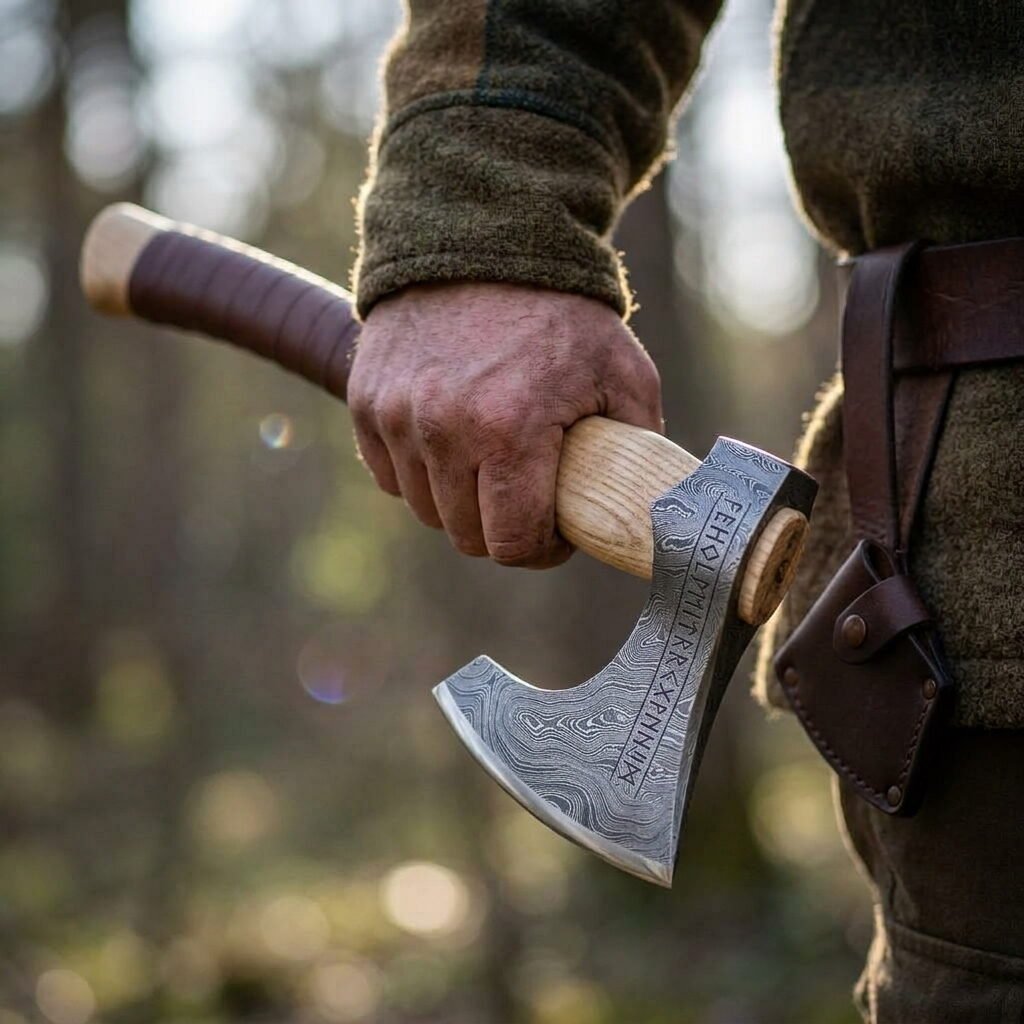
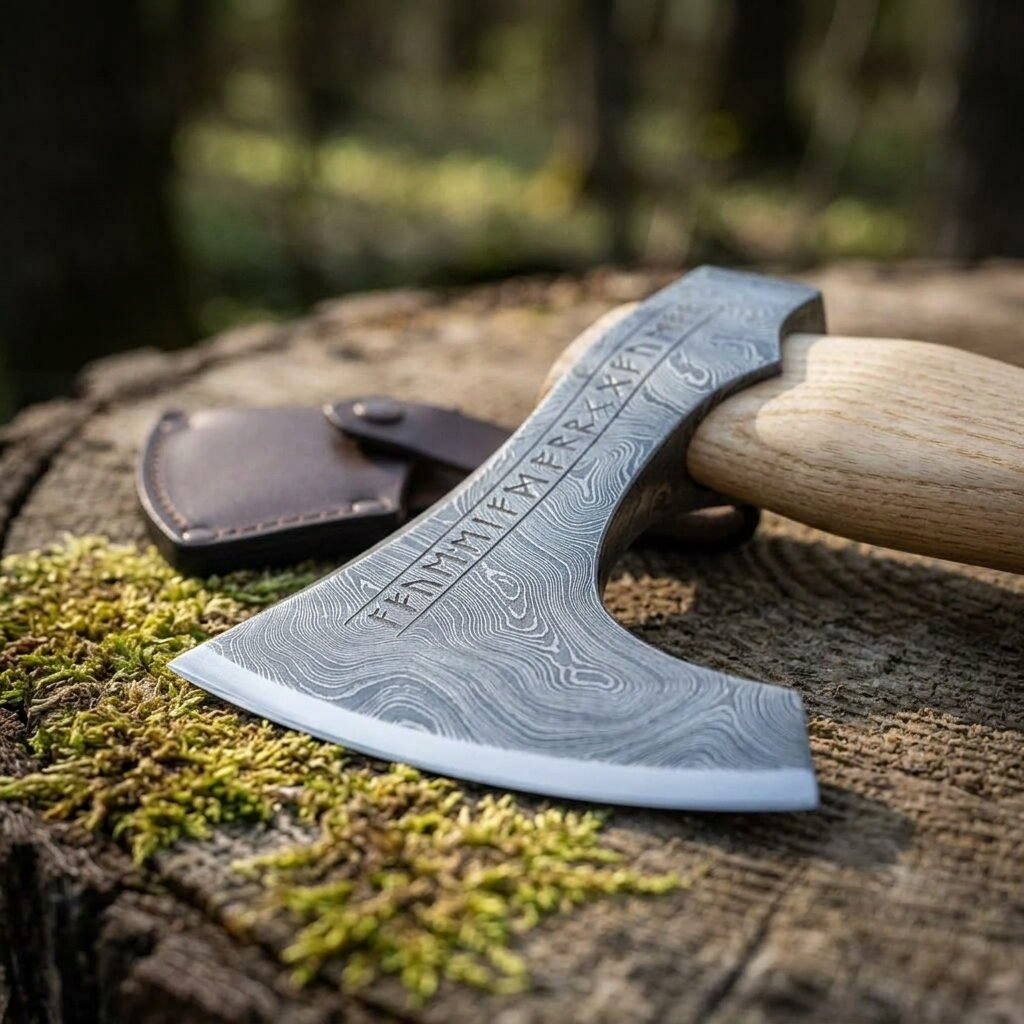
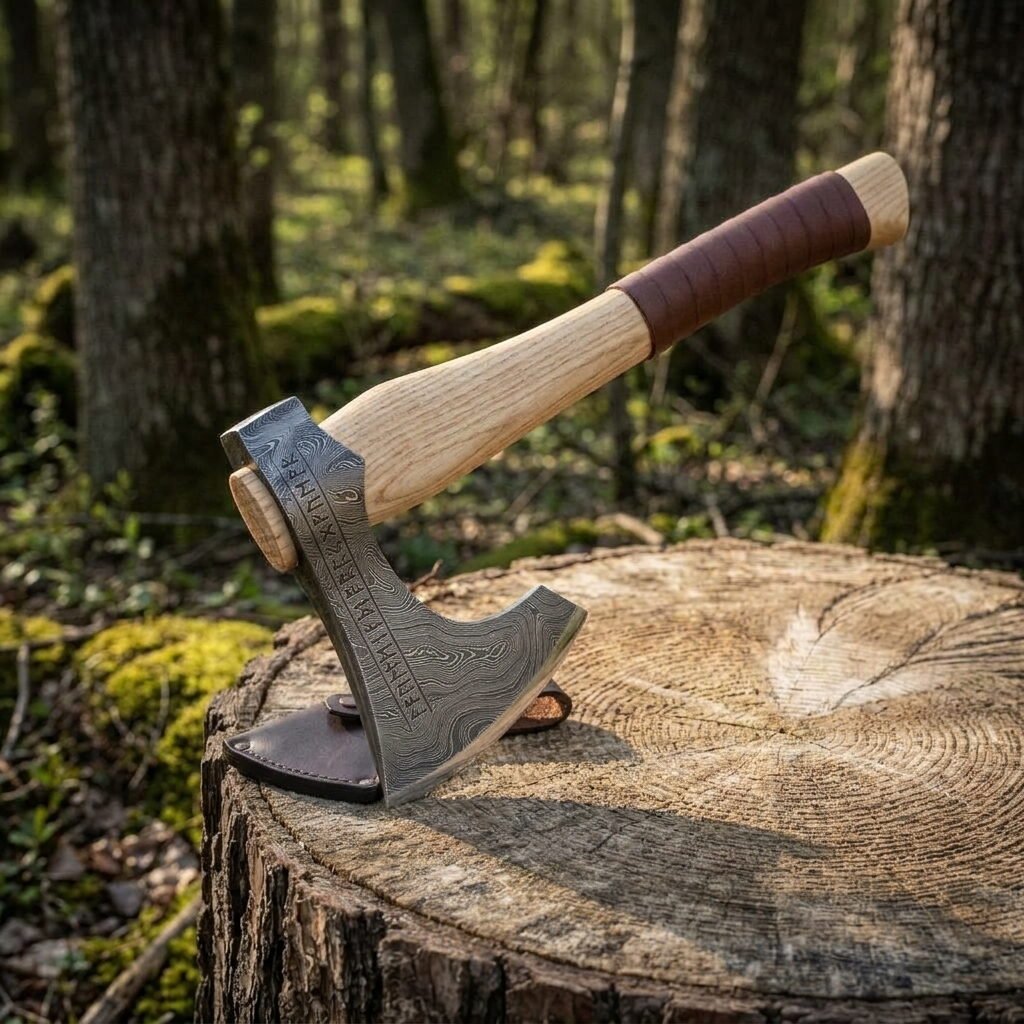
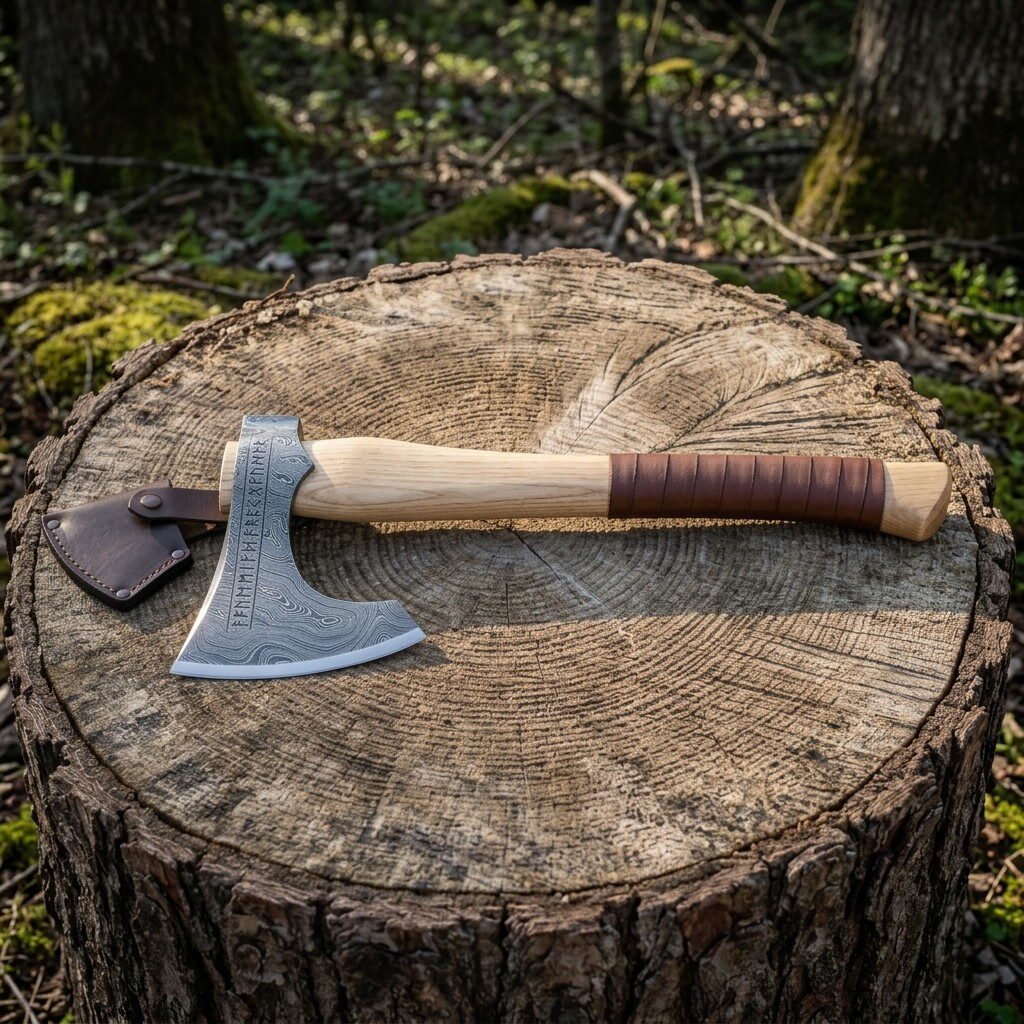
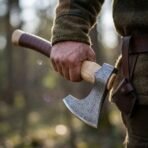
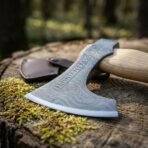
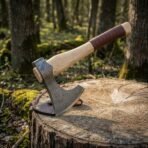
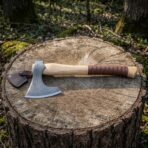
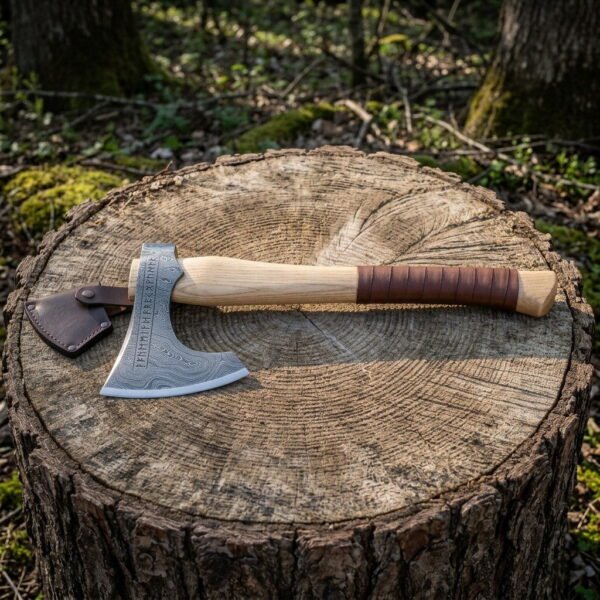
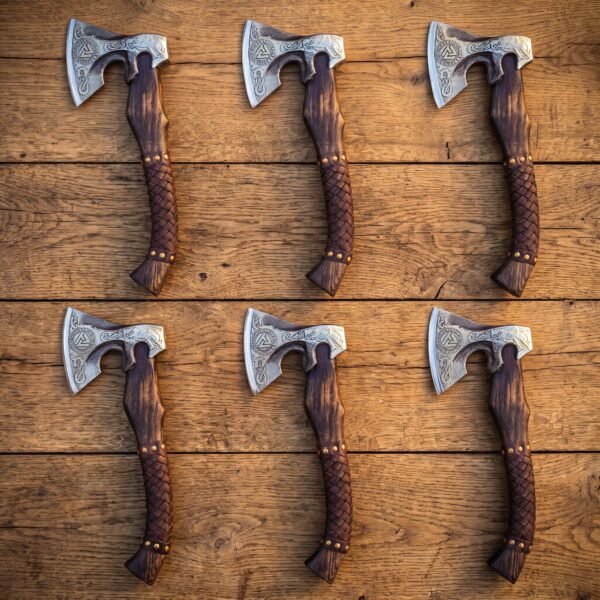
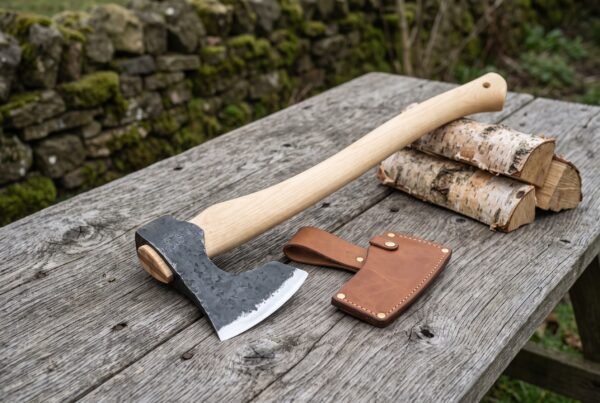
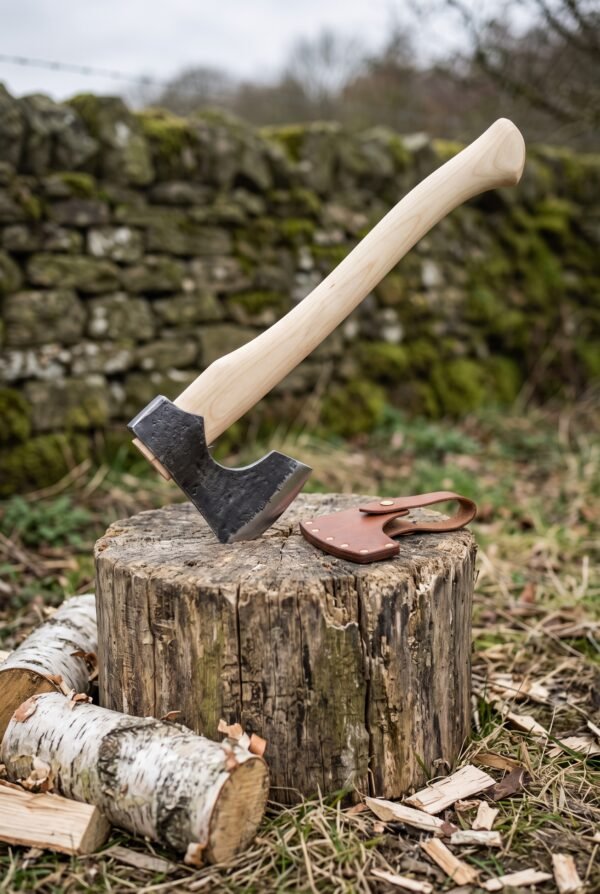
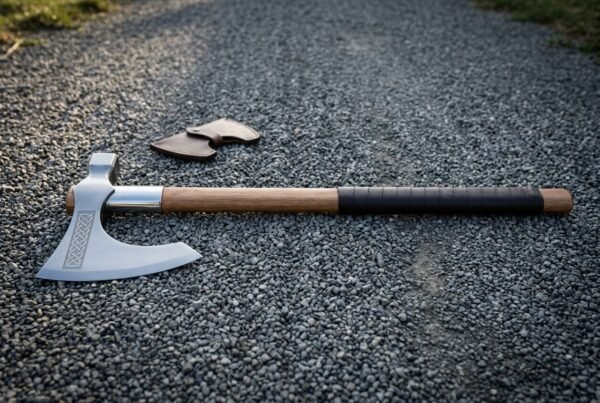
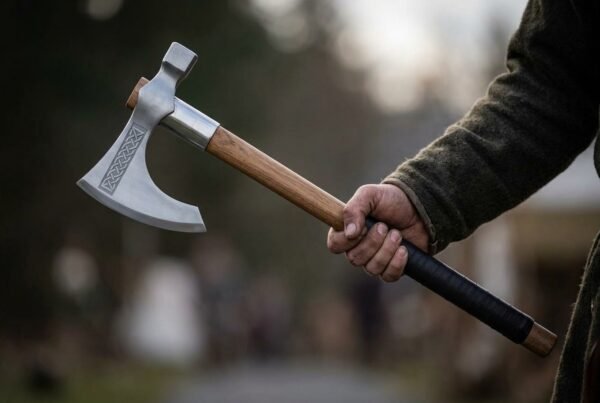
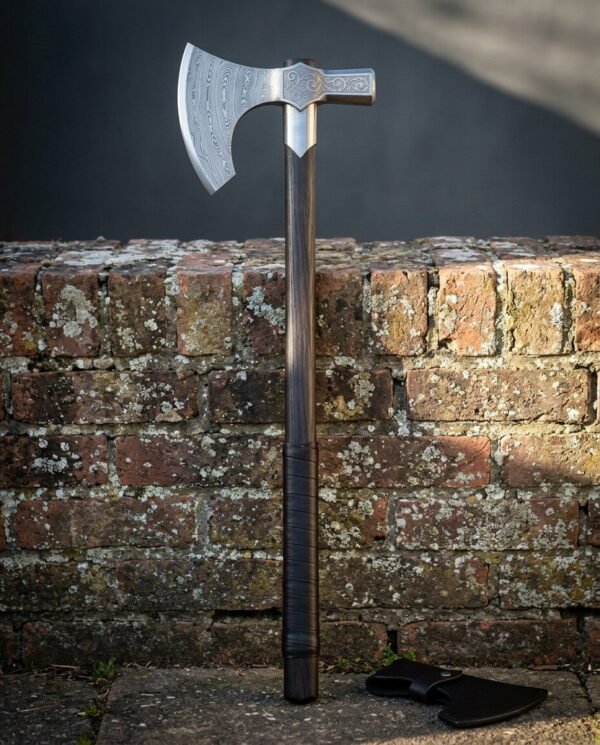
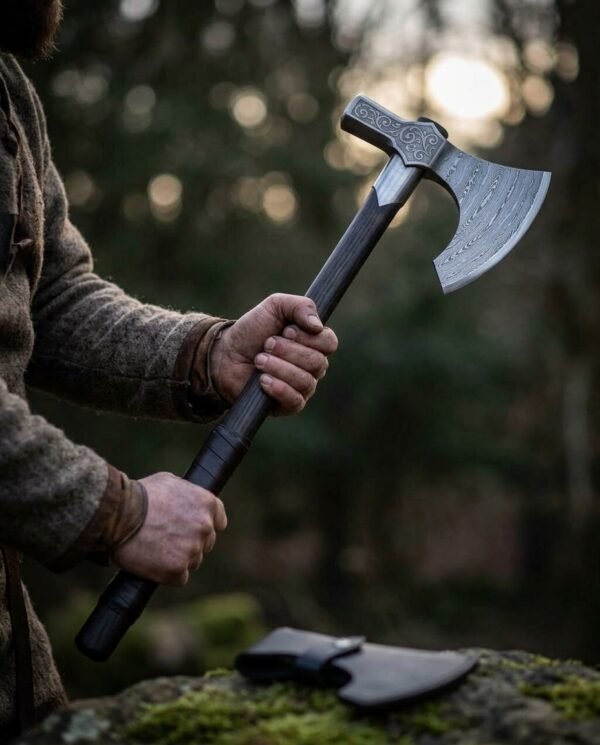
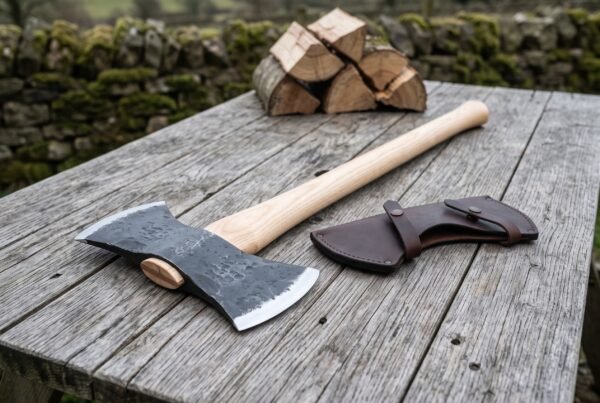
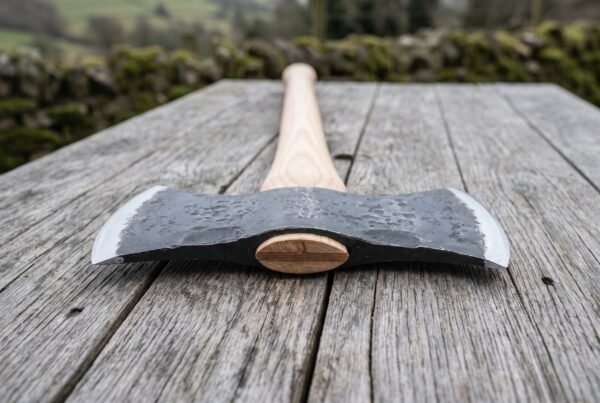
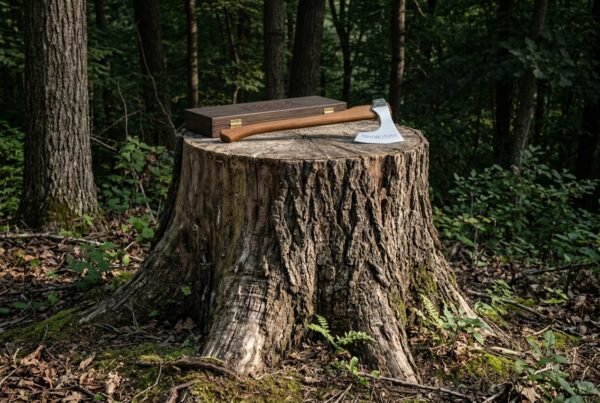
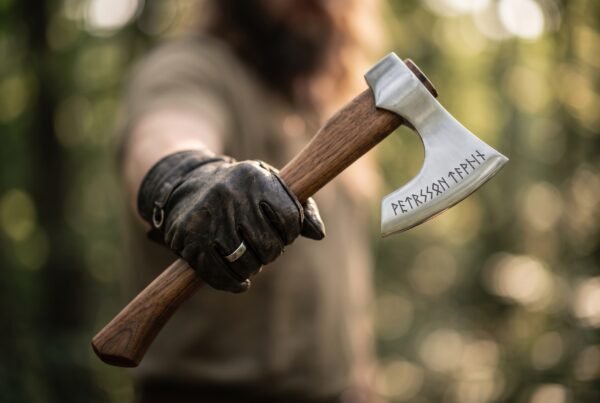
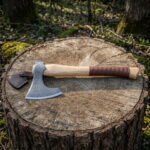
The Whorlbeard is a bearded axe with a pattern welded head. The Damascus runs in tight whorls and rings across both cheeks, a channel of Elder Futhark runes follows the outline of the beard, and the whole thing is hung on a pale ash haft with a brown leather wrap at the grip. A leather cover for the edge comes with it.
Pattern welding started as a solution to a supply problem rather than as a way to make something look good. In early medieval Europe the smelting technology of the day produced bloom iron that came out of the furnace in inconsistent lumps, some of it soft and low in carbon, some of it hard and brittle. Nobody could make a large uniform piece of good steel. So smiths stacked what they had, hot forged the layers together, drew the billet out, folded it, twisted it and welded it again, until the good and the bad were spread evenly through the bar. The pattern was a side effect. Once the technology improved and homogeneous steel became cheap, pattern welding survived purely because people liked looking at it, which is why it is still here a thousand years later. Ours is forged, twisted, ground and etched by hand in the Czech Republic. Filed under the bearded axes, and the Viking axes are the other half of that shelf.
Specifications
| Head material | 1095 and 15N20 pattern welded Damascus, hardened to 58 to 60 HRC |
|---|
| Pattern | Twisted whorl and ring figure across both cheeks, hand etched |
|---|
| Head pattern | Bearded, with a swept lower edge and a narrow eye |
|---|
| Cutting edge | Approximately 4.5 inches along the curve |
|---|
| Overall length | Approximately 16 inches |
|---|
| Haft | Pale ash, unstained, with a brown leather wrap over the lower grip toward the butt |
|---|
| Decoration | Recessed channel of Elder Futhark runes following the outline of the head |
|---|
| Edge cover | Dark brown leather edge cover with a snap strap |
|---|
| Included | Axe and fitted leather edge cover |
|---|
| SKU | RK-1835 |
|---|
How the pattern in the steel is made
The billet starts as a stack of alternating layers of two steels. 1095 is a plain high carbon steel. 15N20 is essentially the same carbon content with about two percent nickel added, and the nickel is the whole trick. Both steels harden. Both hold an edge. But when the finished blade goes into a mild acid, the nickel bearing layers resist the etch and stay bright while the plain carbon layers darken. What you are looking at is not two colours of metal. It is one metal in two states of corrosion, arrested at the moment it looked best.
The whorls and rings on this head come from twisting. A drawn out bar is heated, clamped and turned along its axis, which spirals the layers into a helix. Grind the outside of that helix flat and you cut across the spiral, and the layers surface as concentric rings and teardrops. The figure you see is a cross section through a twist, which is why it can never be repeated exactly and why the two cheeks of the same axe never match.
The edge itself is a plain hardened bevel. The pattern runs right into it, but the working edge is heat treated as a whole and takes the same care as any high carbon axe. Because both constituent steels are high carbon, there is no soft layer running into the edge and no weak line for a chip to start along.
The runes and the haft
The rune channel is cut as a recessed border that follows the profile of the head rather than sitting in a straight line, which is a deliberately Norse way of laying out an inscription. Runic text on real objects wraps around whatever shape it is on, runs backwards when it needs to and turns corners without apology, because the carver was fitting words to an object rather than laying out a page.
The haft is ash. Ash is the traditional wood for a tool handle in northern Europe for a very practical reason: it is ring porous with long straight fibres, which makes it stiff along the grain and unusually good at absorbing shock without splitting. It is also the wood of Yggdrasil in the Norse cosmology, which is a coincidence that the marketing side of us is happy about. Left pale and unstained here so the grain shows, with a leather wrap where your hand sits.
Engraving, runes and your own design
Use the rune converter on this page to turn a name, a date or a short phrase into Elder Futhark and we will cut it into the steel, the leather or the wood. If you would rather have a Viking pattern than a rune line, choose your own design in the engraving option above the add to cart button and tell us where it goes. Where a piece already carries an engraved design, your chosen engraving replaces it rather than sitting alongside it. On this axe the existing rune border is the design, so your text takes its place around the head, and the engraving page shows how a cut reads against an etched Damascus ground.
Handling and balance
Sixteen inches is a short one handed haft, the size of a camp and carving axe. Held at the end it reaches far enough to split kindling, and the head comes round quickly. Choked up under the beard it becomes a carving tool, and the gap behind the beard is what makes that grip possible at all.
The head is compact and the weight is well forward, which is normal for an axe and is what does the cutting. What is slightly different about a pattern welded head is that the etched surface is not glass smooth, so it releases from green wood a little more readily than a mirror polish does. That is a small thing, but you notice it splitting wet rounds.
Care
Damascus needs more attention than plain steel, not less. The etch that makes the pattern visible is a controlled surface corrosion, and rust is uncontrolled surface corrosion, so the two look alike at the start. Wipe the head dry after every use and put a thin film of oil over it. Do not leave a wet head inside the leather cover. If the pattern starts to look flat and grey, a light going over with fine abrasive and a re-etch brings it straight back, and we will do that for you if you would rather not. Sharpen along the bevel with a stone or a puck and never on a powered grinder. Feed the leather wrap and the cover with a neutral conditioner once or twice a year, and oil the ash haft with boiled linseed when it looks dry. Our page on steel care goes through etching, oiling and rust removal properly.
Made in the Czech Republic
The work behind this piece happens in a Czech Republic workshop that has kept to the old methods. Steel is forged and heat treated by hand, the grind is taken down by eye rather than by machine, and the handle, fittings and sheath are cut and finished one at a time. Because of that, every piece carries small marks of the hand that made it.
Ransack Viking is a United States company. We import direct, check each piece when it reaches us, and ship from our Chicago, Illinois warehouse. Engraving is added here in the United States after arrival, so the piece you receive is finished to your order.
A note on handmade variation
This axe is hand made rather than machine made or bulk produced, so what arrives will not be a pixel for pixel copy of the photograph. That is truer of Damascus than of anything else in the range. The figure comes out of a twist and a grind, and no two grinds cut the helix at the same depth, so the rings and whorls on your axe will be its own. The etch strikes at its own contrast. Ash is a natural material and its grain and colour differ board to board. The leather takes its own tone. The edge length, the steels, the heat treat and the build are the same every time. The character is not. There is a longer piece on getting rust off an axe head, and another on the axe Ragnar carried on screen.
Frequently asked questions
Is the Damascus real or is it printed on
It is real pattern welded steel, forge welded from alternating layers of 1095 and 15N20 and etched to bring the layers up. It goes all the way through the head. Grind it and the pattern is still there underneath.
Is it sharp when it arrives
Yes, and it is built to be used. It arrives with a working edge that will split kindling and carve.
Will the pattern wear away
The pattern is structural so it cannot wear away, but the etch contrast fades with handling and polishing over years. Re-etching restores it.
Can I throw this axe
We would rather you did not. A pale ash haft with a leather wrap will not enjoy repeated overrotations onto a hard target. Use a dedicated throwing axe for that.
Can I have my own runes cut around the head
Yes. Your line replaces the border shown. About twenty characters fit comfortably around the profile of a head this size.
How long does it take to ship
One to two weeks of processing, then free shipping inside the United States. Add a few days for engraving.
What is in the box
- Whorlbeard bearded axe with a 1095 and 15N20 Damascus head
- Pale ash haft with a brown leather grip wrap
- Fitted leather edge cover
- Care card covering Damascus oiling, etching and sharpening
- Lifetime warranty against defects in forging, grind, heat treat and fittings
- Forged and finished in the Czech Republic
Explore the range
See the other bearded axes, the full Viking axe range, the Damascus blades, or read the guides for how a twisted billet is welded and etched.
If this one is not it
In the same category sits the Knotwarden bearded axe, pattern welded Damascus. A near match for this one is the Walnutskeg bearded axe, forged from 1095. Closest to this in the range is the Notchcrown bearded axe, forged from 1095.
Fitting out further, the Frostrune Dane axe belongs with it. Pick the steel, the length and the fittings yourself on the custom Viking axe page.


Got this as a gift and now I want one for myself too. Great buy overall.
Knew this axe was special the second I opened the box. Leather sheath is thick and well stitched. Not the cheap stuff you usually get. 10/10 would buy again.
Solid axe. Glad I ordered it. Blade quality is solid. Arrived a bit less sharp than expected but a few passes on a strop fixed it. Would buy from this shop again.