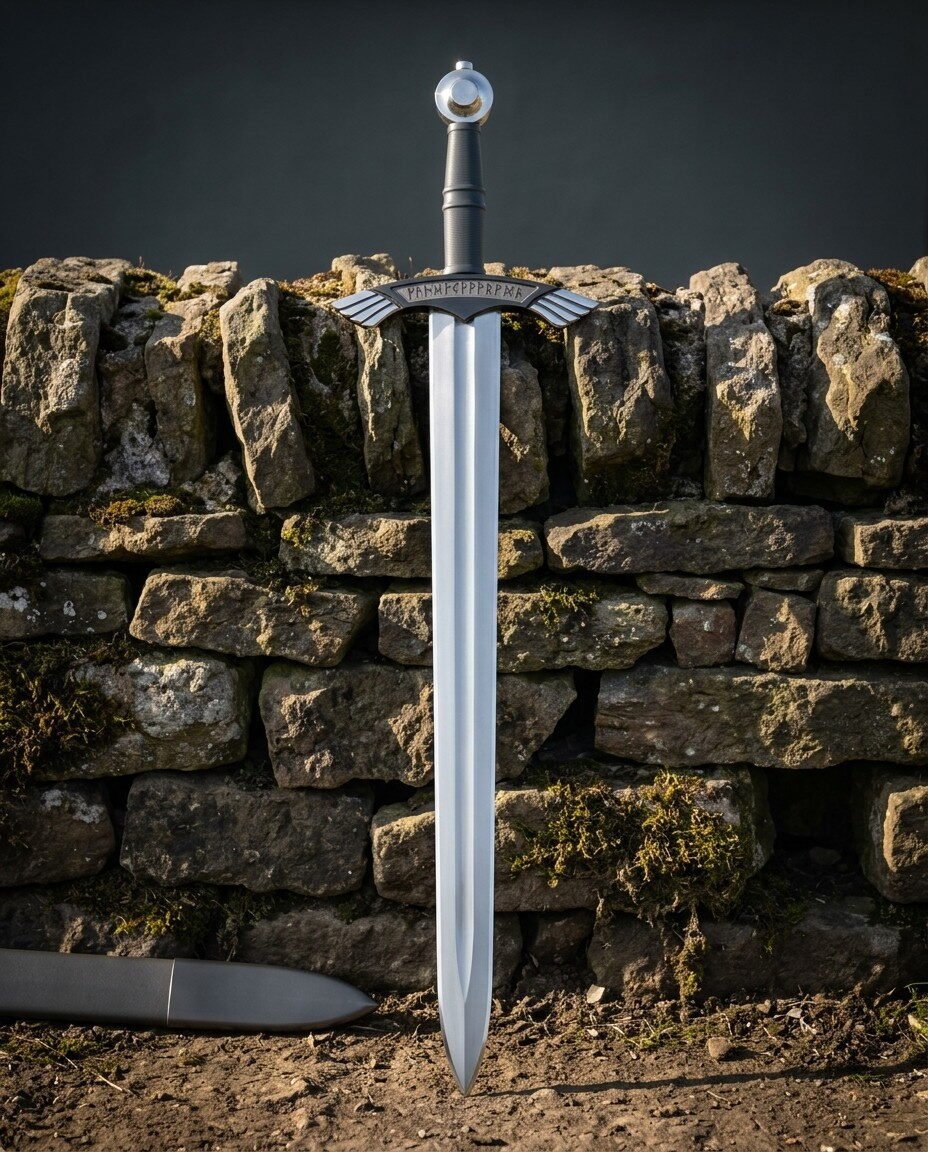
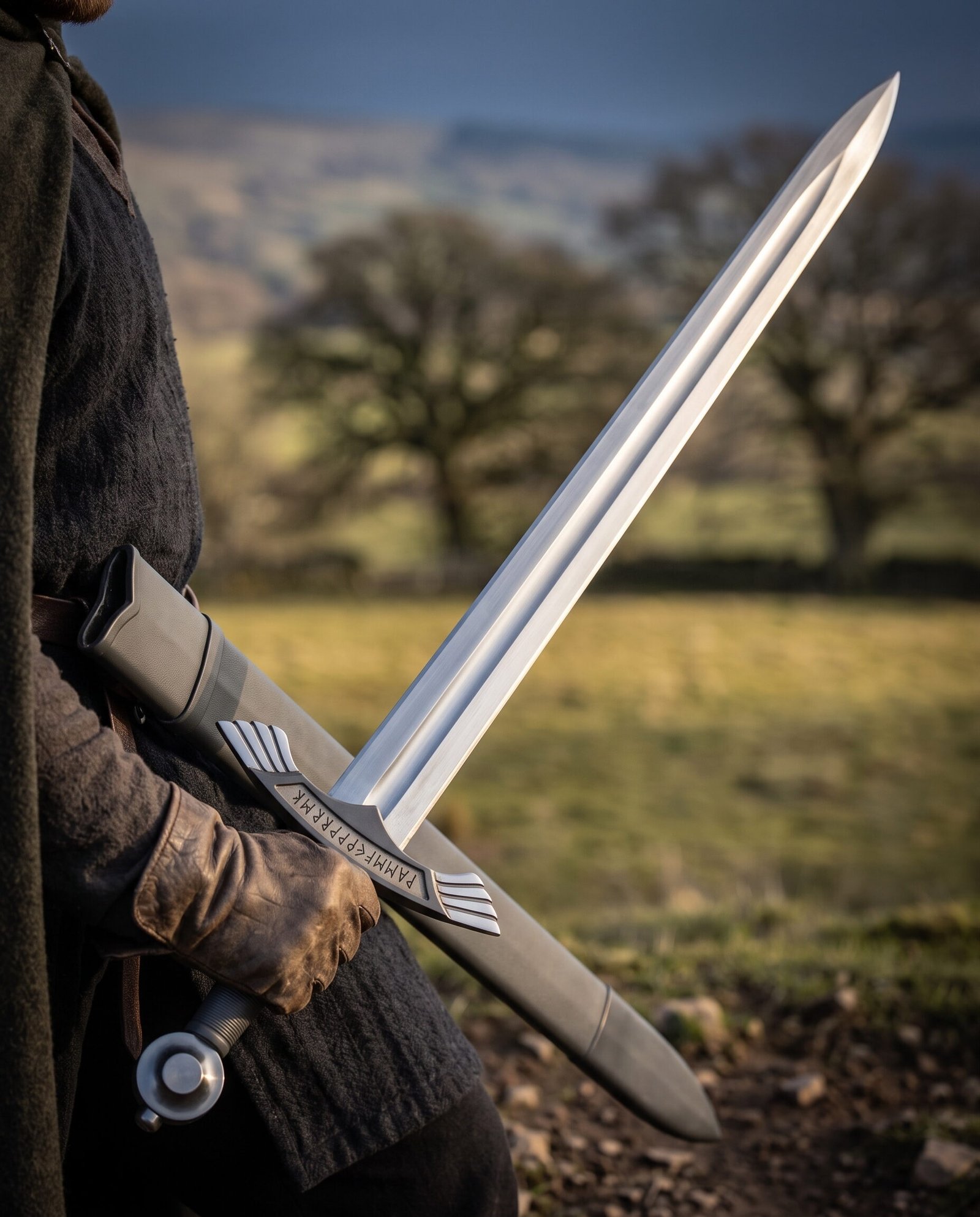
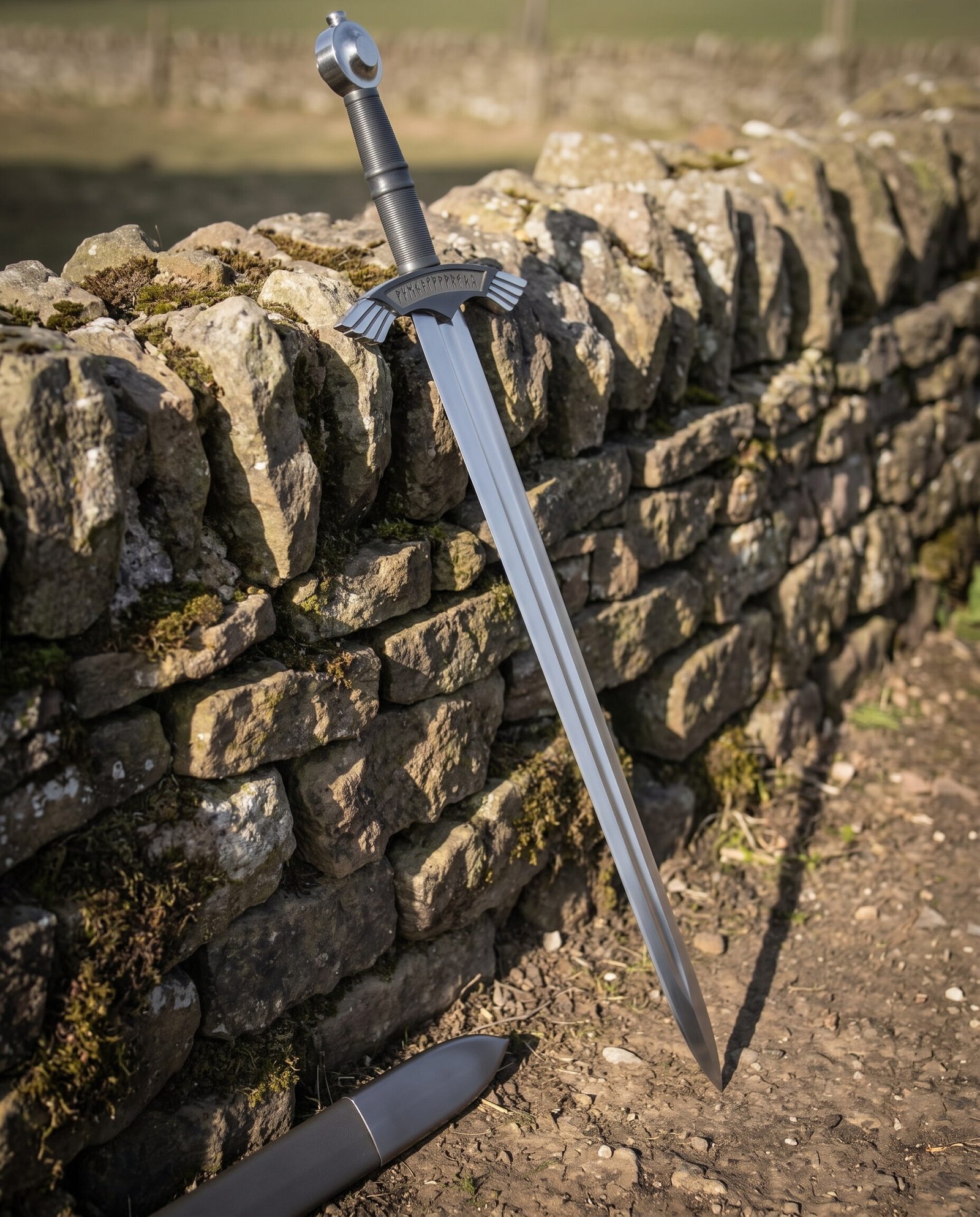
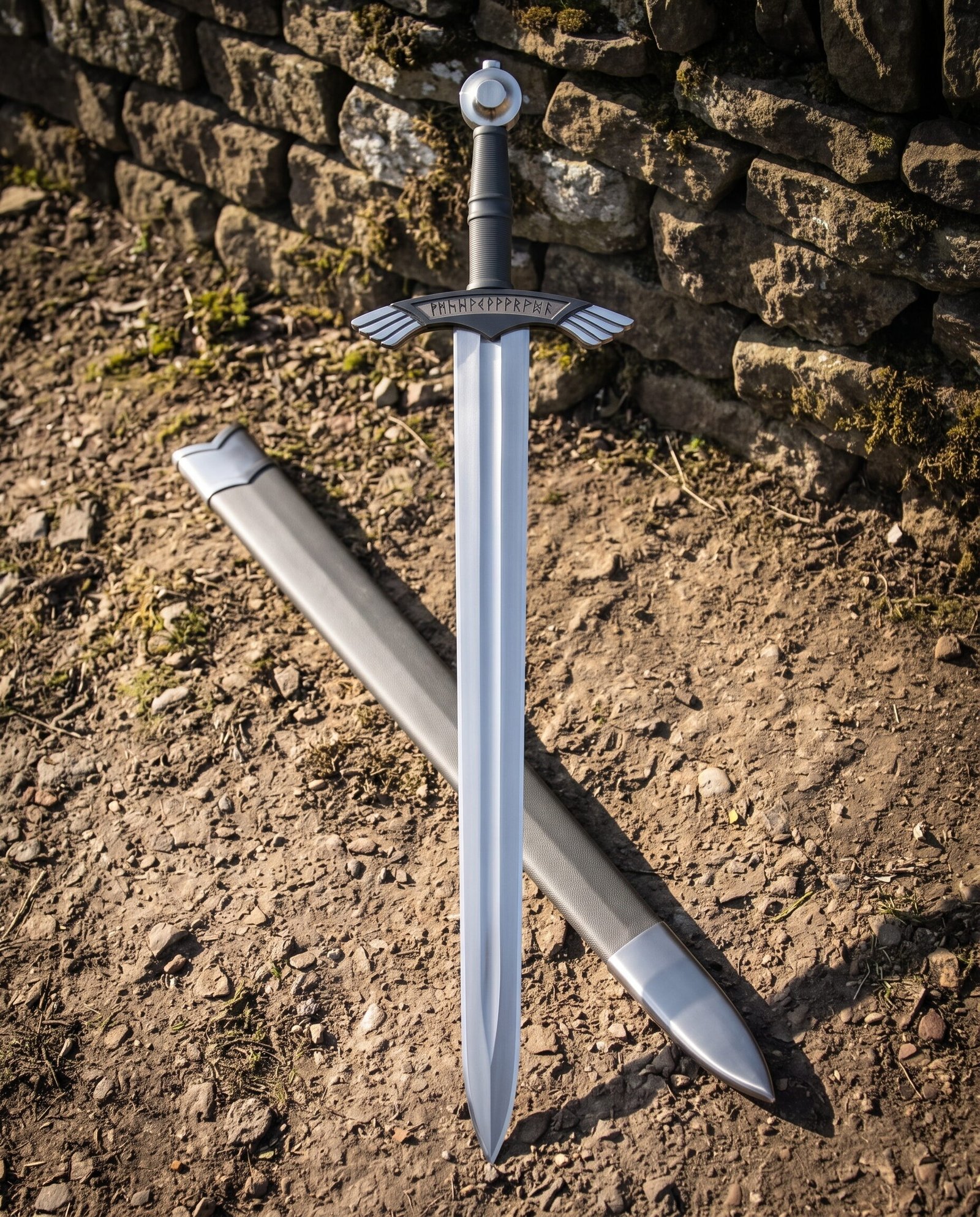
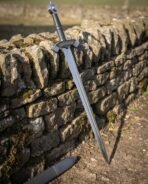
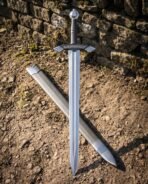
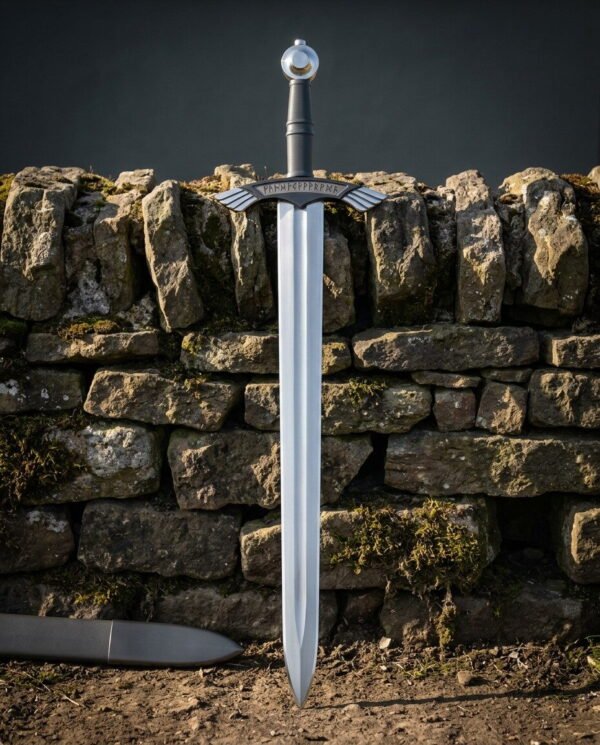
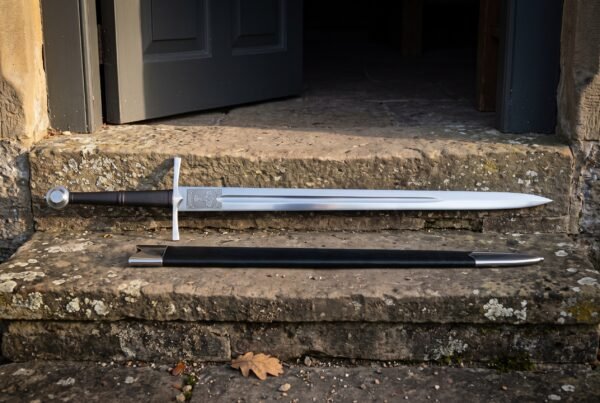
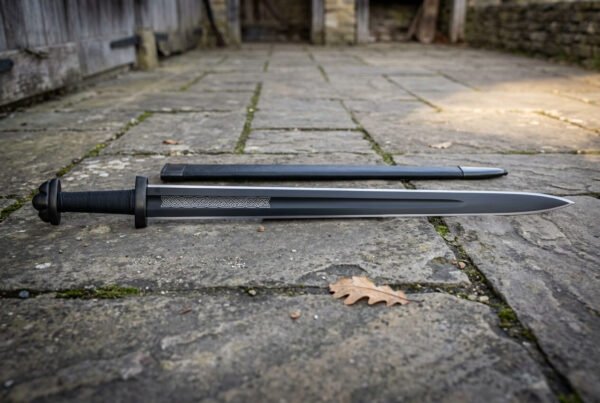
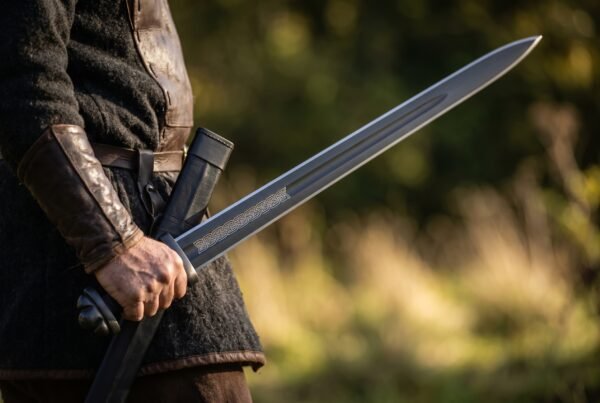
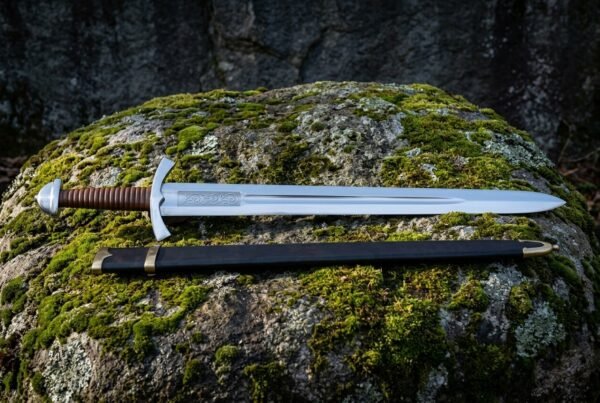
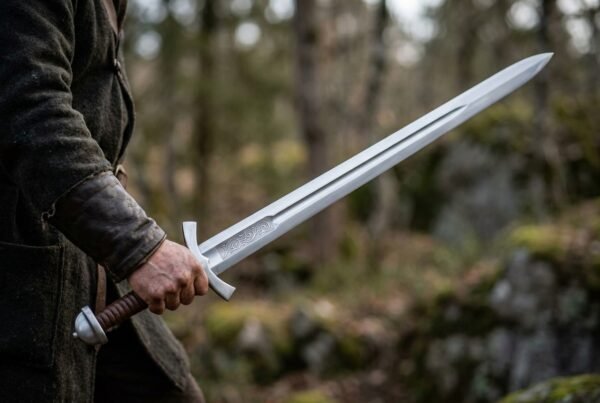
The Loopcrown is a Viking style sword with a polished steel wheel pommel, a round disc with a raised central boss. Below it sits a dark ribbed grip and a blackened downswept guard with a line of Elder Futhark runes cut across its face and polished, feathered tips. The blade is straight, double edged, fullered down the centre and finished in an acute point. It comes with a fitted grey scabbard with a steel throat and chape.
Wheel pommels came into wide use toward the end of the Viking age and stayed on European swords for centuries. The shape is simple to forge, it sits comfortably against the heel of the hand, and it puts a solid counterweight right where the balance needs it. Forged, ground, hardened and assembled by hand in the Czech Republic. It lands in the Viking swords, with the Norse arms close enough that people usually look at both.
Specifications
| Blade material | 1095 high carbon steel, hardened to 54 to 58 HRC |
|---|
| Blade type | Double edged and straight, with a central fuller and an acute point |
|---|
| Overall length | Approximately 31 inches |
|---|
| Blade length | Approximately 24 inches |
|---|
| Pommel | Polished steel wheel pommel with a raised central boss |
|---|
| Guard | Downswept blackened steel cross cut with a line of Elder Futhark runes, polished feathered tips |
|---|
| Grip | Dark ribbed grip with raised risers over a wooden core, single handed |
|---|
| Finish | Satin polished blade, blackened guard, polished pommel |
|---|
| Scabbard | Fitted dark grey scabbard with steel throat and chape |
|---|
| Included | Sword and fitted scabbard |
|---|
| SKU | RK-1834 |
|---|
Why the pommel is a wheel
The pommel of a sword is a counterweight. A solid steel wheel at the end of the grip pulls the balance back toward the hand, so the blade does not drag the point down and the sword recovers quickly after a cut. The raised boss in the centre adds a little mass where it does the most good and gives the peened tang a clean seat.
The steel, the runes and the blackening
The blade is 1095 high carbon steel taken to 54 to 58 HRC. For a long straight double edged blade that is the useful window: hard enough to hold an edge, soft enough to flex under a hard parry and come back straight instead of taking a permanent set or breaking.
The guard is blackened rather than polished bright, while the pommel and the feathered guard tips are left polished. Blackening on steel is an oxide layer rather than a coating, which is why it does not chip off the way paint does, and it has the practical benefit of being one more barrier between bare carbon steel and the air. It also gives the runes contrast without needing any inlay, because the cut faces catch light against the dark ground.
The runes on the guard are Elder Futhark, the older twenty four character alphabet used across Germanic Europe from roughly the second to the eighth century. By the Viking age proper most Scandinavians had moved to the shorter sixteen character Younger Futhark, but Elder Futhark is what almost everyone recognises now and it is what our converter works in.
Engraving, runes and your own design
Use the rune converter on this page to turn a name, a date or a short phrase into Elder Futhark and we will cut it into the steel, the leather or the wood. If you would rather have a Viking pattern than a rune line, choose your own design in the engraving option above the add to cart button and tell us where it goes. Where a piece already carries an engraved design, your chosen engraving replaces it rather than sitting alongside it. On this sword the guard is the obvious place, and the flat of the blade beside the fuller takes a longer line if you need more room. The engraving page shows both at size.
Handling and balance
Viking age swords are quicker in the hand than their reputation suggests. The mass is spread along a fairly parallel blade rather than piled into the last third the way it is on a later cutting sword, and a heavy pommel at the back pulls the balance point in close, usually four to five inches ahead of the guard. The result is a sword that turns fast and recovers fast, which is exactly what you want when your other hand is holding a shield and you are working over its rim.
The point is acute rather than rounded, so this sword thrusts as well as it cuts. It is still balanced first for cutting, which is what a one handed sword used with a shield spends most of its time doing.
Care
Oil the blade. 1095 will rust and a long blade gives it plenty of room to start. Wipe the whole length down after handling, because the acid in a fingerprint is what etches the first mark. Blackened furniture wants the same light oiling as the blade, and it should not be scrubbed with abrasives or the black comes off in patches. Do not store the sword in the scabbard for months in a humid room. Take it out, wipe it, oil it, put it back. Sharpen with a stone along the existing bevel and keep the angle consistent from ricasso to point. Our full page on steel care covers oiling, storage and taking rust off without ruining a finish.
Made in the Czech Republic
Every piece we sell is made by hand in the Czech Republic. The smiths there work the way the trade has been worked for a long time, heating and hammering the steel, taking the bevels down by eye, and fitting the handle and the leather one at a time. There is no automated line anywhere in it, so small differences from one piece to the next are normal and expected.
Ransack Viking is a United States company based in Chicago, Illinois. We bring the pieces in ourselves, inspect them on arrival and ship them from our own warehouse. If you add engraving, that is carried out here in the United States before your order goes out.
A note on handmade variation
This sword is hand made rather than machine made or bulk produced, so what arrives will not be a pixel for pixel copy of the photograph. The blackening on the guard and pommel takes unevenly by nature and no two come out at the same depth of colour. The wheel pommel is shaped and polished by hand and its boss will sit a fraction differently. The cord on the grip finds its own tension. The runes are cut individually and hold their own line. The dimensions, the steel, the heat treat and the build are the same every time. The character is not. For the detail behind that, see how to hang a blade on a wall, and why a full tang matters alongside it.
Frequently asked questions
Is the pommel solid
Yes. The wheel pommel is solid steel with a raised central boss, peened over the tang, so it cannot work loose.
Is it sharp out of the box
Yes. It arrives with a cutting edge. Ask in the order notes if you would rather have it blunt for display or reenactment.
Can I use it for reenactment combat
Not as it ships. Reenactment groups require blunt edges and a rebated tip, and this comes sharp. Ask for a blunt version if that is what you need.
Is the scabbard included
It is. The fitted scabbard in the photograph ships with the sword.
Can I put my own runes on the guard
Yes. The guard takes a short line of about a dozen characters. Longer phrases go on the blade beside the fuller instead.
How long does it take to arrive
Processing is one to two weeks, then free shipping inside the United States. Engraved swords take the longer end.
What is in the box
- Loopcrown Viking sword in 1095 high carbon steel with a wheel pommel
- Fitted scabbard
- Care card covering oiling, blackened finishes and storage
- Lifetime warranty against defects in forging, grind, heat treat and fittings
- Forged and finished in the Czech Republic
Explore the range
See the rest of the Viking swords, the arming swords, the wider Norse arms, or read the guides for how pommel weight changes the way a sword handles.
Others in the same line
If this one is not quite right, there is the Cairnbrand Viking sword, 36 inches overall. Also in this group is the Sableknot Viking sword, 37 inches overall. Sitting beside it in the catalogue is the Duskfuller Viking sword, 36 inches overall.
From the same corner of the shop, there is the Knotbriar arming sword. You can have this made your way instead on the custom Viking sword page.

Been eyeing this sword for months and it did not disappoint. 1095 Steel blade holds a razor edge right out of the box. This shop clearly takes pride in their work.