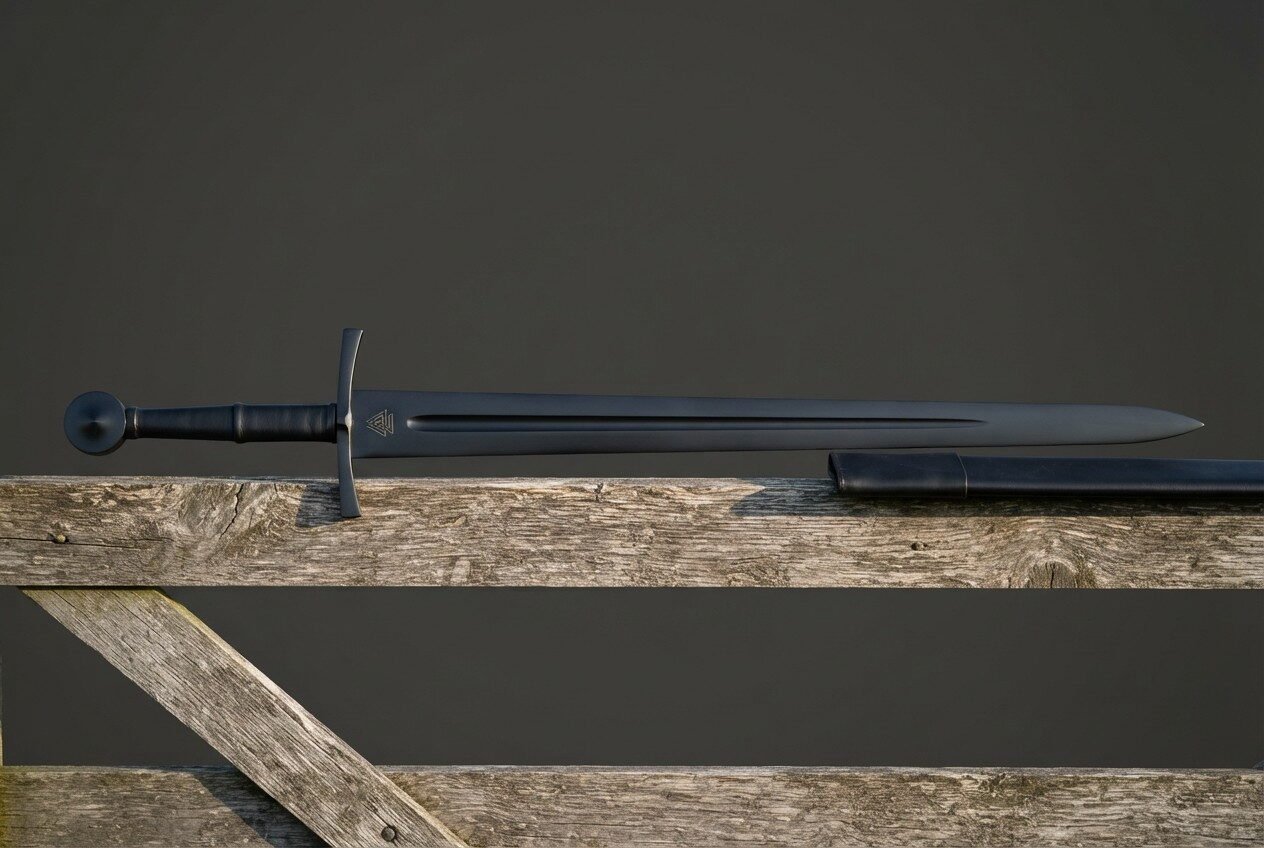
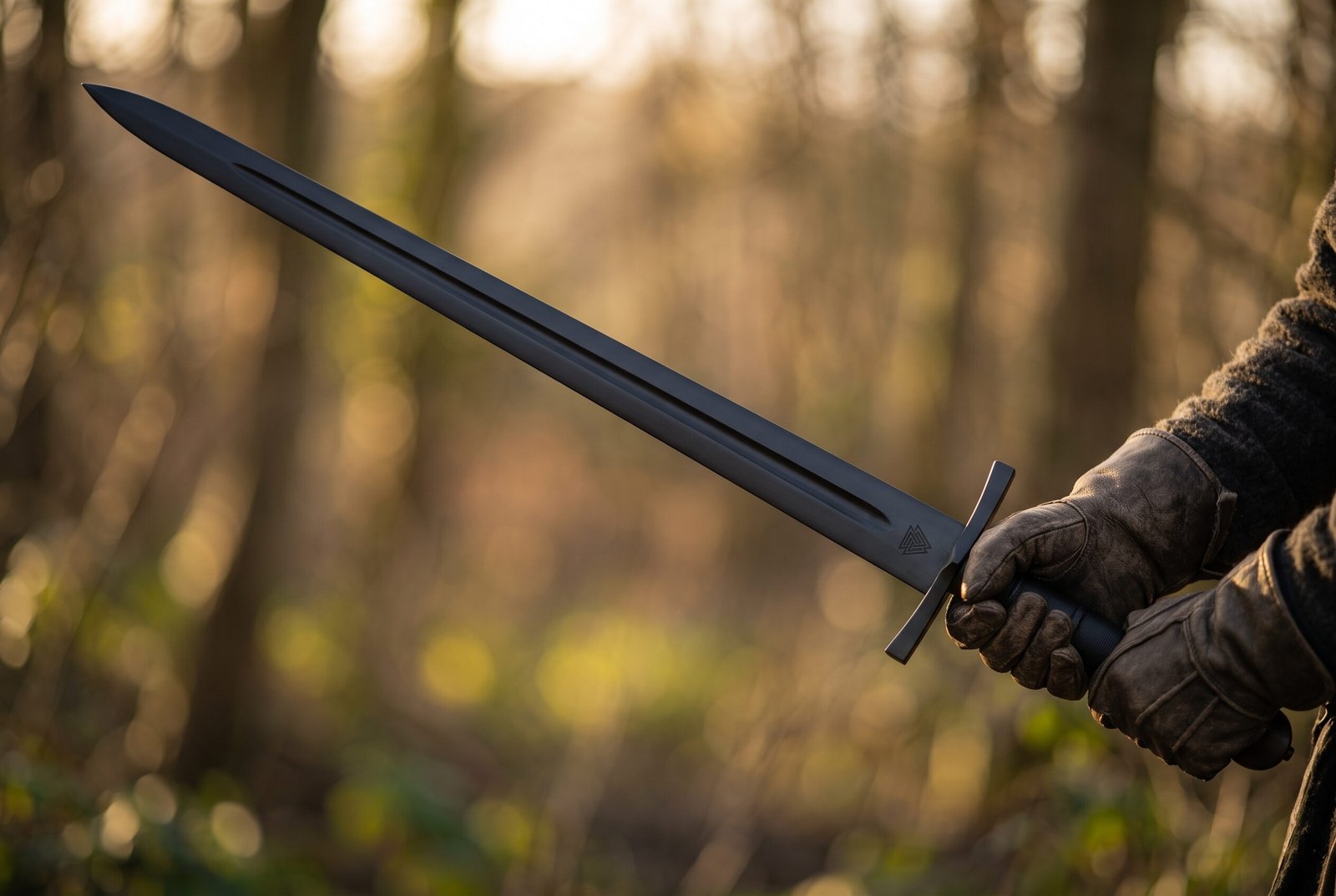
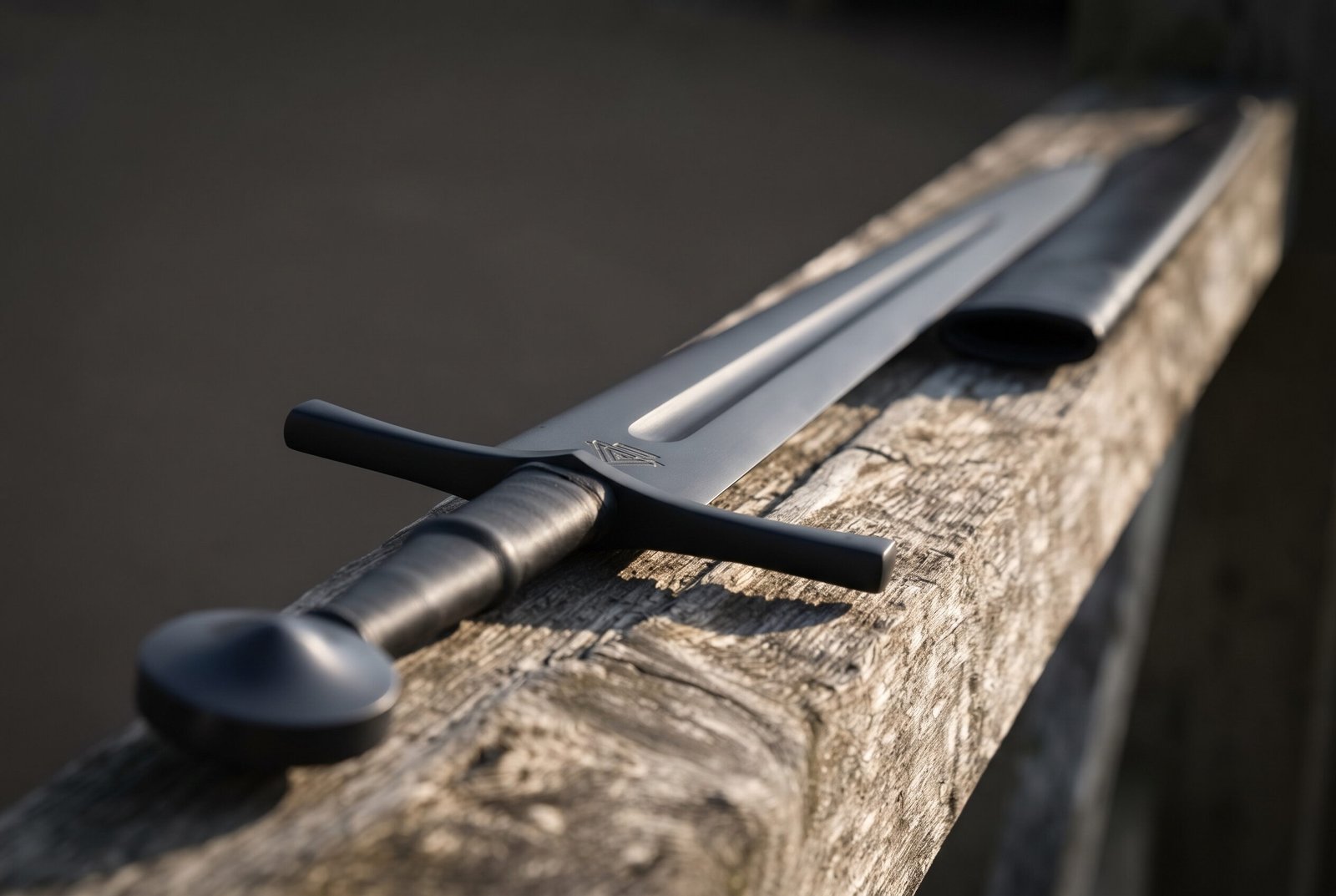
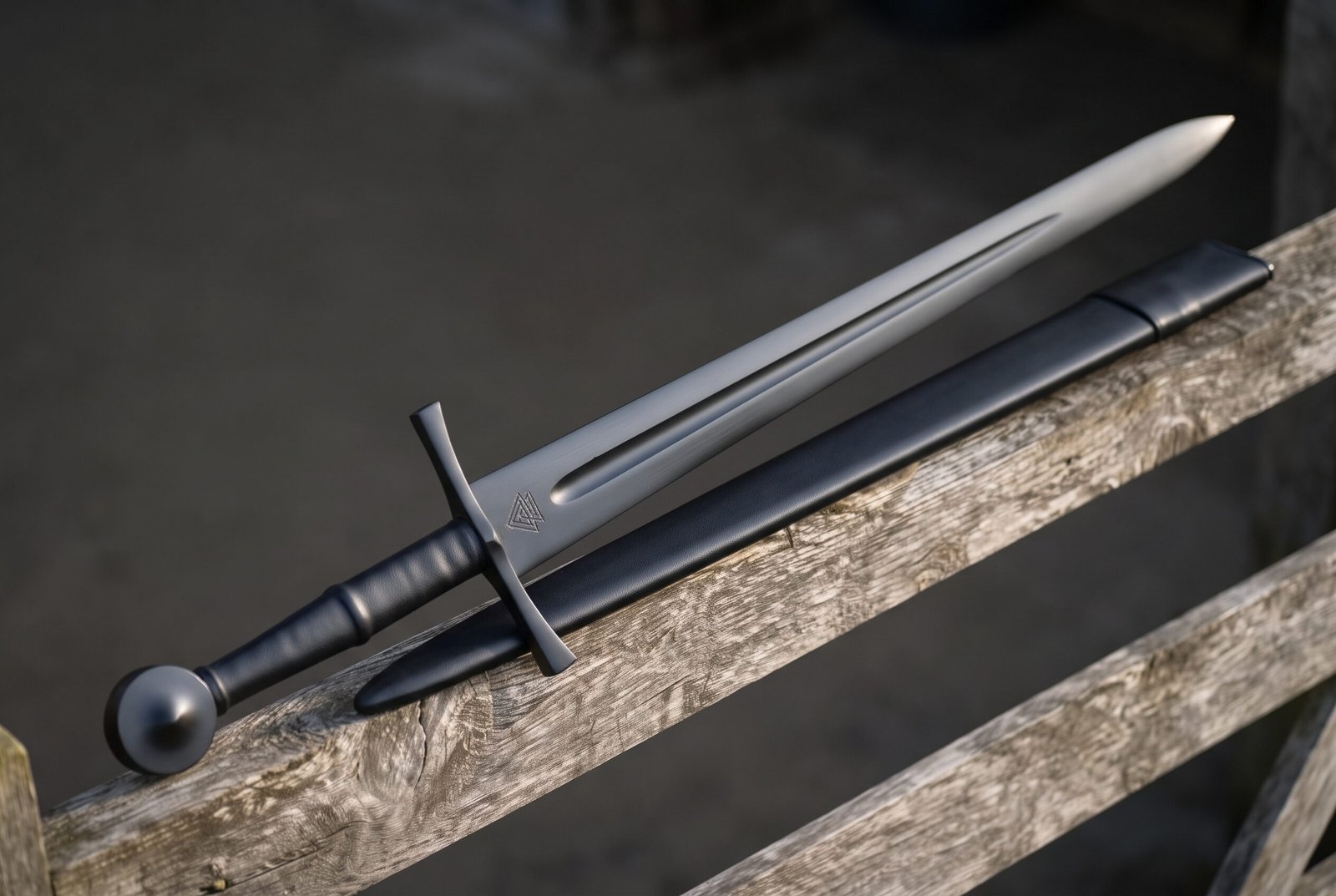
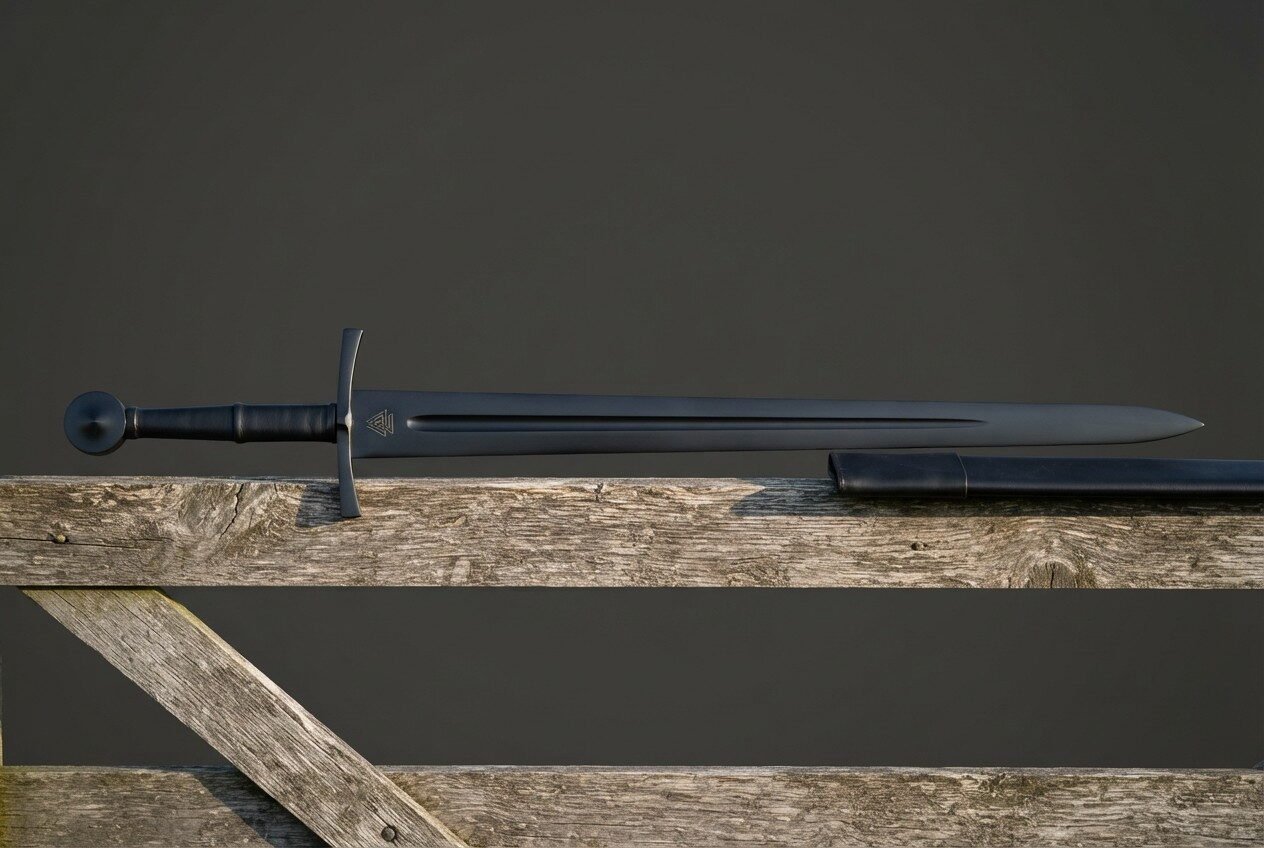
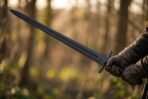
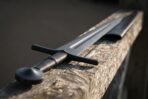
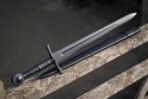
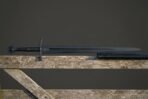
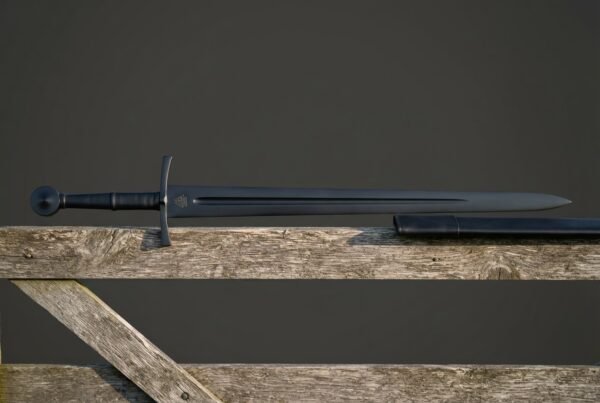
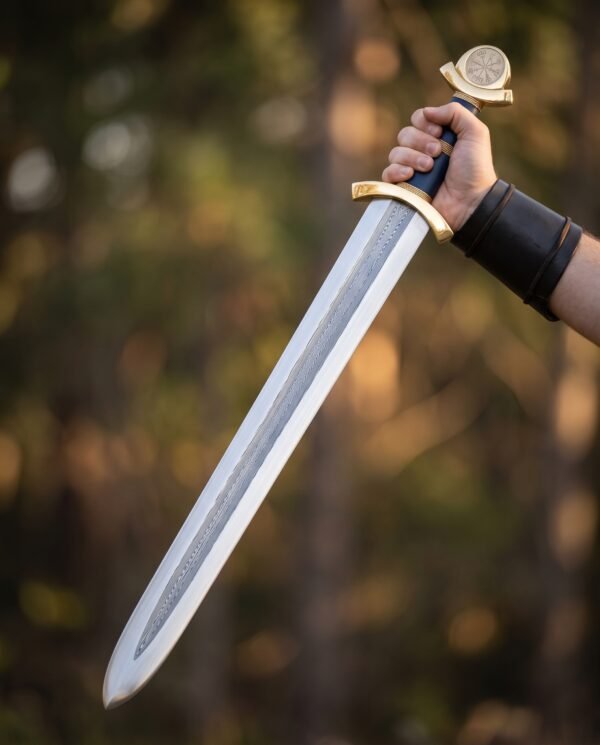
The Sableknot is a Viking style sword finished dark from end to end. The blade, the straight cross and the wheel pommel are all blackened, the grip is a black leather wrap divided by raised rings, and a Valknut is cut into the flat of the blade just ahead of the guard where it catches light against the dark ground. It ships with a black scabbard.
The Valknut is three triangles locked through one another, and it is one of the few genuinely Viking age symbols on the market that is actually Viking age. It appears on the Stora Hammars picture stones on Gotland, on the Tangelgarda stone, on a bedpost from the Oseberg ship burial and on a ring from the River Nene in England. What is striking is the company it keeps. Nearly every surviving example sits in a scene involving death, a sacrifice, a hanging or a ship burial, and very often a figure who is being read as Odin. Nobody in the period wrote down what it meant, and the name itself is modern, coined in Norwegian from the words for the slain and a knot. It is a symbol we can see clearly and cannot read, which is a rare and honest position to be in. We cut it into this blade because it belongs where a sword is, not because we can tell you what it does. Forged, ground, hardened, blackened and assembled by hand in the Czech Republic. It lands in the Viking swords, with the Damascus swords close enough that people usually look at both.
Specifications
| Blade material | 1095 high carbon steel, hardened to 54 to 58 HRC |
|---|
| Blade finish | Blackened throughout, with a central fuller and a Valknut cut at the ricasso |
|---|
| Blade type | Double edged and straight, tapering evenly to a point |
|---|
| Overall length | Approximately 37 inches |
|---|
| Blade length | Approximately 30 inches |
|---|
| Guard | Blackened straight cross with slightly flared tips |
|---|
| Grip | Black leather wrap over a wooden core, divided by raised rings |
|---|
| Pommel | Blackened wheel pommel |
|---|
| Scabbard | Black scabbard fitted to the blade |
|---|
| Included | Sword and scabbard |
|---|
| SKU | RK-1846 |
|---|
Reading a Valknut, and why the three forms matter
There are two distinct ways the figure is drawn on the surviving objects and the difference is worth knowing before you buy one. The unicursal form, the one on the Oseberg bedpost, is drawn as a single continuous line that crosses itself and returns, in the same family as the Borromean rings. The tricursal form, the one on the Stora Hammars stone and the one used here, is three separate closed triangles genuinely interlocked, so that no one of them can be lifted away from the other two without breaking something.
That second property is why the symbol is compelling on an object like this. Three separate things, none of which is joined to any other, and none of which can be separated. Whether anyone in the ninth century thought about it that way is unknowable. But the geometry is deliberate, it takes real care to draw correctly, and a very large number of modern versions get the over and under crossings wrong. Ours is drawn as a true tricursal interlock with every crossing alternating, which is the same rule that governs Norse knotwork generally.
It is cut at the ricasso rather than out on the blade, which is the strongest and widest part of the steel, protected between the guard and the start of the fuller, and the one place a mark will never be touched by a sharpening stone.
The steel and the blackening
The blade is 1095 high carbon steel run at 54 to 58 HRC. On a long double edged blade that is where you want it: a sword has to flex under a bad parry and come back straight, and anything taken toward knife hardness risks breaking instead of bending.
Blackening the whole sword rather than just the furniture is an unusual choice and it changes what the piece is for. A bright blade throws light and reads as a sword across a room. A blackened one absorbs it and reads as a shape. The finish is an oxide layer grown into the surface, magnetite rather than red rust, tightly bonded and not a coating, so it will not chip or peel. It gives a small amount of corrosion resistance, mostly because the porous oxide holds oil, but it is not a substitute for oiling and anyone who treats it as one will find red freckles coming through the black within a season.
The Valknut is cut through the blackening into bright steel, which is what gives it its contrast. There is no inlay and no filler. The mark is a recess and the light in it is the steel underneath.
Engraving, runes and your own design
Use the rune converter on this page to turn a name, a date or a short phrase into Elder Futhark and we will cut it into the steel, the leather or the wood. If you would rather have a Viking pattern than a rune line, choose your own design in the engraving option above the add to cart button and tell us where it goes. Where a piece already carries an engraved design, your chosen engraving replaces it rather than sitting alongside it, so on this sword your mark or rune line takes the place of the Valknut at the ricasso. A cut into a blackened blade comes out bright and is the most legible engraving we do. The engraving page shows exactly that contrast.
Handling and balance
Balance sits four to five inches ahead of the cross, which is normal for a broad early medieval blade and is what gives the sword its authority in the cut. The wheel pommel is the counterweight and its mass is chosen to put the balance where it is; a lighter one would leave the point dragging.
The raised rings in the grip do something specific. They divide the wrap into sections so your hand knows where it is by feel rather than by looking, and they stop the hand creeping forward toward the guard under load. On a single handed sword that only becomes noticeable when you are tired, which is exactly when it matters.
The blade tapers evenly to a defined point, so the sword thrusts as readily as it cuts.
Care
Oil the blade and wipe it down after handling, over the blackening as much as anywhere else. Do not use abrasive metal polish anywhere on this sword, because it cuts straight through the oxide and leaves bright patches that cannot be blended back in. A soft cloth and a light oil is the entire routine and it is all the finish needs. Feed the leather on the grip with a neutral conditioner once or twice a year. Do not leave the sword in its scabbard for months in a damp room. Sharpen along the existing bevel with a stone, keeping it off the flats. Our page on steel care covers oiling, looking after a dark finish and dealing with early rust.
Made in the Czech Republic
This is a handmade piece from the Czech Republic, made in a workshop that still forges, grinds and finishes by hand instead of stamping parts out. The smiths there have kept the older way of working, and the wood, horn and leather are shaped and fitted by hand as well. Two pieces of the same design will never be identical, and that is part of what you are buying.
Ransack Viking is a United States company. We handle the import ourselves, look over every piece when it lands and ship from our warehouse in Chicago, Illinois. Engraving is done in the United States after the piece arrives, so your design goes on before we send it out.
A note on handmade variation
This sword is hand made rather than machine made or bulk produced, so what arrives will not be a pixel for pixel copy of the photograph. Blackening is the most variable part of it. Depth of colour depends on the surface, the temperature and the time, so one blade reads as charcoal and another as near true black, and the same blade will look different in daylight and under a lamp. The Valknut is cut by hand and its crossings sit at their own depth. The leather wrap takes tension its own way. The length, the steel, the heat treat and the build are the same every time. The character is not. For the detail behind that, see how steel and hardness actually work, and the Ulfberht blades alongside it.
Frequently asked questions
Is the Valknut a genuine Viking symbol
Yes, unusually for this market. It is carved on the Gotland picture stones and on the Oseberg burial finds. What nobody knows is what it meant, since no one in the period wrote it down, and the word Valknut itself is modern.
Will the black finish wear off
It is an oxide grown into the steel rather than a coating, so it will not chip or flake. It can be abraded away with metal polish or a stone, which is why neither should go near the flats.
Is it sharp when it arrives
Yes, it comes with a cutting edge. Tell us in the order notes if you would rather have it blunt for display or reenactment.
Can I use it for full contact sparring
No. This is a sharp forged sword for cutting, collecting and display. Sparring requires a blunt with rolled edges and a rebated tip, which is a different build.
Can I replace the Valknut with something else
Yes. Your chosen mark or rune line takes its place rather than sitting beside it, and a cut into a blackened blade is the highest contrast engraving we do.
How long until it ships
One to two weeks of processing, then free shipping inside the United States. Engraved orders take a few days longer.
What is in the box
- Sableknot Viking sword in blackened 1095 high carbon steel with a cut Valknut
- Fitted black scabbard
- Care card covering oiling and looking after a blackened finish
- Lifetime warranty against defects in forging, grind, heat treat and fittings
- Forged and finished in the Czech Republic
Explore the range
See the rest of the Viking swords, the arming swords, the Norse pendants that carry the same symbols, or read the guides for what we actually know about the Valknut.
Also in this part of the catalogue
A near match for this one is the Braidfuller Viking sword, 36 inches overall. Closest to this in the range is the Coilwyrm Viking sword, forged from 1095. If this one is not quite right, there is the Hammerlight Viking sword, 36 inches overall.
The Sootbrand arming sword covers the other half of the same kit. Or start from a blank sheet on the custom Viking sword page.

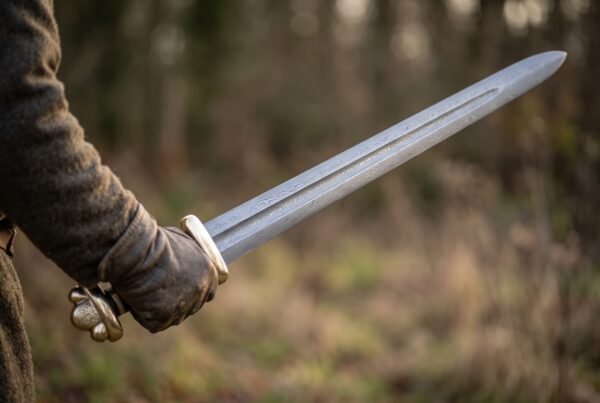
So happy I finally pulled the trigger on this one. Nice touch that it ships from within the US even though it’s crafted in the Czech Republic. Came in a nice gift box which made it feel even more special. The wood handle feels amazing and the balance is perfect. Already telling my friends to check this out.