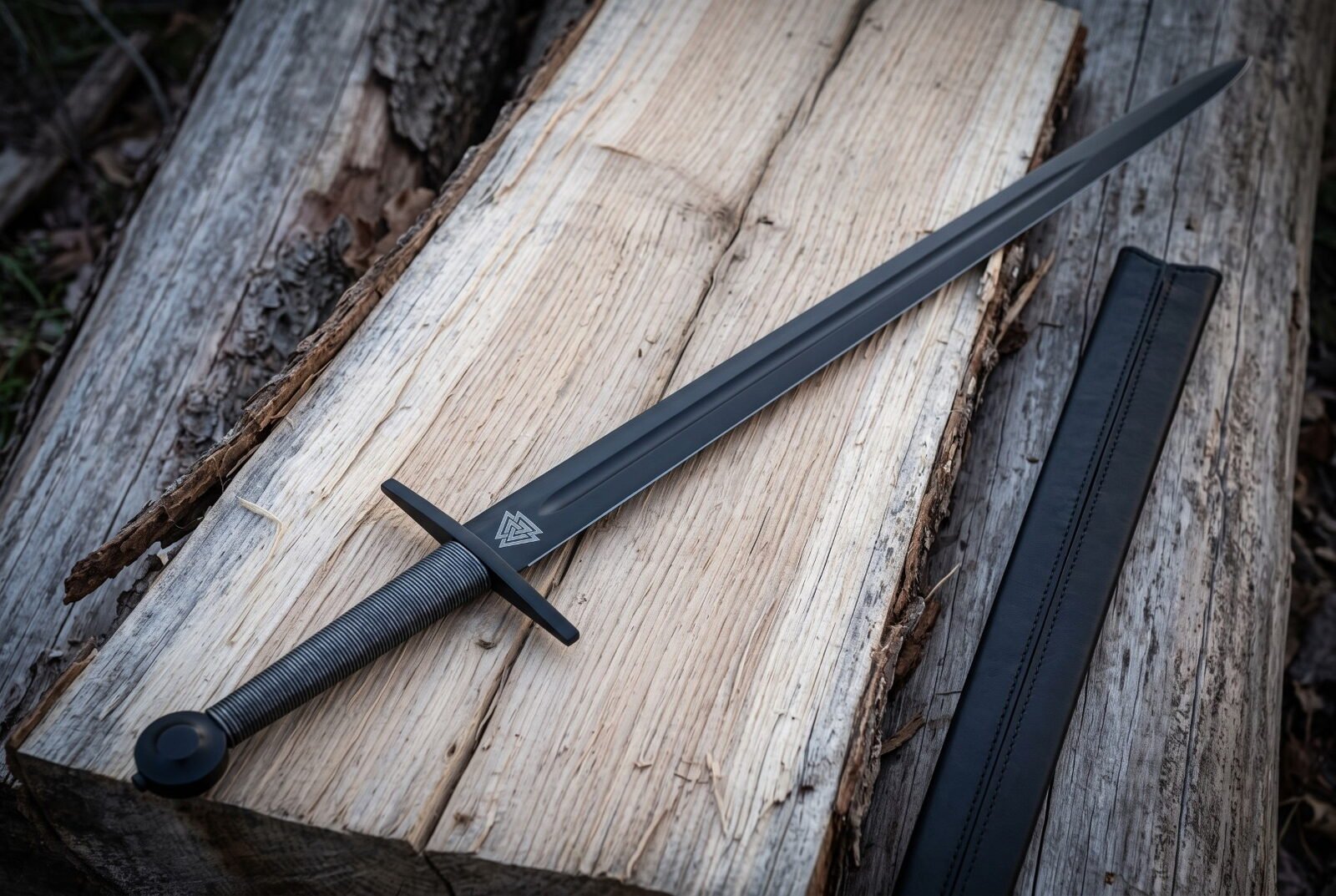
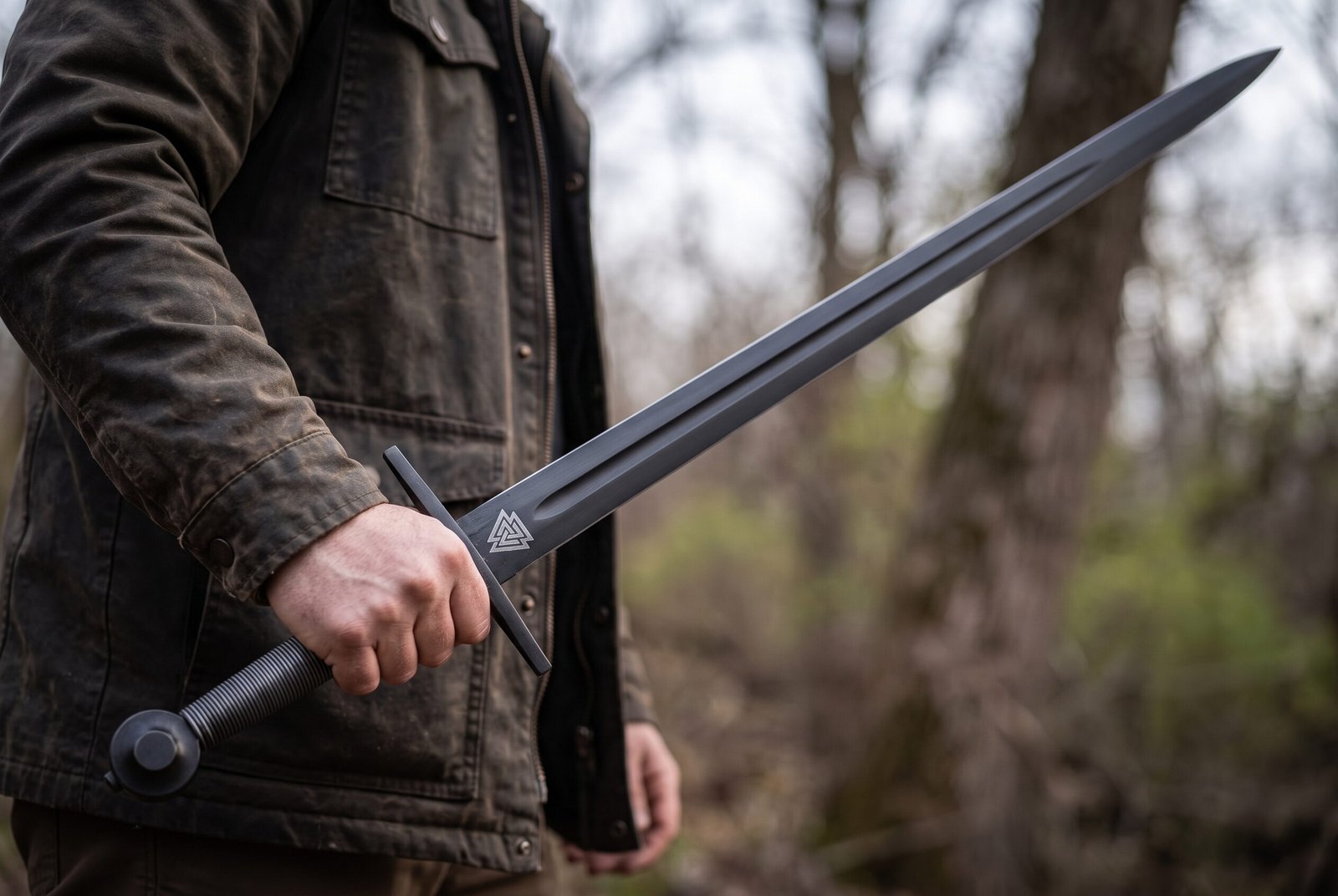
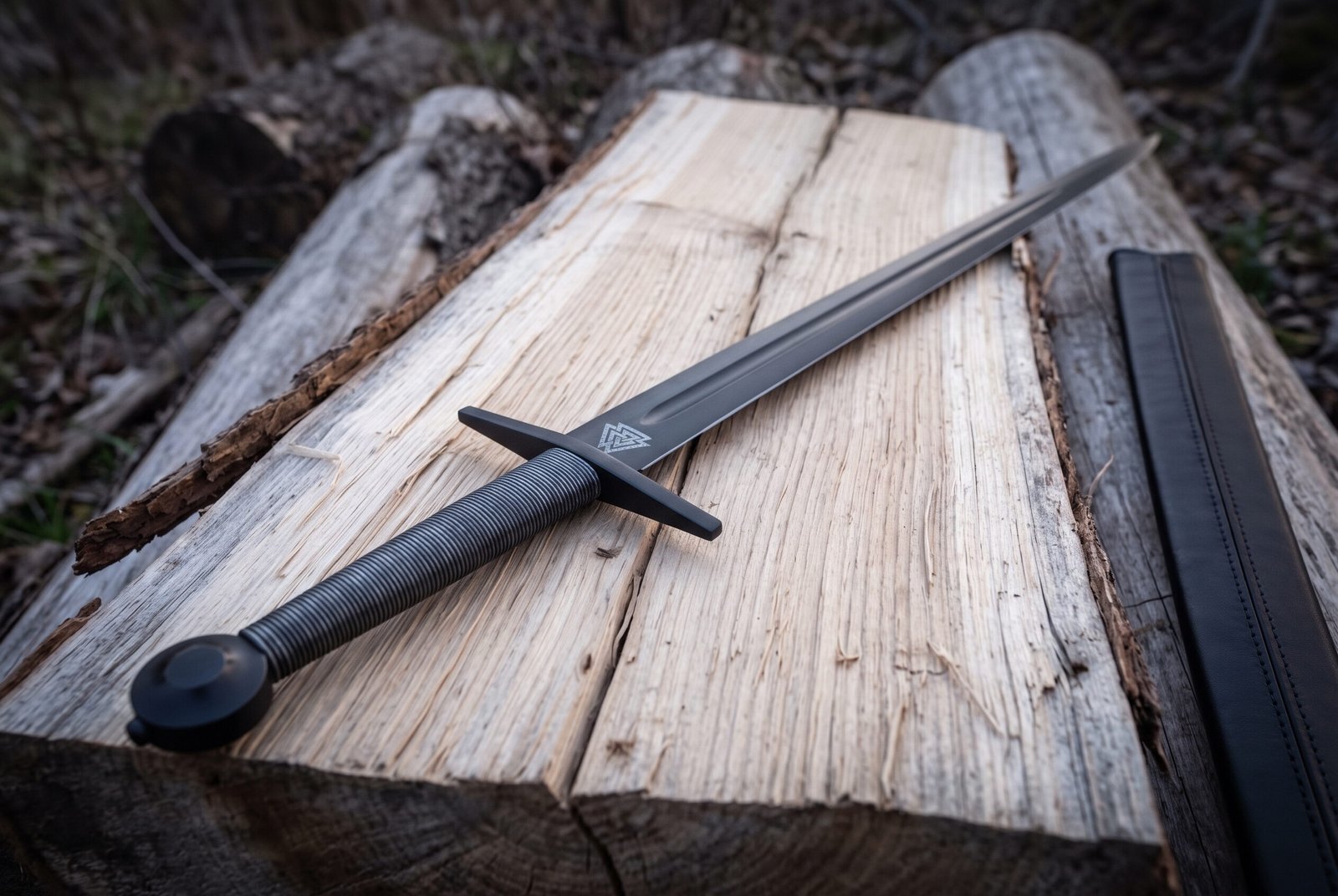
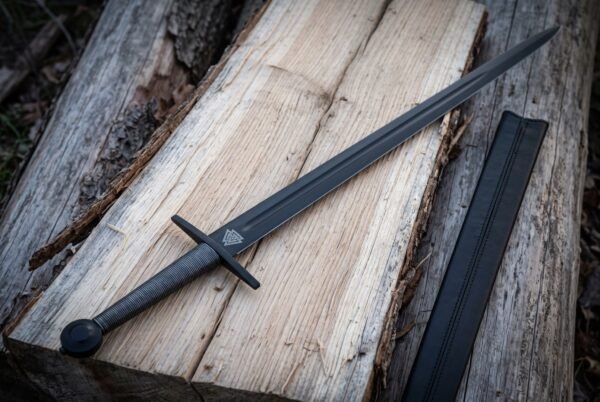
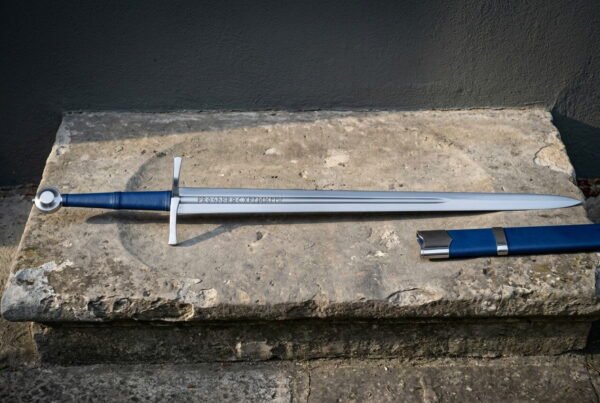
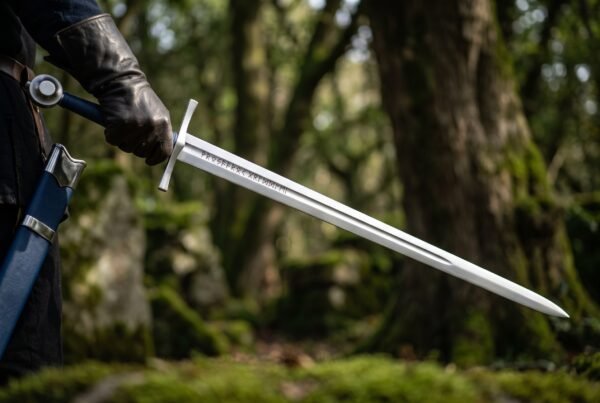
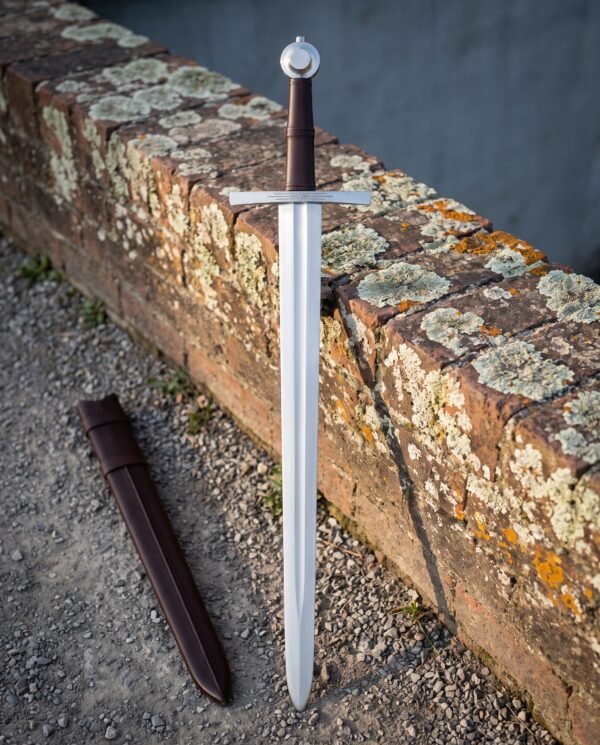
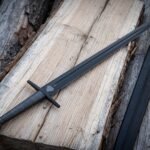
The Sootbrand is a single handed arming sword finished in black oxide from tip to pommel, with a Valknut cut into the flat of the blade just above the guard. The blade is a broad, fullered cutting blade of about twenty four inches with a long central groove running most of its length. The guard is a plain straight cross, the grip is tightly wound steel wire over a hardwood core, and the pommel is a thick wheel disc peened over the tang. A black leather scabbard comes with it.
The Valknut on the blade is three triangles locked into one another so that no single triangle can be lifted free. It is one of the few Norse symbols we can actually place, rather than guess at. It appears carved on the Stora Hammars picture stones on Gotland, on the Tangelgarda stone, and on a bedpost from the Oseberg ship burial, and in almost every case it sits beside Odin, beside a horse, or beside the dead. Nobody living knows what the carvers called it. The modern name is a nineteenth century Norwegian coinage meaning knot of the slain. Every one of these is forged, ground, heat treated, blackened and fitted by hand in the Czech Republic, and each sword ships with the leather scabbard shown and our lifetime warranty against defects in forging, grind, heat treat and fittings.
A single handed sword of this class is the usual first purchase, and how to buy a first sword covers what matters. The valknut is the three interlocked triangles, and what we actually know about the valknut is a shorter list than the internet suggests. The medieval helmets are the obvious thing to hang beside it.
Specifications
| Material | 1095 high carbon steel, hardened to 54 to 58 HRC |
|---|
| Overall length | About 31 inches |
|---|
| Blade length | About 24 inches |
|---|
| Blade type | Double edged with a single central fuller |
|---|
| Grip | Steel wire wrap over a hardwood core, about 6 inches |
|---|
| Guard | Straight steel cross with squared ends, blackened |
|---|
| Pommel | Thick wheel disc, blackened, peened over the tang |
|---|
| Engraving | Valknut etched bright on the blade flat above the ricasso |
|---|
| Finish | Black oxide over the whole sword |
|---|
| Scabbard | Black leather scabbard with a stitched centre seam |
|---|
| Included | Sword and scabbard |
|---|
| SKU | RK-1952 |
|---|
Why the fuller is there and what it is not
The long groove down the middle of this blade is a fuller, and the single most common thing said about it is wrong. It is not a blood groove. It does not let air into a wound, it does not stop suction, and no period source describes it that way. The fuller is a structural feature and it works exactly like the web of an I beam.
When you bend a blade, almost all of the stress is carried at the outside surfaces. The steel sitting in the middle of the cross section does very little work. A fuller removes that idle steel from the flats and leaves the material where the load actually is, near the edges and near the spine. The result is a blade that keeps close to the same stiffness while losing a real fraction of its weight, which on a sword this size is the difference between a bar you swing and a blade you steer. It also moves the point of balance back towards the hand, so the sword turns faster.
The fuller is ground in, not pressed or stamped. That means the fuller tapers with the blade rather than running as a parallel slot, and it stops short of the point where the blade needs its full section.
The steel and the black oxide
The blade is 1095 high carbon steel brought to 54 to 58 HRC. 1095 is about as simple as blade steel gets, roughly one percent carbon and iron, with no chromium, vanadium or molybdenum doing anything clever. It hardens deeply, it holds a cutting edge well at this hardness, and it comes back on a stone without a fight.
The black is not paint and it is not a coating that can peel. Black oxide is a conversion finish. The surface of the steel itself is converted to magnetite, a hard black iron oxide that is chemically part of the blade rather than sitting on top of it. It cannot chip off, it adds almost no thickness so the edge geometry is unchanged, and it kills glare completely. What it will not do on its own is stop rust. Black oxide slows corrosion but it needs oil on top of it, and that is covered below.
Engraving, runes and your own design
Use the rune converter on this page to turn a name, a date or a short phrase into Elder Futhark and we will cut it into the steel, the leather or the wood. If you would rather have a Viking pattern than a rune line, choose your own design in the engraving option above the add to cart button and tell us where it goes. Where a piece already carries an engraved design, your chosen engraving replaces it rather than sitting alongside it. On the Sootbrand that means the Valknut is the spot in question. Ask for runes there and the Valknut comes off the drawing and your line goes on instead. A rune line also sits well down the fuller if you want to keep the Valknut. Everything you need is on the engraving page.
Handling and balance
This is a one handed sword. The grip takes a hand and no more, and the wheel pommel is there to be gripped against rather than to be held. Point of balance sits roughly three to four inches ahead of the cross, which is where a cutting arming sword wants to be. Held properly the wheel presses into the base of your palm and lets you rotate the blade with very little effort, which is the whole reason disc pommels took over from the earlier lobed shapes.
The wire wrap gives a hard, positive grip that does not move under a sweaty hand, though it is less forgiving on bare skin than leather over a long session. This is a sharp forged sword. It is not for sparring and must not be used for full contact work against a person or against another blade. Cutting practice on soft targets such as tatami, bottles and cardboard is what it is for.
Care
Treat this as a carbon steel sword with a head start rather than a stainless one. Wipe the whole sword down after handling, because skin salts will eat through a black oxide surface faster than water will. Keep a light film of mineral oil, camellia oil or a general gun oil over the blade and the fittings, and refresh it every few weeks. If a bright spot appears where the black has worn, that is normal on a working sword and a wipe of oil will keep it from going any further. Our full notes are in the steel care guide.
Do not store the sword long term inside the scabbard. Leather holds moisture and the tannins in it are mildly acidic, so a blade left sheathed for months will come out marked. Feed the scabbard once or twice a year with a leather balm and let it dry naturally if it ever gets wet, well away from a radiator.
If it is going on a wall, hanging swords and axes safely covers mounts, fixings and what not to do.
Made in the Czech Republic
The work behind this piece happens in a Czech Republic workshop that has kept to the old methods. Steel is forged and heat treated by hand, the grind is taken down by eye rather than by machine, and the handle, fittings and sheath are cut and finished one at a time. Because of that, every piece carries small marks of the hand that made it.
Ransack Viking is a United States company. We import direct, check each piece when it reaches us, and ship from our Chicago, Illinois warehouse. Engraving is added here in the United States after arrival, so the piece you receive is finished to your order.
A note on handmade variation
Each of these is made by hand and not machine made or bulk produced, so what arrives will not be a pixel for pixel copy of the photograph. The depth and tone of the black oxide, the tightness and pitch of the wire wrap, the exact width of the fuller and the crispness of the Valknut etch all shift a little from sword to sword. The blade dimensions, the steel, the heat treat and the way it is put together do not change. The character does, because a person made it rather than a machine stamping the hundredth of a run.
Frequently asked questions
Will the black finish wear off
It wears rather than peels. Black oxide is a converted layer in the steel itself, so it cannot flake like paint, but high spots such as the edge bevels and the pommel crown will brighten with handling. Most owners like how that looks. Oil keeps the worn spots from rusting.
Is the Valknut engraved or printed on
Etched into the steel. You can feel it with a fingernail. It is not a transfer or a print and it will not wash off.
Can I have the Valknut swapped for my own runes
Yes. Use the engraving option and tell us what you want. Your engraving replaces the Valknut in that spot rather than sitting next to it, or we can put a rune line down the fuller and leave the Valknut alone.
Is this suitable for reenactment fighting
No. It is sharp, and sharp swords are not permitted in contact reenactment or sparring anywhere. Use it for cutting practice, display and collection.
Is the scabbard leather and is it included
Yes to both. The black leather scabbard shown ships with the sword and is fitted to that individual blade.
How heavy is it
Lighter than most people expect from the look of it. A fullered single handed arming sword of this length sits in the range of two and a half to three pounds, and the wheel pommel puts a good part of that behind your hand rather than out at the tip.
What is in the box
- Sootbrand Valknut arming sword in blackened 1095 high carbon steel
- Fitted black leather scabbard
- Protective oil film on the blade for transit
- Care card and lifetime warranty against defects in forging, grind, heat treat and fittings
- Forged and finished in the Czech Republic
Explore the range
More in arming swords, Viking swords and engraved and personalised pieces, or read the guides for what a fuller does and how heat treatment works.
If this one is not it
Closest to this in the range is the Plumescale arming sword, 34 inches overall. If this one is not quite right, there is the Broadmarch arming sword, 33 inches overall. Also in this group is the Northstave arming sword, 34 inches overall.
If you are putting a set together, the Stonewake Viking sword sits alongside it. Pick the steel, the length and the fittings yourself on the custom Viking sword page.
If you want to spar rather than display, the Orveldt sidesword is the blunt trainer built for it, and our HEMA sidesword range is worth a look.

I collect stuff like this and this sword is on another level. Came in a nice gift box which made it feel even more special. Highly recommend this one.
Absolutely blown away by this sword. Weight and balance make it feel like a real functional piece not some cheap replica. Fit and finish is museum quality. You can tell real craftsmen made this by hand. Came in a nice gift box which made it feel even more special. This is going straight into my display case.
This thing is a beast in the best way. Came in a nice gift box which made it feel even more special. Great buy overall.
Best sword I’ve ever owned. The wood handle feels amazing and the balance is perfect. Already planning my next purchase from this shop.
This is exactly what I wanted and then some. You can tell it’s real Czech blacksmith work and shipping from the States made delivery painless. Weight and balance make it feel like a real functional piece not some cheap replica. This will be a family heirloom for sure.