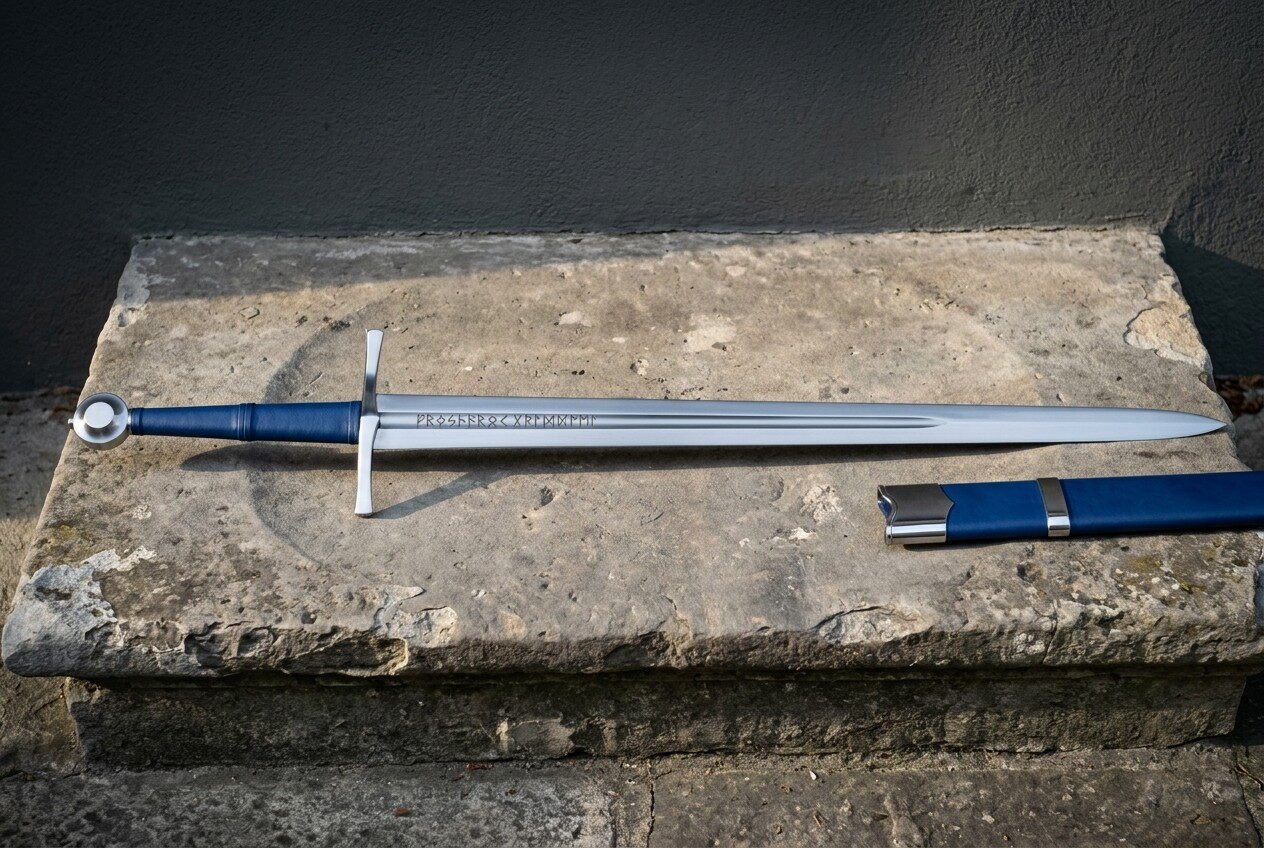
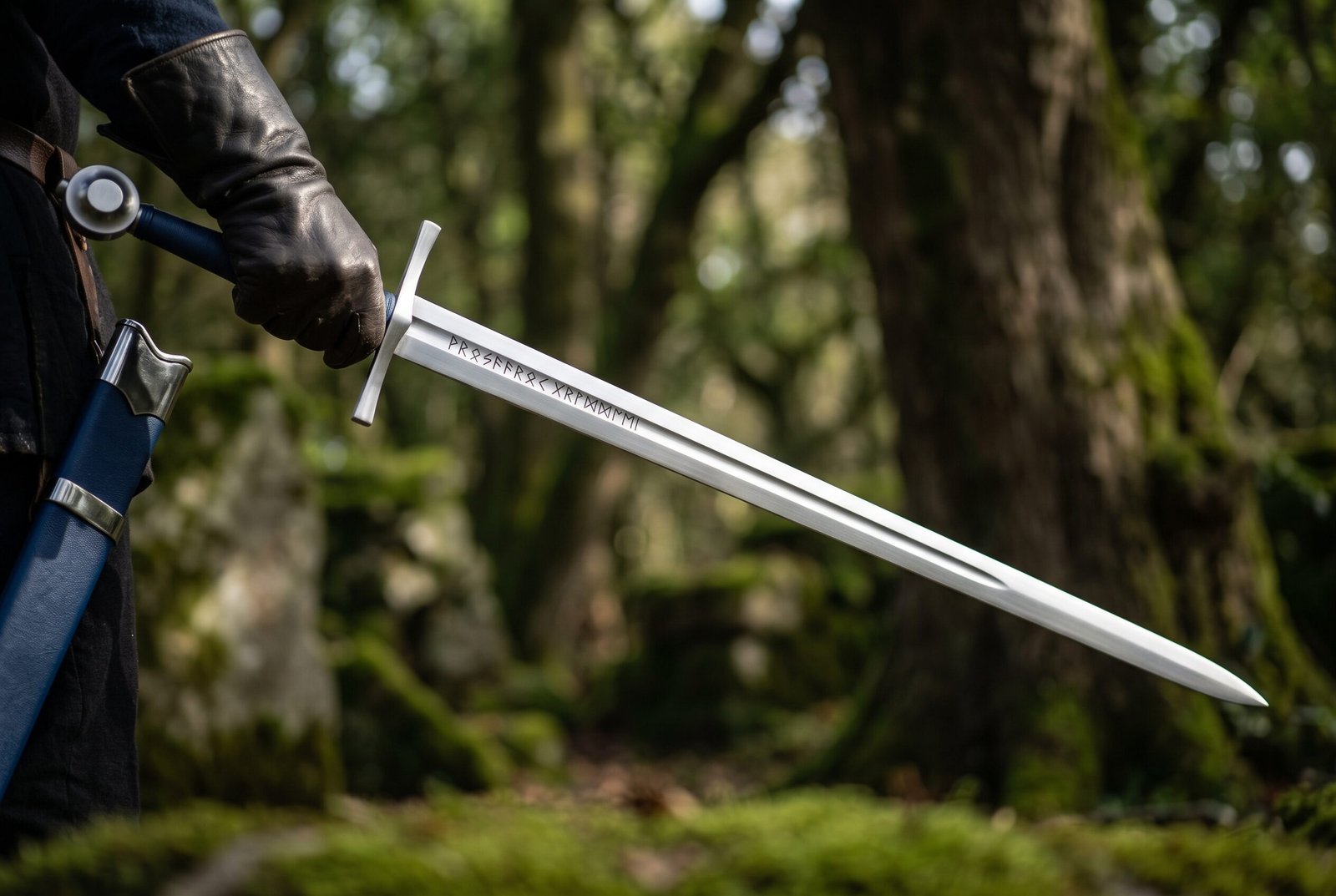
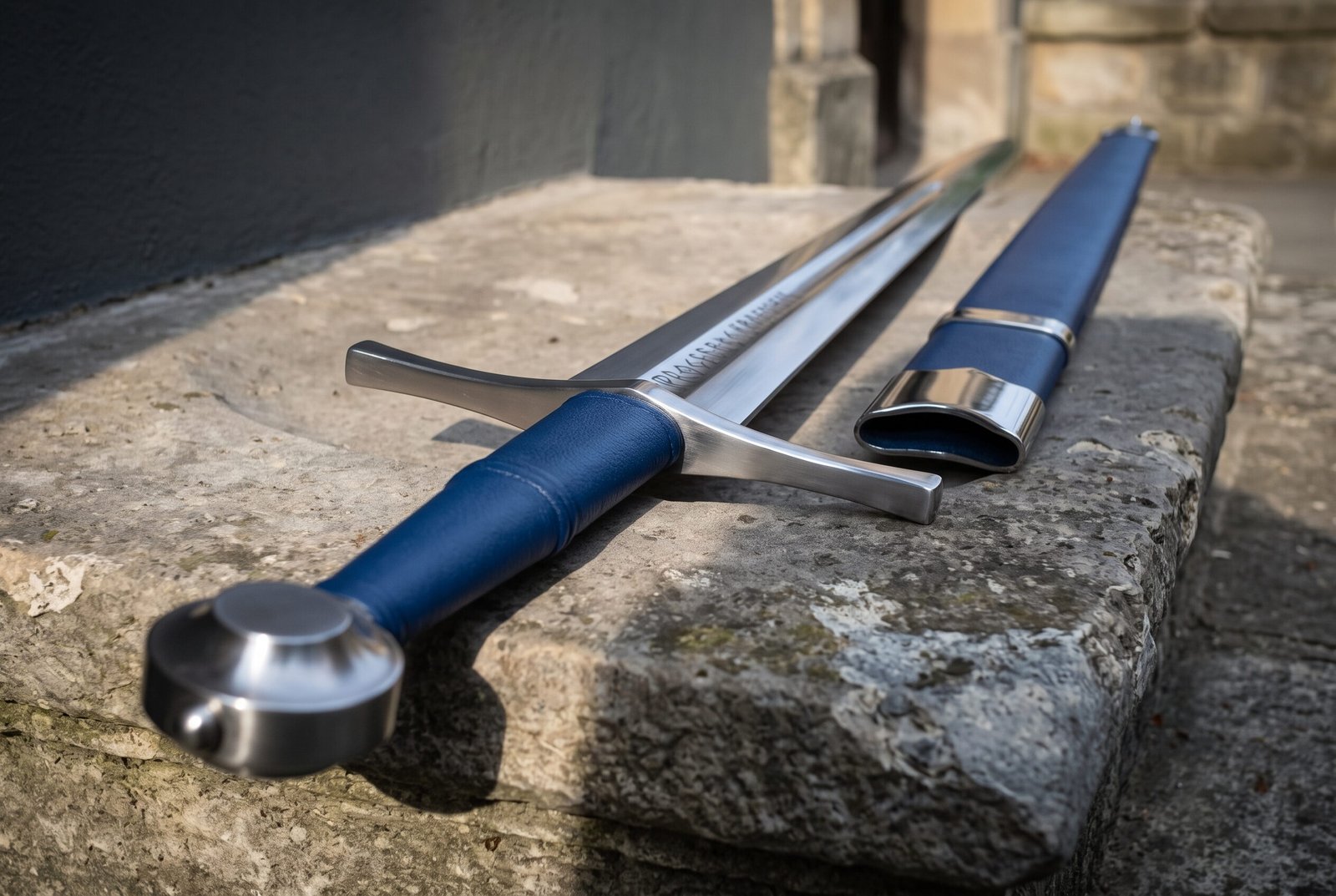
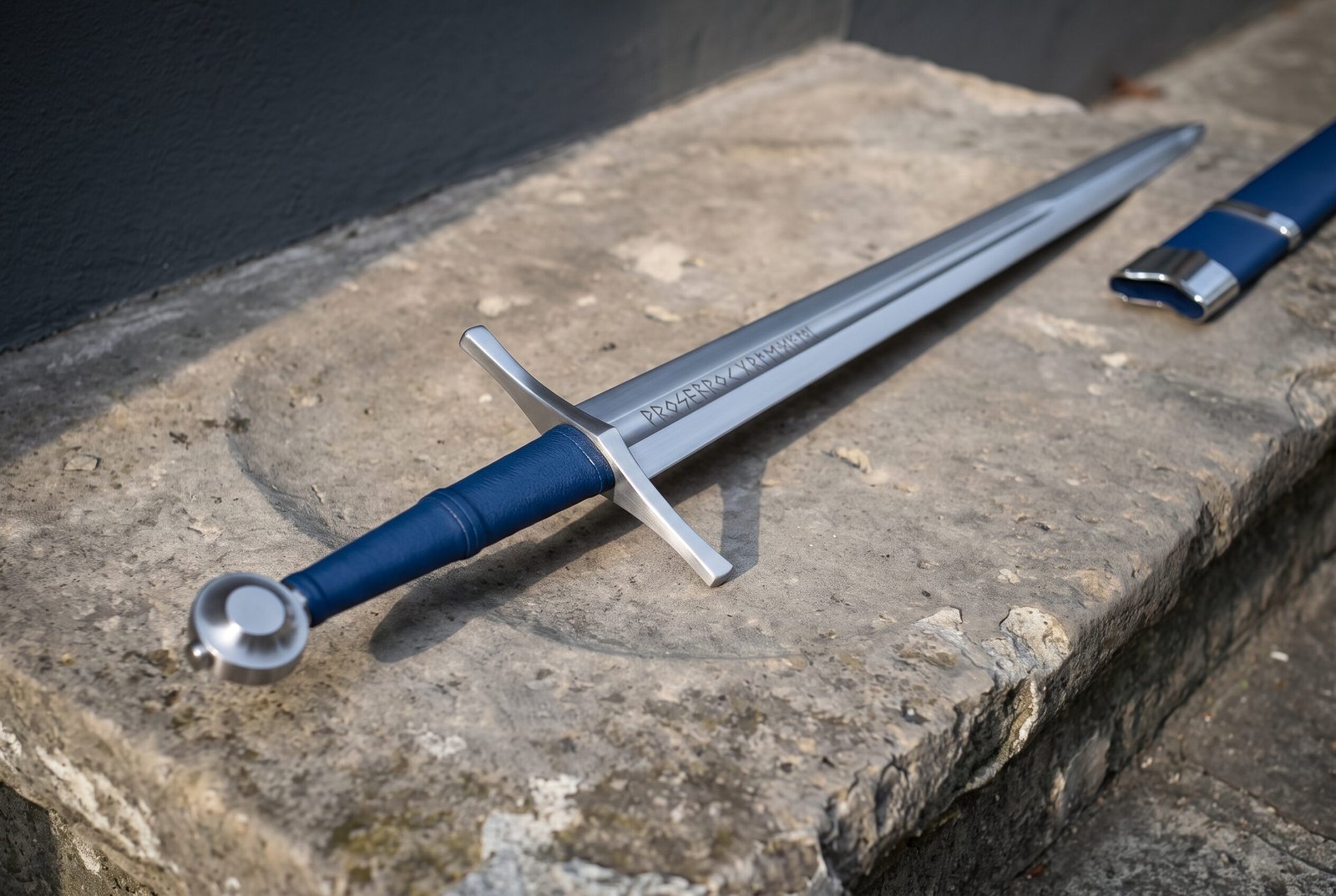
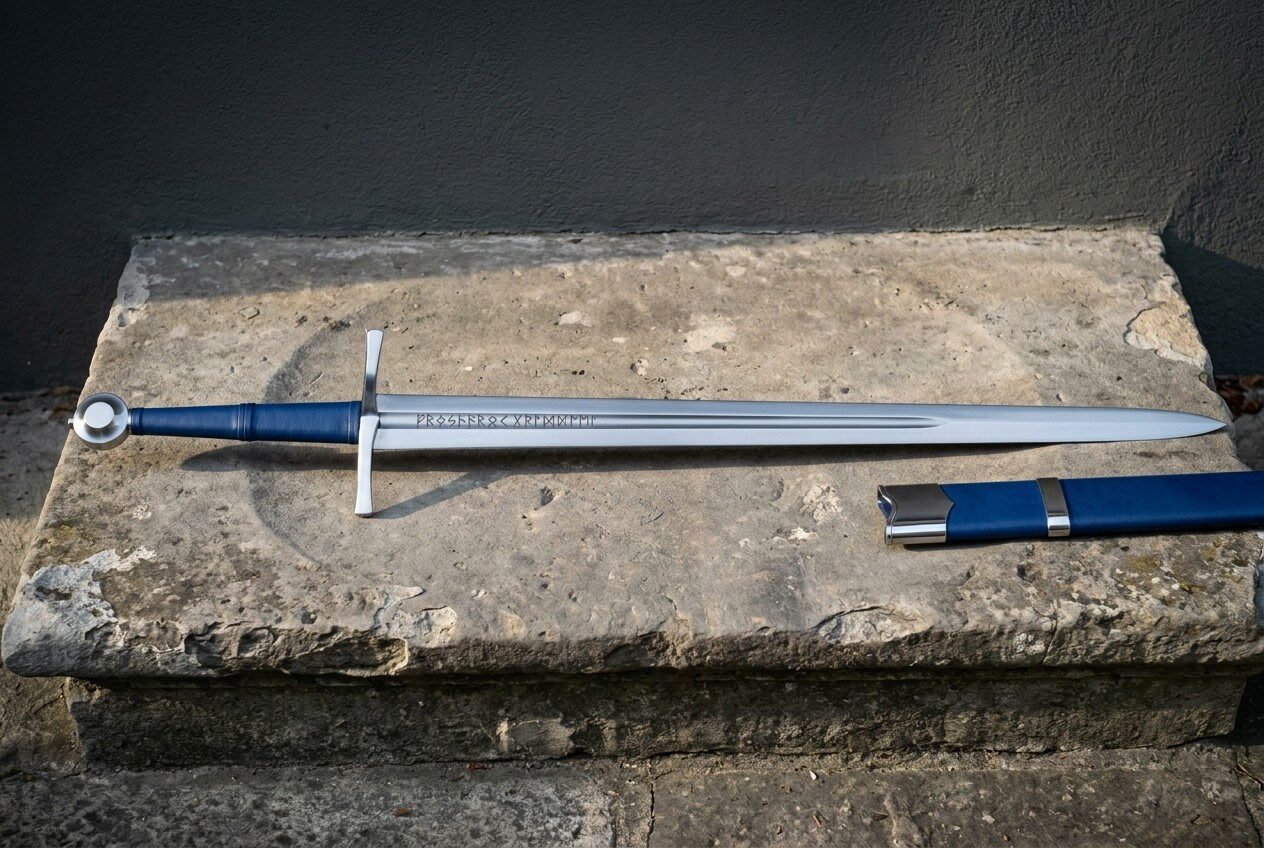
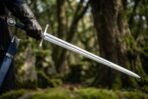
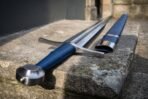
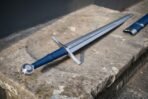
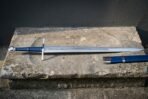
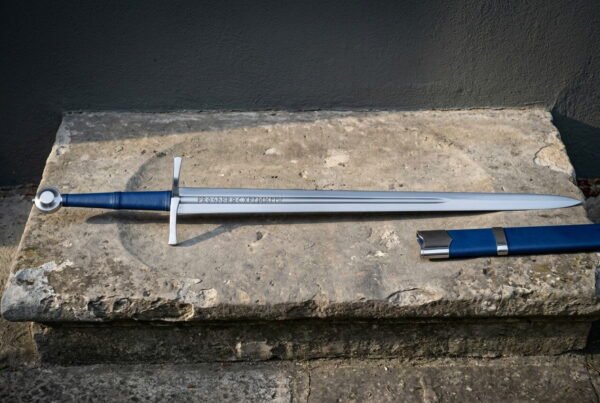
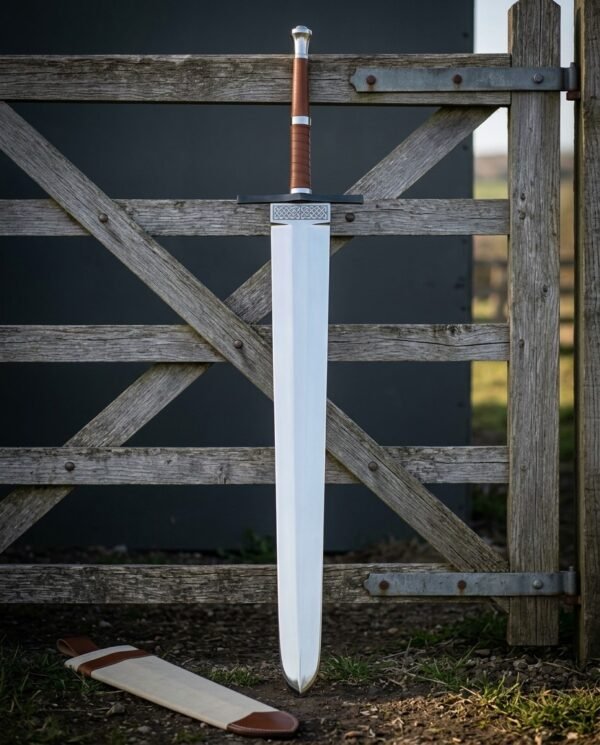
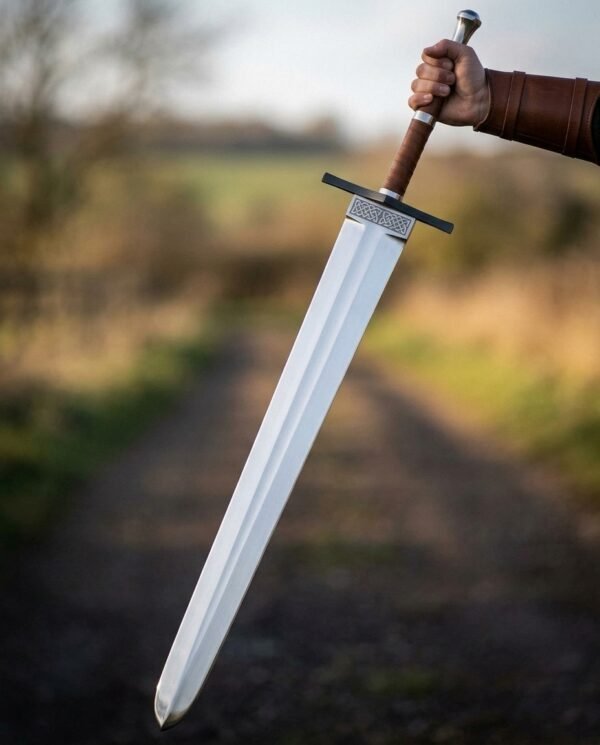
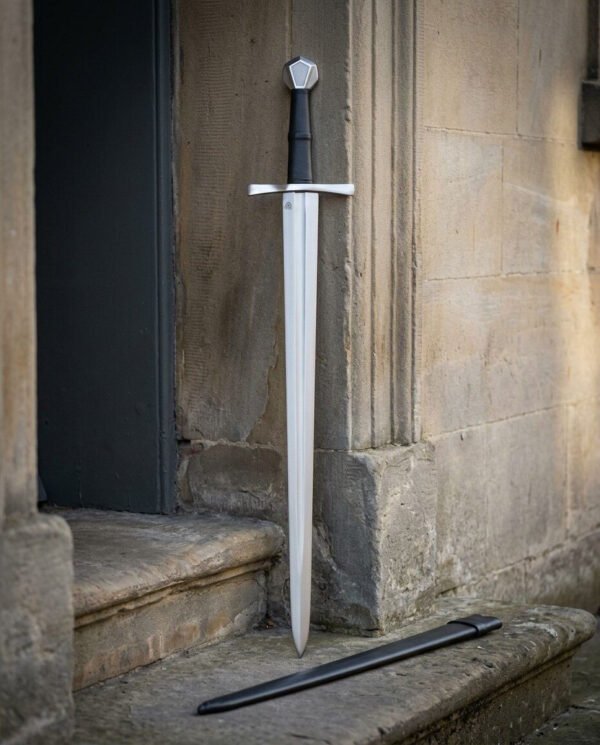
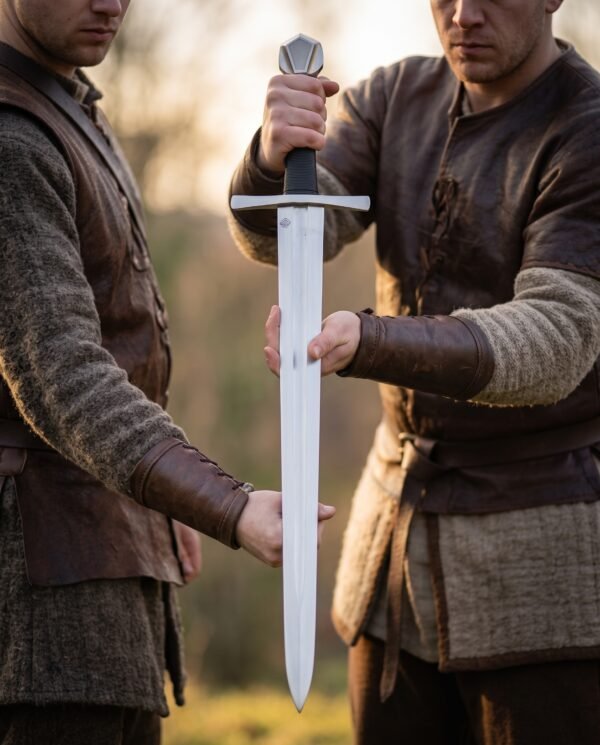
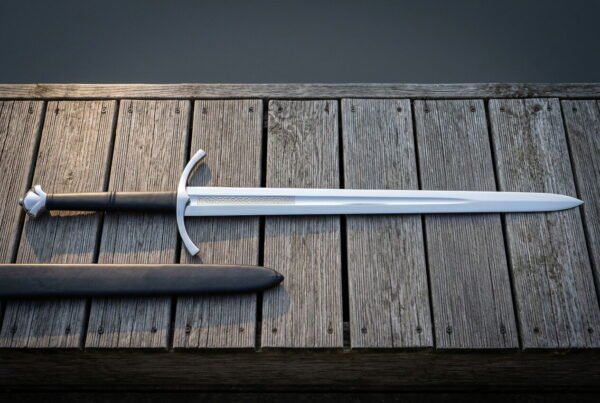
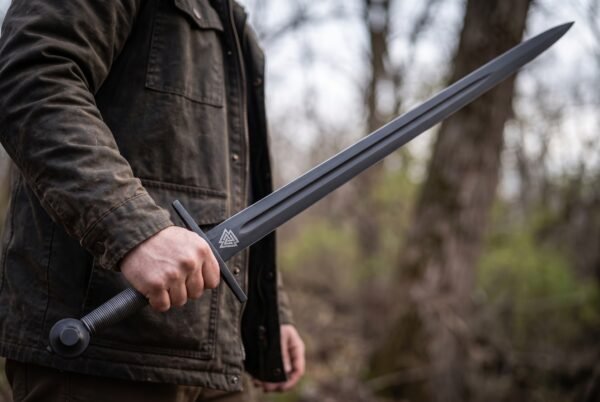
The Azurehold is a single handed arming sword, the plain fighting sword of the high medieval period and the one that hung on the belt of anyone who could afford one between roughly the eleventh and the fourteenth century. Straight cross, disc pommel, a wide fuller running most of the length of the blade, and a grip wrapped in blue leather to match the scabbard. A line of Elder Futhark runes is cut into the fuller.
The habit of putting writing in the fuller is older than the sword type. The most famous examples are the Ulfberht blades, around a hundred and seventy of which have been pulled out of European rivers and graves, each carrying the same name spelled out in iron letters that were hammered into a channel cut in the hot blade and then forge welded flush. Nobody knows whether Ulfberht was a man, a workshop or a mark that got copied for two centuries, and a good number of the surviving examples are misspelled, which suggests the last of those. What is certain is that a name in the fuller was worth money, and that the practice of marking a blade where the metal is thinnest and the light catches best has never really stopped. Ours is forged, ground, hardened and assembled by hand in the Czech Republic, and it ships in the blue leather scabbard shown. Kept with the arming swords, and worth setting against the Viking swords before you decide.
Specifications
| Item type | Medieval arming sword, double edged, single handed |
|---|
| Blade material | 1095 high carbon steel, hardened to 54 to 58 HRC |
|---|
| Blade type | Double edged, straight, with a wide central fuller and a runic inscription near the cross |
|---|
| Overall length | Approximately 37 inches |
|---|
| Blade length | Approximately 30 inches |
|---|
| Grip | Blue leather over a wooden core with a raised ring near each end, approximately 6 inches |
|---|
| Guard | Straight steel cross with slightly flared ends |
|---|
| Pommel | Polished steel wheel pommel with a recessed centre, tang peened over it |
|---|
| Scabbard | Blue leather over a timber core with a steel throat and chape |
|---|
| Finish | Satin polished blade, bright steel furniture |
|---|
| Included | Sword and matching blue leather scabbard |
|---|
| SKU | RK-1833 |
|---|
What the fuller is really doing
Almost everyone calls it a blood groove and almost everyone is wrong. A fuller has nothing to do with blood and nothing to do with a blade sticking in a wound. It is a structural feature and the reasoning behind it is the same reasoning that gives you an I-beam rather than a solid bar of steel in a bridge.
When a blade bends, the stress is carried by the material furthest from the centre line. The steel in the middle of the cross section contributes very little stiffness for the weight it costs. Hollowing that middle out along the length of the blade takes away mass from the place where it is doing the least work, and leaves the edges and the ridges either side of the groove carrying the load. The result is a blade that is close to as stiff as a solid one of the same width and noticeably lighter, which means it accelerates faster and stops faster.
The fuller is not machined out afterwards. It is pushed in with a rounded tool, the fullering iron the feature is named after, while the blade is hot, which spreads the steel outward rather than cutting it away. That is why a fullered blade is also wider than the bar it started as. On this sword the fuller then gives the runes a flat, slightly recessed field to sit in, which is exactly why medieval smiths put their inscriptions there.
The steel and the furniture
The blade is 1095 high carbon steel run at 54 to 58 HRC. On a sword that hardness matters more than it does on a knife, because a sword has to bend and come back. A blade taken too hard is a blade that snaps at the first bad parry, and a blade left too soft takes a set and stays bent. The middle of that range is where a long blade wants to live.
The cross and the disc pommel are steel, polished bright, and the tang runs the full length of the grip and is peened over the pommel rather than screwed into it. The grip is a shaped wooden core wrapped in blue dyed leather. Blue is worth a word: in the medieval period a strong blue on leather came from woad or from imported indigo and was not cheap, which is part of why coloured scabbards and grips show up in manuscript illustration on the belts of people the artist wanted you to notice.
Engraving, runes and your own design
Use the rune converter on this page to turn a name, a date or a short phrase into Elder Futhark and we will cut it into the steel or the leather. If you would rather have a Viking pattern than a rune line, choose your own design in the engraving option above the add to cart button and tell us where it goes. Where a piece already carries an engraved design, your chosen engraving replaces it rather than sitting alongside it. On this sword that means your line of runes takes the place of the one shown in the fuller, and the engraving page shows how many characters fit comfortably along a blade of this length.
Handling and balance
The point of balance sits a hand span in front of the cross, which is where a single handed sword of this era should be. It gives the sword enough presence in the blade to cut and still lets the wrist move it. The disc pommel is not a decoration either. It is a counterweight, and it is doing real work: without it the blade would drag and the sword would want to fall forward out of line every time you changed guard.
The grip runs about six inches, enough for one hand with a little room behind it, and the pommel sits close to the heel of your palm, which is what lets you rotate the sword through a cut by opening and closing the fingers rather than by swinging the whole arm. If you have only handled two handed swords this will feel small at first and then feel very quick.
Care
Keep a light film of oil on the blade. 1095 is not stainless and a long blade has a lot of surface to look after. Wipe fingerprints off before the sword goes back in the scabbard, because the salt in a fingerprint is what starts a rust spot. Do not store a sword indefinitely inside a leather scabbard in a damp room. Leather holds moisture, and a scabbard is the one place on the whole sword you cannot see. Feed the leather on the grip and the scabbard with a neutral conditioner once or twice a year and buff it off. Keep the peen at the pommel dry. Our page on steel care sets out oiling, storage and how to take early rust off without scratching a polish.
Made in the Czech Republic
This piece is made by hand in the Czech Republic, in a workshop that still works the old way. The steel is forged, ground, heat treated and finished by smiths who learned the trade from the people before them, and the wood, horn and leather are cut and fitted by hand rather than pressed out on a line. That is also why no two pieces come out exactly the same.
Ransack Viking is a United States company. We import these pieces ourselves, check every one when it lands and ship from our warehouse in Chicago, Illinois. Engraving is done here in the United States after the piece arrives, so your runes or your own design go on before it leaves for you.
A note on handmade variation
This sword is hand made rather than machine made or bulk produced, so what arrives will not be a pixel for pixel copy of the photograph. The fuller is pushed in by hand and wanders a fraction in width along its run. The satin finish on the blade takes light in its own way. Leather is a natural material and blue dye strikes differently on different hides, so one grip will be a shade deeper than another and the grain will not repeat. The runes are cut by hand and sit at their own depth. The length, the steel, the heat treat and the build are the same every time. The character is not. We wrote up how to hang a blade on a wall separately, and there is a piece on why a full tang matters as well.
Frequently asked questions
Is it sharp when it arrives
Yes, it comes with a cutting edge. If you would rather have it blunt for reenactment or display, say so in the order notes before we ship.
Is this battle ready for full contact sparring
No. This is a sharp forged sword for cutting, collecting and display. Full contact sparring needs a blunt with rolled edges and a rebated tip, which is a different build entirely.
Is the scabbard included
It is. The blue leather scabbard with its steel throat and chape ships with the sword and is fitted to that blade.
Can I choose what the runes say
Yes. Put your name, a date or a short phrase through the rune converter on this page and your line replaces the one in the photograph.
How heavy is it
Lighter than most people expect. A single handed sword of this length and period sits around two and a half pounds, and the balance point well forward of the hand is what makes it feel alive rather than heavy.
How long until it ships
One to two weeks of processing, then free shipping inside the United States. Engraved orders take the longer end of that window.
What is in the box
- Azurehold arming sword in 1095 high carbon steel with a runic fuller inscription
- Blue leather scabbard with a steel throat and chape
- Care card covering oiling and storage
- Lifetime warranty against defects in forging, grind, heat treat and fittings
- Forged and finished in the Czech Republic
Explore the range
See the rest of the arming swords, the Viking swords, the full sword range, or read the guides for how a fuller is forged and why it changes how a blade handles.
Close to this one
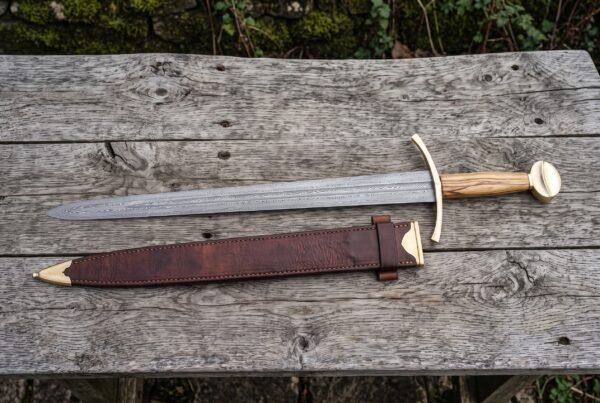
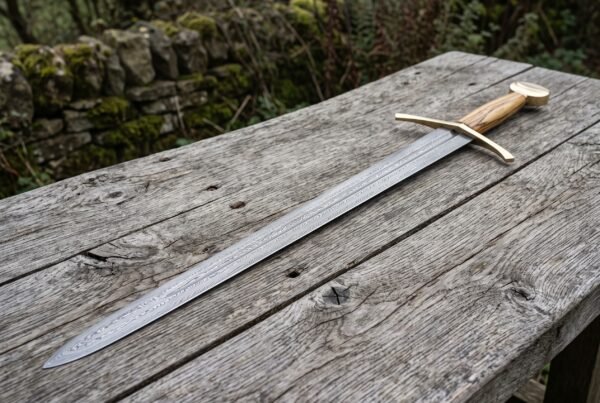
Another in the same line is the Rootspire arming sword, pattern welded Damascus. Next along the rack is the Bluewake arming sword, 38 inches overall. For a straight comparison, see the Emberdisc arming sword, 36 inches overall.
The Cairnbrand Viking sword covers the other half of the same kit. Nothing here exactly right, build one to your own spec on the custom Viking sword page.
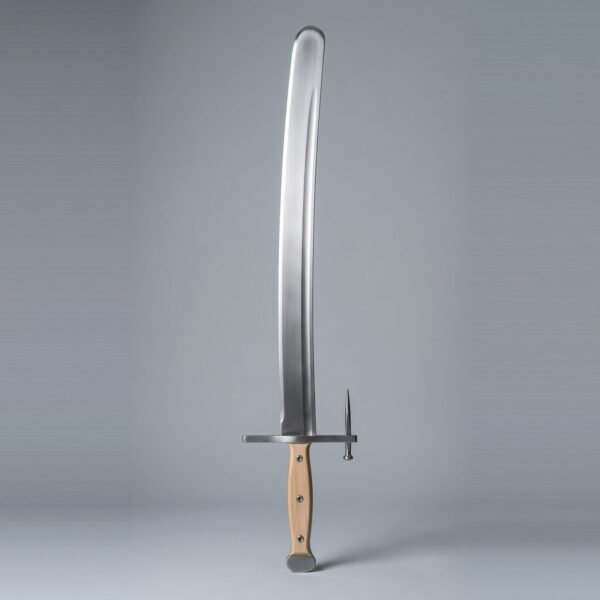
For partner drills and sparring we carry the Skarnvald grosses messer, and our HEMA messer range is a good place to start.

This sword is well made. Just a couple small things kept it from 5 stars. Blade quality is solid. Arrived a bit less sharp than expected but a few passes on a strop fixed it. Still very happy with it and would recommend.
This is exactly what I wanted and then some. Leather sheath is thick and well stitched. Not the cheap stuff you usually get. Even the small engravings are crisp and clean. Already planning my next purchase from this shop.
Been eyeing this sword for months and it did not disappoint. Leather sheath is thick and well stitched. Not the cheap stuff you usually get. Can’t recommend this enough.
Turned out better than I expected going in. Sheath is nice. Wish it had more padding but it does the job. Would still tell others to give this a try.
Should have read more reviews before ordering. Arrived with visible damage and a dull edge that needed real work. Build quality felt cheaper than the pictures suggested. Not the experience I expected from Ransack Viking given their reputation. Would not recommend based on my experience.