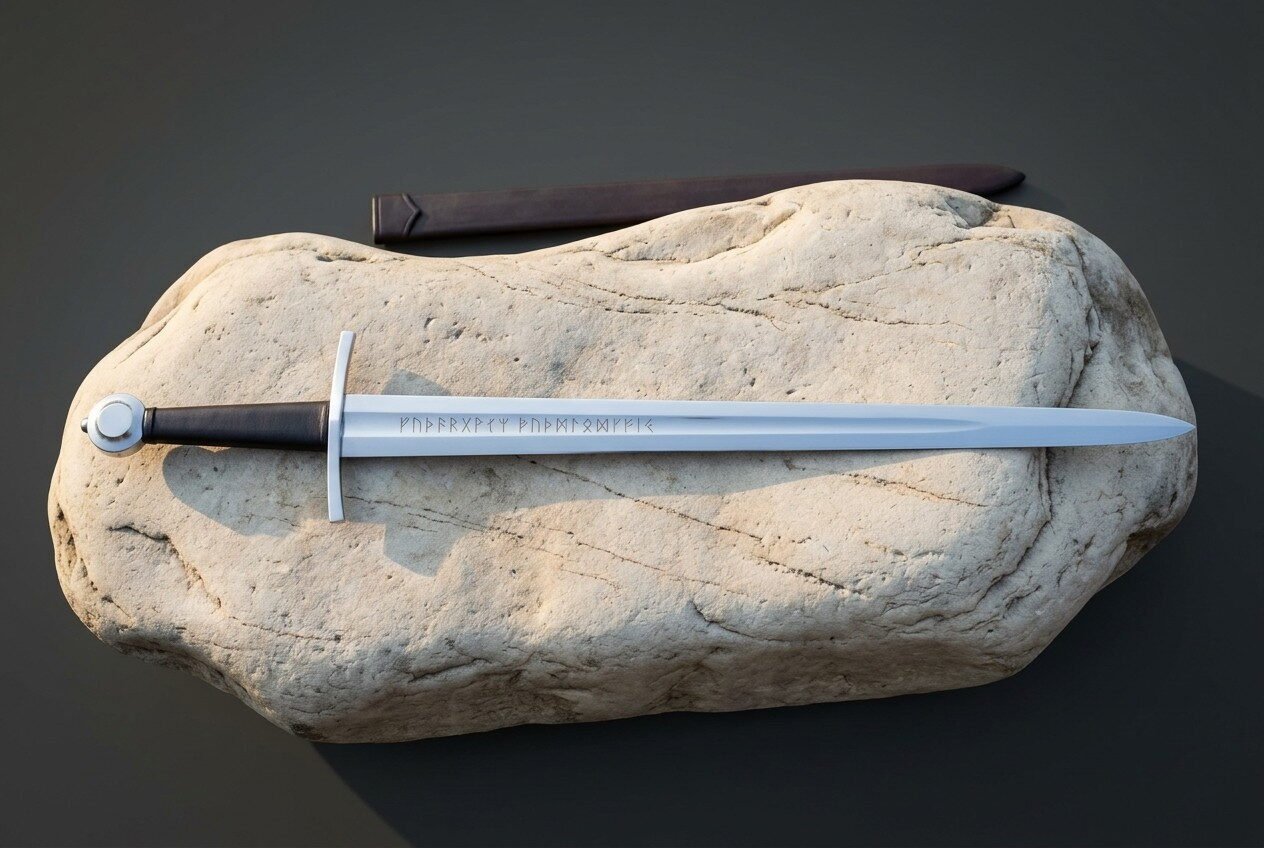
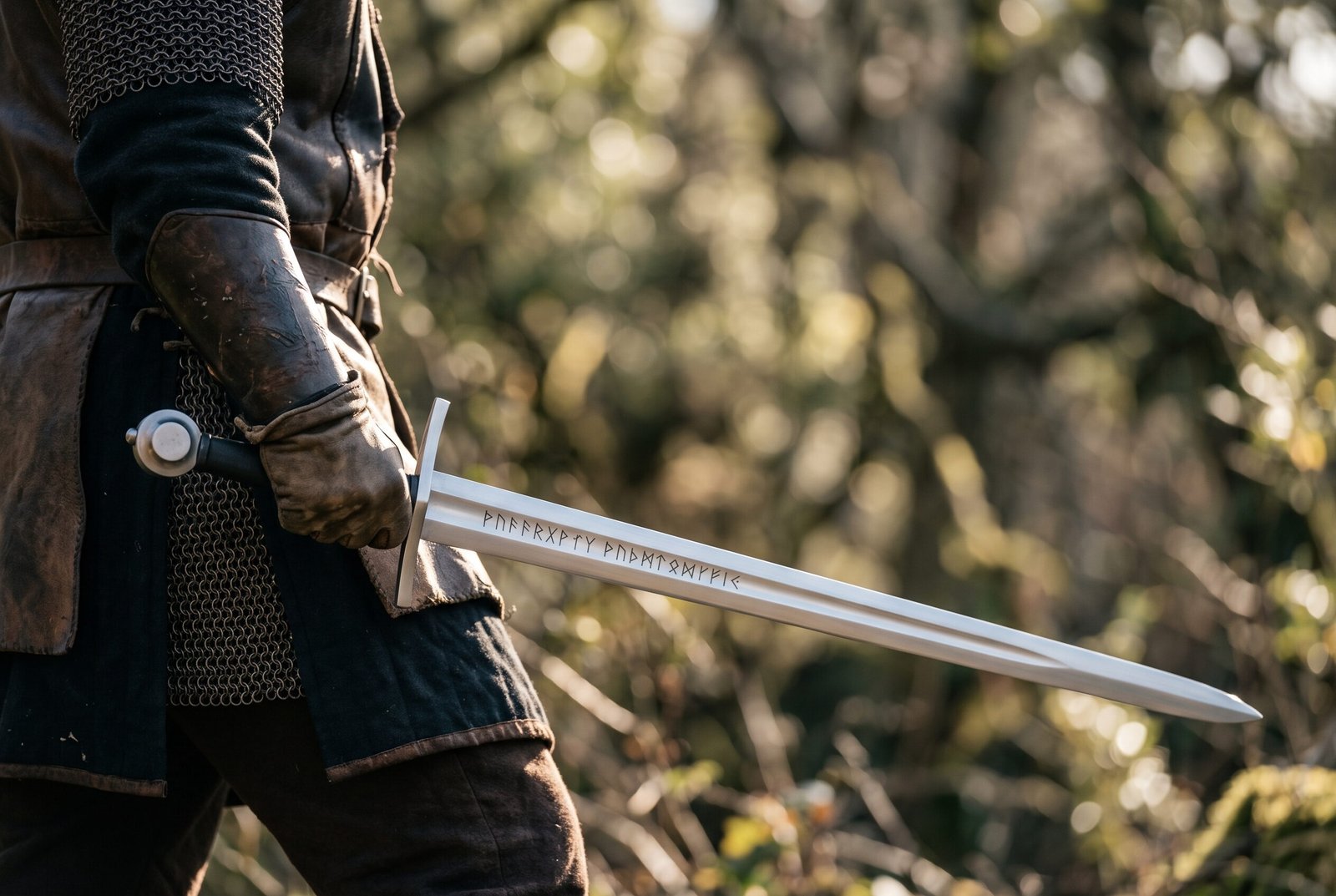
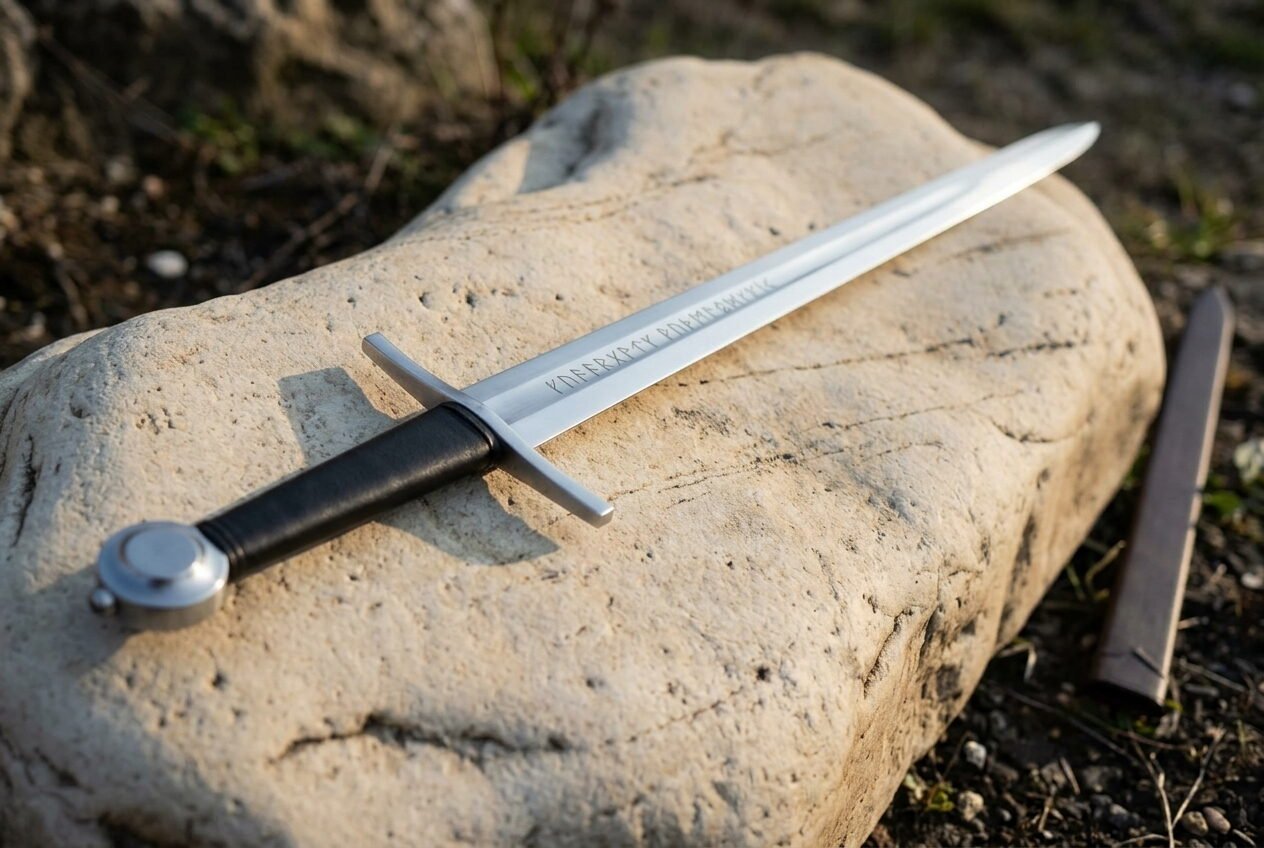
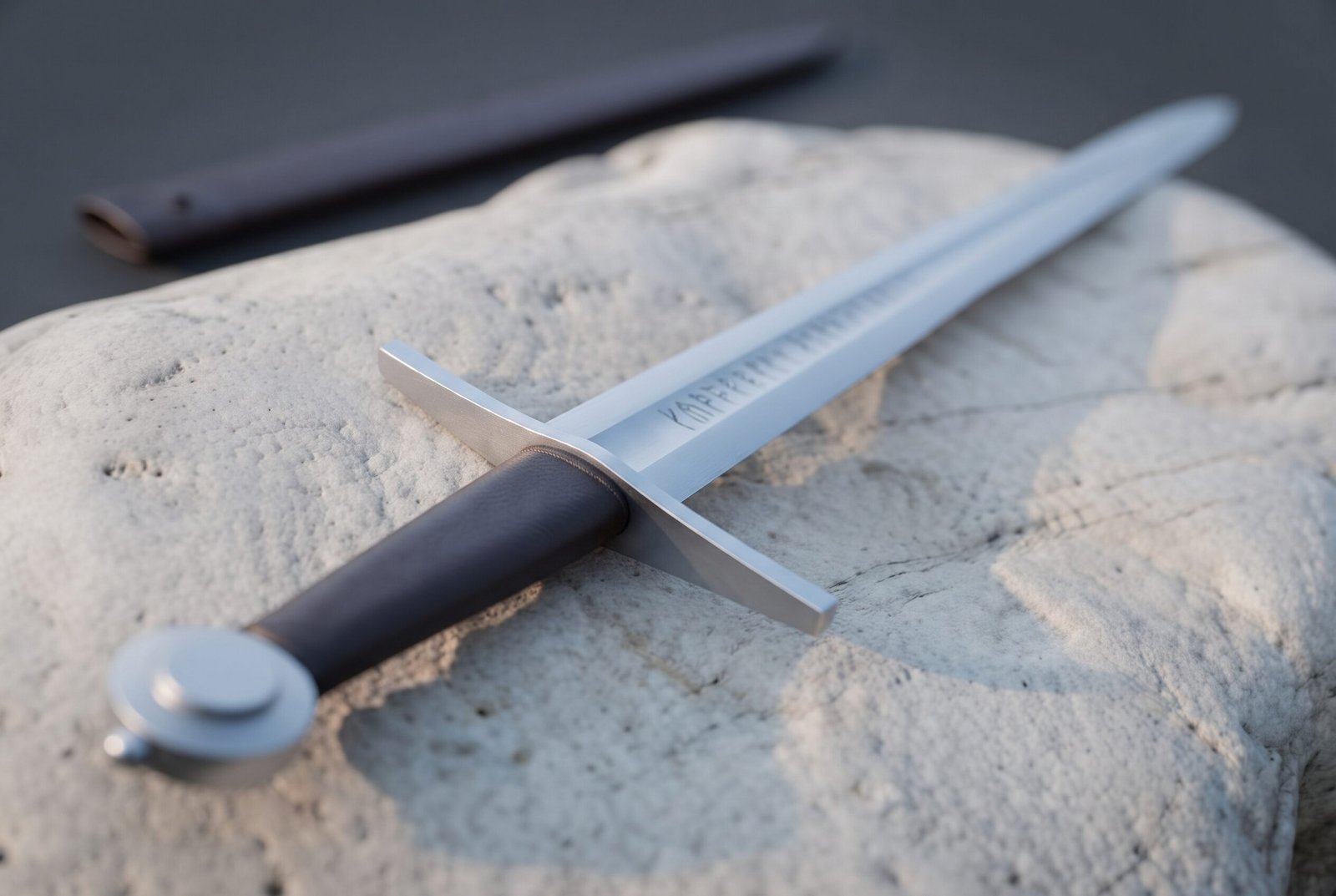
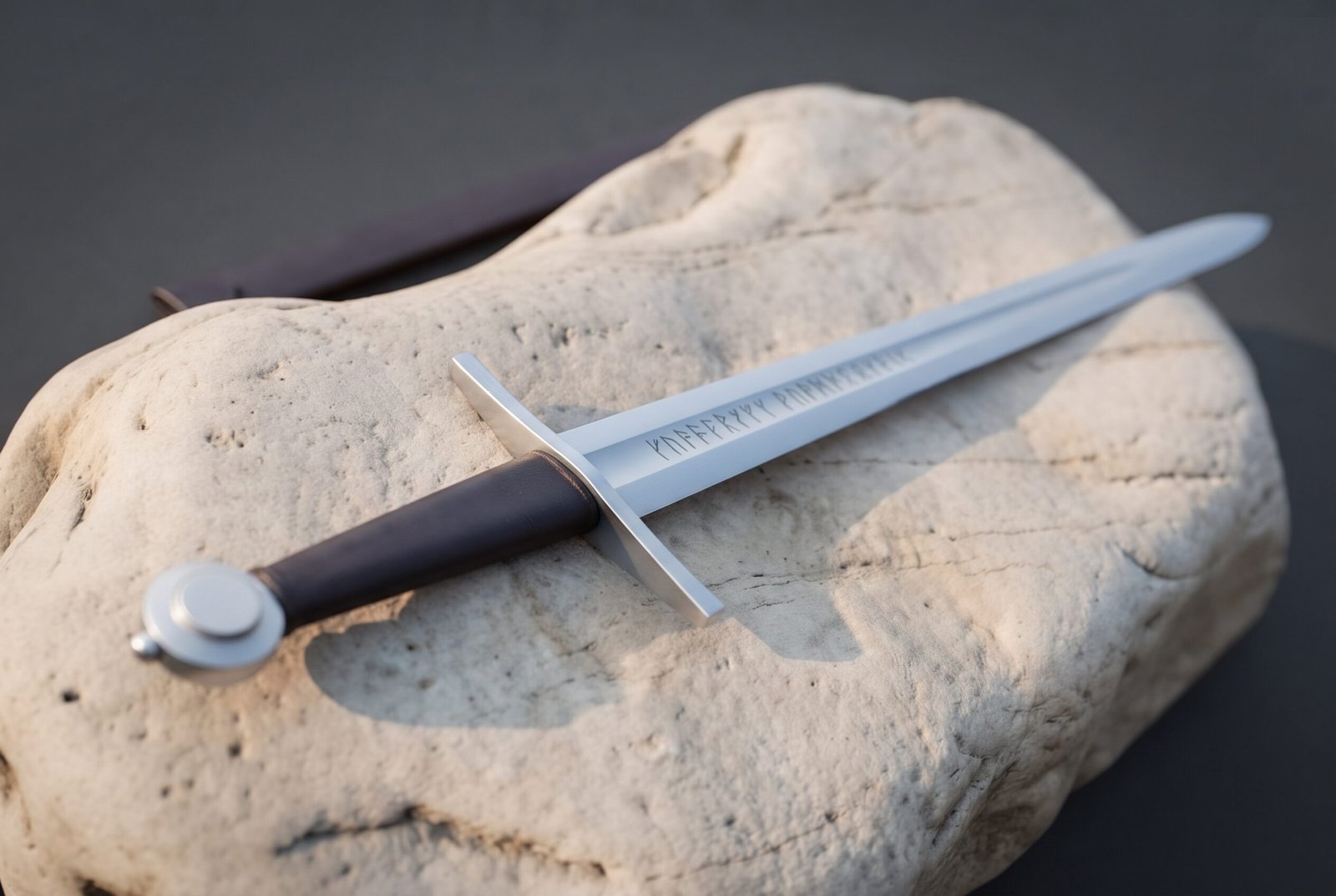
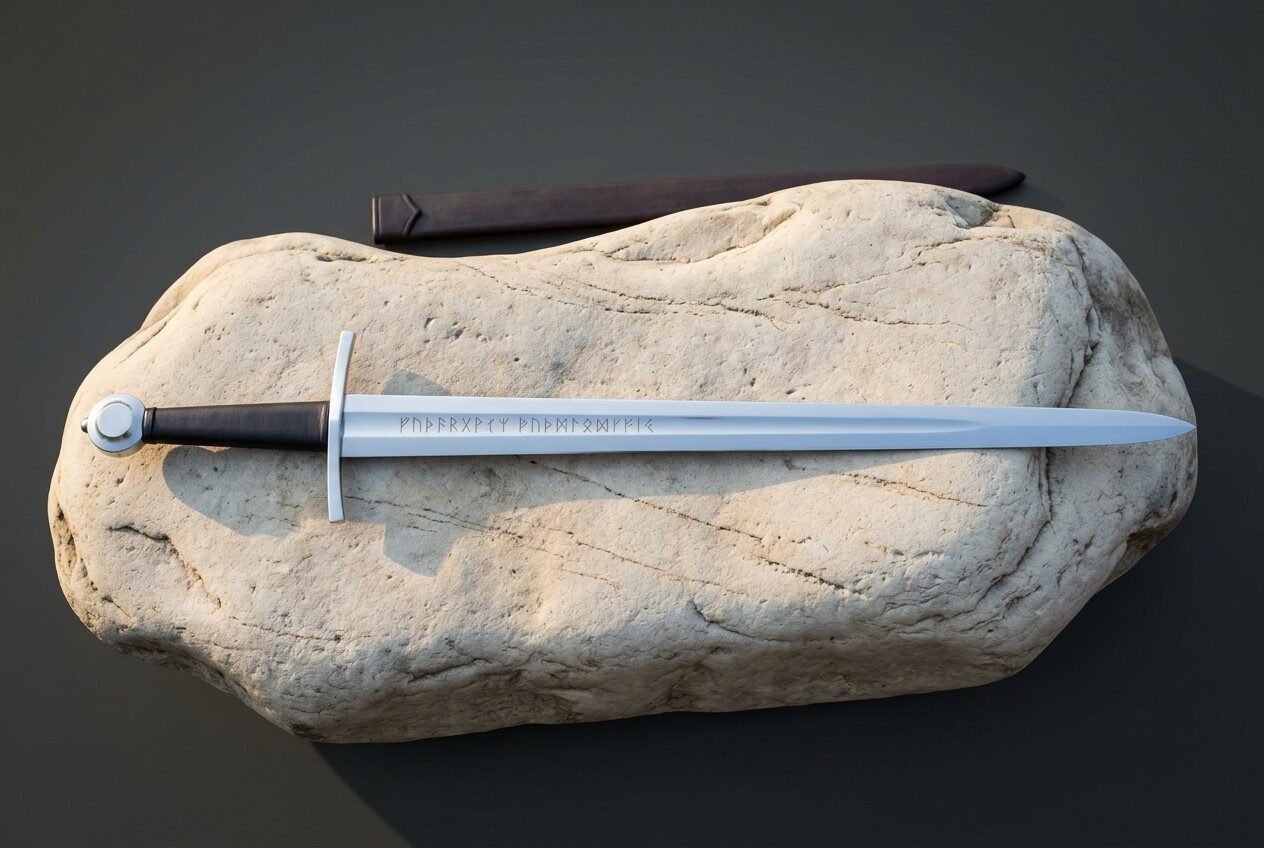
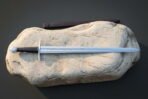
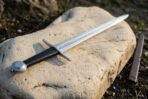
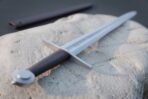
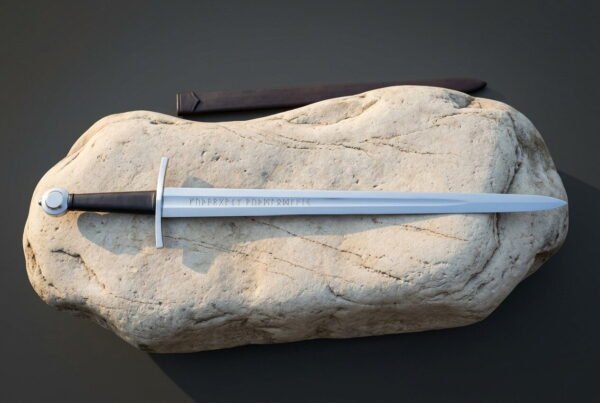
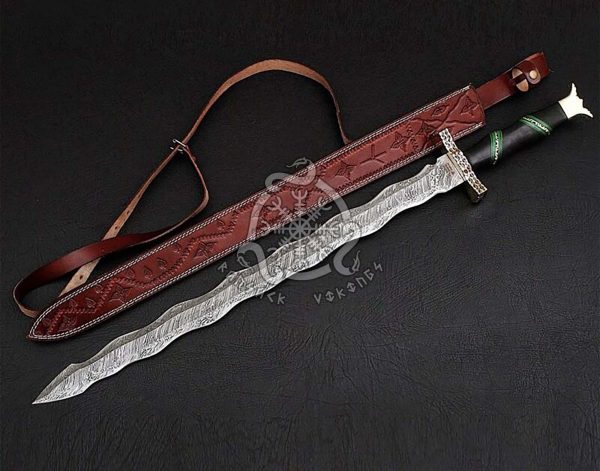
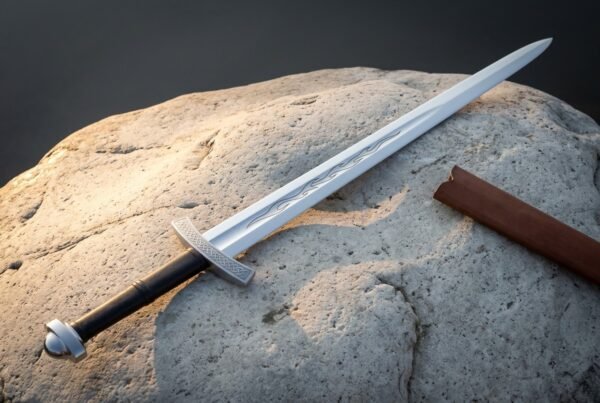
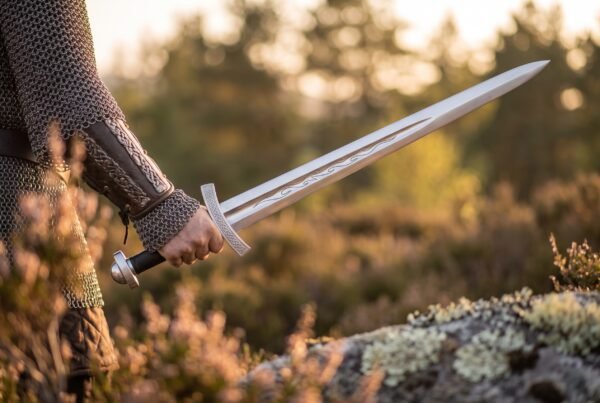
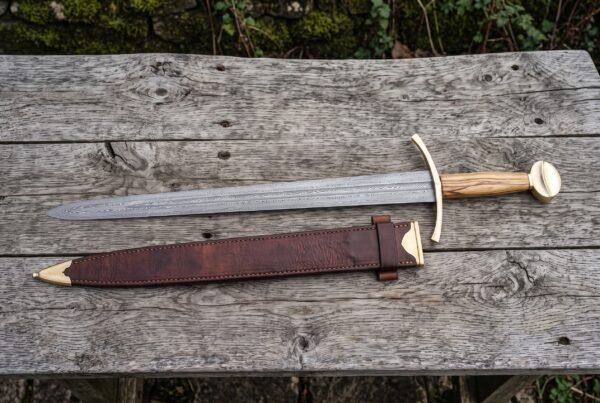
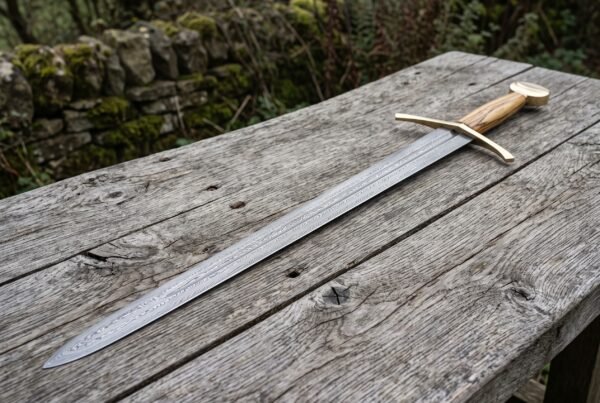
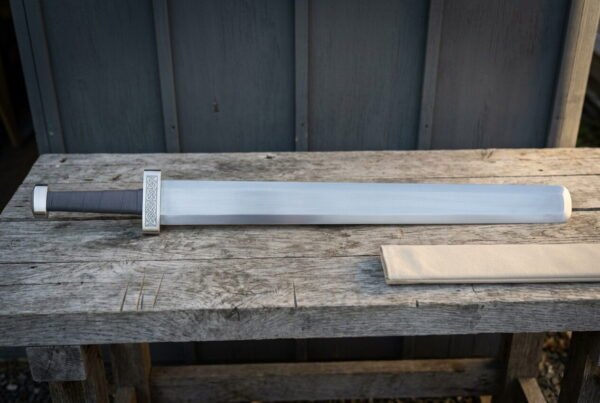
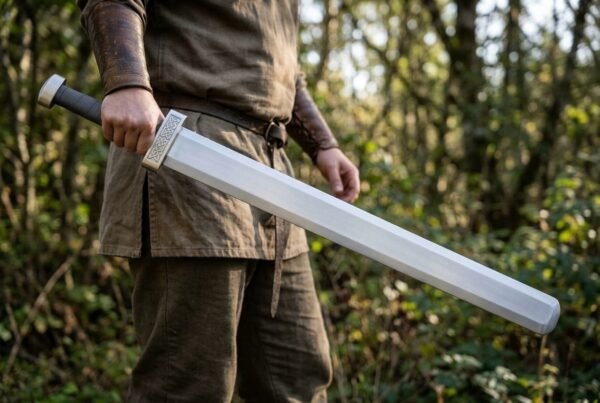
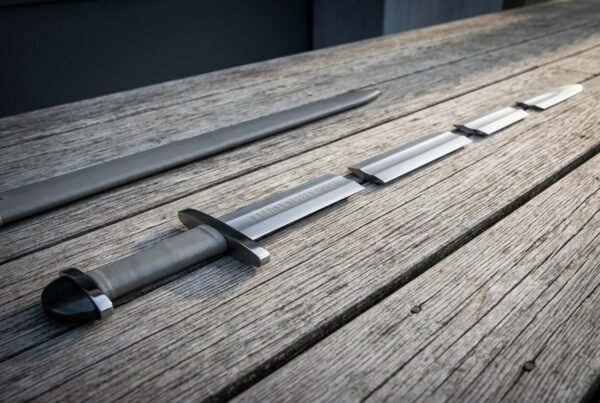
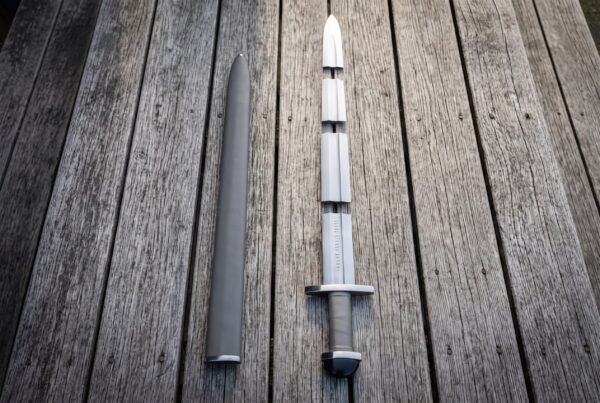
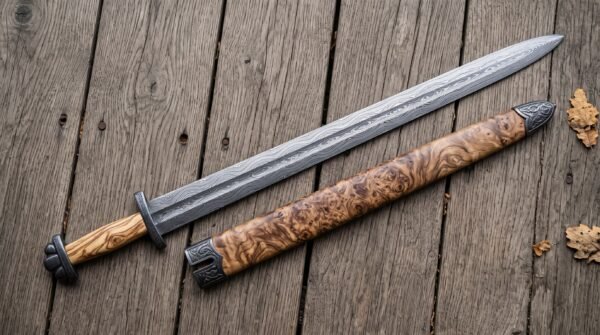
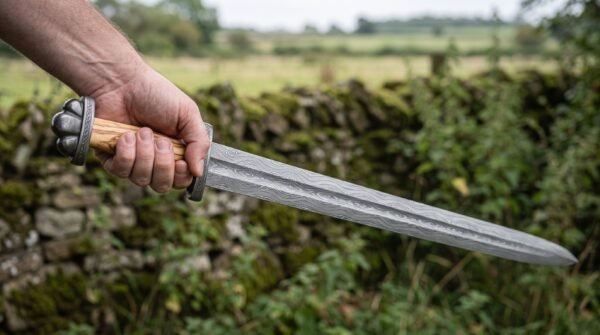
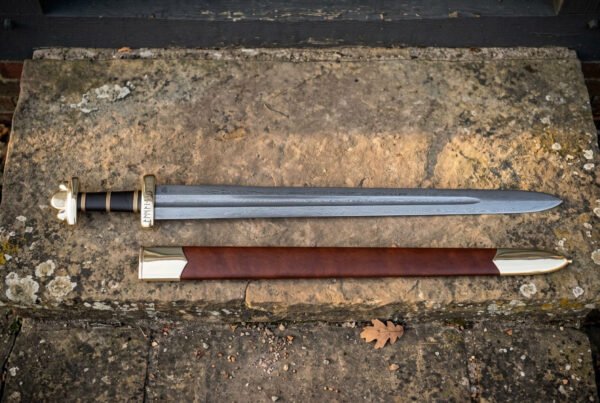
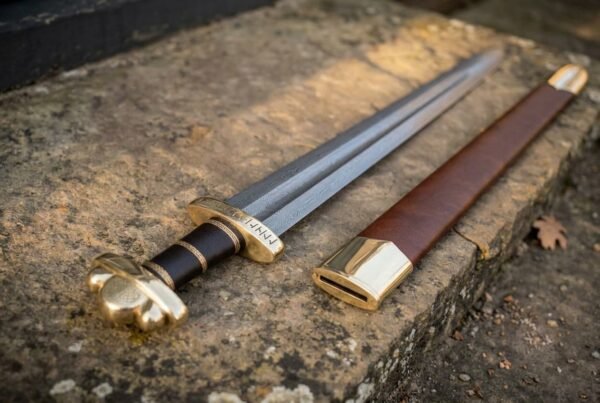
The Cairnbrand is a straight double edged sword in the Viking and early medieval pattern: a broad fullered blade, a simple straight cross, a wheel pommel and a grip wrapped in dark brown leather. A line of Elder Futhark runes runs along the blade below the guard. It ships in a brown leather scabbard.
Look closely at the shape of the letters and you will notice something about runes that most people never think about. There are almost no horizontal strokes and almost no curves. Every character is built from a vertical stem with diagonals hung off it. That is not a stylistic choice, it is a consequence of the material. Runes were cut, not written, and the surface they were cut into for most of their history was wood, along the grain. A horizontal line cut across the grain of a plank splits and disappears into the fibre. A diagonal reads cleanly. The alphabet is shaped by the knife and the grain of the wood, and it kept that shape even when it moved onto stone and steel, where it no longer had to. The Thames scramasax, found in the river in 1857, carries the whole Anglo-Saxon futhorc inlaid down its blade along with the name Beagnoth, and every character on it obeys the same rule. Ours is forged, ground, hardened and assembled by hand in the Czech Republic. It is part of the Viking swords, and the arming swords are put together the same way.
Specifications
| Blade material | 1095 high carbon steel, hardened to 54 to 58 HRC |
|---|
| Blade type | Double edged and straight, broad through the middle with a central fuller, tapering to a point |
|---|
| Inscription | Line of Elder Futhark runes cut along the blade below the guard |
|---|
| Overall length | Approximately 36 inches |
|---|
| Blade length | Approximately 29 inches |
|---|
| Guard | Straight flat steel cross |
|---|
| Grip | Dark brown leather over a wooden core, single handed |
|---|
| Pommel | Polished steel wheel pommel with a raised central boss |
|---|
| Scabbard | Dark brown leather over a timber core |
|---|
| Included | Sword and leather scabbard |
|---|
| SKU | RK-1840 |
|---|
How a rune line is laid out on a blade
Runic inscriptions on real objects follow rules that look strange to anyone used to printed text. They are written boustrophedon on some stones, meaning alternate lines run in opposite directions like a plough turning at the end of a furrow. They double letters at word joins rather than repeating them. They run right to left as readily as left to right. And they are laid out to fit the object, so an inscription on a ring bends around it and an inscription on a blade sits where the metal is flat and the light falls.
That last point is the practical one for a sword. The flat beside the fuller is the widest uninterrupted surface on the whole blade, it is slightly recessed relative to the edges so a cut line is protected, and it catches light along its length rather than across it. Put an inscription anywhere else on a sword and it gets lost in the reflection. Every historical inscribed blade we know of sits either in the fuller or on the flat next to it, and they got there by the same reasoning.
Elder Futhark has twenty four characters and no letters for several sounds that English needs, which is why a name converted into runes is a transliteration rather than a spelling. Our converter handles the substitutions in the standard way.
The steel and the fittings
The blade is 1095 high carbon steel run at 54 to 58 HRC. A long double edged blade has to do two contradictory things: hold an edge, and bend a long way and come back straight. That is why sword hardness sits below knife hardness. A sword taken to sixty is a sword that will break, and a broken sword is significantly more dangerous than a dull one.
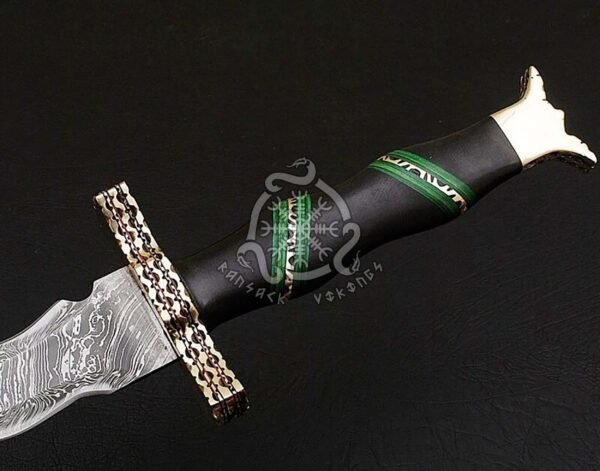
The cross and the wheel pommel are polished steel. The tang runs the full length of the grip and is peened over the pommel, which is the historical assembly and the only one that survives real use. The grip is a shaped wooden core covered in dark brown leather, tapered so that it locks into the palm rather than sitting as a straight cylinder. The scabbard is leather over a timber core, which is how scabbards were actually made: the wood does the protecting and the leather does the wearing.
Engraving, runes and your own design
Use the rune converter on this page to turn a name, a date or a short phrase into Elder Futhark and we will cut it into the steel, the leather or the wood. If you would rather have a Viking pattern than a rune line, choose your own design in the engraving option above the add to cart button and tell us where it goes. Where a piece already carries an engraved design, your chosen engraving replaces it rather than sitting alongside it. On this sword your line takes the place of the one shown along the blade, and around thirty characters fit comfortably at this length. The engraving page shows a full line at size.
Handling and balance
Balance sits four to five inches ahead of the cross, which is where a broad early medieval blade belongs. It gives the sword authority in the cut without letting the point wander. The wheel pommel is doing the counterweighting, and it is worth understanding that as an engineering choice rather than a decorative one. Remove it and the sword becomes point heavy and tiring within a minute.
A single handed grip on a blade this broad means the sword is meant to be used with something in the other hand, historically a shield. That changes how it moves. The cuts are shorter and come from the elbow and wrist rather than a full shoulder swing, and the sword is recovered rather than followed through, because the shield is what you hide behind while you reset.
Care
Keep the blade oiled. There is a great deal of bare high carbon steel on a sword this size and it will show a fingerprint within a week in a humid room. Wipe the whole length down after handling, including the part that sits inside the scabbard. Do not store the sword in the leather scabbard for months at a time in a damp space, since the leather holds moisture and the blade inside it is the one surface you never look at. Feed the leather on the grip and scabbard with a neutral conditioner once or twice a year. Check the peen at the pommel occasionally and stop using the sword if it goes loose. Our page on steel care covers oiling, storage and rust removal.
Made in the Czech Republic
Every piece we sell is made by hand in the Czech Republic. The smiths there work the way the trade has been worked for a long time, heating and hammering the steel, taking the bevels down by eye, and fitting the handle and the leather one at a time. There is no automated line anywhere in it, so small differences from one piece to the next are normal and expected.
Ransack Viking is a United States company based in Chicago, Illinois. We bring the pieces in ourselves, inspect them on arrival and ship them from our own warehouse. If you add engraving, that is carried out here in the United States before your order goes out.
A note on handmade variation
This sword is hand made rather than machine made or bulk produced, so what arrives will not be a pixel for pixel copy of the photograph. The fuller is forged in by hand and its width wanders a fraction along the blade. The runes are cut individually and each one sits at its own depth, which is what makes them look cut rather than printed. Leather takes dye unevenly and the grain of a hide never repeats, so the grip and the scabbard will have their own tone. The polish takes light its own way. The length, the steel, the heat treat and the build are the same every time. The character is not. The long form of that is the Norse symbols and what they meant, with the Viking swords collectors go for next to it.
Frequently asked questions
Can I choose what the runes say
Yes. Put a name, a date or a short phrase through the rune converter on this page and your line replaces the one in the photograph. Around thirty characters fit along the blade.
Is it sharp when it arrives
Yes. Tell us in the order notes if you would rather it came blunt for display or for a reenactment group.
Is this suitable for full contact sparring
No. It ships sharp and it is built for cutting, collecting and display. Sparring requires a blunt with rolled edges and a rebated tip, which is a different sword.
Is the scabbard included
It is. The brown leather scabbard ships with the sword and is fitted to that blade.
Do the runes go all the way through or wear off
They are cut into the steel, not printed on it, so they will not wear off. Heavy polishing over many years softens their edges slightly.
How long does it take to arrive
One to two weeks of processing, then free shipping inside the United States. Engraved orders take the longer end of that window.
What is in the box
- Cairnbrand Viking sword in 1095 high carbon steel with a runic blade inscription
- Brown leather scabbard over a timber core
- Care card covering oiling, leather feeding and storage
- Lifetime warranty against defects in forging, grind, heat treat and fittings
- Forged and finished in the Czech Republic
Explore the range
See the rest of the Viking swords, the arming swords, the full sword range, or read the guides for how Elder Futhark transliterates a modern name.
Others in the same line
Worth putting side by side with this is the Bindoath Viking sword, 36 inches overall. In the same category sits the Runemarch Viking sword, 36 inches overall. A near match for this one is the Serpentcrown Viking sword, 36 inches overall.
For a different piece from the same family, look at the Knotwarden arming sword. You can have this made your way instead on the custom Viking sword page.

Been eyeing this sword for months and it did not disappoint. Even the small engravings are crisp and clean. Leather sheath is thick and well stitched. Not the cheap stuff you usually get. 1095 Steel blade holds a razor edge right out of the box. Already planning my next purchase from this shop.
Photos don’t do this sword justice at all. 1095 Steel blade holds a razor edge right out of the box. Ordered from Ransack Viking before and the quality stays consistent every time. Already planning my next purchase from this shop.
Absolutely blown away by this sword. Already planning my next purchase from this shop.