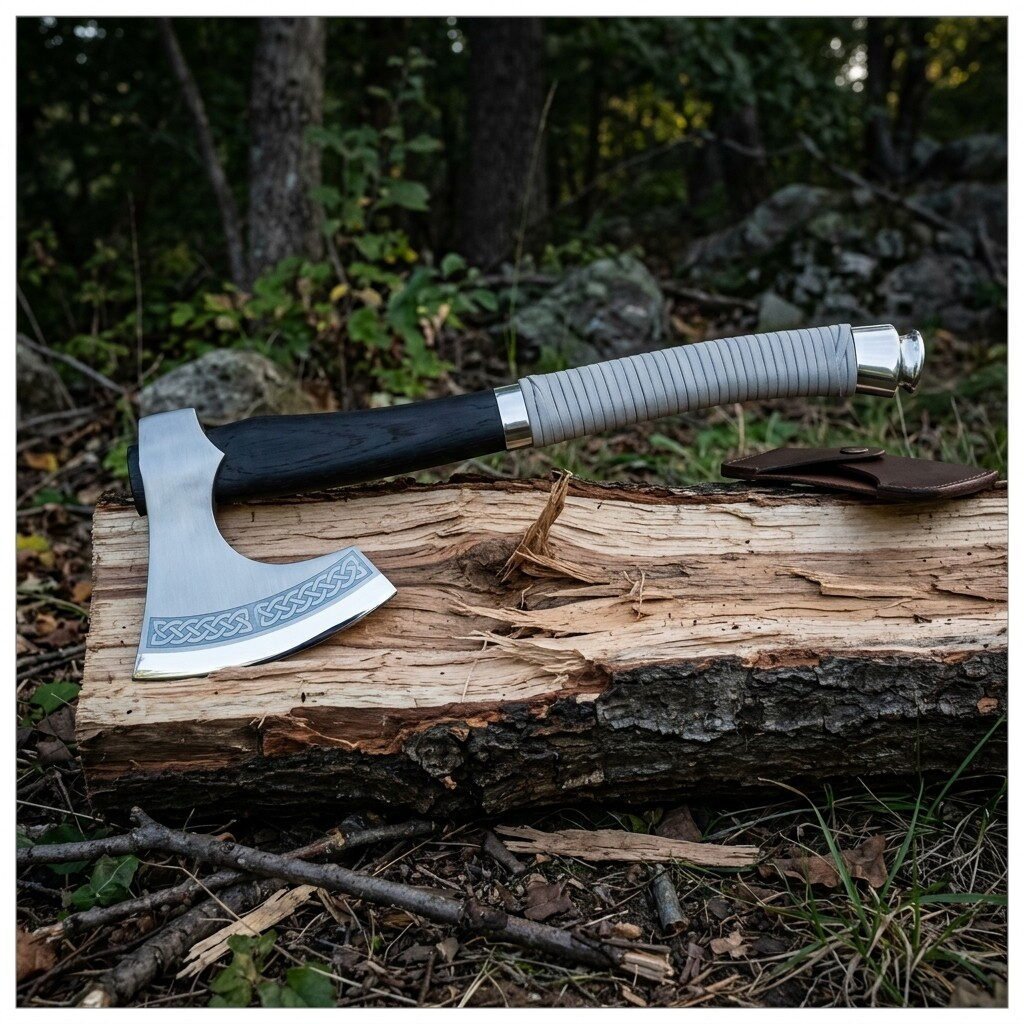
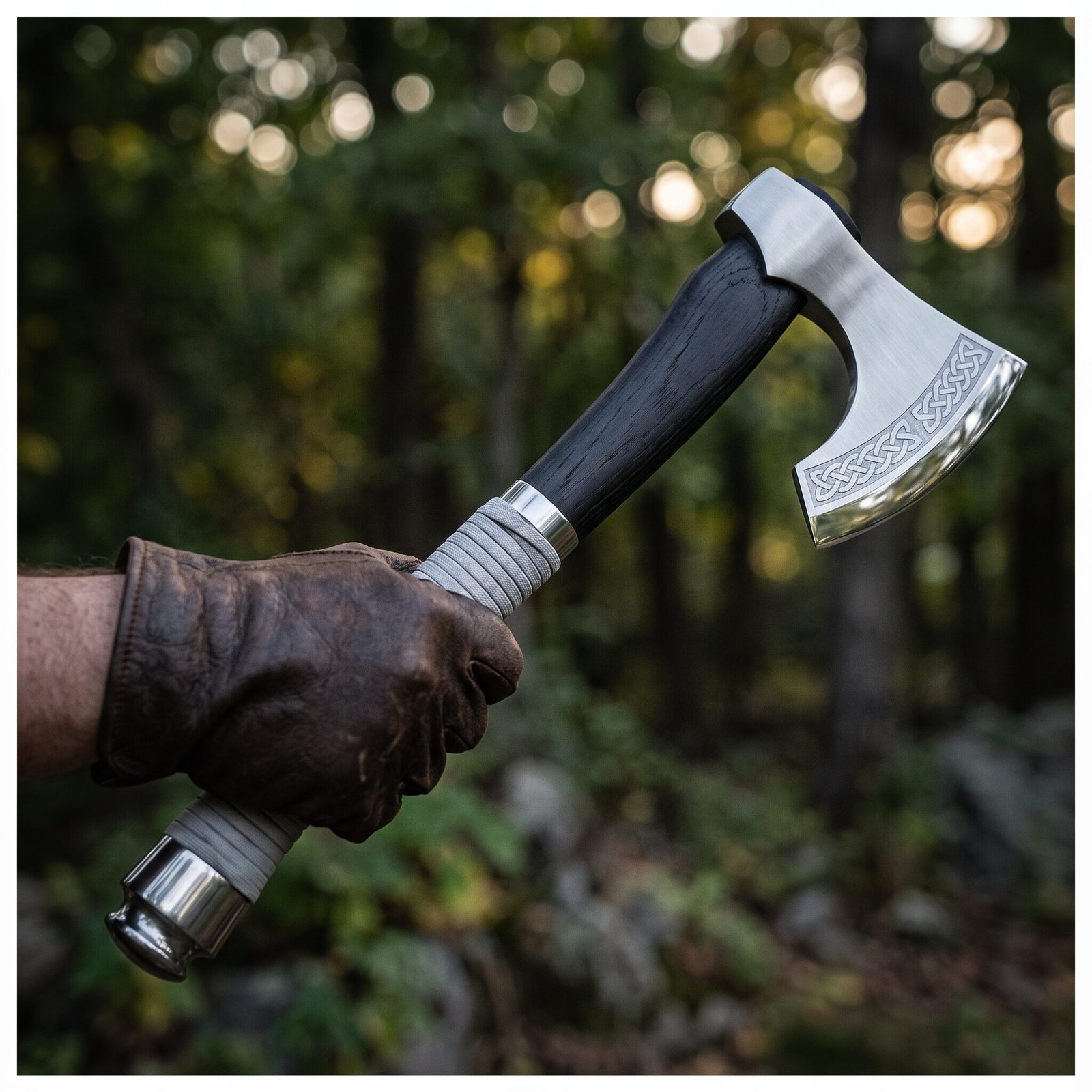
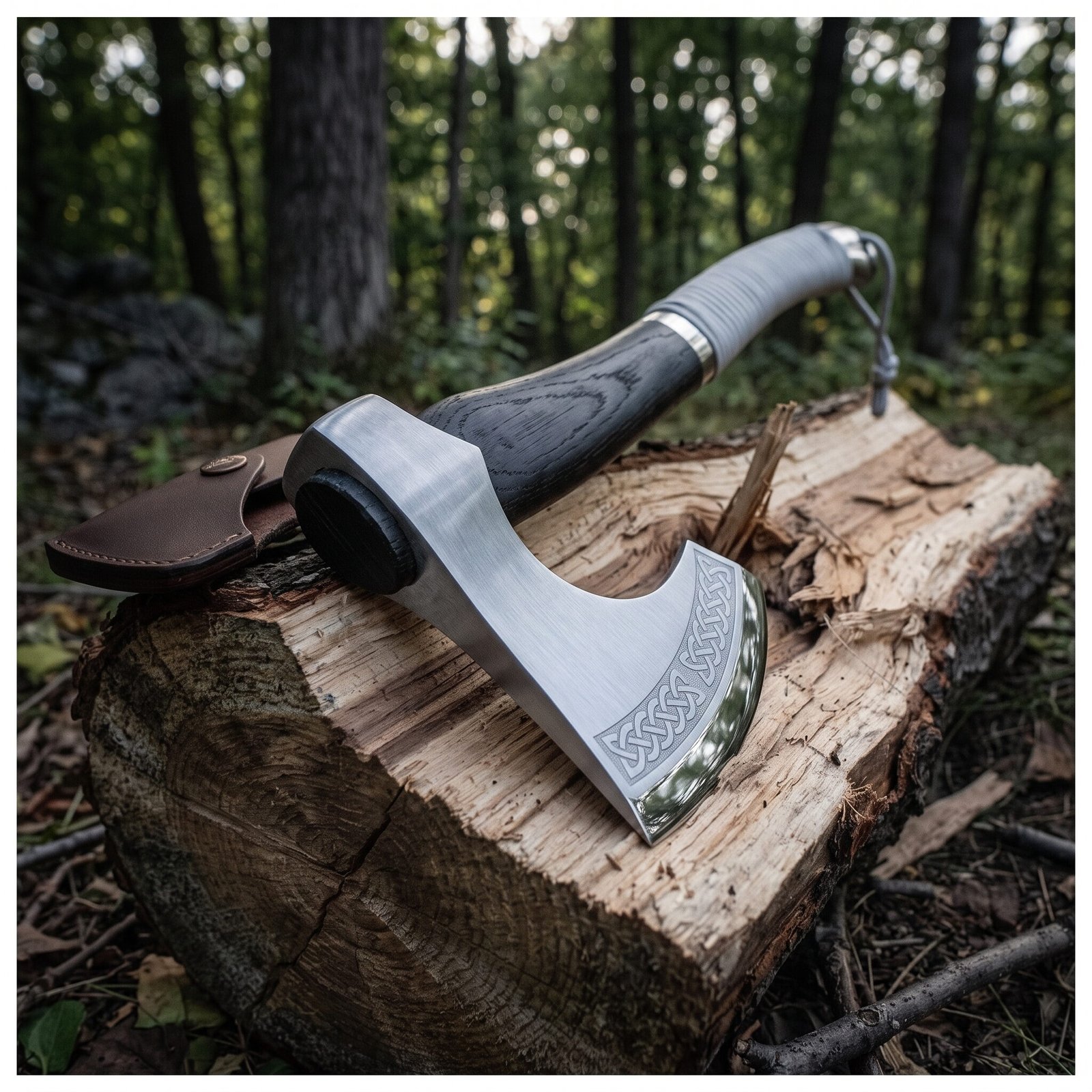
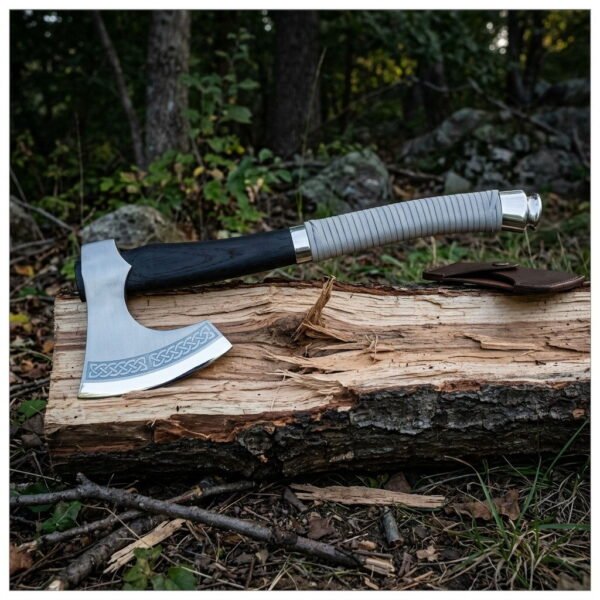
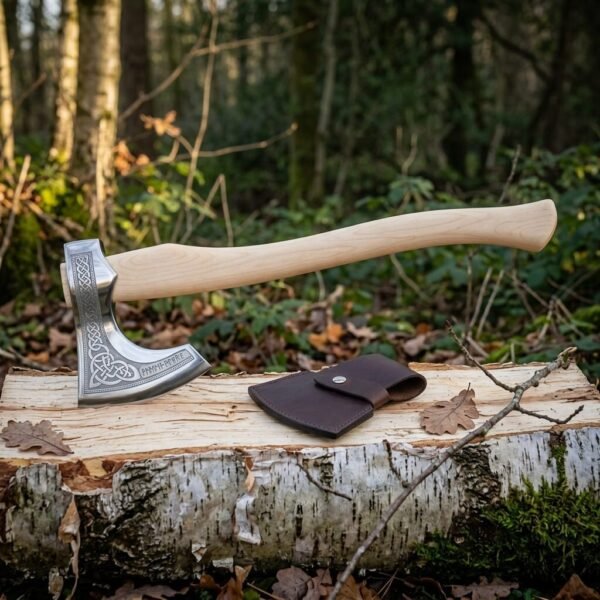
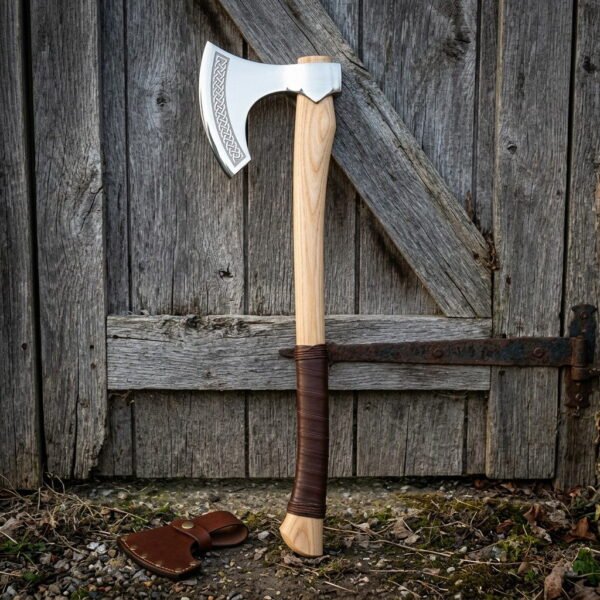
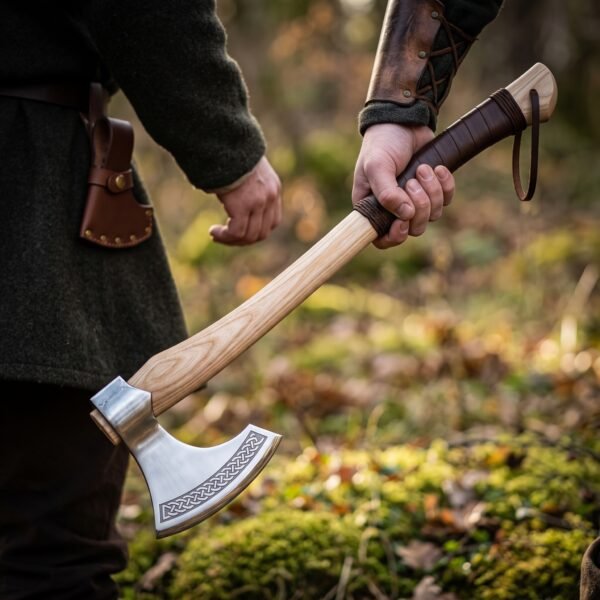
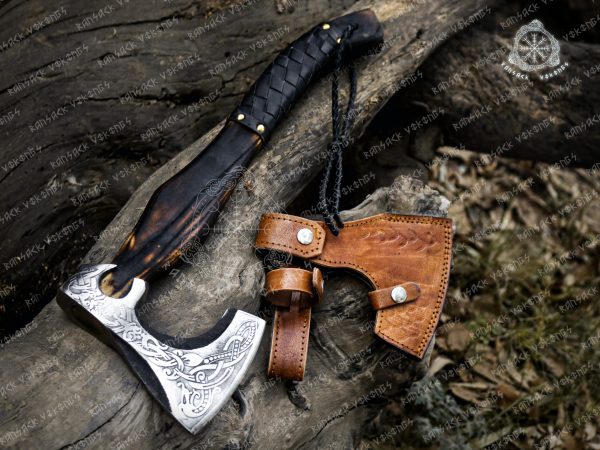
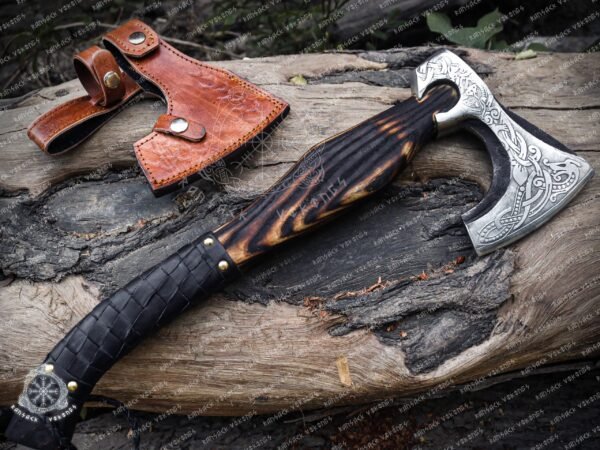
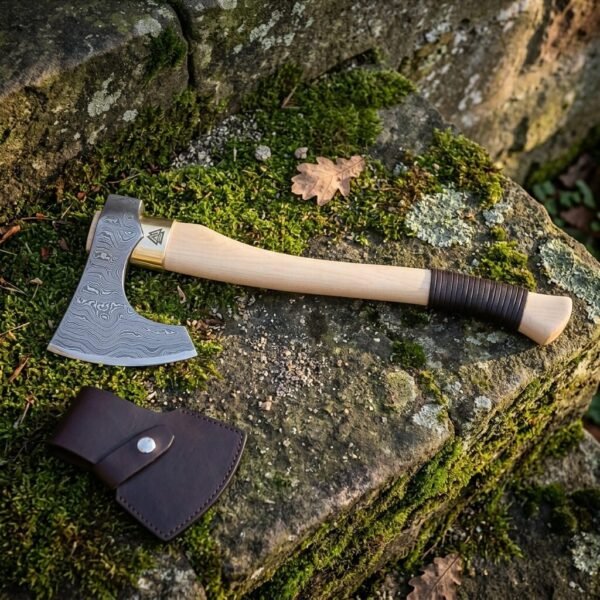
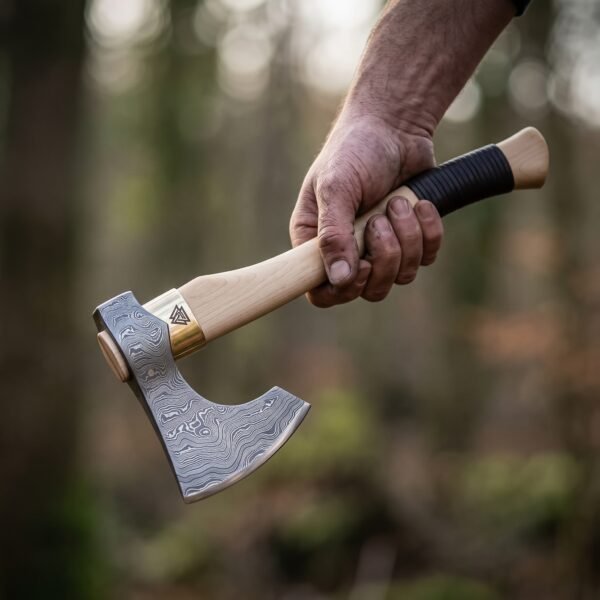
The Braidhewn is a bearded axe, the pattern that turns up more than any other when Viking age graves and river finds are dug out and laid on a table. The head is polished 1095 high carbon steel with a band of Celtic plaitwork etched along the cutting edge, and it sits on a dark hardwood haft with a grey cord wrapped grip, a steel collar and a steel butt cap. A leather cover for the edge comes with it.
The reason so many original axe heads survive is a detail of how they were built. Steel was expensive in the ninth century and iron was not, so a smith would take a bar of wrought iron, bend it around a mandrel to form the eye, forge weld the two tails together to make the blade, and then weld a thin wedge of hardened steel into the cutting edge and nothing else. The body of the axe was cheap iron. Only the last quarter inch was the expensive stuff. It is one of the most economical pieces of metalwork anyone has ever designed, and it is why a working axe was something an ordinary farmer could own when a sword was not. We do not need to save steel that way now, so ours is forged as one piece of 1095, heat treated through, and finished by hand in the Czech Republic. It is catalogued with the bearded axes, and the axe handles and hafts sit one click away.
Specifications
| Head material | 1095 high carbon steel, hardened to 54 to 58 HRC |
|---|
| Head pattern | Bearded, with a swept lower edge and a narrow eye |
|---|
| Cutting edge | Approximately 7 inches along the curve |
|---|
| Overall length | Approximately 20 inches |
|---|
| Haft | Dark stained hardwood, light grey cord wrapped grip on the lower half |
|---|
| Fittings | Polished steel collar above the grip and polished steel butt cap |
|---|
| Decoration | Celtic plaitwork band etched along the cutting edge on both faces |
|---|
| Finish | Bright polished head, polished steel collar and cap |
|---|
| Included | Axe and fitted brown leather edge cover with stud closure |
|---|
| SKU | RK-1832 |
|---|
What the beard on a bearded axe is actually for
The beard is the part of the edge that hangs below the eye, and it does three separate jobs. The first is that it gives you a long cutting edge without giving you a heavy head. Length of edge is what lets you shear rather than chop, and mass is what tires your arm out, so an axe that gains edge by hanging it downward rather than by making the whole head bigger is a better tool to swing all day.
The second job is the gap behind it. Because the beard curves away from the haft there is an open space between the steel and the wood, which means you can slide your hand right up under the head and hold the axe just behind the bit. That grip turns a felling axe into a carving tool. It is how you shape a tenon, take the corners off a post or trim a spoon blank, and it is the reason a bearded axe is still the pattern green woodworkers reach for.
The third job only matters if someone is standing in front of you. A hooked lower point catches things. In the sagas it catches a shield rim, and once the rim is caught the shield comes down and stays down. That is not a use we recommend, but it is why the shape looks the way it does.
The steel, the etching and the haft
The head is 1095, a plain high carbon steel with close to one percent carbon and nothing much else in it. It hardens deeply, it takes a keen edge on an ordinary stone, and it is tough enough to go into seasoned hardwood without chipping. We run it at 54 to 58 HRC, which is a working axe hardness rather than a knife hardness. An axe edge that is too hard chips on a knot, and an axe that chips is worse than an axe that dulls.
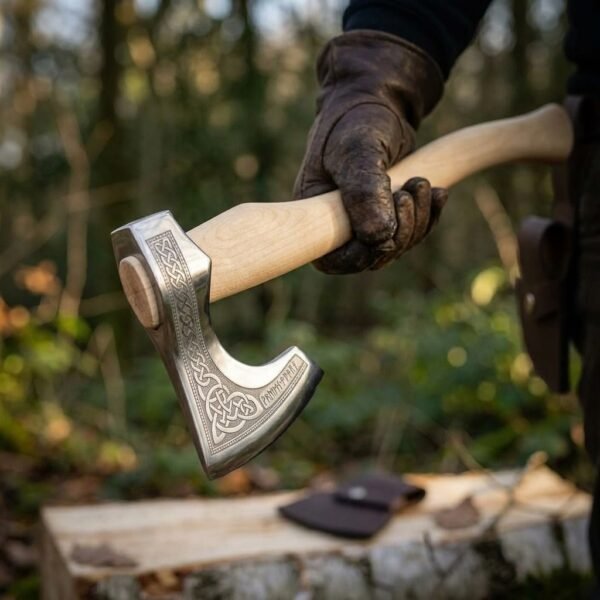
The knotwork band along the beard is acid etched rather than laser marked, which leaves the pattern slightly below the surface of the polish so it holds its line as the axe wears. Interlaced plaitwork of this kind runs across Insular and Norse metalwork for centuries, from the Book of Kells to Urnes style carving, and the whole logic of it is that the band never ends. It is a single cord that crosses itself and returns.
The haft is a close grained hardwood, stained dark, with the grain running along the length of the head as it must on any axe that is going to be used. A haft with the grain running across the eye will break. The cord wrap on the lower half gives a sure hold at the end of the haft, and the bare wood above it is where the hand goes when you choke up.
Engraving, runes and your own design
Use the rune converter on this page to turn a name, a date or a short phrase into Elder Futhark and we will cut it into the steel, the leather or the wood. If you would rather have a Viking pattern than a rune line, choose your own design in the engraving option above the add to cart button and tell us where it goes. Where a piece already carries an engraved design, your chosen engraving replaces it rather than sitting alongside it. On this axe the usual place for a rune line is the flat cheek above the knotwork band, and the engraving page shows how deep the cut sits on a polished face.
Handling and balance
A 20 inch haft is a one handed length. You swing it from the elbow, not the shoulder, and the head does the work. Held at the bottom of the haft it has enough reach and speed to take a limb off a log in a few strokes. Held choked up under the head it becomes a controlled carving tool and the weight stops being a factor at all.
Balance sits well forward, as it should on an axe, which is the opposite of a sword and is what makes an axe feel heavier than its weight. That forward mass is the whole point. It is what carries the edge through the cut once you have started it, and it is why a light axe swung hard does less work than a heavier axe swung correctly.
Care
Wipe the head down after use and put a thin film of oil on it. Bare 1095 will show rust freckles if it goes into a damp shed wet, and a leather cover left on a wet head is the fastest way to get them, so let it dry before the cover goes back on. Sharpen with a puck or a coarse stone worked in circles along the bevel, then strop it. Do not put an axe on a bench grinder. Heat kills the temper and you cannot put it back. Feed the leather cover with a neutral conditioner once or twice a year. Oil the haft with boiled linseed when it starts to look dry and pale, which also swells the wood in the eye and keeps the head tight. Our page on steel care covers rust removal and oiling in more detail.
Made in the Czech Republic
This is a handmade piece from the Czech Republic, made in a workshop that still forges, grinds and finishes by hand instead of stamping parts out. The smiths there have kept the older way of working, and the wood, horn and leather are shaped and fitted by hand as well. Two pieces of the same design will never be identical, and that is part of what you are buying.
Ransack Viking is a United States company. We handle the import ourselves, look over every piece when it lands and ship from our warehouse in Chicago, Illinois. Engraving is done in the United States after the piece arrives, so your design goes on before we send it out.
A note on handmade variation
This axe is hand made rather than machine made or bulk produced, so what arrives will not be a pixel for pixel copy of the photograph. The hammer texture on the cheeks falls where the hammer fell. The etched knotwork bites slightly differently into every face. Hardwood is a natural material and takes stain unevenly, so one haft will be warmer or darker than another and the grain will run its own way. The leather cover will vary in tone. The edge length, the steel, the heat treat and the build are the same every time. The character is not. If you want the longer version, look at the Viking axes worth a look and then at the axe set against the tomahawk.
Frequently asked questions
Is it sharp enough to actually cut wood
Yes. It arrives with a working edge and it is built as a tool, not as a wall piece. Split kindling with it, carve with it, take it camping.
Can I throw it
You can, but a stained hardwood haft with a butt cap is not built to survive repeated misses hitting the target sideways. If you want an axe purely for throwing, buy one with a plain replaceable haft and keep this one for cutting.
Is the leather cover included
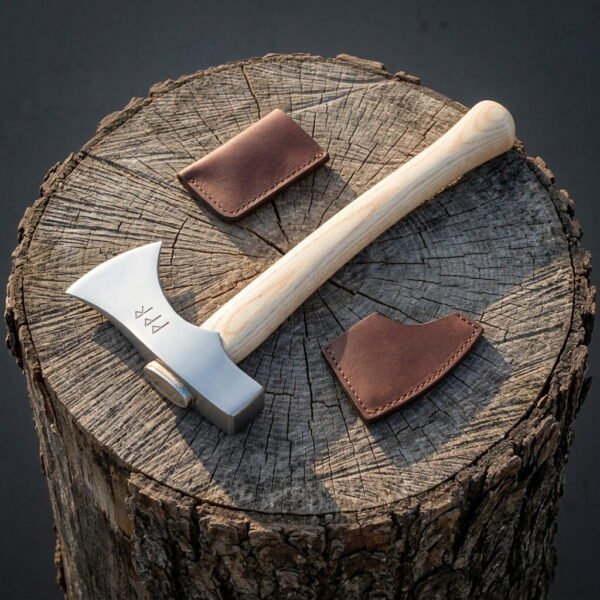
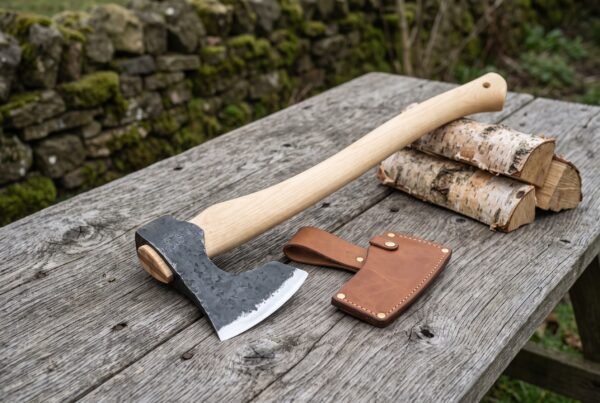
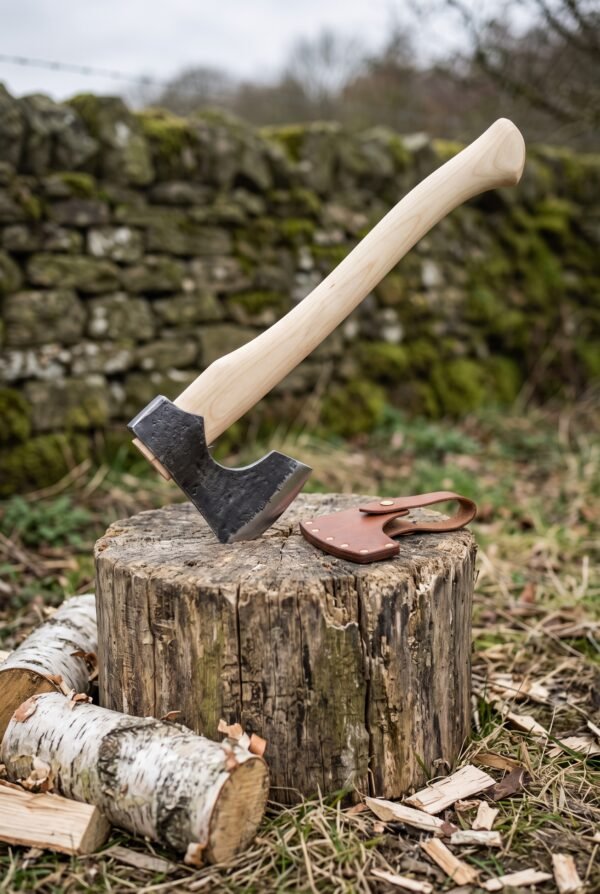
It is. The fitted cover in the photograph ships with the axe and slips over the edge with a stud closure.
Will the knotwork wear off
No. It is etched into the steel rather than printed on top of it, so it survives sharpening and normal use. Heavy polishing over years will soften it slightly.
How do I keep the head tight on the haft
Keep the wood fed with boiled linseed oil and store the axe somewhere that is not bone dry. Wood shrinks in a heated room over a winter, and a head that has gone loose can usually be brought back by oiling the haft rather than by hammering the wedge.
How long does shipping take
One to two weeks of processing, then free shipping inside the United States. Engraved orders sit at the longer end.
What is in the box
- Braidhewn bearded axe with a 1095 high carbon steel head
- Dark stained hardwood haft with a cord wrapped grip and steel butt cap
- Fitted leather edge cover
- Care card covering oiling, sharpening and haft maintenance
- Lifetime warranty against defects in forging, grind, heat treat and fittings
- Forged and finished in the Czech Republic
Explore the range
See the rest of the bearded axes, the wider Viking axe range, the Norse arms we carry, or read the guides for how an axe head is hung and kept tight.
Also in this part of the catalogue
Worth putting side by side with this is the Wyrmhewn bearded axe, high carbon steel. In the same category sits the Brasshelm bearded axe, pattern welded Damascus. A near match for this one is the Wayfarrow bearded axe.
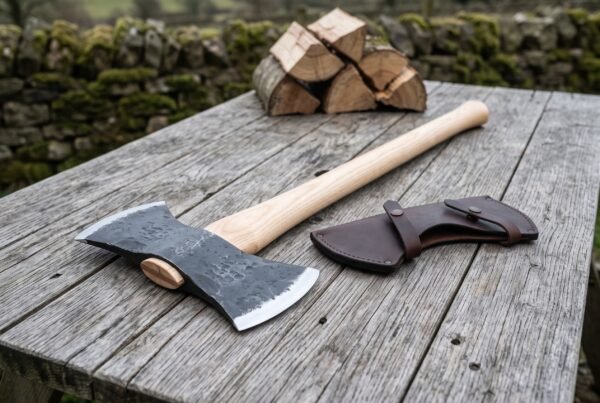
For a different piece from the same family, look at the Twinbite felling axe. Or start from a blank sheet on the custom Viking axe page.


Pretty impressed. Just a couple minor things I’d tweak. Would buy from this shop again.
Pretty impressed. Just a couple minor things I’d tweak. Sheath is nice. Wish it had more padding but it does the job. Would buy from this shop again.
This axe is a genuine work of art. The wood handle feels amazing and the balance is perfect. 1095 Steel blade holds a razor edge right out of the box. Love it.
Got this as a gift and now I want one for myself too. Weight and balance make it feel like a real functional piece not some cheap replica. Shipping was fast and everything arrived well packaged.
Did not expect this level of quality for the price. 1095 Steel blade holds a razor edge right out of the box. Weight and balance make it feel like a real functional piece not some cheap replica. So worth it.