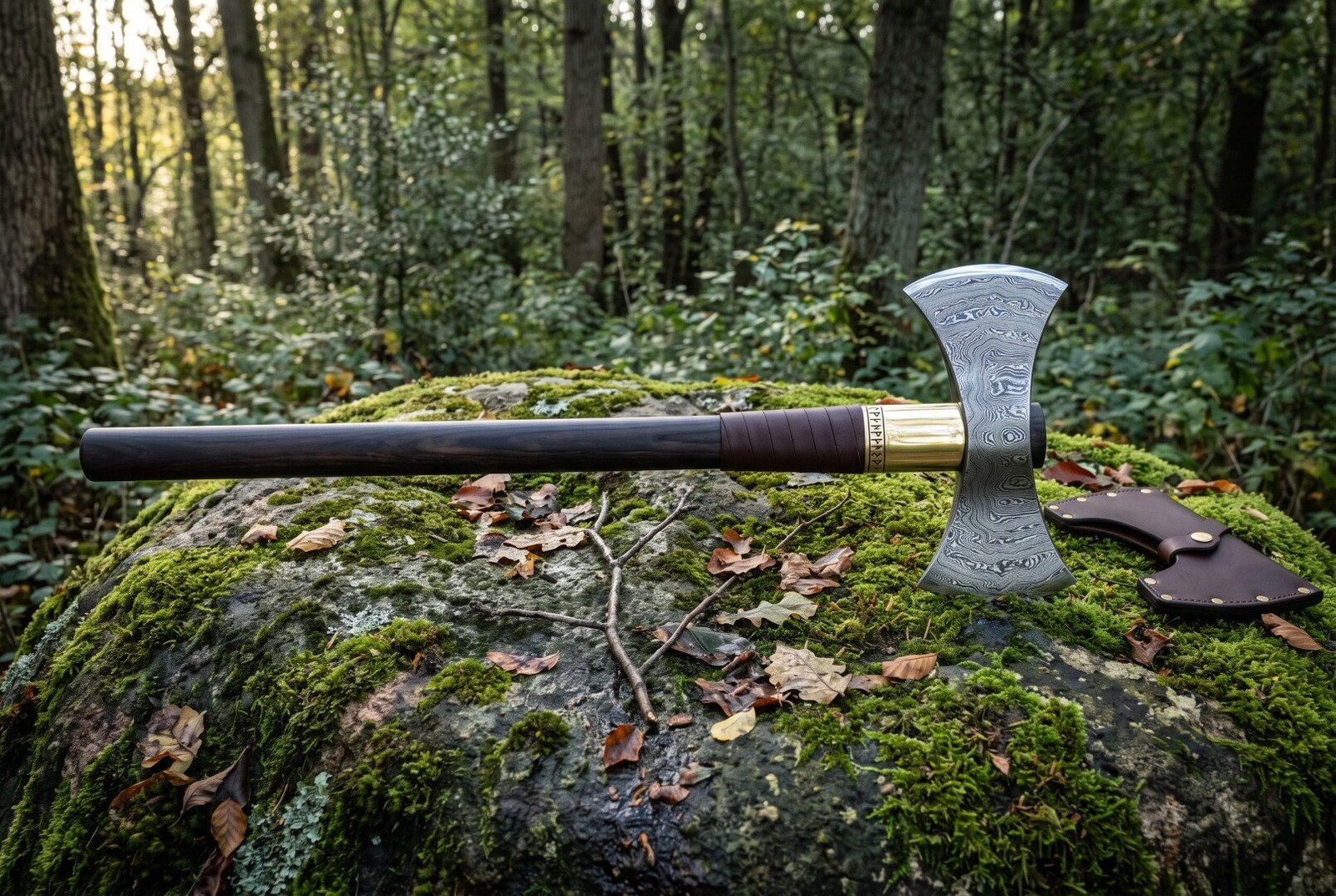
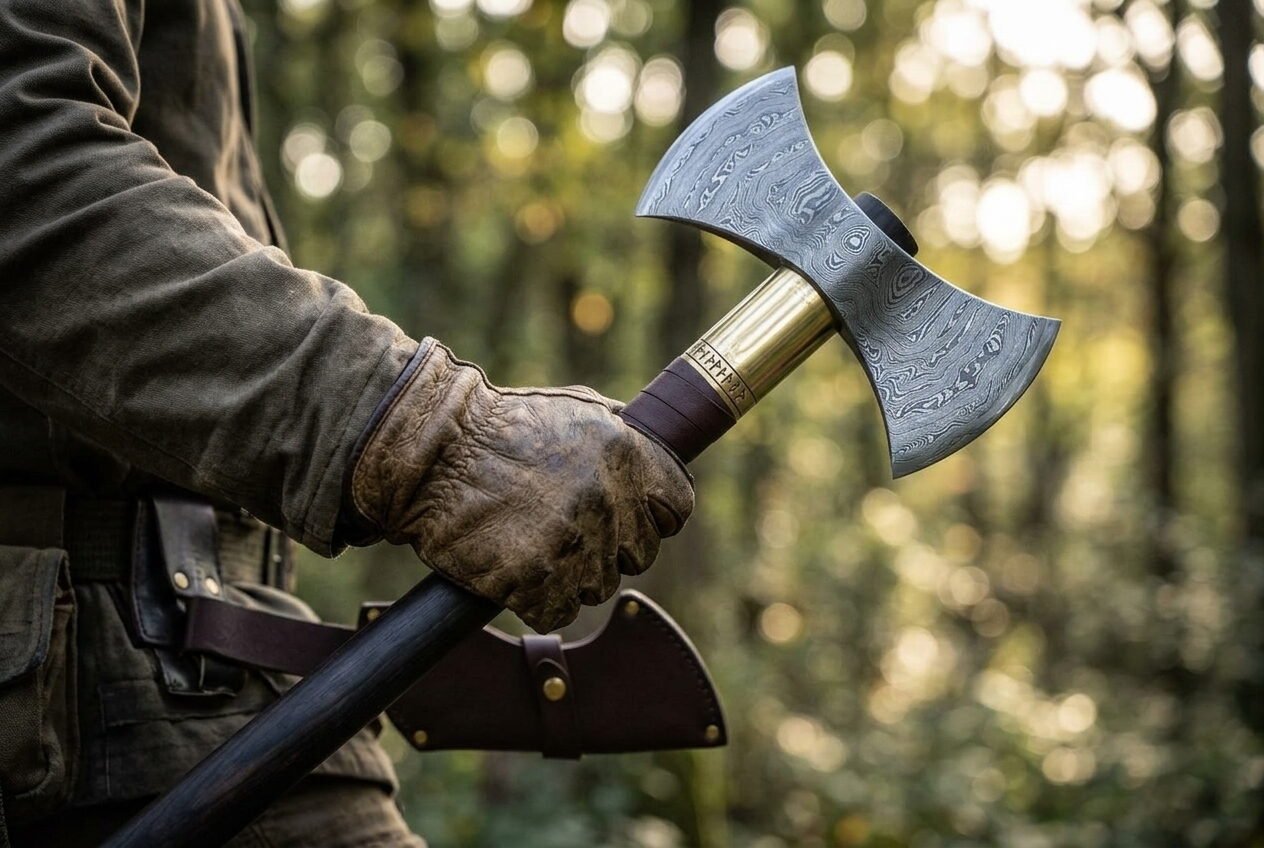
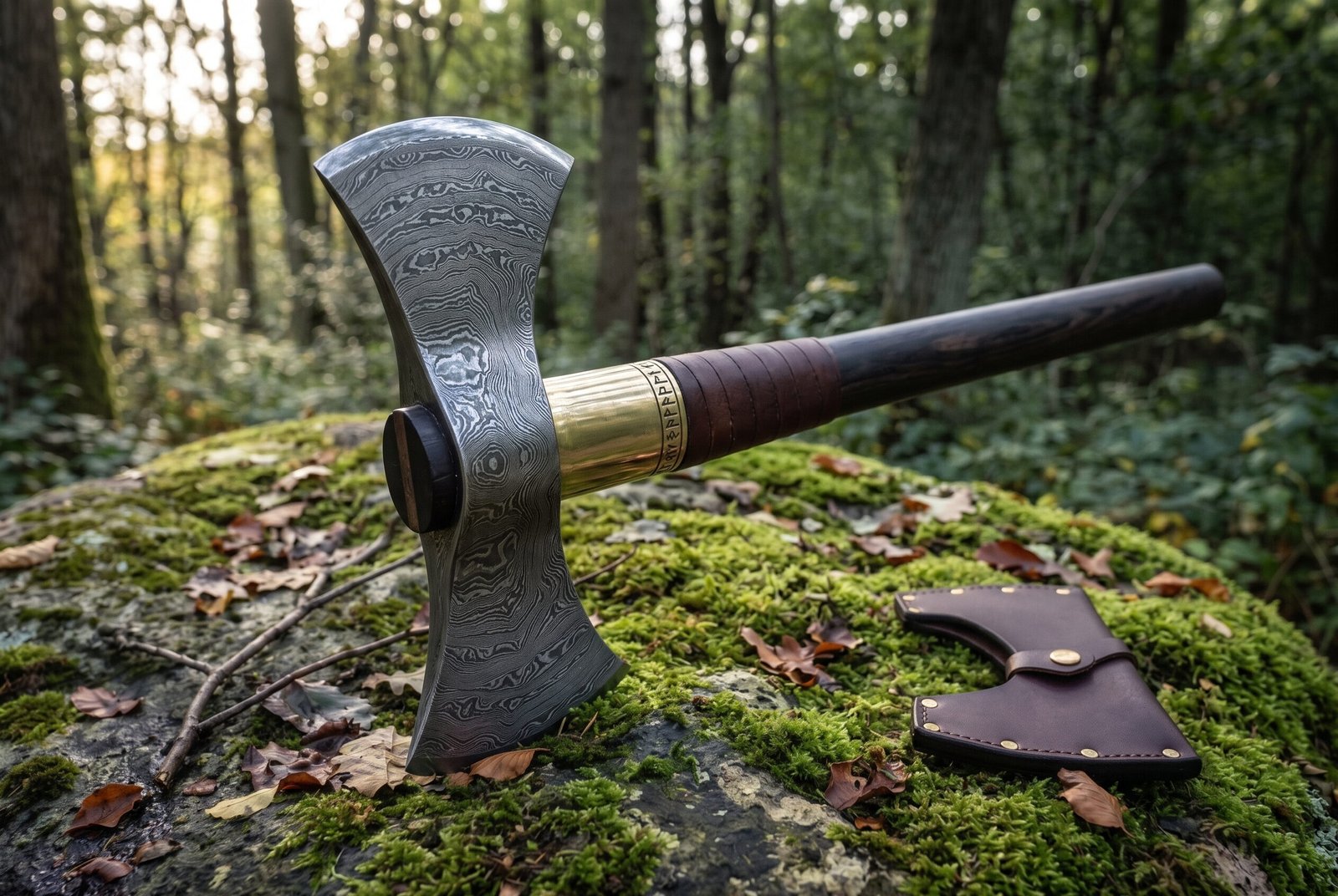
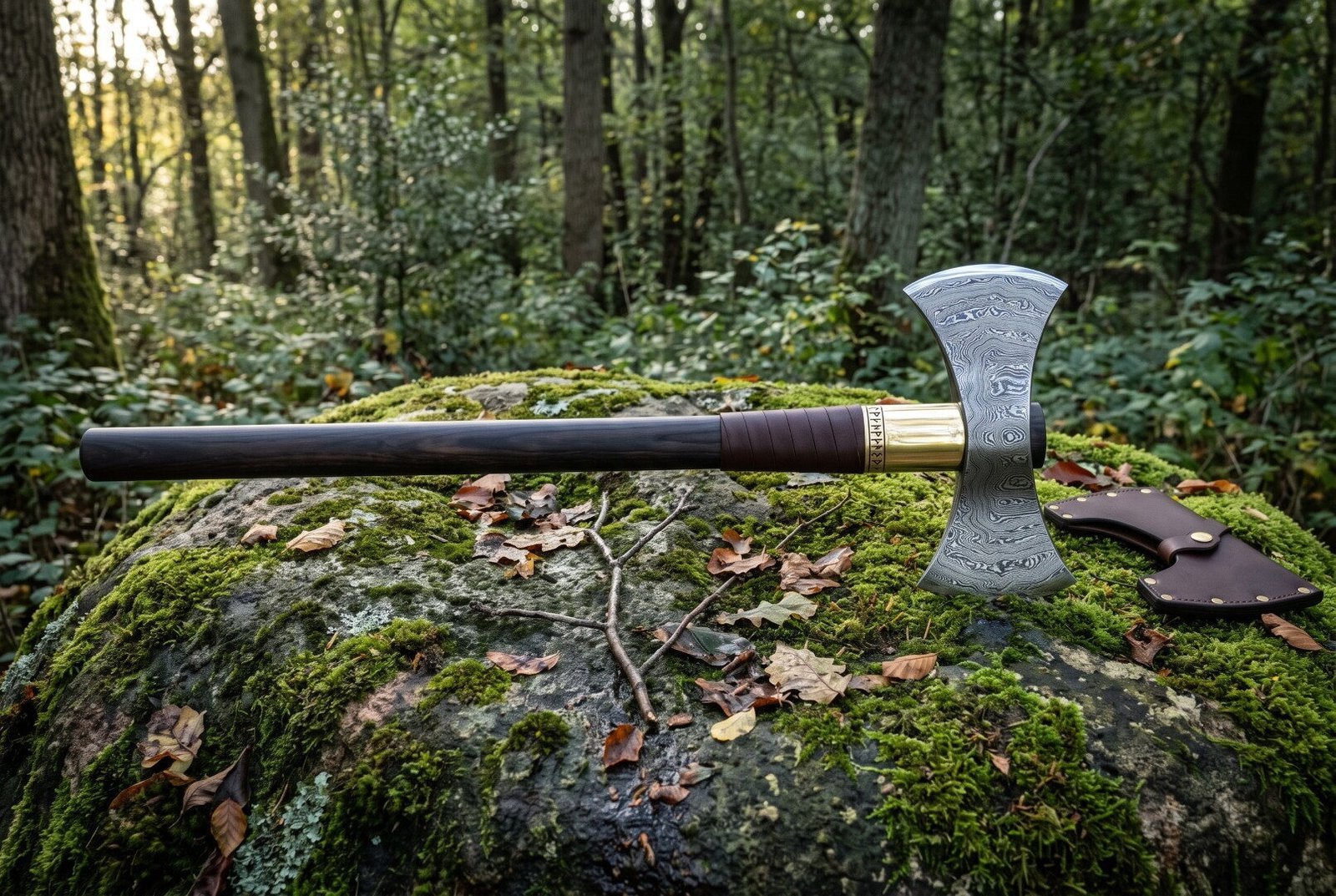
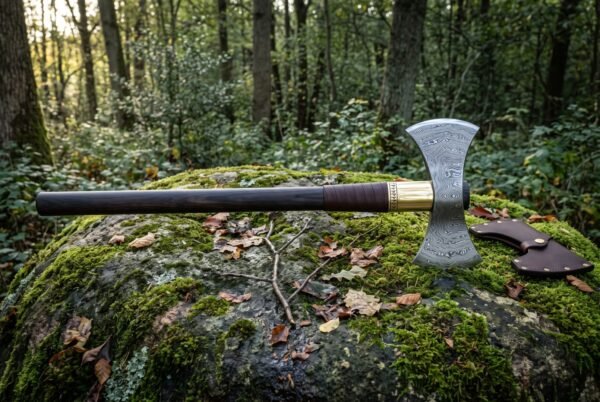
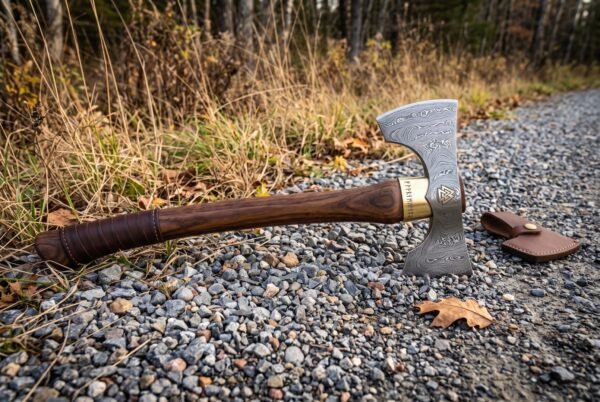
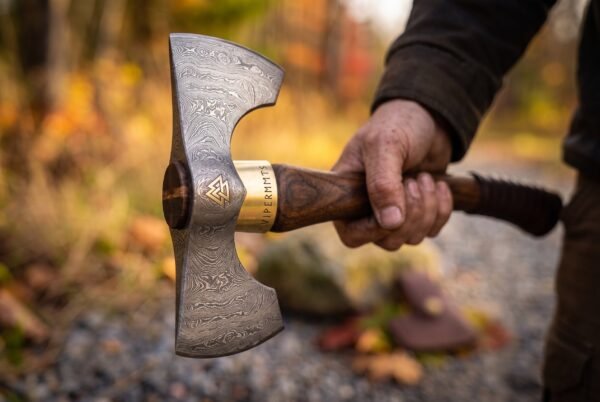
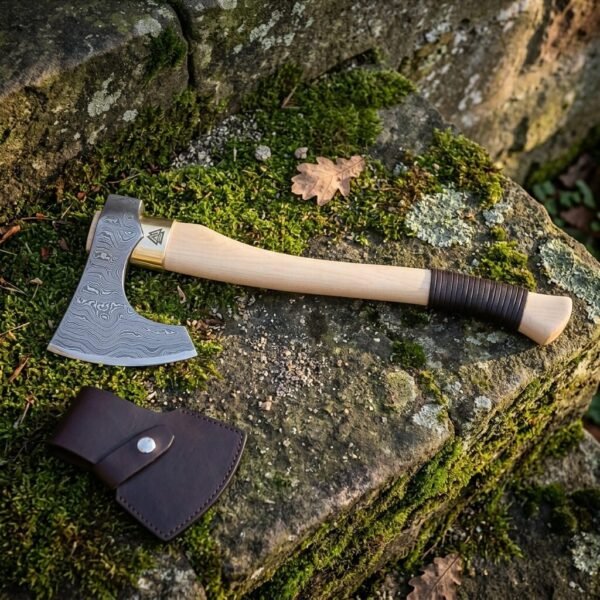
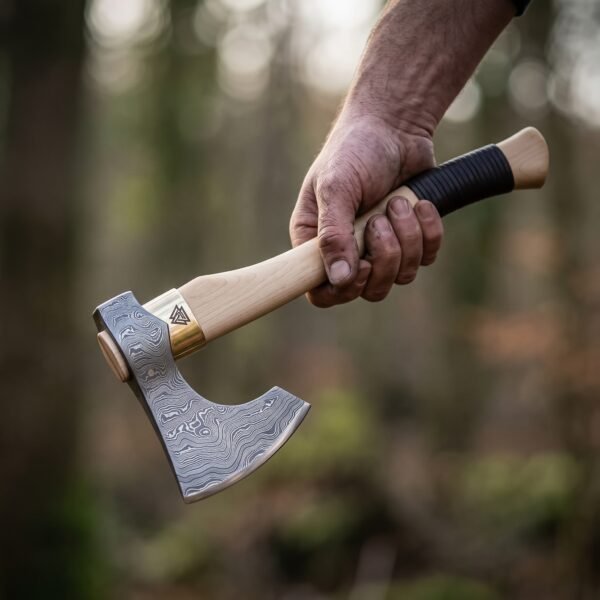
Two bits, one head, a brass collar at the eye and a long dark hardwood haft with a leather wrap where the front hand sits. Both cheeks show the flowing layers of forge welded Damascus, and the brass collar carries an engraved rune band. It is a handsome thing and it is a genuinely useful tool, so let us start with the part most sellers skip. This is not a Viking axe and it never was one. Every axe head recovered from a Norse context, from the light bearded hand axes to the great long hafted Dane axes, has a single bit and a poll on the back. Not one double bitted head has come out of a Viking Age grave anywhere in Scandinavia.
The double bit is an American invention, and a fairly recent one. It appeared in the logging camps of the north east in the middle of the nineteenth century, and the reason it caught on had nothing to do with fighting. A logger kept one edge razor sharp for clean felling cuts and let the other edge run a little thicker and blunter for grubbing near the ground, where a blade meets grit and bark and takes damage. Two edges also meant twice as long between trips to the grindstone. The double headed battle axe that turns up in films and games traces back through fantasy illustration to the Minoan labrys, a Bronze Age ritual object from Crete, not to any battlefield axe. This one is forged, ground, etched and hafted in a Czech Republic workshop, and it ships with a fitted leather blade cover. Head weight, haft length and what each shape is for are set out in how to choose a Viking axe.
Specifications
| Head material | Hand forged Damascus, 1095 and 15N20 forge welded |
|---|
| Hardness | 58 to 60 HRC at the edges |
|---|
| Head pattern | Flowing Damascus layer pattern across both cheeks |
|---|
| Bit width | Approximately 7 inches across both edges |
|---|
| Overall length | Approximately 30 inches |
|---|
| Weight | Approximately 4 lb 6 oz complete |
|---|
| Haft | Dark stained hardwood, oval section, wooden wedge showing at the top of the eye |
|---|
| Grip | Dark brown leather wrap below the collar |
|---|
| Collar | Brass collar at the eye with an engraved rune band |
|---|
| Sheath | Stitched brown leather blade cover with brass rivets |
|---|
| Intended use | Camp and woodland work, display and photography. Not for contact reenactment |
|---|
| SKU | RK-1576 |
|---|
Why two edges, and how to use them
A double bit is balanced in a way a single bit axe never is. Because the mass sits evenly on both sides of the haft, the head does not want to roll in your hands at the top of the swing, and the axe tracks straighter into the same cut over and over. Loggers valued that far more than they valued the second edge, and it is the reason the pattern held on into the twentieth century after the second edge stopped mattering so much.
The traditional discipline is worth keeping. Take one bit and keep it keen for clean wood, sappy standing timber and fresh cuts where nothing will touch the edge but fibre. Let the other run a slightly thicker grind for the dirty work, roots near soil, deadfall that has been lying in grit, splitting rounds where the bit may find the ground. Mark the keen side somewhere on the haft so you know it by feel. Do that and the axe holds a usable edge through a whole weekend of camp work rather than needing a stone at lunchtime.
The brass collar at the eye is not just decoration. A collar spreads the shock of an overstrike, the moment when you miss the round and the haft takes the blow just under the head, which is how most axe handles die. It will not make the haft indestructible, but it takes the worst of the first hit.
Damascus steel and the heat treat
The head is forge welded Damascus, 1095 high carbon steel layered with 15N20, heat treated so the edges land between 58 and 60 HRC. The 1095 carries the carbon that takes and holds an edge, and the nickel in the 15N20 adds the toughness a bit needs when it meets a knot. Keep it off nails and stones all the same, and dress any rolled edge with a file and a stone in the field.
The pattern on the cheeks is the steel itself. The two steels are stacked, forge welded and folded, then the finished head is etched so the 1095 darkens and the 15N20 stays bright. Grind into it and the pattern carries on, because the layers run right through the metal. The rune band sits on the brass collar at the eye, engraved rather than etched.
Engraving, runes and your own design
Use the rune converter on this page to turn a name, a date or a short phrase into Elder Futhark and we will cut it into the steel or the leather. If you would rather have a Viking pattern than a rune line, choose your own design in the engraving option above the add to cart button and tell us where it goes. Where a piece already carries an engraved design, your chosen engraving replaces it rather than sitting alongside it. On this axe the flat of a cheek is the obvious place, and the leather blade cover will also take a name or a date on the face. Details are on the engraving page.
Handling, storage and display
A double bit needs more room than a single bit and more thought about where you put it down. There is no poll to rest on, so it will not stand on a bench, and laying it flat means one edge is always up. Keep the cover on whenever the axe is not in your hands. On a wall it hangs well from two pegs under the head with the haft dropping straight down, and the etched cheeks read best with light coming across them rather than straight on. Do not hang it over a doorway or a seat, and keep it well out of reach of children, because a double bit presents an edge in every direction.
Care
Damascus of 1095 and 15N20 is a carbon steel and it will rust if it is left wet. Wipe the head down after use, especially after cutting green wood, because sap is acidic and will mark bare steel overnight. A thin film of light oil on both bits and across the etched faces two or three times a year is enough for a tool that lives indoors, more often if it lives in a shed. Sharpen with a file for the heavy work and finish on a stone, following the existing bevel rather than trying to reprofile it. Keep the leather cover fed with conditioner so it stays supple, and never store a damp axe inside a leather cover, because leather holds moisture against steel and will etch a permanent shadow into the bit. Full rust and oiling guidance is on the steel care page. Sharpening starts with a file, and how to sharpen an axe takes it through to the strop.
Made in the Czech Republic
Every piece we sell is made by hand in the Czech Republic. The smiths there work the way the trade has been worked for a long time, heating and hammering the steel, taking the bevels down by eye, and fitting the handle and the leather one at a time. There is no automated line anywhere in it, so small differences from one piece to the next are normal and expected.
Ransack Viking is a United States company based in Chicago, Illinois. We bring the pieces in ourselves, inspect them on arrival and ship them from our own warehouse. If you add engraving, that is carried out here in the United States before your order goes out.
A note on handmade variation
This axe is hand made, not machine made and not bulk produced, so what arrives will not be a pixel for pixel copy of the photograph. The Damascus pattern on the cheeks, the exact depth and contrast of the etch, the grain and tone of the hardwood haft and the way the leather wrap sits all vary because each one is worked by hand. The dimensions, the material and the build are the same every time. The character is not.
Frequently asked questions
Is this a real Viking axe?
No, and we will not sell it as one. Norse axes are single bitted with a poll on the back, and no double bitted head has ever been found in a Viking Age context. The double bit is an American logging pattern from the nineteenth century. This is a Norse styled camp and woodland axe rather than a reconstruction.
Is the pattern on the head Damascus?
Yes. The head is forge welded 1095 and 15N20 Damascus, so the layers run right through the metal and the pattern continues across every ground face.
Can I actually chop with it?
Yes. It is a working axe with a real heat treat, sized and weighted for camp and woodland use. Keep one bit keen for clean wood and let the other run thicker for dirty cuts, which is exactly how the pattern was used in the logging camps.
Can I use it in reenactment combat?
No. It is sharp and it is a double bit, which means an edge is always presented in two directions. It is not a blunted contact trainer and no reenactment group will pass it for a bout. Use it for camp work, display and photography.
Does it come sharp?
It ships with a working edge on both bits, ready to cut. Most owners then take one side up finer on a stone for clean wood and leave the other as it comes for rough work.
How long until it ships?
One to two weeks of processing, because each head is forged, heat treated, etched and hung to order and the leather cover is stitched to that head. Engraving adds a few days. Shipping is free within the United States and returns are accepted within seven days.
What is in the box
- One double bit axe head in 1095 and 15N20 Damascus, etched, hung, wedged and pinned
- Approximately 30 inch stained hardwood haft with a leather wrapped grip
- Rune engraved brass collar fitted at the eye
- Stitched leather blade cover
- Care card covering oiling, sharpening and leather
- Forged and finished in the Czech Republic
Explore the range
The single bitted Norse heads are in Viking axes, the heavier working patterns are in splitting and felling axes, the war shapes are in battle axes, and the rest of the edged work is in Norse arms. Steel, hardness and sharpening notes are in the guides.
Others in the same line
Sitting beside it in the catalogue is the Barkbiter felling axe, forged from 1095. Another in the same line is the Emberbite felling axe, forged from 1095. Next along the rack is the Twinbite felling axe, pattern welded Damascus.
Fitting out further, the Thunderclad war axe belongs with it. You can have this made your way instead on the custom Viking axe page.


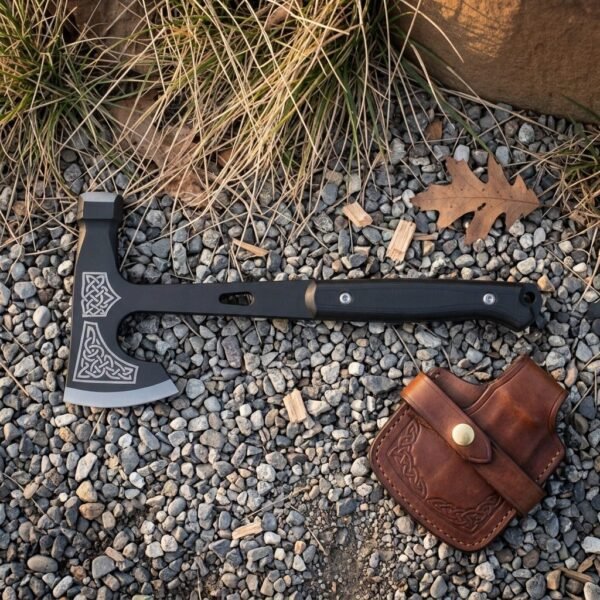
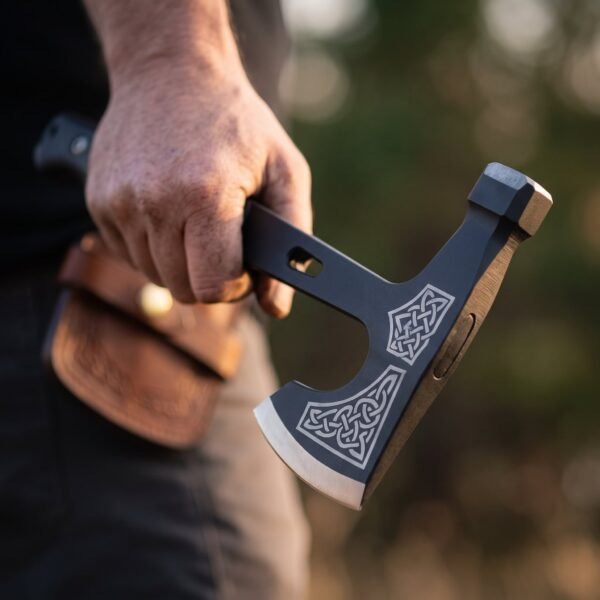
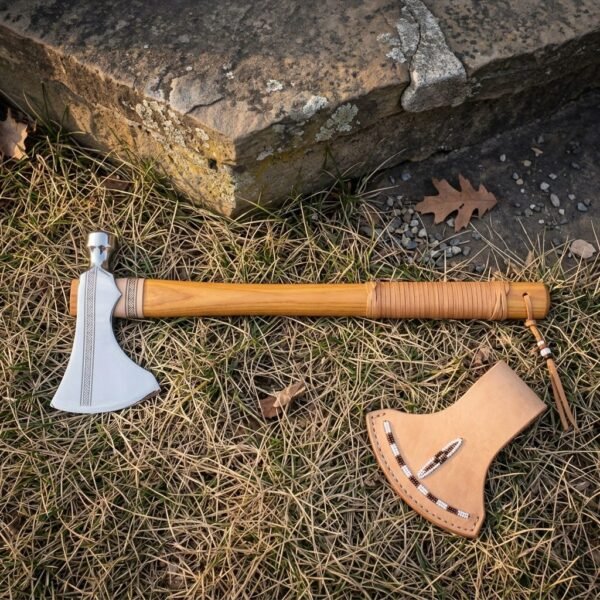
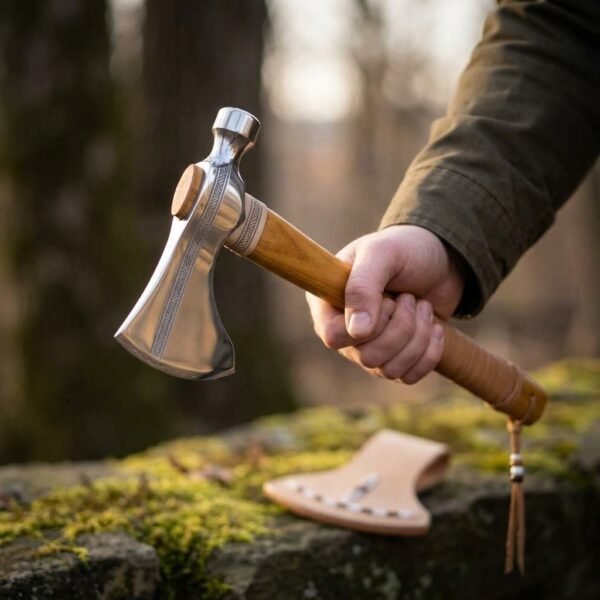
Been eyeing this axe for months and it did not disappoint. 1095 Steel blade holds a razor edge right out of the box. The wood handle feels amazing and the balance is perfect. Already telling my friends to check this out.
Got this as a gift and now I want one for myself too. Nice touch that it ships from within the US even though it’s crafted in the Czech Republic. 1095 Steel blade holds a razor edge right out of the box. Fit and finish is museum quality. You can tell real craftsmen made this by hand. Weight and balance make it feel like a real functional piece not some cheap replica. Can’t recommend this enough.
Five stars isn’t even enough honestly. Nice touch that it ships from within the US even though it’s crafted in the Czech Republic.
Knew this axe was special the second I opened the box. Came in a nice gift box which made it feel even more special. 1095 Steel blade holds a razor edge right out of the box. Leather sheath is thick and well stitched. Not the cheap stuff you usually get. This is going straight into my display case.
Knew this axe was special the second I opened the box. 10/10 would buy again.
Turned out better than I expected going in. Sheath is nice. Wish it had more padding but it does the job. Blade quality is solid. Arrived a bit less sharp than expected but a few passes on a strop fixed it. Minor nitpicks aside, good quality piece.
Did not expect this level of quality for the price. Came in a nice gift box which made it feel even more special. This is going straight into my display case. Ransack Viking’s attention to detail is honestly unmatched.
Can’t stop showing this off to everyone who comes over. Edge retention has been great even after regular use. This is my third order from Ransack Viking and they never disappoint. So worth it.
My whole family was impressed when I unboxed it. Even the small engravings are crisp and clean. Weight and balance make it feel like a real functional piece not some cheap replica. Fit and finish is museum quality. You can tell real craftsmen made this by hand. Worth every penny.
Middle of the road experience with this one. It’s fine but I expected a little more for the price. It’s okay for the price.