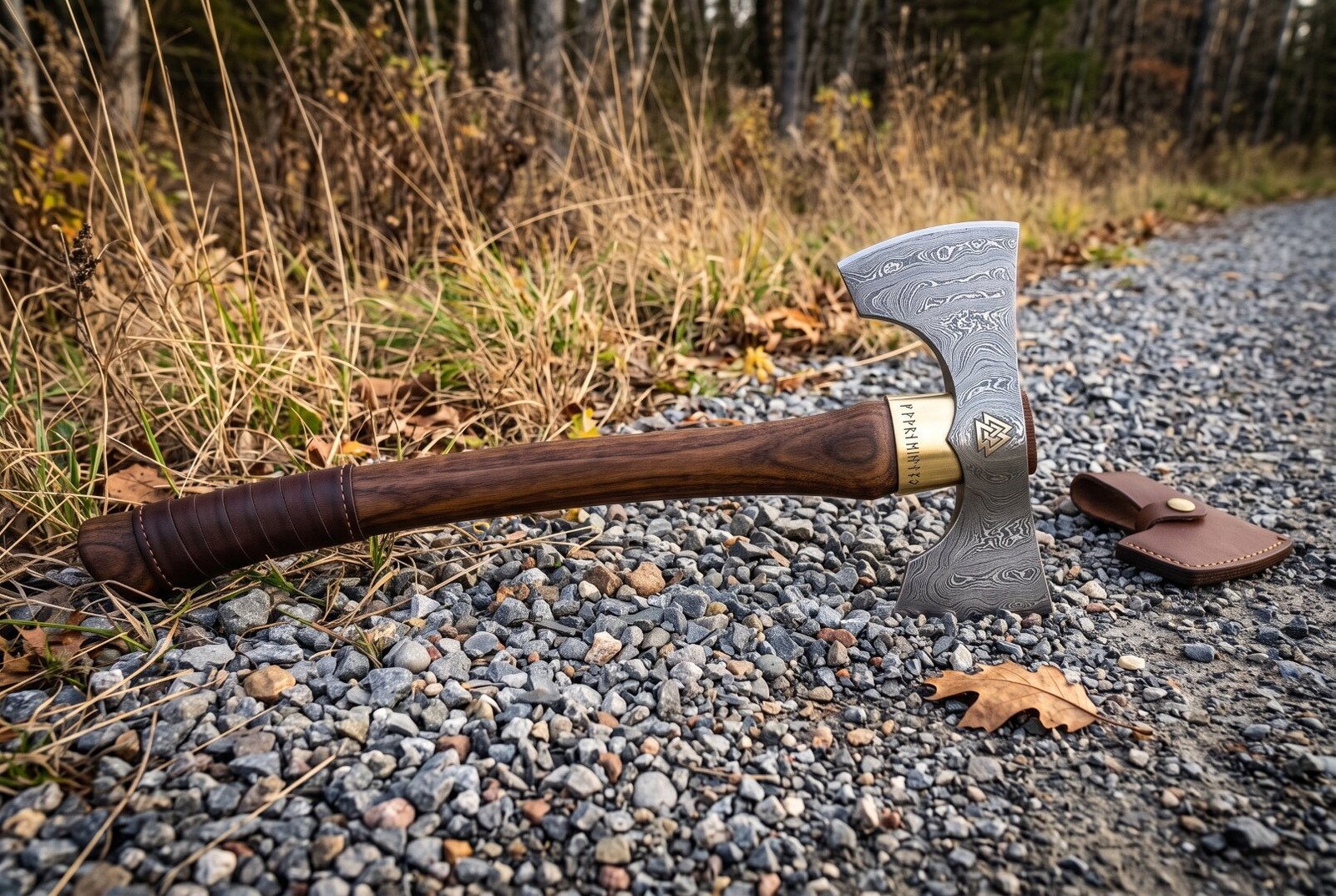
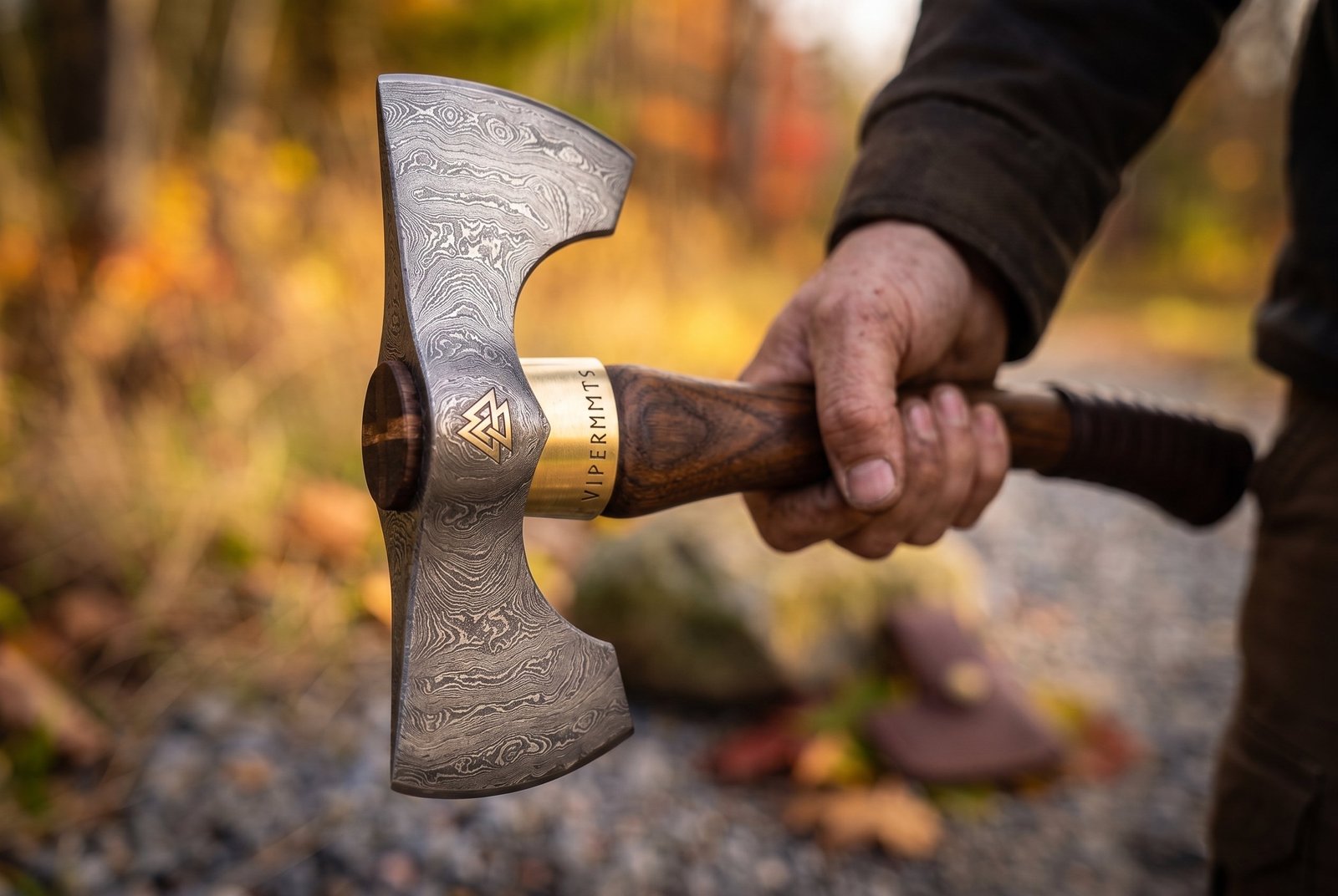
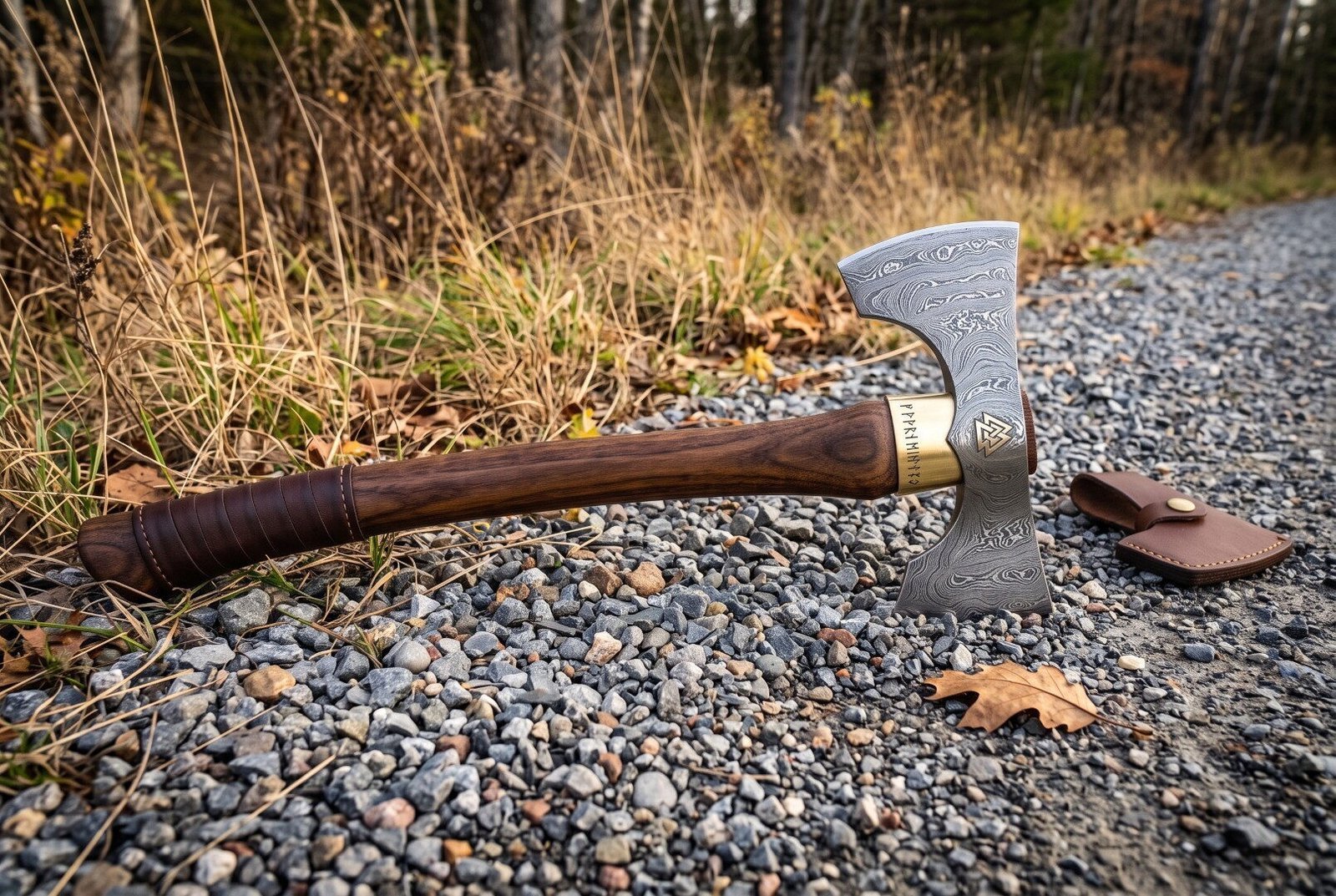
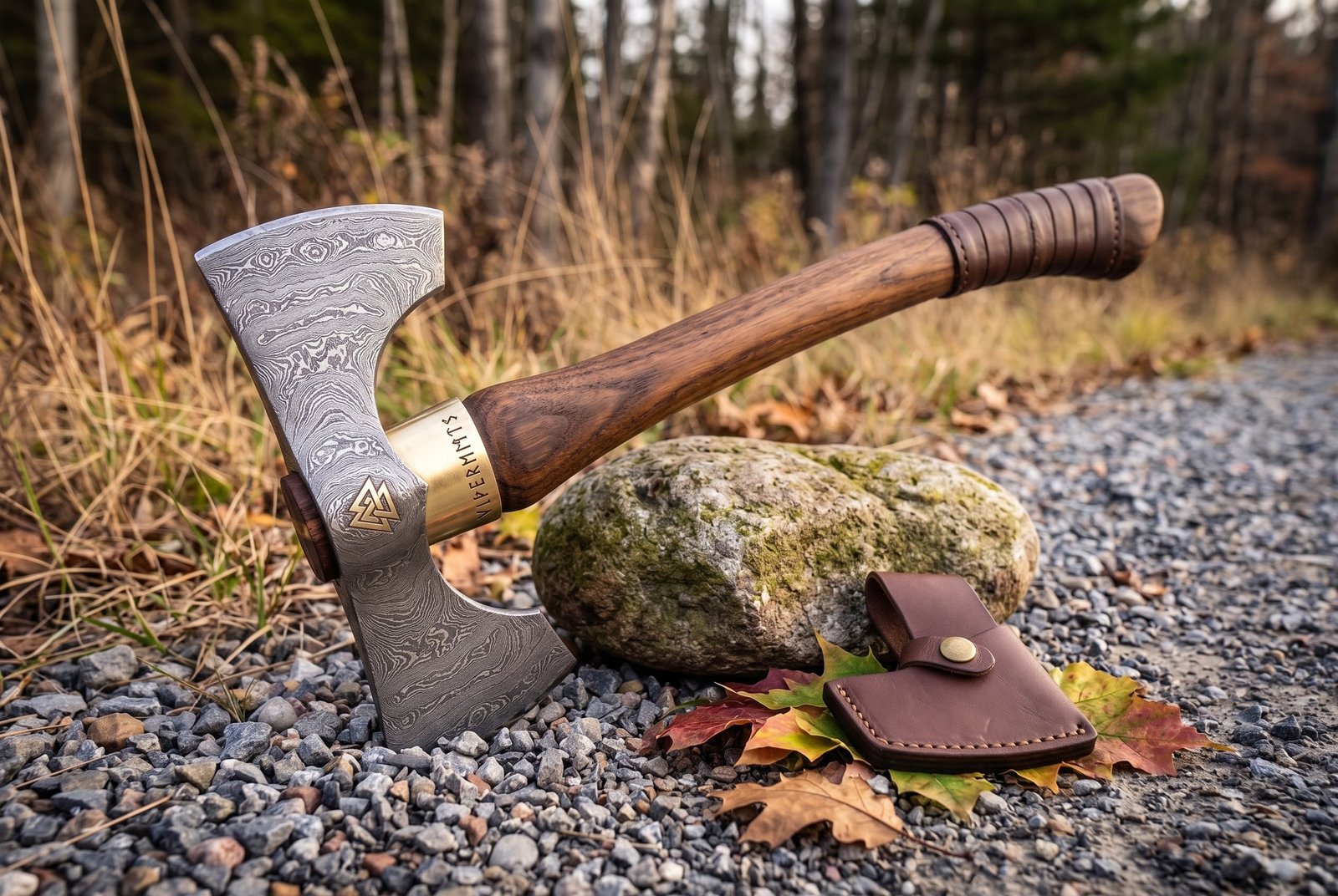
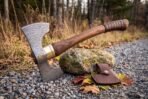
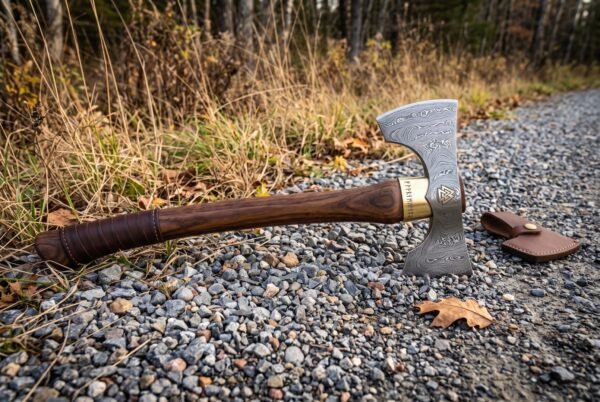
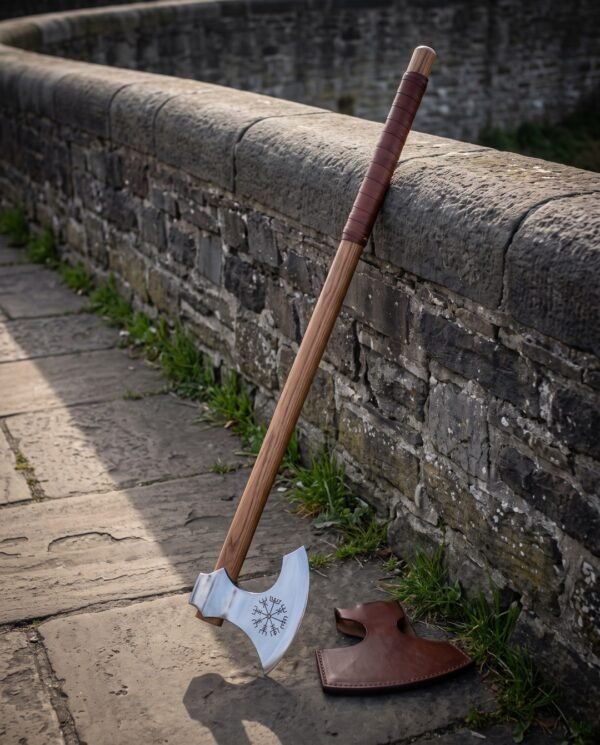
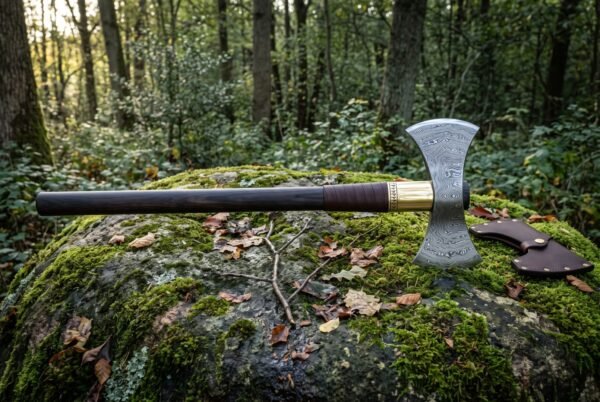
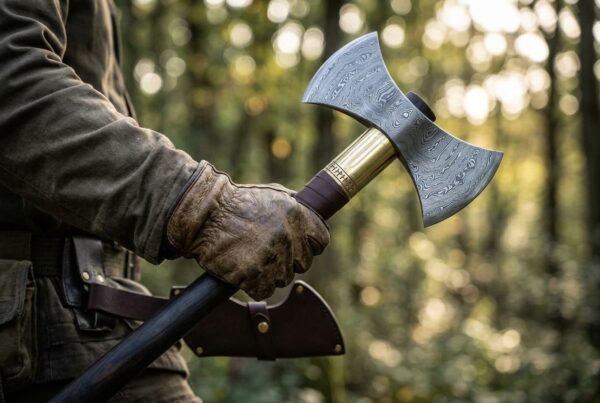
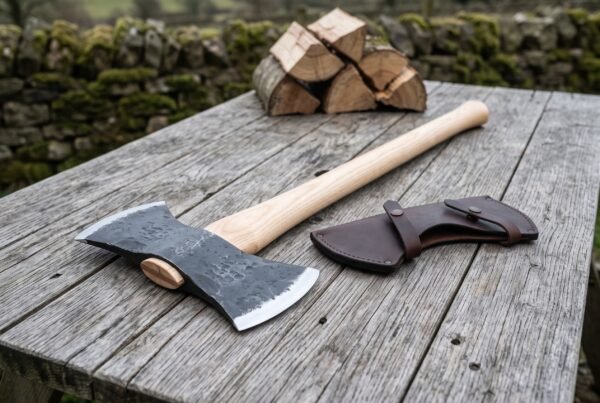
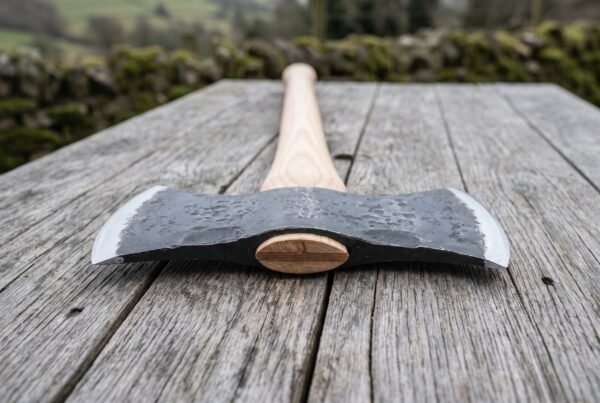
Twinbite is a double bit axe forged from 1095 and 15N20 layered and forge welded into damascus, hung on a straight walnut haft with a leather wrapped lower grip, a runed brass collar under the head and a brass valknut set into the cheek. The pattern running through the bits is real forge welding rather than an etched or printed surface. You can see it wrap around the curve of each edge and carry through the body of the head, which is what layered steel does and what a surface etch cannot fake.
Double bit axes carry two edges for a practical reason. A woodsman ground one bit keen for clean cutting into green timber and left the other slightly blunter and stouter for grubbing near the ground, knots, dirty bark and the occasional buried stone, so that the good edge was never wasted on rough work. That is also why the head is symmetrical and balances so well in the hand. Every Twinbite is forged, welded, ground, heat treated and hung by hand in the Czech Republic. It ships with the leather edge cover shown in the photograph. Free shipping inside the United States, one to two weeks processing, seven day returns, and a genuine lifetime warranty against defects in the forging, the grind, the heat treat and the fittings, with no end date and no receipt needed. Head weight, haft length and what each shape is for are set out in how to choose a Viking axe.
Specifications
| Head steel | Forge welded damascus in 1095 and 15N20 |
|---|
| Hardness | 58 to 60 HRC |
|---|
| Head pattern | Layered and etched to reveal the weld, not a surface print |
|---|
| Head style | Double bit, symmetrical, with flared bits and a rounded eye, one edge ground keen and one left stouter |
|---|
| Inlay | Brass valknut set into the cheek of the head |
|---|
| Collar | Brass collar under the head, engraved with an Elder Futhark line |
|---|
| Haft | Walnut, with a ribbed dark leather wrapped grip at the end |
|---|
| Sheath | Brown leather edge cover with a brass snap closure |
|---|
| Intended use | Felling, limbing and camp work, and it displays beautifully |
|---|
| SKU | RK-1453 |
|---|
What forge welded damascus is, and how to tell it apart from an etch
Damascus in the modern sense means pattern welded steel. Alternating layers of two steels are stacked, welded together at forging heat, drawn out, folded, and welded again until there are hundreds of layers running through the billet. Here the two steels are 1095, a simple high carbon steel that hardens hard and takes a fine edge, and 15N20, which carries nickel. When the finished head is etched, the acid bites the 1095 and leaves the nickel bearing 15N20 bright, and the layers appear as a pattern.
The reason that matters is that the pattern is structural. It is in the steel, right through the head, and grinding the edge back over years of sharpening reveals more of it rather than removing it. A printed or acid stencilled pattern is a skin. It sits on the surface, it stops at the bevel and it wears off. On Twinbite the layers follow the sweep of each bit and run into the body of the head, which is the tell you should look for on any axe sold as damascus.
At 58 to 60 HRC the edge holds well and sharpens cleanly on a stone. That is a working hardness rather than a soft display hardness, so treat both bits as sharp tools the moment the leather cover comes off.
The haft, the collar and the balance
The haft is American walnut, straight rather than curved, which is the traditional choice for a double bit because the axe is swung from either face and a curved haft would only suit one of them. Walnut is chosen for shock absorption and for the way it darkens with handling. The lower section is wrapped in leather for grip in cold or wet hands and to stop the hand sliding off the end during a long swing.
The brass collar under the head does two jobs. It dresses the join where the eye meets the timber and it carries the engraved rune line, which sits in brass rather than in the hardened steel where any cutting would be a compromise. Brass is soft enough to take a crisp letter and it patinas warmly against the walnut.
Engraving, runes and your own design
Use the rune converter on this page to turn a name, a date or a short phrase into Elder Futhark and we will cut it into the steel or the leather. If you would rather have a Viking pattern than a rune line, choose your own design in the engraving option above the add to cart button and tell us where it goes. Where a piece already carries an engraved design, your chosen engraving replaces it rather than sitting alongside it. On Twinbite that means your line takes the place of the existing rune band on the brass collar unless you ask for it on the sheath instead. Full detail is on the engraving page.
Using it and hanging it
A double bit is a two hand tool and it wants room. Give yourself a clear arc behind and above you, because the second bit is coming past your own head on every backswing, and never choke up on a double bit the way you would on a hatchet. Keep the keen bit for clean cuts into standing or felled timber and turn the head over for anything near the soil.
For display, hang it by the haft rather than by the head so the eye is not carrying the whole weight on one screw, and keep the leather edge cover on when it is within reach of anyone who does not know it is sharp. A wall out of direct sunlight suits the walnut best, because strong light will lift the colour out of an oiled hardwood over a few seasons.
Care
High carbon damascus will rust, and the etch that shows the pattern also opens the surface slightly, which makes it a little more willing to spot than plain steel. Wipe the head down after every use, especially after cutting green or resinous wood, and put a thin film of oil on it before it goes away. Never store it in the leather cover long term, because leather holds moisture against the steel. Sharpen on a stone rather than a powered wheel so you do not draw the temper, and feed the leather grip and the sheath with a neutral conditioner two or three times a year. Full oiling and rust removal detail is on our steel care page. Sharpening starts with a file, and how to sharpen an axe takes it through to the strop.
Made in the Czech Republic
Every piece we sell is made by hand in the Czech Republic. The smiths there work the way the trade has been worked for a long time, heating and hammering the steel, taking the bevels down by eye, and fitting the handle and the leather one at a time. There is no automated line anywhere in it, so small differences from one piece to the next are normal and expected.
Ransack Viking is a United States company based in Chicago, Illinois. We bring the pieces in ourselves, inspect them on arrival and ship them from our own warehouse. If you add engraving, that is carried out here in the United States before your order goes out.
A note on handmade variation
This axe is hand made and not machine made or bulk produced, so what arrives will not be a pixel for pixel copy of the photograph. The damascus pattern is different on every head because it is a function of how that particular billet moved under the hammer. Walnut grain, leather tone and the exact placement of the brass inlay vary too. The dimensions, the material and the build are the same every time. The character is not.
Frequently asked questions
Is the pattern real damascus or an etched print?
Real forge welded damascus in 1095 and 15N20. The layers run through the body of the head and wrap around the curve of both bits, which is the thing a surface etch cannot reproduce.
Is it sharp enough to use or is it a display axe?
It is a working axe. The head is heat treated to 58 to 60 HRC and one bit is ground keen. Treat it as a sharp tool from the moment the cover comes off.
Why are the two edges ground differently?
That is the traditional way to use a double bit. The keen bit does clean cutting in good timber, the stouter bit takes the rough work near the ground where a fine edge would be chipped.
Will the head rust?
Yes, if you let it. High carbon steel is not stainless and the etched surface will spot if it is left damp. Wipe and oil it after use and it stays clean.
Can I have the rune line say something specific?
Yes. Use the rune converter on this page and we will cut your line into the brass collar. It replaces the existing rune band rather than being added next to it.
How long does it take to ship?
One to two weeks, because the billet is welded and the axe is ground, hardened and hung to order. Engraved orders sit at the longer end. Shipping inside the United States is free.
What is in the box
- One double bit damascus felling axe on a walnut haft
- Stitched leather edge cover with a stud closure
- Brass collar with an Elder Futhark rune line
- Your own rune line or Viking design in its place where selected
- Sharpening, oiling and storage notes
- Forged and finished in the Czech Republic
Explore the range
See more in splitting and felling axes, Viking axes and battle axes, or read the guides for how pattern welded steel is made.
Near neighbours in the shop
A near match for this one is the Ashfell felling axe, forged from 1095. Closest to this in the range is the Barkbiter felling axe, forged from 1095. If this one is not quite right, there is the Birchbite felling axe, forged from 1095.
The Hallwarden Dane axe covers the other half of the same kit. You can have this made your way instead on the custom Viking axe page.

This axe beat every expectation I had. Edge retention has been great even after regular use. Worth every penny.
Incredible craftsmanship on this one. Even the small engravings are crisp and clean. If you’re on the fence just get it. You won’t regret it.
Can’t stop showing this off to everyone who comes over. Came in a nice gift box which made it feel even more special. This shop clearly takes pride in their work.
Knew this axe was special the second I opened the box.
Five stars isn’t even enough honestly. Couldn’t be happier with this.