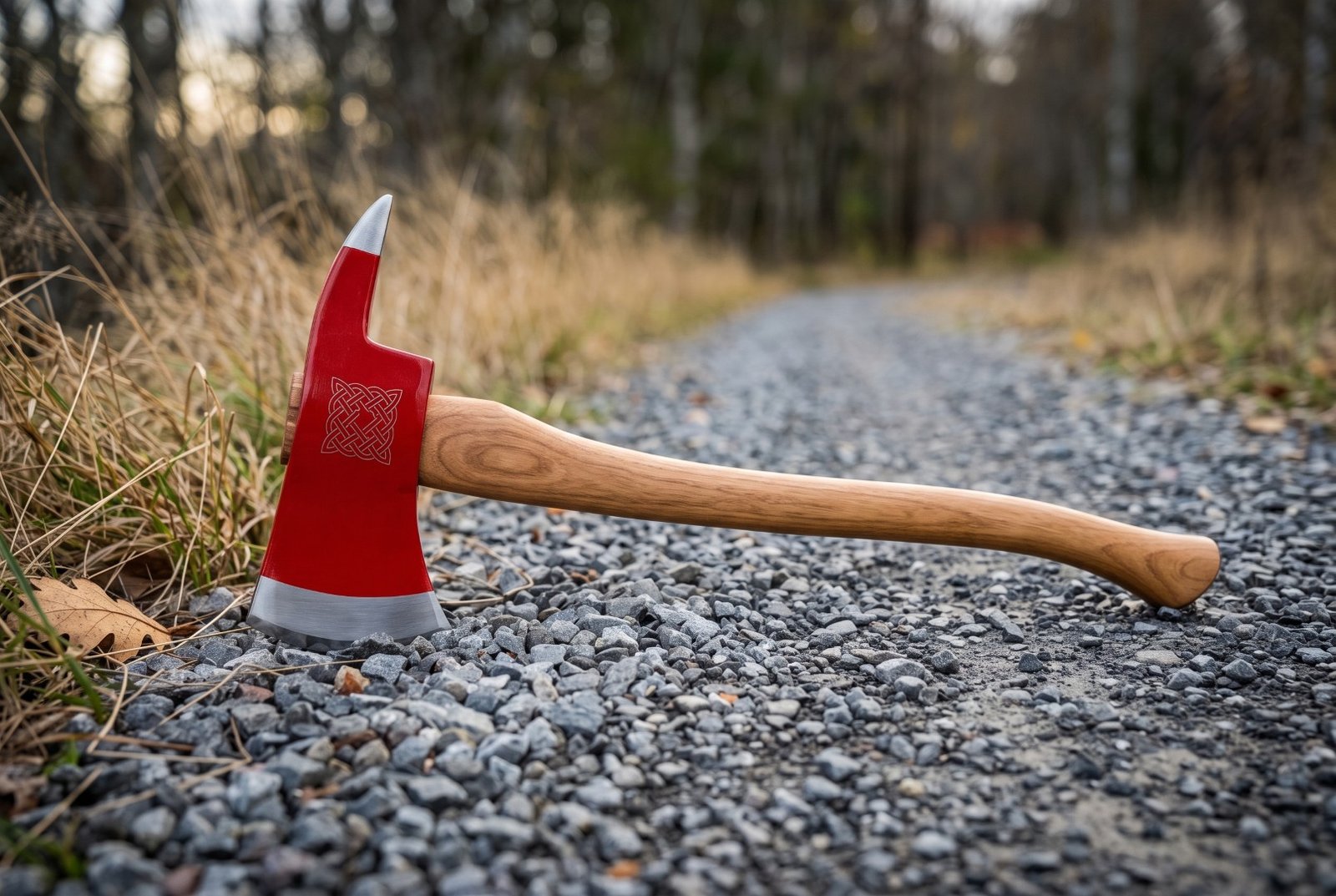
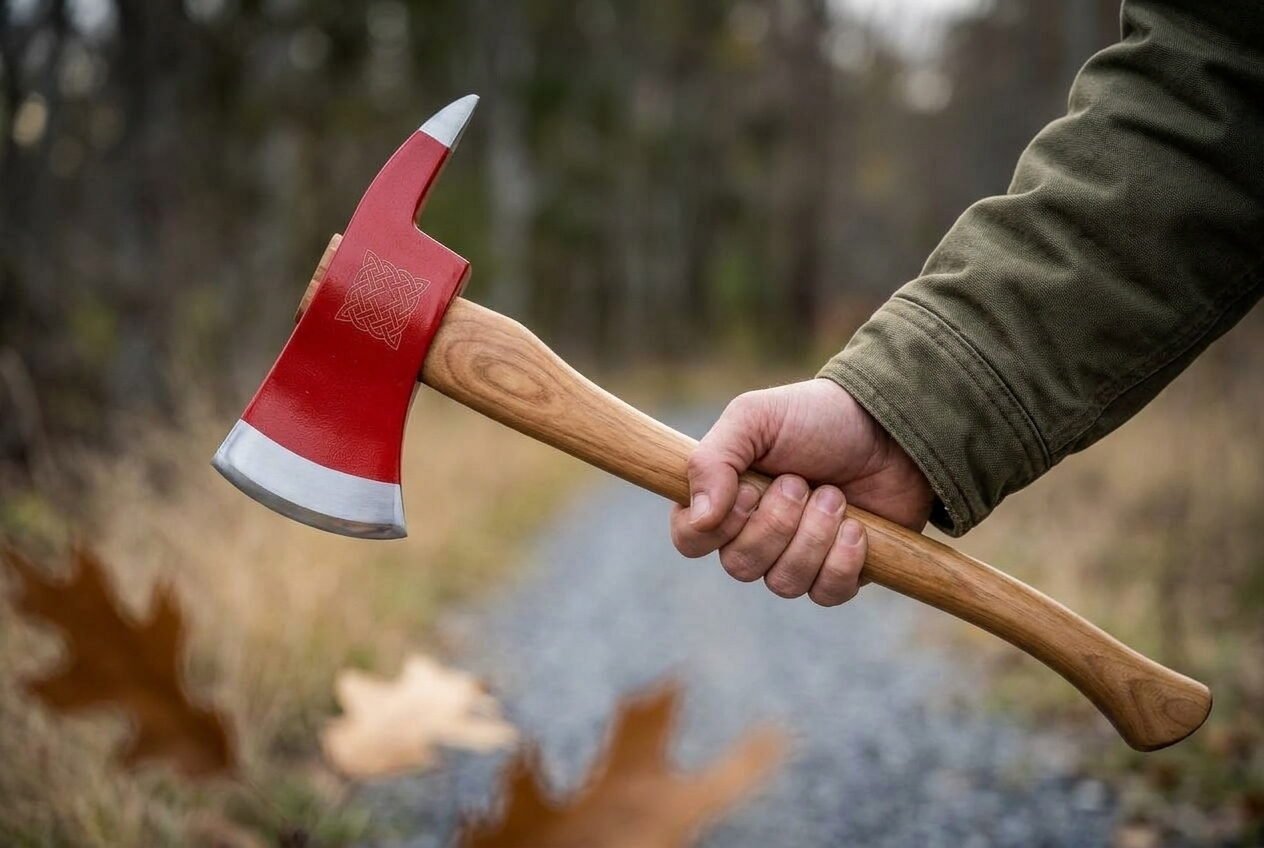
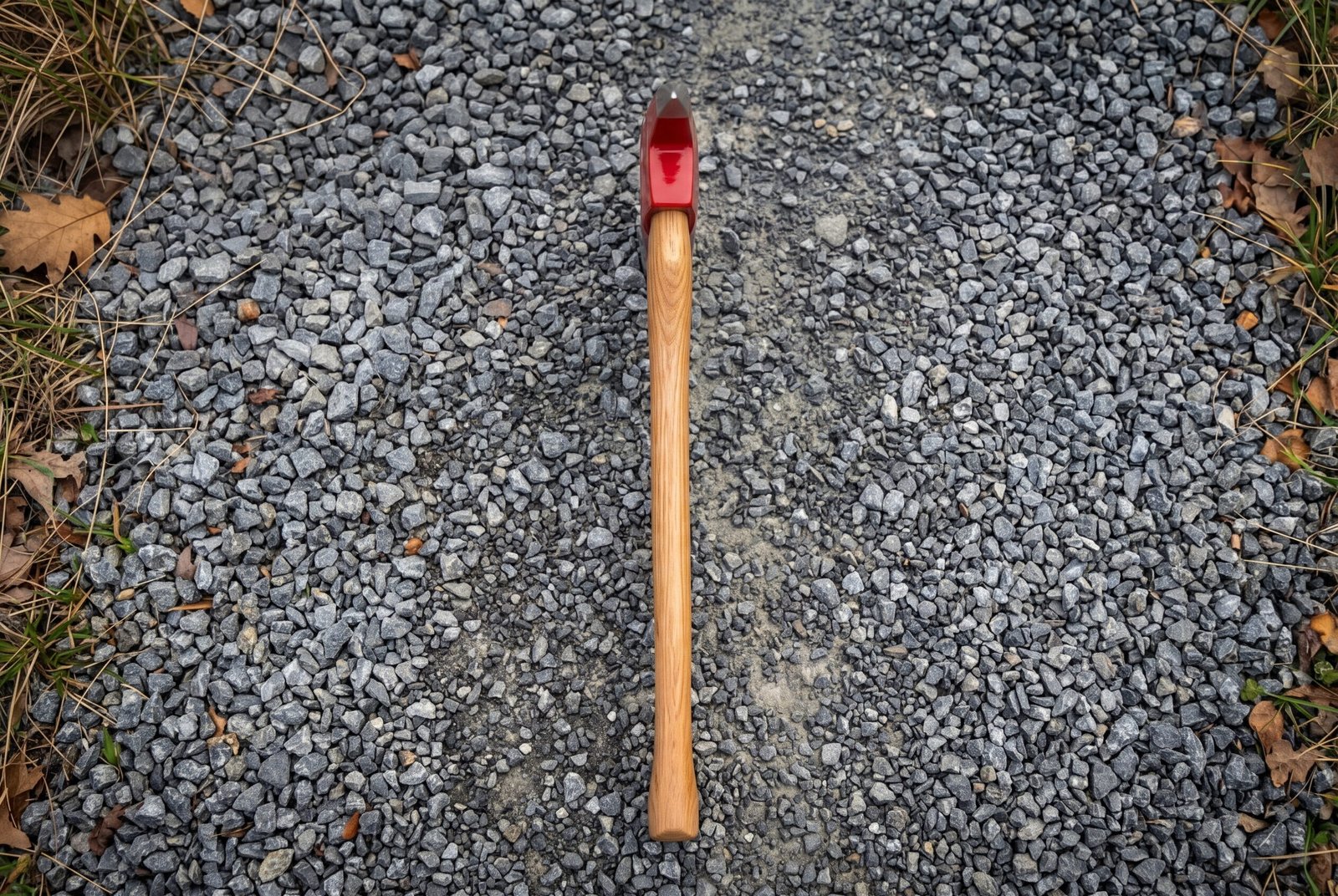
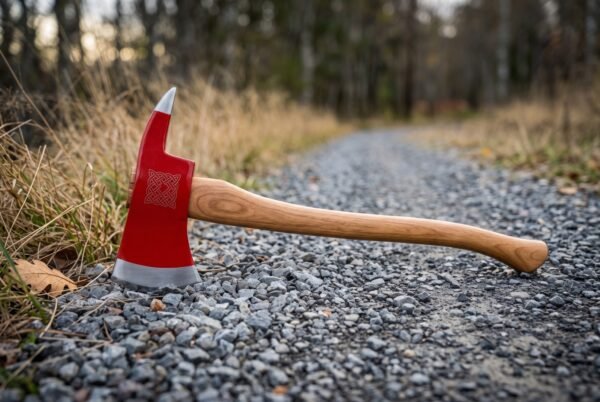
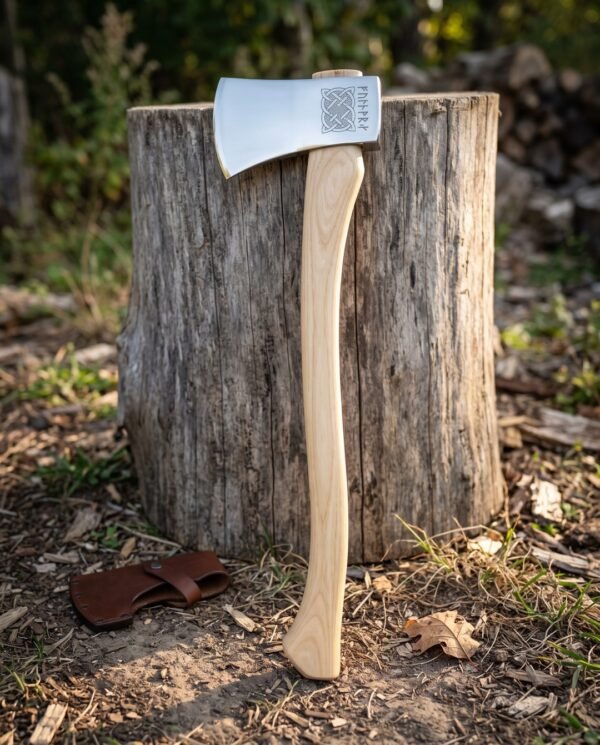
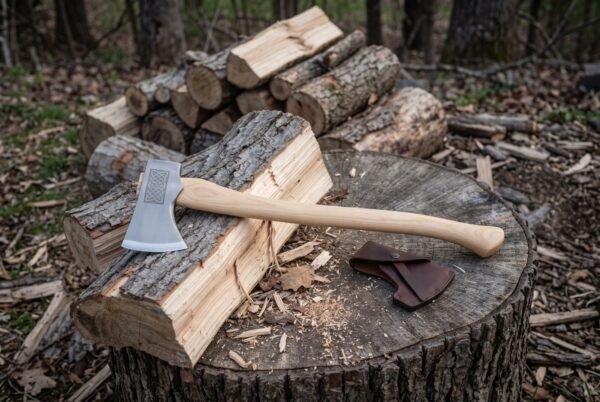
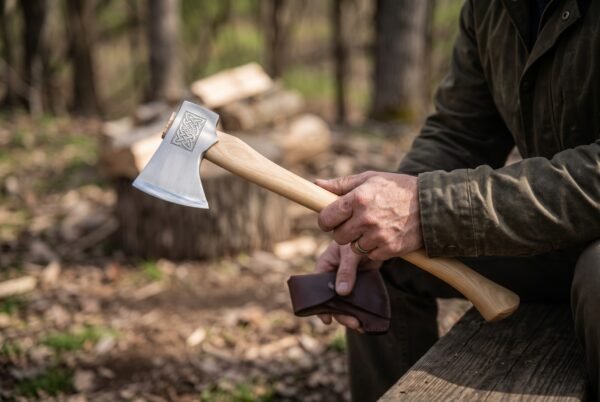
A pick head axe, with a single cutting bit on one side of the eye and a long tapering pick on the other, in the pattern of a fire axe. The bit is ground thin for cutting across wood fibre rather than splitting along it. The cheeks are finished in a deep red enamel with a square Celtic knot cut into the steel, the cutting bevel and the point of the pick are left bright and polished, and the head is hung on a curved hickory handle with a wooden wedge driven through the eye.
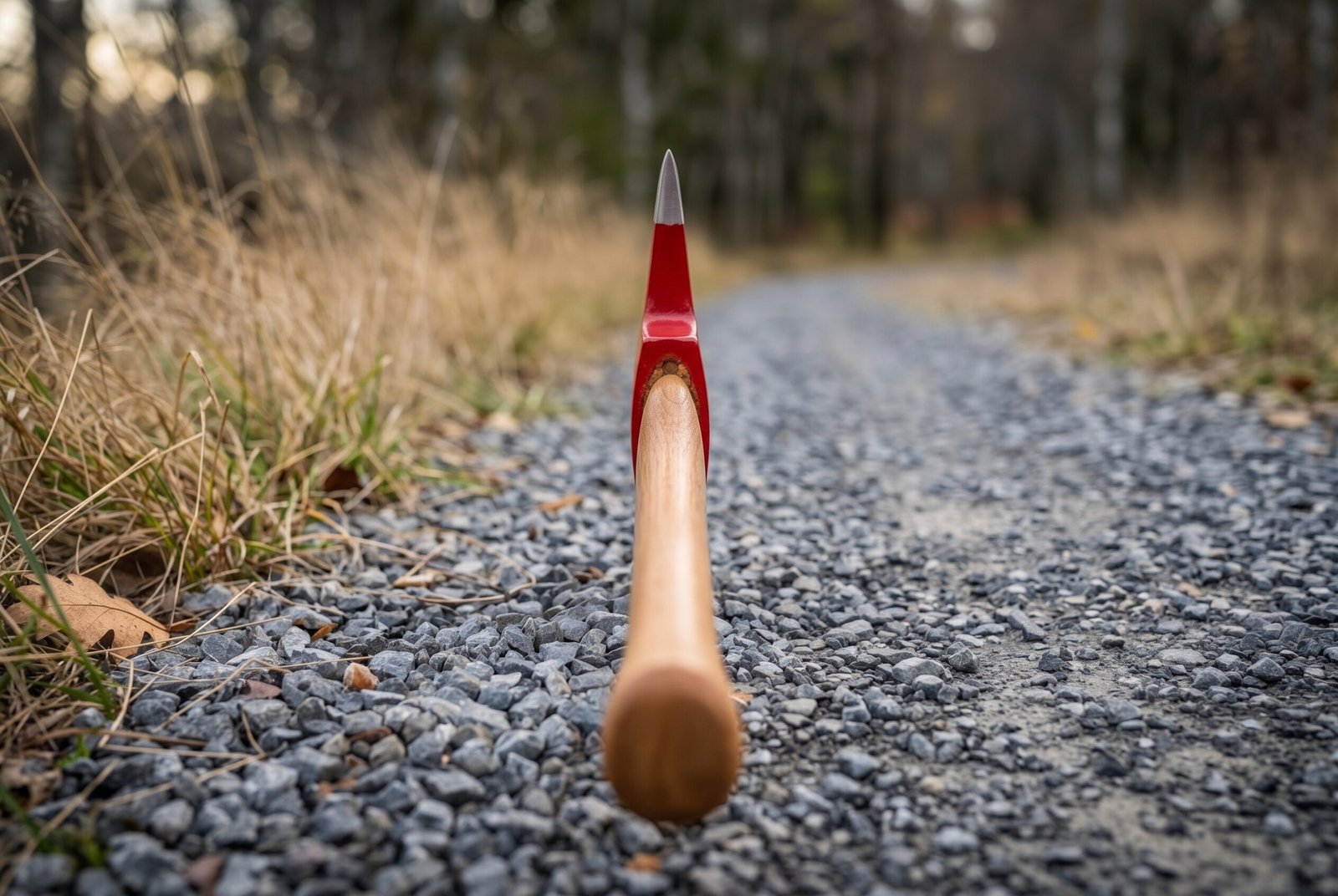
The pick is the part worth looking at. It makes the axe two tools in one: the bit cuts, and the point punches through boards, breaks up packed ground, or hooks a limb and drags it clear without you putting the axe down. This one is forged, hardened, finished and hung in the Czech Republic. Head weight, haft length and what each shape is for are set out in how to choose a Viking axe.
Specifications
| Head steel | 1095 high carbon, forged and differentially hardened |
|---|
| Hardness | 54 to 58 HRC at the bit, softer through the body and eye |
|---|
| Head style | Pick head axe: single cutting bit on one side of the eye, long tapering pick on the other |
|---|
| Head weight | Approximately 2 lb |
|---|
| Edge length | Approximately 5 inches |
|---|
| Overall length | Approximately 28 inches |
|---|
| Handle | Straight grain hickory, gently curved with a swelled knob at the end, hung with a wooden wedge |
|---|
| Finish | Red enamelled cheeks, bright polished bevel and pick point, engraved square Celtic knot panel |
|---|
| Grind | Convex bit, felling profile |
|---|
| SKU | RK-1555 |
|---|
Why a felling bit is thin and a splitting bit is fat
These are two different tools that look superficially alike, and using one for the other job is the single most common way people ruin an axe. Felling means cutting across the grain. The fibres have to be severed, so the bit needs to be thin enough to slice into them and keep going, with a shallow convex cheek that releases from the cut rather than binding in it. Splitting means driving the fibres apart along their length. That wants a fat wedge that opens the wood fast and does not need to cut much at all.
This is a felling profile. Put it into an upright round of knotty oak and it will bury itself and stick, and if you then swing it into a frozen or seasoned round it can chip at the bit because a thin edge in a hard wedge is exactly the condition that chips. Use it for limbing, for cutting through downed timber, for notching and for camp work, and keep a maul for splitting. It will reward you for that.
The convex cheek is deliberate and it is worth not grinding away. A flat cheek looks sharper and cuts beautifully for about three logs, then it wedges in the kerf and stops. The convexity is what pops the chip out.
1095, the differential hardening and the finish
The head is 1095 high carbon steel. It is hardened at the bit to 54 to 58 HRC and left softer through the body and the eye. That difference matters more in an axe than in a knife. A hard bit holds an edge through a day of cutting, and a softer body absorbs the shock of every strike without cracking through the eye, which is where a fully hardened axe head fails. It is the same principle behind a differentially hardened sword, applied to a tool that gets hit thousands of times.
The red on the cheeks is an enamel finish, not the colour of the steel and not an anodising. It protects the flats, it makes the axe easy to find when you set it down in leaf litter, and it wears at the contact points over years, which most owners like. The bevel and the pick point are bare polished steel because that is where the cutting happens and a coating there would be gone in a week. The Celtic knot is engraved into the steel under the enamel, not printed on top of it.
Engraving, runes and your own design
Use the rune converter on this page to turn a name, a date or a short phrase into Elder Futhark and we will cut it into the steel or the leather. If you would rather have a Viking pattern than a rune line, choose your own design in the engraving option above the add to cart button and tell us where it goes. Where a piece already carries an engraved design, your chosen engraving replaces it rather than sitting alongside it. On this axe the knotwork panel on the cheek is the obvious place, and a rune line can also run along the flat of the pick. See the engraving page.
Handle, hang and use
The handle is straight grain hickory, which is still the right answer for an axe after two hundred years because it is stiff along its length and forgiving in shock. It is hung with a wooden wedge driven into a kerf in the eye, which is the traditional method and the one that can be re wedged if the handle ever dries and loosens. Check the head for movement at the start of every season. A loose head is not a fault in the axe, it is timber doing what timber does with humidity, and it takes five minutes to correct.
At 28 inches this is a one and a half hand axe. It is long enough for real two handed work on downed timber and short enough to swing single handed for limbing and camp use. Wear eye protection, clear your swing arc, and never chop toward your shin.
Care
Wipe the bit dry after use and put a film of light machine oil on the bare steel before it goes away, because bare 1095 will spot overnight in a damp shed. Touch the edge up with a file and a stone rather than a powered grinder; a grinder puts heat into a thin edge and softens exactly the part you need hard. Keep the convex cheek and do not flatten it. Oil the hickory once or twice a year with boiled linseed oil, working it into the end grain at the head where water gets in. Store the axe hanging or with the head supported rather than resting the bit on concrete. Our general notes on protecting carbon steel are on the steel care page. Sharpening starts with a file, and how to sharpen an axe takes it through to the strop.
Made in the Czech Republic
Every piece we sell is made by hand in the Czech Republic. The smiths there work the way the trade has been worked for a long time, heating and hammering the steel, taking the bevels down by eye, and fitting the handle and the leather one at a time. There is no automated line anywhere in it, so small differences from one piece to the next are normal and expected.
Ransack Viking is a United States company based in Chicago, Illinois. We bring the pieces in ourselves, inspect them on arrival and ship them from our own warehouse. If you add engraving, that is carried out here in the United States before your order goes out.
A note on handmade variation
This axe is hand made, not machine made or bulk produced. What arrives will not be a pixel for pixel copy of the photograph. The taper of the pick and the sweep of the bit vary a little because they are drawn out under a hammer rather than pressed in a die, the grain and colour of the hickory differ from tree to tree, and the enamel sits over hammer texture that is never identical twice. The weight, the steel and the geometry are the same every time. The character is not.
Frequently asked questions
Can I split logs with it?
You can split small kindling, but do not use it as a splitting axe. The bit is ground thin for cutting across the grain and it will stick in an upright round and can chip on hard or frozen wood. Keep a maul for splitting.
Is it sharp out of the box?
Yes, it arrives with a working edge that will cut wood straight away. It is not shaved to a razor, because a razor edge on an axe rolls on the first knot. Dress it with a file and a stone as you use it.
What is the red finish made of?
It is an enamel finish on the cheeks. It is not the colour of the steel and it is not a plating. The cutting bevel and the pick point are left as bare polished steel, so those two areas need oil.
Will the handle loosen?
It can, in the same way every wooden hafted tool can, as humidity changes through the year. It is hung with a wooden wedge so it can be re wedged in a few minutes. Check for movement before every serious session.
Is this a Viking axe?
Not strictly. It is a pick head axe in the fire axe pattern, a working tool rather than a reproduction of a Norse find. We would rather say that than sell you a Norse label on a modern tool.
How long before it ships?
Processing is one to two weeks because each head is forged and hung to order. Shipping is free inside the United States and returns are accepted within seven days.
What is in the box
- One hand forged 1095 pick head axe, differentially hardened
- Red enamelled cheeks with an engraved Celtic knot panel
- Polished cutting bevel and pick point
- Straight grain hickory handle, wedge hung
- Care and warranty card
- Forged and finished in the Czech Republic
Explore the range
See the rest of the splitting and felling axes, the Viking axes, the blacksmith tools, and the guides.
Others in the same line
If this one is not quite right, there is the Timberrune felling axe, forged from 1095. Also in this group is the Birchbite felling axe, forged from 1095. Sitting beside it in the catalogue is the Twinbite felling axe, pattern welded Damascus.
From the same corner of the shop, there is the Thrimhawk throwing axe. You can have this made your way instead on the custom Viking axe page.





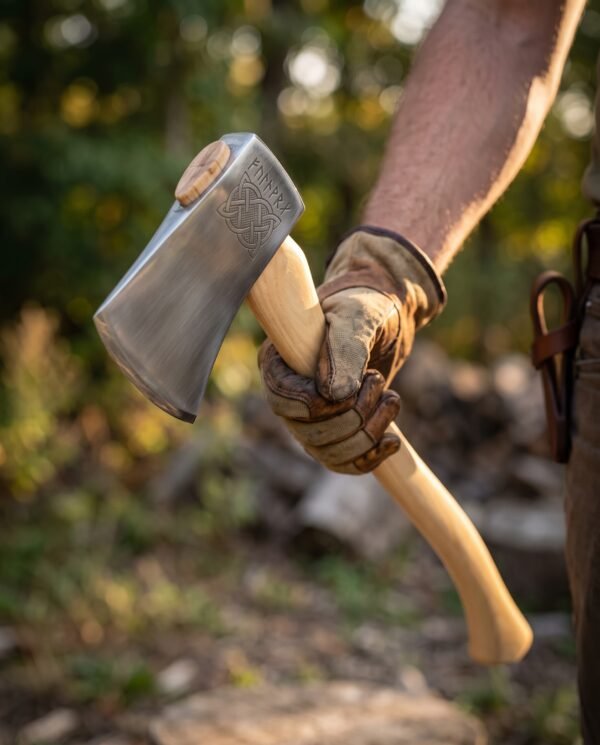
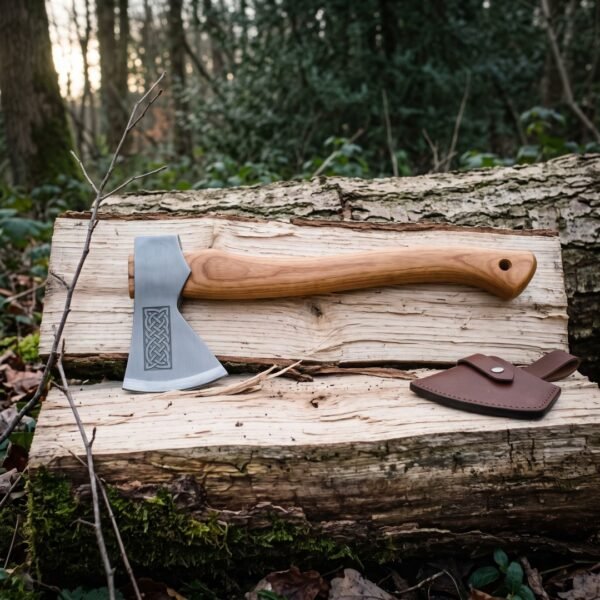
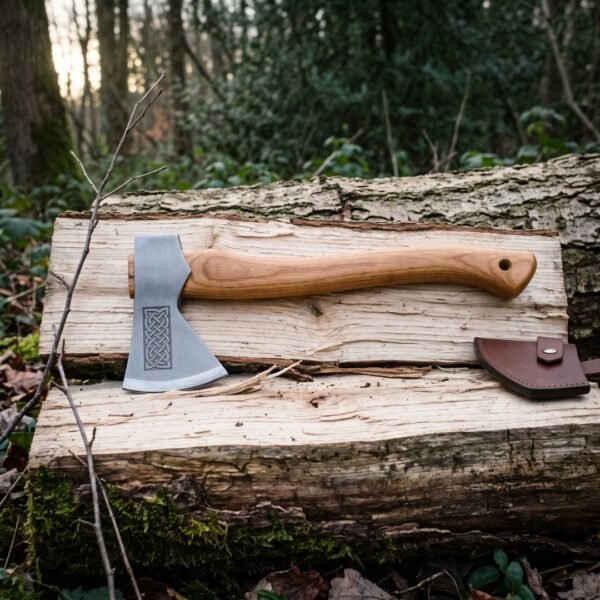
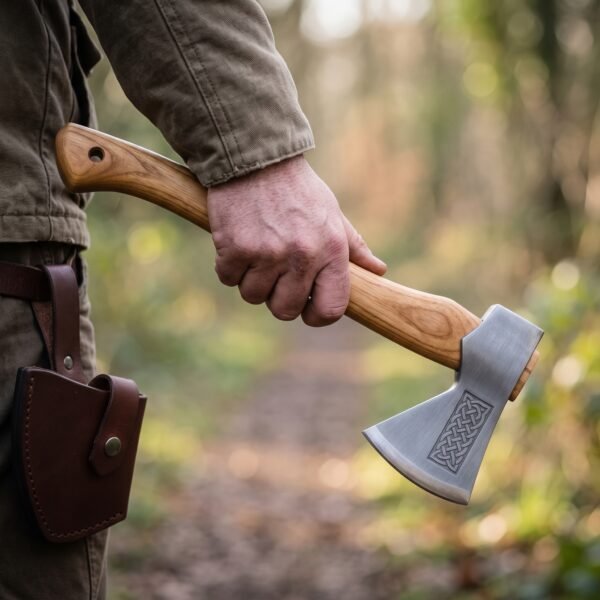


Knew this axe was special the second I opened the box. The wood handle feels amazing and the balance is perfect. Weight and balance make it feel like a real functional piece not some cheap replica. Will definitely order again for another gift.
Feels way more premium than the price suggests. Fit and finish is museum quality. You can tell real craftsmen made this by hand. Highly recommend this one.
Absolutely blown away by this axe. Came in a nice gift box which made it feel even more special. Even the small engravings are crisp and clean. Weight and balance make it feel like a real functional piece not some cheap replica. Worth every penny.
Good quality axe for the price. Sheath is nice. Wish it had more padding but it does the job. Blade quality is solid. Arrived a bit less sharp than expected but a few passes on a strop fixed it. Still very happy with it and would recommend.
So happy I finally pulled the trigger on this one. 1095 Steel blade holds a razor edge right out of the box. This is my third order from Ransack Viking and they never disappoint. Already planning my next purchase from this shop.