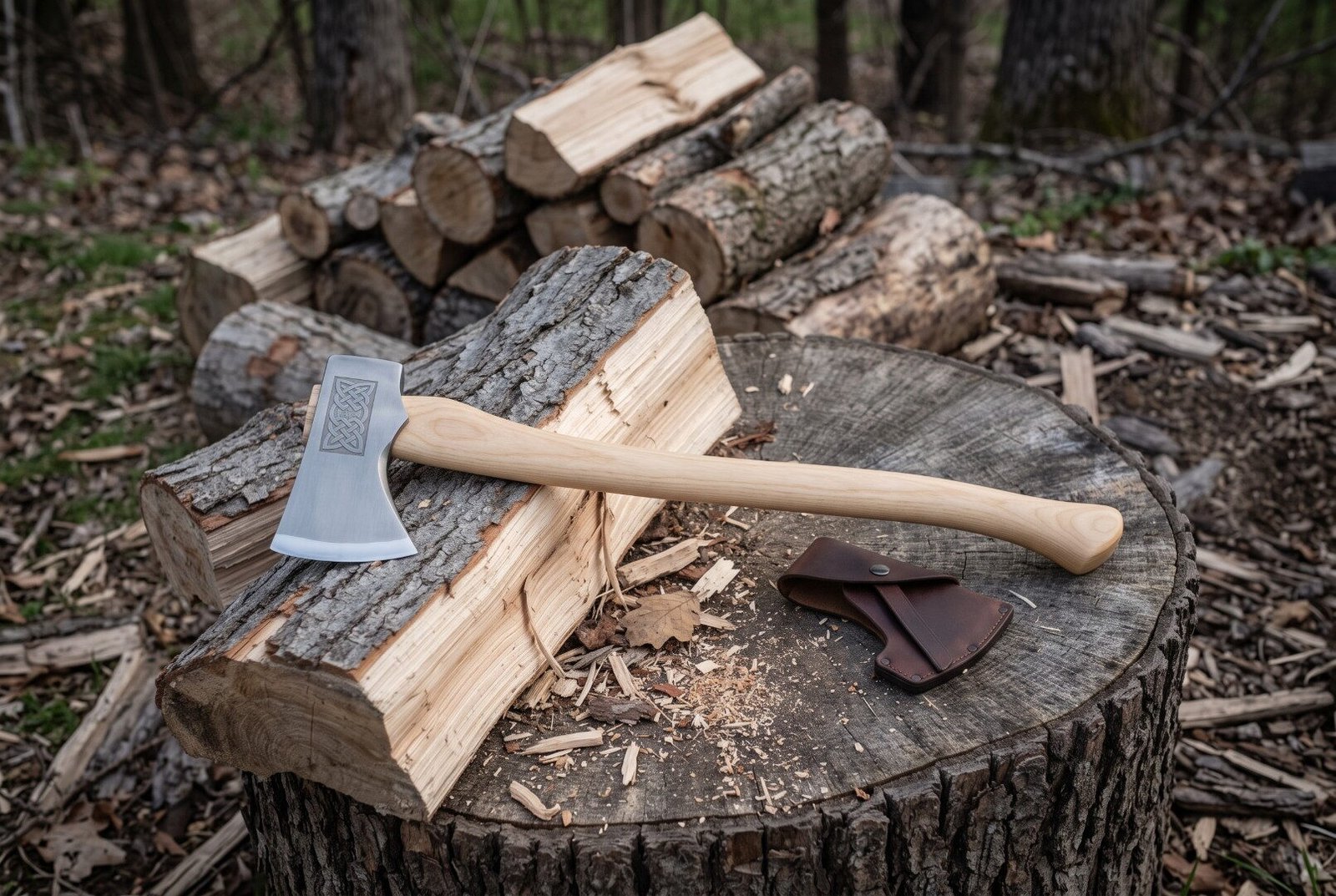
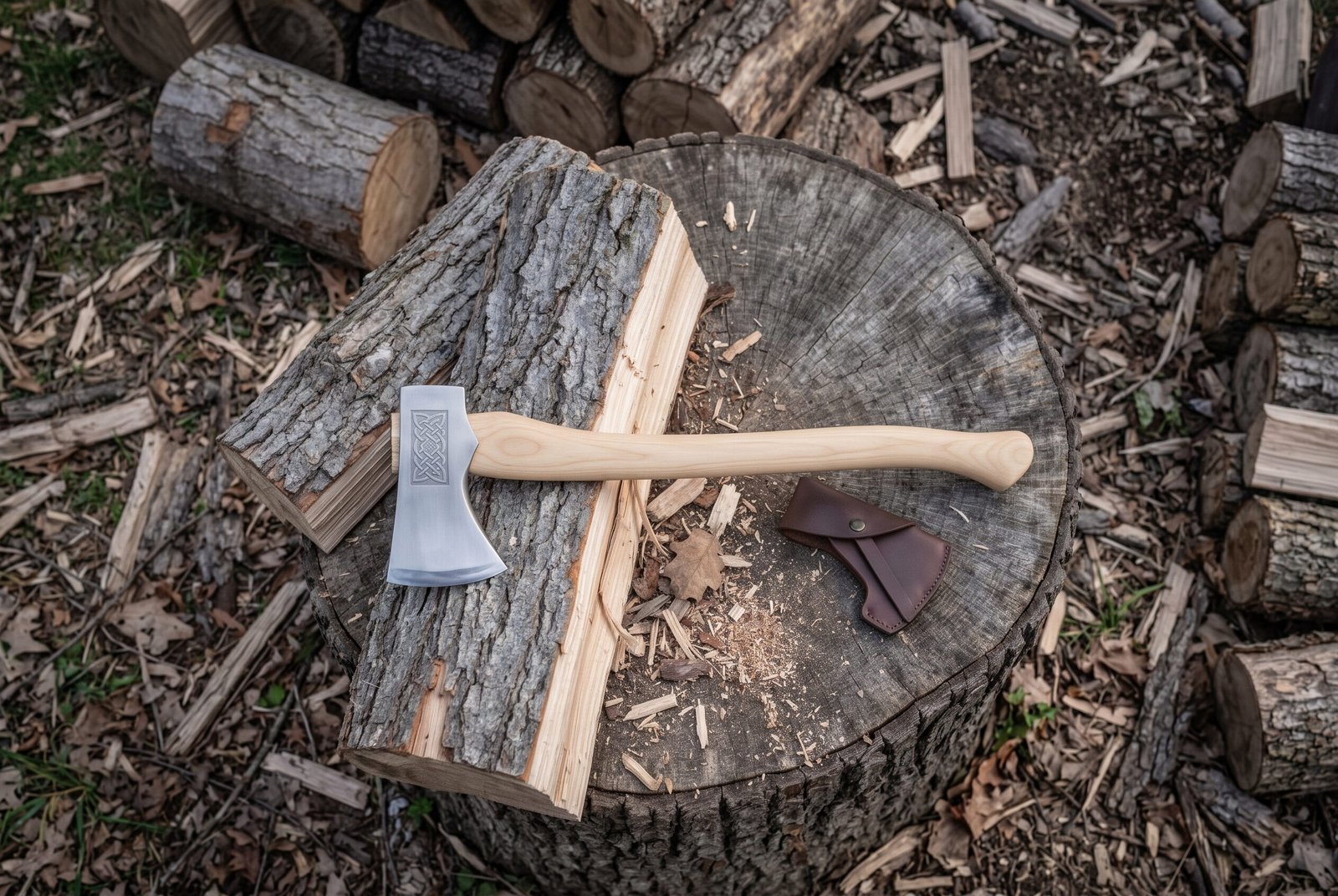
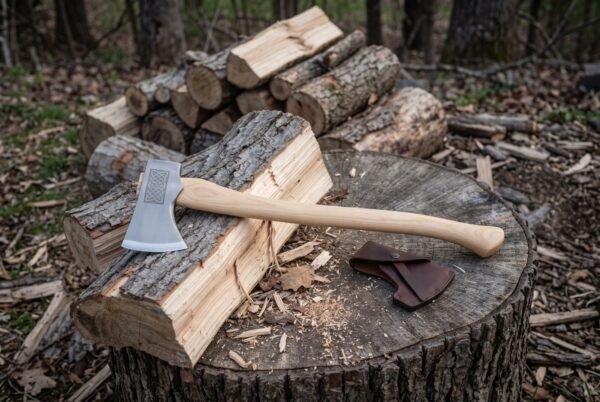
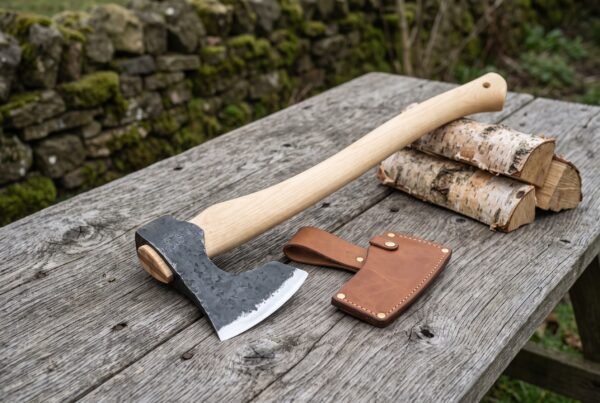
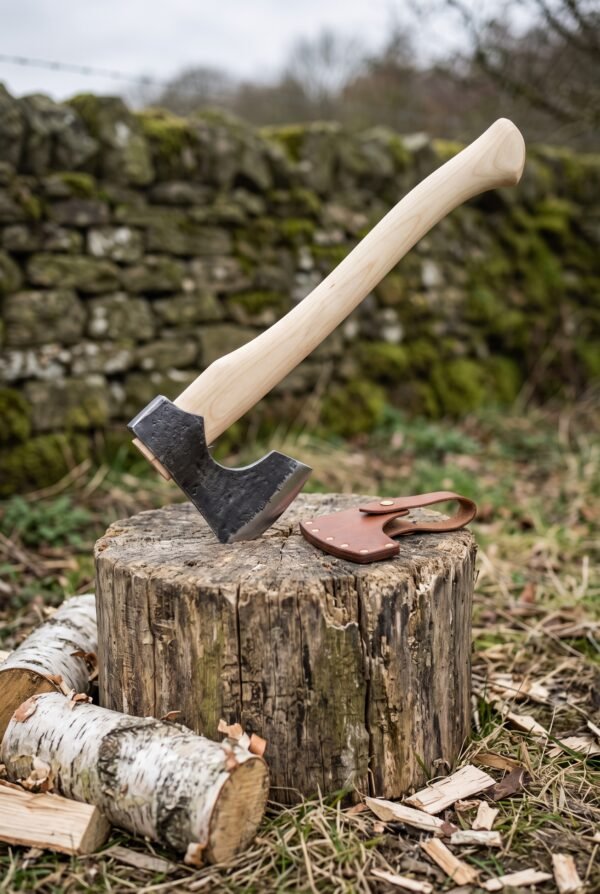
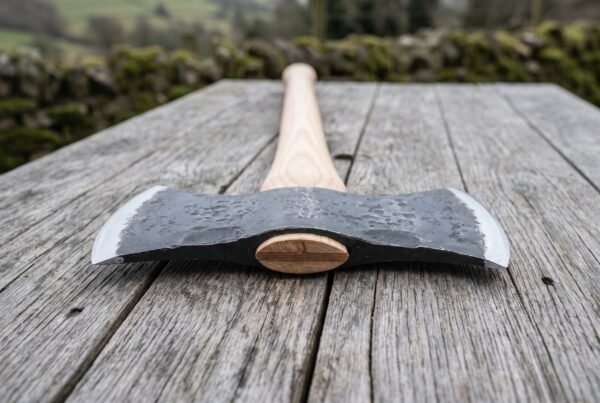
This is a working felling axe, not a wall piece that happens to have an edge. The head is forged from 1095 high carbon steel with a slightly rounded bit and a thin, high cheek, which is the geometry you want for cutting across the grain rather than splitting along it. Felling and splitting are opposite problems and they need opposite tools. A splitting axe wants a fat wedge that forces fibres apart. A felling axe wants a thin, keen bit that severs them, and it wants to release from the cut instead of sticking, which is what the hollow behind the edge is for.
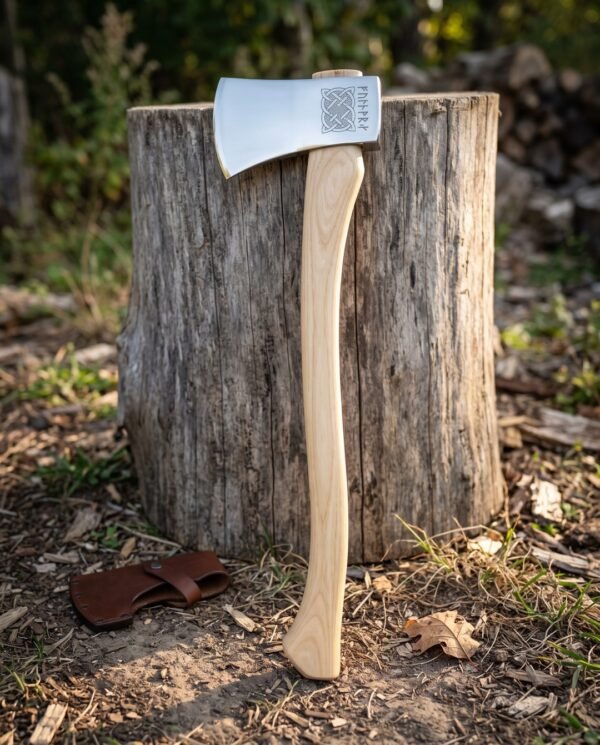
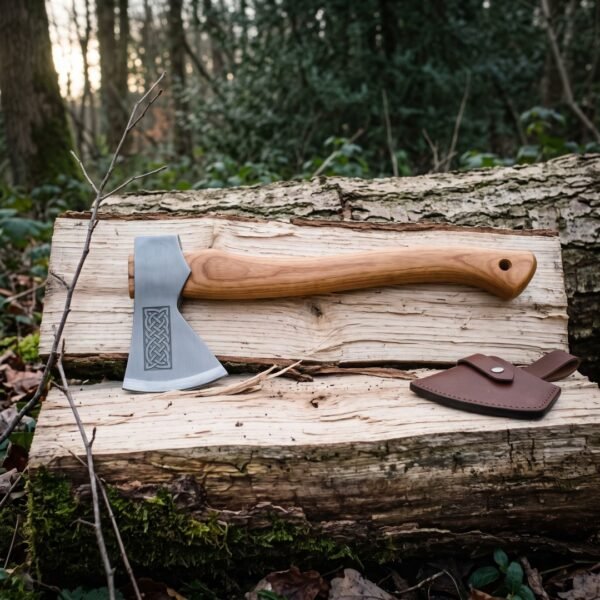
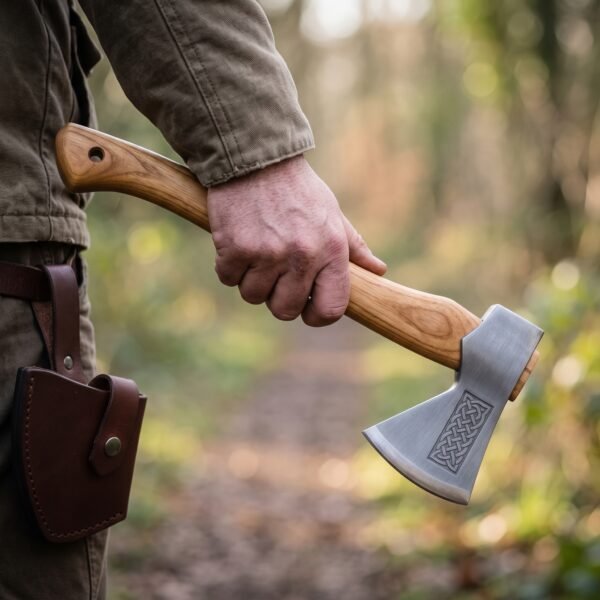
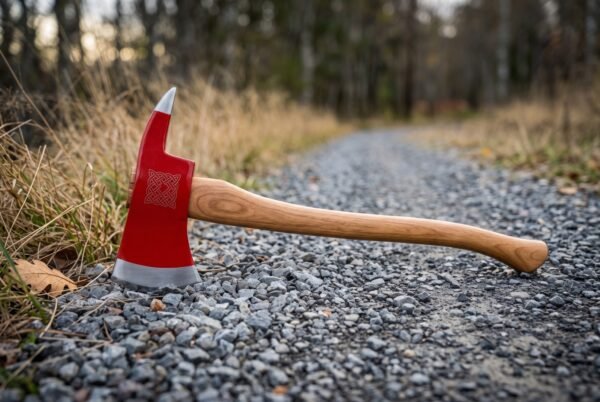
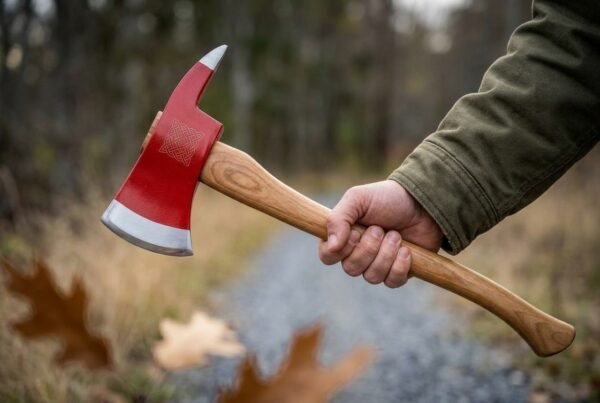
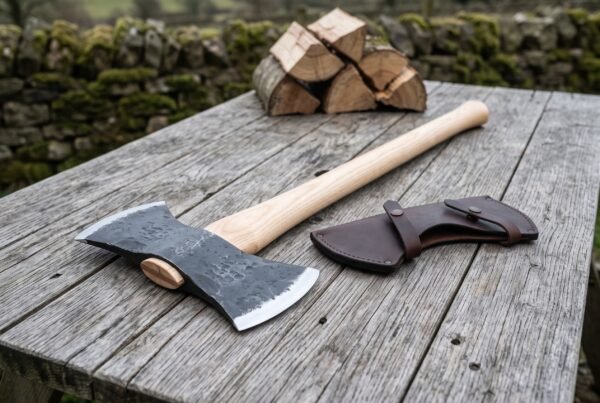
It is forged, hafted and finished in the Czech Republic. The cheek carries a chased Norse knotwork panel, the haft is American hickory with the grain running the right way through the eye, and a fitted leather blade mask is supplied. The chopping block and the split cordwood in the photograph are scenery and are not part of the order. Head weight, haft length and what each shape is for are set out in how to choose a Viking axe.
Specifications
| Head steel | 1095 high carbon steel |
|---|
| Hardness | 54 to 58 HRC |
|---|
| Head form | Single bit felling pattern, rounded bit with a thin high cheek |
|---|
| Cutting edge | Approximately 4 inches |
|---|
| Decoration | Chased knotwork panel in a framed square on the cheek |
|---|
| Haft | American hickory, natural finish, curved with a swelled knob at the butt |
|---|
| Overall length | Approximately 18 inches |
|---|
| Hanging | Wedged in the eye, wood wedge with a steel cross wedge |
|---|
| Sheath | Fitted brown leather blade mask with a stud closure |
|---|
| SKU | RK-1482 |
|---|
What makes a felling axe cut
Three things decide whether an axe works: the bit geometry, the hang, and the mass distribution. Bit geometry is the one people talk about. Behind the cutting edge the cheek is ground thin and slightly hollow, so the wedge angle stays low for the first half inch of penetration. That is where all the cutting happens. Once the bit is in, the swelling cheek behind it pops the chip out sideways. Thicken that first half inch and the axe bounces instead of biting.
The hang is the angle between the edge and the line of the haft, and it is the detail that separates an axe that lands square from one that glances. Sight down the haft from the butt and the edge should sit in line with the middle of the grip. If it is off, every stroke lands on a corner of the bit and the axe twists in your hands. Ours are hung by eye and then checked on a straight edge before the wedge goes in.
The haft itself is hickory, and the important thing about a hickory haft is not the species but the grain orientation. The growth rings should run parallel to the bit, not across it, so the haft flexes in the plane of the swing and is stiff against twisting. A haft with the grain running the wrong way through the eye will break, and it will break at the eye, which is exactly where your hands are not.
The steel
The head is 1095 high carbon steel, heat treated to 54 to 58 HRC. That is a deliberately lower window than we use on a knife, and the reason is chipping. An axe edge meets frozen wood, hidden grit, the occasional nail and, sooner or later, a stone. At 60 HRC that edge would chip out in pieces. At 54 to 58 it rolls instead, and a rolled edge can be steeled or stoned back in a couple of minutes at the woodpile.
1095 is a simple, clean high carbon steel with no alloy additions to complicate the heat treat, which is precisely why it has been the standard for cutting tools for a century. It takes a keen edge quickly and it responds well to field sharpening with a file and a stone, which matters on a tool you use away from a bench. It is not stainless and it will develop a patina and rust if you neglect it.
Engraving, runes and your own design
Use the rune converter on this page to turn a name, a date or a short phrase into Elder Futhark and we will cut it into the steel or the leather. If you would rather have a Viking pattern than a rune line, choose your own design in the engraving option above the add to cart button and tell us where it goes. Where a piece already carries an engraved design, your chosen engraving replaces it rather than sitting alongside it, so the knotwork panel on the cheek is yours to specify. The blade mask also takes a stamped or cut line, which makes this a strong gift piece. See the engraving page.
Handling and storage
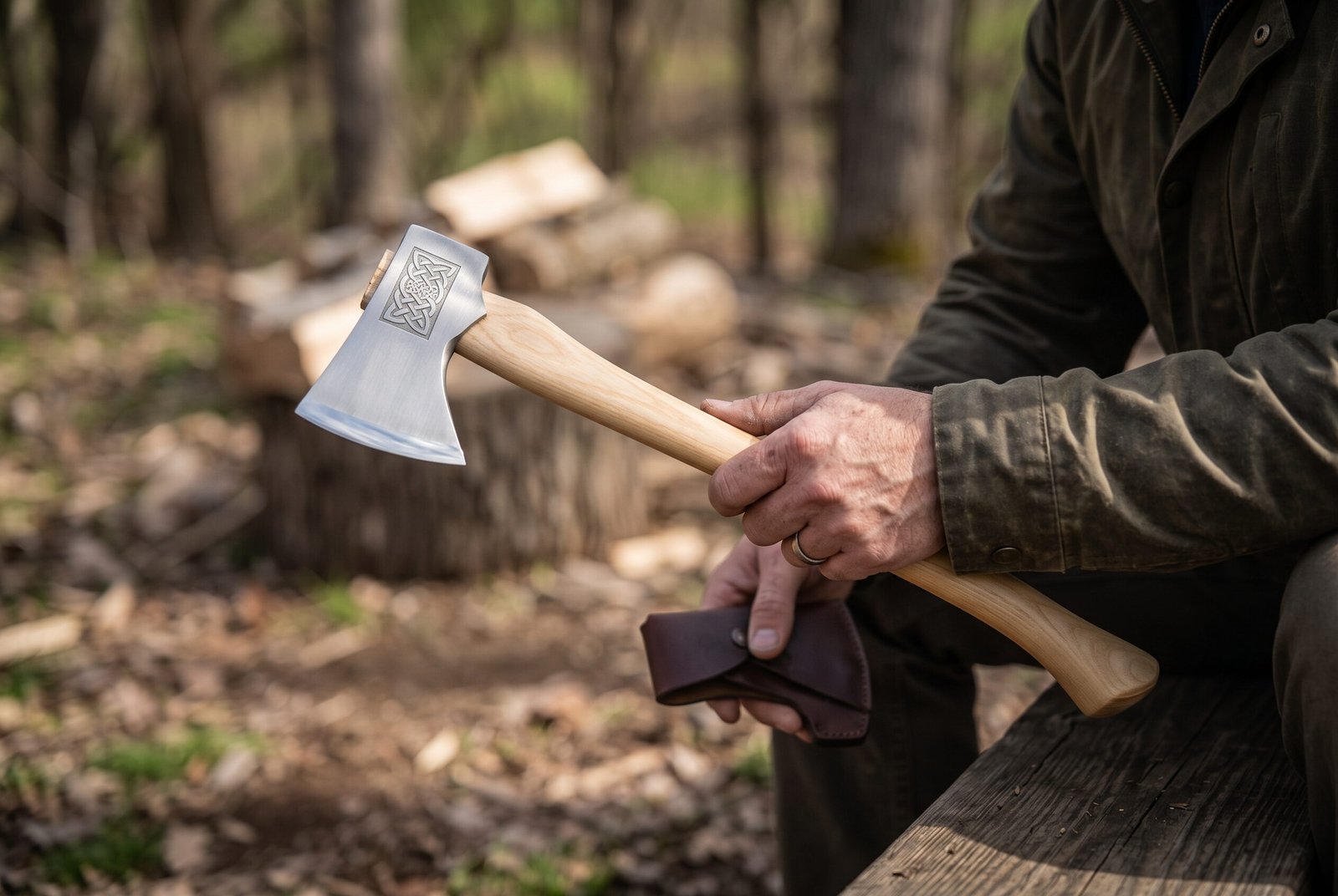
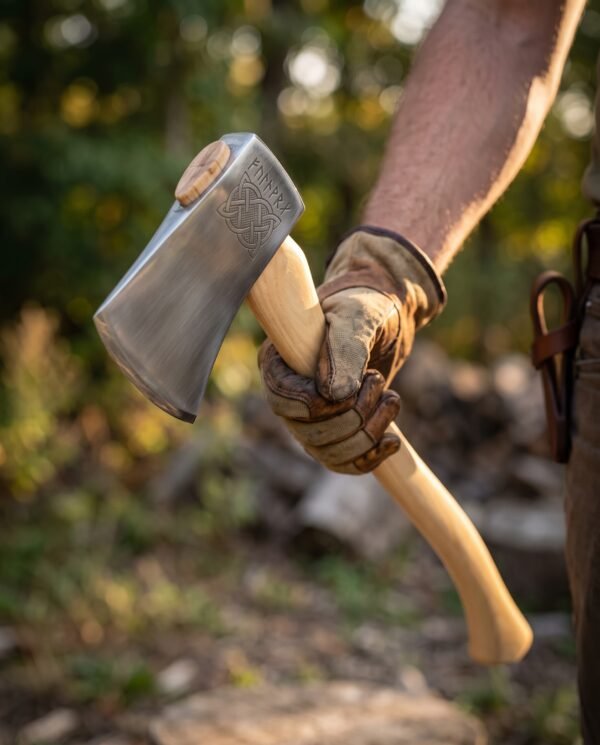
At around eighteen inches this is a one handed axe, a felling pattern head on a short hickory haft that rides in a pack or on a belt. Stand so that a miss goes into the block or the ground and not into your shin, and keep your hand at the swell rather than out on the very end of the haft.
Store it hanging by the head or lying flat in a dry place with the mask on. Do not leave it standing on its bit against a wall, which dulls the edge and lets the head take moisture from the floor. Do not leave it outdoors. A hickory haft left in the sun and rain dries, shrinks and loosens in the eye, and a loose head is dangerous. If the head ever moves at all, stop using the axe and re wedge it before you swing it again.
Care
Wipe the head down and oil it after use. Sap is acidic and will stain and pit a high carbon head overnight if it is left on. Any light machine oil or a wipe of mineral oil is plenty. Touch the edge up with a file for a rolled edge and a stone for a dull one, working from the heel to the toe on both sides, and keep the original bevel angle rather than making the edge steeper.
Give the hickory a wipe of boiled linseed oil once or twice a year, paying attention to the end grain at the butt and around the eye, which is where a haft dries out first. Feed the leather mask with a balm at the same time, and never store the head inside the mask for months at a time, because vegetable tanned leather holds moisture against steel. Our steel care notes cover oils and rust removal in more detail. Sharpening starts with a file, and how to sharpen an axe takes it through to the strop.
Made in the Czech Republic
Every piece we sell is made by hand in the Czech Republic. The smiths there work the way the trade has been worked for a long time, heating and hammering the steel, taking the bevels down by eye, and fitting the handle and the leather one at a time. There is no automated line anywhere in it, so small differences from one piece to the next are normal and expected.
Ransack Viking is a United States company based in Chicago, Illinois. We bring the pieces in ourselves, inspect them on arrival and ship them from our own warehouse. If you add engraving, that is carried out here in the United States before your order goes out.
A note on handmade variation
This axe is hand made, not machine made or bulk produced, so what arrives will not be a pixel for pixel copy of the photograph. Hammer texture on the cheeks, the exact profile of the bit, the colour and figure of the hickory and the depth of the chased knotwork all vary, because each one is worked by hand from natural materials. The dimensions, the material and the build are the same every time. The character is not.
Frequently asked questions
Is this a felling axe or a splitting axe?
A felling axe. The bit is thin and slightly hollow behind the edge for cutting across the grain. It will split small rounds but a dedicated splitting maul does that job far better.
Does it arrive sharp?
Yes, with a working shaving edge straight from the shop. Keep the mask on it in transport and storage.
Why is it only 54 to 58 HRC?
Because an axe edge meets grit, frozen wood and the occasional nail. At a higher hardness it would chip rather than roll, and a rolled edge can be fixed at the woodpile in two minutes.
Can I use it as a throwing axe?
We would rather you did not. Throwing beats up the eye and the wedging and will eventually loosen the head on a hafted felling axe.
Will the head come loose?
Not if you keep it out of the weather. Hickory shrinks when it dries. If the head ever moves, stop using it and re wedge before swinging it again.
How long before it ships?
Processing is one to two weeks because each head is forged, heat treated and hung to order. Shipping inside the United States is free and returns are accepted within seven days.
What is in the box
- One hand forged 1095 felling axe, hung and wedged
- American hickory haft, curved, about 18 inches overall
- Chased knotwork cheek panel, or your own engraving in its place
- Fitted leather blade mask with a stud closure
- Light protective oil coat applied before packing
- Care and sharpening card
- Forged and finished in the Czech Republic
Explore the range
See more in splitting and felling axes, viking axes, blacksmith tools and battle axes, or read the guides.
Near neighbours in the shop
Worth putting side by side with this is the Emberbite felling axe, forged from 1095. In the same category sits the Ashfell felling axe, forged from 1095. A near match for this one is the Birchbite felling axe, forged from 1095.
For a different piece from the same family, look at the Langhewer Medieval axe. You can have this made your way instead on the custom Viking axe page.


Overall a good buying experience. Sheath is nice. Wish it had more padding but it does the job. Wood handle looks great though it’s a little smaller than I imagined. Would still tell others to give this a try.
This is exactly what I wanted and then some. Steel blade holds a razor edge right out of the box. Edge retention has been great even after regular use. Even the small engravings are crisp and clean. Shipping was fast and everything arrived well packaged.
This axe is well made. Just a couple small things kept it from 5 stars. Sheath is nice. Wish it had more padding but it does the job. Would buy from this shop again.
Did not expect this level of quality for the price. The wood handle feels amazing and the balance is perfect. Can’t recommend this enough.
This is exactly what I wanted and then some. Great buy overall. This is my third order from Ransack Viking and they never disappoint.
Photos don’t do this axe justice at all. Made overseas in the Czech Republic yet shipped from a US location so no long customs wait.
Knew this axe was special the second I opened the box. Edge retention has been great even after regular use. Worth every penny.
I collect stuff like this and this axe is on another level. Steel blade holds a razor edge right out of the box. Shipping was fast and everything arrived well packaged.
It’s a decent axe. Nothing extraordinary though. Blade edge needed some sharpening out of the box. Wouldn’t say no to it but wouldn’t rave about it either. Ransack Viking is hit or miss it seems. This one landed in the middle.
Got this as a birthday gift and the reaction was priceless. Edge retention has been great even after regular use. Highly recommend this one.