The spear, not the sword, armed the Viking age. Swords were expensive and comparatively rare; a spear could be made with a fraction of the steel and it outreached everything else on the field. Odin carries Gungnir rather than a blade for a reason, and the act of throwing a spear over an enemy army to dedicate them to him is recorded more than once in the sagas. A grave that contains arms at all usually contains a spearhead, and the Norse word for the spear turns up all over the place in personal names precisely because it was the ordinary man’s arm.
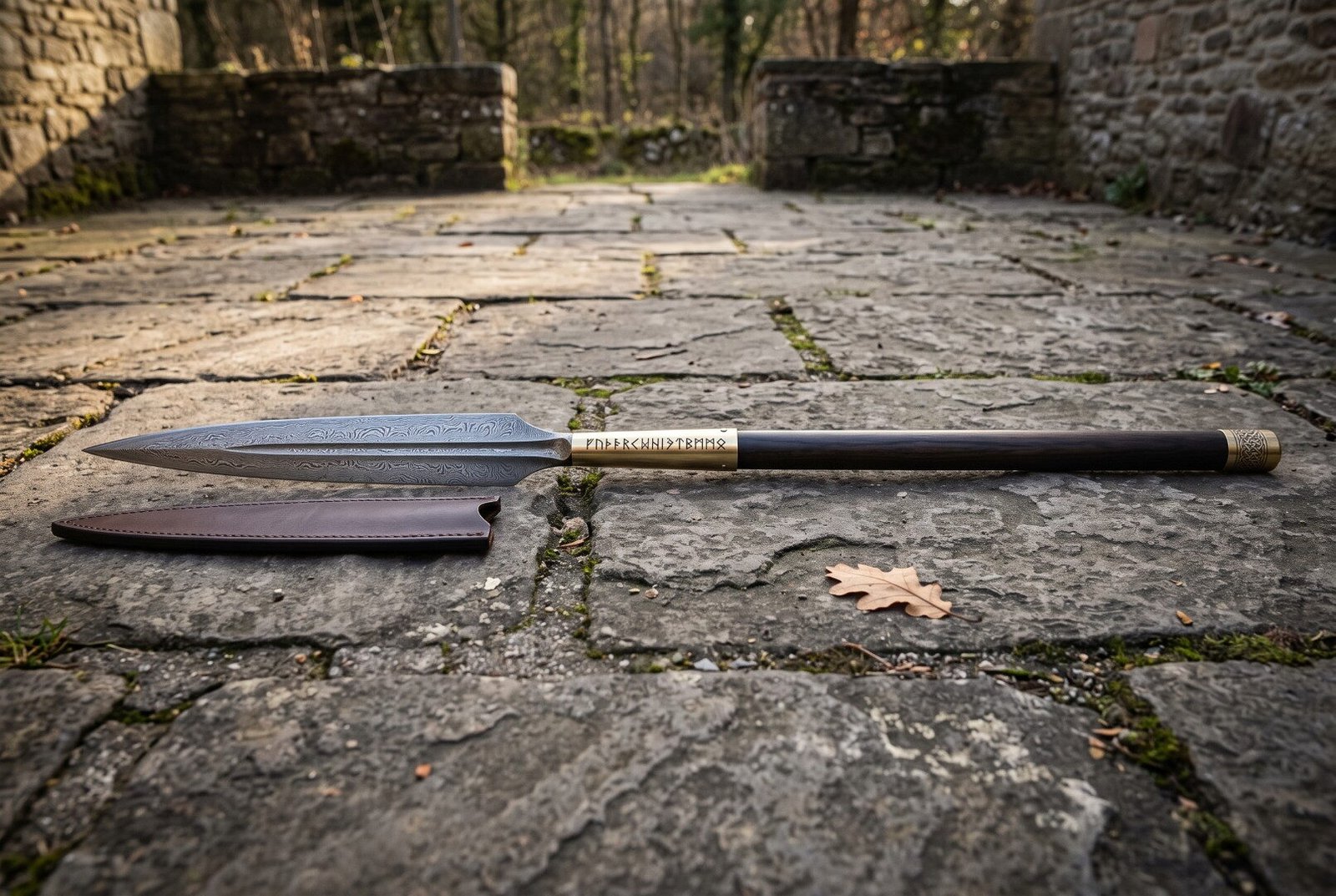
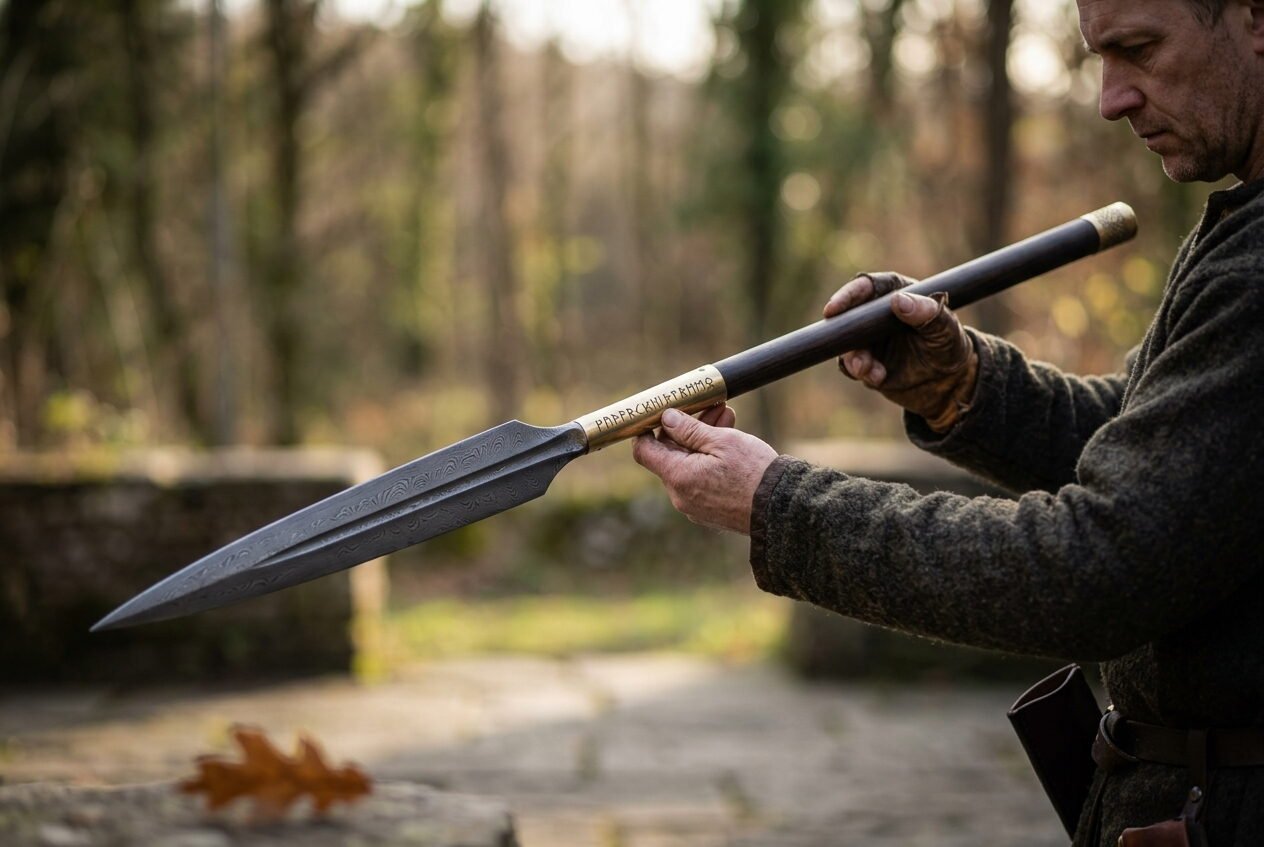
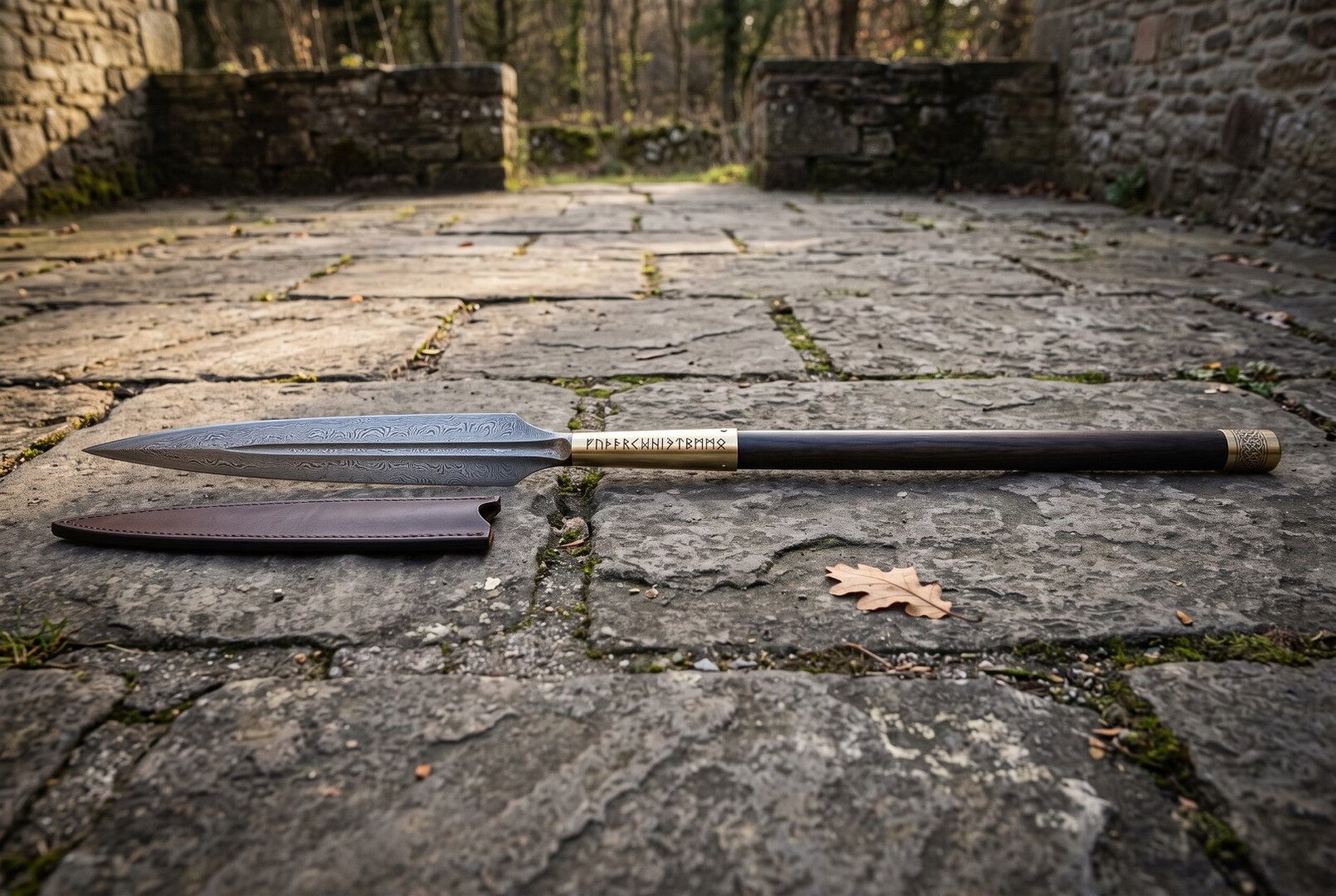
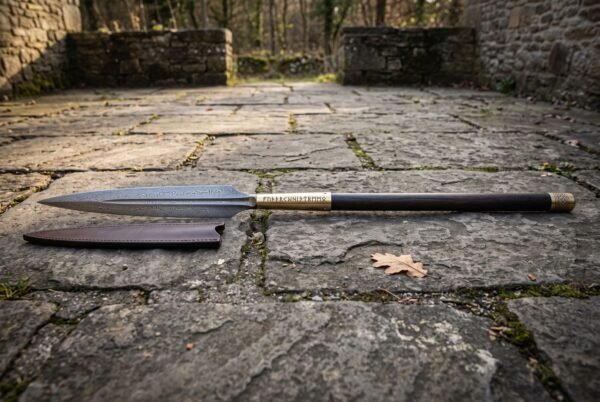
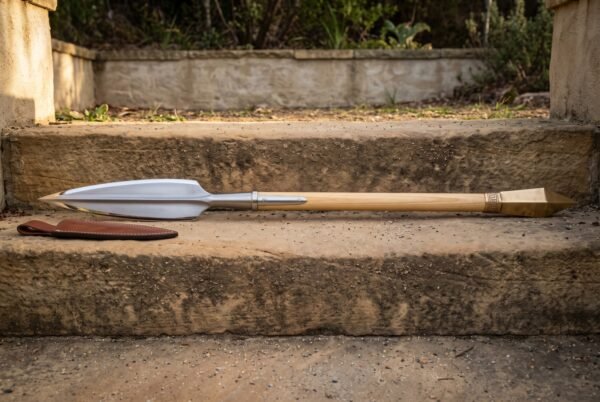
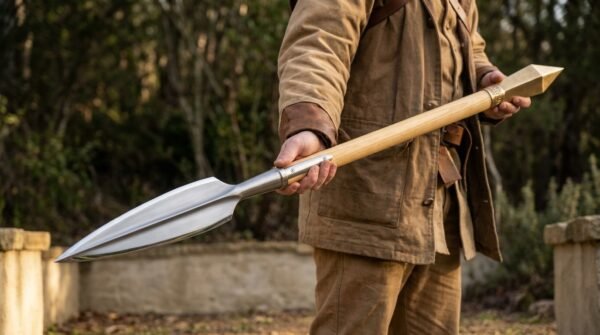
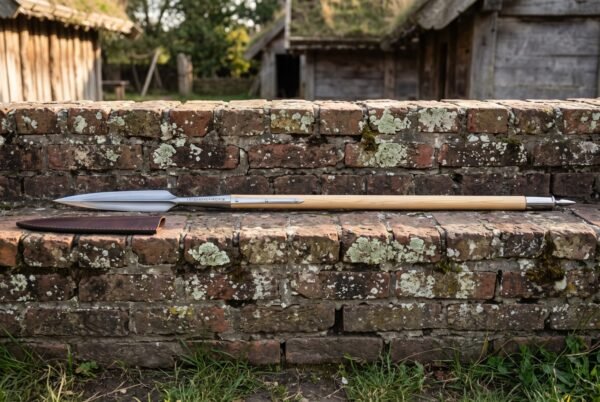
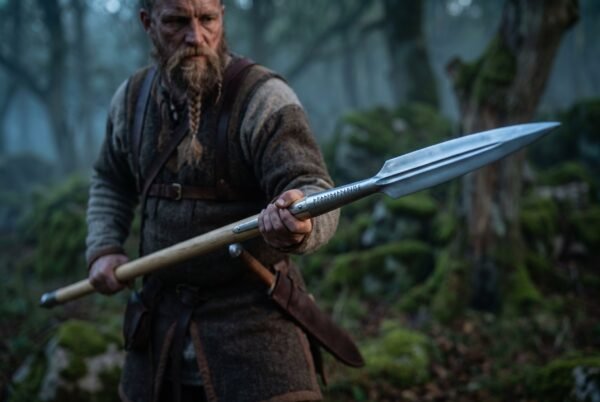
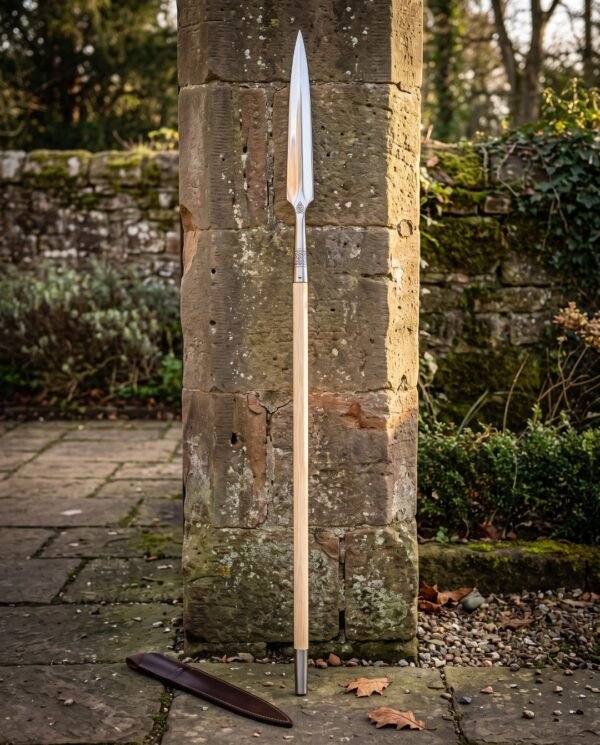
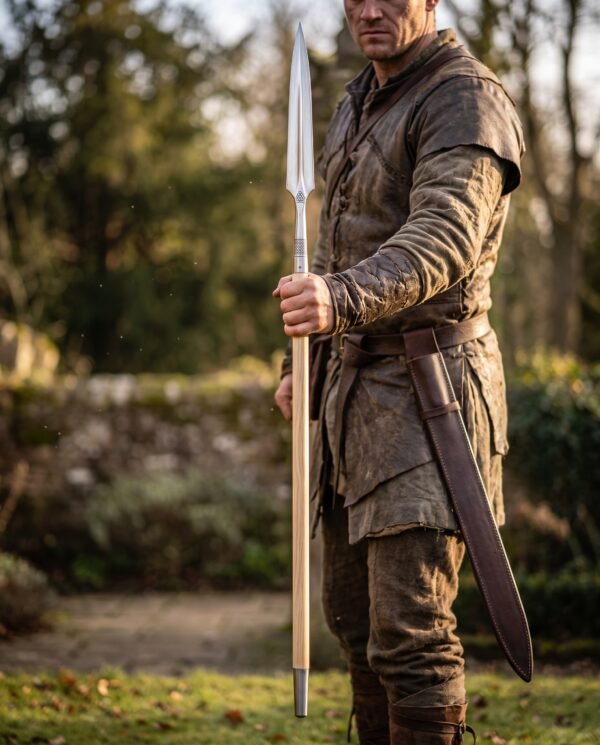
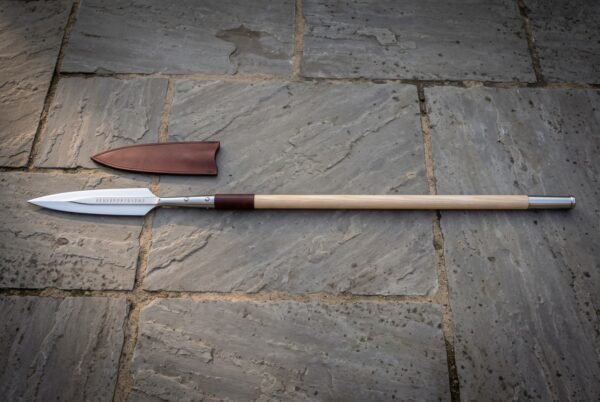
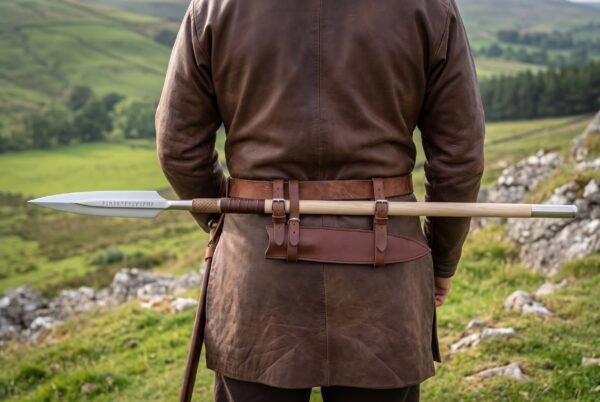
This one is forged in the Czech Republic. The head is a long leaf blade in pattern welded Damascus of 1095 and 15N20, drawn to a fine central spine, and it sits on a brass socket cut with a line of Elder Futhark. The shaft is dark stained ash with a knotwork engraved brass butt cap, and a fitted brown leather blade sheath is supplied so the point can be covered in transport and on the wall. The spear was the arm most Norsemen actually carried, and our piece on the Viking spear covers the types.
Specifications
| Blade steel | Pattern welded Damascus of 1095 and 15N20 |
|---|
| Hardness | 58 to 60 HRC |
|---|
| Head form | Long leaf blade with a raised central spine, double edged |
|---|
| Head length | Approximately 18 inches including the socket |
|---|
| Socket | Brass, cut with an Elder Futhark rune line |
|---|
| Shaft | Dark stained ash, near black |
|---|
| Overall length | Approximately 34 inches |
|---|
| Butt | Brass butt cap engraved with knotwork |
|---|
| Sheath | Fitted dark brown leather blade sheath, stitched along the edge |
|---|
| SKU | RK-1481 |
|---|
Why the socket is the hard part
Everyone looks at the blade. The part that decides whether a spear survives is the socket. A Norse spearhead is not a blade with a spike driven into a stick; it is a blade whose tang is forged out flat, wrapped around a mandrel and closed into a cone, so the head grips the wood over several inches rather than at one point. Get the wrap uneven and the head sits crooked. Get the taper wrong and the shaft splits the first time the spear is used. Historical sockets were often left with a visible seam and sometimes riveted through, and archaeologists can date and place finds by nothing more than the shape of that cone.
The leaf shape does two jobs. The widest point sits well back from the tip, which means the point enters easily and the wound opens as the blade drives on, and the long taper from the widest point back to the socket keeps the head from wedging so it can be recovered. The raised spine down the centre is the structural element. It stiffens a blade that is otherwise long and thin, and it is the reason a spearhead can be ground fine at the edges without folding on contact.
The ash shaft is not a neutral choice either. Ash has long, straight, springy fibres that bend and recover rather than shattering, which is why it has been the standard haft timber for spears, axes and tool handles across Europe for as long as anyone has been recording it.
The steel
The head is genuine pattern welded Damascus, not an etched surface print. Alternating layers of 1095 high carbon steel and 15N20 nickel bearing steel are forge welded, drawn out, folded and welded again, then the head is forged to shape from that billet. The pattern you can see is the edge of every one of those layers cut by the grinder, which is why it flows around the profile of the blade rather than sitting on it like a decal. An acid etch afterwards darkens the 1095 and leaves the 15N20 bright, which is what makes the pattern visible.
The billet is heat treated to 58 to 60 HRC. That is the right window for a spear. Softer and the fine point rolls; harder and the tip chips instead of bending when it meets something it should not. The socket and butt cap are brass, chosen for contrast and because brass takes a cut rune line cleanly.
Engraving, runes and your own design
Use the rune converter on this page to turn a name, a date or a short phrase into Elder Futhark and we will cut it into the steel or the leather. If you would rather have a Viking pattern than a rune line, choose your own design in the engraving option above the add to cart button and tell us where it goes. Where a piece already carries an engraved design, your chosen engraving replaces it rather than sitting alongside it, so the rune band on the socket carries whatever you specify. The brass socket, the butt cap and the leather sheath all take a cut line. See the engraving page.
Mounting and display
A short spear like this suits either a wall or a stand, and both work. On a wall, mount it horizontally on two hooks placed a third of the way in from each end so the shaft is supported rather than sagging in the middle, and always mount to studs. A spear hung on a single central hook will pivot and eventually walk off it.
If you stand it in a corner or a stand, keep the leather sheath on the head. A bare Damascus point in a room is a genuine hazard, and the sheath also keeps the etched pattern from being fingerprinted by everyone who walks past. Do not store the spear leaning against an outside wall or in an unheated garage, because the shaft will take up moisture on one side and bow. Flat, dry and horizontal is best.
Care
Damascus is high carbon steel and it will rust if you let it. Wipe the head down with an oiled cloth after handling, because fingerprints etch into a polished pattern within days in a humid room. Any light machine oil, mineral oil or a dedicated blade oil is fine. Never put the head away wet, and never store it long term sealed inside the leather sheath, since vegetable tanned leather holds moisture and acid against steel.
Feed the sheath with a leather balm once or twice a year. The brass will tarnish; a brass cream brings it back, but keep the cream off the etched blade because it will dull the contrast between the layers. The ash shaft benefits from a wipe of boiled linseed oil once a year to stop it drying out. Full detail is on our steel care page. Etched steel wants its own routine, which is on the Damascus care page.
Made in the Czech Republic
This piece is made by hand in the Czech Republic, in a workshop that still works the old way. The steel is forged, ground, heat treated and finished by smiths who learned the trade from the people before them, and the wood, horn and leather are cut and fitted by hand rather than pressed out on a line. That is also why no two pieces come out exactly the same.
Ransack Viking is a United States company. We import these pieces ourselves, check every one when it lands and ship from our warehouse in Chicago, Illinois. Engraving is done here in the United States after the piece arrives, so your runes or your own design go on before it leaves for you.
A note on handmade variation
This spear is hand made, not machine made or bulk produced, so what arrives will not be a pixel for pixel copy of the photograph. No two Damascus billets ever produce the same pattern, the grain and colour of the ash shaft vary, and the depth of the cut runes changes with the graver, because every piece is worked by hand from natural materials. The dimensions, the material and the build are the same every time. The character is not.
Frequently asked questions
Is the pattern real Damascus or an etch?
Real. The head is forged from a welded billet of 1095 and 15N20, so the pattern runs through the steel and follows the ground profile rather than sitting on the surface.
Is it sharp?
Yes. It ships with a working edge and a fine point. Treat it as a live blade, keep the sheath on it and keep it away from children.
Can I use it for reenactment combat?
No. This is a sharp, live spear built for display and collecting. Combat reenactment requires blunt, rebated heads inspected by your society.
Can the head be removed from the shaft?
It is fitted to stay. If you need it dismantled for shipping or display, tell us at the time of ordering and we will fit it so it can be drawn off.
Will it rust?
High carbon Damascus will rust if it is left damp or fingerprinted. Wipe it with an oiled cloth after handling and it will stay clean indefinitely.
How long before it ships?
Processing is one to two weeks because the billet is welded and the head forged to order. Shipping inside the United States is free and returns are accepted within seven days.
What is in the box
- One Damascus leaf blade spear on a stained ash shaft
- Brass socket cut with an Elder Futhark rune line, or your own engraving in its place
- Knotwork engraved brass butt cap
- Fitted dark brown leather blade sheath
- Light protective oil coat applied before packing
- Care and storage card
- Forged and finished in the Czech Republic
Explore the range
See more in viking spears, Norse arms, viking axes and battle axes, or read the guides.
Other pieces in this group
Closest to this in the range is the Ashreach Viking spear, pattern welded Damascus. If this one is not quite right, there is the Serpentcast Viking spear, 74 inches overall. Also in this group is the Ashgleam Viking spear, forged from 1095.
If you are putting a set together, the Thornwake polearm sits alongside it. Nothing here exactly right, build one to your own spec on the custom Norse arms page.
This is exactly what I wanted and then some. Came in solid packaging and arrived in perfect condition. Highly recommend this one.
This is exactly what I wanted and then some. Ordered from Ransack Viking before and the quality stays consistent every time. Came in solid packaging and arrived in perfect condition. Finish on the metal is even and clearly hand forged. If you’re on the fence just get it. You won’t regret it.
Can’t stop showing this off to everyone who comes over. Came in solid packaging and arrived in perfect condition. So worth it.
This is exactly what I wanted and then some. Shipping was fast and everything arrived well packaged.
My husband was speechless when he opened this. Haft feels sturdy and well balanced for the size of the head. Ransack Viking is quickly becoming my go to shop for anything Norse themed. Great buy overall.
This is exactly what I wanted and then some. Came in solid packaging and arrived in perfect condition. Finish on the metal is even and clearly hand forged. Great for reenactment or just display. Either way it looks amazing. Couldn’t be happier with this.
My whole family was impressed when I unboxed it. Came in solid packaging and arrived in perfect condition. Nice touch that it ships from within the US even though it’s crafted in the Czech Republic. Finish on the metal is even and clearly hand forged. Already telling my friends to check this out.
Best polearm I’ve ever owned. Came in solid packaging and arrived in perfect condition. 10/10 would buy again.
This polearm is a genuine work of art. This will be a family heirloom for sure.
This polearm is well made. Just a couple small things kept it from 5 stars. Haft is solid though a touch shorter than I pictured. Head is well made. Just wish the wood grain was a bit more even. Glad I made this purchase.