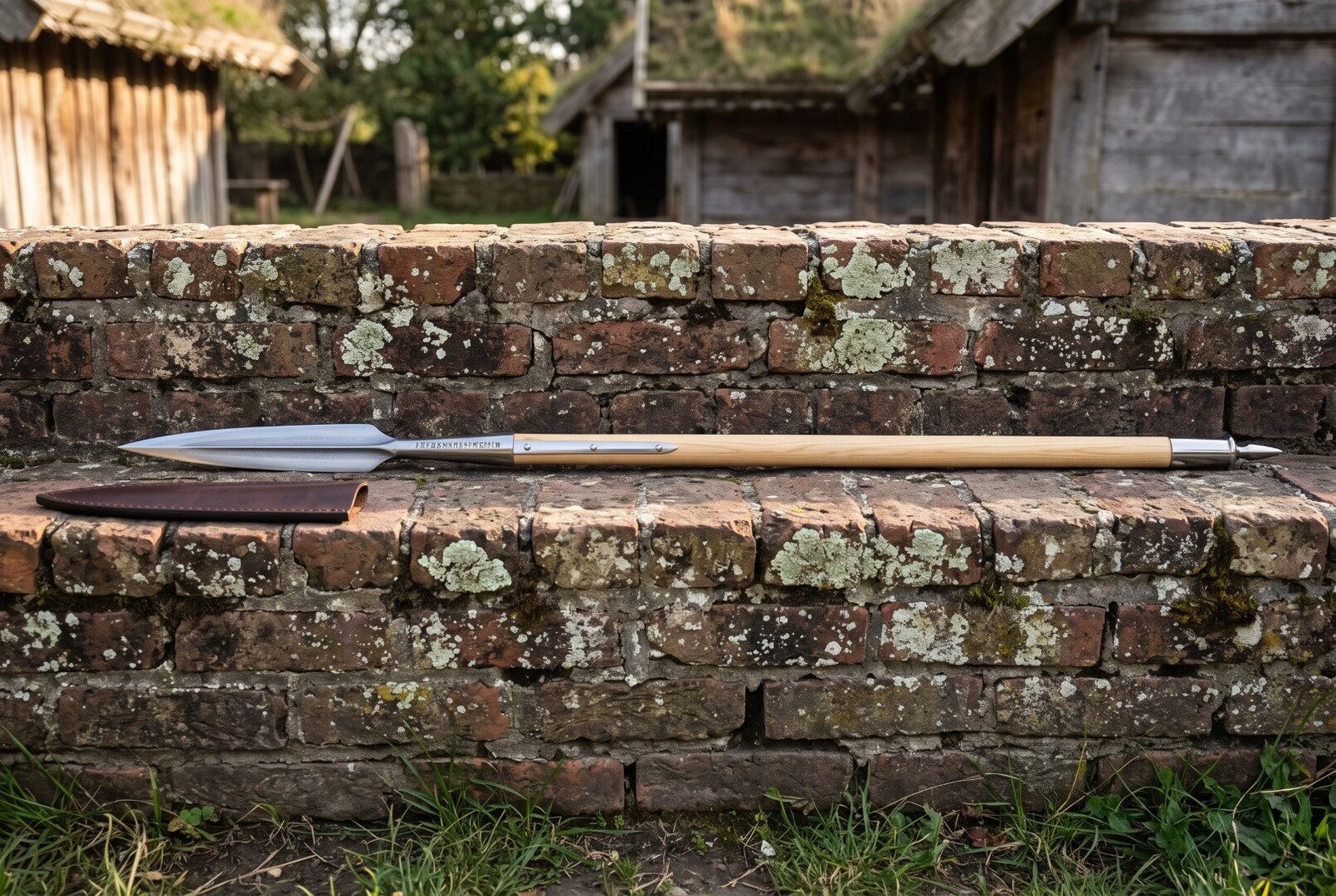
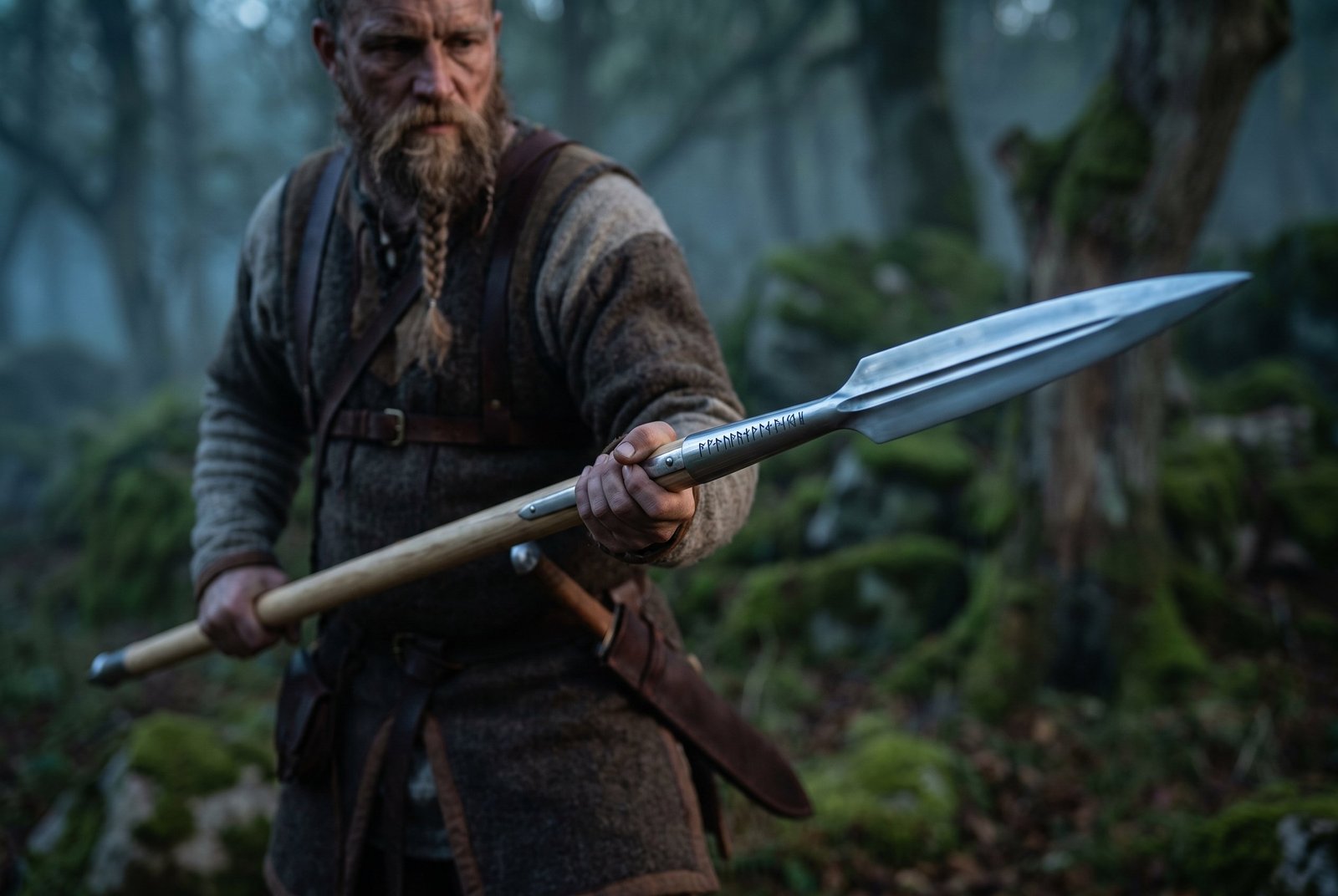
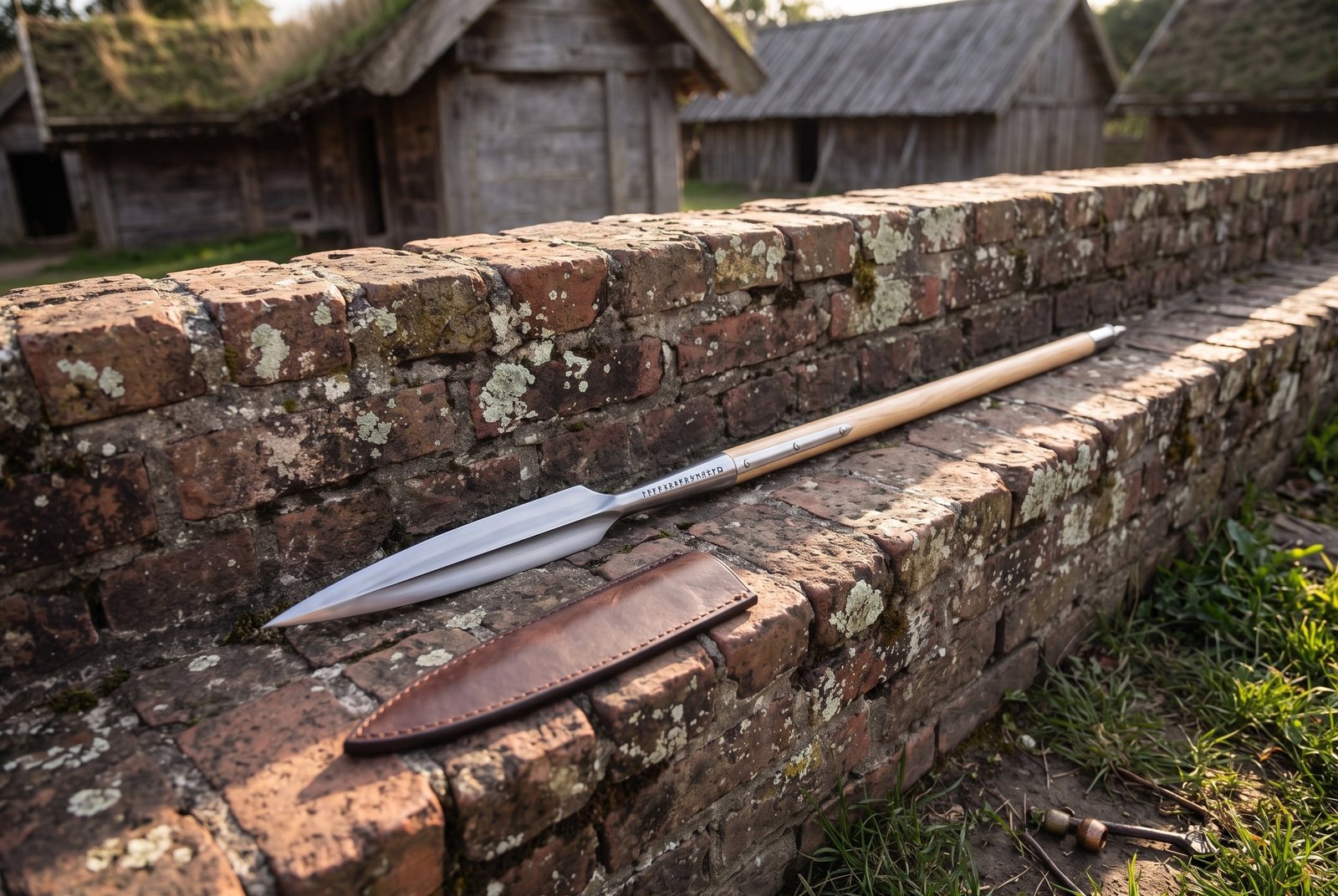
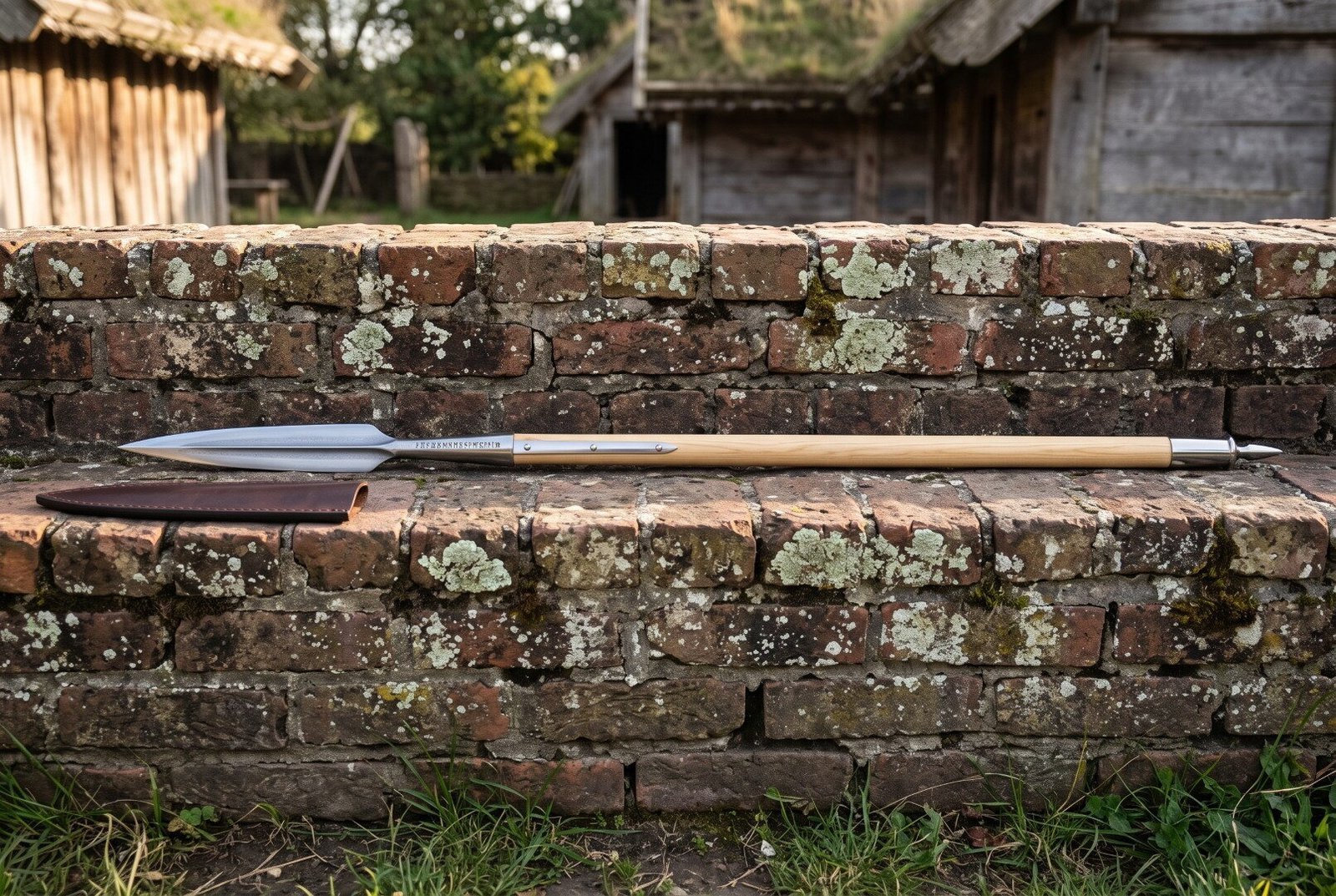
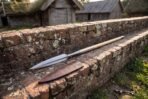
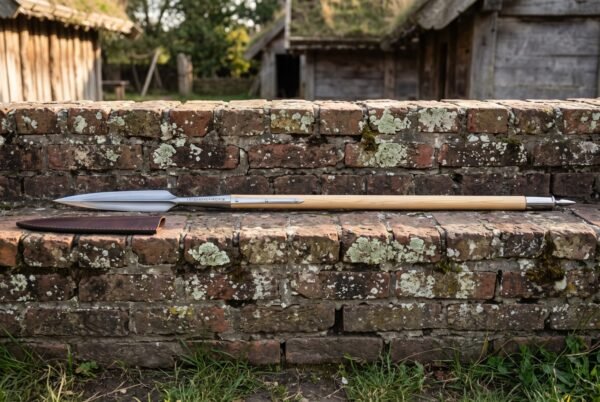
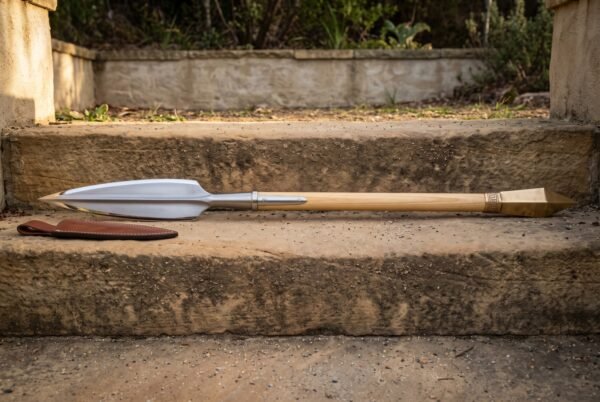
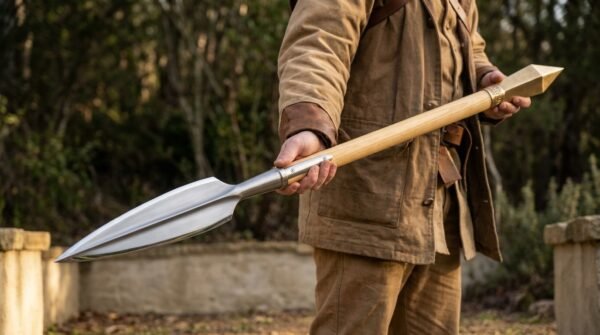
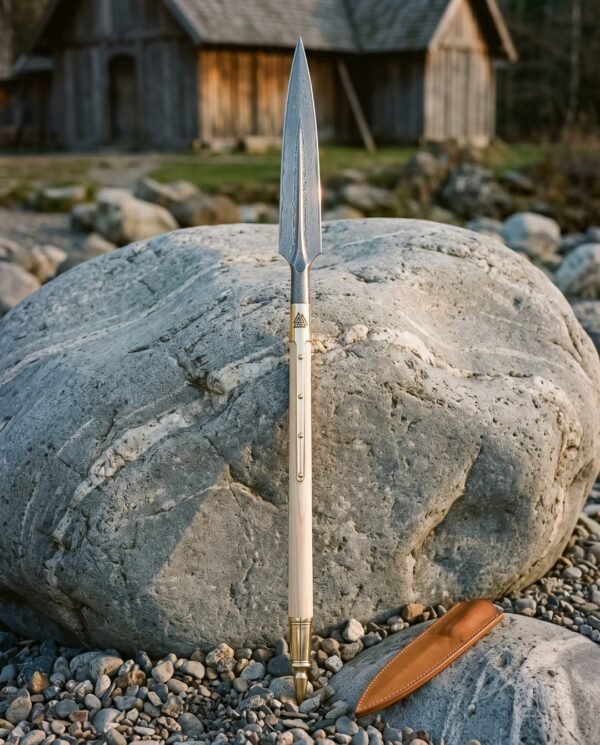
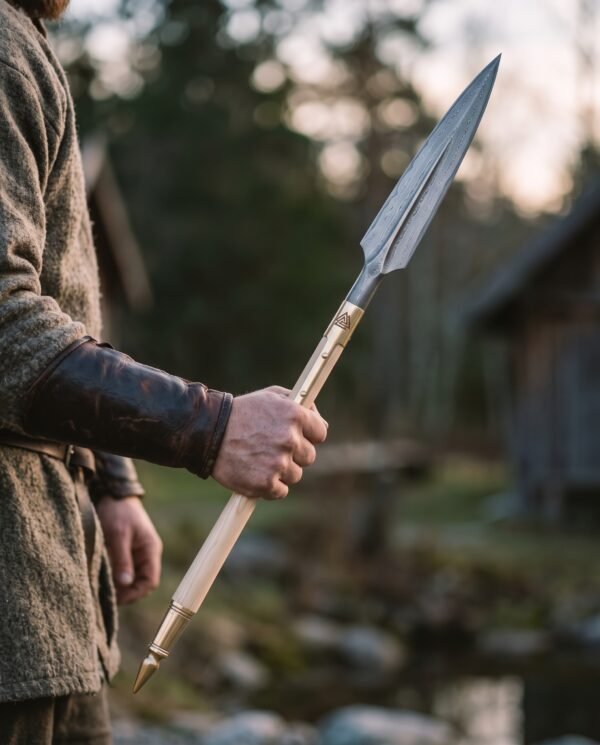
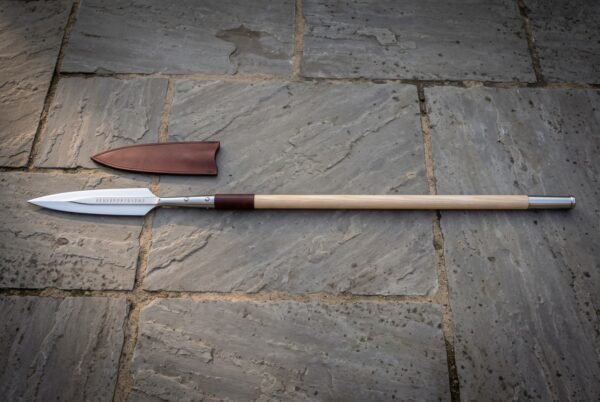
The Ashgleam is a Viking spear built on the plainest and most common pattern in the whole Norse arsenal. A narrow leaf shaped head with a raised central ridge, a long split socket, and a straight ash haft riveted through. There is nothing ornamental about the shape. This is what most Norse fighters actually owned, and it turns up in graves across Scandinavia in far greater numbers than swords ever do.
That is worth saying plainly. A sword was a rich man’s possession, expensive in steel and in labour. A spear needed a fraction of the metal and a length of ash that anyone could cut, which is why the sagas hand spears to farmers and crews and reserve named swords for kings. Odin fought with a spear, not a sword, and Gungnir sits at the centre of the mythology for a reason. This one is forged, ground, engraved and hafted in a Czech Republic workshop, and it carries our lifetime warranty against defects in forging, grind, heat treat and fittings, with no end date and no receipt needed. Look for it with the Viking spears, and take in the glaives and polearms on the way past.
Specifications
| Head material | 1095 high carbon steel, 54 to 58 HRC |
|---|
| Head shape | Narrow leaf blade with a raised central ridge |
|---|
| Head length | Approximately 11 inches including the socket |
|---|
| Blade length | Approximately 6.5 inches of cutting edge |
|---|
| Overall length | Approximately 76 inches |
|---|
| Socket | Tapered socket with two long langets running down the haft, held by steel rivets |
|---|
| Haft | Straight grained ash, oil finished |
|---|
| Butt | Steel butt cap ending in a short point |
|---|
| Engraving | Elder Futhark line cut along the socket |
|---|
| Finish | Satin ground blade with hand rubbed bevels |
|---|
| Weight | Approximately 3 lb assembled |
|---|
| Included | Stitched brown leather head sheath |
|---|
| SKU | RK-1594 |
|---|
How a Viking spear socket is made and why it matters
Almost every Norse spearhead in the museum record is socketed rather than tanged, and the socket is the clever part. The smith forges a flat tongue at the base of the blade, then wraps it around a tapered mandrel until the two edges meet. On many originals you can still see the seam running down one side where the wrap closes, sometimes forge welded shut and sometimes left simply butted. The socket is then drifted to a taper so it grips the shaft along its whole length rather than only at the mouth.
The reason this beats a tang is shock. A tanged head concentrates every impact on a thin bar of steel driven into split wood, and split wood is exactly where a shaft wants to fail. A socket wraps the wood instead, so the shaft is in compression rather than being wedged apart. Add one or two rivets through the sides and the head cannot walk forward off the end or spin.
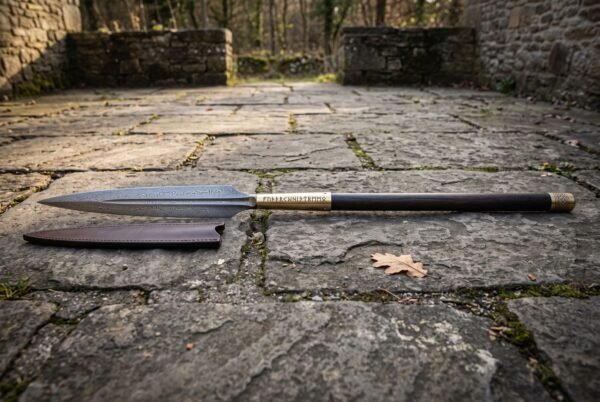
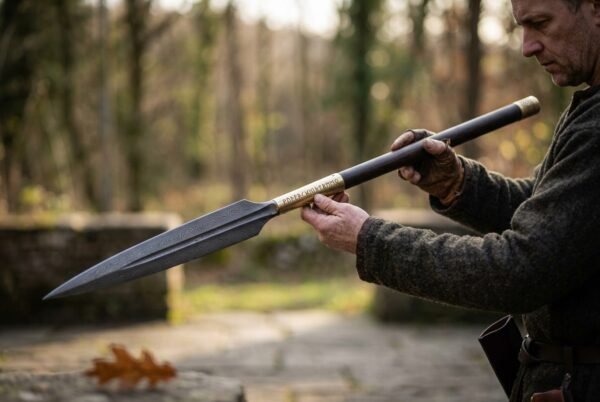
The Ashgleam follows that construction. The socket is long, tapered and riveted twice, and it carries a line of Elder Futhark cut along the flat where a Norse smith would most likely have put an owner’s mark. The leaf shape above it has a central ridge running most of its length, which is what stops a blade this narrow from flexing sideways on a hard thrust.
1095 high carbon steel
The head is forged from 1095, a plain high carbon steel that behaves the way carbon steel has always behaved. Heat it, quench it in oil, temper it back. We take this head to 54 to 58 HRC rather than the harder range we use on small knives, because a spear head sees bending and lateral shock rather than fine cutting. At this hardness the point can take a knock on a hard target and bend a little instead of snapping.
The finish is a hand rubbed satin rather than a mirror. That is a deliberate choice on a reenactment style piece. Satin is closer to what a period blade would have looked like after honing on a stone, it hides normal handling marks, and it does not throw glare under stage or field lighting. The ash haft is chosen for straight grain running the full length, because a runout across the shaft is where a spear breaks. Ash is the traditional wood for a reason. It is stiff enough to thrust with and springy enough not to shatter.
Engraving, runes and your own design
Use the rune converter on this page to turn a name, a date or a short phrase into Elder Futhark and we will cut it into the steel, the leather or the wood. If you would rather have a Viking pattern than a rune line, choose your own design in the engraving option above the add to cart button and tell us where it goes. Where a piece already carries an engraved design, your chosen engraving replaces it rather than sitting alongside it. On this spear that means your text takes the place of the futhark already on the socket. Everything is set out on the engraving page.
Balance and handling
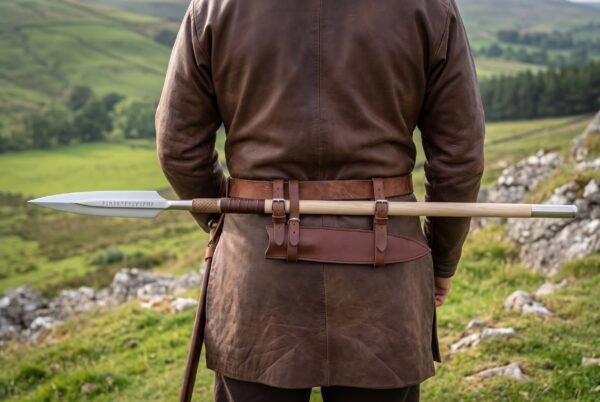
Six foot four is a proper Norse spear length, long enough to fight from behind a shield wall and short enough to carry through a doorway. The balance point sits about thirty inches from the butt, which is well back because the head is light for its size. That is the whole point of the design. A spear you can hold one handed for a long time while the other hand carries a shield is a spear you can actually fight with.
The head arrives sharp on both edges and at the point. This is a working forged spear and it is not sold for battle ready or full contact sparring. It should not be used against another person. For drill, display, film and stage work, and for static reenactment kit, it is exactly the right piece. If you want a blunted head for combat reenactment, ask before ordering.
Care
1095 is not stainless and it will rust if it is stored damp. Wipe the head dry after handling and keep a thin coat of mineral oil, camellia oil or paste wax on the steel. Pay attention to the socket mouth where water sits between wood and metal after a wet event. Take the leather sheath off for storage rather than leaving the head inside it for months. Light surface rust lifts with oil and a green pad. Our steel care page has the full routine. The ash wants boiled linseed or Danish oil once or twice a year, worked in with a rag and wiped back, which also keeps the wood from drying out and shrinking away from the rivets.
Made in the Czech Republic
This piece is made by hand in the Czech Republic, in a workshop that still works the old way. The steel is forged, ground, heat treated and finished by smiths who learned the trade from the people before them, and the wood, horn and leather are cut and fitted by hand rather than pressed out on a line. That is also why no two pieces come out exactly the same.
Ransack Viking is a United States company. We import these pieces ourselves, check every one when it lands and ship from our warehouse in Chicago, Illinois. Engraving is done here in the United States after the piece arrives, so your runes or your own design go on before it leaves for you.
A note on handmade variation
This is hand made, not machine made or bulk produced, so what arrives will not be a pixel for pixel copy of the photograph. Ash varies from near white to a warm honey with darker streaks, and the grain pattern is different in every shaft we cut. The leaf profile shifts by a fraction because it is forged and ground by hand, and the socket seam sits where the wrap closes on that particular head. The dimensions, the material and the build are the same every time. The character is not. You can carry on with the arms in Vikings and The Last Kingdom, or look at the Norse gods while you are there.
Frequently asked questions
Is this sharp when it arrives
Yes. Both edges and the point are sharpened, and the spear ships with a leather sheath over the head. Handle it like a large knife on a stick.
Can I get a blunt version for combat reenactment
We can grind a rolled safety edge on request. Add a note to your order and we will confirm before the head goes into finishing.
How is it packed for shipping
Assembled, in a long tube or a long box with the head boxed separately inside so the point cannot work through the wall in transit.
Can the haft be shortened
Yes, at the butt end with a fine tooth saw. Refit the steel butt cap afterwards or seal the cut end with oil. Do not cut at the head end, where the rivets are.
What do the runes on the socket say
The stock line is a short Elder Futhark sequence used as a maker’s mark. If you want specific words, order the piece with custom engraving and yours replaces it.
Will mine look like the photograph
The size, steel and construction match. The ash grain and the exact leaf profile will be its own, because both are worked by hand from natural material.
What is in the box
- One Ashgleam 1095 Viking spear, head riveted to the ash haft
- One stitched vegetable tanned leather head sheath
- Care card and lifetime warranty note
- Forged and finished in the Czech Republic
Explore the range
Browse the full Viking spears range, the Norse arms catalogue, the Viking shields that go with it, or read the guides.
Other pieces in this group
In the same category sits the Runeleaf Viking spear, 72 inches overall. A near match for this one is the Skyrend Viking spear, pattern welded Damascus. Closest to this in the range is the Ashreaver Viking spear, forged from 1095.
Fitting out further, the Tidefork polearm belongs with it. Nothing here exactly right, build one to your own spec on the custom Norse arms page.

Five stars isn’t even enough honestly. Finish on the metal is even and clearly hand forged. 10/10 would buy again. Ordered from Ransack Viking before and the quality stays consistent every time.