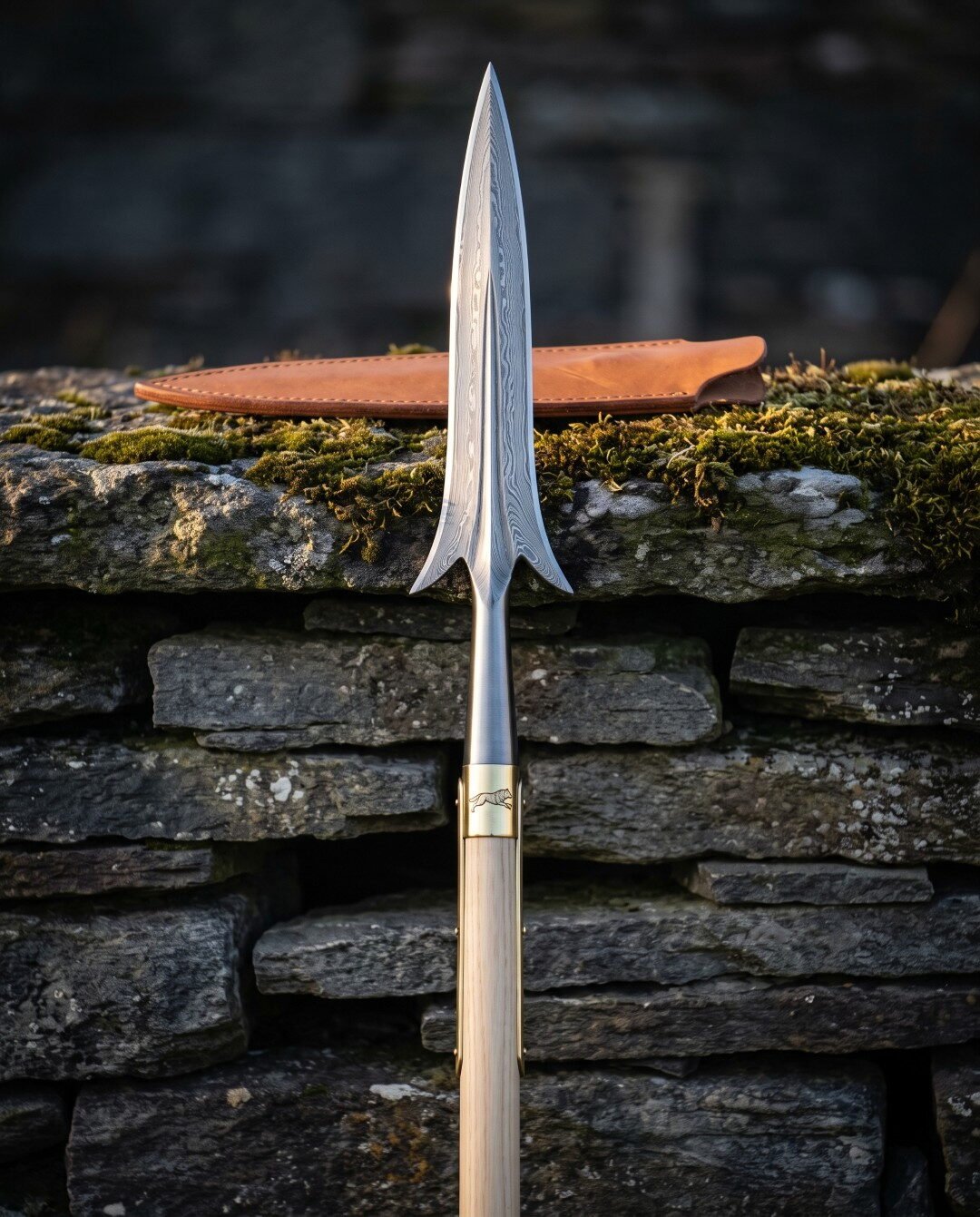
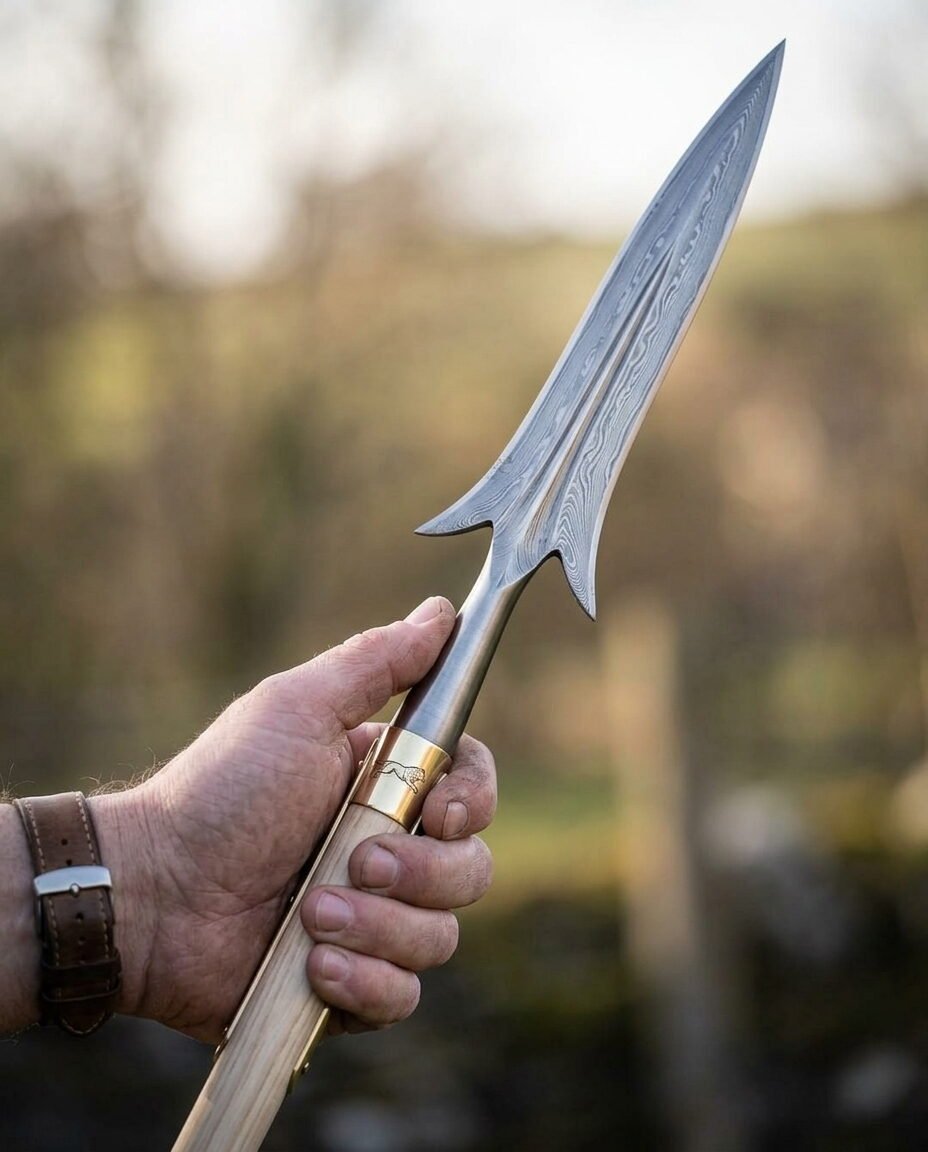
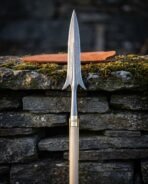
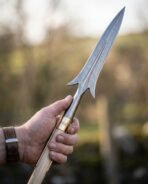
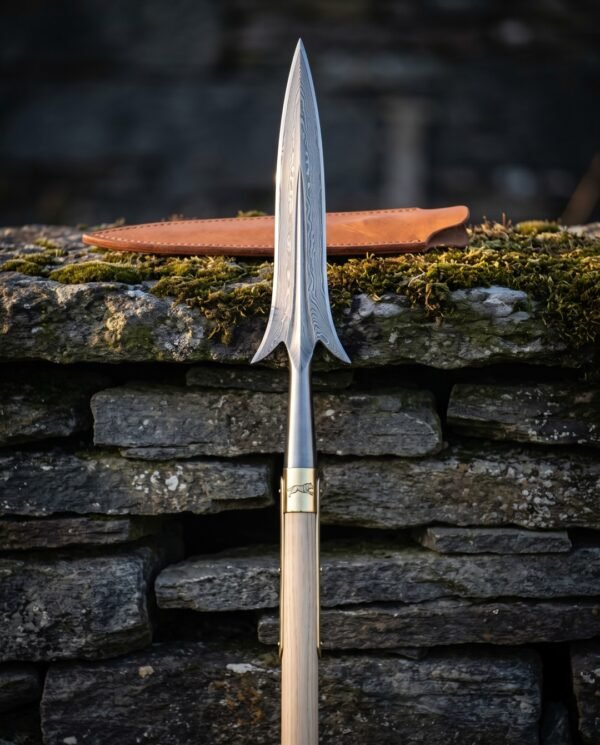
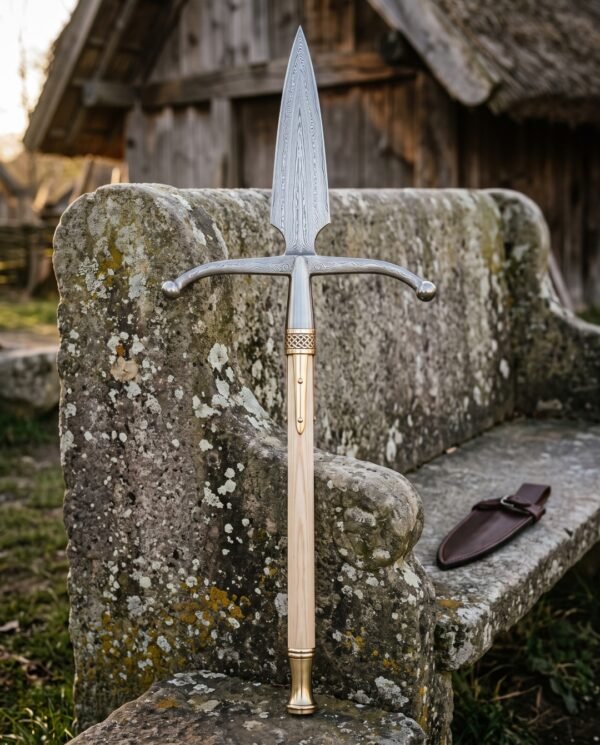
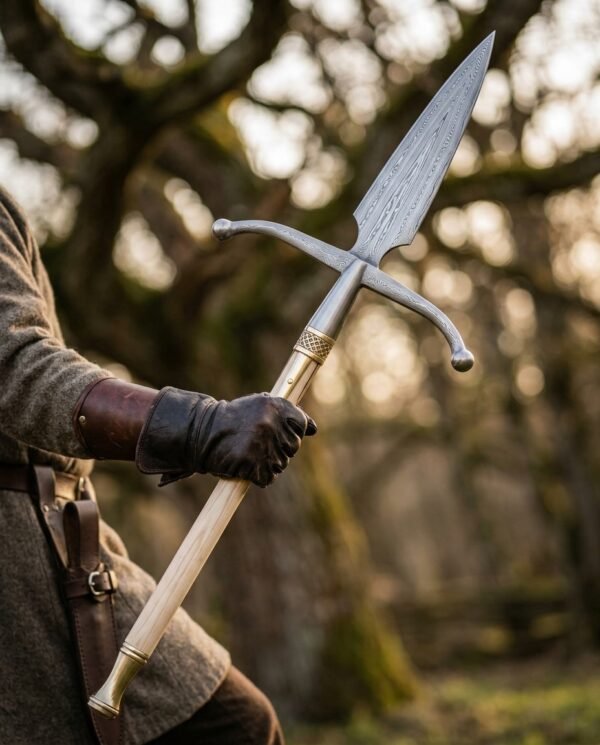
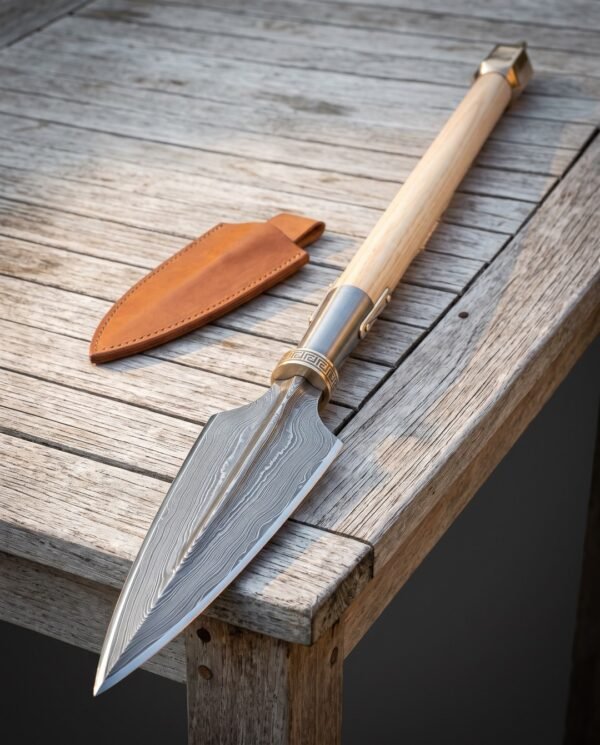
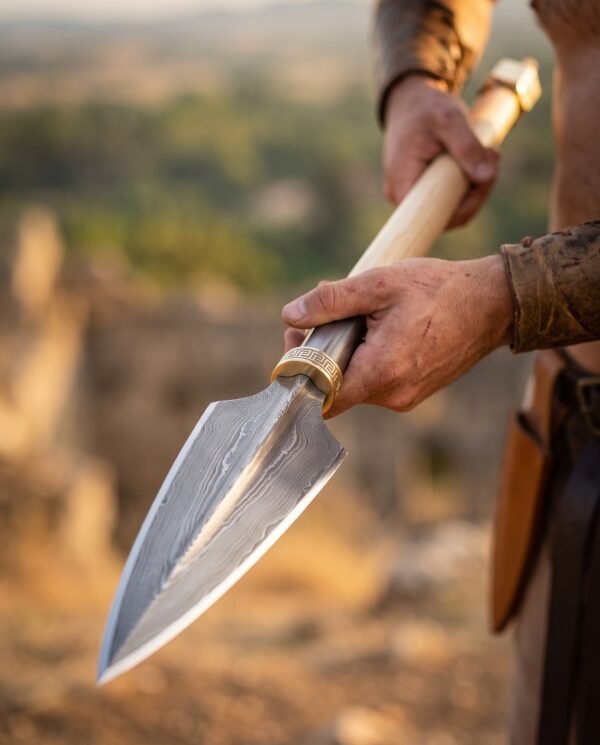
The Thornwake is a winged spear, the pattern of hafted spear that carried northern European war bands from the seventh century through to the end of the Viking age. The head is forged from 1095 and 15N20 Damascus, drawn out into a long lanceolate blade with a raised central ridge, and finished with a pair of swept lugs where the blade meets the socket. Those lugs are the wings the type is named for, and they are not decoration.
A spear that has gone into a shield, a boar or a horse will keep travelling until something stops it, and the wings are what stops it. They also give a fighter a hard point to hook, bind and lever against another shaft. Every Thornwake head is forged, ground, heat treated and etched in a Czech Republic workshop, then fitted to a straight grained ash haft with an engraved brass collar and brass side straps. It ships with a stitched leather head sheath and carries our lifetime warranty against defects in forging, grind, heat treat and fittings, with no end date and no receipt needed. The spear was the arm most Norsemen actually carried, and our piece on the Viking spear covers the types.
Specifications
| Head material | 1095 and 15N20 Damascus, 58 to 60 HRC |
|---|
| Head | Long lanceolate blade with a raised central ridge and two barbed wings swept back toward the haft |
|---|
| Socket | Long polished steel socket |
|---|
| Head length | Approximately 12 inches including the socket |
|---|
| Blade length | Approximately 8 inches from the wings to the point |
|---|
| Overall length | Approximately 72 inches |
|---|
| Haft | Straight grained American ash, oil finished |
|---|
| Fittings | Brass collar engraved with a running animal, thin brass straps down both sides of the haft |
|---|
| Finish | Acid etched Damascus with hand rubbed satin bevels |
|---|
| Weight | Approximately 3 lb 4 oz assembled |
|---|
| Included | Stitched tan leather head sheath |
|---|
| SKU | RK-1591 |
|---|
What the wings on a winged spear actually do
Archaeologists call this type a lugged or winged spear, and in the German literature it is a Flugellanze. The wings sit at the top of the socket and stand out to either side, usually swept forward or curled slightly toward the point. Three things follow from that shape. The first is depth control. Against a heavy animal or a mass of shields, the wings arrest the head before the whole shaft is buried and the spear becomes impossible to recover. The second is leverage. A winged spear can be used to trap and turn another shaft, to press a shield rim down, or to catch an opponent behind the knee and unbalance him. The third is simple structure. The wings are forged from the same billet as the socket, so they act as a broad shoulder that spreads the shock of a hard thrust across the top of the haft instead of concentrating it on the rivets.
Norse spears varied enormously. Grave finds from Norway and Sweden run from slim throwing points barely six inches long to broad two foot heads meant for two hands. The winged form sits in the middle of that range, a serious close quarter spear rather than a missile, and it is the pattern most often shown in period carving in the hands of a fighter who is holding the line rather than throwing.
The steel in the head
The billet is 1095 high carbon steel folded with 15N20, a nickel bearing steel that stays bright when the finished blade is etched. That contrast is what makes the pattern readable. The layers are drawn, folded and manipulated to produce the flowing lines you can see running from the ridge down into the bevels, then the head is normalised, hardened and tempered to 58 to 60 HRC. That hardness is chosen deliberately for a thrusting head. Too soft and the point rolls on a hard target, too hard and it chips. The band we work in gives a point that holds its shape and a body that will flex a little rather than snap.
The Damascus is real pattern welded steel, not an etched print or a coating. It goes all the way through the head, which is why the pattern continues onto the cut faces of the wings. The socket is forged closed around a mandrel and drifted to fit the ash. Below it sits a brass collar engraved with a running animal, with thin brass straps running down the haft on either side.
Engraving, runes and your own design
Use the rune converter on this page to turn a name, a date or a short phrase into Elder Futhark and we will cut it into the steel, the leather or the wood. If you would rather have a Viking pattern than a rune line, choose your own design in the engraving option above the add to cart button and tell us where it goes. Where a piece already carries an engraved design, your chosen engraving replaces it rather than sitting alongside it. On a spear the usual places are the flat of the socket, the ricasso just above the wings, or the ash itself just below the ferrule. Full details are on the engraving page.
Balance and handling
Assembled, the Thornwake balances roughly eighteen inches below the wings, which is further forward than a light throwing spear and further back than an axe. In practice that means it wants to be held with the rear hand well down the haft and the forward hand loose, sliding rather than gripping. The head is heavy enough to carry a thrust through a padded target and light enough that you can recover the point quickly and thrust again.
This is a working forged spear, not a stage prop, and the point and edges arrive sharp. It is not sold for full contact sparring and should not be used against another person. If you want it for drill, target work or display, that is exactly what it is built for. The ash haft can be shortened at home with a fine tooth saw if you want a shorter one handed length, though the brass collar and straps sit at the head end and should be left alone.
Care
Damascus is high carbon steel and it will rust if you leave it wet. Wipe the head dry after handling and put a thin film of mineral oil, camellia oil or paste wax on it before it goes back in the sheath. Do not store the head inside the leather for months at a time, because vegetable tanned leather holds moisture and will freckle a bright etch. If light surface rust does appear, a dab of oil on a green pad will take it off without hurting the pattern. Full guidance is on our steel care page. The ash haft wants a wipe of boiled linseed or Danish oil once or twice a year, and the brass will develop a warm patina that comes back to bright with any household metal polish. Etched steel wants its own routine, which is on the Damascus care page.
Made in the Czech Republic
This piece is made by hand in the Czech Republic, in a workshop that still works the old way. The steel is forged, ground, heat treated and finished by smiths who learned the trade from the people before them, and the wood, horn and leather are cut and fitted by hand rather than pressed out on a line. That is also why no two pieces come out exactly the same.
Ransack Viking is a United States company. We import these pieces ourselves, check every one when it lands and ship from our warehouse in Chicago, Illinois. Engraving is done here in the United States after the piece arrives, so your runes or your own design go on before it leaves for you.
A note on handmade variation
This is hand made, not machine made or bulk produced, so what arrives will not be a pixel for pixel copy of the photograph. The Damascus pattern is different on every billet we weld, and the way that pattern lands on the bevels depends on where in the bar the head was cut. Ash grain, colour and the exact sweep of the wings vary because each one is worked by hand from natural materials. The dimensions, the material and the build are the same every time. The character is not, and that is the point of buying something forged rather than stamped.
Frequently asked questions
Is the spear sharp when it arrives
Yes. The point and both edges are sharpened before the head is fitted, and the spear ships with the leather sheath over the head for that reason. Treat it as you would a large knife.
Is the Damascus real or is it printed on
It is real pattern welded steel, 1095 folded with 15N20. The layers run all the way through the head, so you can see the pattern on the cut edges of the wings as well as on the faces.
Can I throw this spear
You can, but we do not recommend it. A winged head this size is built for thrusting, and repeated hard landings on stone or frozen ground will bend a point that was hardened for a different job.
Does it come apart for shipping
No. The head is riveted to the haft and ships assembled in a long box. If you need it shortened for a particular display, tell us in the order notes before it goes into finishing.
Will mine look exactly like the photograph
The shape, size and materials will match. The Damascus figure and the ash grain will not, because both are natural and both differ from piece to piece.
How long does it take to reach me
Processing is one to two weeks, then free shipping inside the United States. Engraved orders sit at the back end of that window rather than the front.
What is in the box
- One Thornwake Damascus winged spear, head riveted to the ash haft
- One stitched vegetable tanned leather head sheath
- Care card and lifetime warranty note
- Forged and finished in the Czech Republic
Explore the range
See the rest of the Viking spears, the glaives and polearms, the wider Norse arms range, or read the guides.
Other pieces in this group
Another in the same line is the Boarhelm polearm, forged from 1095. Next along the rack is the Dawnleaf polearm, 68 inches overall. For a straight comparison, see the Reedfork polearm, forged from 1095.
The Ashgleam Viking spear covers the other half of the same kit. Nothing here exactly right, build one to your own spec on the custom Norse arms page.

Perfect gift. Perfect quality. No complaints. Haft feels sturdy and well balanced for the size of the head. This is going straight into my display case.
My whole family was impressed when I unboxed it. You can tell it’s real Czech blacksmith work and shipping from the States made delivery painless. Great for reenactment or just display. Either way it looks amazing. Haft feels sturdy and well balanced for the size of the head. This is going straight into my display case.
Absolutely blown away by this polearm. Steel head is heavy in a good way. You can tell it’s not hollow. Already telling my friends to check this out.
Can’t stop showing this off to everyone who comes over. Steel head is heavy in a good way. You can tell it’s not hollow. Ordered from Ransack Viking before and the quality stays consistent every time. Came in solid packaging and arrived in perfect condition. Great buy overall.
This polearm is well made. Just a couple small things kept it from 5 stars. Head is well made. Just wish the wood grain was a bit more even. Minor nitpicks aside, good quality piece.