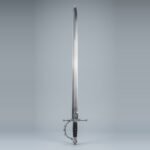
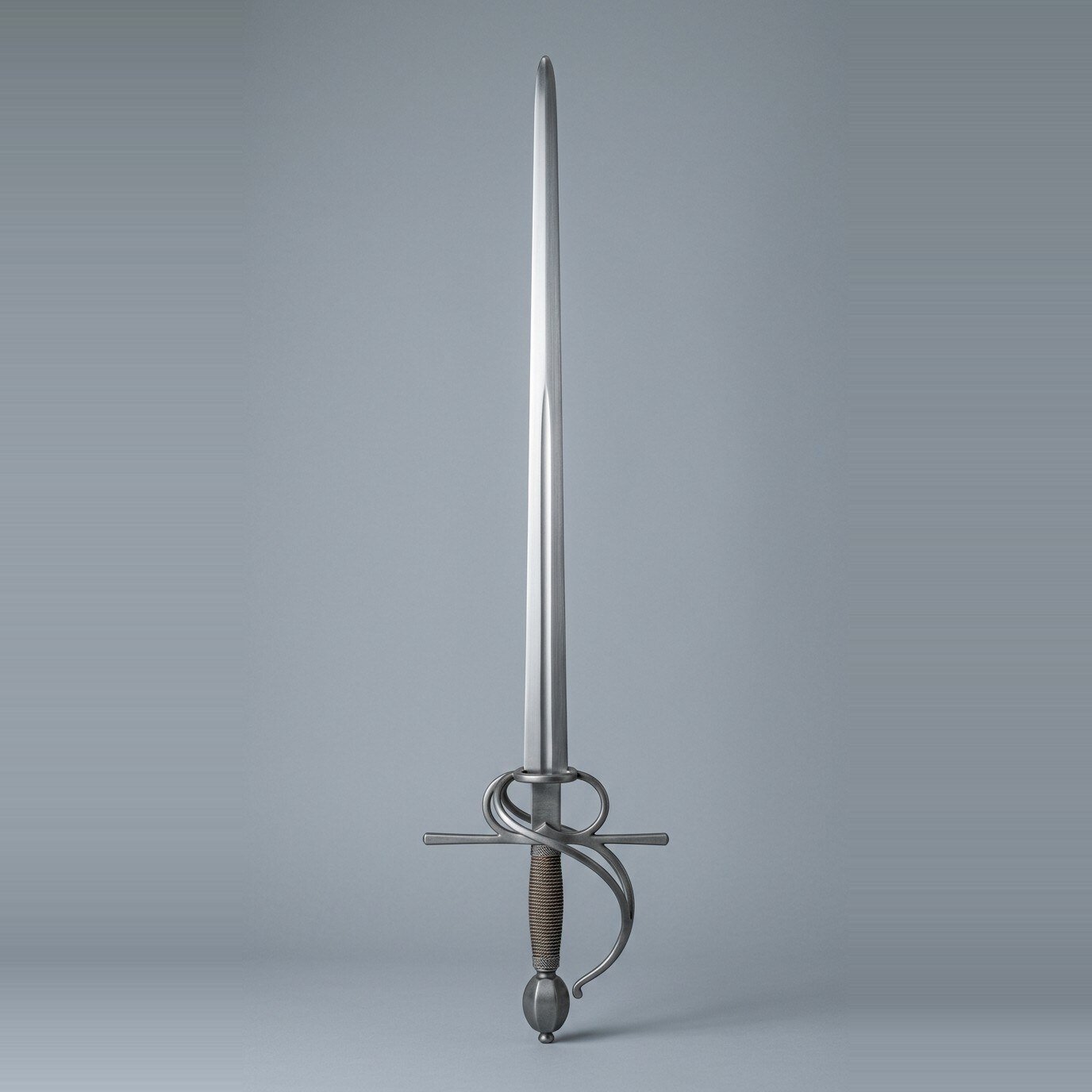
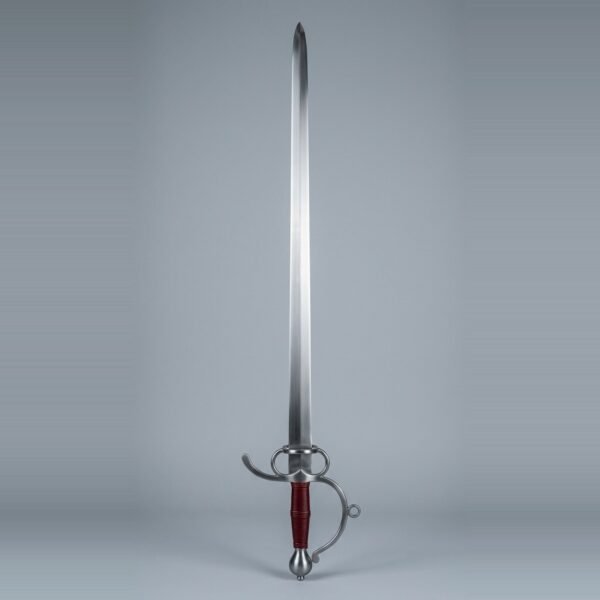
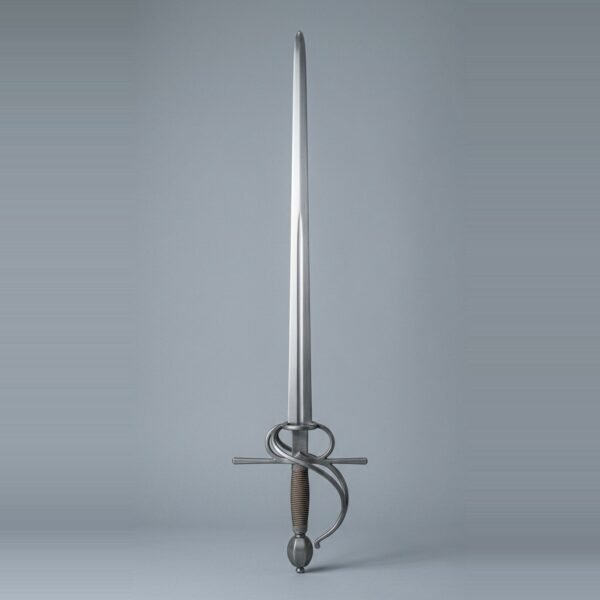
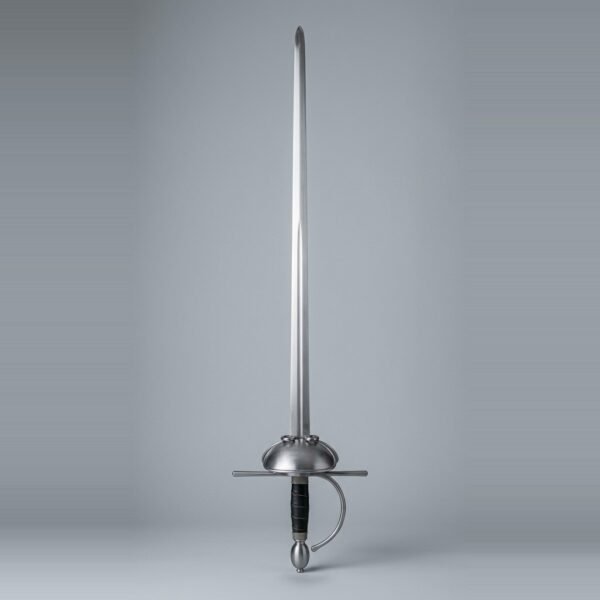
This is the sidesword at the point where the hilt starts taking over. A side ring over the outside, a bar sweeping back from the cross to form a counterguard, a knuckle bow closing the inside line, all of it wrapped around a blade that still tapers like something meant to cut as well as thrust. Fence with it and you are standing exactly where the Italian tradition stood in the second half of the sixteenth century, halfway between the cutting sword and the rapier.
The grip is wound in brass wire, which gives a warmer look against the bright hilt and a slightly softer feel in the hand than steel wire. The pommel is an olive, turned and peened over the tang so the whole assembly stays in compression. Blade aside, the thing to look at is the counterguard bar: it is the part that lets you fence with a finger over the cross for real point control without leaving that finger hanging in open air.
The blade is blunt, forged in 51CrV4 spring steel and hardened to 49 to 52 HRC, with flat edge lands and a rolled, flared point. If you are working out whether you want this or something longer and more thrust led, rapier versus sidesword lays out the difference and how to choose your first HEMA sword covers the rest. The other hilts in the family are on the HEMA sideswords page.
Specifications
| Material | 51CrV4 spring steel, hardened to 49 to 52 HRC |
|---|
| Overall length | About 42 inches, hand made so it varies a little piece to piece |
|---|
| Blade length | About 35 inches |
|---|
| Blade type | Double edged cut and thrust blade tapering from a short flat ricasso |
|---|
| Edge | Blunted, about 3 mm flat land, not sharpened |
|---|
| Tip | Rolled and flared, about 15 mm across |
|---|
| Guard | Swept hilt, side ring over the outside, counterguard bar sweeping back to the pommel, knuckle bow |
|---|
| Pommel | Olive form, turned and peened over the tang |
|---|
| Grip | Brass wire wound over a shaped core |
|---|
| Flex | Medium, suited to drill and controlled sparring |
|---|
| Included | Sword only, no scabbard |
|---|
| SKU | RK-3017 |
|---|
The swept hilt and the road from sidesword to rapier
Nothing about a swept hilt happened for ornament. Sixteenth century fencers were putting fingers over the cross to gain leverage on the blade, so the cross alone stopped being enough, and rings and bars grew outward from it one function at a time. First a ring over the outside to shelter the fingered hand. Then a bar sweeping back from the quillon block to the pommel, catching anything that runs down the outside of the blade toward the fingers. Then a knuckle bow on the inside. Put them together and you have this hilt, and the fencer inside it can commit to a bind instead of flinching out of one.
That same pressure is what produced the rapier. As civilian fencing leaned further onto the thrust, the blade lengthened and narrowed and the hilt grew again into swept bars, pas d ane rings and eventually cups. The sidesword is the stage before that, and it is arguably the more interesting one to train, because it still rewards a proper cut. Camillo Agrippa was already arguing the thrust case in 1553 while the Bolognese cutting plays were being taught in the same decade, and both of those arguments fit on this blade. You can fence Marozzo out of it and you can drill the linear Italian thrusting lines out of it without changing sword.
Blade taper, the bind and the flex that has to survive it
The blade tapers from a short flat ricasso down to the rolled tip, which does two things. It puts the mass you need for a cut in the forte and the first half of the blade, and it thins the foible so the point is easy to move and easy to keep in line. When two of these cross, the fencer whose forte meets the other fencer foible owns the bind, and a blade with honest taper teaches that lesson faster than a blade of even section. Work the crossing, feel whether the pressure against you is hard or soft, and answer accordingly. That is the whole game and the sword has to be built to take it.
Which is why it is 51CrV4 at 49 to 52 HRC and not high carbon at 54 to 58. Hardness buys edge retention and a trainer has no edge to retain. What a trainer needs is steel that bends under a hard bind and springs back to straight rather than taking a set or snapping. Spring steel does that, so this blade does that. The edges are left as a flat land of about 3 mm rather than ground to a line, and the point is rolled and flared to about 15 mm across so a thrust spreads over a broad face. Flex sits in the medium band. We name a tier rather than print a number in pounds because we have not put this blade on a flex rig, and HEMA sword flex explained sets out what the tiers actually mean.
Engraving, runes and your own design
Use the rune converter on this page to turn a name, a date or a short phrase into Elder Futhark and we will cut it into the steel or the grip. Club names, a founding year, a line from the source you train out of, all of it works.
Engraving is done in the United States after the piece lands in North Babylon, so nothing is cut until you have told us what you want. Text and runes are $19, a symbol is $39 and a family crest is $49. If you would rather have your own design than a rune line, choose your own design in the engraving option above the add to cart button and tell us where it goes. Where a piece already carries an engraved design, your chosen engraving replaces it rather than sitting alongside it. More on the engraving page.
Handling and balance
No weight and no point of balance are given here, for the same reason we give none anywhere in this range. We have not measured this piece and a borrowed number helps nobody. In use it feels quick at the point and settled behind the cross. With a finger through the ring and over the quillon the pivot sits well back and the point is easy to hold on line while you change measure, which is exactly the grip the hilt was designed around. Take a full fist behind the cross instead and the sword swings more freely for cutting and loses a little of that fine point control. The counterguard bar keeps the hilt from feeling exposed in either grip, and the brass wire gives enough texture to hold on to once the glove is damp.
Care
Wipe the blade down after every session and oil it lightly before it goes in the bag, because 51CrV4 is a carbon steel and will spot if it is put away wet. Brass wire will dull to a warmer tone over time, which most people prefer to the factory brightness, and a soft cloth brings it back if you would rather it stayed bright. Pay attention to the sweeps and rings when you clean, since sweat collects where the bars meet the quillon block. Check the pommel for movement now and then and get a loose one seen to early. Take any burrs off the edge land with a fine file, keeping the land flat, and never let anybody sharpen a trainer. The routine is written out in the blade care guide.
Made in the Czech Republic
Made by hand in the Czech Republic and imported by Ransack Viking. Nothing here is drop shipped out of an importer catalogue straight to a customer. Every one is checked for hilt tightness, pommel seating and blade straightness at our North Babylon, New York warehouse, and ships from there. Shipping in the United States is free, returns run for seven days, and the lifetime warranty against defects in the forging, the grind, the heat treat and the fittings has no end date and needs no receipt.
A note on handmade variation
This is hand forged. It is not machine made, not cast and not bulk produced, so what arrives will not be a pixel for pixel copy of the photograph on this page. A swept hilt is bent and fitted by hand, so the exact curve of the bar, the reach of the ring and the pitch of the pommel shift a little from piece to piece. The steel, the hardness range, the blunt edge land and the rolled tip do not shift, and they are the parts that decide whether the sword is safe against a partner.
Frequently asked questions
Whether this sidesword is sharp
No. Both edges are left as a flat blunt land and the point is rolled and flared to about 15 mm. It is a trainer for drill and controlled sparring and we will not sharpen one on request.
Whether the hilt suits a large hand
The grip takes a normal fencing glove comfortably and the ring is sized for a finger over the cross with a glove on. If your hands are unusually large, message us before ordering and we will tell you honestly whether it will suit.
What flex tier this blade sits in
Medium. That is the band that holds up to drill and club sparring without being so stiff that a thrust has nowhere to go. We give a tier rather than a number in pounds because this individual blade has not been tested on a rig.
Whether it is allowed in competition
Only your ruleset can answer that and every event writes its own gear rules. The rolled tip is about 15 mm across, which clears the 1.5 cm minimum used by the Berlin HEMA Cup, but we will not call any piece tournament legal without naming the ruleset that allows it.
Whether a scabbard is included
No, and none is offered. This is sold as a sword only, which is normal for training swords at this end of the market.
How this compares to a rapier trainer
Shorter, broader and better balanced for cutting. A rapier puts almost everything into the thrust and lengthens the blade to do it. This will cut properly and still thrust well, which is what makes it a good first sword for the Italian material.
What is in the box
- The Orveldt swept hilt sidesword trainer, blunt, blade about 35 inches
- A warranty card covering the forging, the grind, the heat treat and the fittings, with no end date
- Care notes for the spring steel blade and the brass wire grip
- Your engraving already cut into the piece, if you chose one at checkout
Explore the range
The neighbouring shelves are worth a walk. The HEMA sideswords run from a plain single ring to full sweeps like this, the HEMA rapiers take the thrust argument to its conclusion, the rapier swords shelf holds the wider collection, and the HEMA swords hub lists every trainer we make. Background reading lives at the guides hub.
If this one is not it
Close in size and role you have Skelvard sidesword, about 40 inches overall, Thanmir sidesword, about 42 inches overall, Elmgarth sidesword, about 41 inches overall and Velstrand cup hilt rapier, about 47 inches overall to compare against this one.
The full HEMA sidesword category and the wider HEMA sword hub hold the rest of the line, and you can specify your own on the custom sword builder.








Reviews
There are no reviews yet