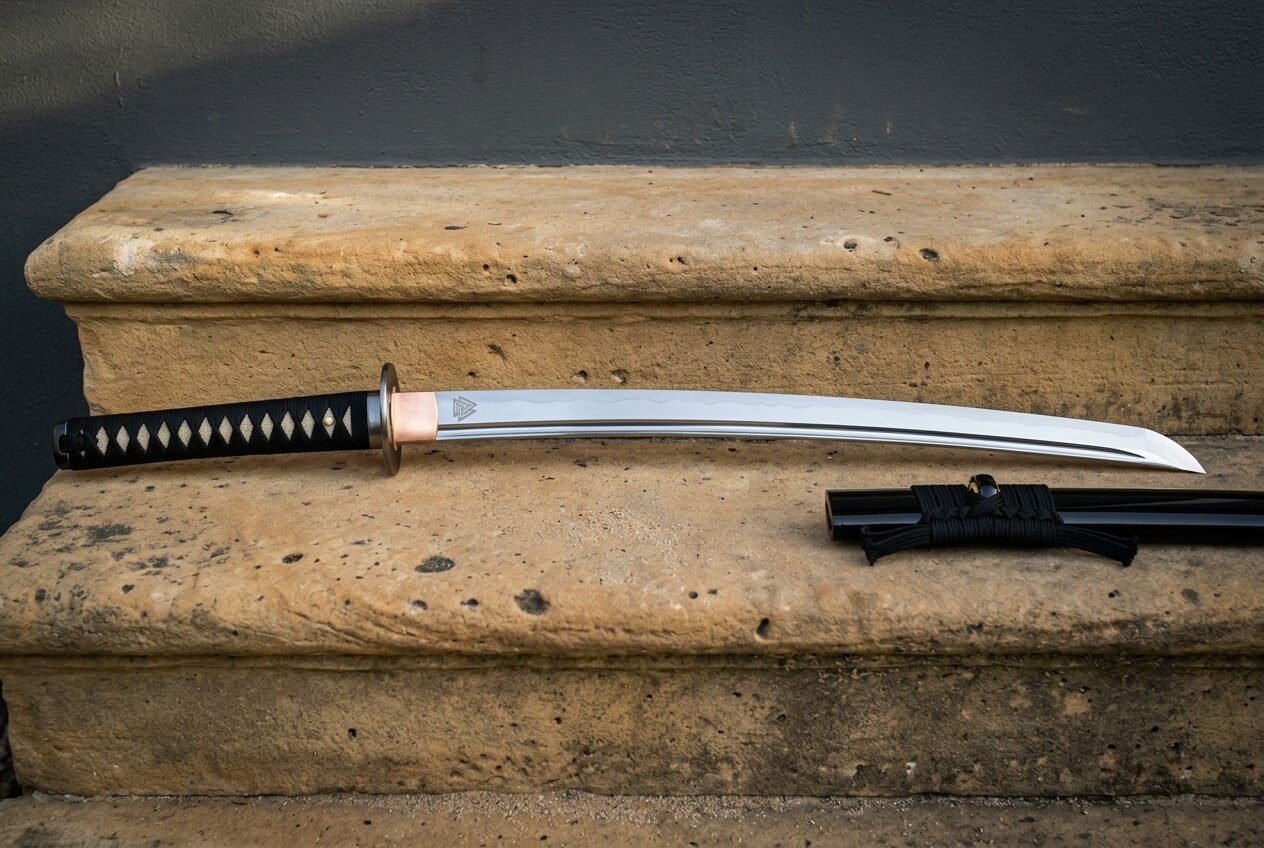
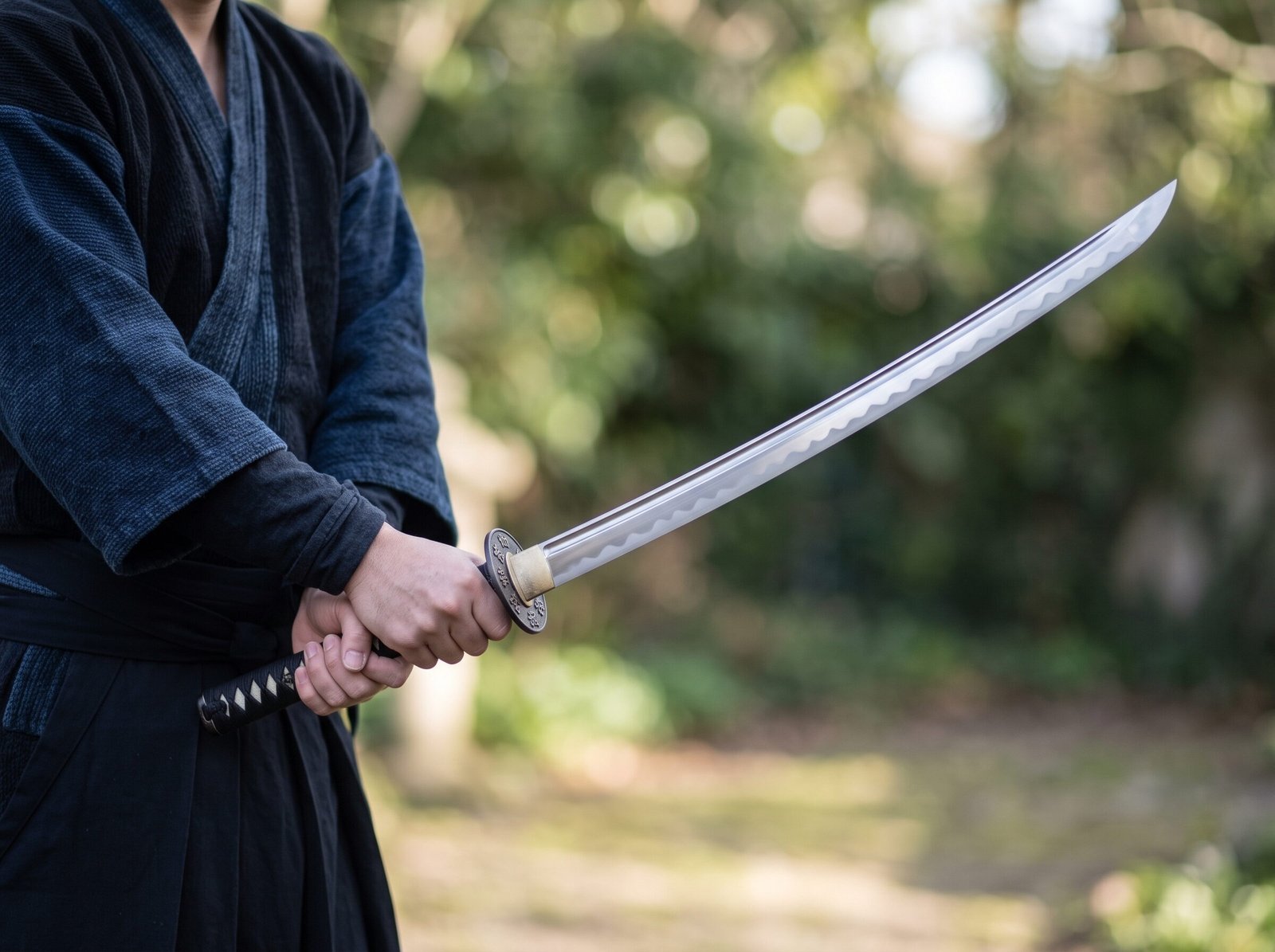
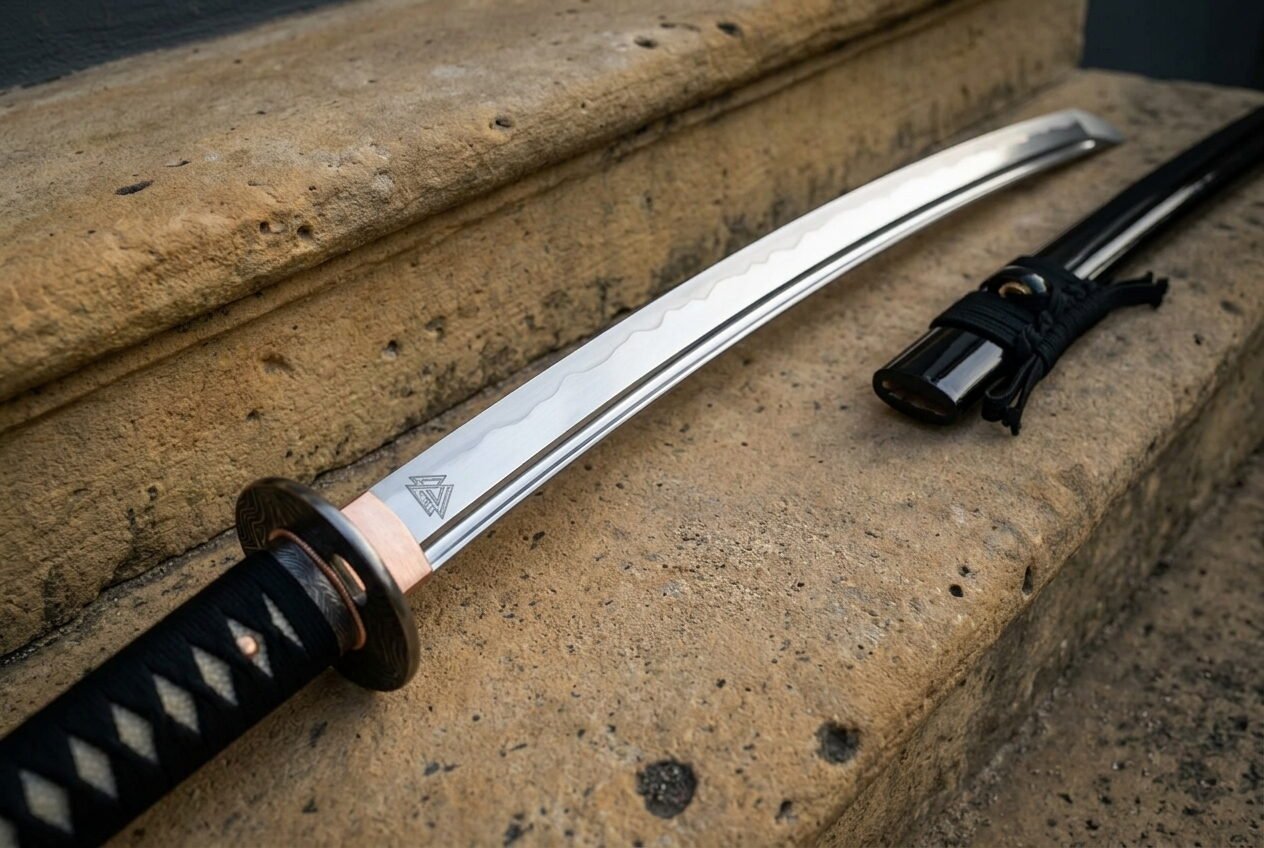
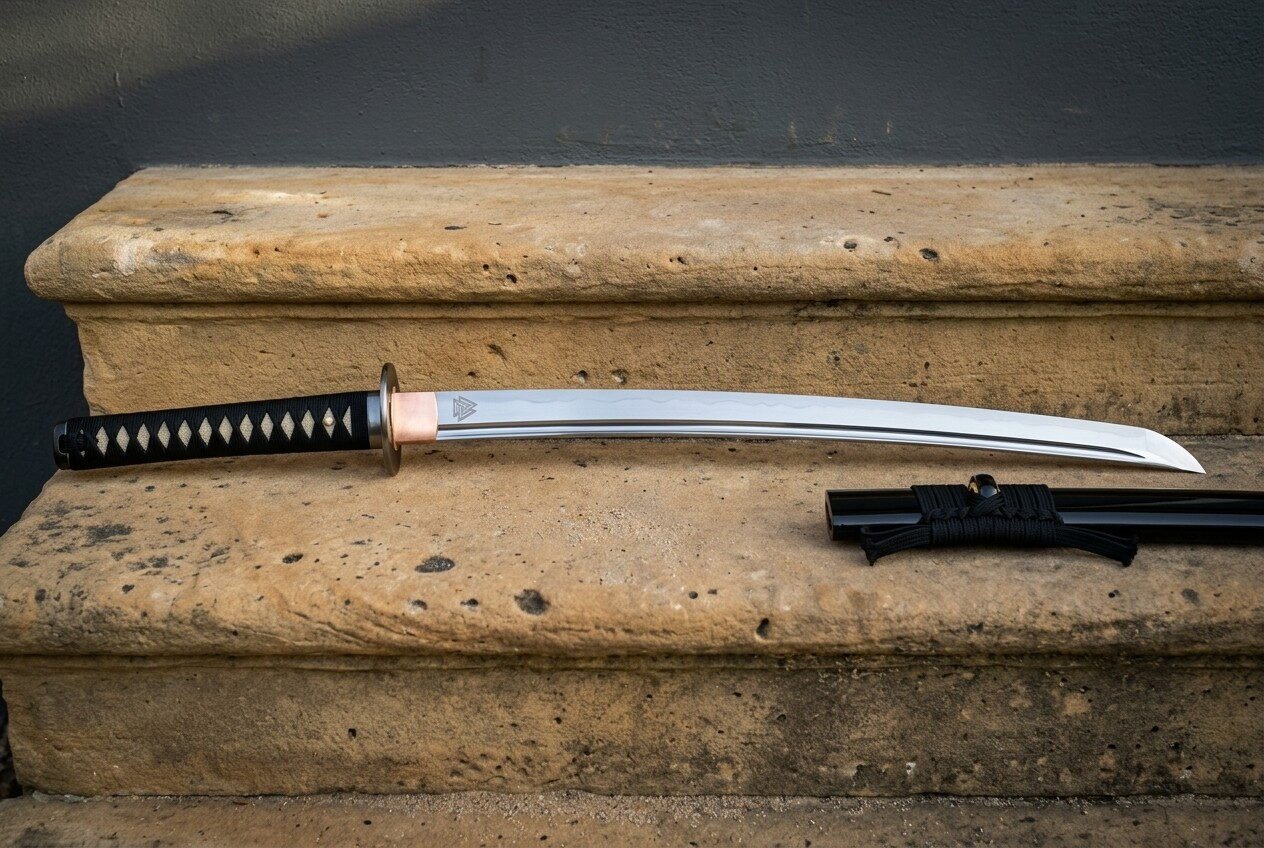
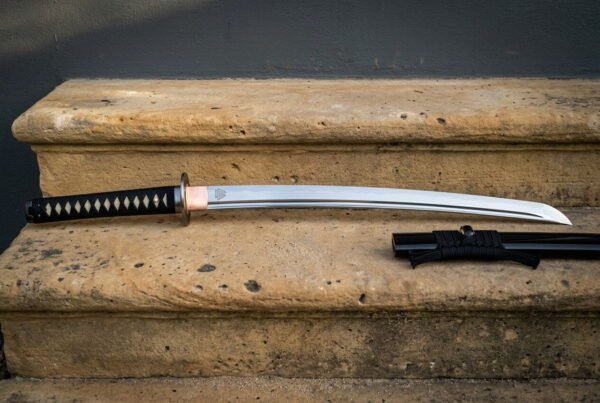
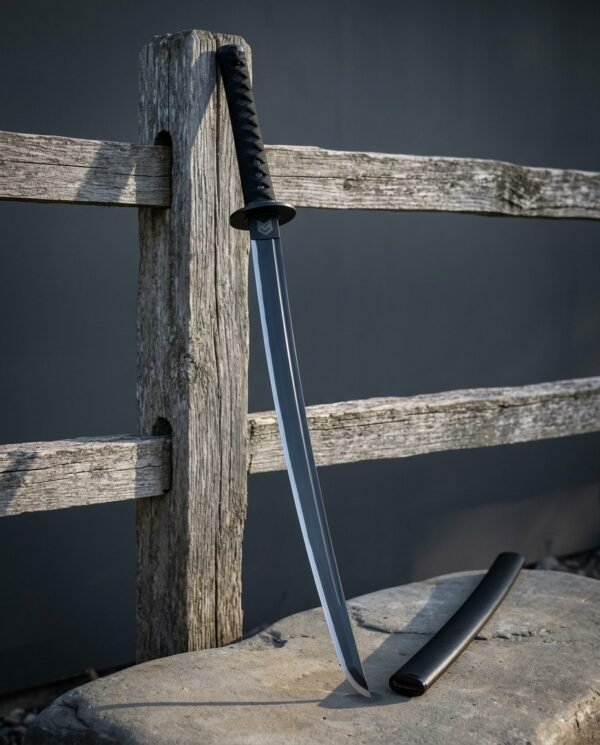
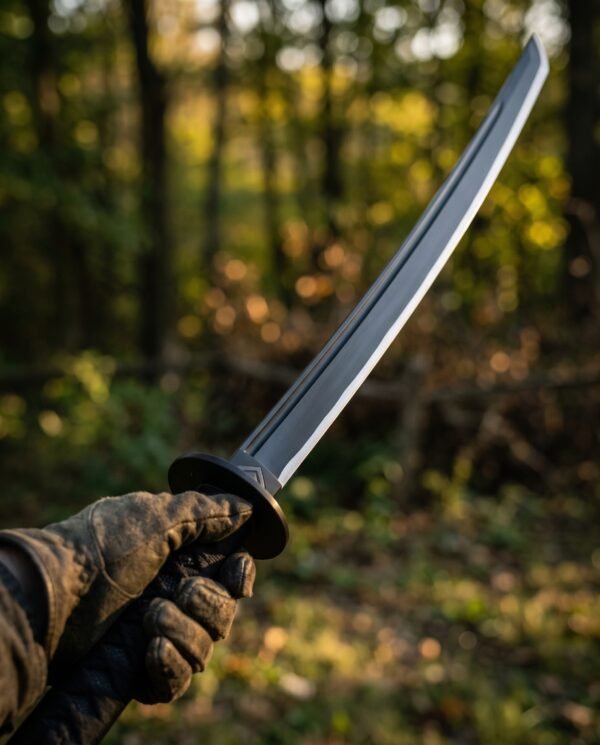
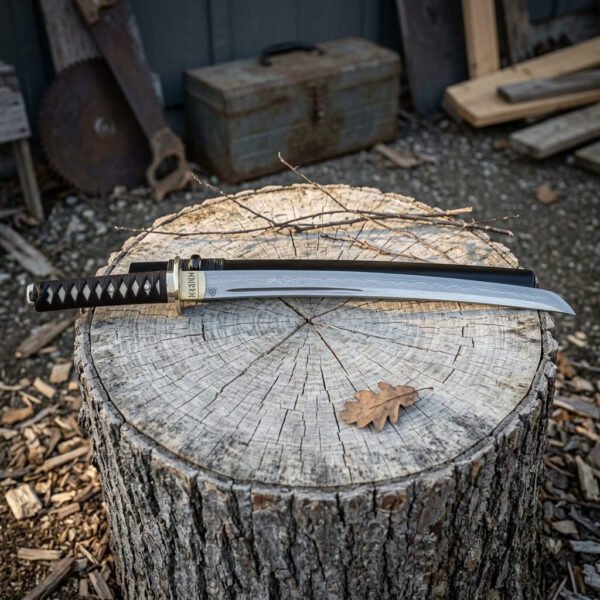
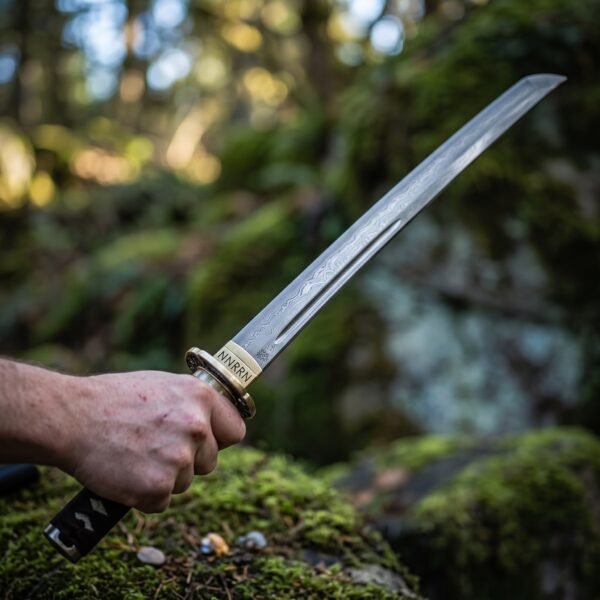
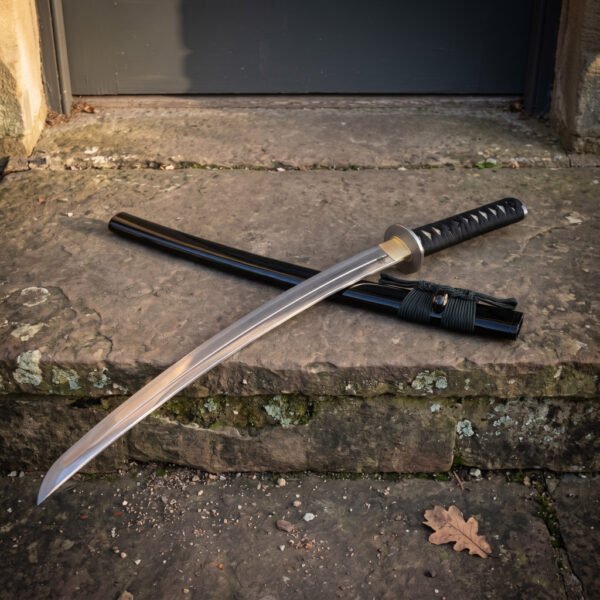
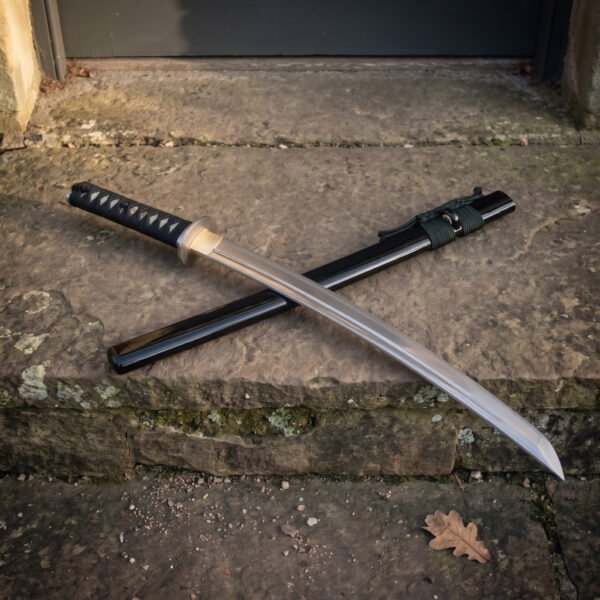
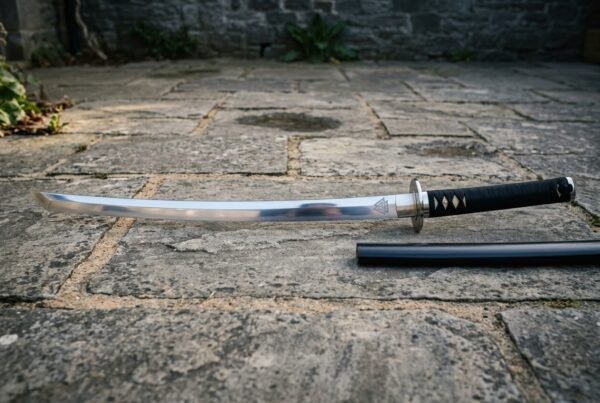
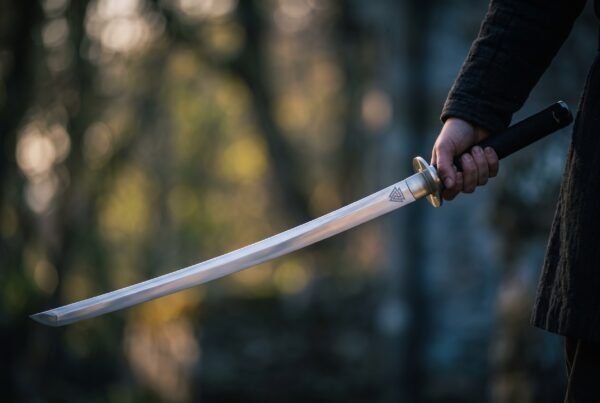
The Inkwake is a katana built the traditional way around a curved single edged 1095 blade. The handle is wrapped in black cord over white rayskin, so the pale diamonds show through the crossings, and it is fitted with a round dark steel guard, a copper collar at the base of the blade and a small engraved Valknut above it. The scabbard is gloss black lacquer with a black cord tied at the throat.
The part of a Japanese sword that people look at least and that matters most for how it feels is the handle wrap. It is not a decorative binding. Underneath the cord is a panel of rayskin, which is covered in hard round nodules and grips the cord so it cannot creep. Under the rayskin sit two small metal ornaments called menuki, positioned deliberately so that they fall into the hollow of the palm and the base of the fingers. Between every crossing of the cord the wrapper folds a small triangle of stiff paper and tucks it in, which is what gives the wrap its hard raised diamonds instead of a soft tube. The result is a handle that locks into a hand that is wet, gloved or moving, without needing to be gripped tightly. Ours is forged, hardened, polished and assembled by hand in the Czech Republic. It sits in the Japanese swords, a step across from the wakizashi blades.
Specifications
| Blade material | 1095 high carbon steel, hardened to 54 to 58 HRC |
|---|
| Blade type | Single edged and curved, differentially hardened with a visible hamon |
|---|
| Overall length | Approximately 36 inches |
|---|
| Blade length | Approximately 26 inches |
|---|
| Handle | Black cord wrap over white rayskin on a hardwood core, approximately 10 inches, dark end cap |
|---|
| Guard | Round dark steel tsuba |
|---|
| Collar | Copper habaki |
|---|
| Engraving | Valknut engraved on the blade just above the habaki |
|---|
| Scabbard | Gloss black lacquered wooden saya with a black cord tied at the throat |
|---|
| Included | Sword and lacquered saya |
|---|
| SKU | RK-1836 |
|---|
The habaki, the one piece that holds the whole sword together
The small copper collar sitting between the blade and the guard is called the habaki and it is the most quietly important fitting on a Japanese sword. Everything above it, the guard, the spacers, the handle, is held on by nothing but compression. There is no thread and no glue. A single bamboo peg through the handle holds the blade in place, and the habaki is what all the other parts are pressed against so the stack cannot rattle.
It has a second job. It carries the whole weight of the sword in the scabbard. The blade floats clear of the wood along its length, and the only contact is the habaki wedging into the mouth of the saya. That is why a good sword makes a small dry click as it seats home and why it stays in the scabbard when you carry it edge upward. It is also why the habaki is made of copper rather than steel. Copper is softer than the blade and softer than the wood, so it deforms very slightly and takes up the wear, and if it eventually goes loose you replace a small copper collar rather than the scabbard.
The steel and the hamon
The blade is 1095, close to one percent carbon and very little else, taken to between 54 and 58 HRC at the edge. It is clay hardened, which means the spine is coated with a thick layer of refractory clay before the quench and the edge is left almost bare. In the water the exposed edge cools in a fraction of a second and transforms into hard martensite. The insulated spine cools slowly and ends up softer. The cloudy line you can see wandering along the blade is the border between those two crystal structures, and it is a genuine metallurgical feature rather than an etched or acid drawn imitation.
That process is also why the blade has the curve it has. A clay hardened blade goes into the quench close to straight and comes out curved, because the edge expands as it turns to martensite and the softer spine cannot follow. The smith controls the amount of curve by how the clay is laid on. The shape is made by the fire rather than by grinding.
Engraving, runes and your own design
Use the rune converter on this page to turn a name, a date or a short phrase into Elder Futhark and we will cut it into the steel, the leather or the wood. If you would rather have a Viking pattern than a rune line, choose your own design in the engraving option above the add to cart button and tell us where it goes. Where a piece already carries an engraved design, your chosen engraving replaces it rather than sitting alongside it. On this sword that applies to the Valknut at the base of the blade, which your chosen mark takes the place of. The engraving page shows how a cut reads on a mirror polished blade.
Handling and balance
A ten inch handle on a twenty six inch blade is a two handed grip with room to spare, and the spare room is the point. The two hands work against each other rather than together. The forward hand steers and the rear hand pulls, which is what rotates the blade through a cut and why a katana can be swung hard by someone who is not strong.
Balance sits about four inches ahead of the guard. That is further forward than a European single handed sword and further back than an axe, and it gives you a sword that feels light to carry and heavy at the moment of contact. Draw with the left hand rotating the scabbard rather than by pulling the blade straight out, and practise it slowly first. Almost every accident with a curved sword happens on the draw or the return, not the cut.
Care
Wipe the blade after handling and lay a thin film of mineral or camellia oil over it before it goes back in the saya. Fingerprints etch bare high carbon steel within days in a humid room. Do not store the sword in the scabbard for a long period in a damp space, and never put it away wet. A lacquered saya is sealed on the outside but the interior is bare wood and will hold moisture against the blade. Wipe the lacquer with a soft dry cloth only, since solvents and abrasive polishes will dull it. Give the dark steel guard the same thin film of oil as the blade. Sharpen on waterstones following the existing bevel and the curve. Our page on steel care covers oiling, storage and dealing with early rust.
Made in the Czech Republic
This is a handmade piece from the Czech Republic, made in a workshop that still forges, grinds and finishes by hand instead of stamping parts out. The smiths there have kept the older way of working, and the wood, horn and leather are shaped and fitted by hand as well. Two pieces of the same design will never be identical, and that is part of what you are buying.
Ransack Viking is a United States company. We handle the import ourselves, look over every piece when it lands and ship from our warehouse in Chicago, Illinois. Engraving is done in the United States after the piece arrives, so your design goes on before we send it out.
A note on handmade variation
This sword is hand made rather than machine made or bulk produced, so what arrives will not be a pixel for pixel copy of the photograph. The hamon is the clearest example. It is laid on in clay by hand and formed in water, so it wanders differently on every blade and no two are ever alike. The curve sets itself in the quench, so it varies slightly. The rayskin under the wrap has its own nodule pattern, and the cord finds its own tension across the diamonds. Lacquer builds to its own depth. The dimensions, the steel, the heat treat and the build are the same every time. The character is not. Anyone new to this should read sharpening a curved blade first, then what makes a katana a katana.
Frequently asked questions
Is the hamon real or is it etched on
It is real. The blade is clay hardened and the line is the border between hardened and softer steel. It is not a wire brushed or acid drawn imitation.
Is it sharp when it arrives
Yes. It ships with a cutting edge. Handle the draw and the return carefully until the motion is second nature.
Can I use it for cutting practice
It is a functional forged blade rather than a wall hanger, so yes, but get instruction before you cut targets. A curved sword returns along a different line from the one it went out on.
Can the handle be taken apart
It can. A single peg through the handle holds the blade, and the sword is designed to come apart for cleaning. Do not do it casually, because reassembling it out of order leaves the stack loose.
Will the guard rust
Not if it is wiped and oiled with the blade. If a spot of surface rust appears on the dark steel guard, take it off with oil and a soft cloth rather than an abrasive.
How long until it ships
One to two weeks of processing, then free shipping inside the United States. Engraved orders take a little longer.
What is in the box
- Inkwake katana in clay hardened 1095 high carbon steel
- Gloss black lacquered saya with its cord
- Care card covering oiling, storage and lacquer
- Lifetime warranty against defects in forging, grind, heat treat and fittings
- Forged and finished in the Czech Republic
Explore the range
See the rest of the katanas, the shorter wakizashi, the wider sword range, or read the guides for how a clay hardened blade takes its curve.
Worth a look beside this
Next along the rack is the Knotcurve Japanese sword, forged from 1095. For a straight comparison, see the Valkgleam Japanese sword, forged from 1095. Worth putting side by side with this is the Duskwake Japanese sword, 40 inches overall.
If you are putting a set together, the Reedcurve wakizashi sits alongside it. Or start from a blank sheet on the design your own page.


Showed up right on time and looked even better than the photos. Ransack Viking is quickly becoming my go to shop for anything Norse themed. The wood handle feels amazing and the balance is perfect. Worth every penny.