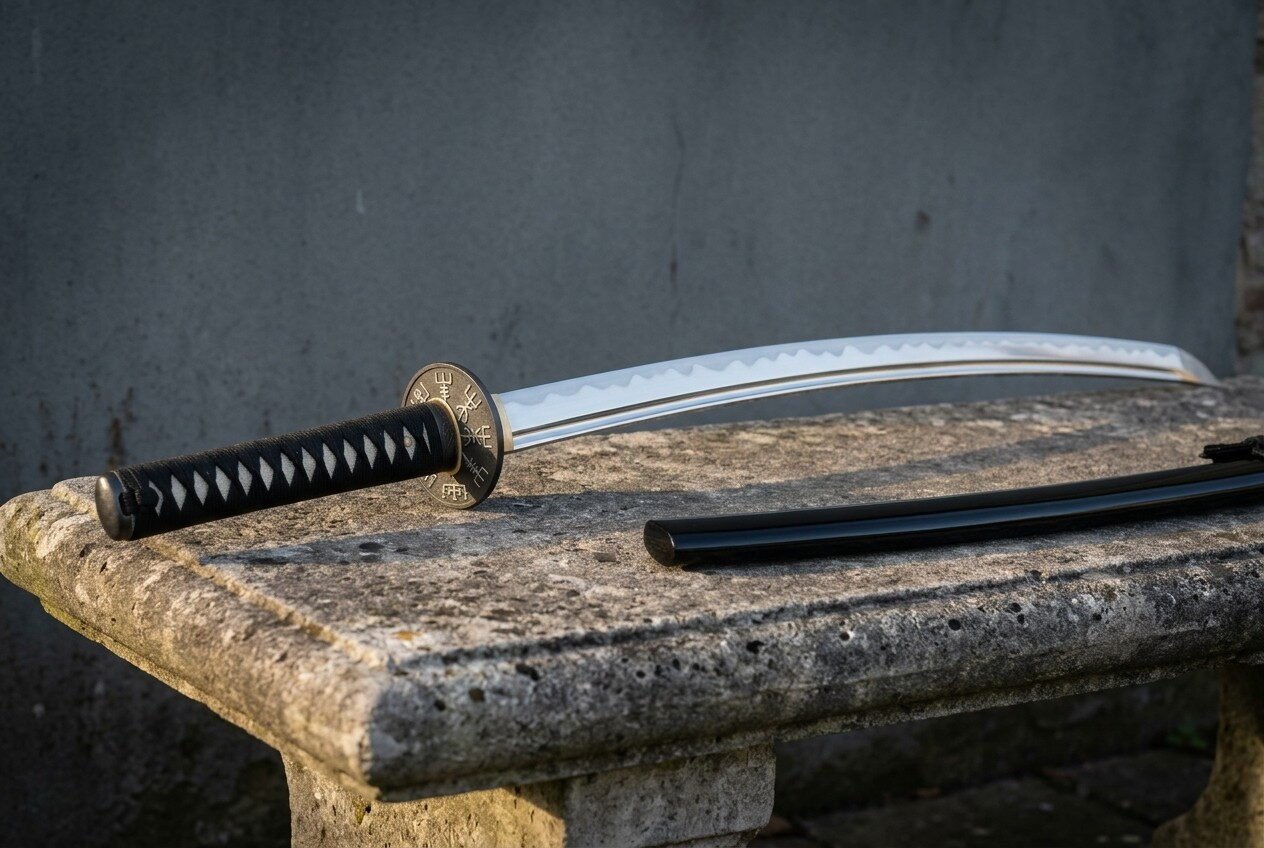
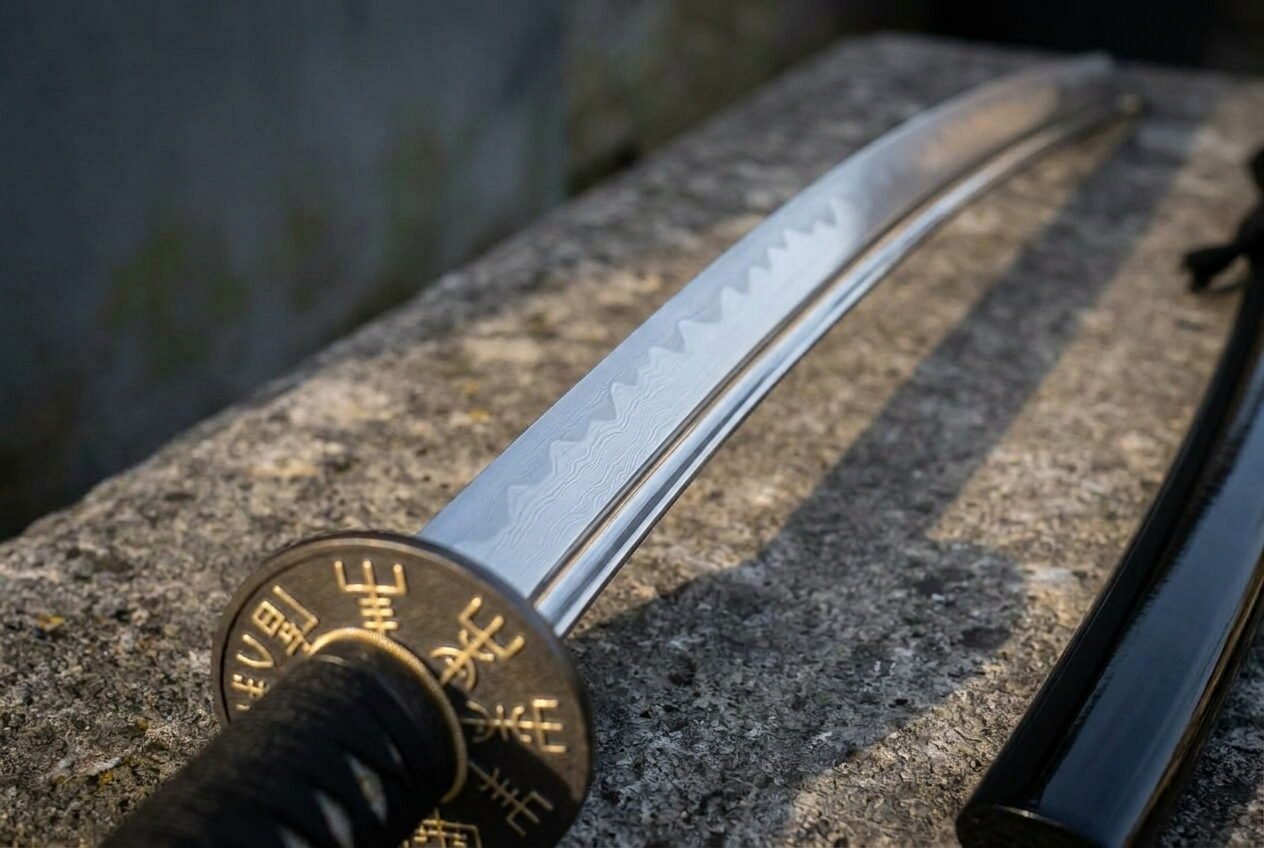
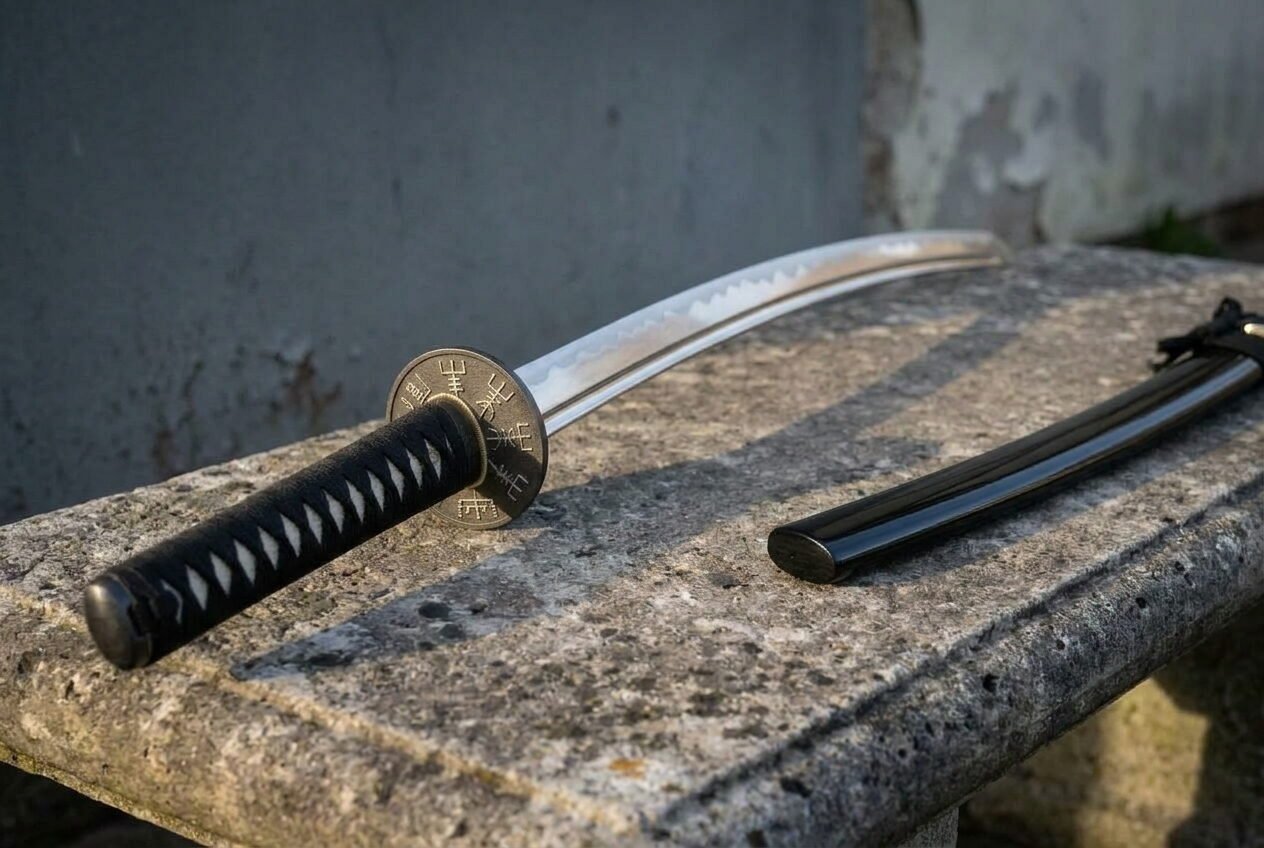
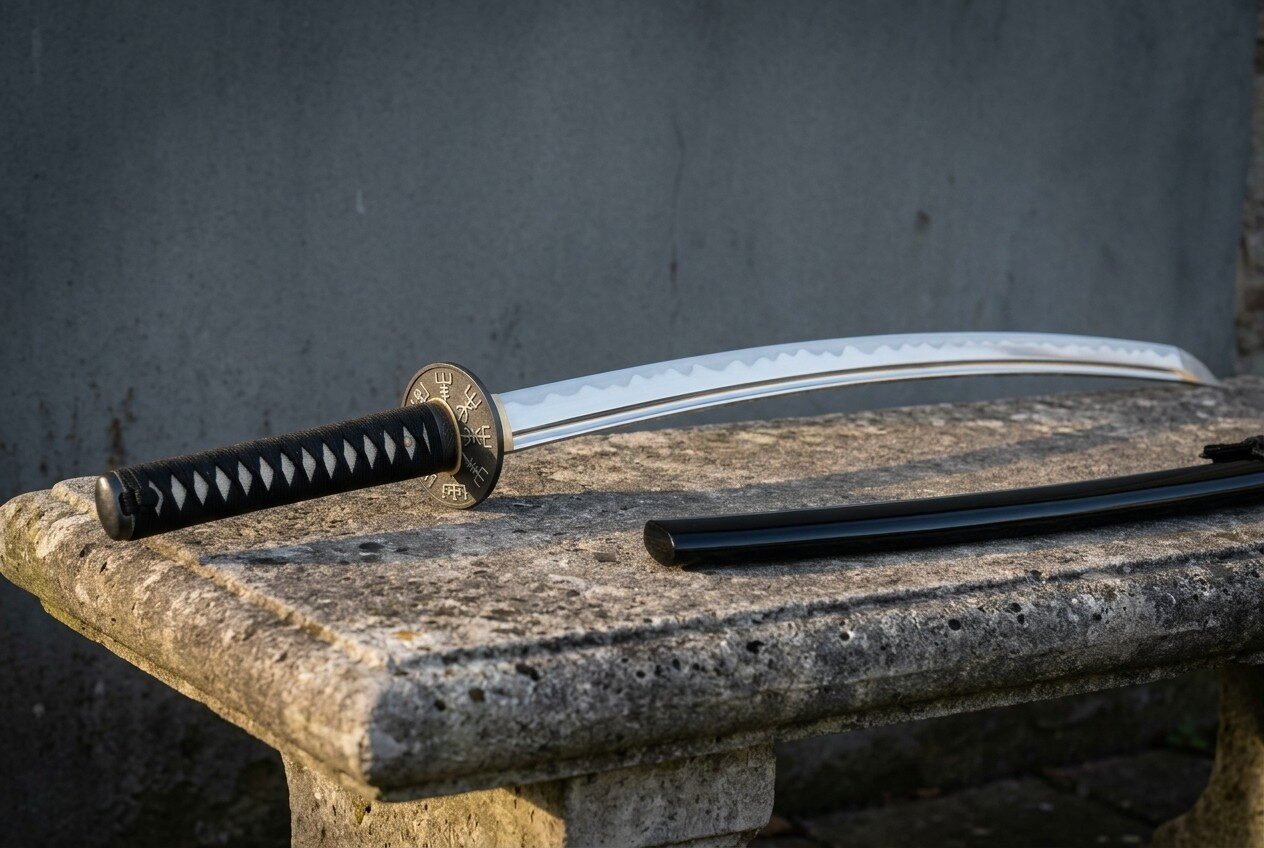
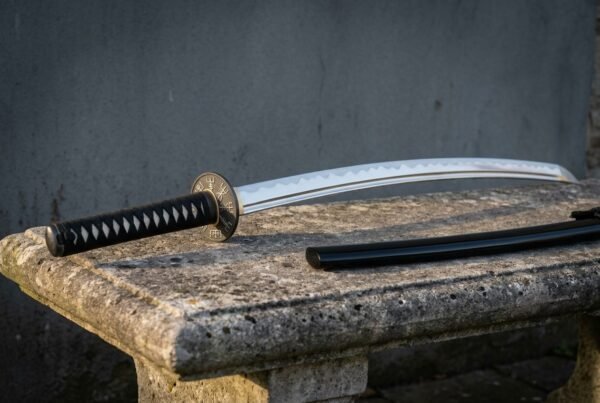
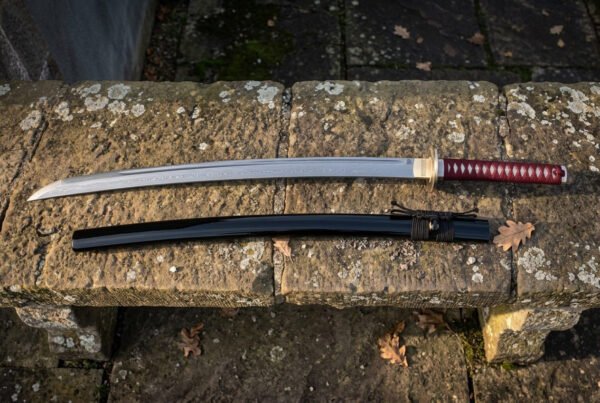
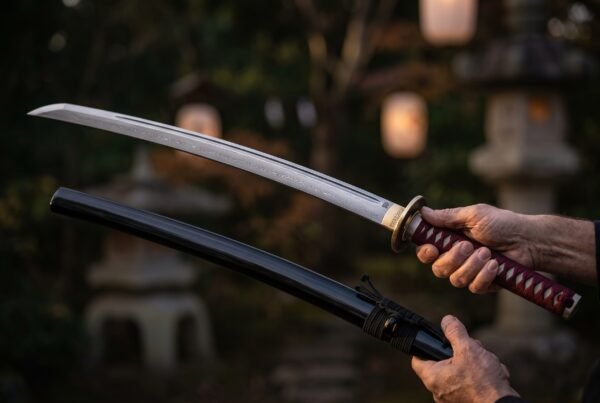
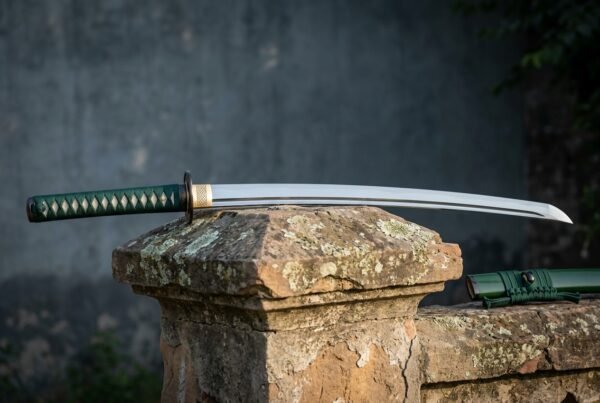
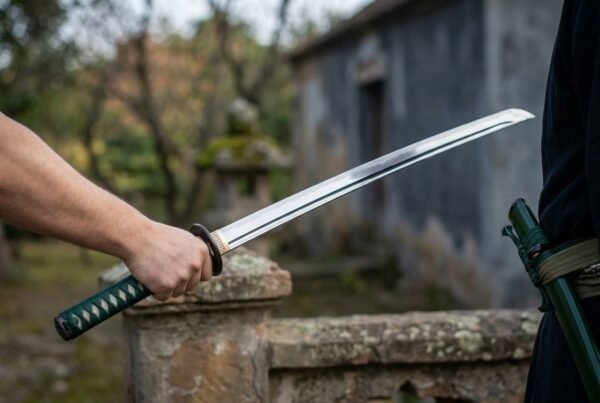
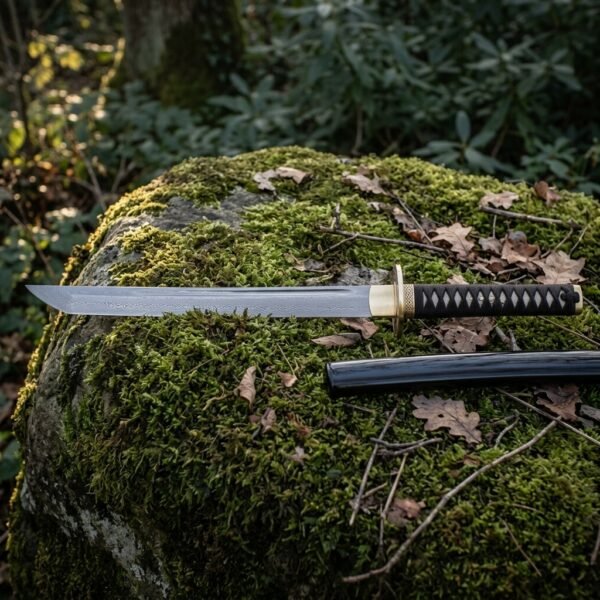
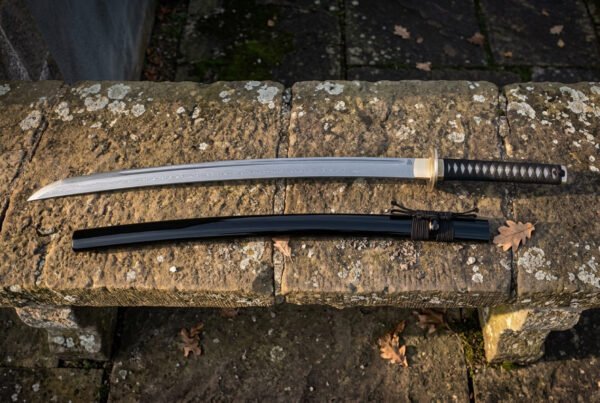
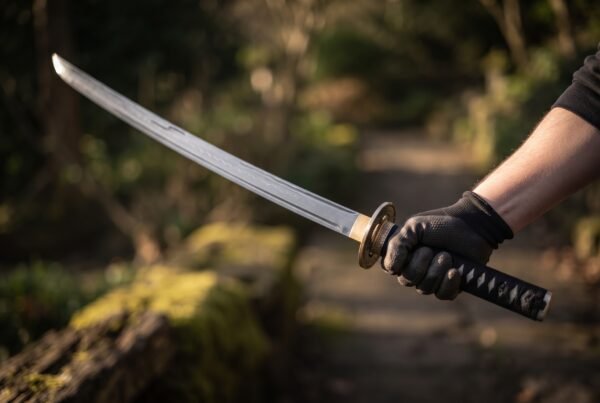
This is a katana with a differentially hardened blade. The steel is 1095, forged to a curve, clay coated along the spine and quenched, which leaves a hard edge, a softer back and a visible wavy temper line running the length of the blade where the two meet. The tsuka is bound in black ito over white same in a tight diamond wrap, the tsuba is a dark round plate carrying an engraved runic compass, and the saya is black lacquered wood.
The line on the edge is the most misunderstood feature on any Japanese sword, largely because it is faked so often. A genuine hamon is not a decoration applied to the surface. It is the visible boundary between two different crystal structures inside the same piece of steel, and it exists because the smith deliberately cooled one part of the blade faster than the other. Everything about how the sword performs follows from that boundary, and everything about how it looks is a side effect.
Forged, ground, clay quenched, polished and mounted by hand in the Czech Republic, and shipped with its saya. It is catalogued with the Japanese swords, and the Damascus swords sit one click away.
Specifications
| Blade steel | 1095 high carbon, differentially hardened, 54 to 58 HRC |
|---|
| Overall length | 40 inches nominal in the saya |
|---|
| Blade length | 27 inches nominal, single edged with a curved profile |
|---|
| Temper line | Clay quenched hamon, wavy, running the length of the edge |
|---|
| Tsuka | Black ito cord in a diamond wrap over white same, two hand length |
|---|
| Tsuba | Dark round plate with an engraved runic compass stave |
|---|
| Fuchi and kashira | Black |
|---|
| Saya | Black lacquered wood with a black sageo cord, fitted to the blade |
|---|
| Finish | Polished blade with a visible hamon, satin black furniture |
|---|
| Included | Fitted saya |
|---|
| SKU | RK-1782 |
|---|
What a hamon actually is
Steel that is heated past a certain temperature and then cooled very fast turns into martensite, which is hard, brittle and holds an edge. Cooled slowly, the same steel turns into pearlite, which is soft, tough and will bend rather than break. A blacksmith cannot change what the steel is, only how fast different parts of it cool.
Clay is how you control that. Before the quench, the spine and the upper flats of the blade are coated in a thick layer of clay slurry and the edge is left almost bare, or given only the thinnest skim. Into the water it goes. The bare edge loses its heat in a fraction of a second and becomes martensite. The clay insulated spine cools far more slowly and stays pearlite. What you end up with is one piece of steel with two personalities, hard where it cuts and forgiving where it needs to absorb shock.
The hamon is simply the visible line where one becomes the other. Polishing brings it out because the two structures reflect light differently and etch differently. The waves in the line are made by the shape the smith painted the clay in, which is why every school of Japanese swordmaking has its own signature hamon patterns.
There is a shortcut, and you should know about it. A cosmetic hamon can be faked on a fully hardened blade by wire brushing or acid etching a line onto the surface. It looks similar in a photograph and it does nothing at all for the sword, and it will vanish the first time the blade is properly polished. Ours comes out of the quench.
Steel, and honesty about what this sword is
The blade is 1095 high carbon steel, hardened to between 54 and 58 HRC, with the edge sitting at the top of that band and the spine below it. That spread is the point of the whole exercise. A through hardened blade at a single hardness has to compromise. A differentially hardened one does not have to.
1095 is a simple carbon steel with no chromium in it, so it takes a keen edge, sharpens easily and rusts if you neglect it. Every traditional blade steel had the same weakness and every traditional owner had a cloth and a bottle of oil.
This is a modern katana forged by hand in the Czech Republic in the traditional mounting. It is not a Japanese made nihonto, it is not smelted from tamahagane, and it is not a licensed reproduction of any historical sword. We would rather say so plainly than let anyone assume otherwise.
Engraving, runes and your own design
Use the rune converter on this page to turn a name, a date or a short phrase into Elder Futhark and we will cut it into the steel, the leather or the wood. If you would rather have a Viking pattern than a rune line, choose your own design in the engraving option above the add to cart button and tell us where it goes. Where a piece already carries an engraved design, your chosen engraving replaces it rather than sitting alongside it.
This sword already carries a runic compass on the tsuba, so an engraving ordered there takes its place. The other good positions are the nakago, the tang under the wrap, where a maker or an owner name traditionally goes, and the habaki. We avoid cutting into the polished flats above the hamon, because engraving there interrupts the line the polish exists to show. See the engraving page.
Handling and balance
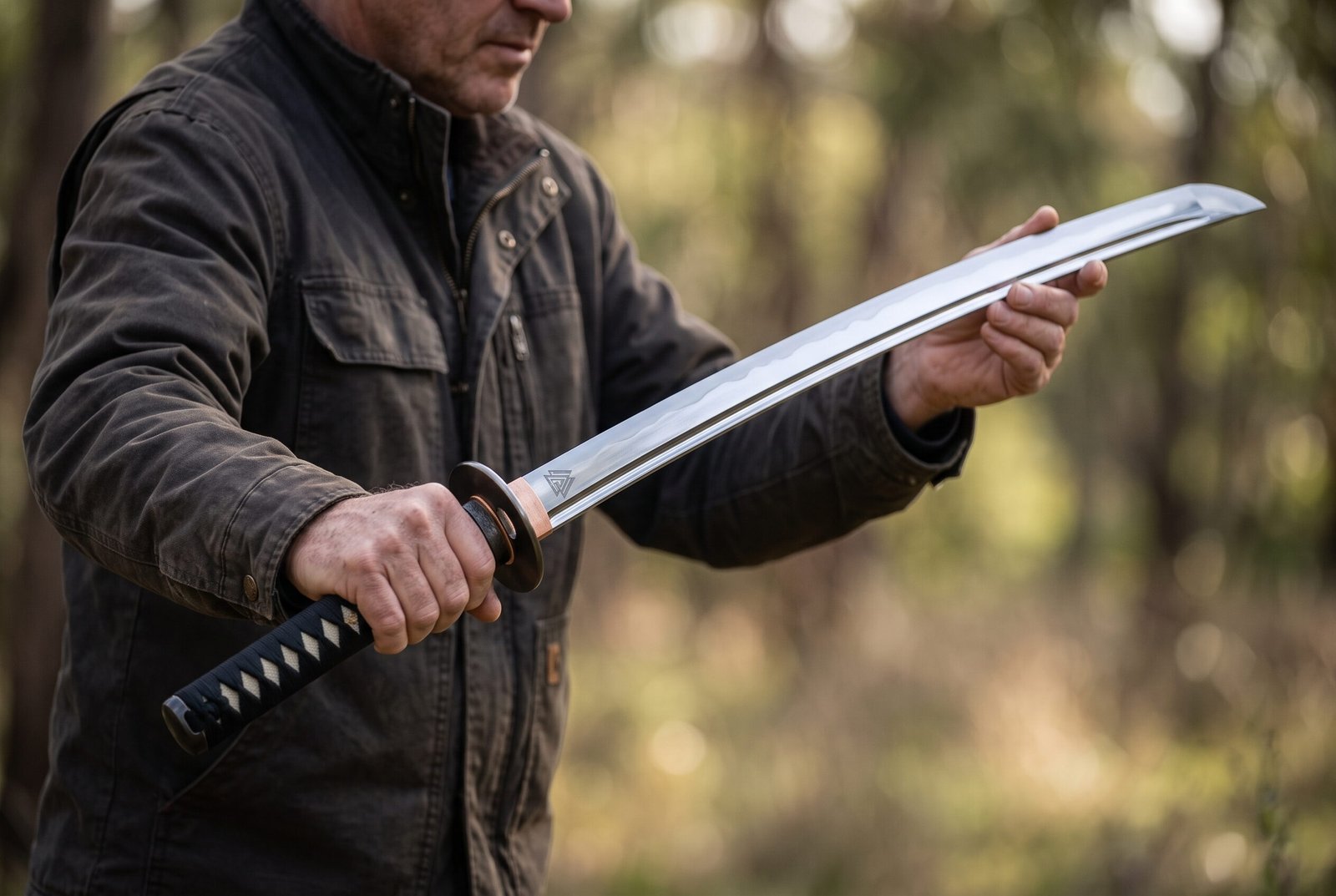
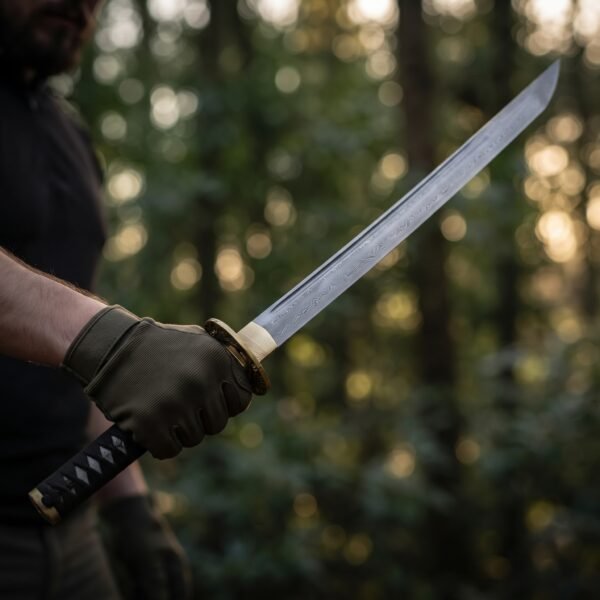
Two hands, well apart, left hand at the butt of the tsuka and right hand near the tsuba, and the left hand does the work. The commonest mistake with a katana is to drive with the right hand, which pushes the blade rather than pulling it and turns a slicing cut into a chop.
The curve means the edge meets the target at an angle and continues to meet it at an angle as the cut travels, so the sword cuts on a draw. That is the entire reason for the sori and it is why a curved single edged blade outcuts a straight one of the same mass on soft targets.
It arrives sharp. This is a live blade. We do not sell it for sparring, partner drills or contact of any kind, and cutting practice with a sharp sword should be learned from someone who already knows how, in a space where nothing behind the target matters.
Care
Wipe the blade after every handling, moving from the habaki toward the tip with the cloth on the spine side of the edge, then apply a thin film of camellia oil. Traditional practice used uchiko powder and oil, and if you want to keep to that we will not argue, but a clean cloth and a light oil does the job.
The polished area around the hamon is the part to protect. Rust starts as a speckle, and once it pits into the polish the line becomes harder to see. Check the blade monthly if it is in storage. Our steel care notes cover the routine in detail and apply just as well to a plain carbon blade as to a pattern welded one.
Do not store the sword in the saya for months at a time. A lacquered wooden scabbard traps whatever moisture goes in with the blade. Wipe, oil and store the sword horizontally with the edge upward if it is going away for a season. Never use an abrasive on the blade.
Made in the Czech Republic
This is a handmade piece from the Czech Republic, made in a workshop that still forges, grinds and finishes by hand instead of stamping parts out. The smiths there have kept the older way of working, and the wood, horn and leather are shaped and fitted by hand as well. Two pieces of the same design will never be identical, and that is part of what you are buying.
Ransack Viking is a United States company. We handle the import ourselves, look over every piece when it lands and ship from our warehouse in Chicago, Illinois. Engraving is done in the United States after the piece arrives, so your design goes on before we send it out.
A note on handmade variation
This katana is hand made rather than machine made or bulk produced, so what arrives will not be a pixel for pixel copy of the photograph. A hamon is drawn in clay and finished by fire, and no two ever run the same way. The waves will sit at different intervals and different heights on your blade, the curve varies slightly because it comes out of the quench rather than a die, and the ito wrap is tied by hand so the diamonds are a person’s work.
The steel, the hardness, the dimensions and the build are the same every time. The hamon is yours alone. If you want the longer version, look at the gap between a display sword and a battle ready one and then at how the Japanese blade lengths line up.
Frequently asked questions
Is the hamon real or etched on?
Real. It comes from a clay quench, which means it is the boundary between hard and soft steel inside the blade rather than a line put on the surface. A cosmetic hamon disappears under a polish. This one does not.
Is it sharp out of the box?
Yes. It ships with a working cutting edge. Treat it as a live blade the moment the box opens.
Is this a genuine Japanese sword?
No. It is a modern katana hand forged in the Czech Republic, in the traditional mounting. It is not a nihonto and it is not made from tamahagane, and we will not pretend otherwise.
Why is the spine softer than the edge?
Because that is what makes the sword work. A hard edge cuts and holds. A softer spine absorbs the shock of a bad cut and lets the blade bend instead of snapping.
Can I display it on a stand?
Yes. Rest it edge upward on a katana stand, or hang it. Storing it edge down for long periods lets oil creep toward the tsuka and into the wrap.
Can I have the tsuba engraving changed?
Yes. Anything you order in that position replaces the runic compass rather than sitting beside it. Use the rune converter for an Elder Futhark line.
What is in the box
- Duskwake katana, 1095 high carbon, clay quenched and sharpened
- Fitted black lacquered saya
- Light protective oil coat on the blade
- Steel care card
- Forged and finished in the Czech Republic
Explore the range
Browse the rest of the katana and Japanese swords, the wakizashi, the full swords range, and the guides.
Worth a look beside this
Worth putting side by side with this is the Valkcurve Japanese sword, 40 inches overall. In the same category sits the Nightbraid Japanese sword. A near match for this one is the Blackreed Japanese sword, forged from 1095.
For a different piece from the same family, look at the Bonecrest wakizashi. Or start from a blank sheet on the design your own page.



This sword is a genuine work of art. Weight and balance make it feel like a real functional piece not some cheap replica. Came in a nice gift box which made it feel even more special. Even the small engravings are crisp and clean. So worth it.
Feels way more premium than the price suggests. Even the small engravings are crisp and clean. Fit and finish is museum quality. You can tell real craftsmen made this by hand. Came in a nice gift box which made it feel even more special. If you’re on the fence just get it. You won’t regret it.
My whole family was impressed when I unboxed it. Edge retention has been great even after regular use. Shipping was fast and everything arrived well packaged.