
Blog
Katana vs Wakizashi vs Tanto: Length, Use and Which to Start With

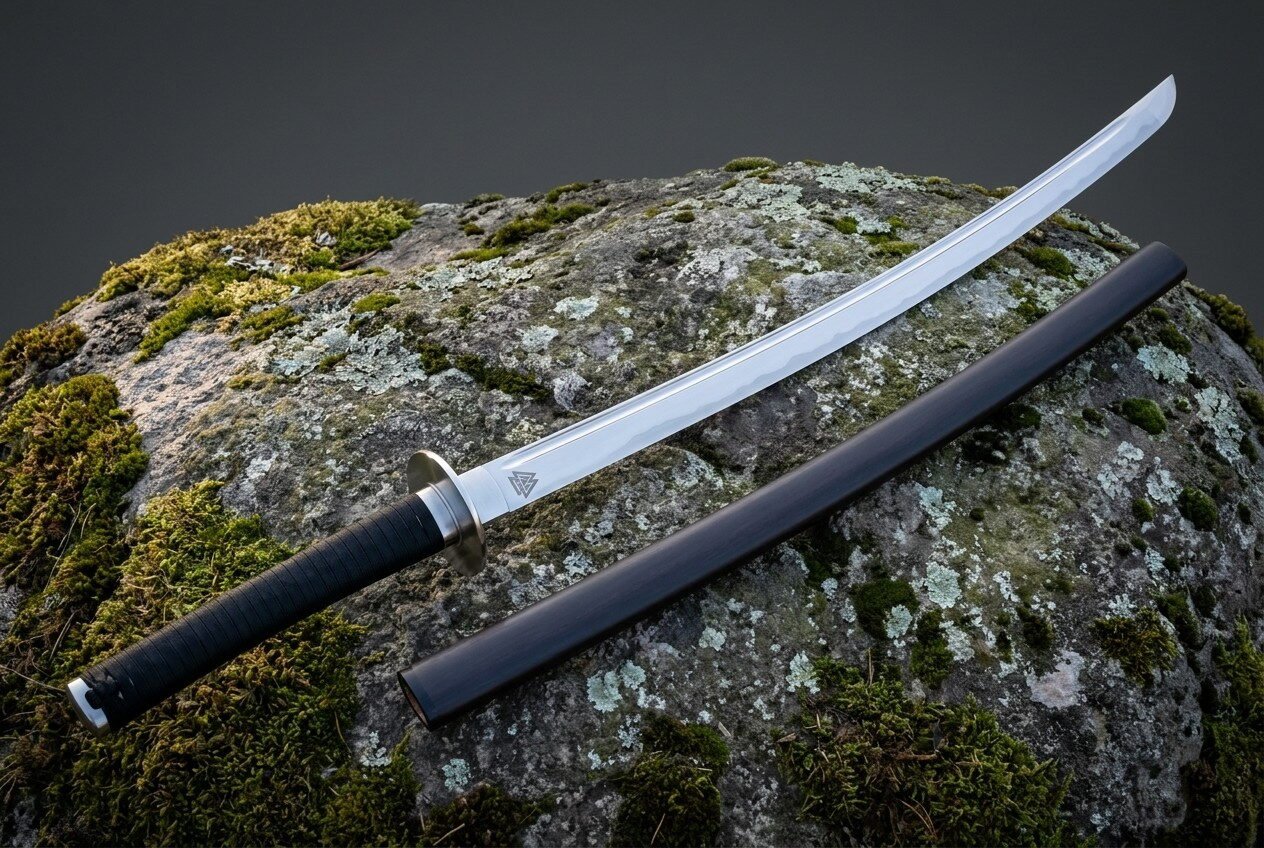
Start with the katana. It is the one everybody pictures, it fills a wall, and anything shorter bought first tends to look like a substitute for the sword you actually wanted. Buy a wakizashi first only if your space or your budget is tight, or you want something you can handle indoors. The tanto is a third purchase pretending to be a first one.
These three are not different designs. They are the same design at three lengths, and the Japanese classification is a ruler with a vocabulary. Once you understand that, the choice becomes a question about your wall, your hands and your money rather than about which one is best.
The short comparison
| Katana | Wakizashi | Tanto | |
|---|---|---|---|
| Traditional class | Daito, long sword | Shoto, short sword | Dagger |
| Blade length by the old rule | Over two shaku, roughly 24 inches and up | One to two shaku, roughly 12 to 24 inches | Under one shaku, roughly 12 inches and under |
| Hands | Two | One or two | One |
| How it was worn | Edge up through the sash, outdoors | Edge up through the sash, kept when indoors | Tucked in the sash or carried close |
| Best at | Display, cutting practice, the full presence of the pattern | Close quarters, handling indoors, smaller spaces | Detail, a desk piece, a companion to a longer blade |
| Wall space needed | A clear run of about a metre | Half that | A shelf or a small stand |
| Buy it if | This is your first Japanese sword | You want something shorter, cheaper or easier to handle | You already own a longer blade, or you want a small collectible |
How the three are actually defined
Japanese blade classification works on nagasa, the straight line length of the cutting edge from the tip to the notch where the blade meets the tang. The traditional unit is the shaku, close to a foot. Over two shaku is a daito, a long sword. Between one and two shaku is a shoto, a short sword. Under one shaku is a tanto. There is no separate geometry involved. A tanto is not a different kind of thing from a katana in the way a Bowie is different from a seax. It is the same curved single edged blade, shorter.
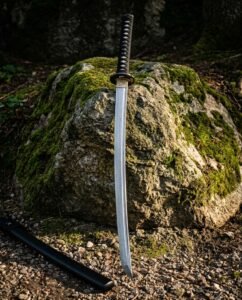 Tidefold Hand Forged Damascus Katana | 40 Inch Overall Length | 1095 and 15N20 Pattern Welded Blade with Black Ito Wrapped Tsuka | Collector Gift | RK-1777
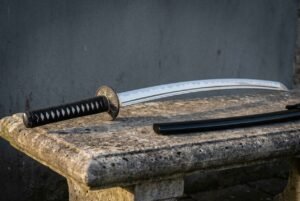 Duskwake Hand Forged 1095 Steel Katana Sword | 40 Inch Overall Length | Clay Quenched Hamon with Runic Compass Tsuba and Black Saya | Samurai Collector Gift | RK-1782
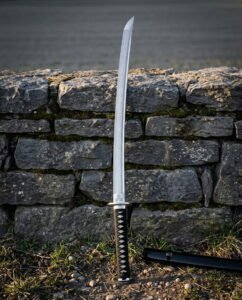 Spiralcrest Hand Forged Damascus Katana with Engraved Triskelion | 40 Inch Overall Length | Cord Wrapped Tsuka, Steel Habaki and Black Saya | Martial Arts Collector Gift | RK-1821
Two things follow from that. All three share the same fittings vocabulary: the tsuka is the handle, the tsuba is the guard, the saya is the scabbard, and the hamon is the hardening line along the edge. And the numbers on a modern listing are usually overall length, not nagasa, so a piece advertised at 40 inches is quietly counting the handle.
The pairing of a katana with a wakizashi is the daisho, the long and short, and wearing both was the mark of the samurai class in the Edo period. If you want the deeper story behind each, we have separate pieces on what a katana is, what a wakizashi is and what a tanto is.
The katana
The long sword, curved, single edged, made to be drawn and cut in one movement from a sash worn edge up. That last detail is what separates it from the older tachi, which hung edge down from cords. The curve, the sori, is what makes the draw and the cut work as one motion, and it is why a katana feels alive in the hand in a way a straight sword does not.
What it does well
Presence. Nothing else in this group commands a room the same way. A katana on a stand or a wall rack is a statement, and the length gives a Damascus pattern or a visible hamon the room to show itself.
Cutting, if that is your interest. A two handed grip on a curved blade of that length gives leverage and edge speed together. For anyone doing tameshigiri style practice on tatami or mats, this is the tool for it, with the caveat that you need training and space before you swing anything.
What it does badly
Space. A full length katana with a stand wants around a metre of clear wall or shelf, and it is awkward to move around a small flat. People underestimate this, and a beautiful sword ends up behind a door instead of on it.
Handling indoors. You cannot really pick one up and swing it in a living room, which is exactly why the wakizashi existed. If part of the pleasure for you is holding the piece, a shorter blade gives you more of that.
Price. It is the longest blade with the most work in it, so it is the dearest of the three in any given finish.
The wakizashi
The short sword of the pair, and the most underrated piece in this group. A wakizashi was worn constantly, indoors as well as out, because the long sword came off at the door and the short one did not. It is the blade a samurai actually had with him most of the time.
What it does well
Handling. This is the one you can pick up, draw and move with in a normal room. It is lighter, quicker and far less intimidating to a new owner than a full katana, and it still has real presence.
Space and price. Half the wall, less money, and none of the sense that you have bought something smaller than you wanted. A wakizashi on a single stand on a shelf looks intentional.
It completes a daisho later. If you buy the katana first and the wakizashi second, or the other way round, you end up with the historical pair. That is a satisfying way to collect and it gives the second purchase a reason.
What it does badly
It is not the piece people picture. If you have wanted a Japanese sword since you were fifteen, what you wanted was a katana, and a wakizashi bought instead tends to leave the itch where it was. Work out which one you actually want before you bank the saving.
Cutting practice. It works, but a shorter blade with a two handed grip is cramped, and the shorter edge means less margin for error on the angle. It is a harder blade to learn on, not an easier one.
The tanto
The dagger of the group, under about a foot of blade, and historically the most personal of the three. Tanto were carried by people who were not warriors as well as those who were, and they range from plain functional pieces to highly decorated ones.
What it does well
Detail. On a short blade your eye is close to the work, so the finish of the tip, the line of the hamon and the fit of the habaki all read clearly. A well made tanto rewards inspection in a way a big sword does not.
It fits anywhere. A desk, a shelf, a display case, a drawer. If you want a Japanese blade and you genuinely have no wall, this is the answer rather than a compromise.
The point. Tanto geometry, with the reinforced angular tip, is strong enough that the word has been borrowed by modern knife makers for anything with a similar point. That is a real functional property, not a style label.
What it does badly
It underwhelms as a first buy. A tanto next to nothing is a knife on a shelf. A tanto next to a katana is part of a collection. The context does most of the work.
It gets treated as a knife. It is not a camp tool and the fittings were never built for one. If you want something to use, buy a working fixed blade and leave the tanto to be admired.
Choosing by what you will do with it
Display
Katana, on a horizontal stand with the edge up and the curve reading as an arc. Give it height and a plain background. If wall space is the constraint, a wakizashi on a small stand looks better than a katana crammed into a corner.
Handling and learning
Wakizashi for handling in a normal space, katana if you have a club, a mat and someone to teach you. Do not buy a sharp blade to swing without instruction. Weight, balance and edge alignment are learned things.
Collecting
Start with the katana, add the wakizashi to make the daisho, then the tanto. Buying in that order means every piece you add improves the set rather than sitting on its own.
Gifts
Katana if the budget stretches, wakizashi if it does not, and check the recipient has somewhere to put it. A sword given to someone with no wall becomes a storage problem, which is a poor result for a generous gift. Engraving is done in the US after arrival if you want the piece marked.
Cosplay and events
Wakizashi or tanto, and check the rules of the event first. Many venues have length limits or ban live edges outright, and a shorter blade is far easier to carry all day than a full katana on a hip.
Steel, and what these are made from
Traditional Japanese swords were made from tamahagane, a steel smelted in a clay tatara furnace, then folded to even out the carbon and often built with a hard edge welded to a softer core. That is a specific craft tradition with its own smiths and its own eye watering prices, and it is not what this shop sells.
Everything here is either plain 1095 at 54 to 58 HRC or Damascus, meaning 1095 and 15N20 forge welded at 58 to 60 HRC. Both are high carbon steels, both take a fine edge, both rust if neglected. A hamon on a modern blade may be a genuine differential hardening line or a surface finish imitating one, so read the listing rather than the photograph. Neither steel is stainless, so treat any of these three the way you would treat any carbon blade: wipe, dry, oil lightly and store out of the saya if it is going to sit for months. The care guide covers the routine.
Buy this one if
Buy a katana if this is your first Japanese sword, you have the wall for it, you want the piece that people recognise instantly, or you intend to train with a qualified instructor.
Buy a wakizashi if your space is limited, you want to spend less without owning something you regard as a lesser piece, you want to handle the blade indoors, or you already own a katana and want the pair.
Buy a tanto if you have no wall at all, you already own something longer, you want a small piece to keep close, or you like the detail that only shows on a short blade.
What we stock
Our katana and Japanese swords category holds the long blades, including daisho sets that give you the katana and wakizashi together. The wakizashi group holds the short swords and the tanto sit alongside them, since they share the same fittings and finishes. If you want to browse the whole sword range across cultures, the swords category is the top level, and the hand forged katana tag narrows it to the Japanese patterns. Ransack Viking is a US company in Chicago, Illinois. Every piece is handmade in the Czech Republic the old way, then imported, inspected and shipped from Chicago.
A curved single edge is not only a Japanese idea, as we show in the scimitar. If you are buying rather than comparing, start with our advice on a first sword, and the metallurgy terms are defined in the steel glossary.
Questions people ask
What is the difference between a katana and a wakizashi?
Length, and almost nothing else. Both are curved single edged Japanese blades with the same fittings. The old rule puts a katana over two shaku of blade, roughly 24 inches and up, and a wakizashi between one and two shaku. Worn as a pair they form the daisho, the long and short that marked the samurai class.
Is a tanto a knife or a sword?
A dagger, formally. Under one shaku of blade, roughly a foot or less, which puts it below the short sword class. Modern knife makers borrowed the name for the angular reinforced point, so a “tanto point” folder shares a tip shape with a real tanto and, past that, a marketing department.
Which should I buy first?
The katana, if you have the space. It is the piece most people actually wanted all along, and everything else reads as a companion to it. Buy a wakizashi first if your wall or your budget is small, or if handling the blade matters more to you than how it looks mounted.
How much wall space does a katana need?
Around a metre of clear run for a full length blade on a horizontal stand, plus clearance above and below so it is not crowded. A wakizashi needs roughly half that and a tanto sits happily on a shelf. Measure before you order rather than after.
Are these made from tamahagane?
No. Tamahagane is a traditional Japanese smelted steel with its own smiths and its own prices, and nobody sells it at our prices. Our blades are plain 1095 at 54 to 58 HRC or 1095 and 15N20 Damascus at 58 to 60 HRC, both high carbon and both hand forged in the traditional way.
Can I train with one of these?
Only with instruction, space and a blade meant for it. Cutting practice needs a qualified teacher, a proper target and a lot of clear room. Display pieces and sharp blades are not the same thing, so tell us what you intend before you order if you are unsure which is which.
If you are buying
Ready to ship, the Twinsaya Daisho sword and the Brasswind Katana. The Moonwake Wakizashi short sword and the Shadowreed Tanto are the other two.
Starting on the European side
Which one to start with is a fair question, and it has a European twin that gets asked at every HEMA club. Choosing a first HEMA sword answers it for the club floor, and the HEMA sword range is where the answers are kept.
Shop the range
Tidefold Hand Forged Damascus Katana | 40 Inch Overall Length | 1095 and 15N20 Pattern Welded Blade with Black Ito Wrapped Tsuka | Collector Gift | RK-1777Duskwake Hand Forged 1095 Steel Katana Sword | 40 Inch Overall Length | Clay Quenched Hamon with Runic Compass Tsuba and Black Saya | Samurai Collector Gift | RK-1782Spiralcrest Hand Forged Damascus Katana with Engraved Triskelion | 40 Inch Overall Length | Cord Wrapped Tsuka, Steel Habaki and Black Saya | Martial Arts Collector Gift | RK-1821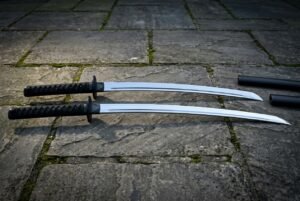 Twinsaya Hand Forged 1095 Steel Daisho Sword Set | 2 Piece Katana and Wakizashi | Black Cord Wrapped Tsuka with Iron Tsuba and Lacquered Saya | Collector Gift | RK-1915
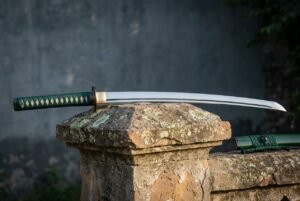 Jadecord Hand Forged 1095 Carbon Steel Katana Sword with Green Ito Wrap | 40 Inch Overall in Saya | Iron Tsuba and Matching Green Lacquered Scabbard | Collector Gift | RK-1697
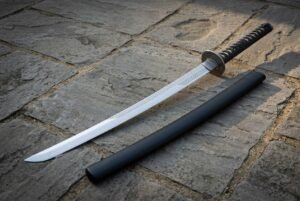 Knotcurve Hand Forged 1095 Steel Katana | Etched Norse Knotwork Band | Satin Steel Tsuba with Cord Wrapped Tsuka and Black Saya | Norse Collector Gift | RK-1882