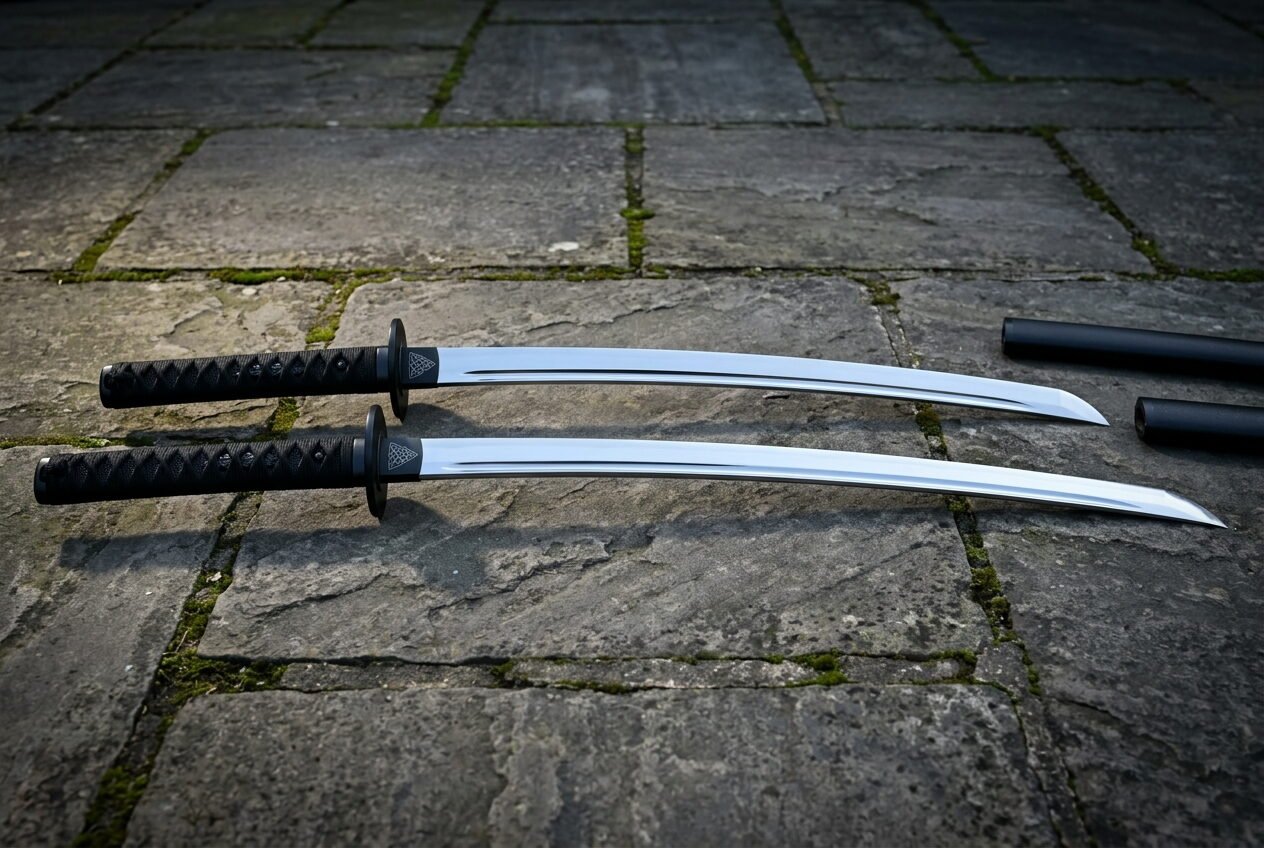
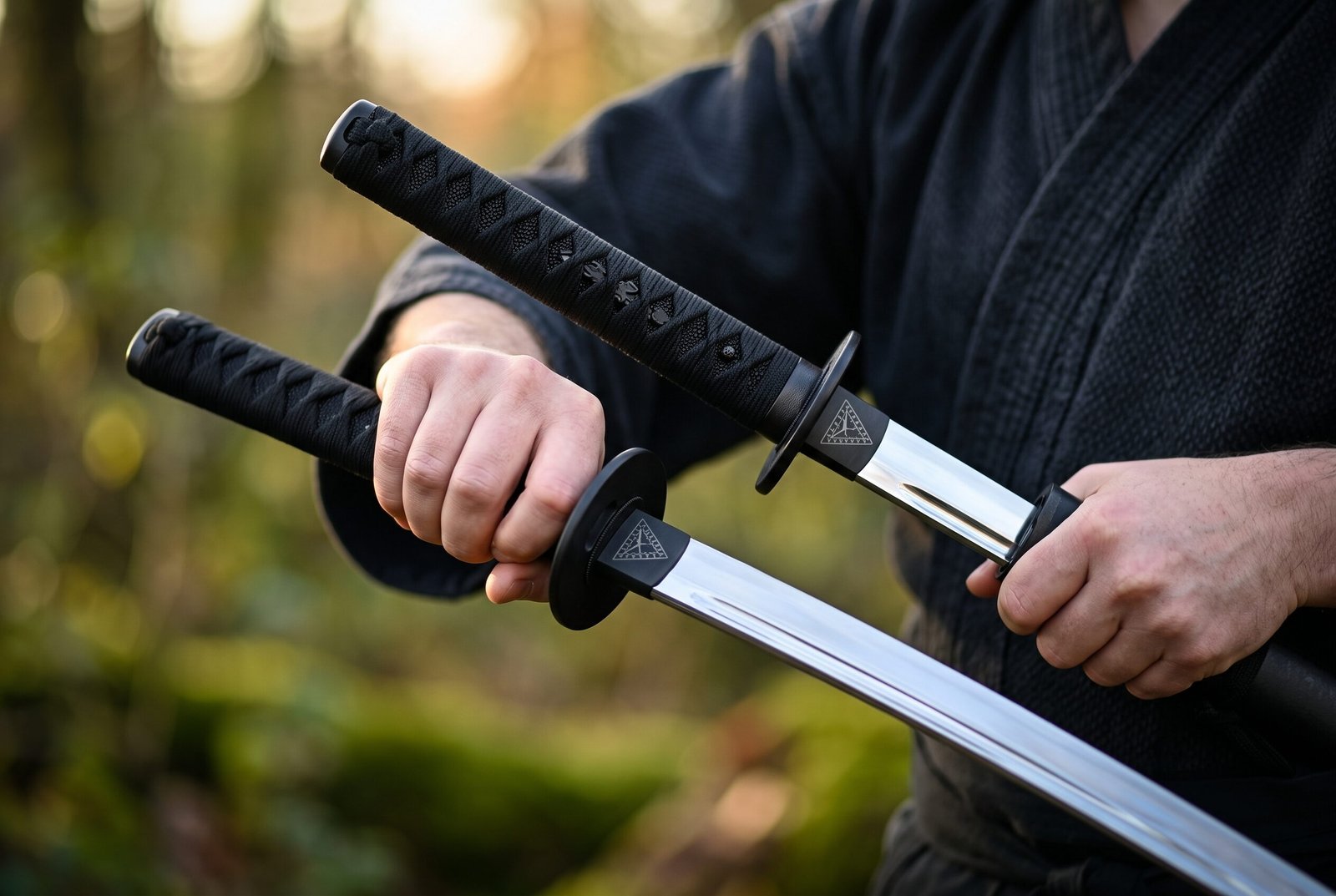
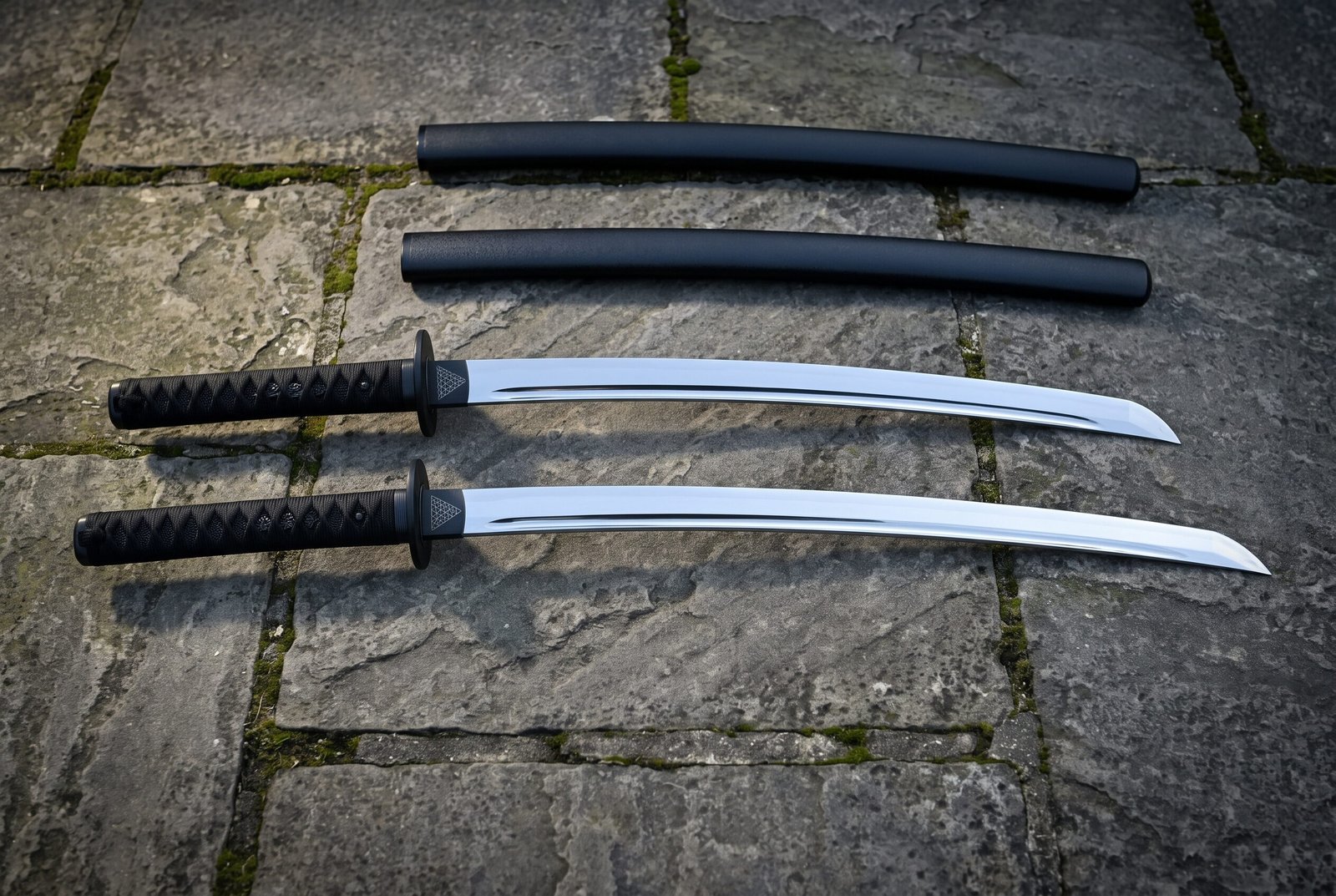
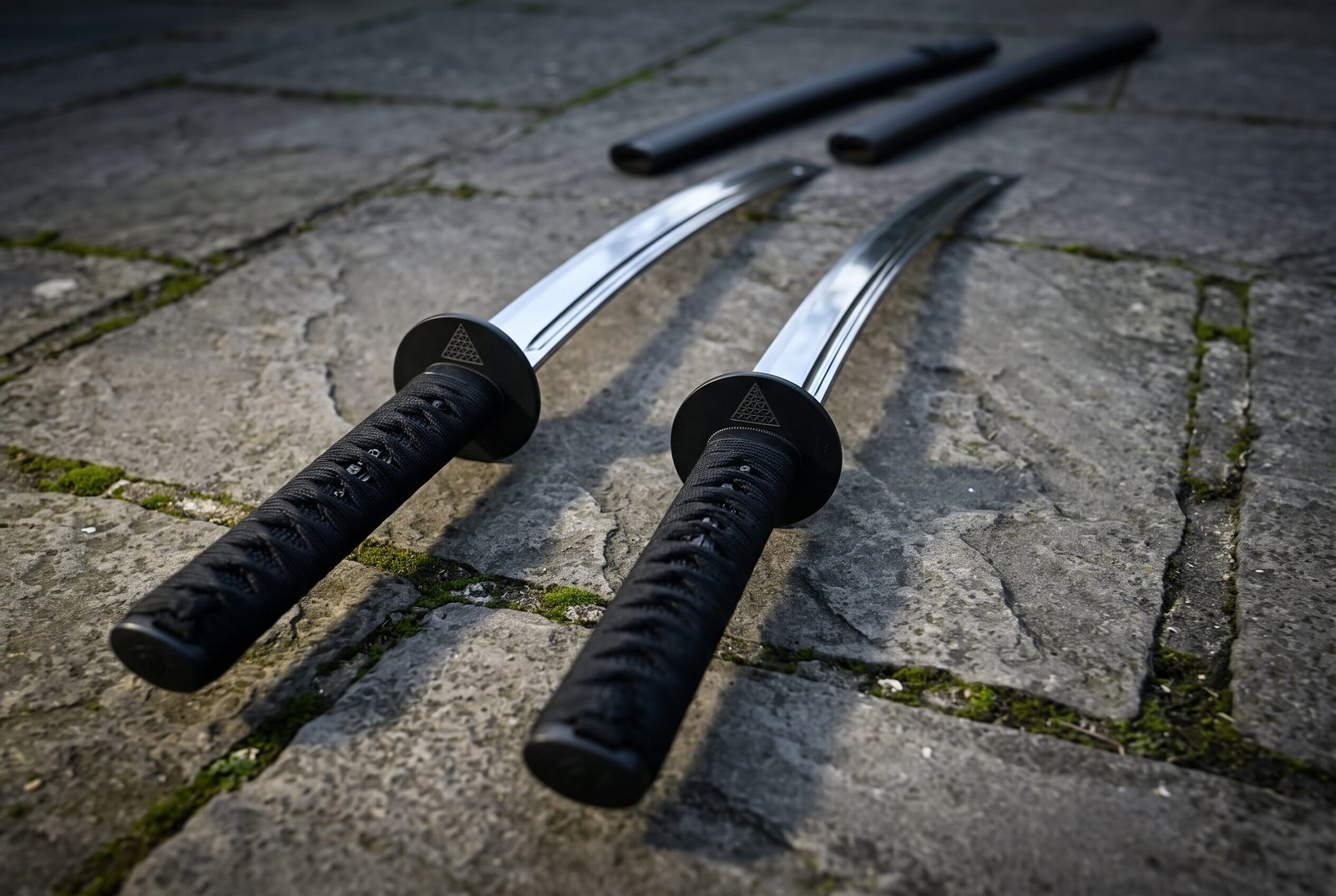
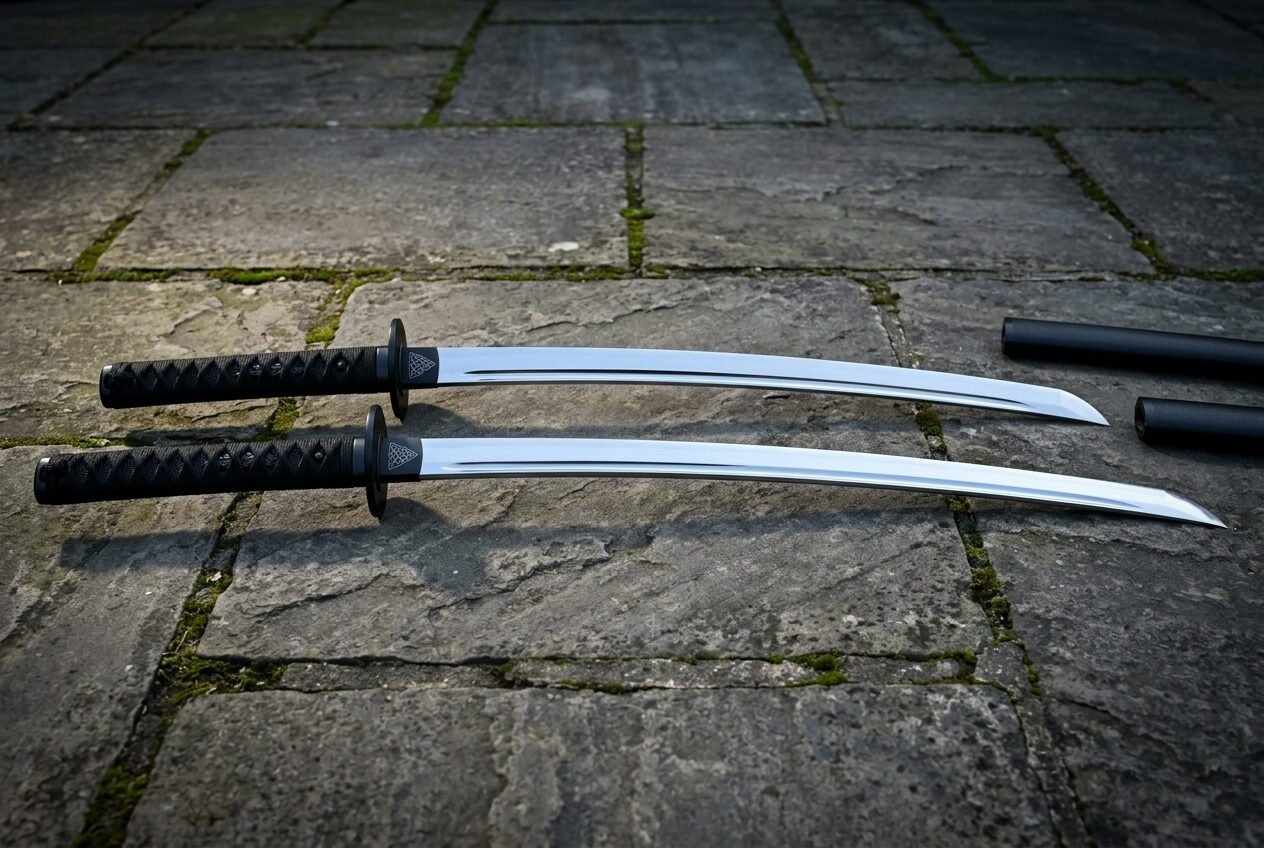
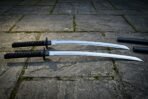
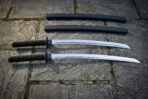
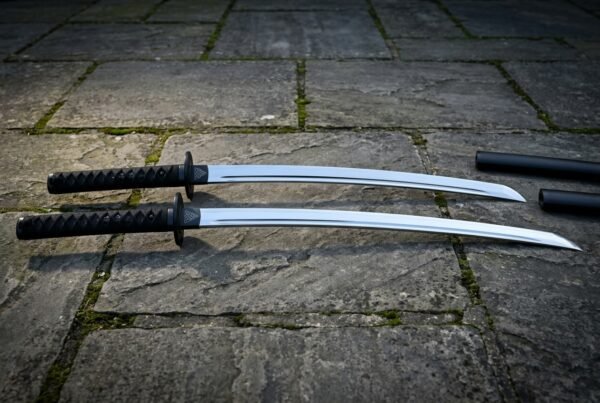
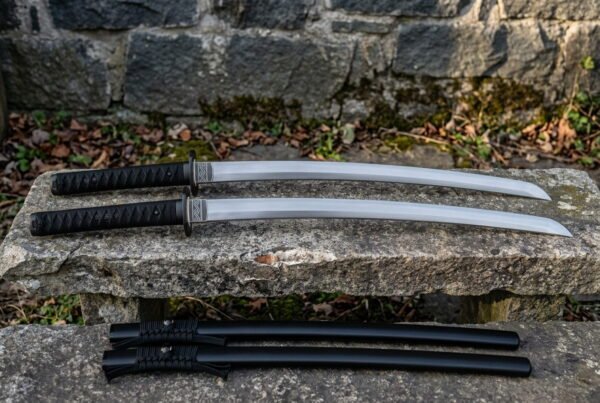
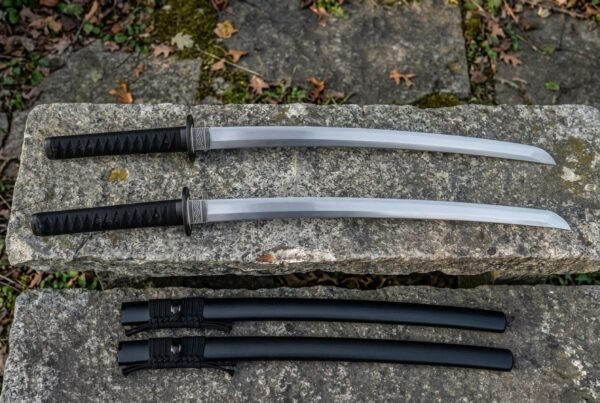
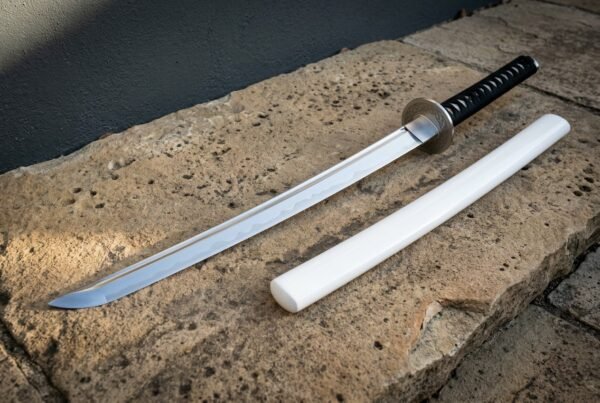
The Twinsaya is a two piece daisho set, one katana and one wakizashi, both forged from 1095 high carbon steel and both mounted the same way in black. The tsuka are wrapped in black cord over black rayskin, the tsuba are plain round iron, and each blade has its own black lacquered saya. Two swords, two scabbards, sold and priced as one set.
Daisho simply means large and small, and the pairing is younger than most people assume. Through the Muromachi period a warrior carried whatever combination of blades suited him. It was the Edo period sumptuary codes of the seventeenth century that turned the matched long and short pair into a formal marker of samurai rank, and specifically the right to wear both together in public. A merchant could own a wakizashi. Wearing the pair was the point. That is why matched mountings, the same wrap, the same fittings, the same lacquer, mattered so much: the set read as a single statement rather than two swords that happened to be owned by the same man. Forged, ground, heat treated, polished and mounted in the Czech Republic.
If you are deciding where to start, the three Japanese lengths compares the lengths. For where 1095 sits on the hardness scale and what that buys you, see the steel and hardness page. The tanto knives carry the same furniture at knife length.
Specifications
| Blade material | 1095 high carbon steel, 54 to 58 HRC |
|---|
| Pieces included | 2 swords and 2 saya |
|---|
| Katana | 40 inches overall, 27.5 inch blade |
|---|
| Wakizashi | 30 inches overall, 20 inch blade |
|---|
| Blade geometry | Shinogi zukuri with a defined ridge line, gentle sori |
|---|
| Blade finish | Mirror polished monosteel, no hamon |
|---|
| Handle | Black cord wrap in a diamond pattern over black rayskin on a wooden core |
|---|
| Fittings | Plain round black iron tsuba, matching black fuchi and kashira |
|---|
| Saya | Black lacquered wood, one for each blade |
|---|
| Edge | Both blades sharpened |
|---|
| SKU | RK-1915 |
|---|
Why a wakizashi is not just a short katana
The difference is not scale, it is intended distance. A katana is a two hand sword built for open ground, and its length is a liability indoors, which is exactly where a wakizashi earns its keep. Corridors, low ceilings, seated positions and doorways all favour a blade of twenty inches, and the shorter blade can be drawn and cut in one motion from a seated posture where a long sword cannot clear its own scabbard.
The second difference is that the wakizashi stayed with its owner. Custom required the long sword to be surrendered at the door of a house or a castle. The short sword did not leave the belt. Everything about how it is mounted, the shorter tsuka, the tighter sori, the way the saya sits, follows from being worn constantly rather than drawn occasionally. On the Twinsaya both blades share the same geometry and the same fittings, so the pair reads as one set, but the proportions of each are correct for what it is.
The steel and the polish
Both blades are 1095 high carbon steel, quenched and tempered through to 54 to 58 HRC. This is a through hardened monosteel blade, not a clay tempered one, and we say that plainly because it matters. There is no hamon on these blades and nothing has been etched on to imitate one. What you get instead is a tougher blade than a hard edged clay tempered blade of the same price would be, with far less risk of a crack running from a hard edge into a soft spine.
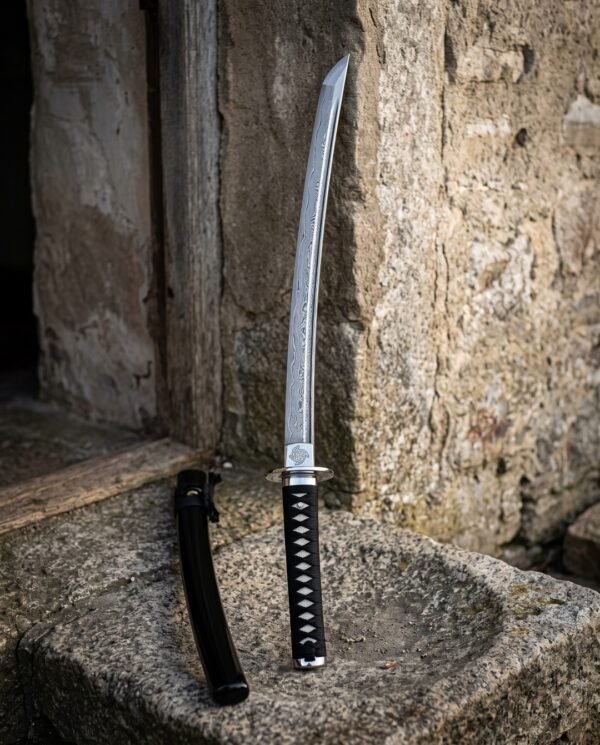
The polish is a bright mirror finish that follows the shinogi, the ridge that runs the length of each blade and separates the flat of the shinogi ji above from the ground bevel below. That ridge is the geometric heart of a Japanese blade. It puts thickness and stiffness along the spine while letting the cutting bevel stay thin, and getting it dead straight on a curved blade is the part of the grind that takes the longest.
Engraving, runes and your own design
Use the rune converter on this page to turn a name, a date or a short phrase into Elder Futhark and we will cut it into the steel, the leather or the wood. If you would rather have a Viking pattern than a rune line, choose your own design in the engraving option above the add to cart button and tell us where it goes. Where a piece already carries an engraved design, your chosen engraving replaces it rather than sitting alongside it. On this set we usually cut into the flat of the shinogi ji near the habaki, and we can do it on one blade or both. See the engraving page.
Handling and balance
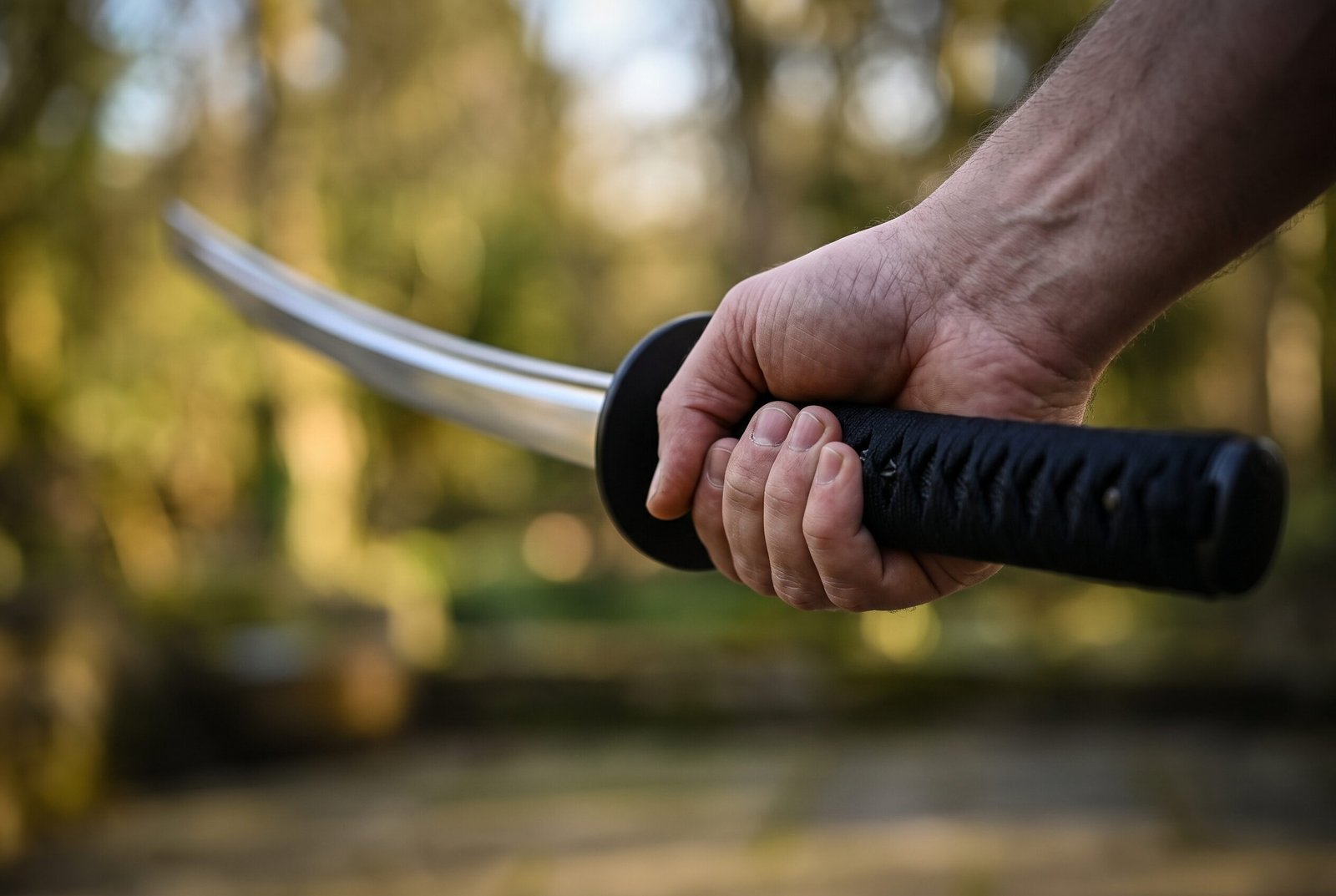
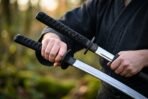
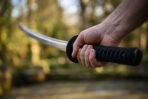
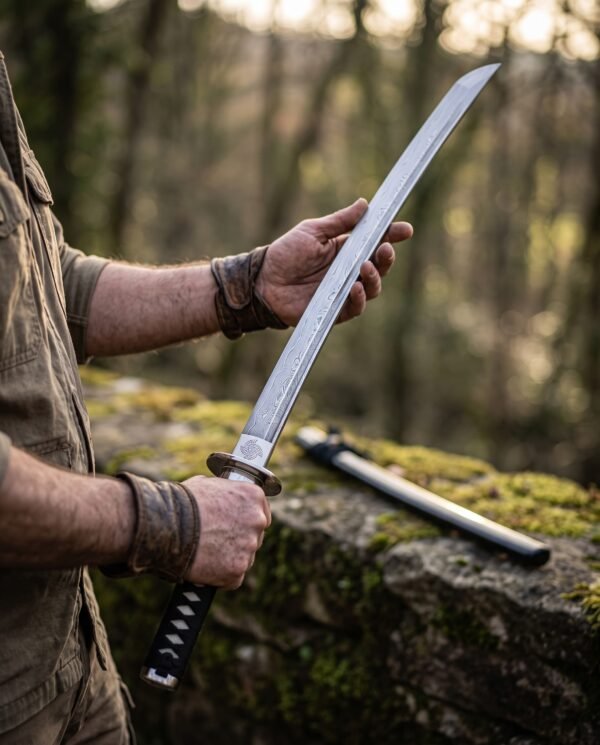
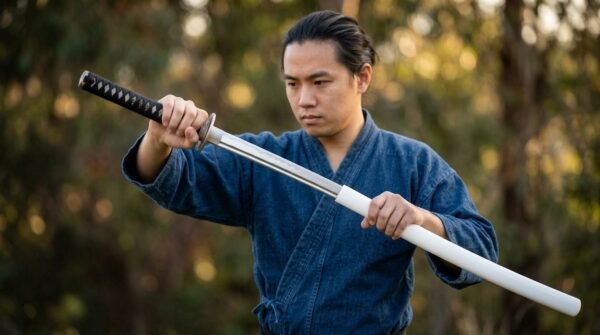
The katana balances around four inches ahead of the tsuba and is meant to be held with both hands well apart, the right hand up under the fuchi and the left low on the kashira. The power comes from the left hand pulling rather than the right hand pushing, which is the single thing most new owners get wrong. The wakizashi is a one hand sword in practice, balanced closer to the guard so it turns quickly at short range.
Both blades arrive sharp. Drawing and returning a curved blade to a fitted saya is a skill, and the way to learn it is slowly, with the saya held mouth up and the spine of the blade riding the inside of the wood. Never force a blade back edge first.
Care
Oil both blades after any handling. Fingerprints are acidic and a mirror polished carbon steel blade will show an etched print within days if it is left. Wipe from the tsuba towards the point with a soft cloth and use a light mineral or blade oil, applied thinly. Store the swords horizontally with the edge upward so the blade does not rest its weight on the lacquer inside the saya. Do not use household abrasives on the polish, and do not clean the lacquered saya with solvent. There is more on steel care on the site.
A curve like this does not sharpen the way a straight edge does, and sharpening a curved blade works through the stroke.
Made in the Czech Republic
Every piece we sell is made by hand in the Czech Republic. The smiths there work the way the trade has been worked for a long time, heating and hammering the steel, taking the bevels down by eye, and fitting the handle and the leather one at a time. There is no automated line anywhere in it, so small differences from one piece to the next are normal and expected.
Ransack Viking is a United States company based in Chicago, Illinois. We bring the pieces in ourselves, inspect them on arrival and ship them from our own warehouse. If you add engraving, that is carried out here in the United States before your order goes out.
A note on handmade variation
This set is hand made rather than machine made or bulk produced, so it will not be a pixel for pixel copy of the photograph. The curvature of a quenched blade is set by the quench itself and no two come out identical, so the sori on your katana will differ slightly from the one shown. Cord wrap tension, the pattern of the rayskin under it and the depth of the lacquer all vary. The dimensions, the material and the build are the same every time. The character is not.
Frequently asked questions
How many pieces are in the set?
Four items in total: one katana, one wakizashi and one lacquered saya for each. Both swords are included in the single price shown.
Do the blades have a real hamon?
No, and we will not pretend otherwise. These are through hardened monosteel blades with a mirror polish. Nothing has been acid etched to fake a temper line.
Are they sharp out of the box?
Yes, both of them. If you want either blade left unsharpened for display, tell us in the order notes.
Can I use these for cutting practice?
The katana will cut rolled mats and water bottles. Neither blade is intended for contact against another sword or for full contact sparring of any kind.
Can I buy just the wakizashi?
Not at this listing. The Twinsaya is sold as a matched pair because the fittings and the lacquer are made together. Single blades appear elsewhere in the range.
How long does it take to arrive?
One to two weeks to forge, polish and mount, then free shipping within the United States.
What is in the box
- One Twinsaya katana, 40 inches overall
- One Twinsaya wakizashi, 30 inches overall
- Two black lacquered saya, one fitted to each blade
- Care card covering oiling and saya handling
- Lifetime warranty against defects in forging, grind, heat treat and fittings
- Forged and finished in the Czech Republic
Explore the range
See more in katana and Japanese swords, wakizashi and sword stands and displays, or read the guides.
Near neighbours in the shop
Worth putting side by side with this is the Riverstone wakizashi, 28 inches overall. In the same category sits the Bonecrest wakizashi, 27 inches overall. A near match for this one is the Cinderpine wakizashi, 5 inches overall.
For a different piece from the same family, look at the Emberdusk Japanese sword. You can have this made your way instead on the design your own page.

Did not expect this level of quality for the price. 1095 Steel blade holds a razor edge right out of the box. Great buy overall.