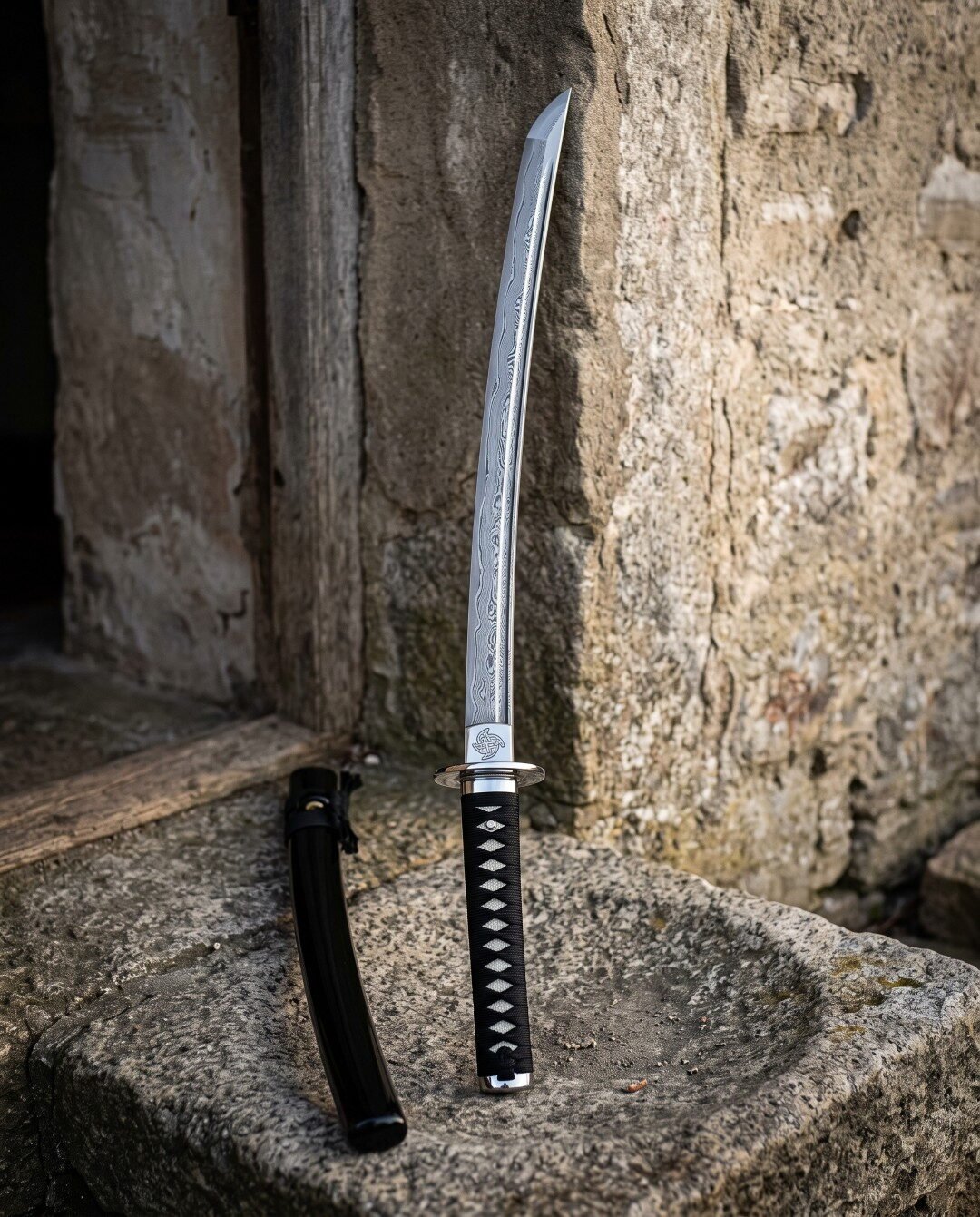
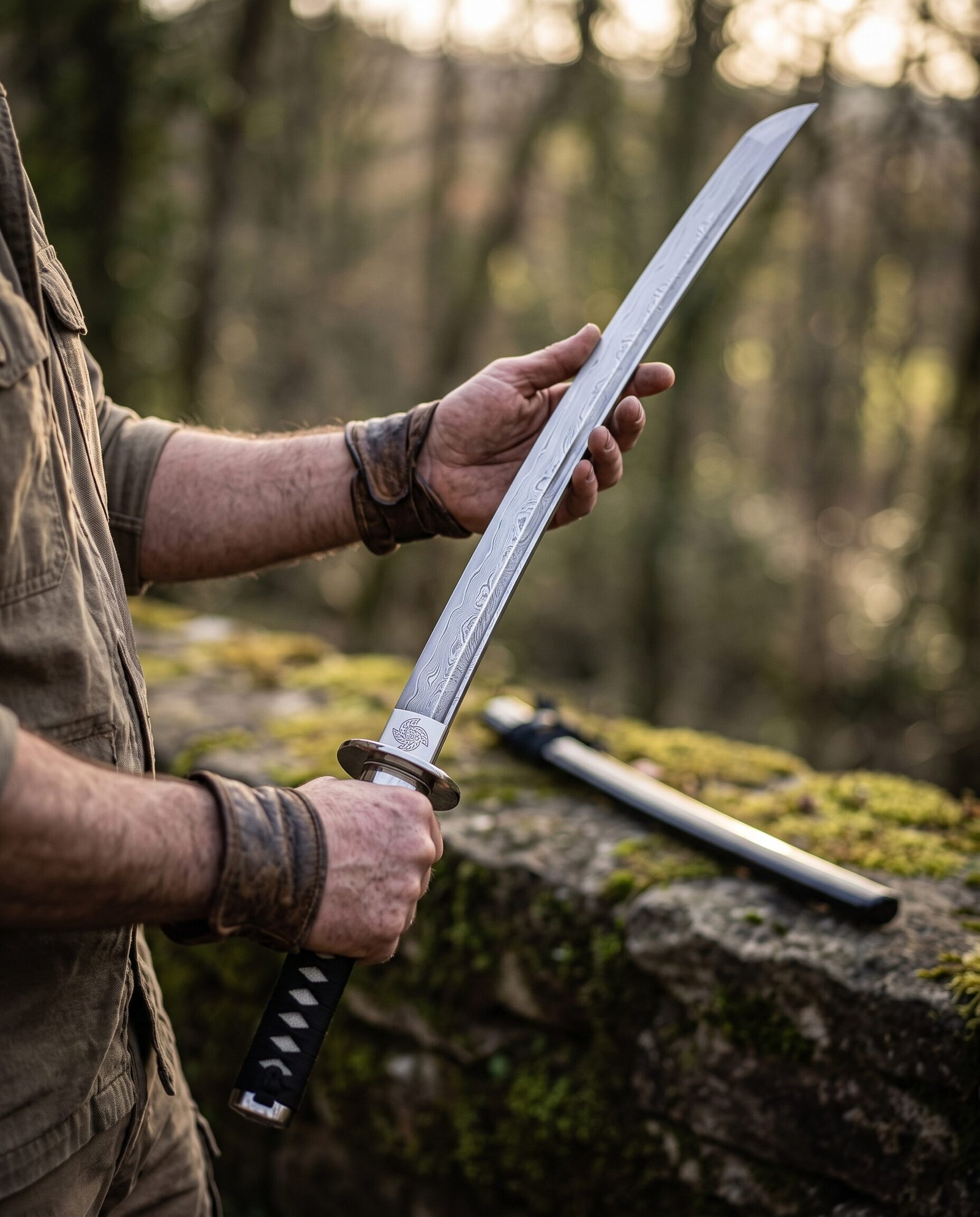
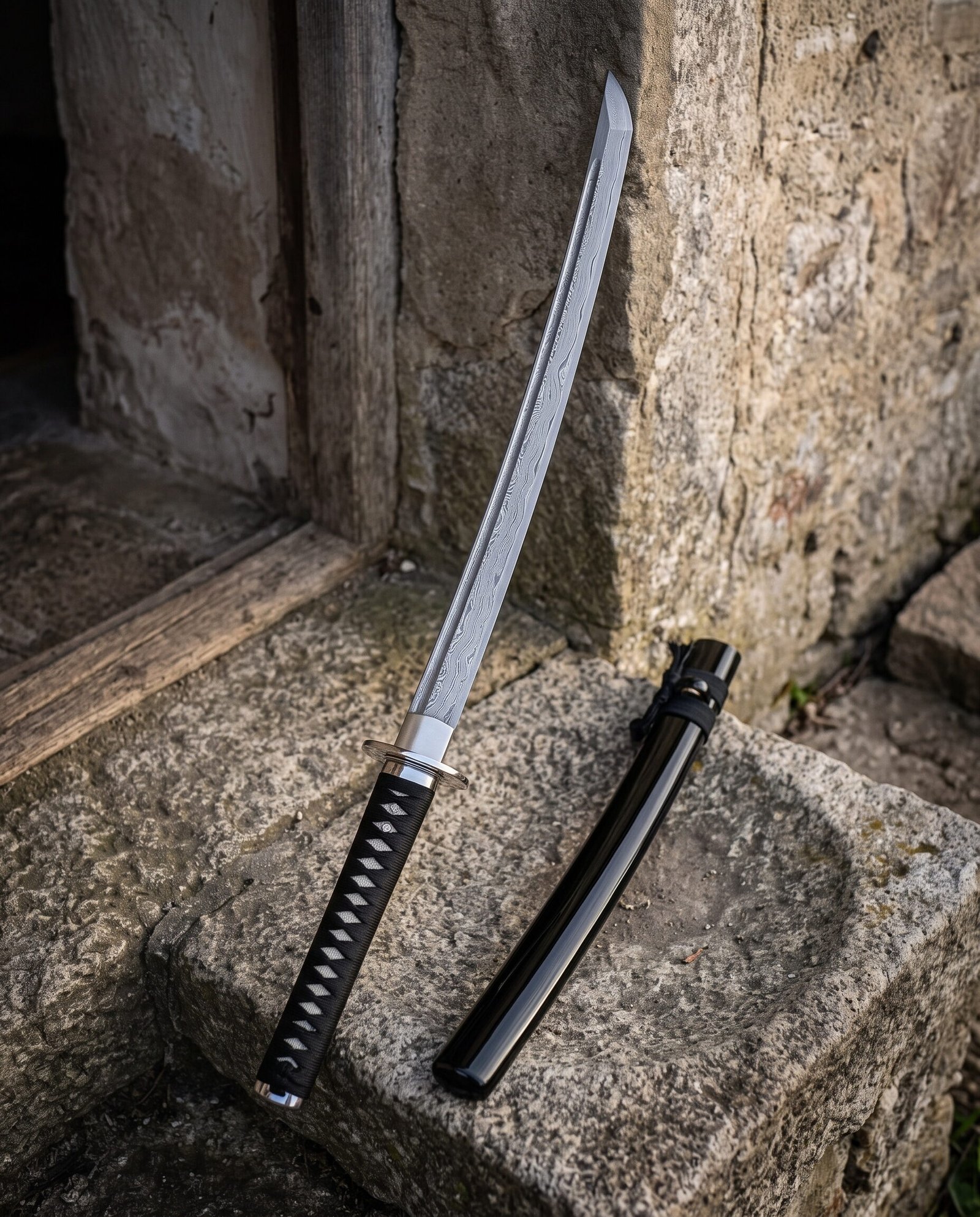
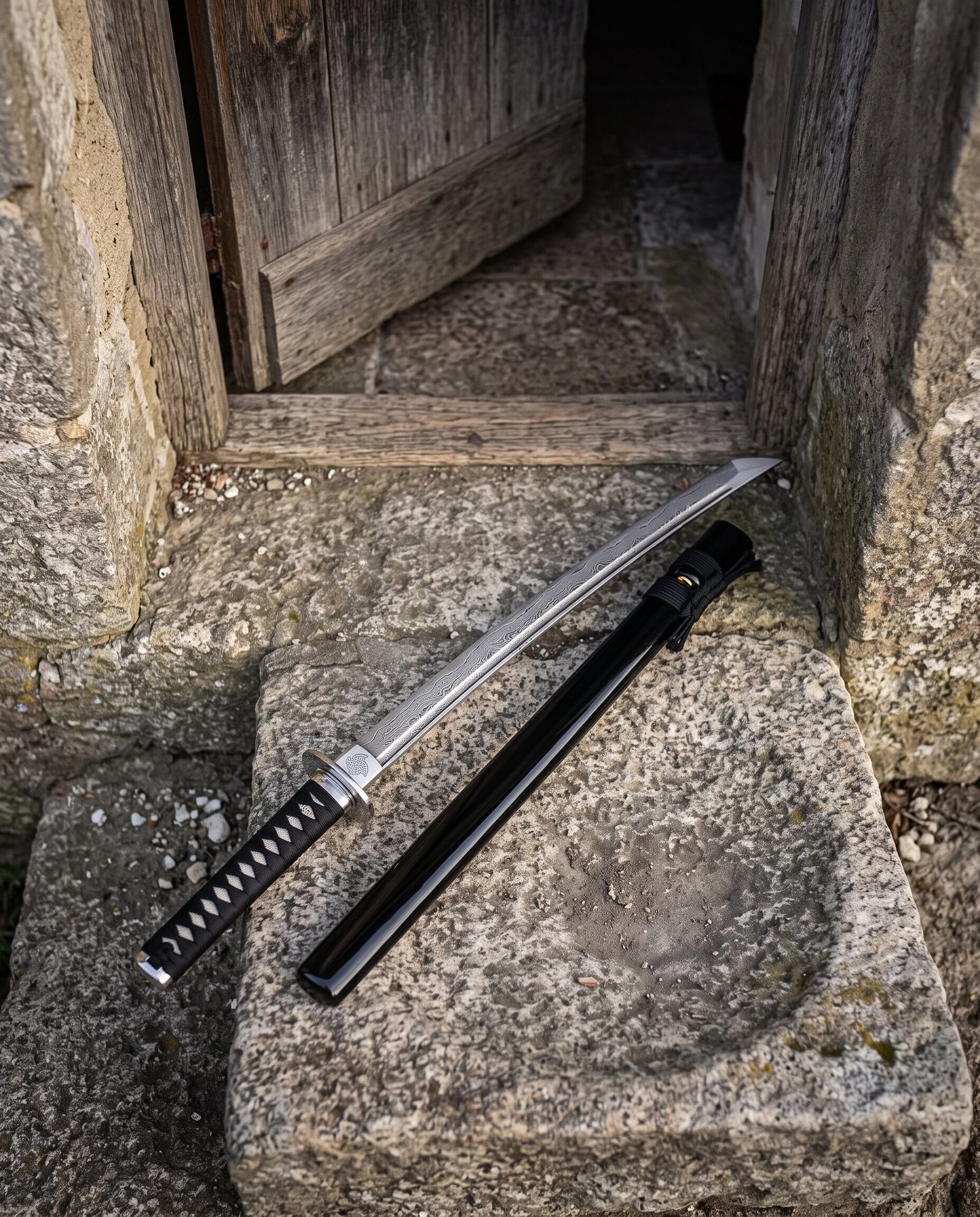
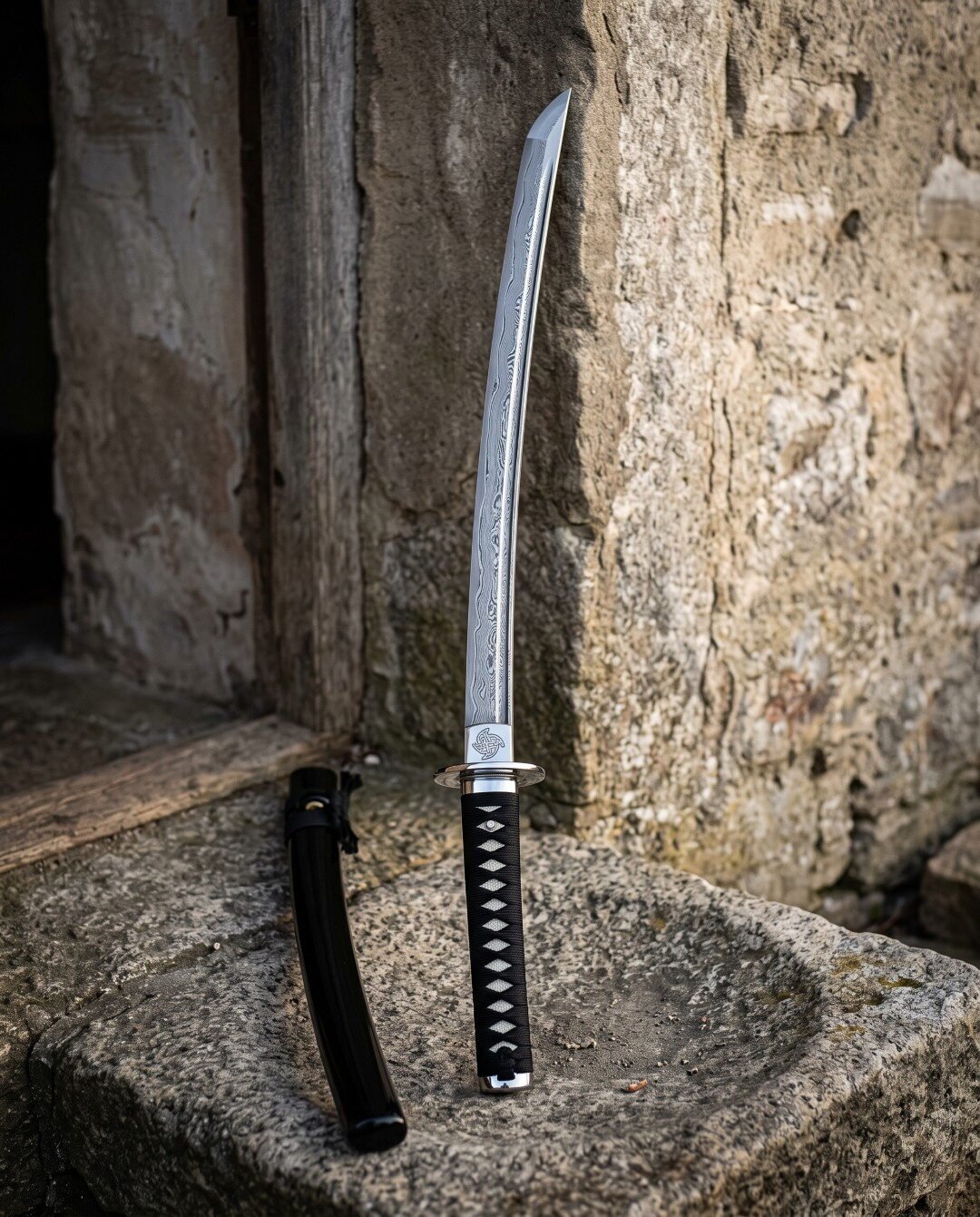
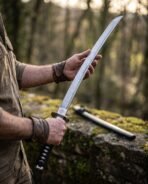
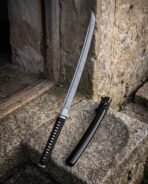
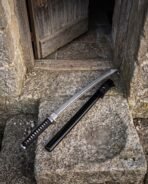
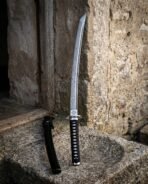
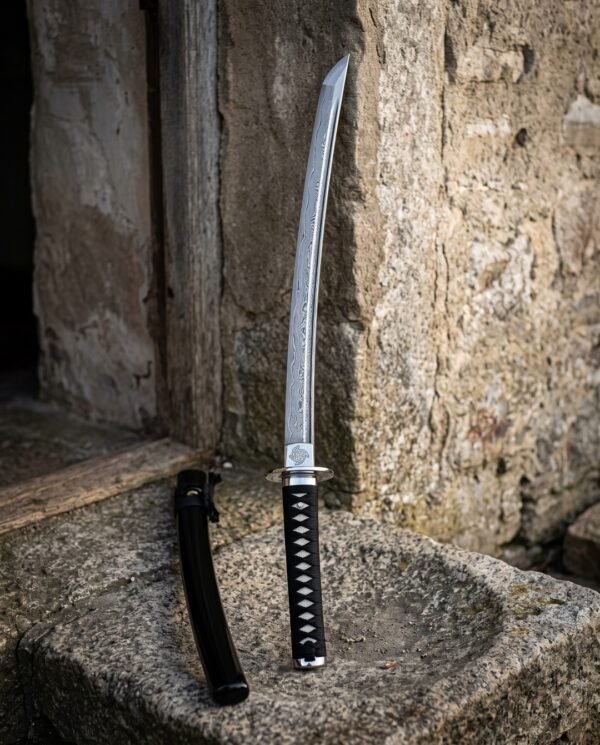
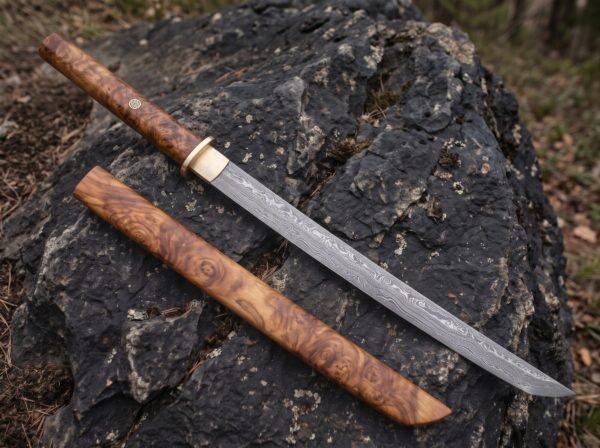
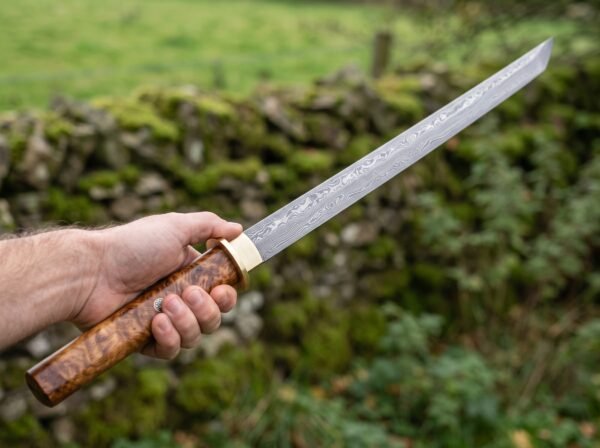
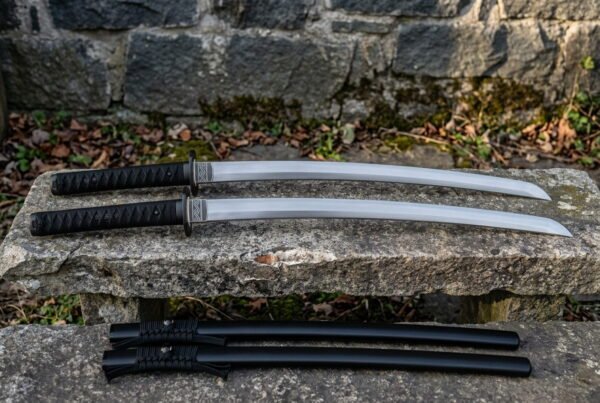
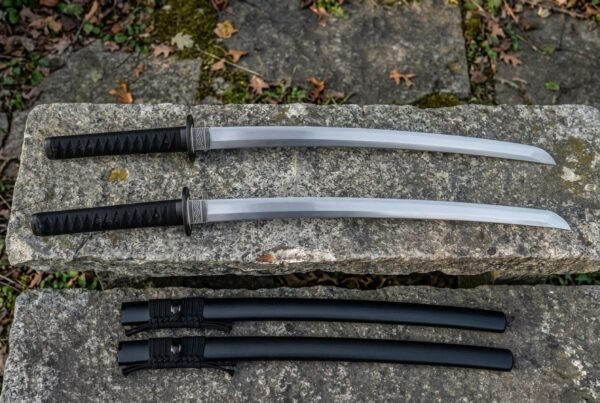
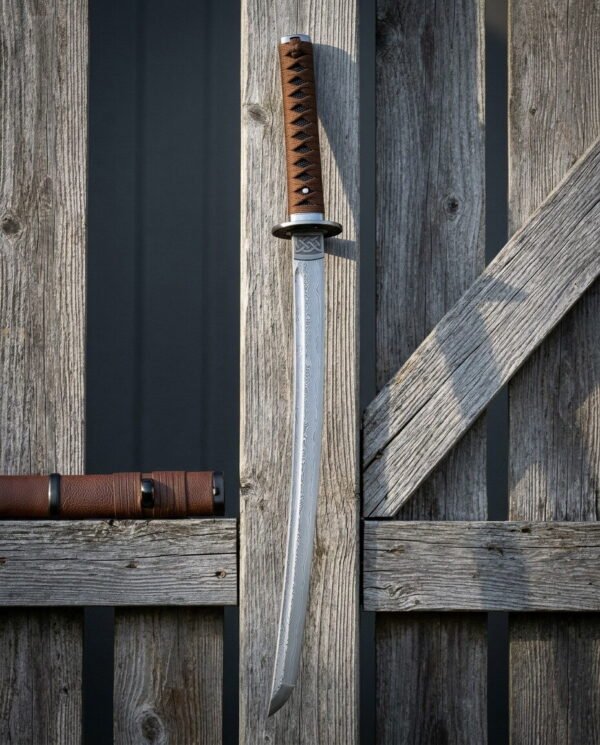
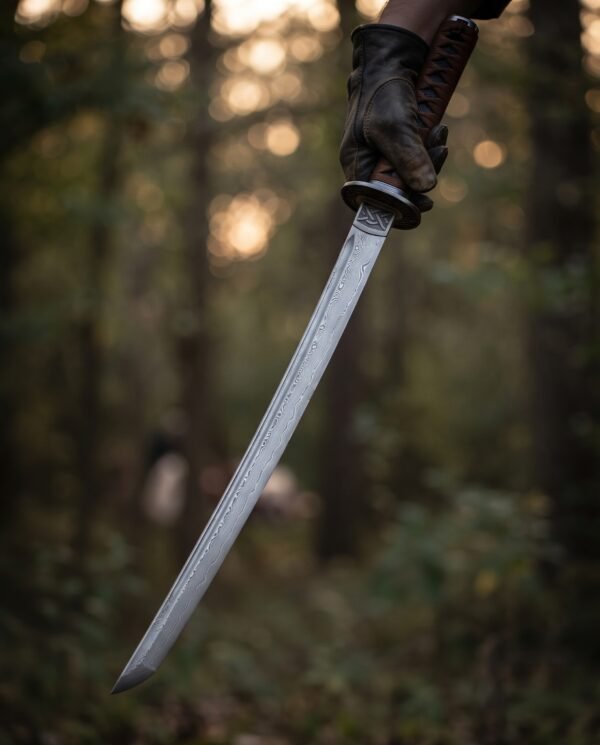
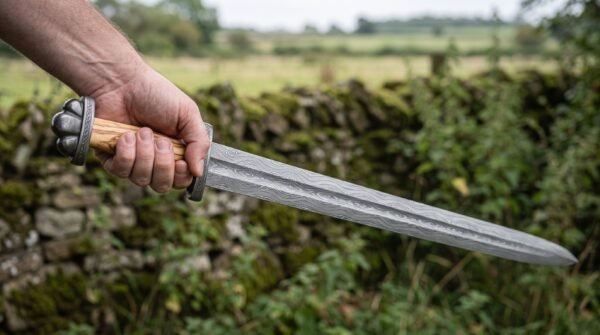
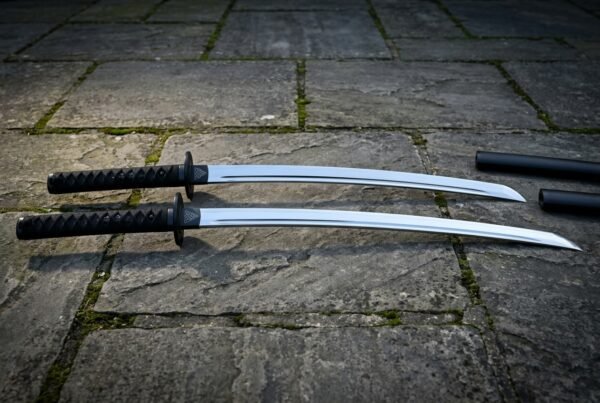
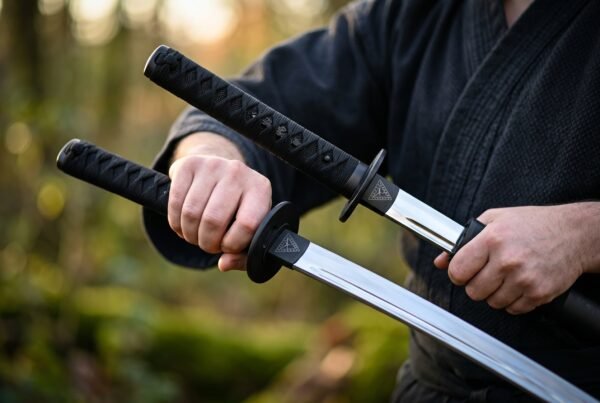
The Inkfold is a wakizashi, the short companion sword of the Japanese pair, forged from a pattern welded billet of 1095 and 15N20. The pattern runs the full length of the blade in tight ripples that follow the curve, and it is a genuine layered structure rather than an etched imitation. The tsuka is bound in black cord over a pale under wrap, the tsuba is a plain round steel plate, the habaki carries a small engraved knot emblem, and the saya is finished in gloss black lacquer with a cord tie at the throat.
A wakizashi was not simply a small katana. Under Tokugawa law the long sword was left at the door when a samurai entered a house, and the short sword stayed on the hip. That single rule shaped the whole type. The wakizashi had to be worn all day indoors, drawn in a corridor or a low room, and used in spaces where a thirty inch blade could not clear its scabbard. This one is forged, ground, heat treated and finished in the Czech Republic.
For how the three Japanese lengths differ in use, katana, wakizashi and tanto compared lays them out. The pattern is real forge welding rather than a print, and five checks before you buy shows you how to tell. The tanto knives use the same fittings at knife length.
Specifications
| Material | 1095 and 15N20 pattern welded Damascus, hardened to 58 to 60 HRC |
|---|
| Overall length | 28 inches in the saya |
|---|
| Blade length | 19 inches measured along the curve |
|---|
| Blade finish | Acid etched and hand polished to bring out the folded pattern |
|---|
| Tsuka | Black cord wrapped over a pale under layer on a shaped timber core, about 8 inches |
|---|
| Tsuba | Small round polished steel plate |
|---|
| Fittings | Polished steel fuchi and kashira, steel habaki engraved with a knot emblem |
|---|
| Saya | Timber core finished in gloss black lacquer with a black cord tie at the throat |
|---|
| Weight | About 1 lb 12 oz for the sword alone |
|---|
| Included | Wakizashi and fitted saya |
|---|
| SKU | RK-1937 |
|---|
Why the short sword existed at all
The daisho, the long and short pair, is usually explained as a matched set worn for status. That is true of the late Edo period, but it is not where the wakizashi came from. The short sword arrived first as a practical sidearm and only later became half of a formal pair.
Three things drove it. Indoor etiquette meant the long sword was surrendered or left on a rack at the entrance to a house, so the short sword was the one blade a man kept on him from waking to sleeping. Interior architecture meant a blade had to be drawn and used with a low ceiling and paper walls close on both sides, which puts a hard ceiling on useful length. And the wakizashi was the blade that non samurai townsmen and merchants were permitted to carry, which is why far more of them were made than long swords.
The design follows from that. The curve is shallower than a katana’s because a short draw does not need much of it. The point section is stout because a short blade is used at close range where thrusting matters. The tsuka takes a full two hand grip even though the sword is often used one handed, because you want the option when the room allows it.
The tsuba is worth a second look as well. It is not a hand guard in the European sense and it is not there to stop a blade sliding down onto the fingers. Its main job is to stop the hand sliding forward onto the edge during a thrust, and its secondary job is to balance the sword by adding mass right at the pivot.
1095 and 15N20 Damascus
The blade is pattern welded from alternating layers of 1095 and 15N20. Both are high carbon steels and both harden. The difference between them is nickel, which 15N20 carries and 1095 does not, and nickel is what resists the etching acid. When the finished blade goes into the acid the 1095 layers darken and the 15N20 layers stay bright, and the contrast you see is the actual internal structure of the steel showing on the surface.
That is worth stating plainly because a great deal of what is sold as Damascus is a pattern printed, laser marked or acid stencilled onto a plain blade. Grind into one of those and the pattern stops at the surface. Grind into this one and the pattern continues, because it goes all the way through.
Hardness is 58 to 60 HRC, which is higher than the long European swords in the range and appropriate here because the blade is short and stiff. The rippling pattern along the edge is the layered billet, not a hamon. This blade is not clay quenched and it would be wrong to describe a fold pattern as a temper line, because they are different things and telling them apart is the first skill a Japanese sword collector learns.
Engraving, runes and your own design
Use the rune converter on this page to turn a name, a date or a short phrase into Elder Futhark and we will cut it into the steel, the leather or the wood. If you would rather have a Viking pattern than a rune line, choose your own design in the engraving option above the add to cart button and tell us where it goes. Where a piece already carries an engraved design, your chosen engraving replaces it rather than sitting alongside it. On the Inkfold the usual placements are the flat of the blade near the habaki or the face of the tsuba, and a cut line shows up strongly against an etched Damascus ground because it exposes bright steel. See the engraving page.
Handling and balance
The point of balance sits about three inches ahead of the tsuba. With the mass of the fittings behind the hand the blade feels light and quick, and the shallow curve means it tracks straight through a cut rather than wanting to skid. Draw and cut in one motion and you can feel why the type was made for close spaces.
This is a sharp, hand forged Damascus blade sold for collecting, display and controlled solo cutting practice. It is not a training sword. Do not use it for partner work, do not use it against another blade, and do not treat it as iaito. Anyone practising draw and cut with a partner in the room needs a blunt trainer.
Care
Damascus needs a little more attention than plain steel because the etched surface is slightly porous and holds moisture in the low layers. Wipe the blade after handling and keep a very light film of camellia oil or mineral oil on it. Traditional Japanese practice uses uchiko powder and oil, which works, but a clean cloth and a drop of oil does the job just as well.
Never store the sword in the saya for long periods in a humid room, and never put it away wet. Lacquer is tough but not indestructible, so keep the saya away from solvents and out of hot cars where the finish can soften. Full guidance lives on our steel care page.
Damascus wants oil more than plain steel does, because the etch that shows the pattern also opens the surface, and caring for a Damascus pattern covers what to use.
Made in the Czech Republic
This is a handmade piece from the Czech Republic, made in a workshop that still forges, grinds and finishes by hand instead of stamping parts out. The smiths there have kept the older way of working, and the wood, horn and leather are shaped and fitted by hand as well. Two pieces of the same design will never be identical, and that is part of what you are buying.
Ransack Viking is a United States company. We handle the import ourselves, look over every piece when it lands and ship from our warehouse in Chicago, Illinois. Engraving is done in the United States after the piece arrives, so your design goes on before we send it out.
A note on handmade variation
This wakizashi is hand made rather than machine made or bulk produced, so what arrives will not be a pixel for pixel copy of the photograph. Pattern welded steel is the least repeatable material there is. Every billet folds a little differently and the ripples on your blade will follow their own course, tighter in some places and looser in others. The cord wrap and the depth of the lacquer vary a little as well. The dimensions, the steel, the heat treat and the build are the same every time. The pattern never is, and that is the whole appeal of Damascus.
Frequently asked questions
Is the pattern real Damascus or an etch?
It is real. The blade is welded from alternating 1095 and 15N20 layers and the pattern runs through the steel rather than sitting on the surface.
Is that wavy line a hamon?
No. A hamon is a hardening line from a clay quench. What you are looking at is the layered structure of the billet. We do not sell it as a hamon because it is not one.
Is it sharp when it arrives?
Yes, sharp and ready. Say so in the order notes if you want it shipped unsharpened for display.
Can I use it for iaido or tameshigiri?
Solo cutting on a stand is reasonable if you have the training. It is not an iaito, it is not a trainer, and it should not be used in a class where anyone is within reach.
Will the Damascus pattern fade?
It will not fade, but the contrast can dull if the blade is neglected and allowed to develop surface rust. Keep it oiled and it stays as crisp as the day it arrived.
Does it come with a stand?
No, the saya is included but a stand is not. Stands are listed separately in sword stands and displays.
What is in the box
- One Inkfold wakizashi in 1095 and 15N20 pattern welded Damascus
- One fitted black lacquer saya with a cord tie
- A protective film of oil on the blade for transit
- Care notes for Damascus steel and lacquered timber
- Lifetime warranty against defects in forging, grind, heat treat and fittings
- Forged and finished in the Czech Republic
Explore the range
More Japanese work and pattern welded blades: wakizashi, katana and Japanese swords, Damascus swords and sword stands and displays. Background reading lives in the guides.
Also in this part of the catalogue
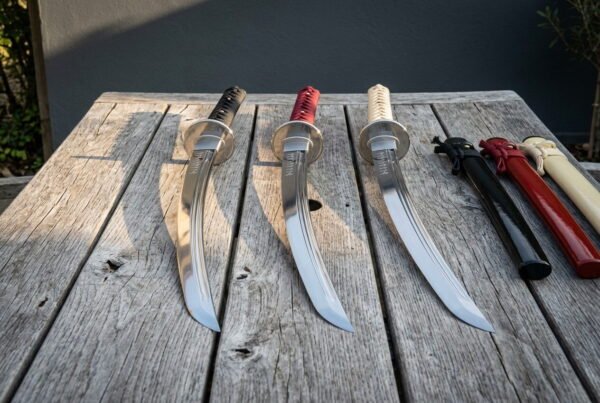
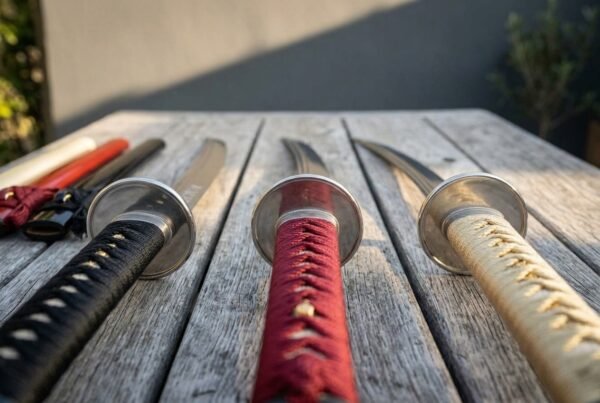
Sitting beside it in the catalogue is the Rippleguard wakizashi, 28 inches overall. Another in the same line is the Reedcurve wakizashi, 28 inches overall. Next along the rack is the Duskmere wakizashi, pattern welded Damascus.
Fitting out further, the Moonedge Japanese sword belongs with it. Or start from a blank sheet on the design your own page.

Good quality sword for the price. Blade quality is solid. Arrived a bit less sharp than expected but a few passes on a strop fixed it. Good product. Just not quite perfect.