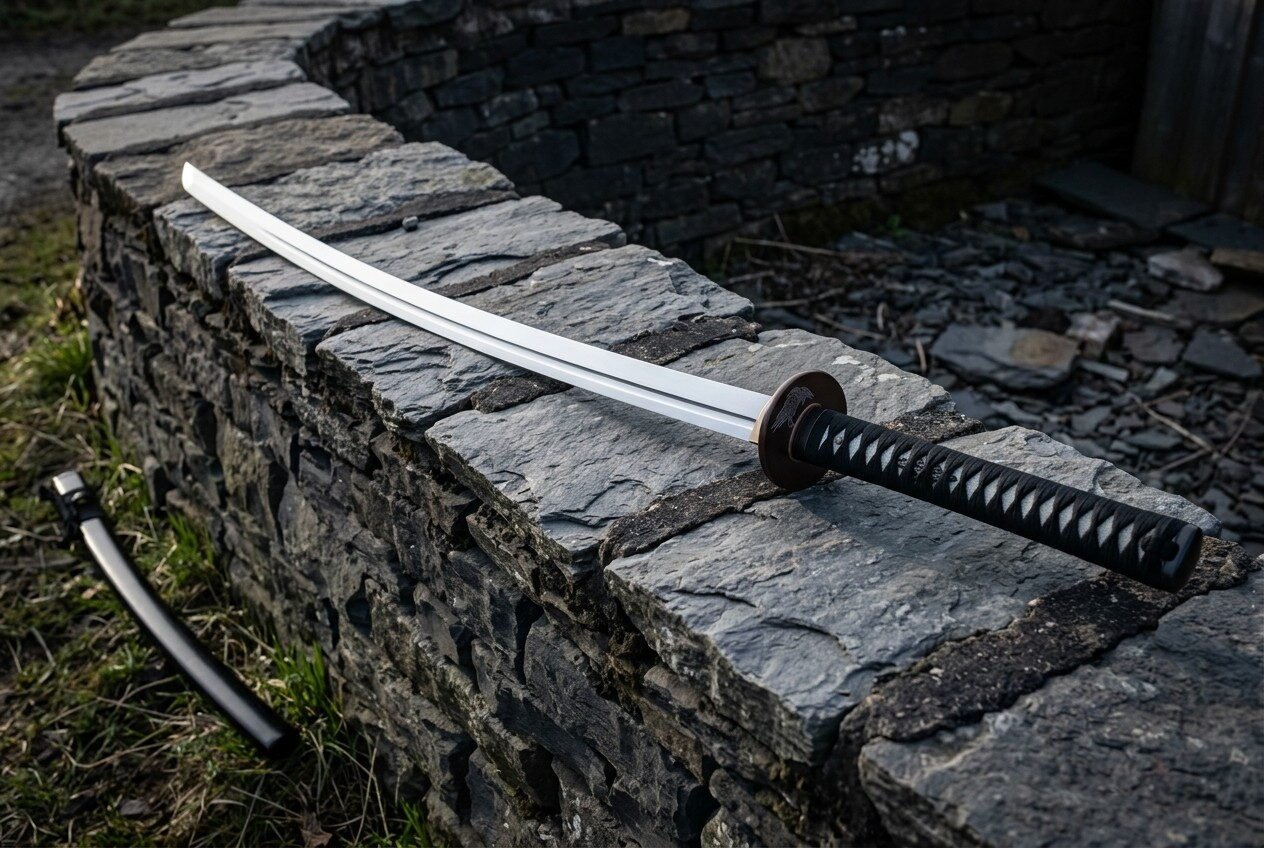
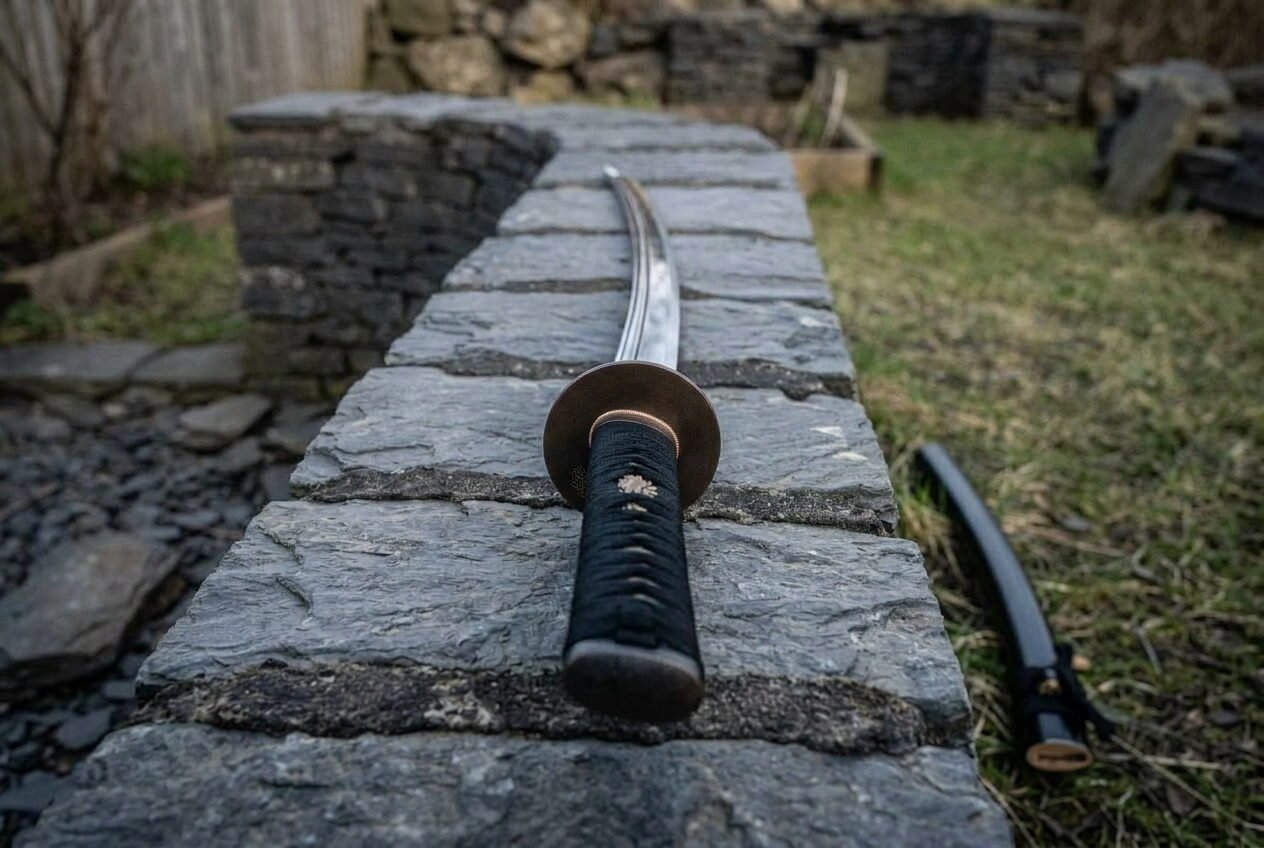
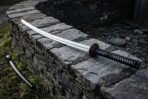
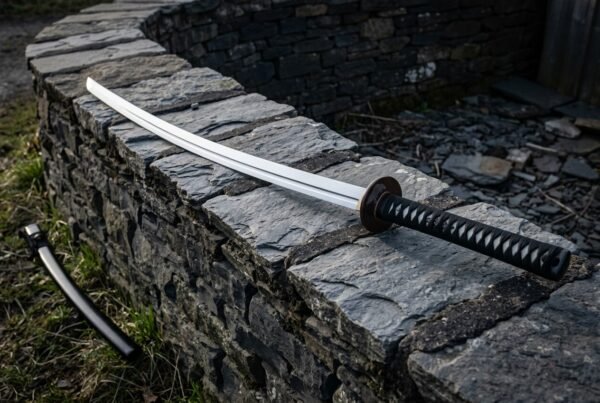
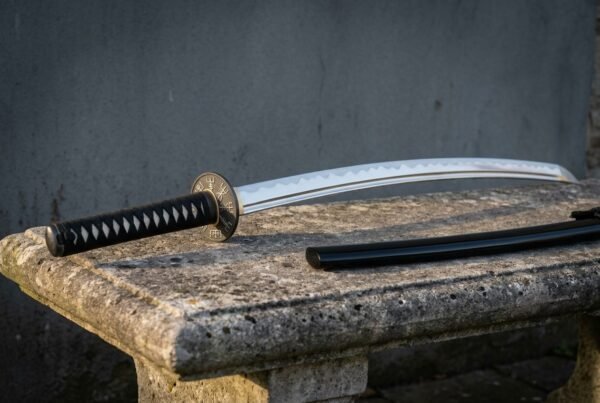
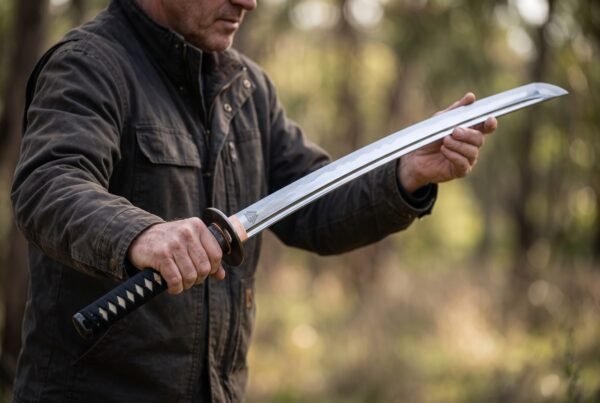
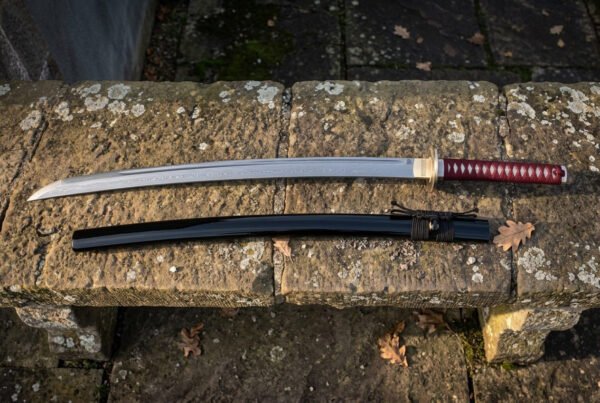
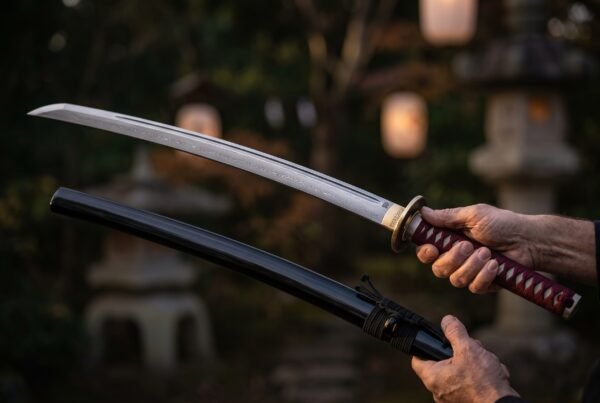
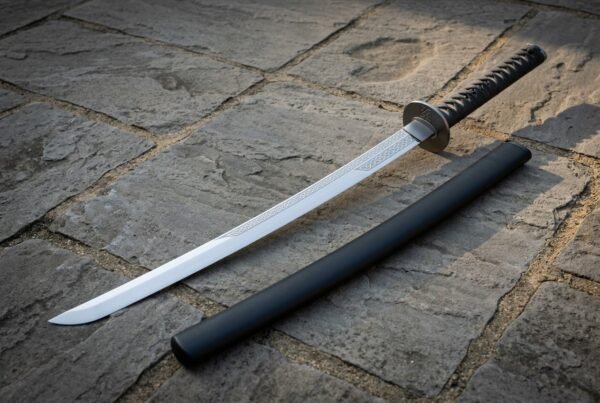
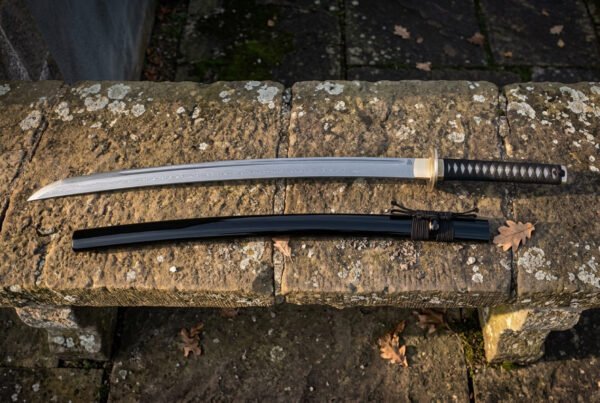
The Moonedge is a katana with a mirror polished monosteel blade, a deep bo hi groove cut down each side, a round bronze toned tsuba with a raven motif, a black cord wrapped handle over a ray skin style underlay and a plain black lacquer saya. There is no pattern welding and no etch on this blade. It is bright, clean 1095 high carbon, ground and polished so the geometry of the curve and the groove do the work instead of decoration.
The groove is the detail worth understanding. Almost everyone calls it a blood groove, and almost everyone is wrong about what it does. A bo hi is a structural feature. Removing steel from the centre of each flat, where the material contributes least to stiffness, drops the weight of the blade without meaningfully weakening it, in exactly the way an I beam is stiff for its mass. The result is a sword that moves faster and recovers quicker, and one that sings when you cut properly. Japanese swordsmen used the note the groove makes as feedback on edge alignment, which is a far more useful function than any drainage myth. Ours is forged, ground, hardened, polished and mounted in the Czech Republic. Filed under the Japanese swords, and the wakizashi blades are the other half of that shelf.
Specifications
| Blade steel | 1095 high carbon, hardened to 54 to 58 HRC |
|---|
| Blade | Single edged curved blade with a bo hi groove cut down both flats, mirror polished |
|---|
| Guard | Round tsuba in a dark bronze tone with a raven motif |
|---|
| Handle | Black cord wrapped tsuka over a pale textured underlay, menuki under the wrap, dark kashira at the butt |
|---|
| Scabbard | Black lacquer finish saya, gently curved to follow the blade |
|---|
| Finish | Polished bright blade, dark furniture, gloss black saya |
|---|
| Edge | Ground and sharpened by hand, arrives keen |
|---|
| Included | Katana and matching saya |
|---|
| SKU | RK-1619 |
|---|
What the bo hi does and what it does not
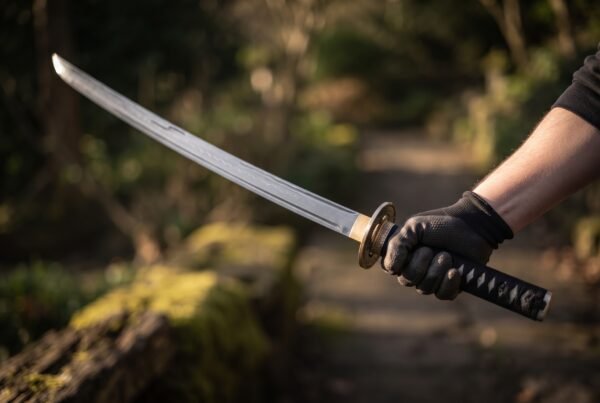
A bo hi is the long shallow trough running from just above the habaki toward the tip on each side of the blade. On this sword it is cut wide and even, which is harder to do well than it looks, because any wander in the groove shows immediately against a polished flat.
Three things follow from cutting it. The first is weight. A groove of this size takes a real percentage of the blade mass out, and it takes it from the centre of the section where it does the least structural work, so the sword ends up lighter and faster with very little loss of stiffness. The second is balance. Because the groove runs along the upper part of the blade, more of the removed mass comes from out toward the tip than from near the hand, which pulls the balance point back and makes the sword feel livelier.
The third is sound. A grooved blade makes a distinct note as it passes through the air, and the note only comes out clean when the edge is travelling exactly in line with the cut. Swing with the edge off line and the sound goes flat and breathy. That feedback is genuinely useful and it is the main reason people who train with a sword ask for a bo hi.
What it does not do is let blood out of a wound or stop a blade sticking. That story was invented long after the fact.
The steel and the polish
The blade is 1095 high carbon, a simple carbon steel with roughly one percent carbon and very little else, hardened and tempered to 54 to 58 HRC. That is the right window for a long blade. Harder than this and a sword of this length becomes brittle in a way that matters when something goes wrong. Softer and the edge rolls. In the mid fifties you get an edge that takes a keen finish, holds it through real cutting, and can be steeled or stoned back without specialist equipment.
The polish is bright. There is no etch, no coating and no pattern, which means every flaw would show, so the grinding has to be honest all the way through the grits. A bright polished carbon blade is also the most demanding blade to own, because there is nothing on the surface to hide a fingerprint. The furniture is dark, the tsuba bronze toned, and the handle is cord wrapped over a textured underlay in the traditional arrangement, which gives you a grip that stays secure when your hands are damp.
Engraving, runes and your own design
Use the rune converter on this page to turn a name, a date or a short phrase into Elder Futhark and we will cut it into the steel, the leather or the wood. If you would rather have a Viking pattern than a rune line, choose your own design in the engraving option above the add to cart button and tell us where it goes. Where a piece already carries an engraved design, your chosen engraving replaces it rather than sitting alongside it. On a katana the sensible placements are the flat above the habaki or the saya, and we would talk you out of cutting anything into the middle of a mirror polished blade. See the engraving page.
Handling and balance
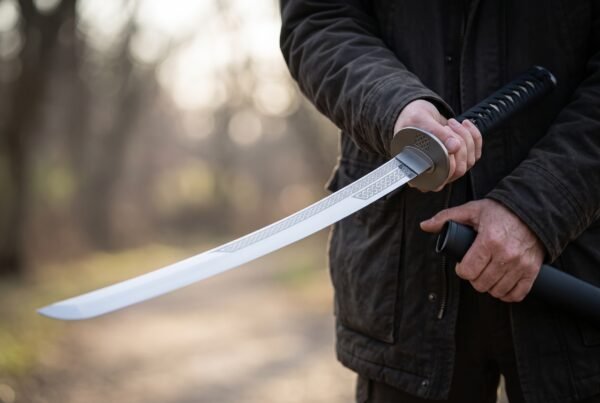
Two hands, spaced apart, is how this sword wants to be held. Left hand at the butt doing the pulling, right hand up under the tsuba doing the steering, both grips relaxed rather than clenched. A katana is cut with the whole body rotating and the hands following, not with the arms.
The bo hi moves the balance point back toward the hand compared with an ungrooved blade of the same size, so this one turns over quickly and stops where you put it. That is a pleasure to handle and it is also a warning, because a light fast sword with a keen edge is far easier to misjudge than a heavy slow one.
Be clear about what this is. It is a functional sharp sword, and it will cut a rolled mat or a water bottle cleanly if you have the technique. It is not for sparring. Do not use it in blade on blade contact, do not strike hard targets, do not cut anything with a hidden core, and never test an edge against bone or metal. A carbon steel edge chips, and a chipped edge on a swinging sword is how people get hurt.
Care
A bright carbon blade needs oil and it needs it regularly. Wipe the blade down after every handling session, because a fingerprint left overnight in a humid room will etch itself into the polish, and once it has, only repolishing takes it out. Use a light mineral oil or a proper blade oil on a soft cloth, front and back, edge to spine, and wipe the excess off before it goes back in the saya. Detail is in steel care.
Do not store the sword in the saya long term in a damp room. A lacquered scabbard holds humidity against the steel, so if the sword is going away for months, oil it and keep it out. Store it edge up on a rack. Keep the cord wrap dry, and wipe the tsuba and fittings so sweat does not sit at the seams.
Made in the Czech Republic
The work behind this piece happens in a Czech Republic workshop that has kept to the old methods. Steel is forged and heat treated by hand, the grind is taken down by eye rather than by machine, and the handle, fittings and sheath are cut and finished one at a time. Because of that, every piece carries small marks of the hand that made it.
Ransack Viking is a United States company. We import direct, check each piece when it reaches us, and ship from our Chicago, Illinois warehouse. Engraving is added here in the United States after arrival, so the piece you receive is finished to your order.
A note on handmade variation
This is hand made, not machine made and not bulk produced, so what arrives will not be a pixel for pixel copy of the photograph. Grain, tone, hammer texture and exact profile vary because each piece is worked by hand from natural materials. The depth of the curve, the exact width of the bo hi, the tightness of the cord wrap and the depth of the lacquer on the saya all shift a little between swords. The dimensions, the material and the build are the same every time. The character is not. There is a longer piece on sharpening a curved blade, and another on what makes a katana a katana.
Frequently asked questions
Is it sharp out of the box
Yes. It is hand ground and sharpened and arrives keen. Treat it as a live blade from the moment you open the box.
Can I use it for sparring
No. This is a sharp functional sword, not for sparring. Blade on blade contact will chip a hardened carbon edge and is dangerous with any live blade. Use a blunt trainer for partner work.
Can I cut with it
It will cut soft targets such as rolled mats or bottles cleanly if your technique and edge alignment are sound. Do not cut anything with a hidden hard core, and do not test the edge on bone or metal.
Is the blade damascus
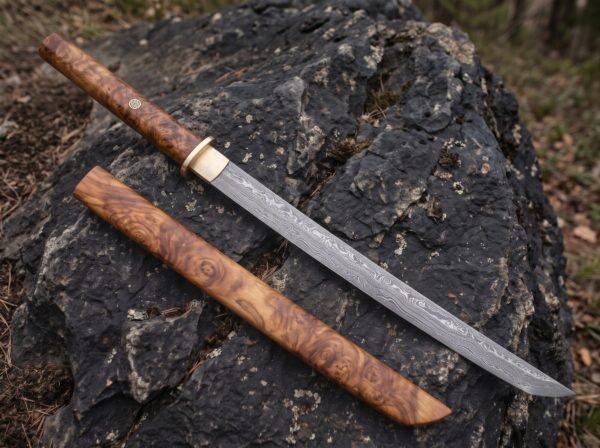
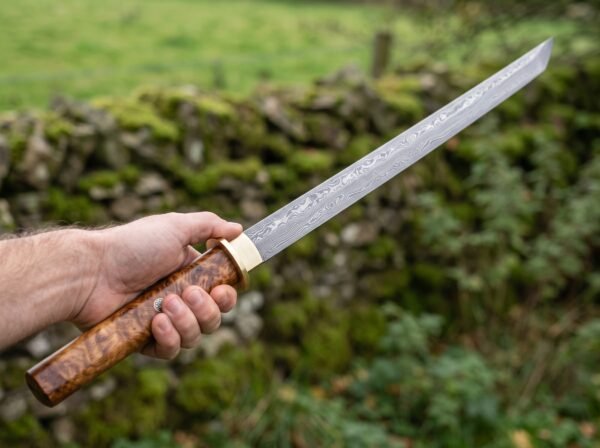
No. This one is deliberately plain monosteel, mirror polished, with a bo hi. If you want a layered pattern, look at our damascus katana instead.
Is the tang full length
The handle is built around a tang running into the tsuka in the traditional arrangement, with the furniture seated against it rather than glued on as decoration.
How long does shipping take
Processing is one to two weeks in the shop plus transit. Shipping within the United States is free.
What is in the box
- One Moonedge katana with a 1095 blade, bo hi groove and cord wrapped handle
- One black lacquer finish saya
- Care card covering blade oiling and safe storage
- Forged and finished in the Czech Republic
Explore the range
See more in katana and Japanese swords, wakizashi, swords and damascus swords, or read the guides.
Compare it with these
Also in this group is the Jadecord Japanese sword, 40 inches overall. Sitting beside it in the catalogue is the Inkwake Japanese sword, 36 inches overall. Another in the same line is the Valkgleam Japanese sword, forged from 1095.
For a different piece from the same family, look at the Cinderpine wakizashi. Pick the steel, the length and the fittings yourself on the design your own page.

Reviews
There are no reviews yet