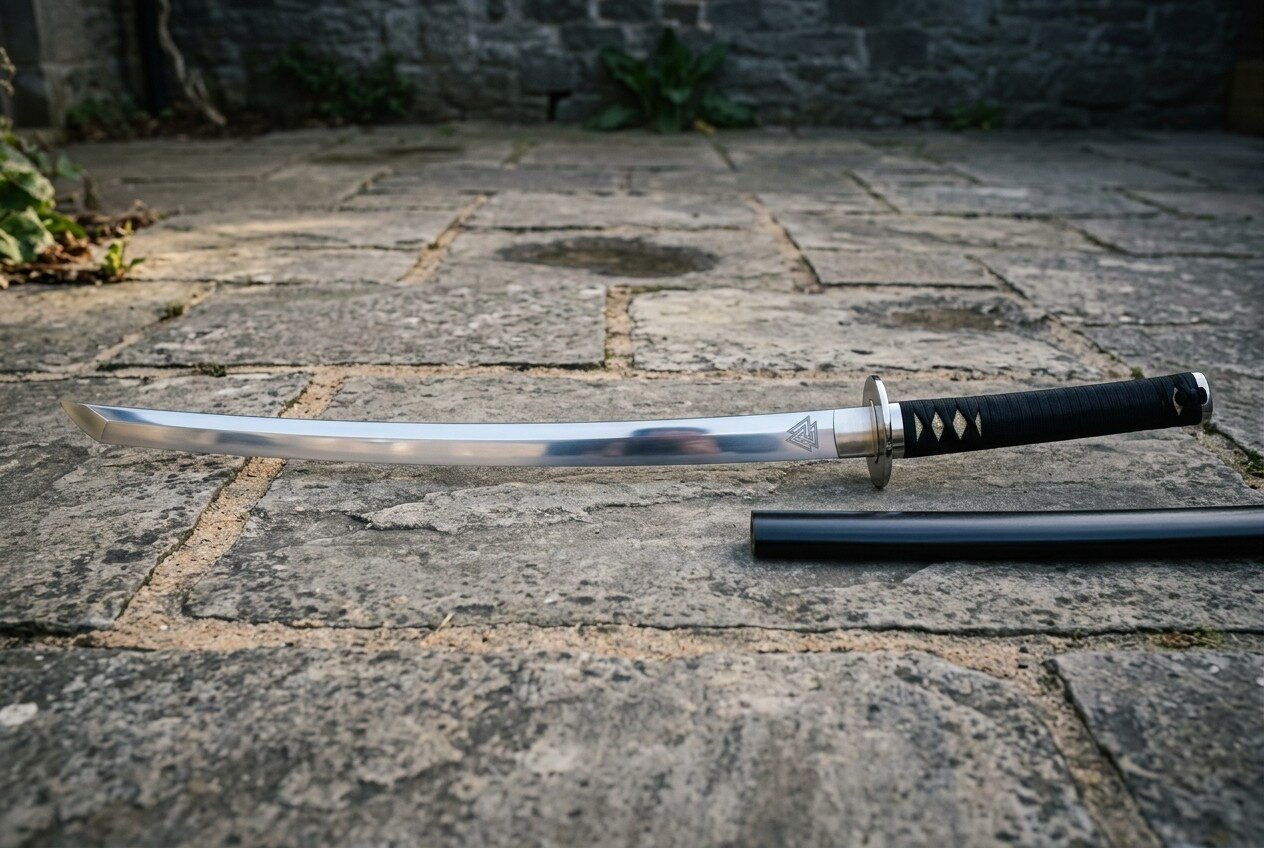
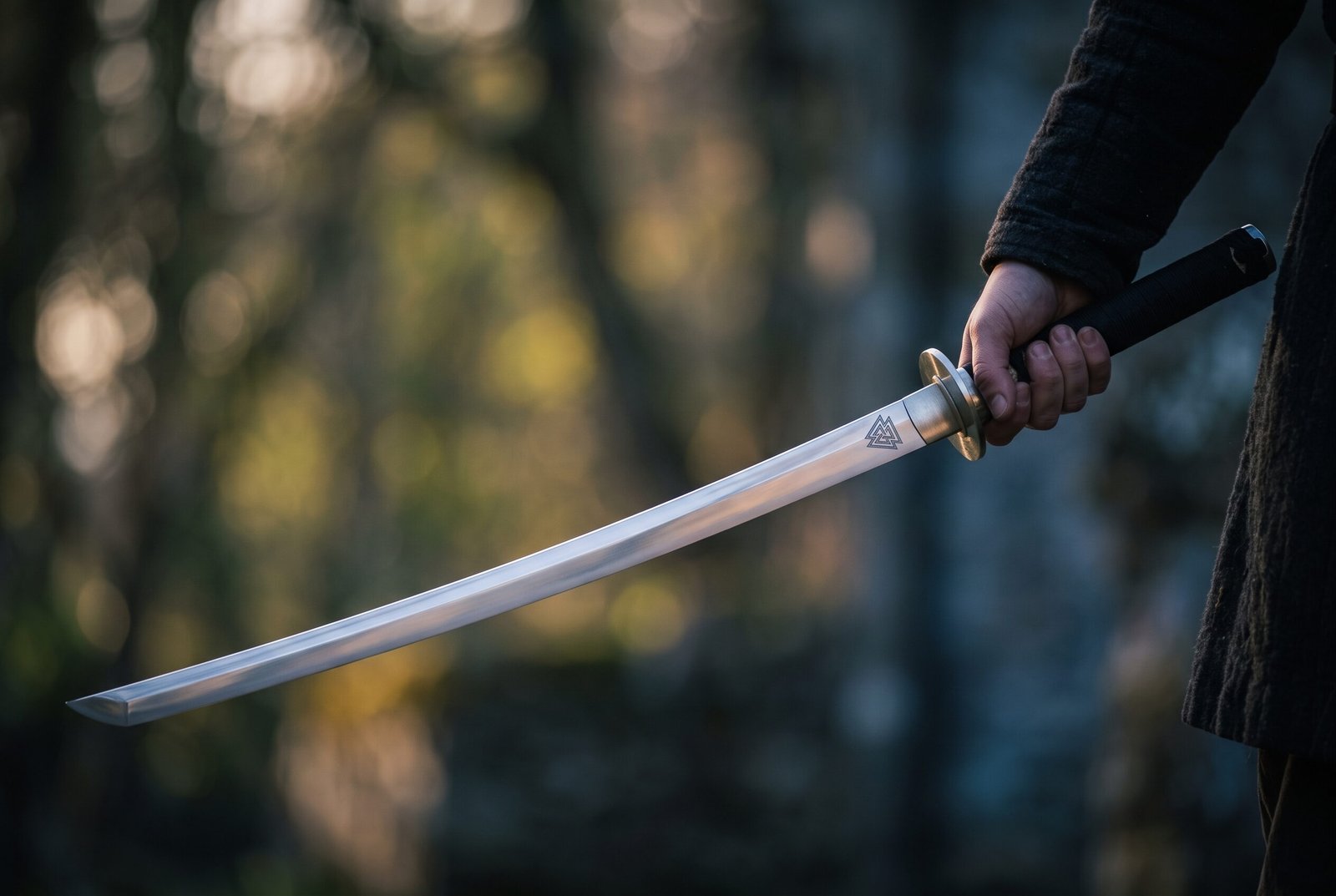
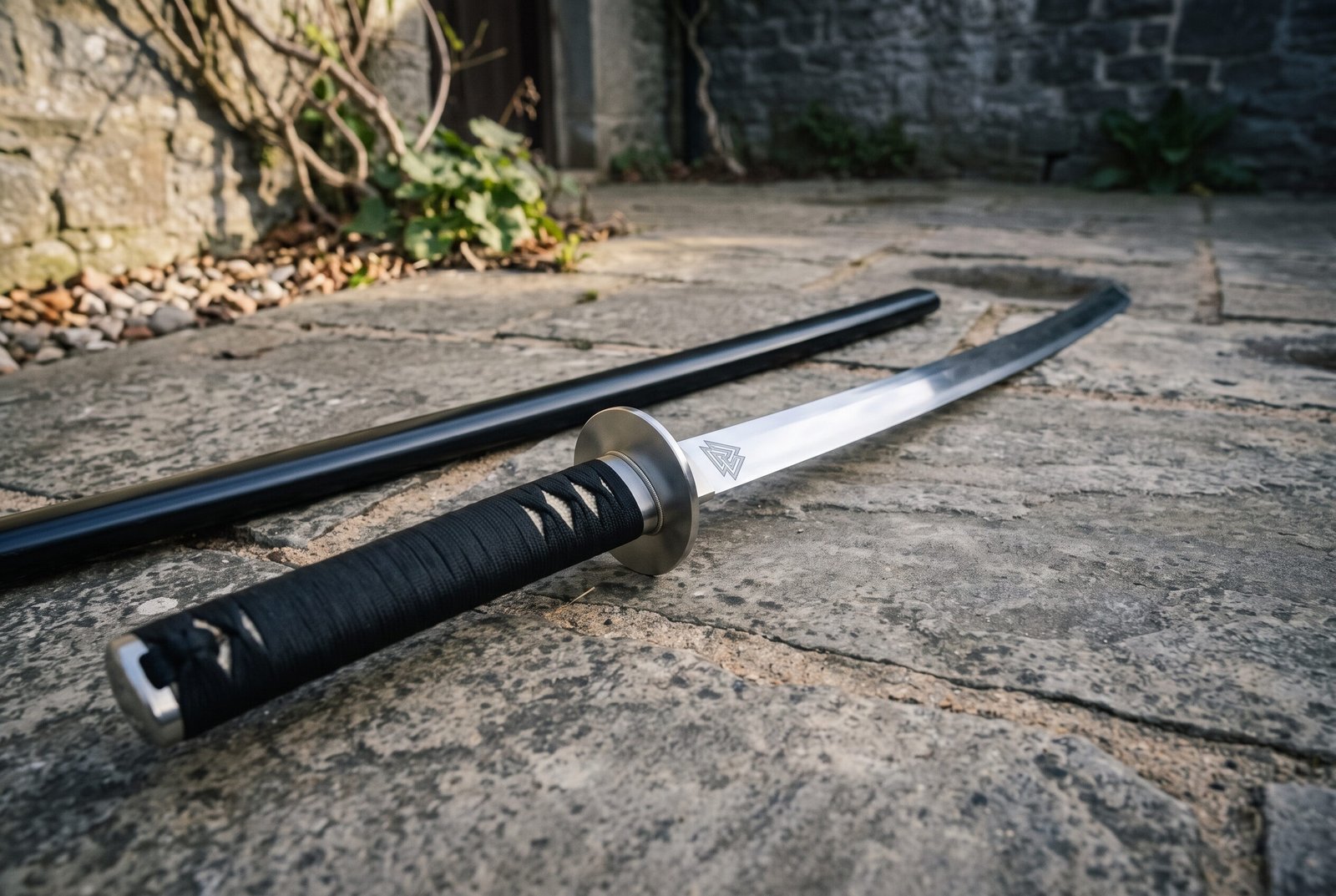
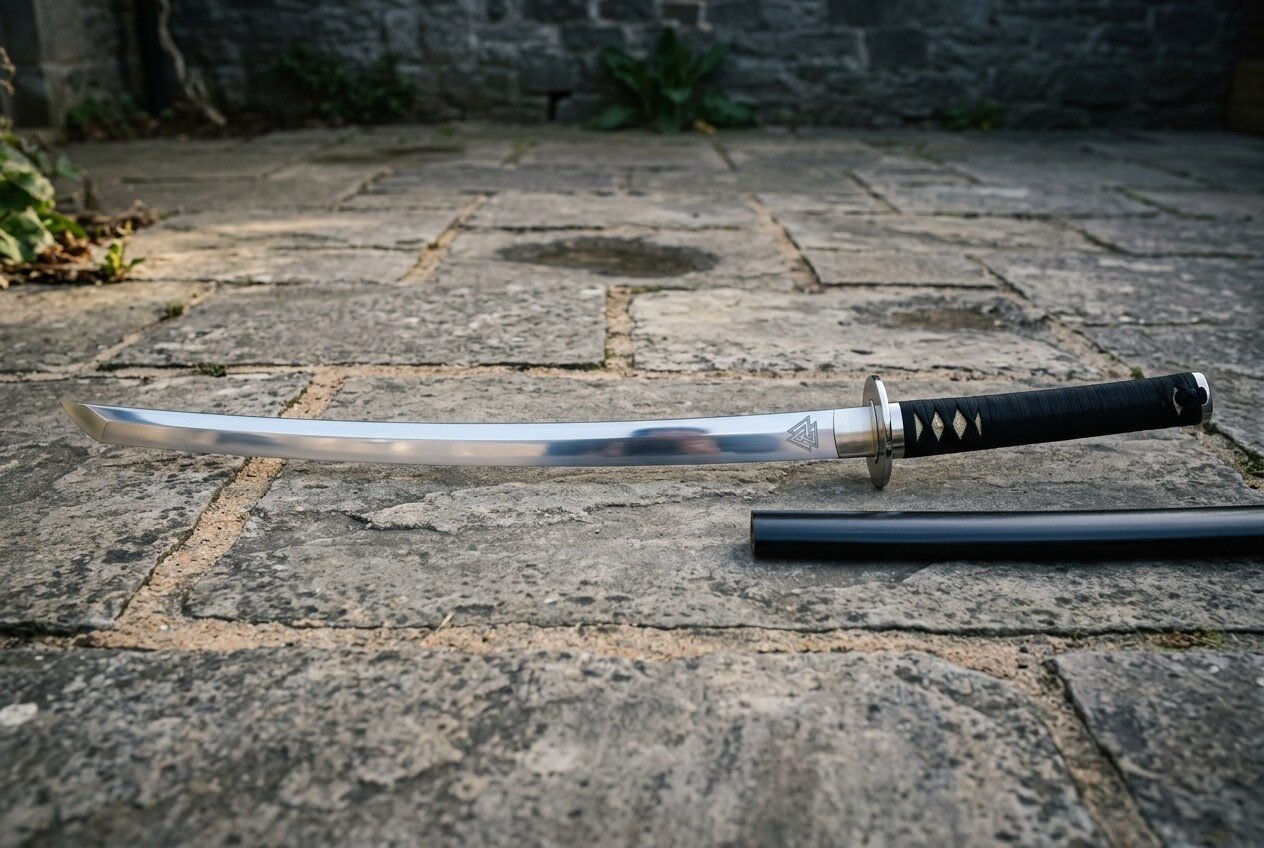
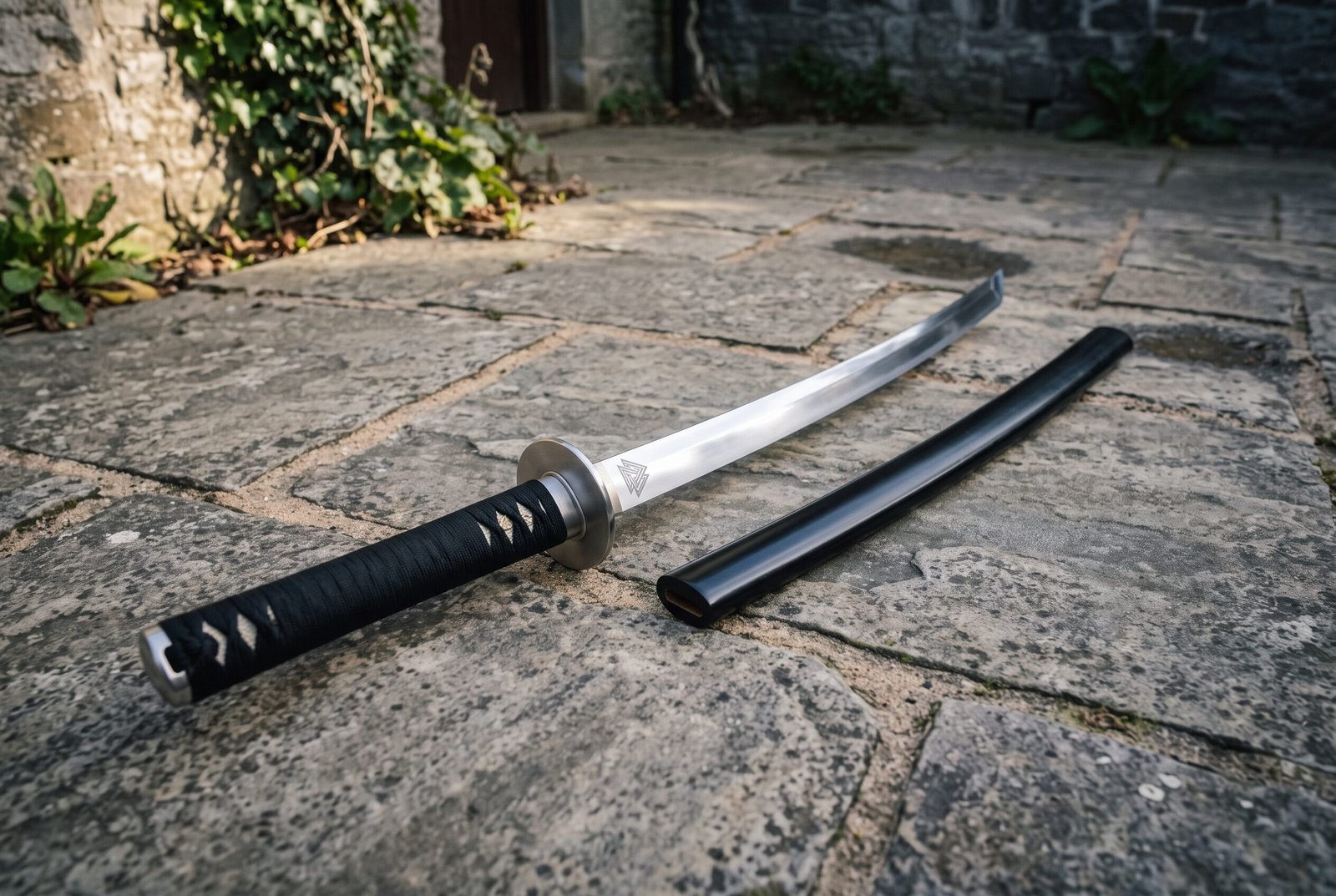
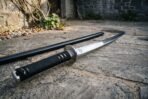
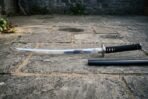
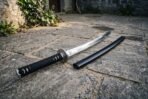
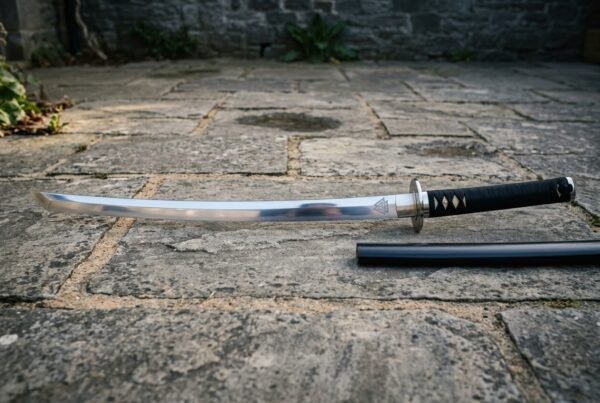
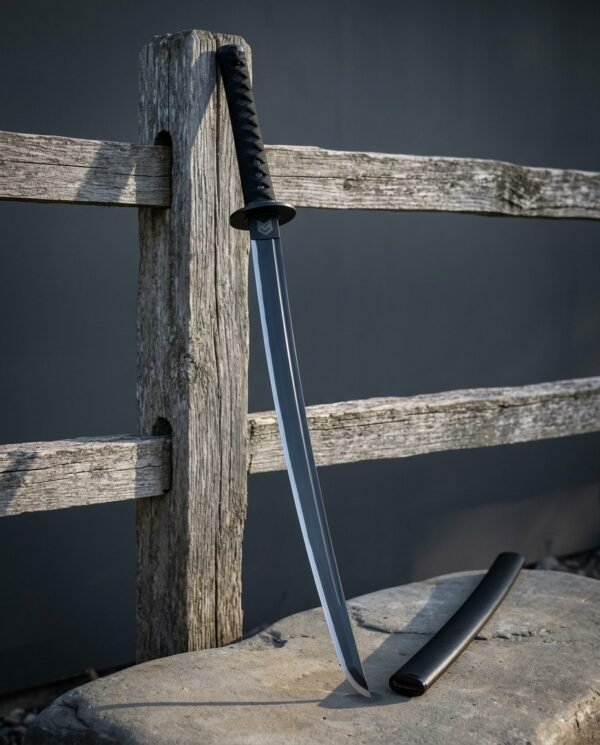
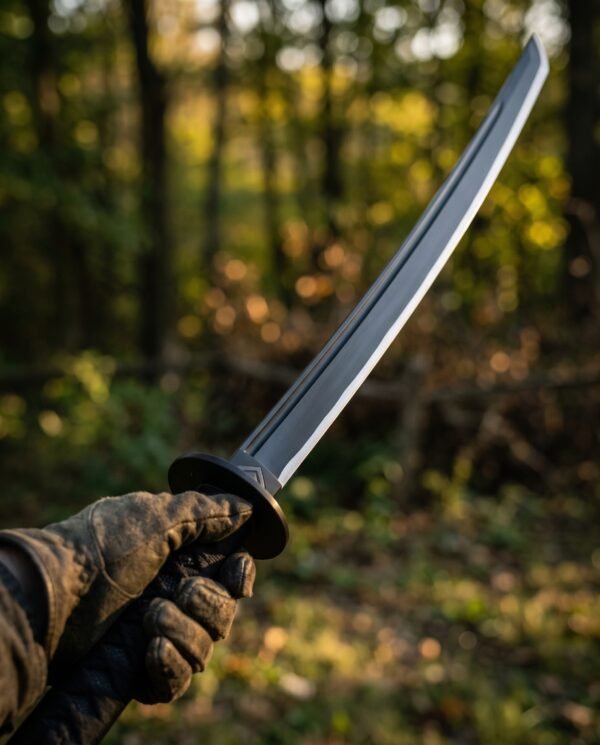
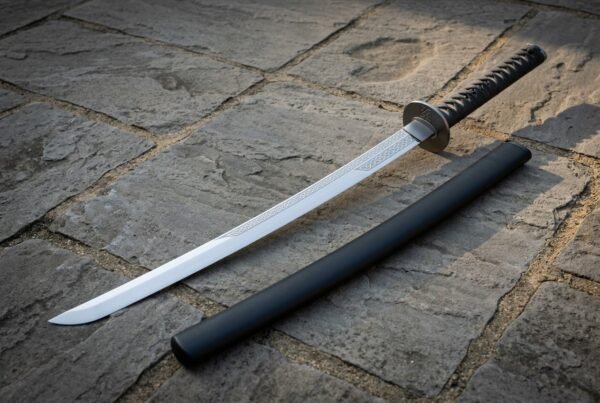
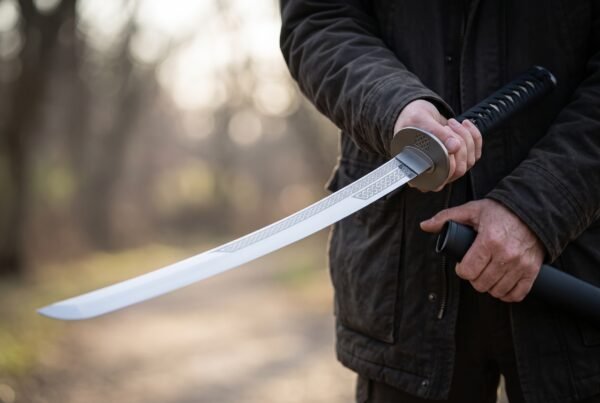
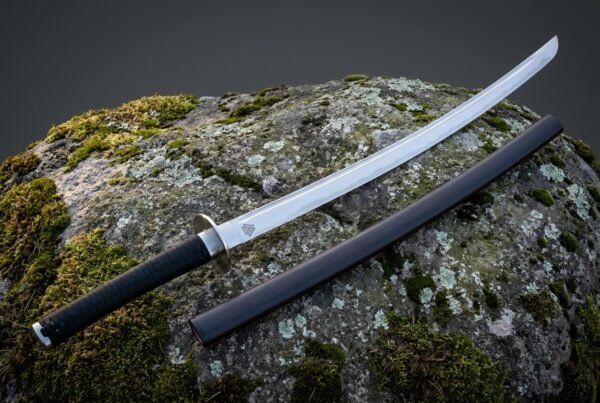
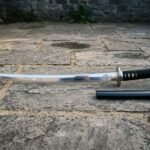
The Valkgleam is a katana with a bright mirror polished 1095 blade, clean of decoration except for one mark: a valknut, three interlocked triangles, etched into the flat at the very base of the blade where it leaves the habaki. The tsuba is a plain round polished steel disc with no piercing, the tsuka is wrapped in black cord over white same panels that show as diamonds through the wrap, and the saya is plain black. The restraint is the point. On a blade this bright, one symbol carries more weight than a full length band would.
Here is what is actually known about that symbol, which is less than most sellers admit. Three interlocked triangles appear on a small number of Viking age objects: the picture stones at Stora Hammars and Tangelgarda on Gotland, the Oseberg ship burial, and a handful of others. On the Gotland stones the shape sits in scenes that appear to show sacrifice or death, often near a figure read as Odin and near his ravens. That association is why it is usually interpreted as a knot tied to the slain and to Odin’s claim on warriors who fall. What we do not have is a Norse word for it. The name valknut is a modern Norwegian construction from valr, the slain, and knut, knot, coined long after the Viking age. Nobody knows what the carvers called it or precisely what they meant by it. This sword is forged and finished in the Czech Republic.
If you are deciding where to start, the three Japanese lengths compares the lengths. That knot of three triangles is the valknut, and where the valknut appears comes down to a handful of picture stones. The tanto knives carry the same furniture at knife length.
Specifications
| Blade | 1095 high carbon steel, hardened to 54 to 58 HRC |
|---|
| Blade profile | Curved single edged with a defined kissaki point |
|---|
| Blade length | Approximately 27 inches |
|---|
| Overall length | Approximately 39 inches |
|---|
| Blade mark | Valknut etched at the base of the blade above the habaki |
|---|
| Habaki | Polished steel |
|---|
| Tsuba | Plain round polished steel disc |
|---|
| Tsuka | Black cord wrapped over white rayskin style same panels, polished steel kashira |
|---|
| Saya | Plain black |
|---|
| Finish | Mirror polished blade and tsuba |
|---|
| Included | Sword and saya |
|---|
| SKU | RK-1885 |
|---|
What the same panels under the wrap are doing
Look at the handle and you can see white diamonds showing through the gaps in the black cord. That layer is the same, the panel wrapped around the wooden core underneath the cord wrap, and it is one of the cleverest details in Japanese sword mounting. Its surface is covered in hard round nodules, and when the cord is pulled tight over it the cord sits down into the gaps between those nodules and locks. The wrap cannot creep or rotate on the handle, even when it gets wet and even after the cord has stretched with use.
That is why the diamonds are left showing rather than covered. It is not only decoration; it is the visible evidence that there is a gripping layer under the wrap doing structural work. A cord wrap applied straight onto smooth wood or leather will eventually turn on the handle, which on a sword is more than an inconvenience, because a handle that rotates takes your edge alignment with it.
The steel and the polish
The blade is 1095 high carbon steel hardened to 54 to 58 HRC, ground and then polished through progressively finer stages to a mirror. There is no coating and no plating: what you see is the steel itself taken to a fine finish, which is why it is so reflective and why it needs oiling.
This blade is not clay tempered and carries no hamon, and we would rather say that plainly than let a photograph imply otherwise. It is a uniformly hardened monosteel blade with a mirror polish, which is a perfectly honest way to build a sword and considerably stronger than the traditional method. The valknut is acid etched into the surface after polishing, so it sits below the finish and cannot be rubbed, washed or worn away.
Engraving, runes and your own design
Use the rune converter on this page to turn a name, a date or a short phrase into Elder Futhark and we will cut it into the steel, the leather or the wood. If you would rather have a Viking pattern than a rune line, choose your own design in the engraving option above the add to cart button and tell us where it goes. Where a piece already carries an engraved design, your chosen engraving replaces it rather than sitting alongside it. On this katana the valknut sits at the base of the blade, so a symbol ordered for that position takes its place. A rune line placed further up the flat can sit alongside the valknut if you would rather keep both, and that is the option most people choose here. See the engraving page.
Handling and balance
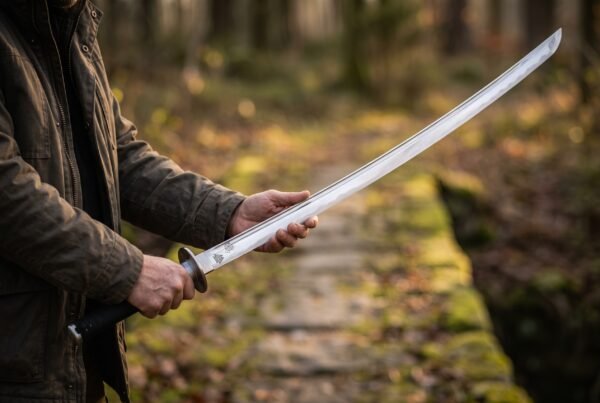
The tsuka is sized for two hands with a gap between them. Held that way the rear hand near the pommel does the pulling and the front hand near the tsuba steers, which is what makes a katana feel light for its length. The plain steel tsuba is solid and sits right at the hand, which pulls the balance point back and gives the sword a quick, controlled feel through a cut.
The deep curve on this blade means it cuts on the draw with very little wrist input, and it clears the saya in an arc rather than pulling straight out. Hold the saya when you draw and always draw the edge away from your body. This is a sharp collector and display sword. It is not a training sword and it is not certified for cutting practice, partner drills or contact of any kind.
Care
A mirror polished blade with almost no decoration on it shows absolutely everything, so treat this one carefully. Wipe it with a clean dry cloth after any handling and keep a thin film of light oil on it. Choji oil is traditional and plain mineral oil is equally effective. Skin acid will etch a permanent mark into polished carbon steel within days if a print is left on it. The polished steel tsuba wants the same treatment. Do not use abrasive polish over the etched valknut. Do not store the sword in the saya for long stretches. Our steel care page has the full routine.
A curve like this does not sharpen the way a straight edge does, and sharpening a curved blade works through the stroke.
Made in the Czech Republic
This is a handmade piece from the Czech Republic, made in a workshop that still forges, grinds and finishes by hand instead of stamping parts out. The smiths there have kept the older way of working, and the wood, horn and leather are shaped and fitted by hand as well. Two pieces of the same design will never be identical, and that is part of what you are buying.
Ransack Viking is a United States company. We handle the import ourselves, look over every piece when it lands and ship from our warehouse in Chicago, Illinois. Engraving is done in the United States after the piece arrives, so your design goes on before we send it out.
A note on handmade variation
This is hand made, not machine made or bulk produced, so what arrives will not be a pixel for pixel copy of the photograph. The same panels are natural material, so the size and pattern of the white nodules differ on every handle and therefore so does the exact look of the diamonds through the wrap. The cord wrap is done by hand, so the diamond spacing varies. The etched valknut sits a fraction differently at the base of each blade. The dimensions, the material and the build are the same every time. The character is not.
Frequently asked questions
What does the valknut mean
Honestly, nobody knows for certain. It appears on Viking age carvings in contexts connected with death and with Odin, which is why it is usually read as a knot of the slain. The name itself is modern. Anyone who tells you a precise Viking age meaning is guessing.
Does this katana have a hamon
No. It is a uniformly hardened monosteel blade with a mirror polish. There is no clay tempering and no temper line, and we say so rather than letting the photograph do the talking.
Is the handle wrapped over real rayskin
The panels under the cord are rayskin style same with the characteristic hard nodules that lock the wrap in place. That texture is what makes the grip work, and you can see it as white diamonds through the cord.
Is it sharp when it arrives
Yes, it arrives with a working edge. Ask in the order notes if you want it blunt for display and we will do it at no extra cost.
Can I add runes as well as the valknut
Yes, and this is the usual request. Keep the valknut at the base of the blade and put a rune line further up the flat. Use the rune converter on this page for the text.
How long does it take to arrive
One to two weeks of processing, then free US shipping. Put any deadline in the order notes before you order and we will tell you honestly whether we can meet it.
What is in the box
- Valkgleam 1095 steel katana with an etched valknut at the base of the blade
- Plain black saya
- Care card for mirror polished carbon steel
- Lifetime warranty against defects in forging, grind, heat treat and fittings
- Forged and finished in the Czech Republic
Explore the range
See more in katana and Japanese swords, swords and engraved and personalised pieces, or read the guides on Norse symbols and blade care.
Also in this part of the catalogue
Sitting beside it in the catalogue is the Blackreed Japanese sword, forged from 1095. Another in the same line is the Nightfold Japanese sword, pattern welded Damascus. Next along the rack is the Knotcurve Japanese sword, forged from 1095.
Fitting out further, the Shieldwall sword belongs with it. Or start from a blank sheet on the design your own page.


This is exactly what I wanted and then some. Leather sheath is thick and well stitched. Not the cheap stuff you usually get. The wood handle feels amazing and the balance is perfect. Love it.
This sword is a genuine work of art. Fit and finish is museum quality. You can tell real craftsmen made this by hand. Nice touch that it ships from within the US even though it’s crafted in the Czech Republic. Weight and balance make it feel like a real functional piece not some cheap replica. Great buy overall.
No regrets on this purchase at all. The wood handle feels amazing and the balance is perfect. Shipping was fast and everything arrived well packaged.