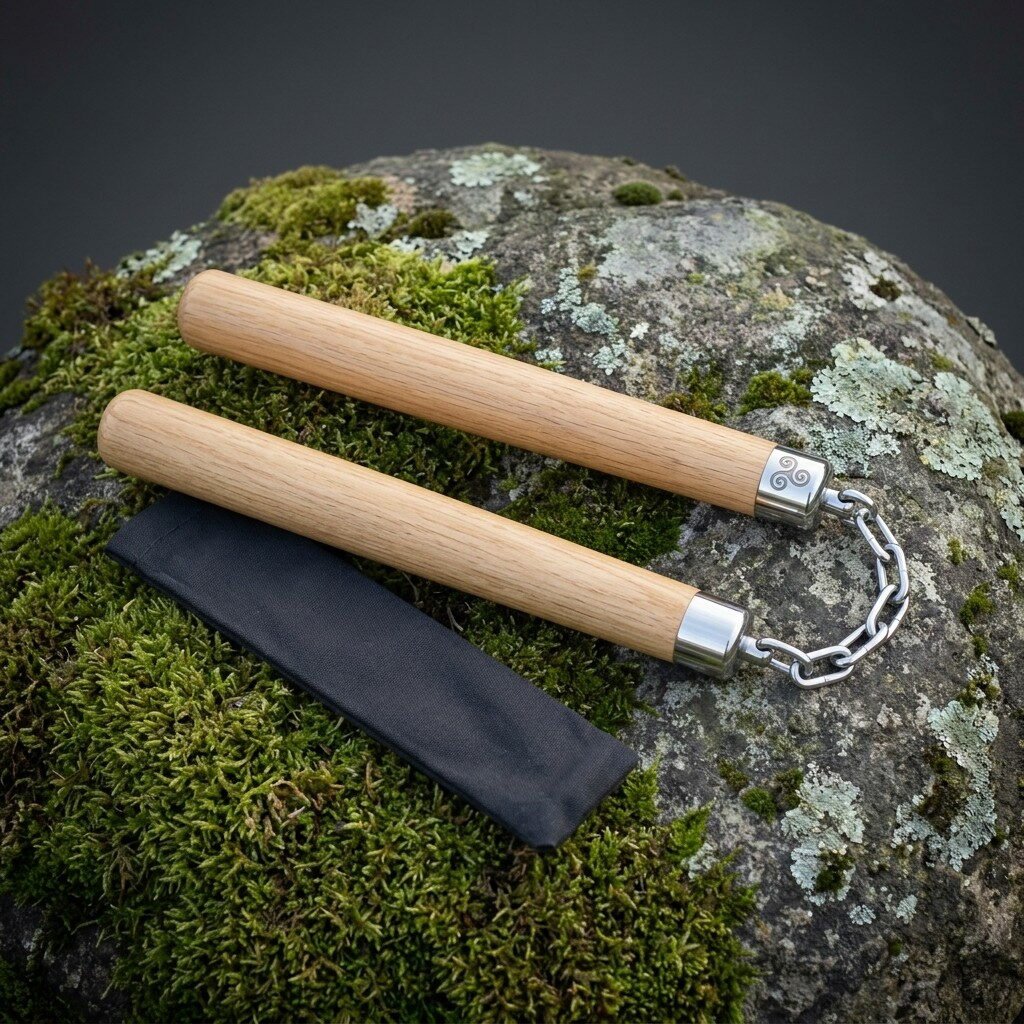
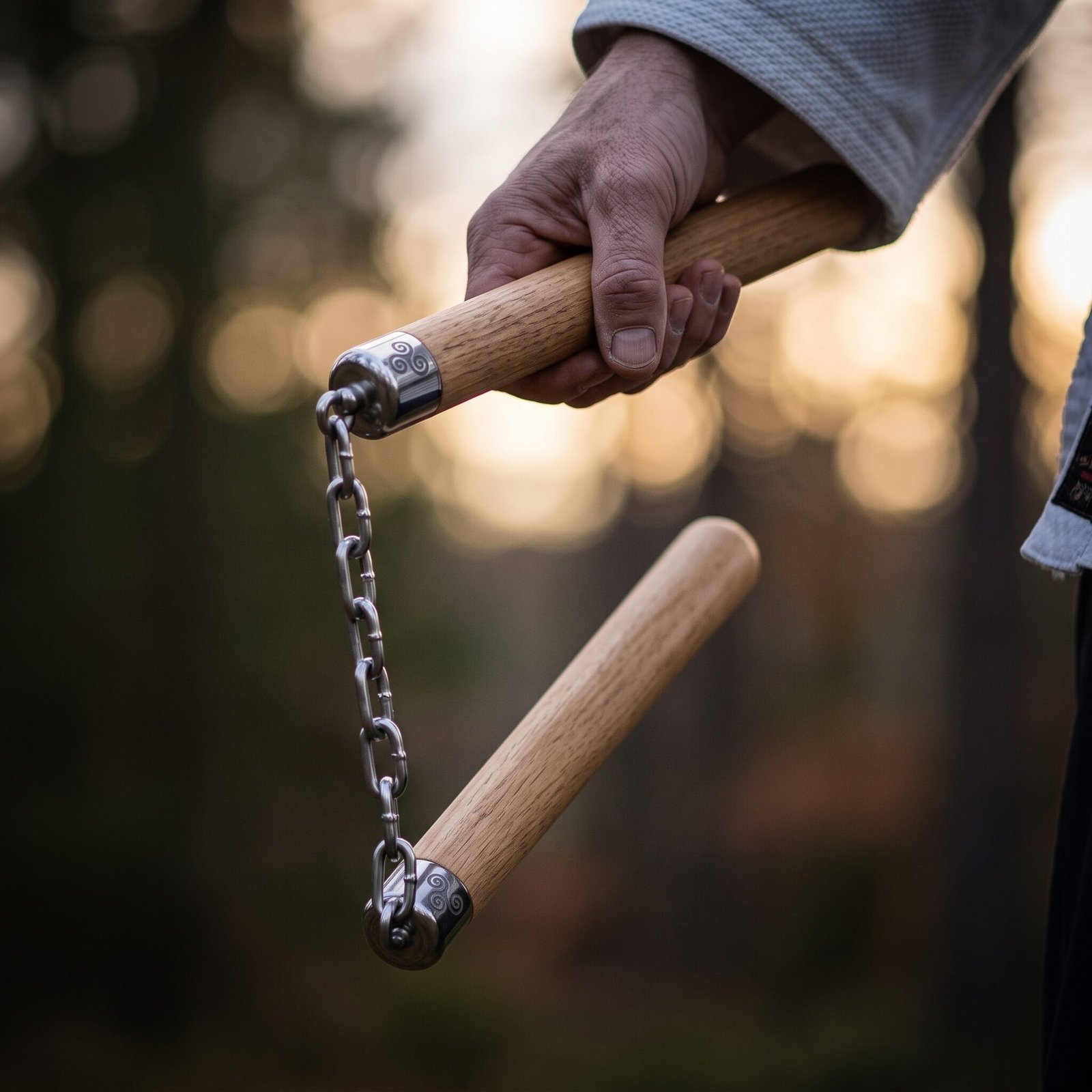
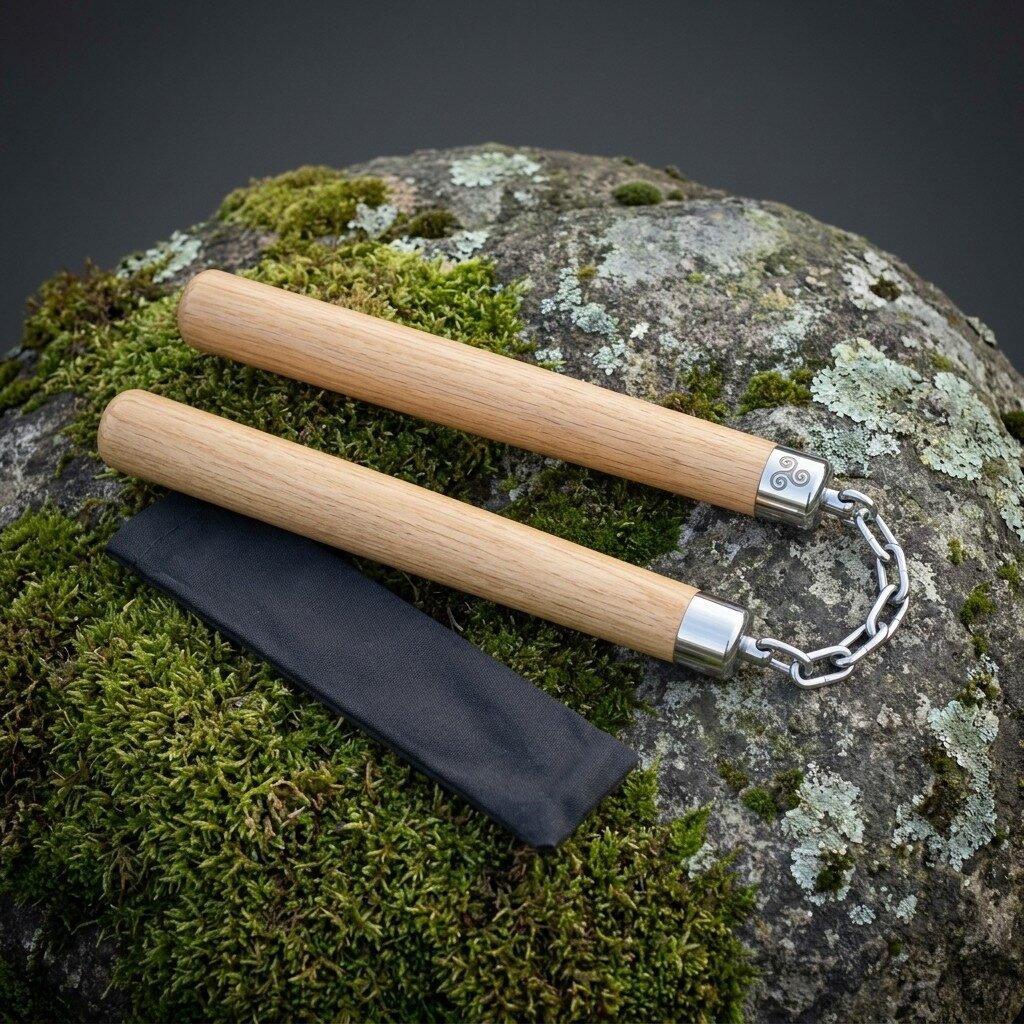
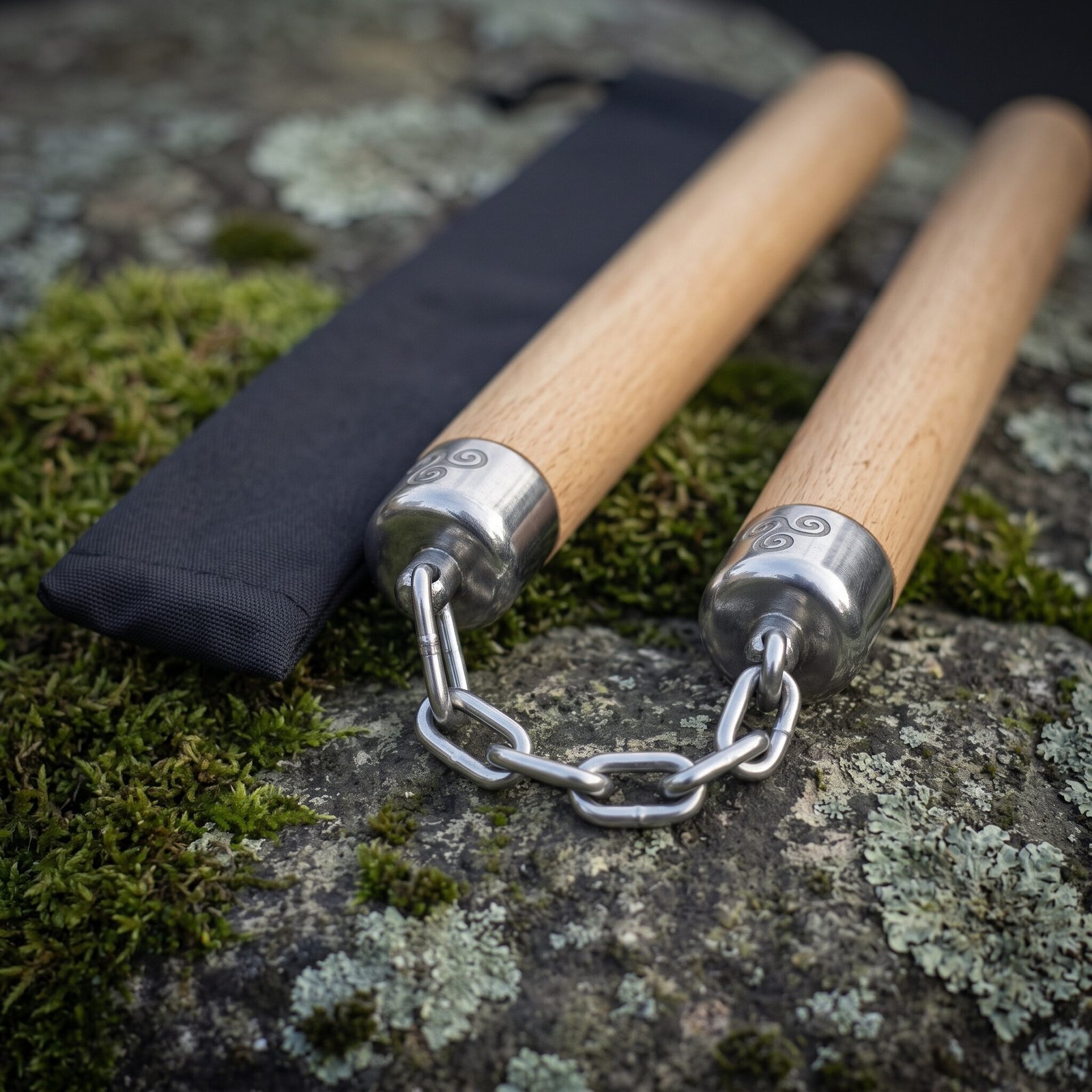
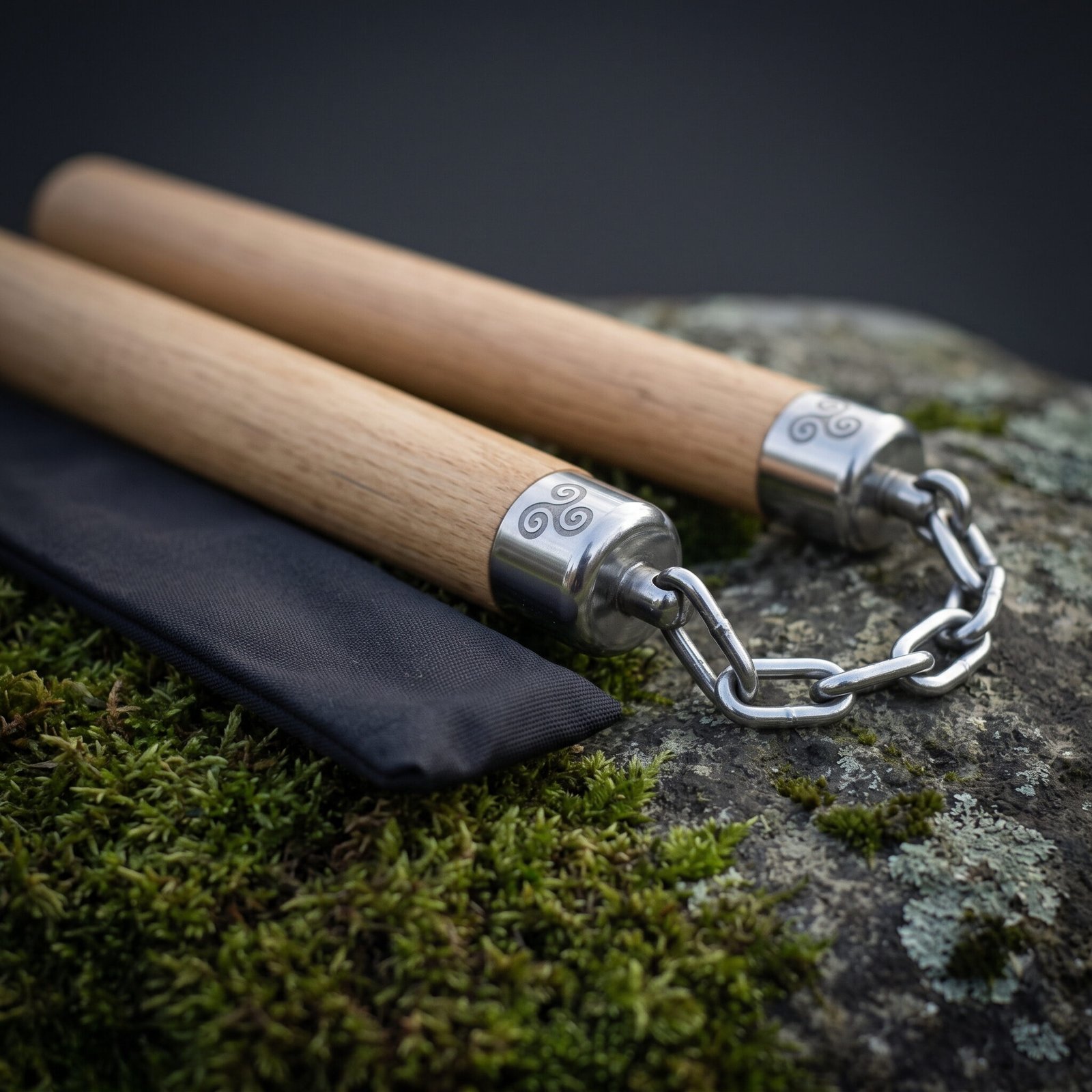
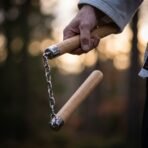
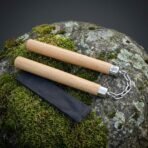
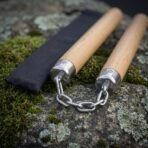
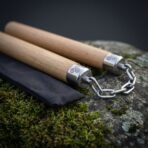
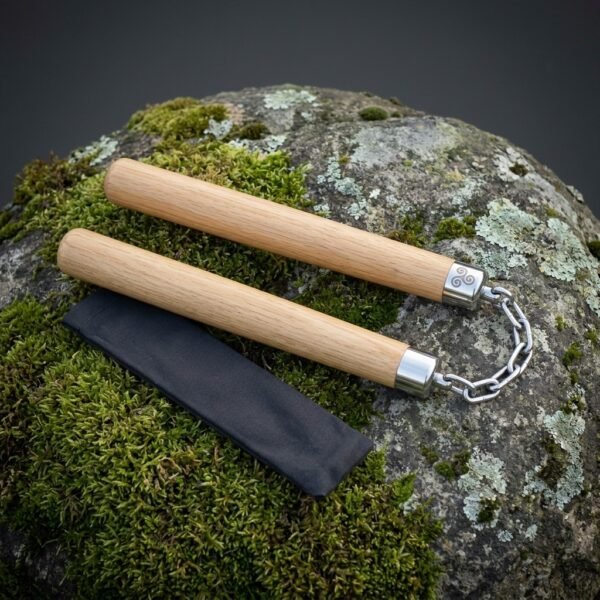
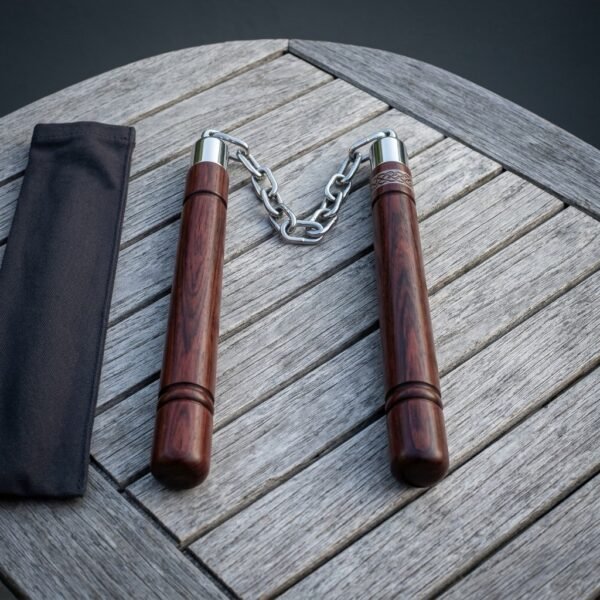
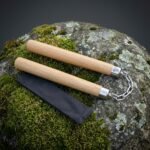
The Chainoak is a nunchaku: one product made of two turned hardwood batons joined by a short heavy steel chain. Both batons are pale oak toned close grained hardwood, turned round and slightly tapered toward the free end, and each is capped at the joining end with a polished steel ferrule. Both caps carry an engraved triskele, the triple spiral. The chain is welded link steel, polished bright, and swivels freely at both caps. A black carry pouch is included.
The triskele on the caps is much older than anything Norse. Three spirals joined at the centre are carved into the entrance stone at Newgrange in the Boyne Valley in Ireland, cut around five thousand years ago, which makes it older than Stonehenge and older than the pyramids at Giza. The same three part rotational figure resurfaces in Iron Age Celtic metalwork, in Insular manuscripts, on the flag of the Isle of Man and in Norse and Anglo Saxon ornament, and it is one of a small handful of symbols that appears independently across widely separated cultures because three rotating arms is a very natural thing for a human being to draw. This piece is made and finished in the Czech Republic.
Ash is used for hafts and staves because it bends a long way before it breaks, and steel, wood and leather covers why. The triskele is the three legged spiral and it is older than the Norse use of it, which the symbols guide explains. The rest of the Norse home pieces sit in the same corner of the shop.
Specifications
| Pieces included | Two batons joined by one chain, sold and priced as a complete set |
|---|
| Material | Close grained hardwood in a pale oak tone |
|---|
| Baton length | Approximately 12 inches each |
|---|
| Profile | Round section with rounded free ends |
|---|
| Chain | Polished welded link steel, approximately 4 inches, on swivelling eyes |
|---|
| Overall length | Approximately 28 inches fully extended |
|---|
| Caps | Polished steel caps at the joining ends, both engraved with a triskele |
|---|
| Included | Nunchaku and black fabric carry pouch |
|---|
| SKU | RK-1886 |
|---|
Why a chain makes a stick far more dangerous
A nunchaku is a flail, and a flail beats a rigid stick of the same length for one reason. When you swing a solid staff, every part of it turns at the same rate about your hands, so the tip speed is limited by how fast you can move your arm. Put a hinge in the middle and that ceases to be true. The held baton accelerates the joint, and the free baton then rotates about that joint on top of the speed it already has. The two rotations add. The free end can be travelling considerably faster than anything your hand is doing, which is where the disproportionate energy comes from.
The same physics is why the nunchaku is so unforgiving to a beginner. Energy that goes out has to come back, and a free baton that misses its target keeps going and returns along a path you did not choose. Practically everyone who picks up a pair of nunchaku hits themselves in the first hour. The origin story is worth a note too: the popular claim that the nunchaku began life as an Okinawan rice threshing flail is disputed and poorly evidenced. Other researchers point to a horse bridle, or to the hyoshigi, the pair of wooden clappers a night watchman struck together to mark the hours. The honest answer is that the origin is not settled.
The wood, the chain and the caps
Straight grain is what matters in a hardwood baton. A length of wood whose grain runs parallel down its whole length will take repeated impact and stay together, while one where the grain runs out at an angle across the shaft has a built in split waiting to happen. We select stock for straight grain rather than for figure, so the plainer looking pair is usually the stronger one.
The chain is welded link steel rather than open link, so no link can pull open under load. It is attached through swivelling eyes in the steel caps, which matters more than it sounds: a chain that cannot rotate at its anchor points will bind and twist itself shorter during use, and a bound chain changes the length and the timing of the whole nunchaku halfway through a movement. The steel ferrules also protect the end grain of the wood at the joint, which is the point that takes the most stress.
Engraving, runes and your own design
Use the rune converter on this page to turn a name, a date or a short phrase into Elder Futhark and we will cut it into the steel, the leather or the wood. If you would rather have a Viking pattern than a rune line, choose your own design in the engraving option above the add to cart button and tell us where it goes. Where a piece already carries an engraved design, your chosen engraving replaces it rather than sitting alongside it. On this set both steel caps carry the triskele, so a chosen symbol on a cap takes the place of the one already there. Swapping only one cap for a short rune line or a set of initials is the option most people take when they want to keep a triskele. See the engraving page.
Handling and legal note
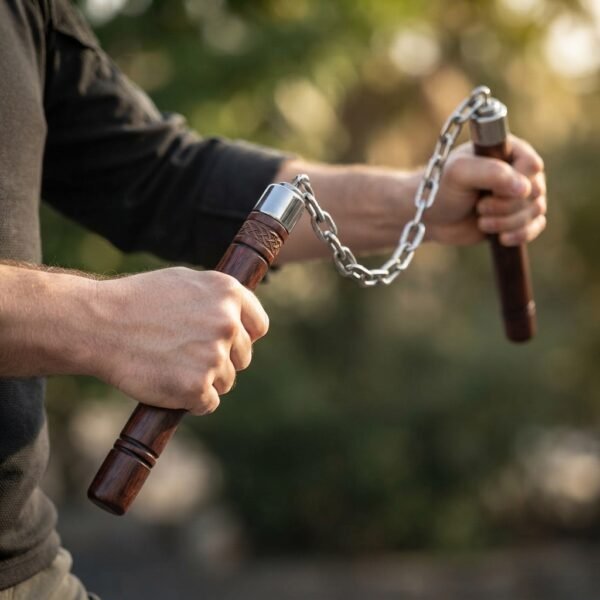
Hold one baton with the chain hanging free and the other baton pointing down, which is the neutral position everything starts from. Almost every basic movement is a rotation about the wrist rather than a swing from the shoulder. Work slowly and in open space with nothing breakable within a wide radius, and wear eye protection while you are learning. Solid hardwood with steel caps on a steel chain will break a nose, a finger or a television, and it is entirely capable of doing so on the return path of a movement you thought had finished.
There is one more thing you need to know before you buy. Nunchaku are legally restricted in some jurisdictions. Several countries and a small number of US states and cities regulate or prohibit possession, and the rules change. It is your responsibility to check the law where you live before ordering, and we cannot advise on it. If in doubt, check before you buy rather than after it ships.
Care
Wipe the wood down after use and oil it once or twice a year with a hardwood or boiled linseed oil, worked in with a cloth and wiped back, which keeps the timber from drying out and going brittle. Inspect both batons for cracks running with the grain before any hard use and retire the set if you find one. Keep a light smear of oil on the steel chain and caps if the set lives somewhere humid, and wipe them dry if they get wet, because bare steel will spot. Do not store the set in the pouch damp. Check the chain and the swivels for wear and for any link that has started to elongate.
Hardwood wants an occasional wipe of oil the same way an axe haft does, and the haft and edge care guide covers that.
Made in the Czech Republic
This piece is made by hand in the Czech Republic, in a workshop that still works the old way. The steel is forged, ground, heat treated and finished by smiths who learned the trade from the people before them, and the wood, horn and leather are cut and fitted by hand rather than pressed out on a line. That is also why no two pieces come out exactly the same.
Ransack Viking is a United States company. We import these pieces ourselves, check every one when it lands and ship from our warehouse in Chicago, Illinois. Engraving is done here in the United States after the piece arrives, so your runes or your own design go on before it leaves for you.
A note on handmade variation
This is hand made, not machine made or bulk produced, so what arrives will not be a pixel for pixel copy of the photograph. Wood is a natural material and no two batons take the finish identically, so one pair may run paler or warmer than another and the grain will be entirely its own. Even the two batons in a single set will not match each other perfectly, because they came from different parts of the board. The engraved triskele is cut by hand, so its depth varies. The dimensions, the material and the build are the same every time. The character is not.
Frequently asked questions
Is this one nunchaku or two
It is one product. A nunchaku is a pair of batons joined by a chain, and the price covers the complete set with the chain fitted and the pouch included. You are not buying a single stick.
Are these legal where I live
That depends entirely on where you live, and the rules vary by country, state and sometimes city. Please check your local law before ordering. We cannot give legal advice and we cannot ship around a restriction.
Are these suitable for a beginner
They are solid hardwood with steel caps, which is unforgiving while you are learning. Most instructors start beginners on foam or padded training nunchaku and move to hardwood later. If this is your first pair, go slowly and wear eye protection.
Will the chain rust
It is bare polished steel, so it can spot if it is stored damp. A wipe down and an occasional smear of light oil keeps it bright indefinitely.
Can I have both caps engraved
Yes. Both arrive with the triskele as standard. Ask for one cap to carry initials, a date or a short rune line in place of its triskele, or have both done with your own design.
How long does it take to arrive
One to two weeks of processing, then free shipping within the US. Tell us in the order notes if you have a date to hit and we will be honest about whether we can make it.
What is in the box
- Chainoak hardwood nunchaku, two batons joined by a polished steel chain
- Black carry pouch
- Care card for finished hardwood and bare steel
- Lifetime warranty against defects in the build and the fittings
- Made and finished in the Czech Republic
Explore the range
See more in Norse arms, accessories and engraved and personalised pieces, or read the guides on caring for hardwood and bare steel.
Close to this one
Closest to this in the range is the Pocketforge accessory. If this one is not quite right, there is the Hornhook accessory, pattern welded Damascus. Also in this group is the Chainwood accessory.
If you are putting a set together, the Hornmead drinking horn sits alongside it. Nothing here exactly right, build one to your own spec on the design your own page.

Nice piece for the price. Solid piece. Packaging could’ve been a bit sturdier. Good overall quality. Just a couple very minor details off. Minor nitpicks aside, good quality piece.