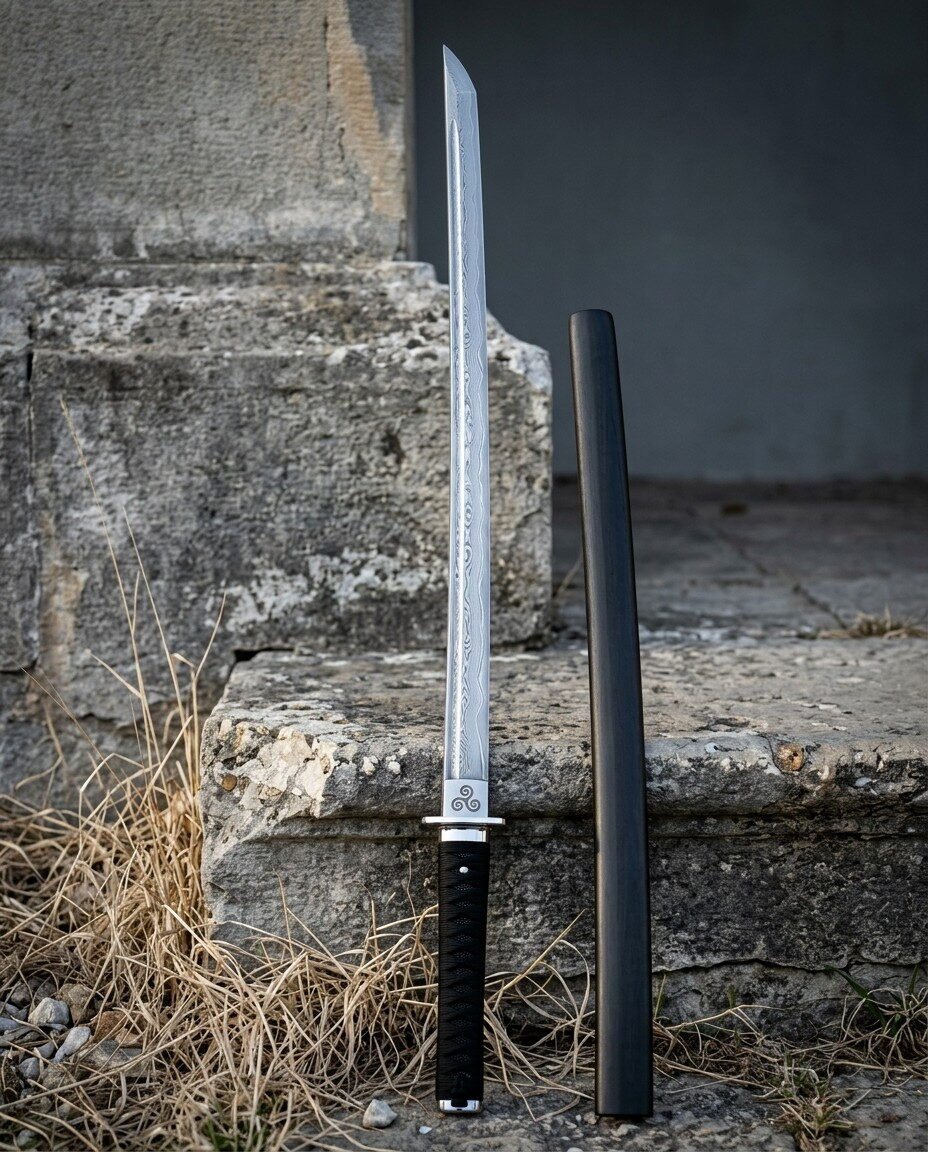
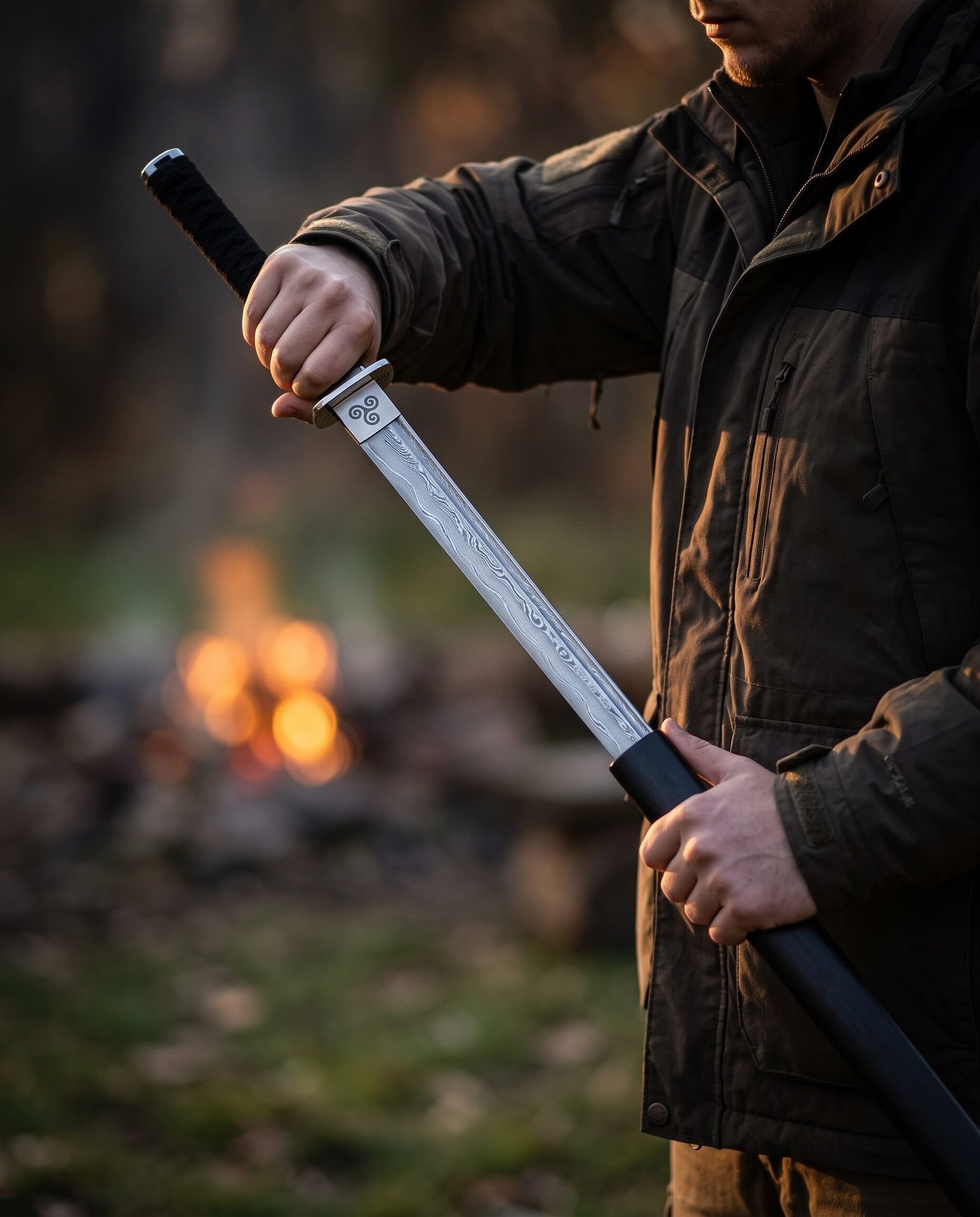
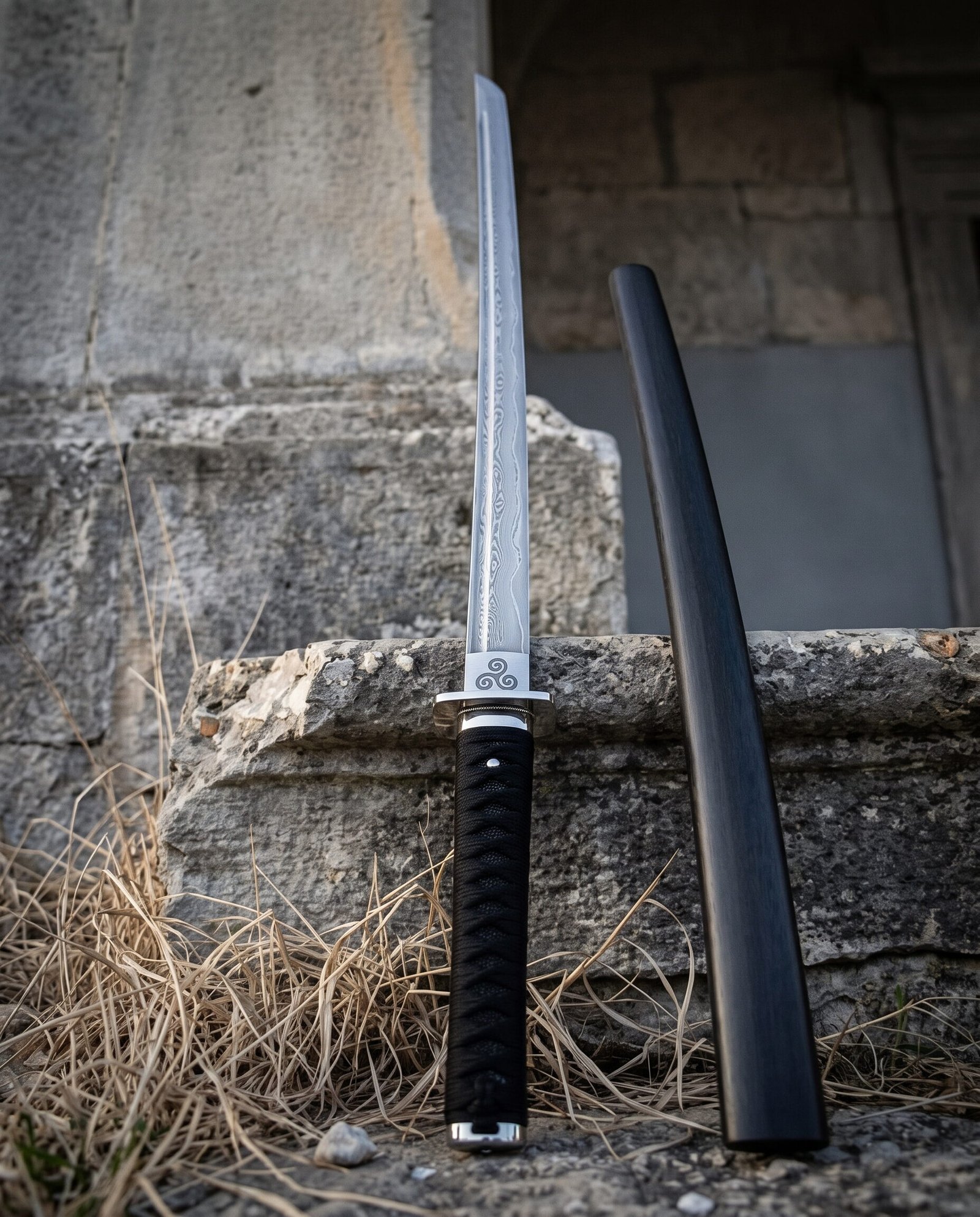
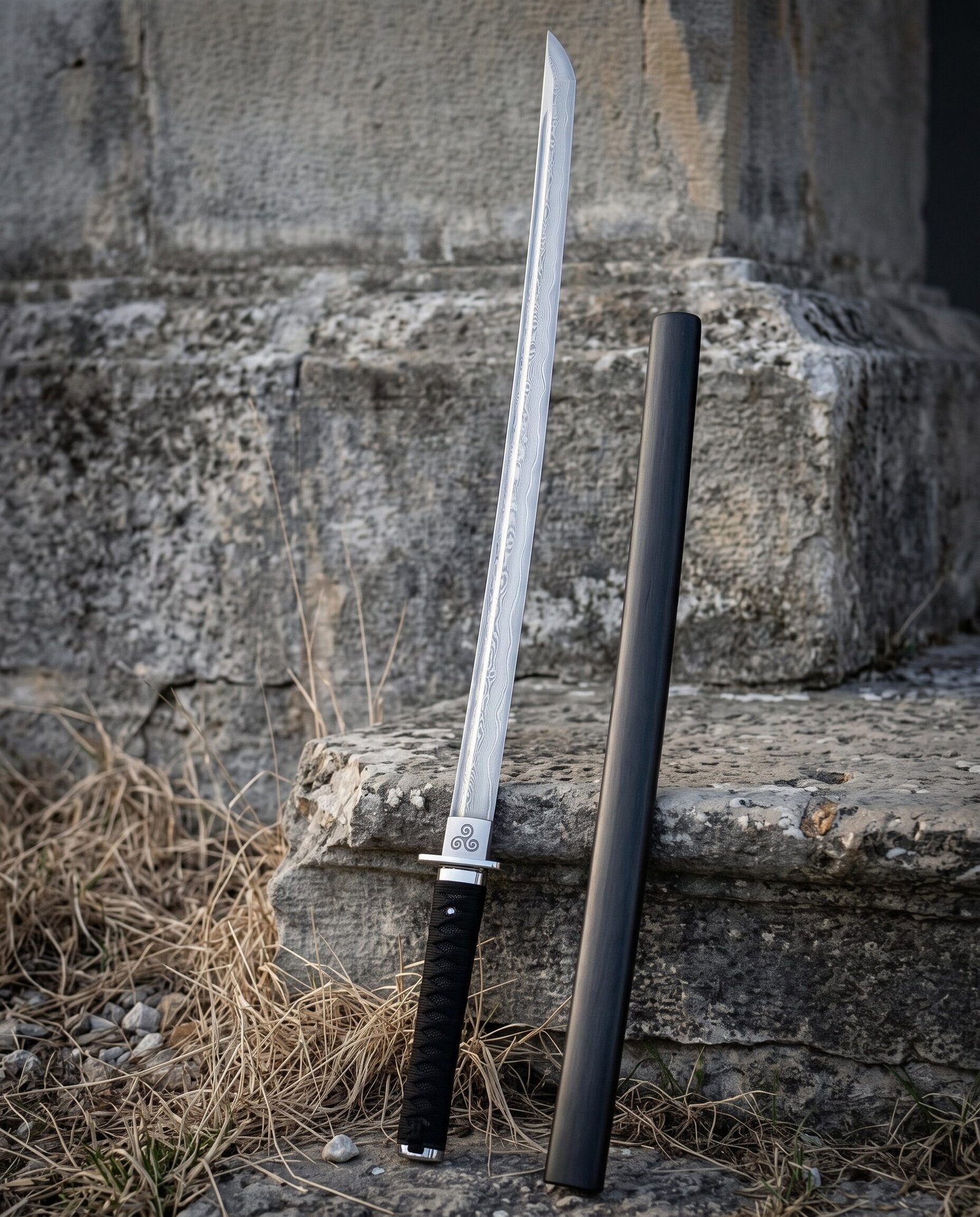
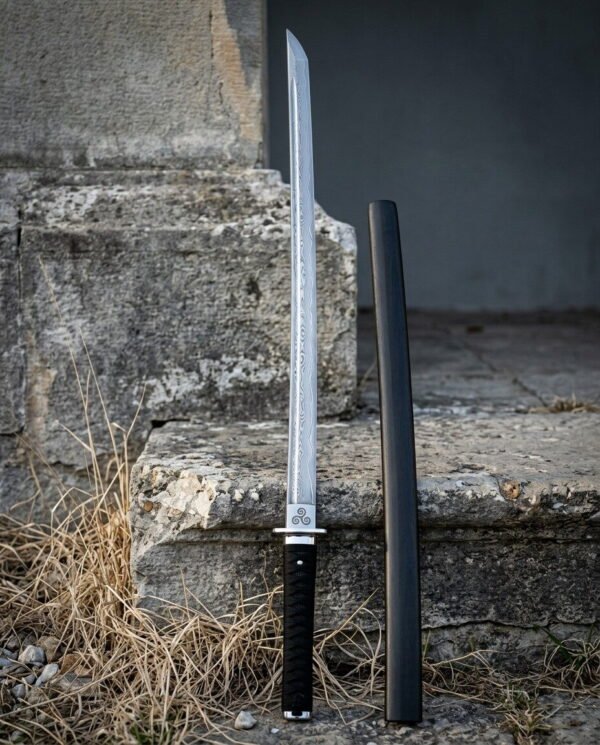
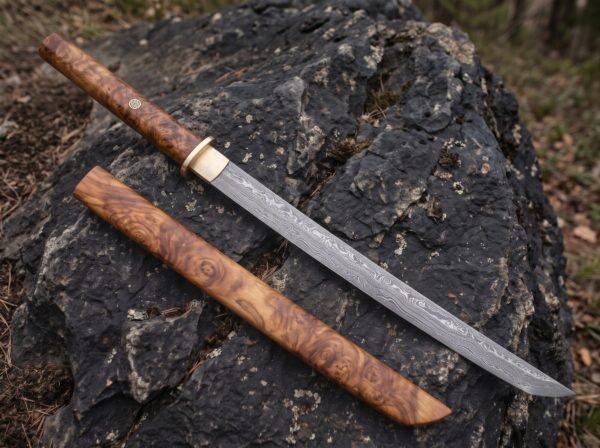
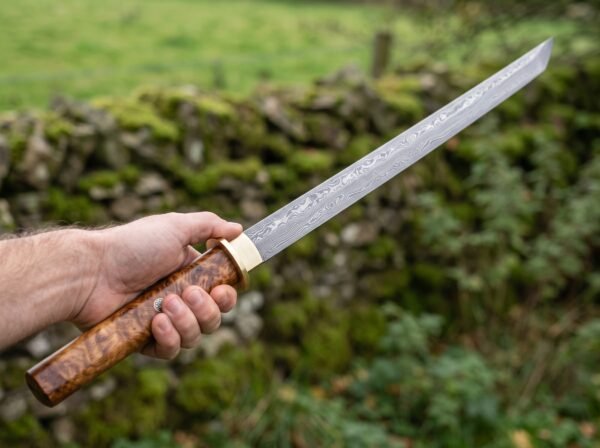
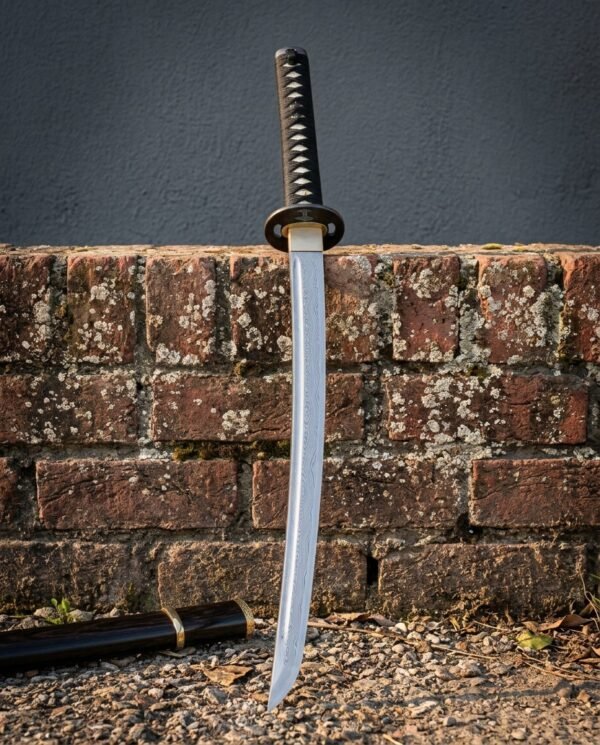
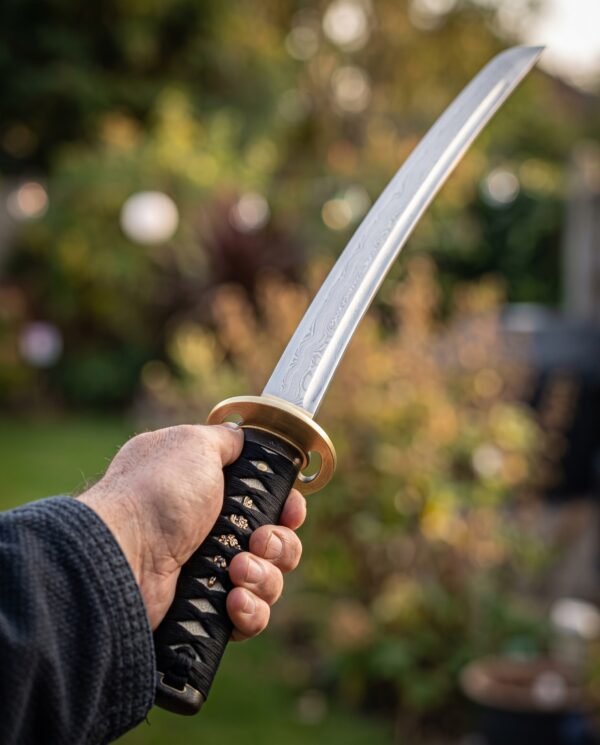
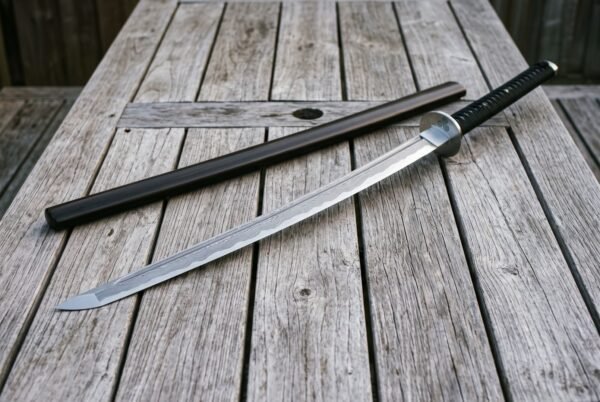
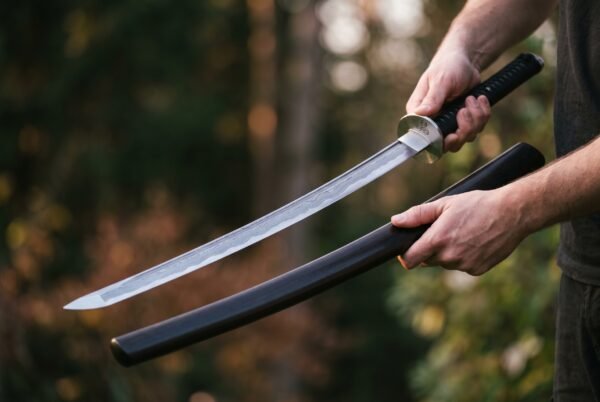
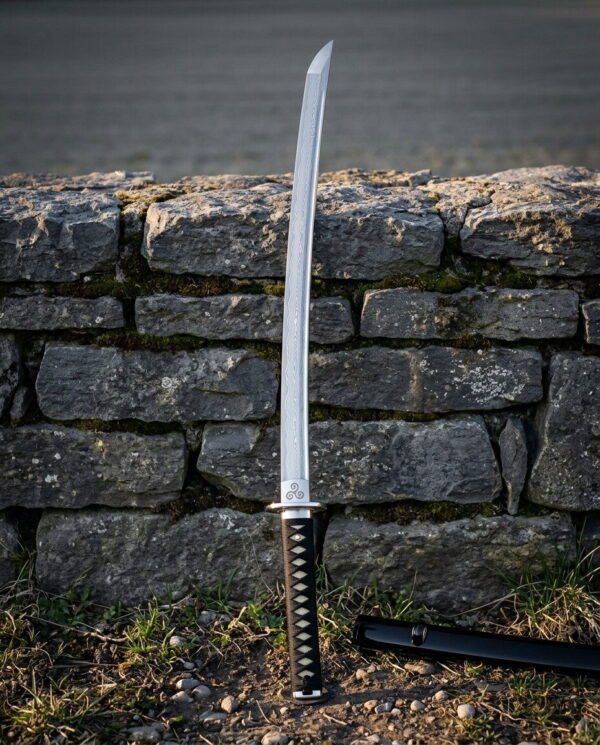
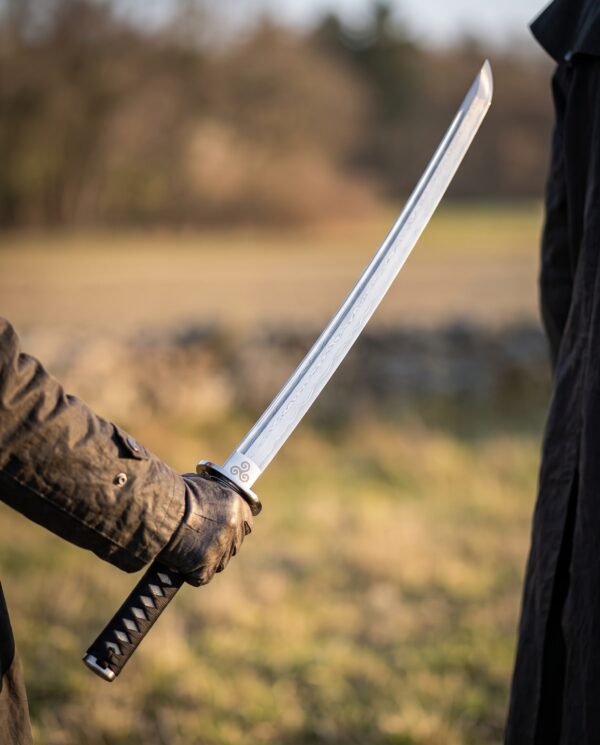
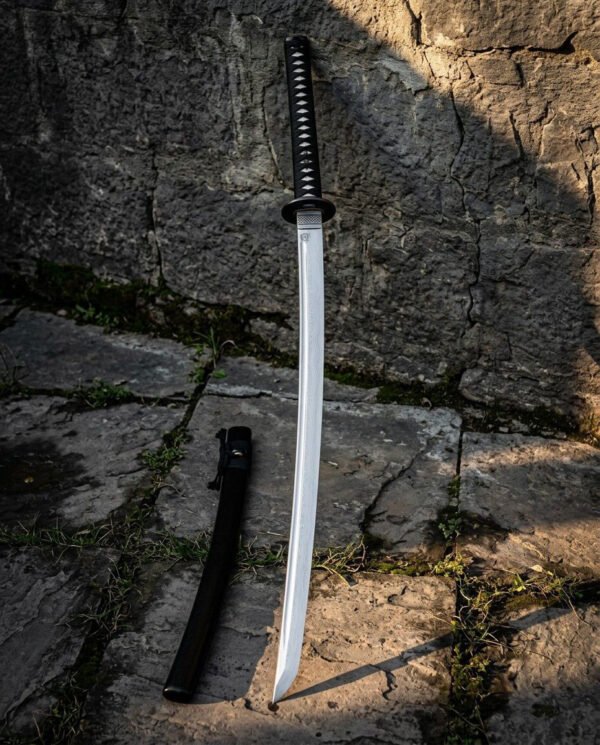
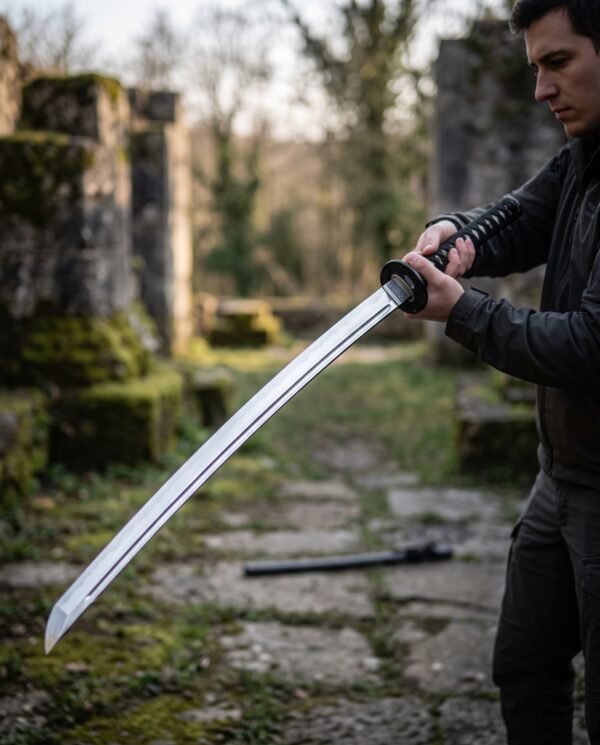
A ninjato is the straight bladed cousin of the katana, and this one is forged in pattern welded Damascus steel. The blade runs dead straight from the collar to an angled tanto style point, single edged, with the layered pattern of 1095 and 15N20 running the full length in tight bands and whorls that shift as you move it under a light. A triple spiral is cut into the steel blade collar above a small rounded steel guard, the handle is bound in black cord over a textured underlay, and the sword drops into a plain black lacquered scabbard with no fittings on it at all.
Worth being straight about the history. The ninjato as a distinct historical sword type is far less documented than popular culture suggests, and most of what people believe about it comes from twentieth century writing rather than from surviving Edo period blades. What is genuinely true is that a straight, shorter, plainly mounted sword was cheaper to make, easier to conceal and far less conspicuous than a full katana, and those are practical reasons a straight blade in undecorated mounts would be chosen. We build ours as a straight bladed Japanese style sword and we would rather tell you that than sell you a legend. It is forged, ground, etched and fitted by hand in the Czech Republic. It is part of the Japanese swords, and the short swords are put together the same way.
Specifications
| Blade steel | Pattern welded Damascus in 1095 and 15N20, hardened to 58 to 60 HRC |
|---|
| Blade profile | Straight, single edged, angled tanto style point, acid etched to reveal the pattern |
|---|
| Collar | Fitted steel blade collar cut with a triple spiral |
|---|
| Guard | Small rounded steel plate guard |
|---|
| Handle | Black flat cord wrapped over a textured underlay, one steel peg through the handle |
|---|
| Pommel | Steel butt cap |
|---|
| Scabbard | Hardwood with a plain black lacquer finish and no external fittings |
|---|
| Finish | Etched and hand polished Damascus, satin steel fittings |
|---|
| Included | Sword, lacquered scabbard, care card |
|---|
| SKU | RK-1796 |
|---|
Why a straight blade changes how the sword works
Curve is not decoration on a Japanese sword, it is a cutting mechanism. A curved edge meeting a target presents only a short section of edge at a time and then draws through, so the cut becomes a slice rather than a chop, and the force concentrates on a small moving contact patch. Take the curve away and you lose that. A straight blade contacts along a much longer section at once and behaves more like a chisel driven forward.
What you gain is thrusting. A straight blade points where the handle points, which makes a thrust intuitive rather than something that has to be corrected for. It is also stiffer for a given cross section because the load runs straight down the spine rather than around a curve. That combination, poor draw cut and excellent thrust, is why straight single edged blades keep reappearing in every sword tradition alongside curved ones rather than being replaced by them.
1095 and 15N20 Damascus and what the pattern actually is
Pattern welded Damascus is not one steel, it is two, forge welded together in alternating layers and then drawn out, folded, cut and rewelded until the layer count runs into the hundreds. We use 1095, a high carbon steel, and 15N20, which carries about two percent nickel. Both harden. The nickel in 15N20 is what makes the pattern visible, because nickel resists the acid etch while the 1095 darkens under it. The bright bands are 15N20 and the dark bands are 1095, and the pattern is a map of how the billet was manipulated on the anvil.
Hardened to 58 to 60 HRC, this blade sits a little harder than our plain carbon swords. Damascus tolerates it because the layering gives the blade a slightly different failure behaviour, and a straight, thick spined blade is not being asked to flex the way a long curved sword is.
Engraving, runes and your own design
Use the rune converter on this page to turn a name, a date or a short phrase into Elder Futhark and we will cut it into the steel, the leather or the wood. If you would rather have a Viking pattern than a rune line, choose your own design in the engraving option above the add to cart button and tell us where it goes. Where a piece already carries an engraved design, your chosen engraving replaces it rather than sitting alongside it, which here means a custom design on the blade collar takes the place of the triple spiral. On a Damascus blade an engraving reads best cut shallow near the collar so it does not fight the pattern. See the engraving page.
Handling and balance
The handle is long relative to the blade, which means you can take it in two hands and use the rear hand for leverage the way a katana is held, or drop the rear hand and use it one handed with plenty of reach. Balance sits just ahead of the guard. It feels lighter and quicker than a curved sword of the same length because there is less steel out at the tip once the curve is removed.
It is a sharpened collector and display sword. It is not sold for sparring or full contact and should not be used against another blade or a person. If you practise cutting forms, handle it as you would any sharp tool and give yourself far more room than feels necessary.
Care
Damascus needs more attention than plain steel, because the acid etch that reveals the pattern leaves a surface that is chemically active and slightly textured. Rust will start in the etched valleys first. Wipe the blade after every handling and keep a thin film of mineral oil or camellia oil on it. Never put it away wet. If a haze appears, a light pass with oil and a soft cloth usually lifts it, and a heavier bloom can be taken back without losing the pattern if you catch it early. Do not store it inside the scabbard in a damp room. The cord wrap takes a dry brush and no water. Our full routine is under steel care.
Made in the Czech Republic
Every piece we sell is made by hand in the Czech Republic. The smiths there work the way the trade has been worked for a long time, heating and hammering the steel, taking the bevels down by eye, and fitting the handle and the leather one at a time. There is no automated line anywhere in it, so small differences from one piece to the next are normal and expected.
Ransack Viking is a United States company based in Chicago, Illinois. We bring the pieces in ourselves, inspect them on arrival and ship them from our own warehouse. If you add engraving, that is carried out here in the United States before your order goes out.
A note on handmade variation
This is hand made, not machine made or bulk produced, so what arrives will not be a pixel for pixel copy of the photograph. Damascus is the clearest case of that anywhere in our range. No two billets fold identically, so the pattern on your blade will be its own, with its own whorls, its own band spacing and its own contrast depending on how the etch took. The cord wrap and the lacquer depth also vary by hand. The steels, the layer construction, the hardness and the dimensions are the same every time. The figure in the steel is not, and that is the whole appeal. The long form of that is what makes a katana a katana, with sharpening a curved blade next to it.
Frequently asked questions
Is the Damascus pattern real or is it etched on
It is real. The blade is forge welded from alternating layers of 1095 and 15N20 and then acid etched to reveal what is already inside the steel. It is not a surface print and it cannot wear off.
Is the blade sharp when it arrives
Yes. It comes with a hand put working edge. Treat it as a sharp tool from the moment you unpack it.
Can I use this for cutting practice
Only if you are trained and only against soft targets. It is not sold for sparring and it must never be used in contact drills against another blade or a partner.
Why is the scabbard so plain
Because that is the point of this mounting. Undecorated black lacquer with no external fittings was the discreet, inexpensive option historically, and it suits a straight blade.
Does Damascus need more care than normal steel
Yes. The etched surface holds moisture in its valleys, so wipe it down and oil it after handling rather than leaving it.
Will my blade have the same pattern as the photograph
No, and it should not. Every billet folds differently. Yours will be the same construction and the same steels with its own figure.
What is in the box
- Hand forged 1095 and 15N20 Damascus ninjato with a straight single edged blade
- Small rounded steel guard and a fitted steel blade collar cut with a triple spiral
- Black cord wrapped handle over a textured underlay
- Plain black lacquered hardwood scabbard
- Care card covering oiling and Damascus storage
- Lifetime warranty against defects in forging, grind, heat treat and fittings
- Forged and finished in the Czech Republic
Explore the range
Browse the katana and Japanese swords, the Damascus swords, the full sword range and the guides.
Others in the same line
Worth putting side by side with this is the Shadowfen Japanese sword, pattern welded Damascus. In the same category sits the Spiralcrest Japanese sword, 40 inches overall. A near match for this one is the Ravenwake Japanese sword, pattern welded Damascus.
For a different piece from the same family, look at the Tidefold wakizashi. You can have this made your way instead on the design your own page.

Feels way more premium than the price suggests. Damascus blade holds a razor edge right out of the box. Great buy overall.
Middle of the road experience with this one. Blade edge needed some sharpening out of the box. Not bad, not amazing either. Ransack Viking is hit or miss it seems. This one landed in the middle.
It’s a decent sword. Nothing extraordinary though. Blade edge needed some sharpening out of the box. Wouldn’t say no to it but wouldn’t rave about it either.