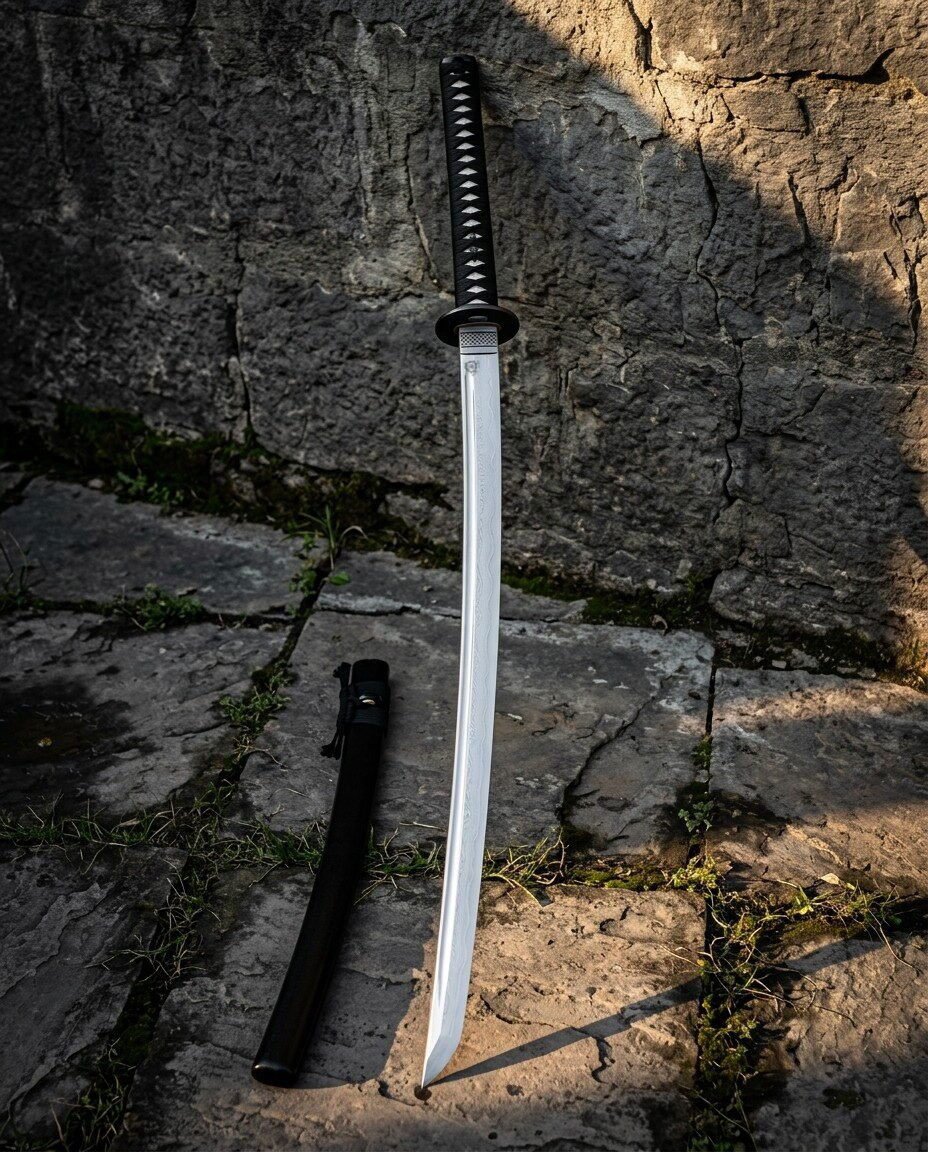
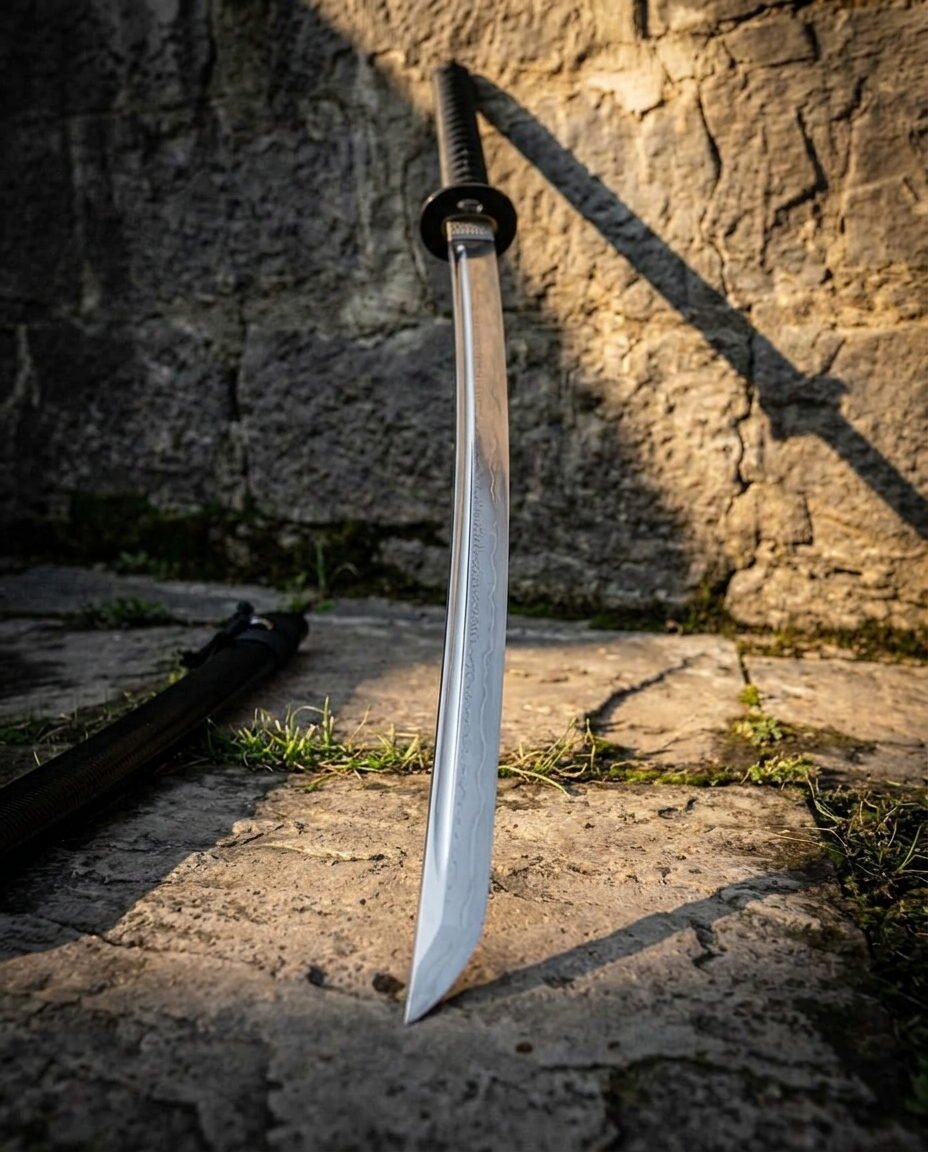
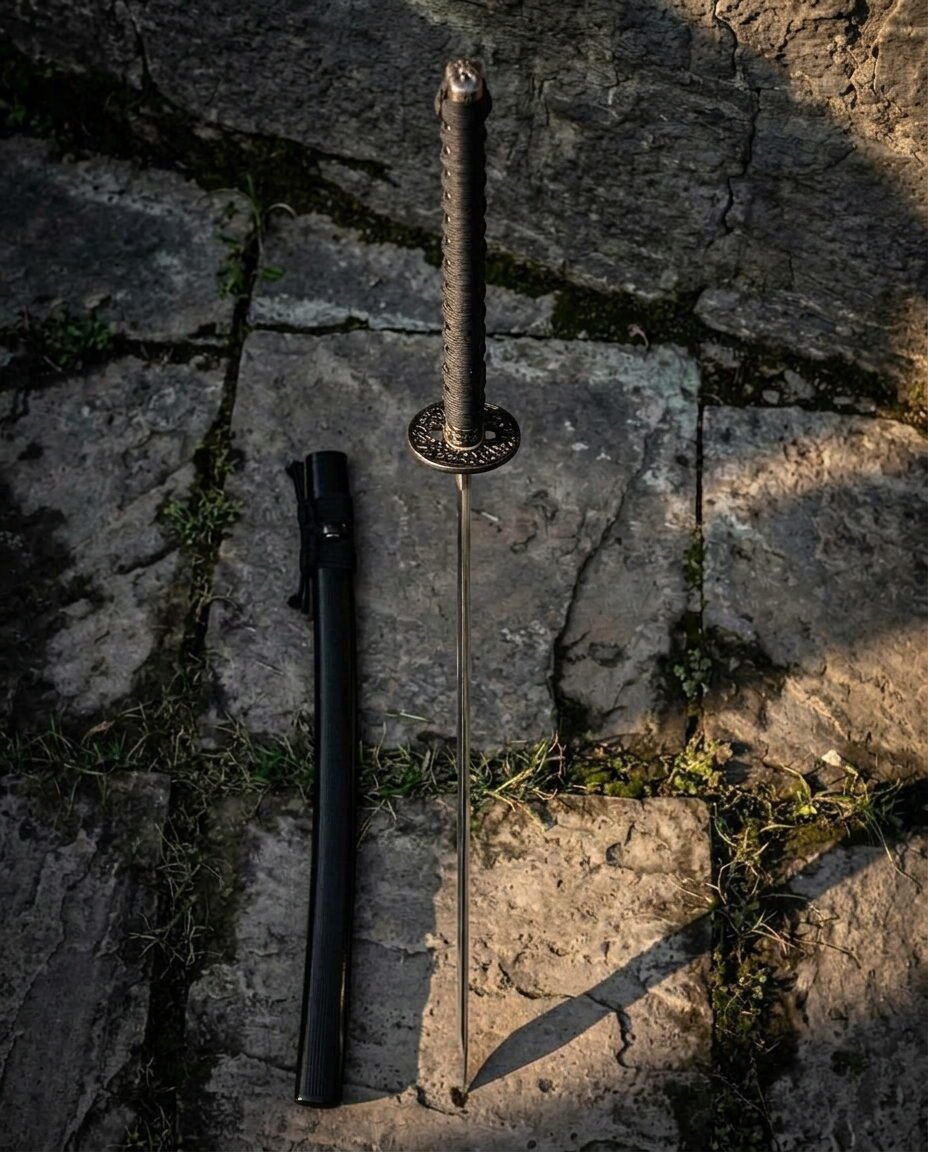
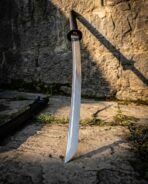
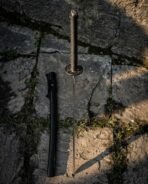
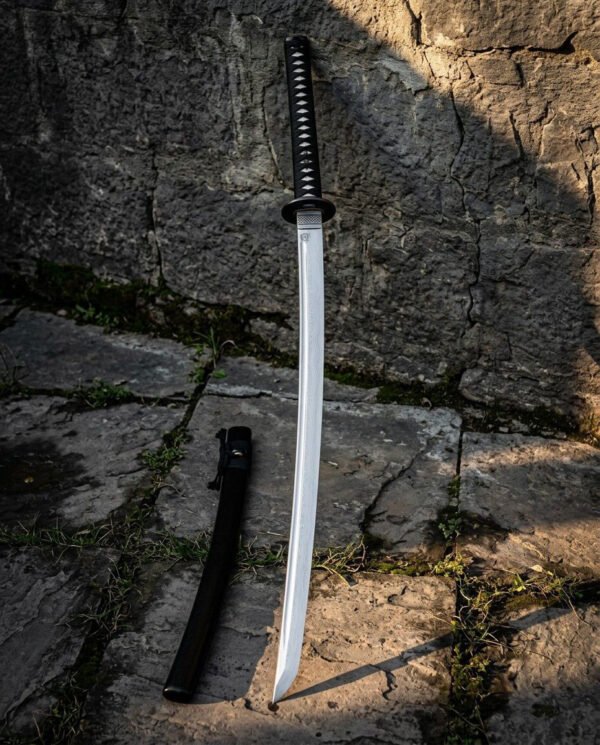
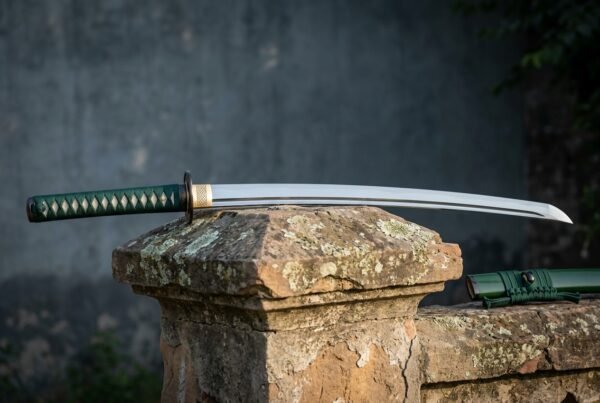
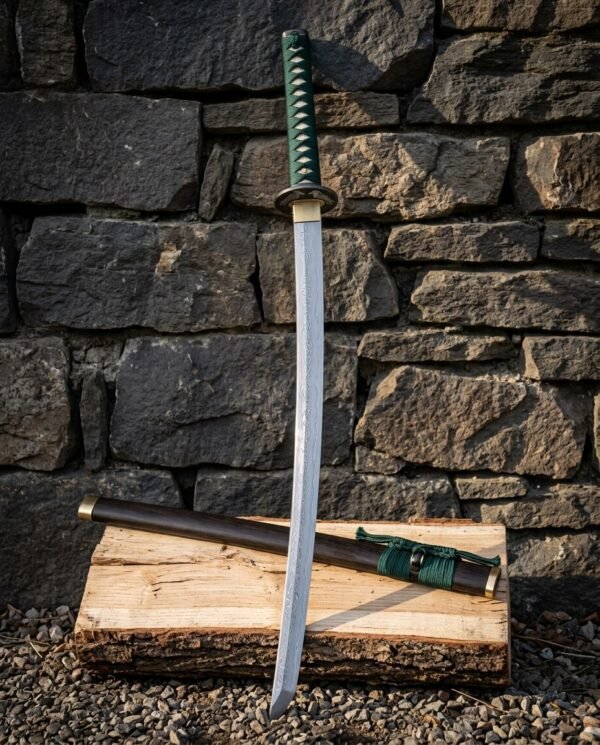
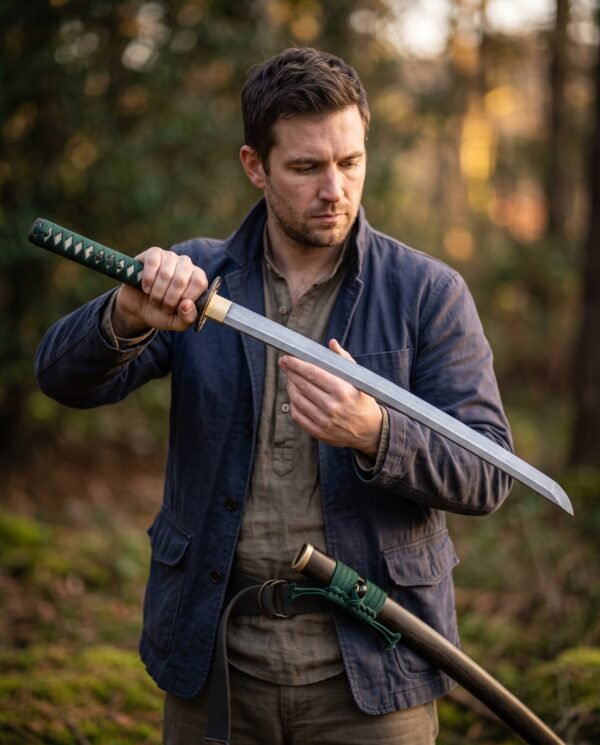
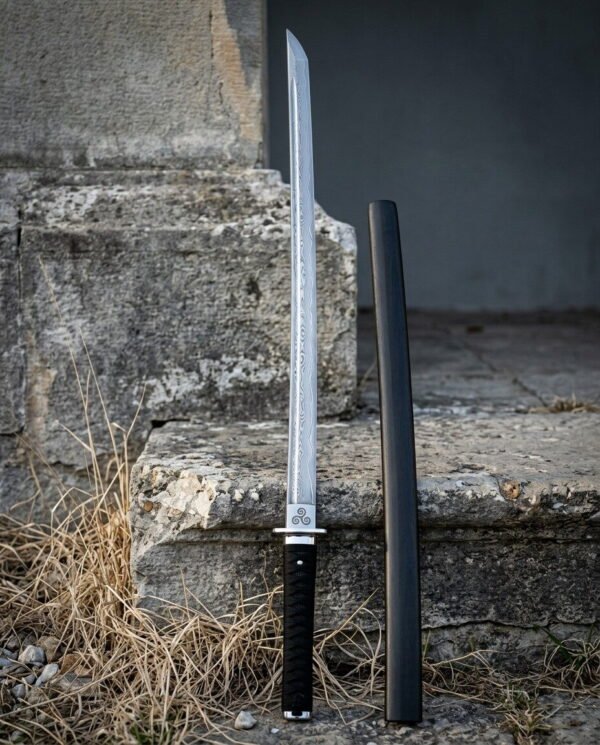
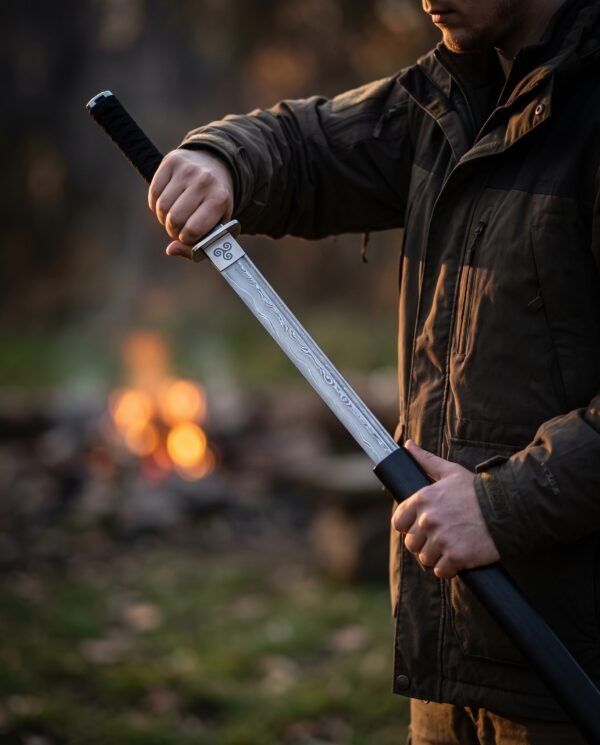
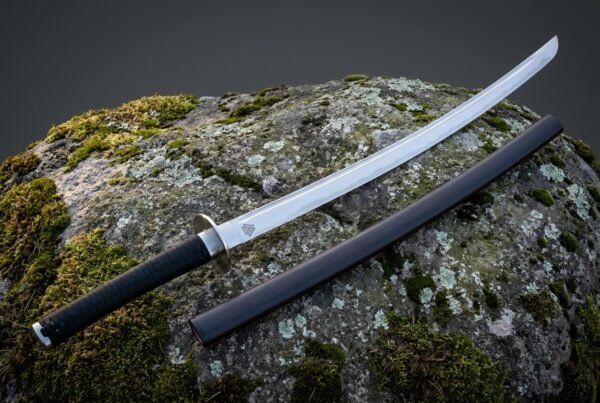
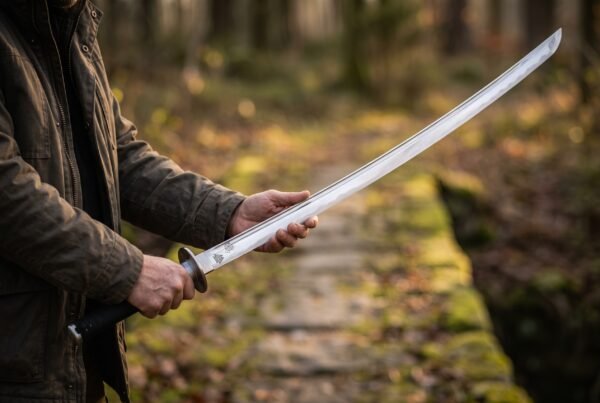
The Stormfold is a katana with a bright polished 1095 high carbon steel blade, a wavy temper line along the edge and a bo hi groove running up the blade. The curve is drawn out long and shallow rather than tight. It wears a round iron tsuba, a patterned habaki collar at the base of the blade, a black cord wrapped handle over a textured underlay and a black lacquer saya.
The blade is a single bar of 1095, a plain high carbon steel that takes a keen edge and is easy to bring back on a stone at home. Ours is forged, ground, hardened and mounted in the Czech Republic. It lands in the Japanese swords, with the wakizashi blades close enough that people usually look at both.
Specifications
| Blade steel | 1095 high carbon steel, hardened to 54 to 58 HRC, polished bright |
|---|
| Blade | Single edged curved blade with a long shallow curve, bo hi groove and a visible wavy temper line |
|---|
| Guard | Round iron tsuba in a dark finish |
|---|
| Collar | Patterned habaki at the base of the blade, seating the sword in the saya |
|---|
| Handle | Black cord wrapped tsuka over a pale textured underlay, black kashira at the butt |
|---|
| Scabbard | Black lacquer finish saya with a fitted mouth and black sageo cord |
|---|
| Edge | Ground and sharpened by hand, arrives keen |
|---|
| Included | Katana and matching saya |
|---|
| SKU | RK-1624 |
|---|
The blade steel
1095 is a simple carbon steel with roughly one percent carbon and very little else in it. Hardened and tempered to 54 to 58 HRC it takes a fine edge, holds it well through cutting practice and comes back quickly on a stone. The flats are polished bright, and the wavy line you can see running above the edge is the temper line left by the heat treatment.
The curve, the steel and the mounting
The curve on this blade, the sori, is long and shallow rather than deep. A shallow curve puts more of the edge in contact through a cut and makes the sword point more naturally, which is why the shape drifted this way over the centuries as swords were carried edge up in the belt rather than slung edge down.
The blade is hardened and tempered to 54 to 58 HRC, which keeps a long blade tough enough to flex a little rather than snap, while still taking a keen edge.
The mounting is traditional in arrangement. A round iron tsuba, a patterned habaki that wedges the blade into the mouth of the saya so it does not rattle, a cord wrap over a textured underlay that gives grip in damp hands, and a lacquered saya. The habaki is the unglamorous part that does the most work. It is the only thing holding the sword in the scabbard.
Engraving, runes and your own design
Use the rune converter on this page to turn a name, a date or a short phrase into Elder Futhark and we will cut it into the steel, the leather or the wood. If you would rather have a Viking pattern than a rune line, choose your own design in the engraving option above the add to cart button and tell us where it goes. Where a piece already carries an engraved design, your chosen engraving replaces it rather than sitting alongside it. On this katana the flat of the blade above the groove takes a short rune line well, and the saya and the tsuba are good surfaces too. Talk to us through the engraving page and we will tell you what will look right.
Handling and balance
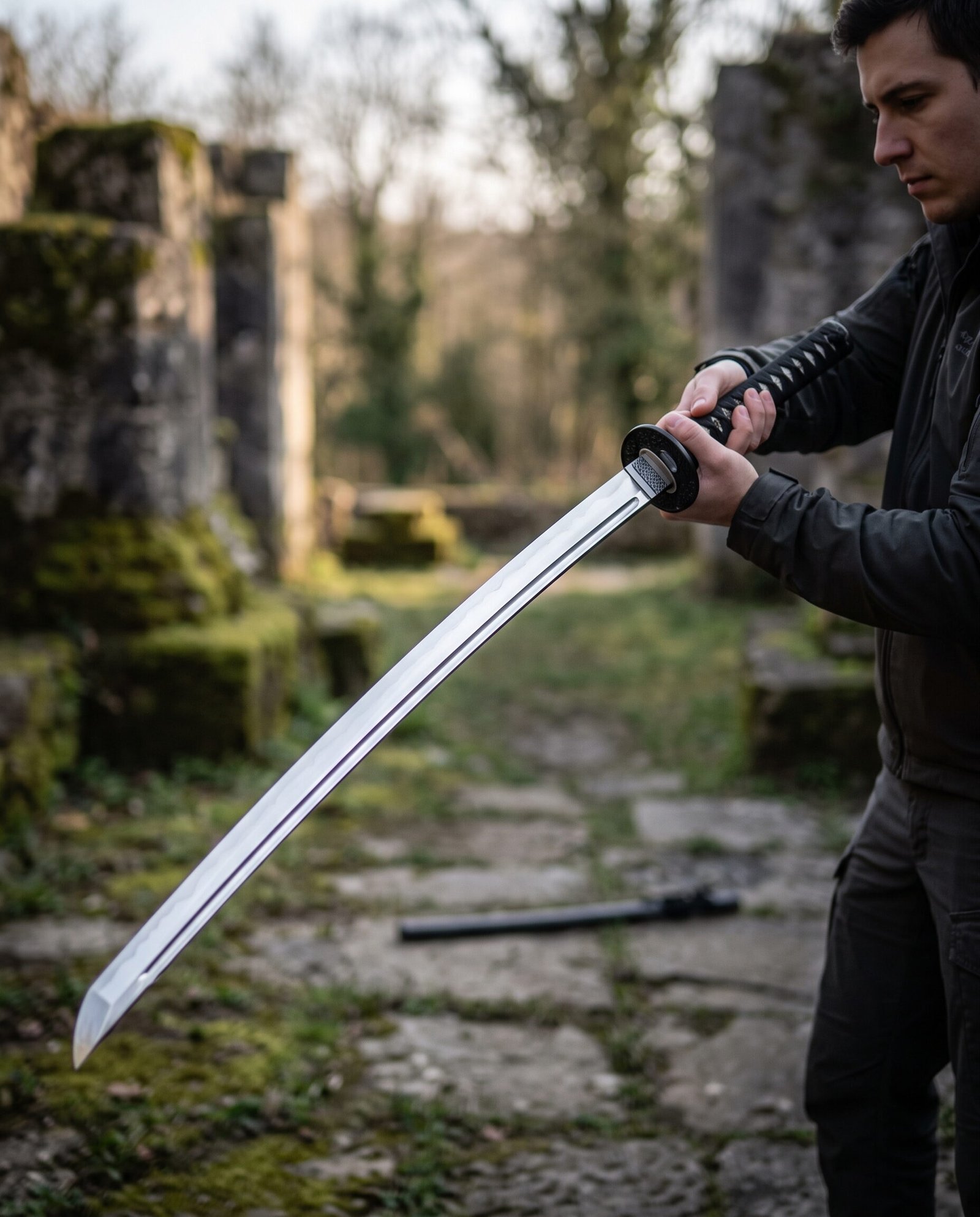
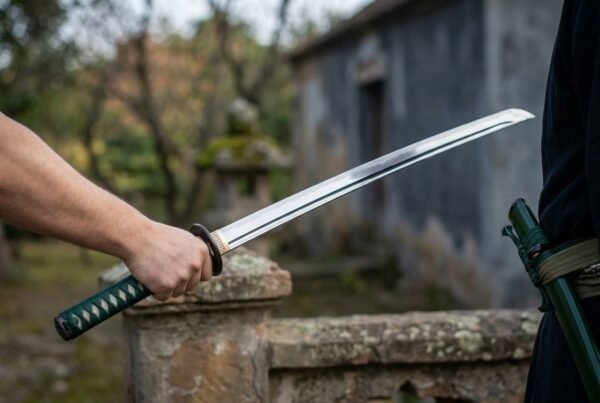
This is a two handed sword and it wants both hands spaced well apart, left hand at the butt pulling, right hand under the tsuba steering, neither of them clenched. The cut comes from the hips and the shoulders rotating, with the hands finishing the movement rather than starting it.
The bo hi groove takes a little weight out of the blade without losing stiffness, so the sword feels quicker in the hands than its length suggests.
It is a sharp functional sword. It will cut soft targets cleanly with good technique. It is not for sparring. No blade on blade contact, no hard targets, nothing with a hidden core, and never test an edge on bone or metal. Hardened carbon steel chips.
Care
1095 rusts if it is left wet or handled with bare fingers and not wiped. Wipe the blade after every handling session and keep a light film of mineral oil or blade oil over the flats. If a spot appears, lift it with oil and a soft cloth. Keep coarse abrasive paper off the polished flats, because it leaves scratches that are slow to polish out. Full detail sits in steel care.
Do not leave the sword stored in the saya for months in a humid room. A lacquered scabbard traps moisture against steel. Oil it and store it out on a rack for long periods. Keep the cord wrap dry and wipe the tsuba and habaki so sweat does not sit in the seams.
Made in the Czech Republic
Every piece we sell is made by hand in the Czech Republic. The smiths there work the way the trade has been worked for a long time, heating and hammering the steel, taking the bevels down by eye, and fitting the handle and the leather one at a time. There is no automated line anywhere in it, so small differences from one piece to the next are normal and expected.
Ransack Viking is a United States company based in Chicago, Illinois. We bring the pieces in ourselves, inspect them on arrival and ship them from our own warehouse. If you add engraving, that is carried out here in the United States before your order goes out.
A note on handmade variation
This is hand made, not machine made and not bulk produced, so what arrives will not be a pixel for pixel copy of the photograph. The temper line along the edge is the most variable part of all, and no two blades carry exactly the same line. Grain, tone, hammer texture, the exact depth of the curve, the tightness of the cord wrap and the depth of the lacquer all vary because each piece is worked by hand. The dimensions, the material and the build are the same every time. The character is not. For the detail behind that, see the tanto, and what the wakizashi was for alongside it.
Frequently asked questions
Is it sharp when it arrives
Yes. It is hand ground and sharpened and arrives keen. Treat it as a live blade the moment you open the box.
What steel is the blade
1095 high carbon steel, hardened to 54 to 58 HRC and polished bright.
Can I use it for sparring or cutting
Careful target cutting on soft targets, yes, with sound technique. Sparring, no. Blade on blade contact chips a hardened carbon edge and is dangerous with any live blade.
Does it have a bo hi groove
Yes. A bo hi runs along the blade, which lightens it a little and gives the sword a quicker feel in the hands.
How do I stop it rusting
Wipe it after handling and keep a light film of oil on the flats. Bare carbon steel shows fingerprints quickly, so make the wipe down a habit rather than an afterthought.
How long does it take to ship
Processing is one to two weeks plus transit, at the longer end for engraved orders. Shipping within the United States is free.
What is in the box
- One Stormfold 1095 high carbon steel katana with a round iron tsuba and cord wrapped handle
- One black lacquer finish saya
- Care card covering oiling a carbon steel blade and safe storage
- Forged and finished in the Czech Republic
Explore the range
See more in katana and Japanese swords, wakizashi and sword stands and displays, or read the guides.
Near neighbours in the shop
If this one is not quite right, there is the Valkshade Japanese sword. Also in this group is the Mistfold Japanese sword, 40 inches overall. Sitting beside it in the catalogue is the Jadewake Japanese sword, 40 inches overall.
From the same corner of the shop, there is the Legionward gladius. You can have this made your way instead on the design your own page.

Can’t stop showing this off to everyone who comes over. Made overseas in the Czech Republic yet shipped from a US location so no long customs wait. Even the small engravings are crisp and clean. The wood handle feels amazing and the balance is perfect. Damascus blade holds a razor edge right out of the box. This will be a family heirloom for sure.
No regrets on this purchase at all. Edge retention has been great even after regular use. The wood handle feels amazing and the balance is perfect. Leather sheath is thick and well stitched. Not the cheap stuff you usually get. Already telling my friends to check this out.
Really happy with this sword overall. Blade quality is solid. Arrived a bit less sharp than expected but a few passes on a strop fixed it. Glad I made this purchase.