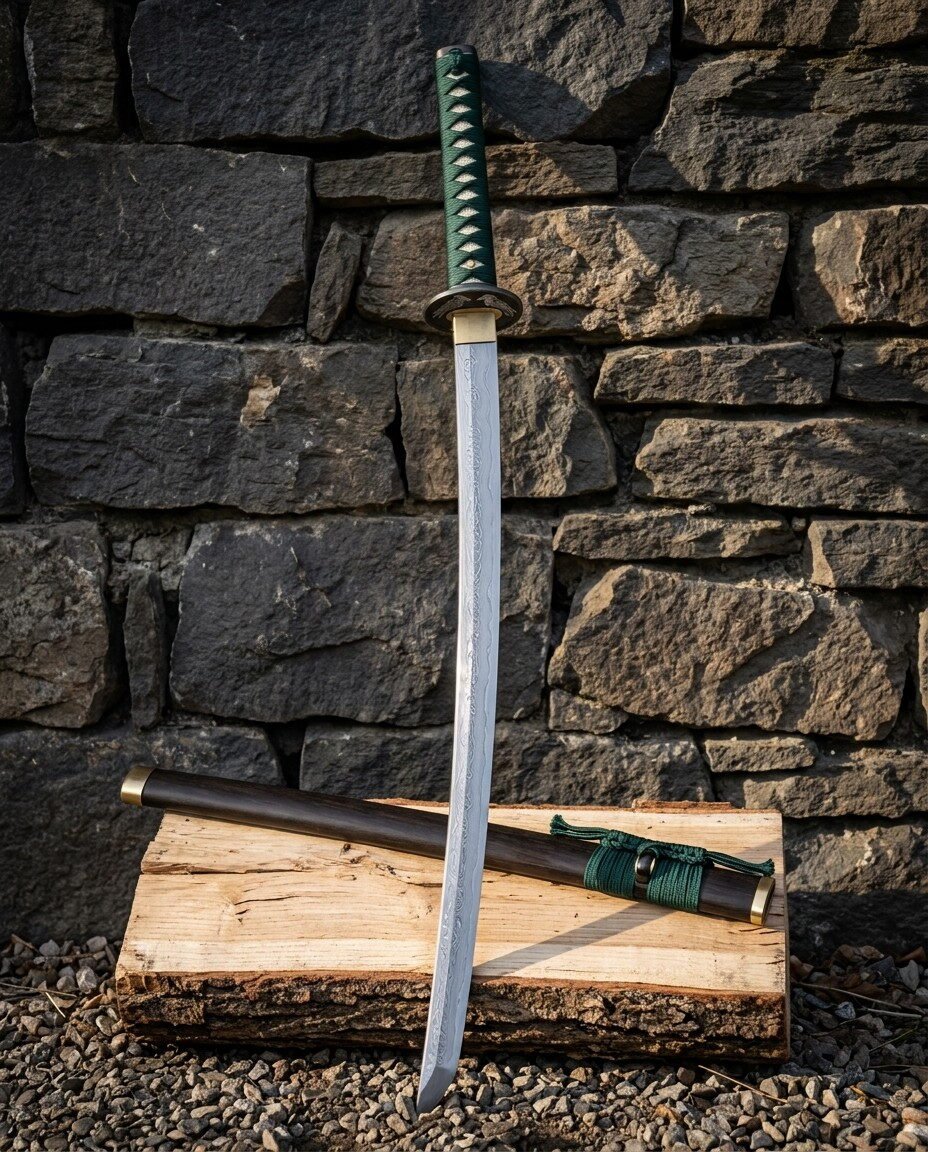
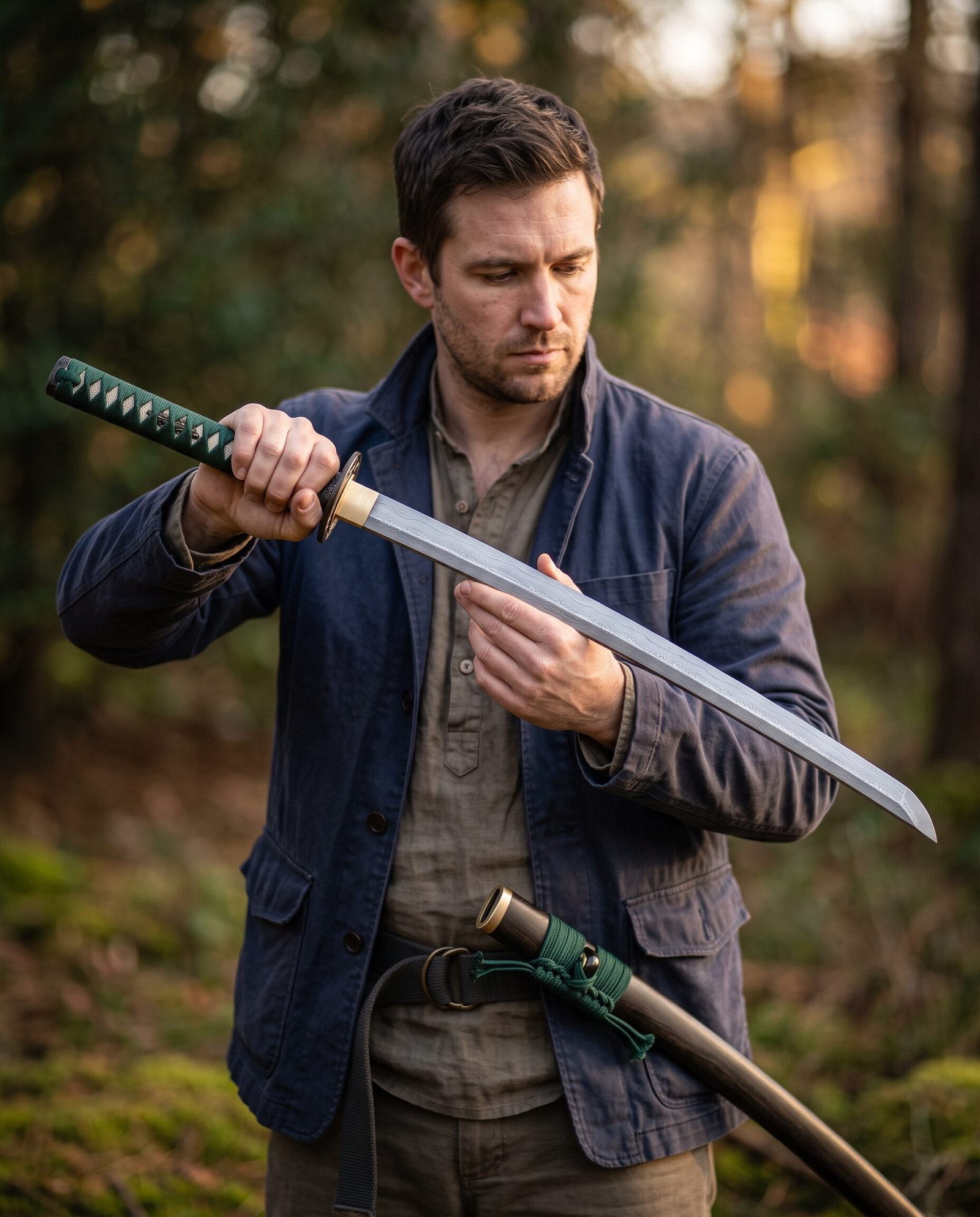
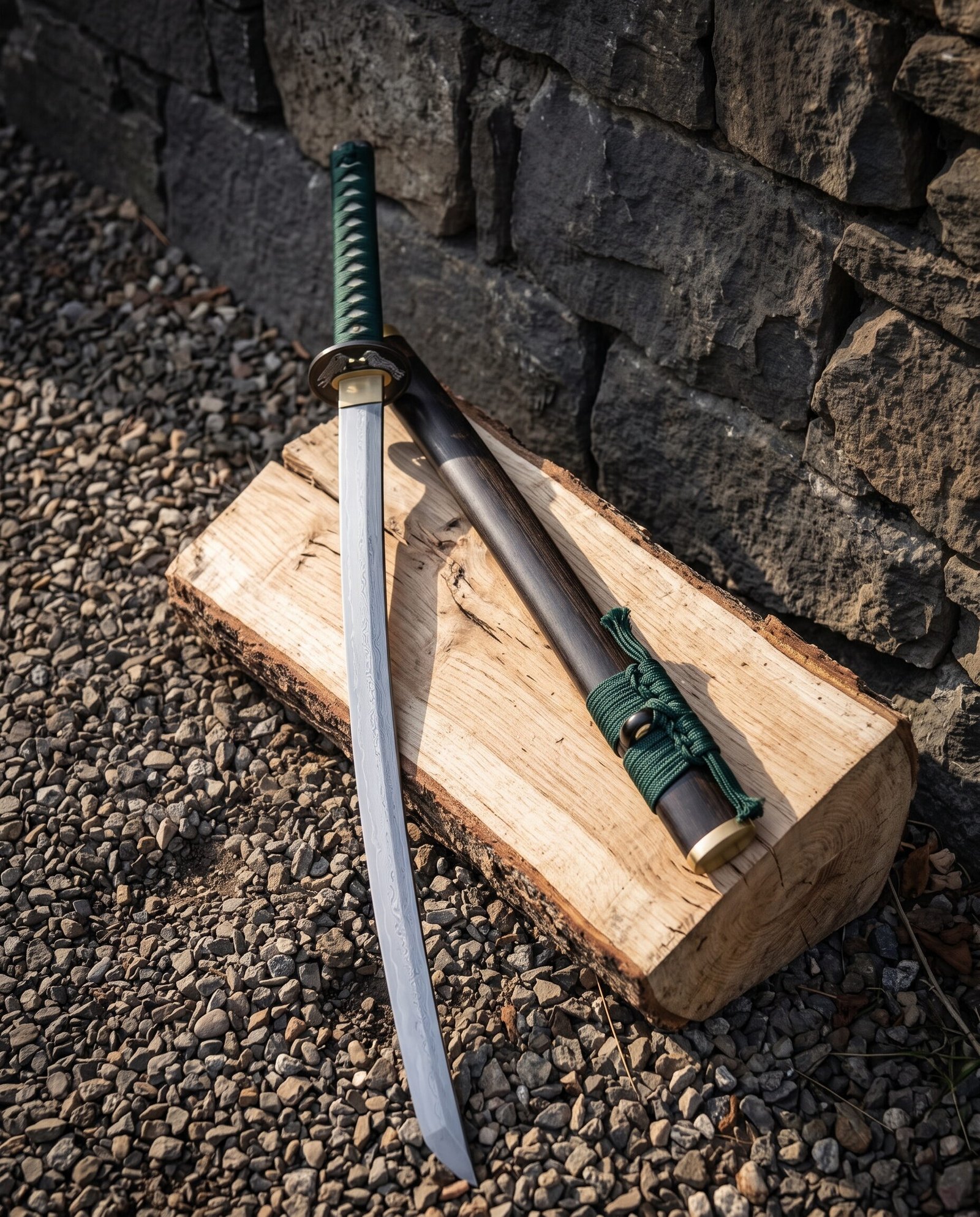
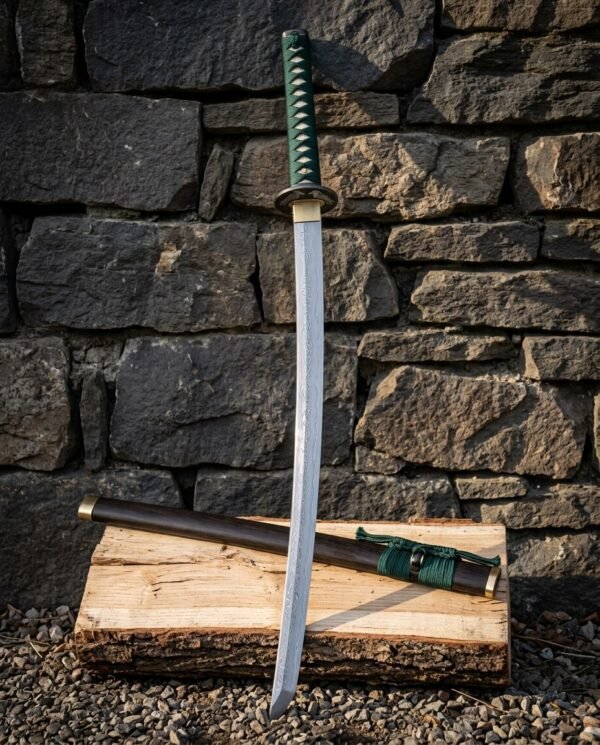
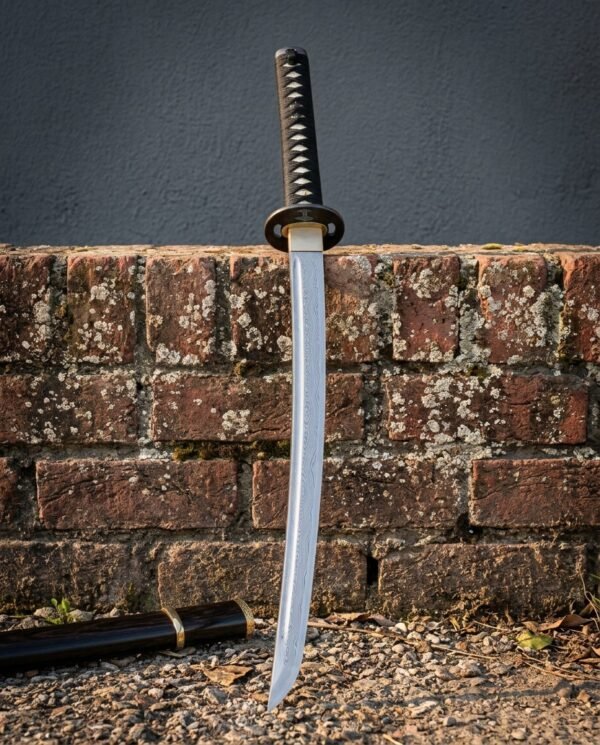
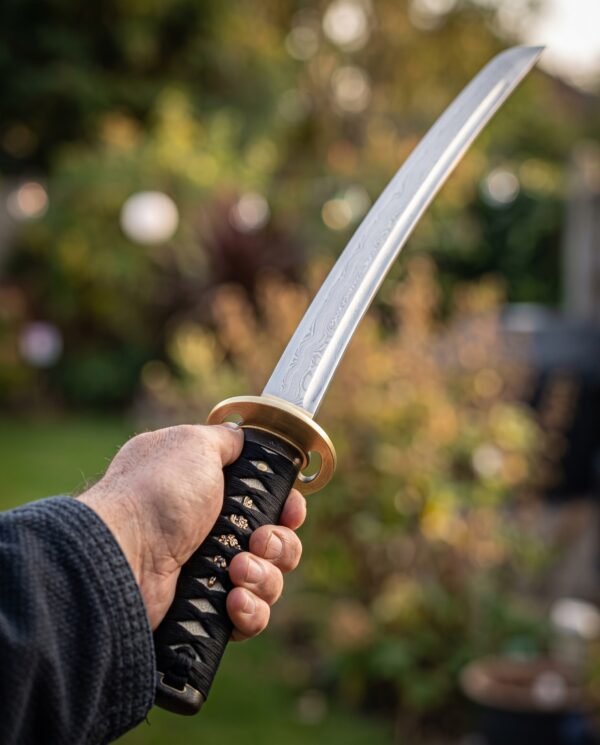
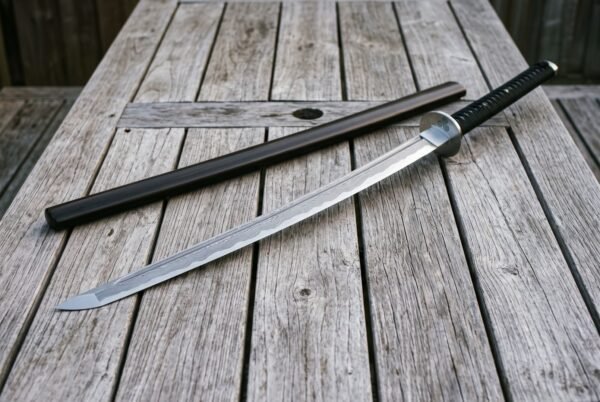
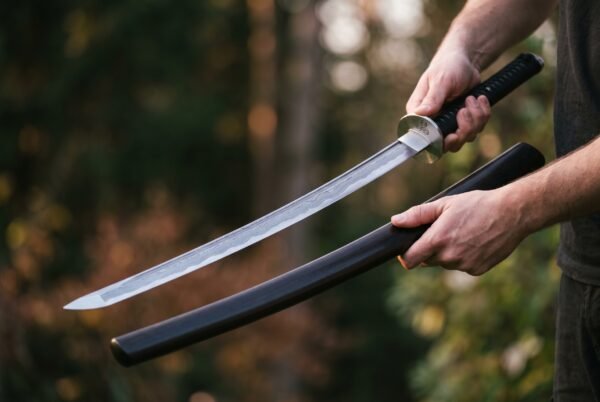
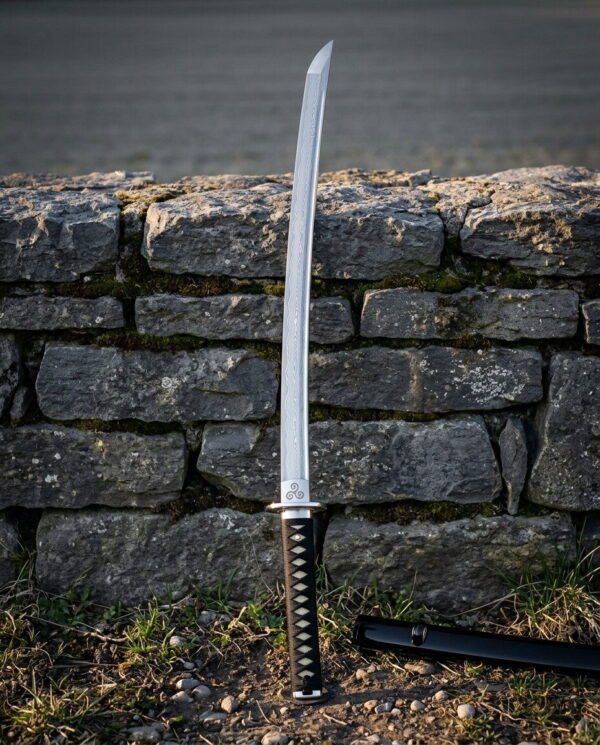
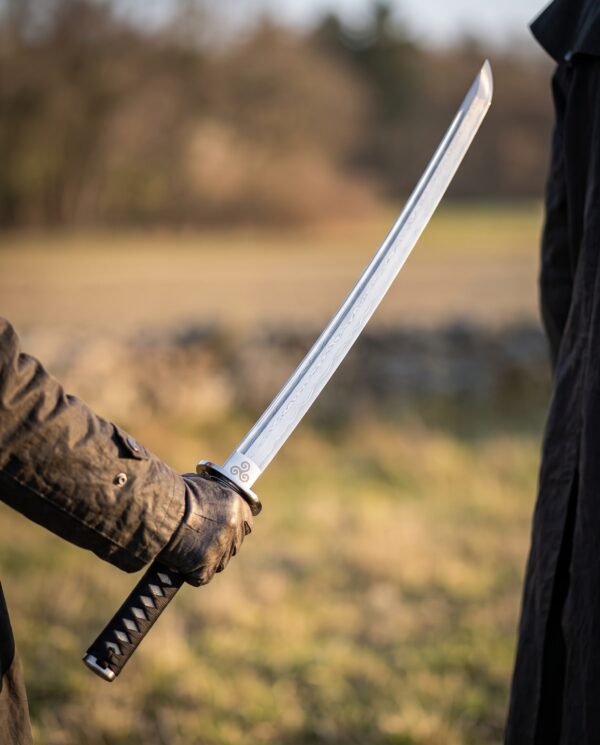
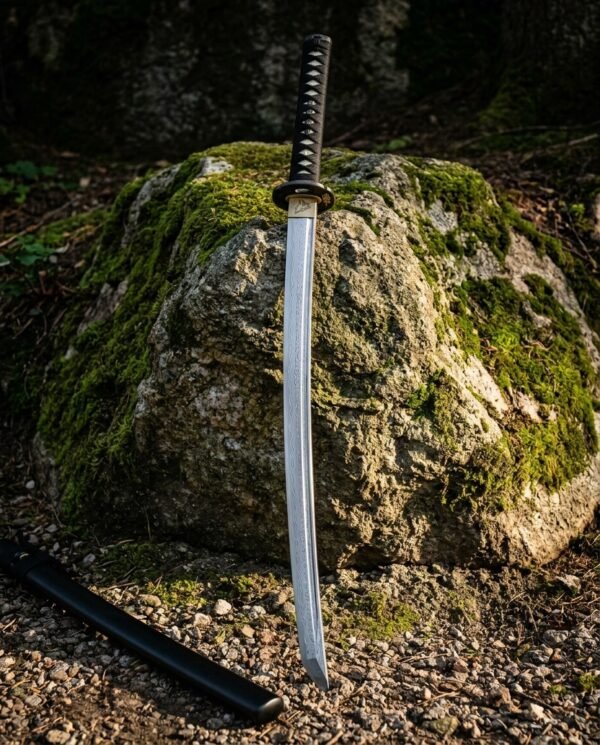
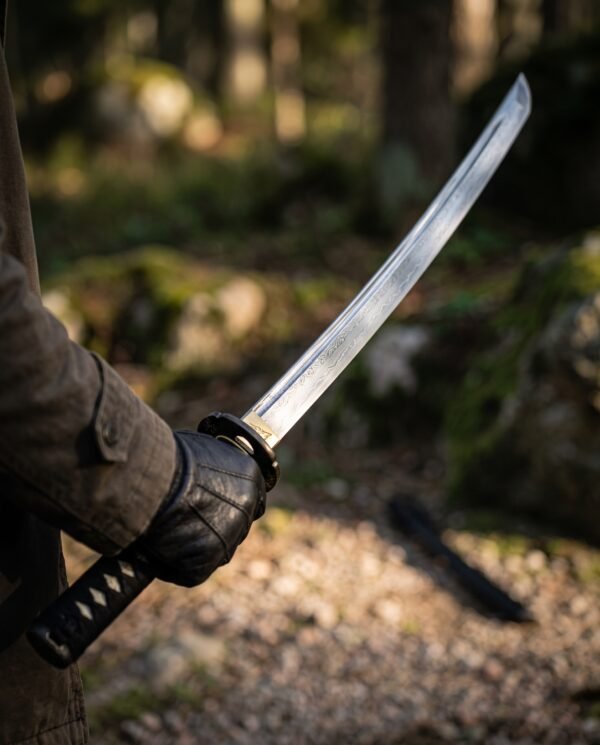
The Jadewake is a hand forged damascus katana built around a single edged blade with the shallow sori curve that gives the type its draw cut. The tsuka is wrapped in deep green cord over a textured underlay in the traditional diamond pattern, the tsuba is a dark pierced round plate behind a brass habaki, and the saya is turned from close grained hardwood with a brass mouth and a brass end cap. A green sageo cord is tied at the kurigata so the saya can be carried through a belt.
Here is the part most people get wrong about a katana. The curve is not filed into the steel as a shape. On a traditional clay quenched blade it appears during hardening, because the smith paints a thin clay coat along the edge and a thick coat along the spine, the edge cools faster, changes structure first and pushes the spine into a bow. That blade is soft in the back and hard at the edge. This one is different and we will say so plainly. A damascus billet is hardened through, so the curve on the Jadewake is forged and ground in by hand before heat treat rather than pulled out of a clay quench. The result is a blade that is uniform in hardness from spine to edge and holds the pattern across the whole surface. It is forged and finished in the Czech Republic, and it ships with the hardwood saya, the sageo already tied, and a cotton sleeve. The curve, the hamon and the parts by their proper names are in what is a katana.
Specifications
| Material | 1095 and 15N20 damascus steel, hardened to 58 to 60 HRC |
|---|
| Overall length | Approximately 40 inches in the saya |
|---|
| Blade length | Approximately 28 inches from habaki to tip |
|---|
| Blade profile | Single edged with a shallow sori curve, flowing layer pattern the full length |
|---|
| Handle | Approximately 11 inch tsuka, green cord wrap over a pale textured underlay |
|---|
| Fittings | Dark metal kashira and fuchi, brass habaki |
|---|
| Guard | Round dark pierced tsuba |
|---|
| Saya | Close grained hardwood, dark walnut tone, brass koiguchi and kojiri, green sageo |
|---|
| Finish | Hand etched and polished damascus |
|---|
| Weight | Approximately 2 lb 10 oz bare, 3 lb 6 oz with the saya |
|---|
| Included | Katana, hardwood saya, tied sageo cord, cotton storage sleeve |
|---|
| SKU | RK-1651 |
|---|
What the curve, the kissaki and the tsuba actually do
A katana is not a chopping sword. The curve means that when the arms travel in a straight line the edge meets the target at an angle and keeps travelling along it, so the cut is a slice with the weight of the swing behind it rather than a blunt impact. That is why the draw and the cut are one motion in the classical schools. The point section, called the kissaki, is ground as its own small geometry with its own boundary line, and it is the hardest part of a blade to grind well because the bevels have to change direction cleanly without a dip in the surface.
The tsuba does less than people expect. It is not a hand guard in the European sense and it will not catch a descending blade. Its job is to stop the hand sliding forward onto the edge during a thrust and to balance the sword slightly back towards the hand. A heavier tsuba pulls the balance point closer to the grip and makes the sword feel quicker in the wrist. On the Jadewake it is a dark pierced plate seated behind a brass habaki.
The steel and the pattern
The billet is 1095 high carbon steel and 15N20 nickel bearing steel, folded and drawn out by hand and then forged to shape. The two steels are chemically close enough to weld cleanly and far enough apart in nickel content that an acid etch darkens one and leaves the other bright. That contrast is the pattern. Nothing is printed, stamped or laser marked on this blade. Cut the steel anywhere along its length and the same layers run through the section.
After forging the blade is normalised, hardened and tempered to 58 to 60 HRC. That range is chosen on purpose. Below it a long blade will take a set and stay bent. Above it the steel becomes brittle in a piece this long and a hard knock at the tip can chip rather than deform. At 58 to 60 the blade takes a keen edge, holds it through repeated cutting practice on soft targets, and still has enough toughness to survive being handled by someone who is learning.
Engraving, runes and your own design
Use the rune converter on this page to turn a name, a date or a short phrase into Elder Futhark and we will cut it into the steel, the leather or the wood. If you would rather have a Viking pattern than a rune line, choose your own design in the engraving option above the add to cart button and tell us where it goes. Where a piece already carries an engraved design, your chosen engraving replaces it rather than sitting alongside it. On this katana the usual placements are along the flat of the blade near the habaki, on the face of the tsuba, or on the wood of the saya just below the mouth. See the engraving page for what fits in each spot.
Handling and balance
The Jadewake balances roughly four inches ahead of the tsuba, which is a light forward balance for a katana. It carries enough mass in the forward third to feel like it wants to complete a cut, without the tip heaviness that makes a sword tiring to hold at guard. Two hands on the tsuka is the intended grip, the right hand close under the tsuba and the left at the butt, with the wrists doing the last part of the cut rather than the shoulders.
This is a hand forged sharp sword and it is sold as a collector and display piece and for solo cutting practice on soft targets such as rolled mats and water bottles. It is not sold for full contact sparring against another blade and no sword with an edge should be used that way. Keep it in the saya when it is not in your hands and keep it away from children.
Care
Damascus is high carbon steel and it will rust if you leave it wet or leave fingerprints on it. Wipe the blade down after handling and put a thin film of mineral oil or camellia oil on it before it goes back in the saya. Never store a damp blade in wood, because the saya will hold that moisture against the steel for days. If the pattern starts to look flat, a light pass with a non abrasive metal polish and a re oil brings the contrast back. Full instructions are on steel care. The saya itself only needs a wipe and an occasional coat of furniture wax on the outside, never oil on the inside. Where the katana sits against the wakizashi and the tanto is settled in katana versus wakizashi versus tanto.
Made in the Czech Republic
The work behind this piece happens in a Czech Republic workshop that has kept to the old methods. Steel is forged and heat treated by hand, the grind is taken down by eye rather than by machine, and the handle, fittings and sheath are cut and finished one at a time. Because of that, every piece carries small marks of the hand that made it.
Ransack Viking is a United States company. We import direct, check each piece when it reaches us, and ship from our Chicago, Illinois warehouse. Engraving is added here in the United States after arrival, so the piece you receive is finished to your order.
A note on handmade variation
This katana is hand made, not machine made or bulk produced, so what arrives will not be a pixel for pixel copy of the photograph. The damascus pattern is different on every blade because it comes from how that particular billet was folded and drawn. The green of the wrap varies slightly with the dye lot. The grain and tone of the hardwood saya changes from one board to the next. The dimensions, the steel, the heat treat and the build are the same every time. The character is not.
Frequently asked questions
Is it sharp out of the box
Yes. It arrives with a working edge put on by hand and it will cut paper. Treat it as a sharp tool from the moment you open the box.
Is the wooden saya included in the price
It is. The hardwood saya, the brass mouth and end cap and the tied green sageo cord all come with the sword at no extra charge.
Can I use this for cutting practice
For solo practice on soft targets such as rolled tatami mats, pool noodles and filled bottles, yes. Do not use it against another blade or against hard targets like wood or bone.
Will the damascus pattern wear off
No. The pattern is the structure of the steel itself, not a coating. Polishing changes how strongly it reads but it cannot remove it.
Can I have a name cut into the blade
Yes. Send it through the rune converter for Elder Futhark or ask for plain lettering, and tell us whether you want it on the blade flat, the tsuba or the saya.
How long before it ships
One to two weeks while the blade is forged, ground and fitted, then free shipping inside the United States.
What is in the box
- Jadewake damascus katana with green cord wrapped tsuka and dark pierced tsuba
- Hardwood saya with brass koiguchi and kojiri
- Green sageo cord, tied and ready
- Cotton storage sleeve
- Care card for high carbon damascus
- Lifetime warranty against defects, no receipt needed
- Forged and finished in the Czech Republic
Explore the range
See the rest of the katana and Japanese swords, the wider damascus swords, everything under swords, and the guides for how these blades are carried and heat treated.
If this one is not it
Closest to this in the range is the Stormfold Japanese sword, pattern welded Damascus. If this one is not quite right, there is the Emberfold Japanese sword, 40 inches overall. Also in this group is the Spiralcrest Japanese sword, 40 inches overall.
If you are putting a set together, the Cinderpine wakizashi sits alongside it. Pick the steel, the length and the fittings yourself on the design your own page.



Reviews
There are no reviews yet