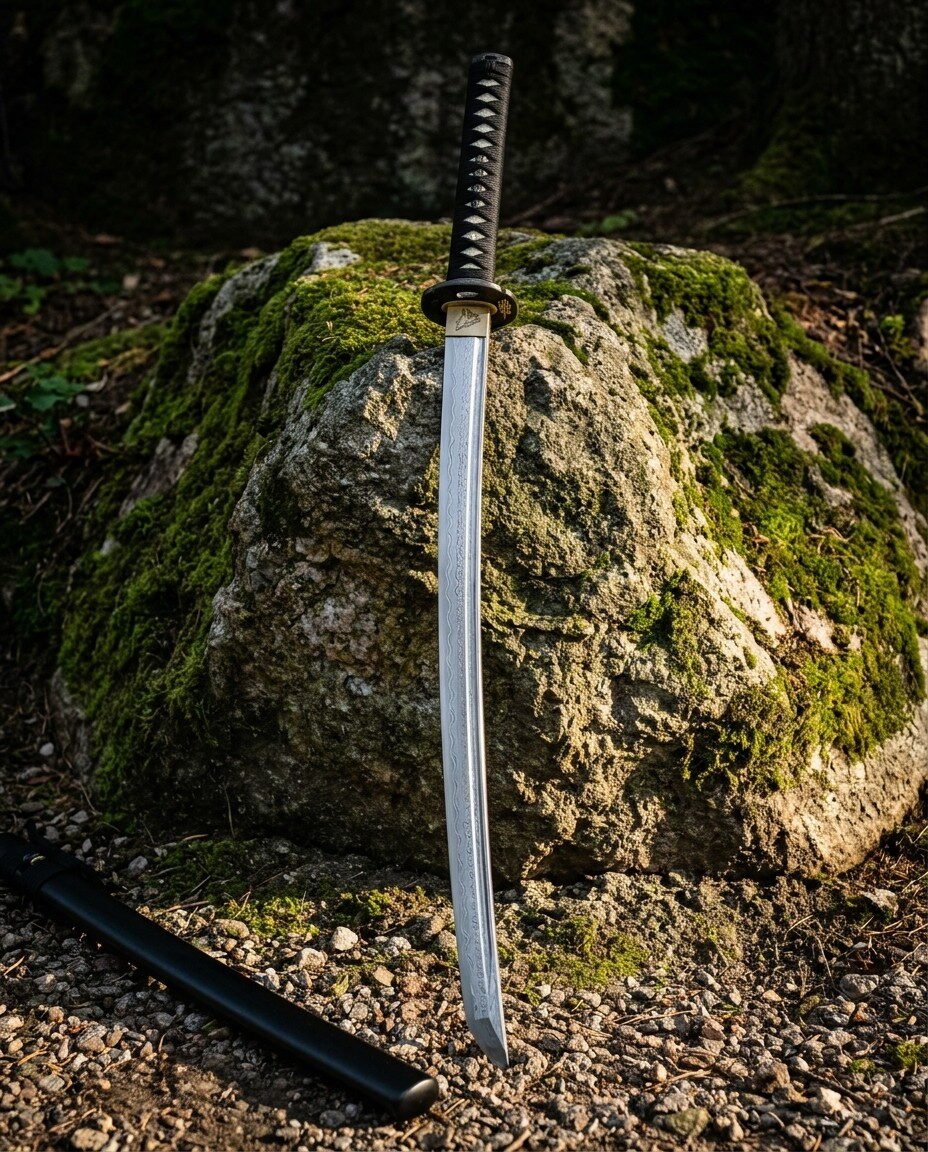
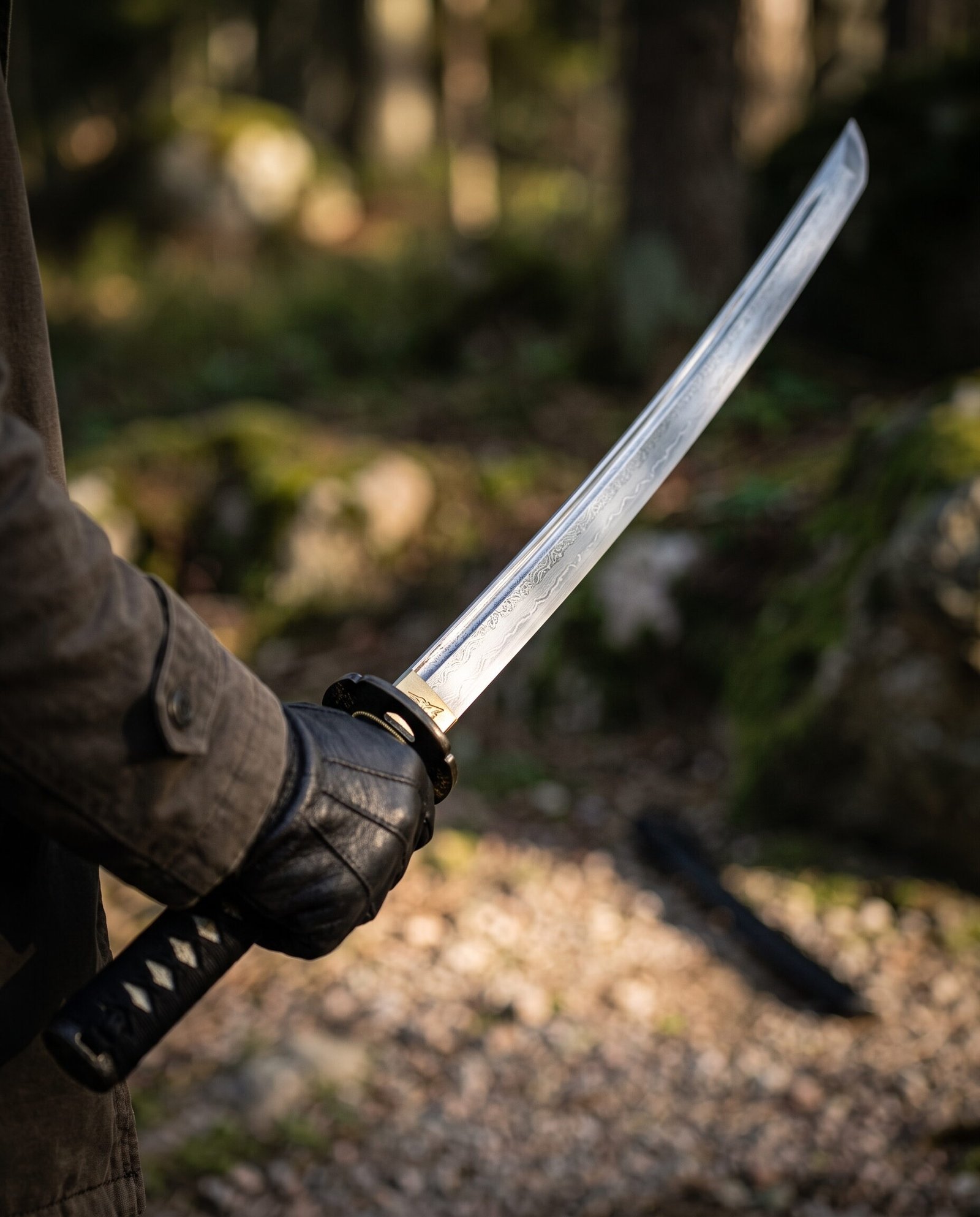
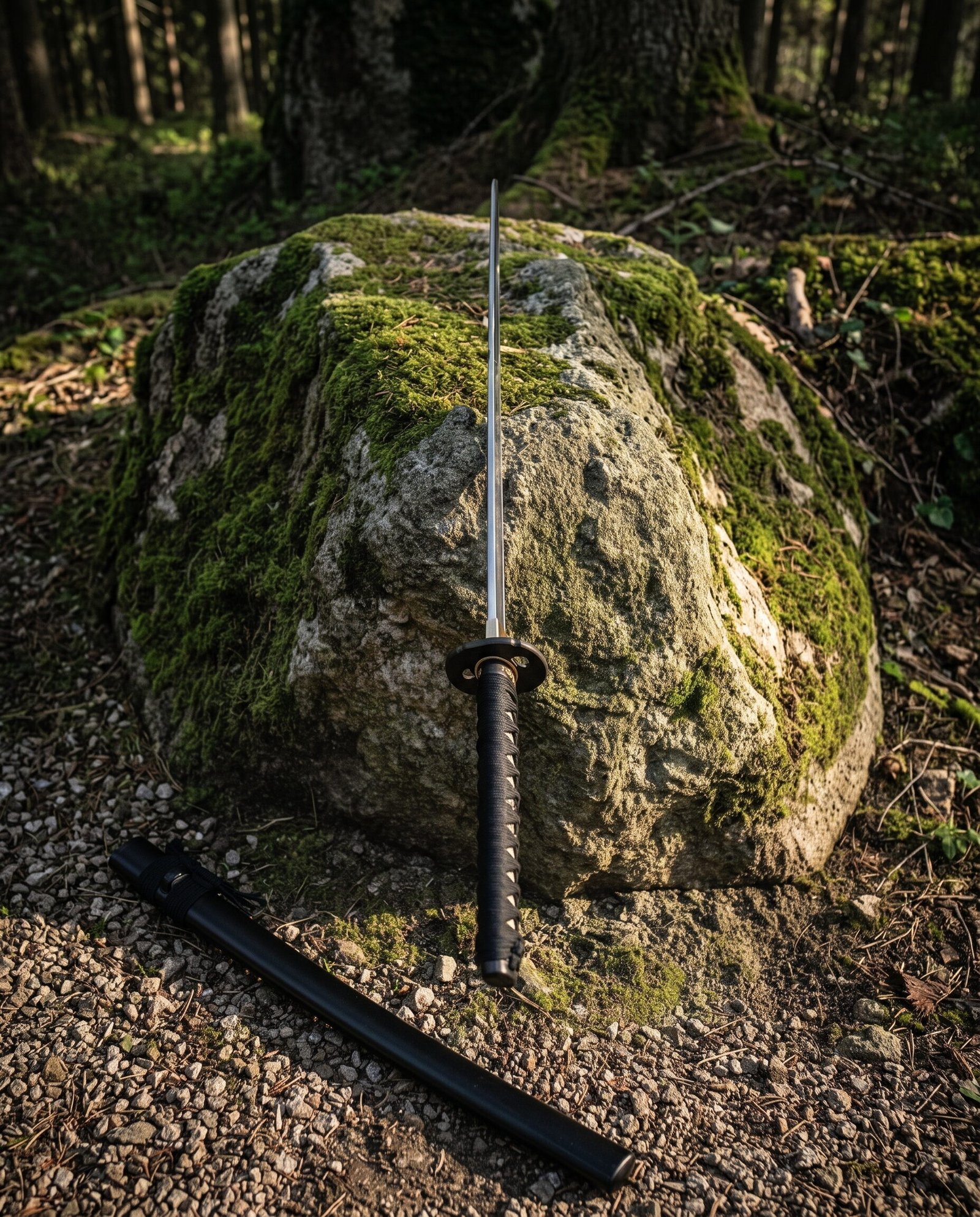
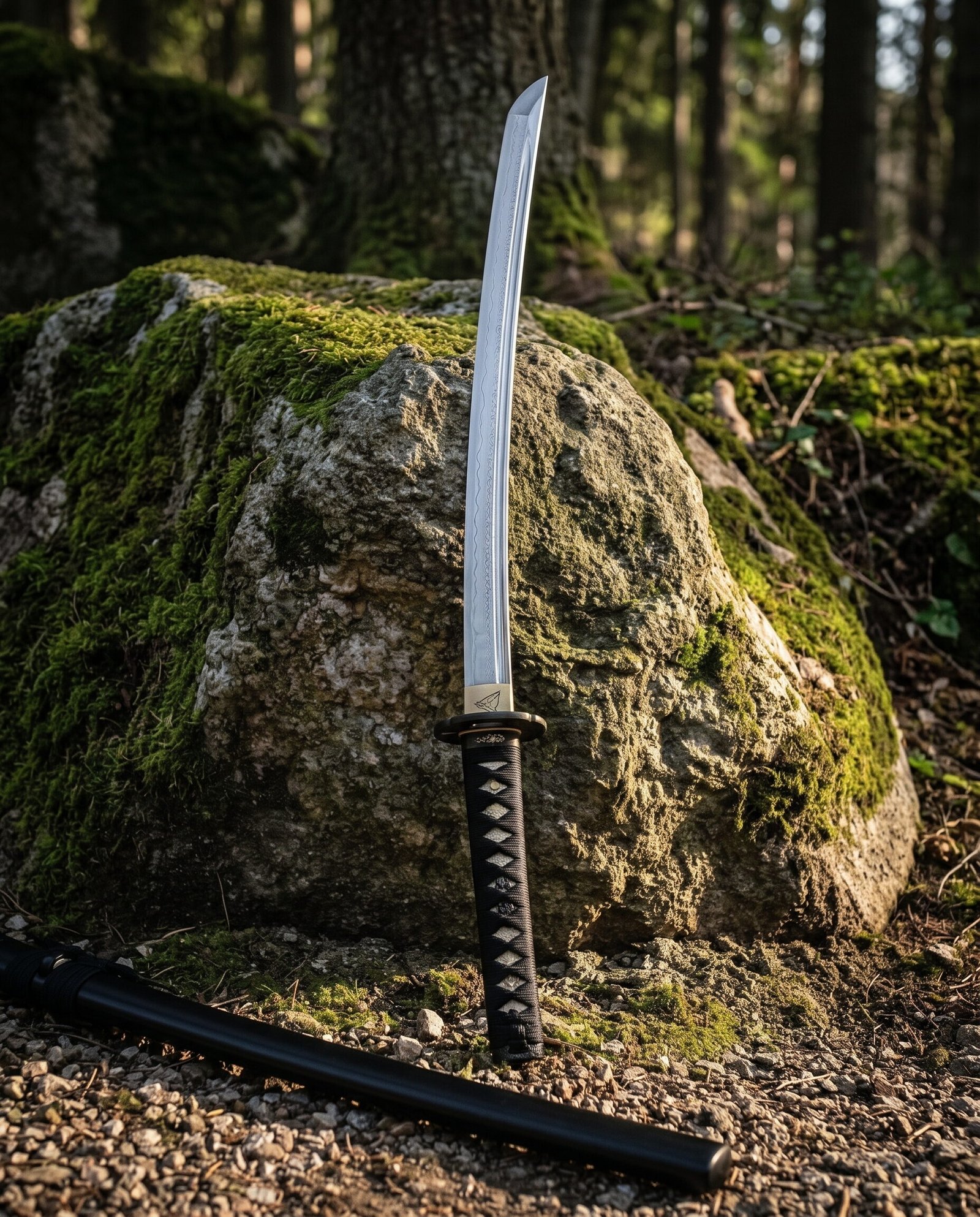
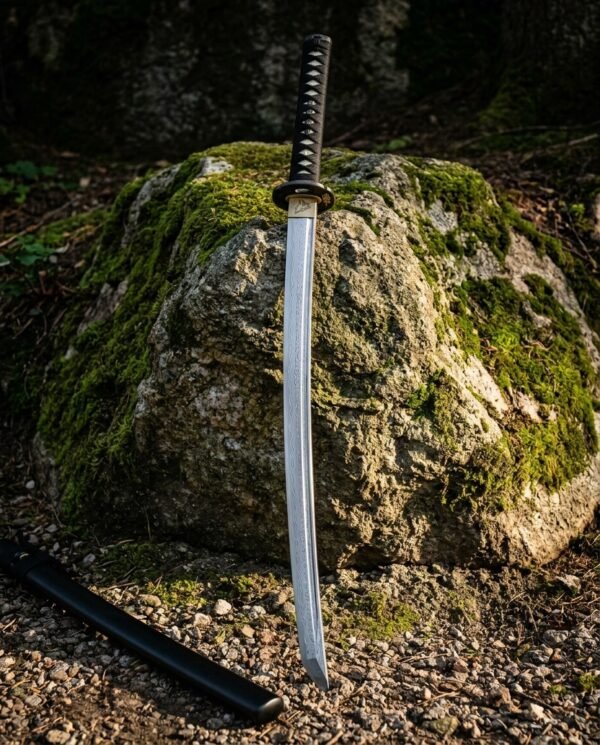
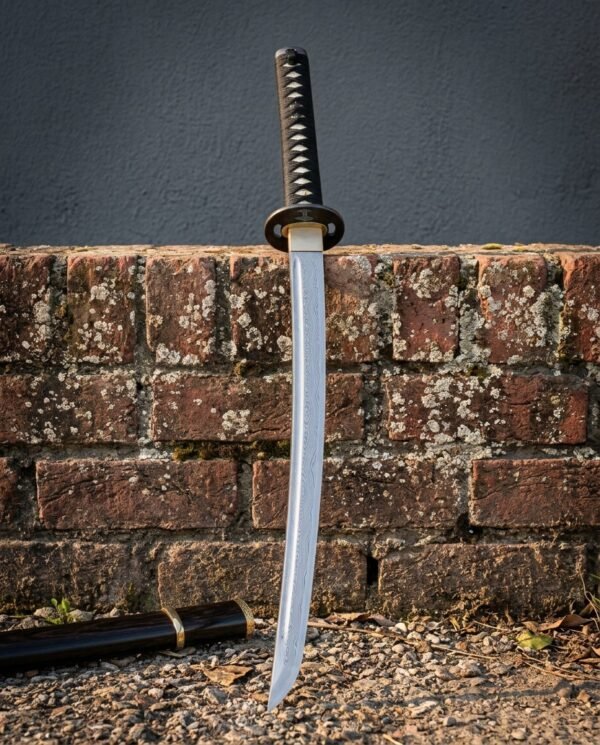
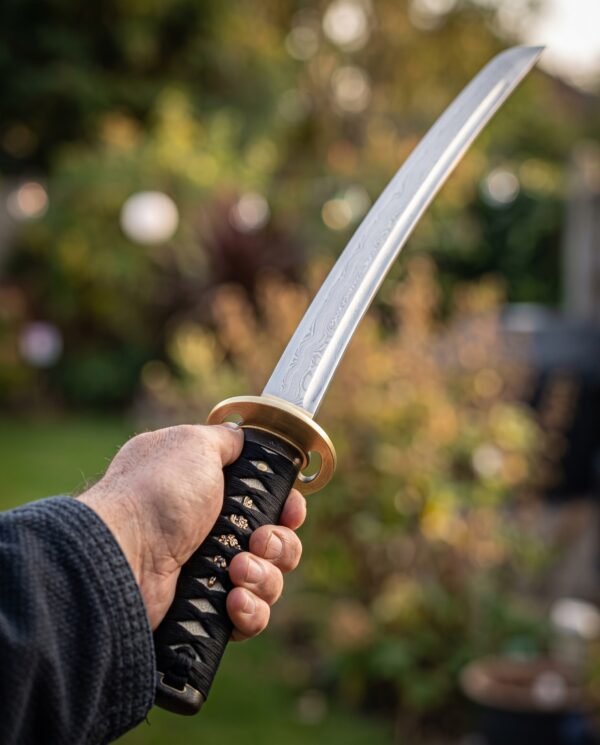
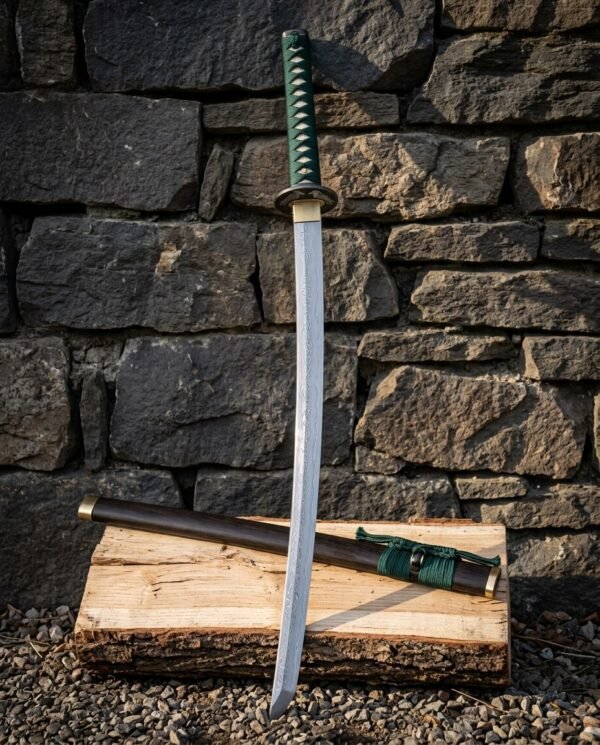
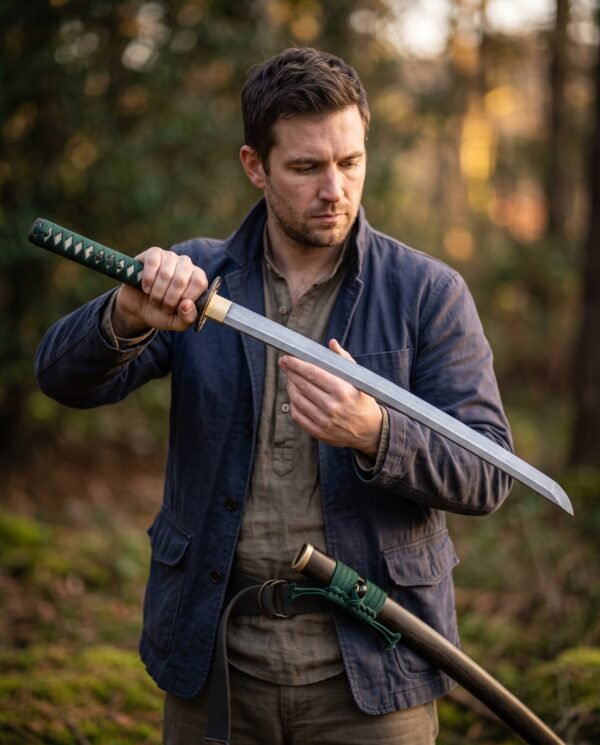
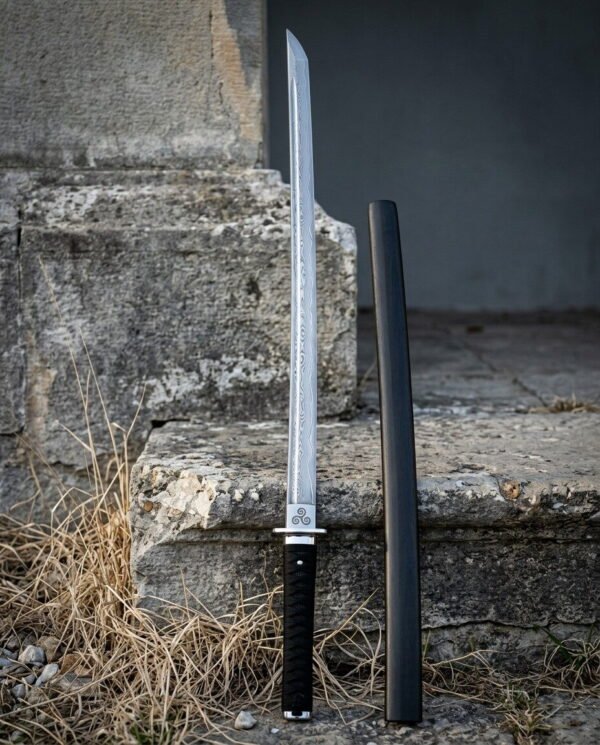
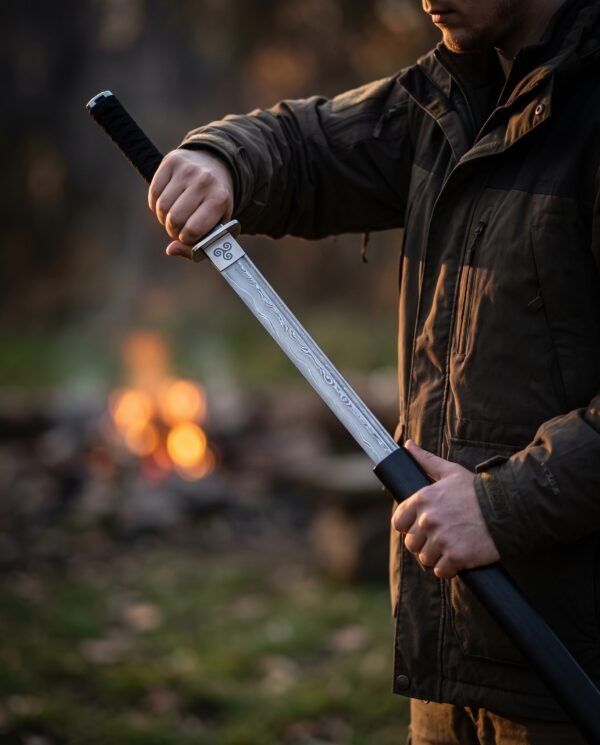
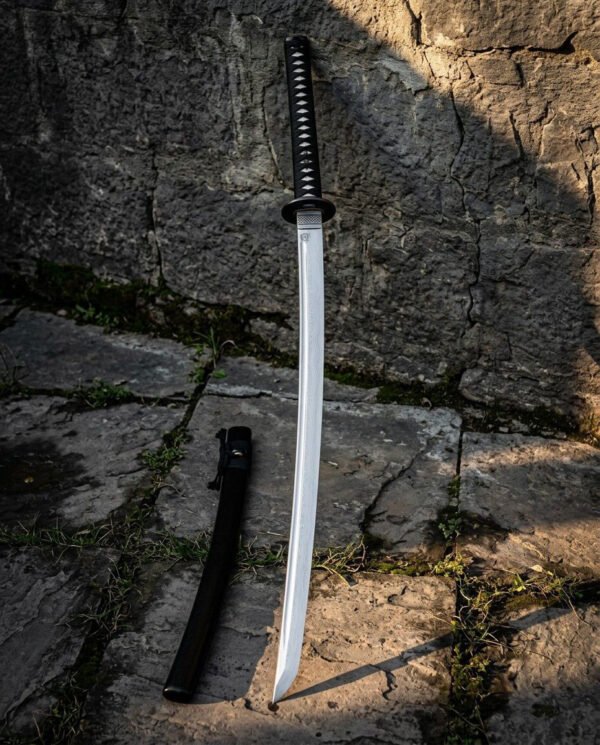
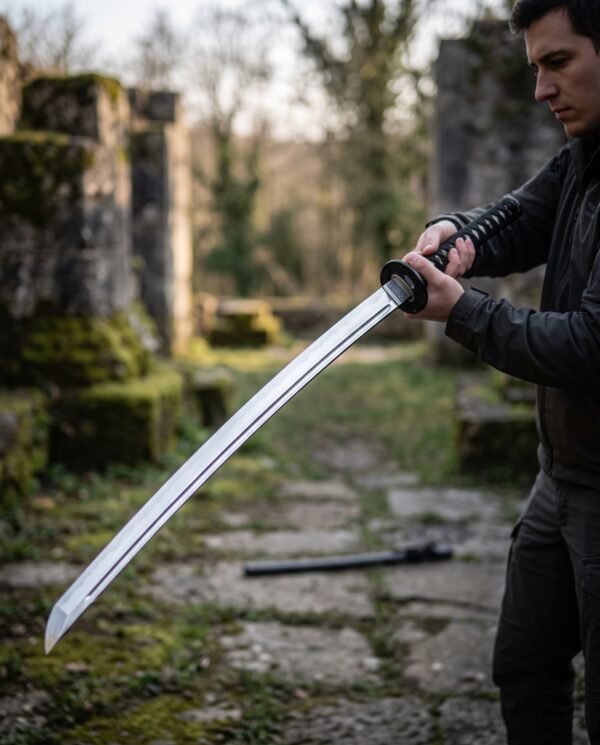
This is a katana with a pattern welded blade. The steel is a billet of alternating 1095 and 15N20 forged, folded and drawn out, so the finished blade carries a running wave pattern that follows the curve from the habaki to the kissaki. The tsuka is bound in black ito over pale same, the tsuba is a round iron plate with a gold toned inlay, and the saya is black lacquered wood. It is a two hand sword with a genuine sori, the gentle curve that makes a katana cut the way it does.
The curve is the interesting part, because on a traditionally made blade nobody puts it there on purpose. The smith forges the blade straight, coats the spine in a thick jacket of clay and the edge in a thin one, and quenches. The thinly coated edge cools first and transforms to martensite, which is a less dense crystal structure than the steel it came from, so the edge expands. The spine, still insulated, cools slowly and stays soft. An expanding edge on a stable spine can only do one thing, and the blade bends itself backward into a curve in the quench tank. Japanese smiths spent centuries learning to predict how much.
Forged, ground, heat treated, polished and mounted by hand in the Czech Republic, and shipped with its saya. It is part of the Japanese swords, and the short swords are put together the same way.
Specifications
| Blade steel | 1095 and 15N20 Damascus, pattern welded, hardened to 58 to 60 HRC |
|---|
| Overall length | 40 inches nominal in the saya |
|---|
| Blade length | 27 inches nominal, single edged with a curved profile |
|---|
| Pattern | Running wave, etched to bring out the layer contrast |
|---|
| Habaki | Brass collar with an engraved motif |
|---|
| Tsuba | Round black iron plate with a gold toned inlay |
|---|
| Tsuka | Black ito cord wrapped over pale same, black kashira, two hand length |
|---|
| Saya | Black lacquered wood, fitted to the blade |
|---|
| Finish | Etched and polished Damascus blade, satin black furniture |
|---|
| Included | Fitted saya |
|---|
| SKU | RK-1777 |
|---|
Where the pattern comes from
Pattern welded steel is often called Damascus, which is a historical misnomer that has stuck. What it actually is, is two different steels forge welded into a single billet and then manipulated until the boundary between them becomes a picture.
We use 1095 and 15N20. They are chosen for one reason above all others. 15N20 contains about two percent nickel, and nickel does not react with the acid we etch the finished blade in. 1095 does. So when the polished blade goes into the etch, the 1095 layers darken and the 15N20 layers stay bright, and the boundary between hundreds of alternating layers becomes visible as a pattern. Without that difference in etch response you would have a perfectly good billet with nothing to look at.
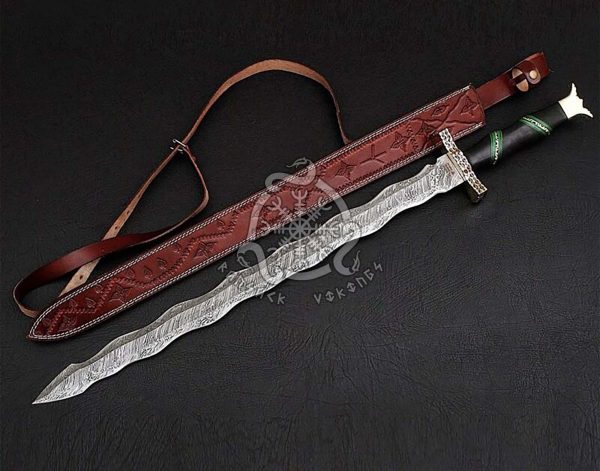
The wave you see running along this blade is made by grinding a set of shallow ladder cuts into the surface of the billet before the final draw out, then forging them flat again. The layers underneath dome upward into each cut, and when the surface is ground back down the domes are cut through and reveal themselves as a repeating wave. Every one is slightly different because the layers move under the hammer rather than under a program.
Steel, hardness and honesty about what this is
The billet is 1095 and 15N20, hardened to between 58 and 60 HRC. On a single edged blade with a thick spine you can afford a harder edge than on a double edged European sword, because the spine carries the toughness and only the edge needs to be hard.
What this is not is a traditionally made Japanese nihonto. We do not smelt tamahagane in a tatara, we are not a Japanese licensed smith and we are not going to pretend otherwise. This is a modern pattern welded katana, forged by hand from modern high carbon steels in the Czech Republic, mounted in the traditional layout. It is an honest and very good sword. It is not an antique and it is not a licensed reproduction of one.
The blade will rust if it is neglected. Neither 1095 nor 15N20 contains chromium and the etch that reveals the pattern also opens the surface slightly.
Engraving, runes and your own design
Use the rune converter on this page to turn a name, a date or a short phrase into Elder Futhark and we will cut it into the steel, the leather or the wood. If you would rather have a Viking pattern than a rune line, choose your own design in the engraving option above the add to cart button and tell us where it goes. Where a piece already carries an engraved design, your chosen engraving replaces it rather than sitting alongside it.
On a pattern welded blade we usually put engraving on the nakago, the tang under the wrap, or on the habaki, because cutting into the etched surface of the blade interrupts the pattern. If you want a line on the blade itself we will do it, but we will tell you first where the pattern will be broken. See the engraving page.
Handling and balance
Hold it with the hands apart, left hand at the base of the tsuka and right hand up near the tsuba, and let the left hand do the pulling. Almost everyone new to a katana grips too hard with the right and too loosely with the left, which turns a cutting sword into a club.
The curve means the edge meets a target at a slicing angle rather than square on, and the cut is finished by drawing the blade through rather than chopping into. That is the whole point of a curved single edged sword and it is why a katana out cuts a straight blade of similar weight on soft targets.
It arrives sharp. This is a real forged and hardened blade. We do not sell it for sparring, for contact drills with a partner, or for tameshigiri without proper instruction. Cutting practice with a live blade is something to learn under someone who knows what they are doing, in a space with nothing behind the target.
Care
Wipe the blade after every handling, with a clean cloth, from the habaki toward the tip, spine side of the edge. Then a thin film of camellia oil, which is the traditional choice and works as well as anything modern. An etched Damascus surface holds moisture in its topography more readily than a mirror polish does, so this blade needs slightly more attention than a plain one. See our steel care notes for the full routine.
Do not leave it in the saya for months at a time. A lacquered wooden saya is a sealed tube and any moisture that goes in with the blade stays in. Wipe, oil, and store the sword horizontally with the edge up if you are leaving it for a season.
Never put anything abrasive on the blade. A Damascus pattern lives in the top fraction of a millimetre and a scouring pad will take it off permanently.
Made in the Czech Republic
This is a handmade piece from the Czech Republic, made in a workshop that still forges, grinds and finishes by hand instead of stamping parts out. The smiths there have kept the older way of working, and the wood, horn and leather are shaped and fitted by hand as well. Two pieces of the same design will never be identical, and that is part of what you are buying.
Ransack Viking is a United States company. We handle the import ourselves, look over every piece when it lands and ship from our warehouse in Chicago, Illinois. Engraving is done in the United States after the piece arrives, so your design goes on before we send it out.
A note on handmade variation
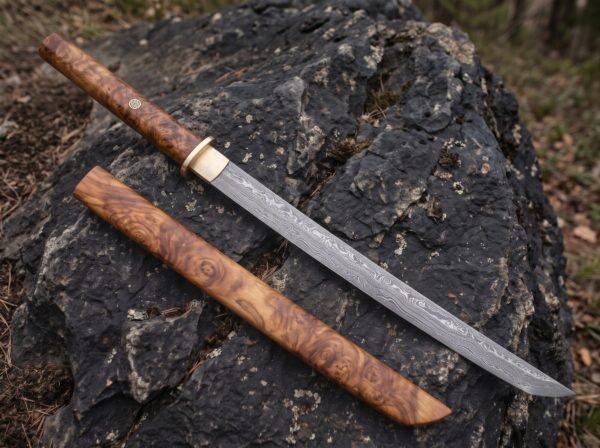
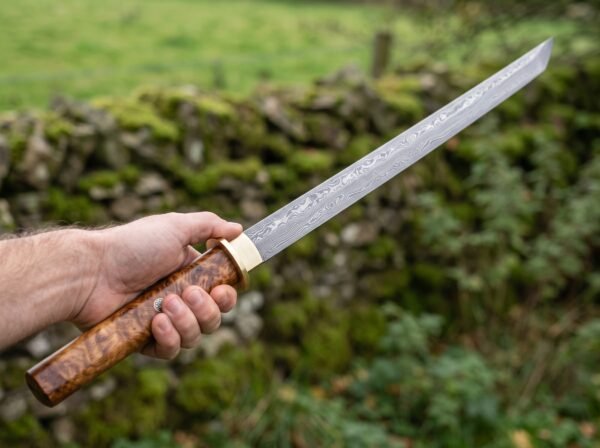
This katana is hand made rather than machine made or bulk produced, so what arrives will not be a pixel for pixel copy of the photograph. No two pattern welded blades carry the same pattern. The waves sit at different intervals, the contrast between light and dark layers shifts with the etch, and the exact depth of the curve varies a little because the curve comes out of a quench rather than a die. The ito wrap is tied by hand and the diamonds it forms are a person’s work.
The steel, the hardness, the dimensions and the build are the same every time. The pattern is yours alone. The long form of that is what the wakizashi was for, with the tanto next to it.
Frequently asked questions
Is the pattern etched on or is it real Damascus?
It is real. The pattern goes all the way through the blade because it is made of hundreds of alternating layers of two steels. Acid etching only reveals what is already there. A printed or surface etched pattern disappears the first time the blade is sharpened. This one does not.
Is it sharp out of the box?
Yes. It ships with a working cutting edge and should be treated as a live blade from the moment the box opens.
Is this a traditional Japanese made sword?
No, and we will not claim it is. It is a modern pattern welded katana forged by hand in the Czech Republic in the traditional mounting. It is not a nihonto and it is not made from tamahagane.
Will the pattern wear off with sharpening?
No. Sharpening removes a little steel from the very edge and exposes the next layers down, so the pattern simply continues. Only heavy polishing of the flats will change how it looks, and even then the pattern is still there.
Can I hang it on a wall?
Yes, or stand it on a katana stand with the edge upward. Hanging it edge down for years lets oil creep toward the tsuka and soak into the wrap.
How long does it take to arrive?
Processing is one to two weeks because pattern welding takes time and the sword is made after you order. Shipping within the United States is free.
What is in the box
- Tidefold Damascus katana, 1095 and 15N20, sharpened
- Fitted black lacquered saya
- Light protective oil coat on the blade
- Damascus care card
- Forged and finished in the Czech Republic
Explore the range
See the rest of the katana and Japanese swords, the Damascus swords, the full swords range, and the guides.
Also in this part of the catalogue
Sitting beside it in the catalogue is the Nightfold Japanese sword, pattern welded Damascus. Another in the same line is the Knotcurve Japanese sword, forged from 1095. Next along the rack is the Shadowfen Japanese sword, pattern welded Damascus.
Fitting out further, the Drakefang sword belongs with it. Or start from a blank sheet on the design your own page.

Average quality for the price honestly. It’s fine but I expected a little more for the price. Handle material felt a bit different than pictured. Not bad, not amazing either.
This thing is a beast in the best way. The wood handle feels amazing and the balance is perfect. Shipping was fast and everything arrived well packaged.
This sword is a genuine work of art. Came in a nice gift box which made it feel even more special. Shipping was fast and everything arrived well packaged.