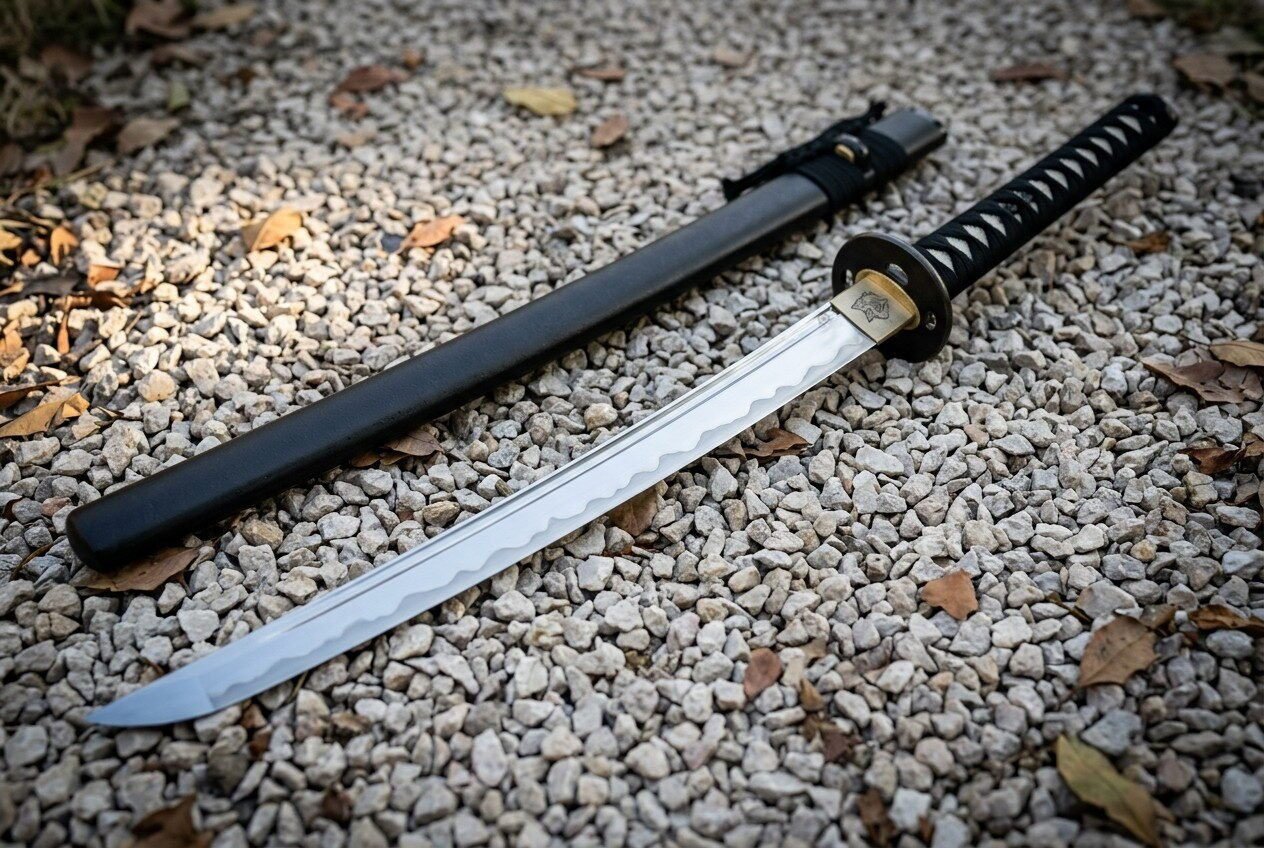
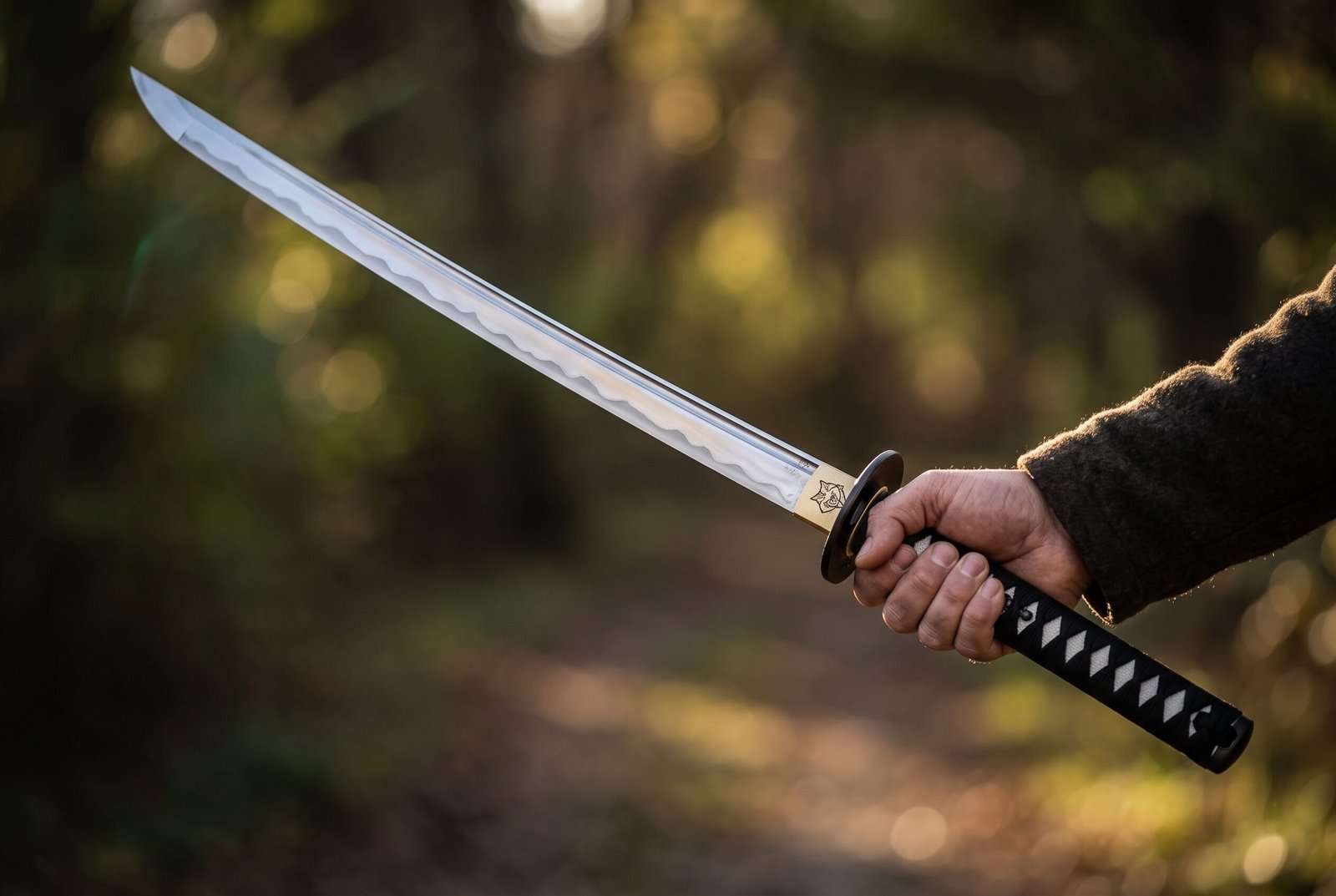
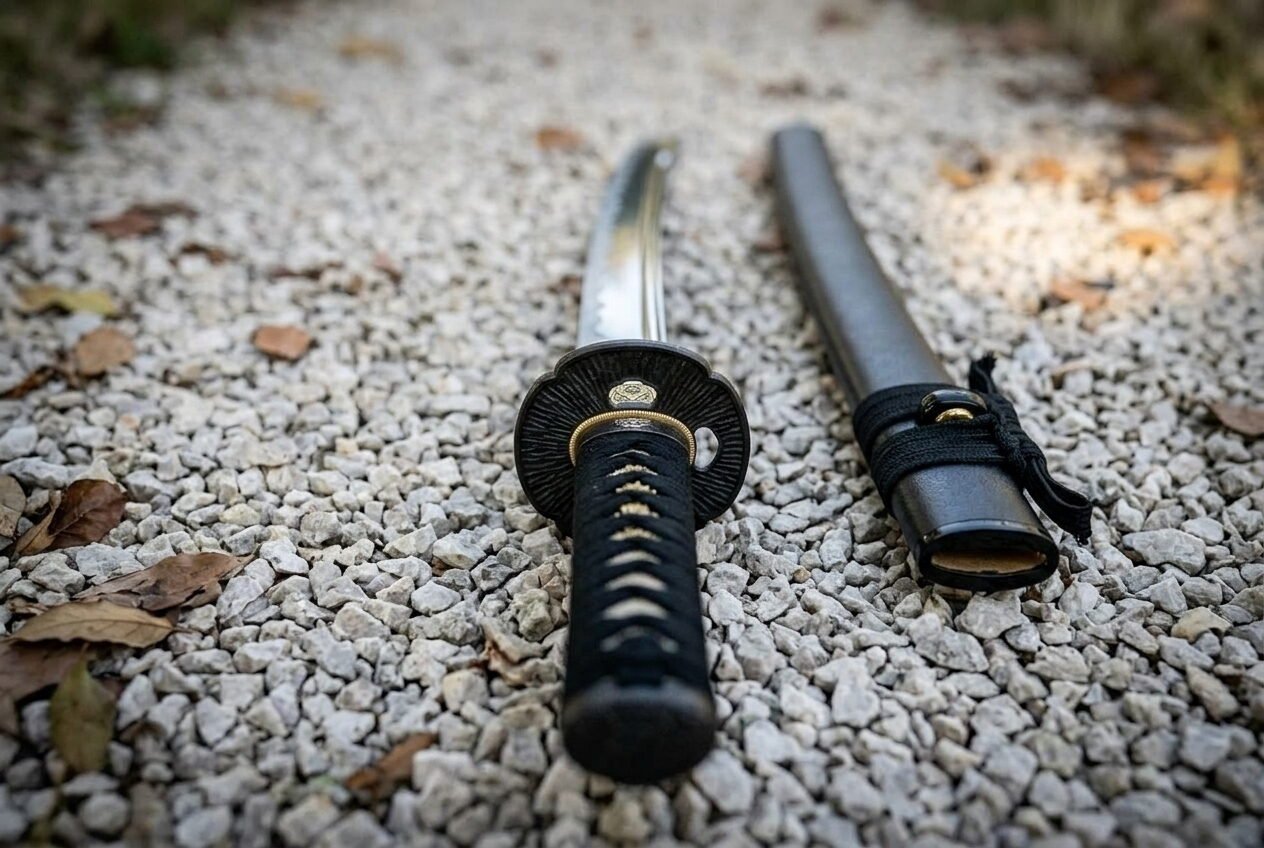
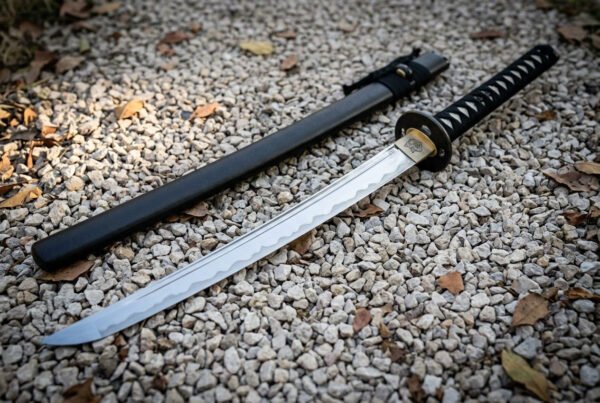
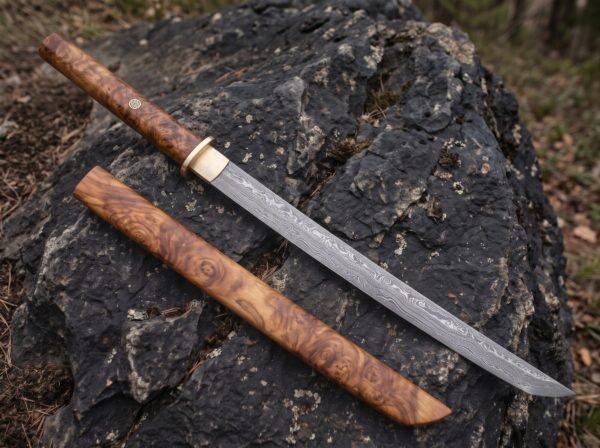
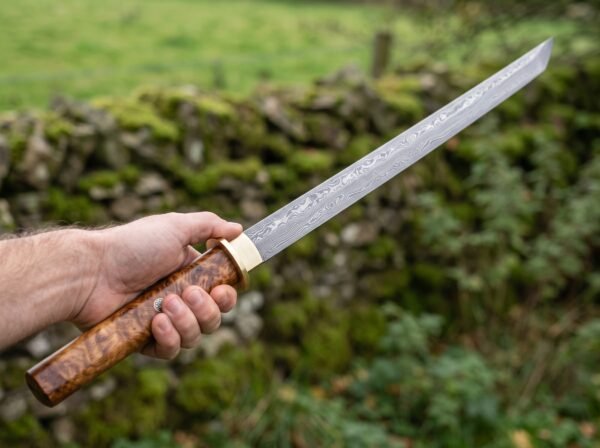
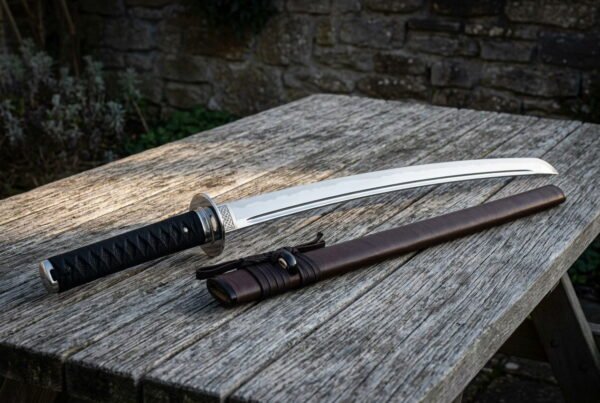
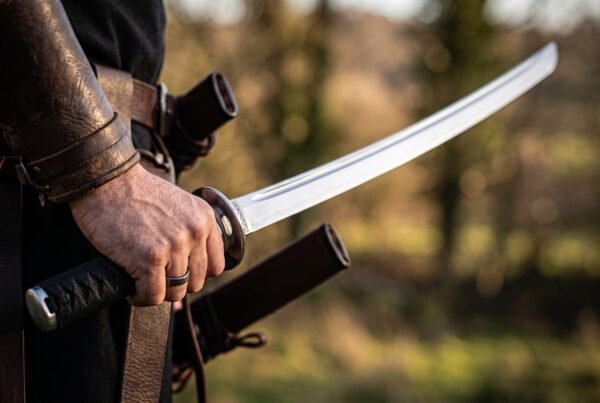
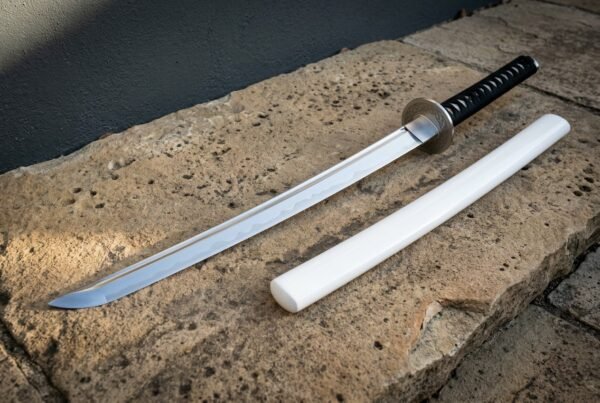
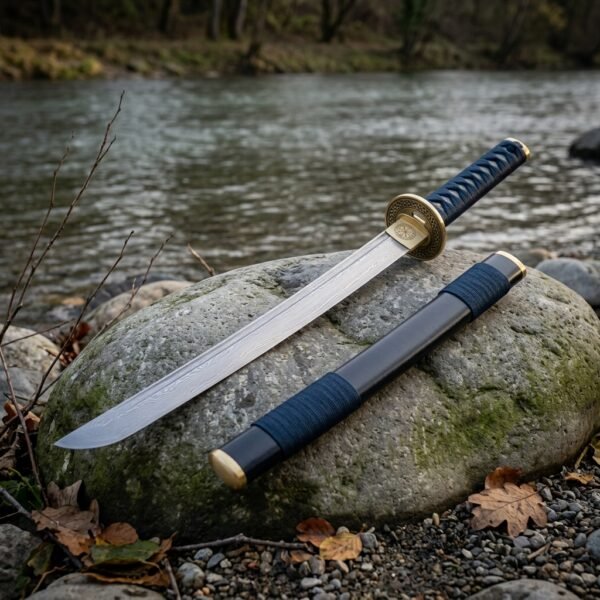
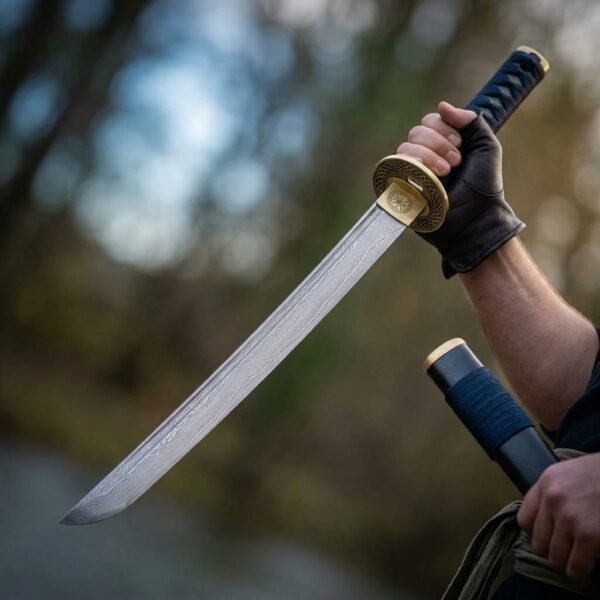
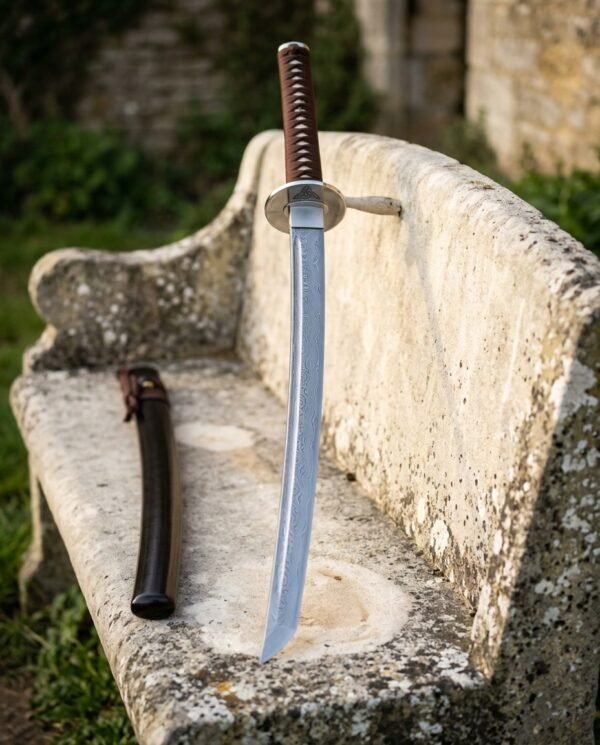
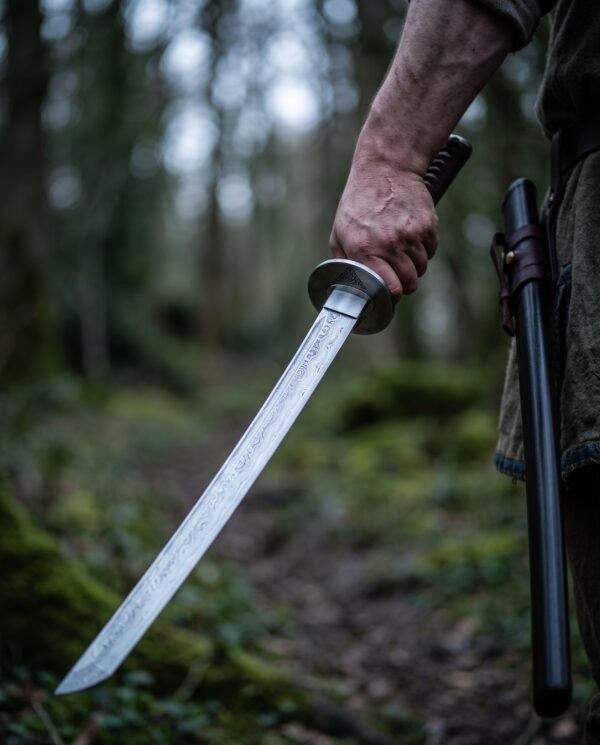
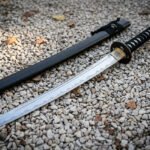
The Moonwake is a wakizashi, the shorter of the two swords a samurai carried, forged from 1095 high carbon steel and clay hardened so a real hamon runs the length of the edge. The temper line on this one is a rolling notare pattern, bright and slightly cloudy against the darker body of the blade. Fittings are a round black tsuba, a brass habaki with an engraved motif at the base of the blade, a black ito wrapped tsuka and a lacquered black saya.
The wakizashi was the sword that stayed on the hip. A visitor entering a house left the long sword with a servant at the door and kept the short one, which is why it turns up in so many accounts of indoor incidents, and why the pair together were called the daisho, the large and the small. At around eighteen inches of blade it is short enough to draw in a corridor and long enough to be a serious blade. Every Moonwake is forged, clay hardened, polished and mounted by hand in the Czech Republic. Look for it with the wakizashi, and take in the Japanese swords on the way past.
Specifications
| Steel | 1095 high carbon steel, clay hardened |
|---|
| Hardness | 54 to 58 HRC, edge at the top of the range with a softer spine |
|---|
| Overall length | Approximately 26 inches in the saya |
|---|
| Blade length | Approximately 18 inches from habaki to tip |
|---|
| Blade finish | Polished blade with a visible rolling notare hamon along the edge |
|---|
| Tsuka | Approximately 7 inches, black ito wrapped over white ray skin |
|---|
| Tsuba | Round black tsuba |
|---|
| Habaki | Brass, engraved |
|---|
| Fuchi and kashira | Black, matching the tsuba |
|---|
| Tang | Full length nakago held by a bamboo mekugi peg |
|---|
| Saya | Lacquered black saya with a black sageo cord |
|---|
| SKU | RK-1757 |
|---|
The hamon and how it gets there
The wavy bright line following the edge of this blade is a hamon, and it is a map of where the steel is hard. Before the quench the smith coats the blade in a clay slurry, thick along the spine and thin or absent along the edge. Into the water it goes. The bare edge cools in a fraction of a second and transforms into martensite, which is hard, brittle and bright. The clay slows the spine enough that it cools into pearlite, which is softer and tougher and etches darker. The boundary between the two is the hamon.
That single trick is why a Japanese blade can be run hard at the edge without snapping. The edge holds a razor because it is glass hard. The spine absorbs shock because it is not. A blade hardened all the way through at the same figure would either be soft at the edge or brittle everywhere. The wavy line is a by product of a real engineering decision, not a decoration, and the shape it takes depends entirely on how the clay was laid. This one is a notare, a gentle rolling wave. A hamon that is painted or wire brushed on will sit flat on the surface and look identical from every angle. A real one changes as you tilt the blade under a light, because you are seeing into a difference in the metal rather than at a mark on it.
The steel and the heat treat
1095 is the right steel for a differentially hardened blade because it is simple. There is nothing in it but iron, carbon and a little manganese, so it responds to the water quench sharply and predictably, and it develops the fine grained martensite that gives a clean hamon. Alloy steels with chromium or vanadium in them behave sluggishly in water and produce a muddy line, which is one reason the traditional method stayed with plain carbon steel.
The edge lands around 58 HRC and the spine sits well below it. That is a real differential heat treat and not a printed line. It also means the blade will rust like any plain carbon steel: there is no chromium here and no corrosion resistance at all. A blade left with a fingerprint on it for a week in a humid room will keep that fingerprint as a shadow.
Engraving, runes and your own design
Use the rune converter on this page to turn a name, a date or a short phrase into Elder Futhark and we will cut it into the steel, the leather or the wood. If you would rather have a Viking pattern than a rune line, choose your own design in the engraving option above the add to cart button and tell us where it goes. Where a piece already carries an engraved design, your chosen engraving replaces it rather than sitting alongside it. On the Moonwake the nakago under the wrap is the traditional place for a mark and takes a rune line without touching the polished flat, and a chosen design on the habaki replaces the motif already there. See the engraving page.
Handling and balance
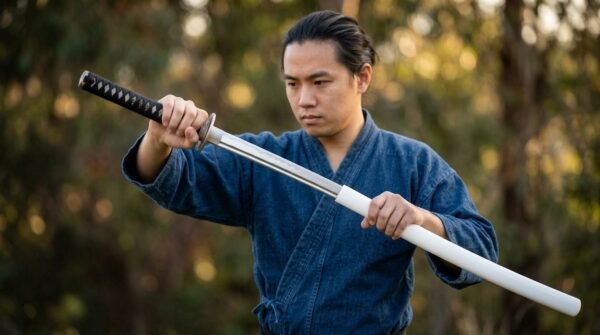
A wakizashi is a one handed sword for most people and a very cramped two handed one for the rest. Balance sits about three inches ahead of the tsuba, which is much closer to the hand than on a katana, and the whole sword feels quick and a little nervous by comparison. That is correct. This blade was made for close quarters where a long sword cannot be drawn, and everything about the proportions serves that.
Check the bamboo mekugi peg before you handle it. It is the one component designed to be sacrificial and it should be snug, replaceable and dry. This is a sharp forged blade suited to collection, display and supervised cutting practice on soft targets. It is not a blunt trainer and it should never be used in contact practice against another person or another blade.
Care
Wipe the blade along its length with a soft cloth after every handling, never across the edge, and keep a thin film of camellia oil or light mineral oil on the steel. Do not leave the sword in the saya for months in a humid room. Lacquered wood traps moisture and a hamon polish is exactly the sort of finish that shows the first spot of rust. Uchiko powder is the traditional cleaning method and it works, but it is mildly abrasive, so use it sparingly rather than every week. Keep the ito wrap dry and out of direct sun. There is more on our steel care page.
Made in the Czech Republic
This piece is made by hand in the Czech Republic, in a workshop that still works the old way. The steel is forged, ground, heat treated and finished by smiths who learned the trade from the people before them, and the wood, horn and leather are cut and fitted by hand rather than pressed out on a line. That is also why no two pieces come out exactly the same.
Ransack Viking is a United States company. We import these pieces ourselves, check every one when it lands and ship from our warehouse in Chicago, Illinois. Engraving is done here in the United States after the piece arrives, so your runes or your own design go on before it leaves for you.
A note on handmade variation
Each blade is made by hand and not machine produced in bulk, so what arrives will not be a pixel for pixel copy of the photograph. The hamon in particular is unrepeatable. It is the record of how the clay was laid on that one blade and how the water took it, and the peaks and valleys of your temper line will not sit where they sit in the picture. The polish, the tone of the brass habaki and the tightness of the ito wrap all move a little from piece to piece. The length, the steel, the hardness and the build are the same every time. The character is not. You can carry on with what the wakizashi was for, or look at sharpening a curved blade while you are there.
Frequently asked questions
Is the hamon real
Yes. It comes from clay hardening the blade before the quench, which is why it changes appearance as you tilt the sword under a light. A wire brushed or acid painted line looks the same from every angle and this one does not.
Is it sharp out of the box
Yes, it arrives with a working edge. Ask in the order notes if you want it blunted for display or for a household with children and we will roll the edge at no extra cost.
How is this different from a katana
Length, mostly. A wakizashi runs around eighteen inches of blade to a katana around twenty seven, and it was carried indoors when the long sword was left at the door. The two together made the daisho pair.
Will it rust
Yes if you neglect it. 1095 has no chromium in it. Wiped and oiled after handling it will stay clean for years, and left damp in a saya it will spot within a month.
Is the saya included
Yes. The lacquered black saya shown in the photograph is made to this blade so the koiguchi seats with a click rather than rattling loose.
How long does shipping take
Processing takes one to two weeks because the blade is made rather than picked from a shelf, plus a few days for engraving. Shipping inside the United States is free and returns are accepted within seven days.
What is in the box
- Moonwake wakizashi in clay hardened 1095 high carbon steel
- Lacquered black saya fitted to this blade
- Black ito wrapped tsuka over ray skin with a bamboo mekugi peg
- Engraved brass habaki and matching fittings
- Care sheet with oiling and storage instructions
- Lifetime warranty against defects in forging, grind, heat treat and fittings
- Forged and finished in the Czech Republic
Explore the range
See the rest of the wakizashi, our katana and Japanese swords, the full range of swords, and the guides.
Close to this one
Closest to this in the range is the Trithorn wakizashi, forged from 1095. If this one is not quite right, there is the Shadowcurve wakizashi, 28 inches overall. Also in this group is the Snowfold wakizashi, 30 inches overall.
If you are putting a set together, the Blackreed Japanese sword sits alongside it. Nothing here exactly right, build one to your own spec on the design your own page.


Reviews
There are no reviews yet