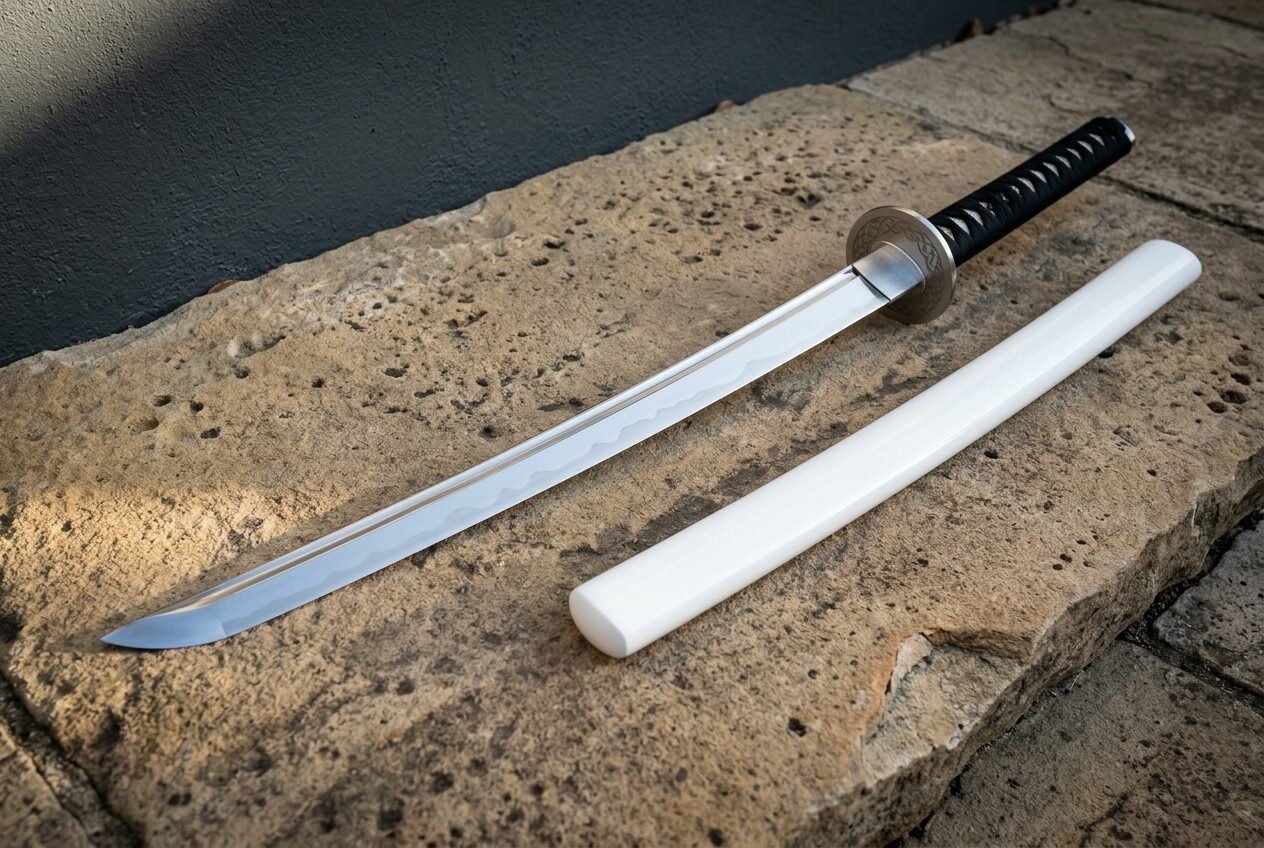
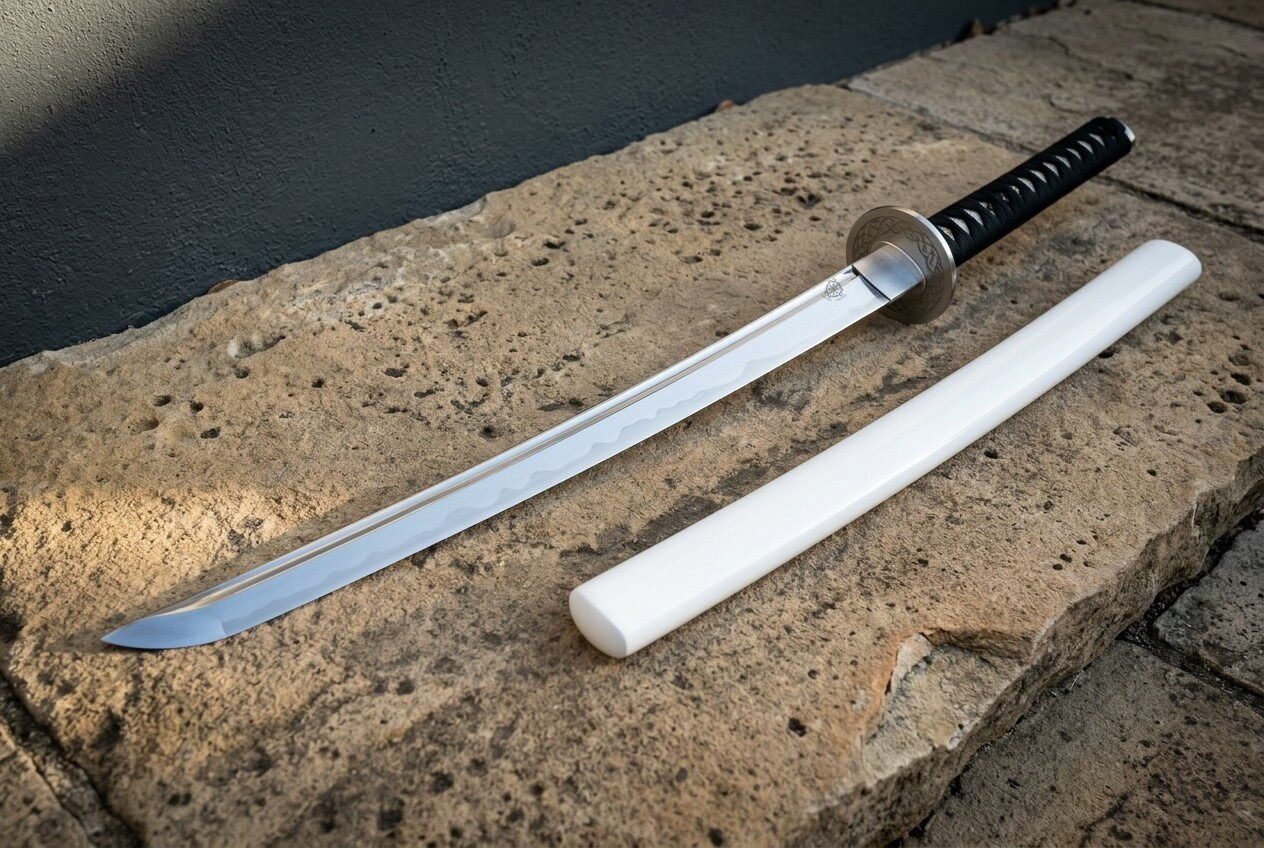
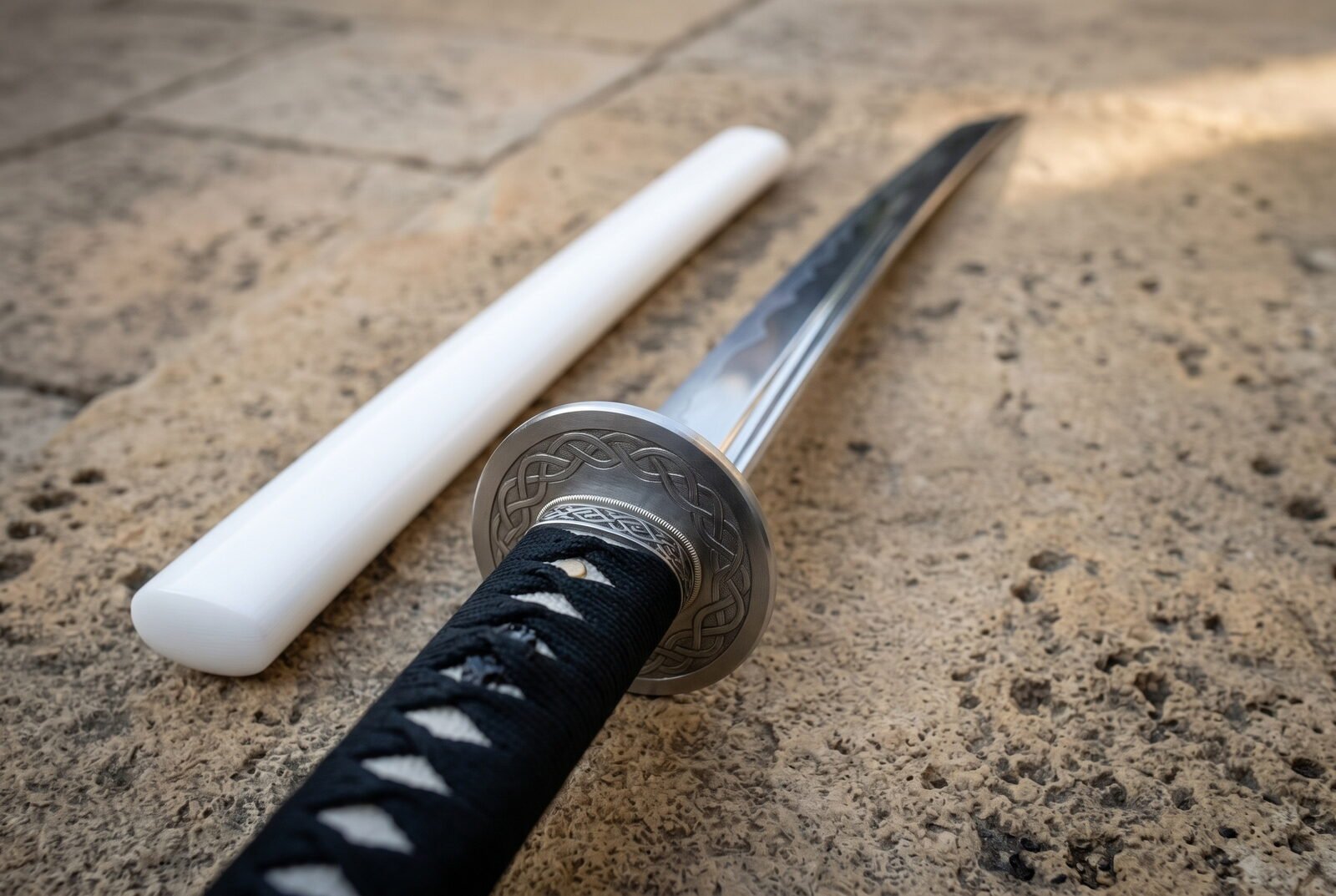
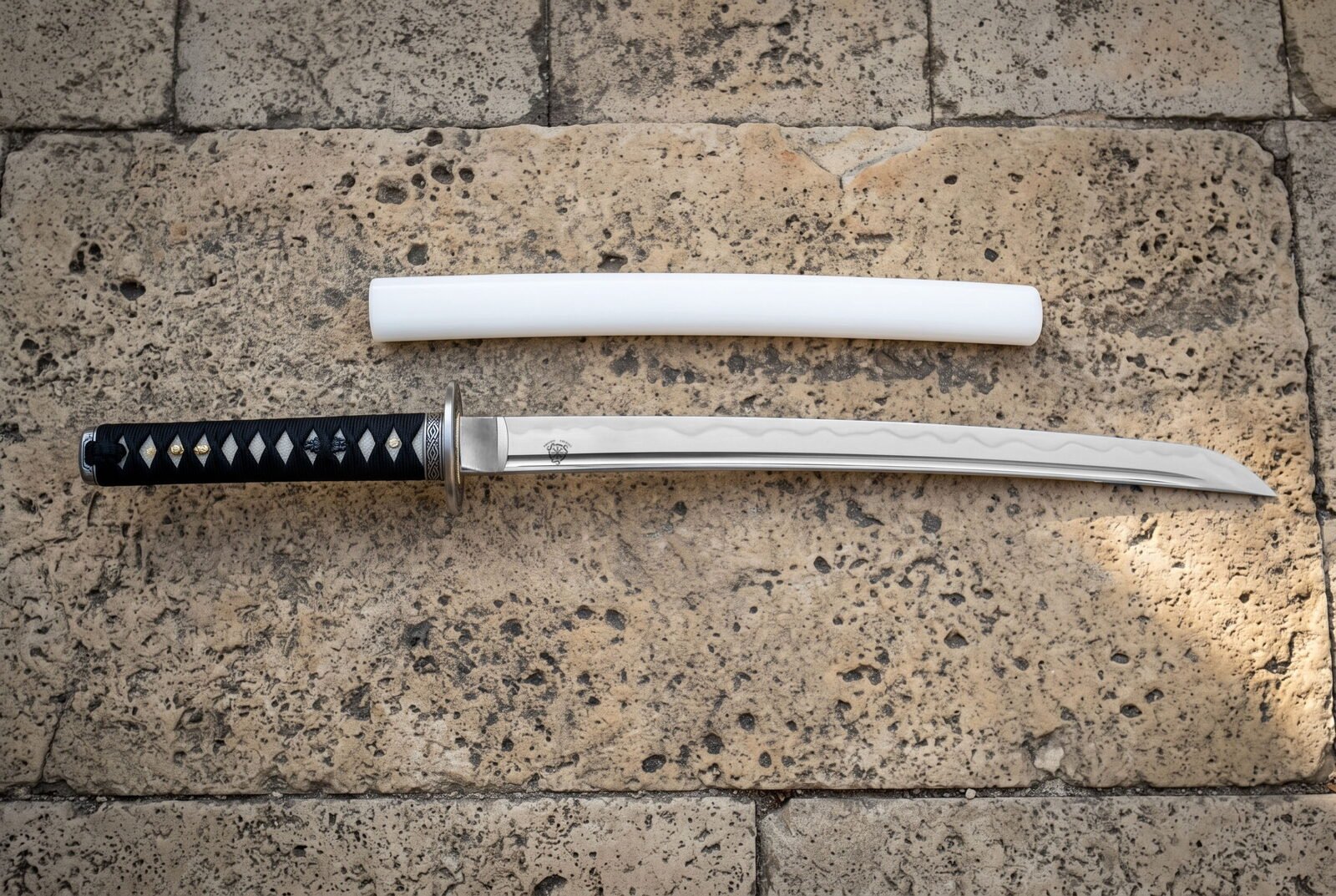
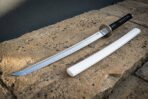
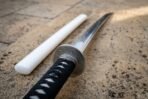
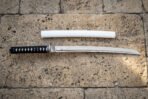
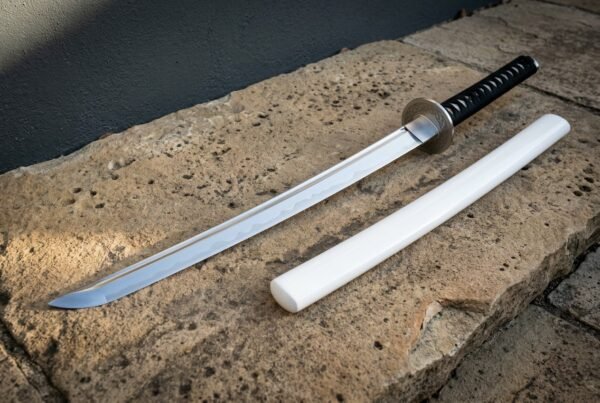
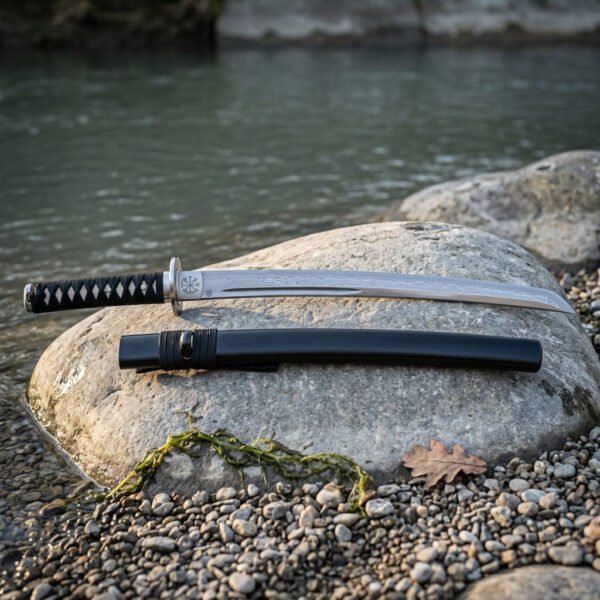
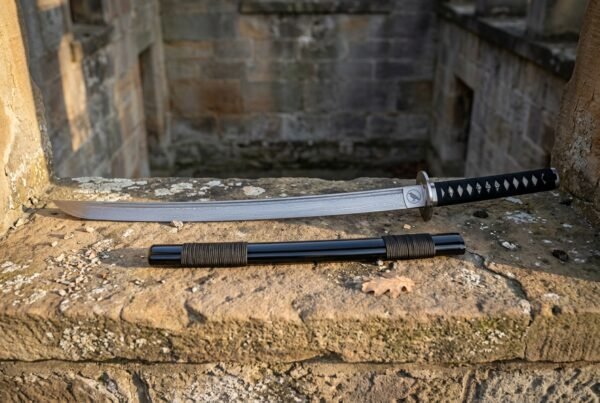
Snowfold is a katana with a bright polished blade and a gloss white saya. The blade is 1095 high carbon steel, single edged with a clean curve, and a hamon runs the length of the edge as a soft wave dividing the hardened edge from the softer spine. The tsuka is wrapped in black cord over white rayskin, the tsuba is a round antiqued disc, and the saya is finished in a high gloss white that throws the whole piece into contrast. It is the brightest sword in the range.
The hamon is the visible record of a differential hardening. Clay is painted along the spine of the blade in a thicker layer than along the edge before the quench, so the edge cools fast and forms hard martensite while the spine cools slowly and stays tougher pearlite. Where those two structures meet, the steel etches and polishes to a different brightness, and that line is the hamon. It is not applied afterward and it cannot be drawn on. Snowfold is forged, clay coated, quenched, polished and mounted by hand in the Czech Republic.
For how the three Japanese lengths differ in use, katana, wakizashi and tanto compared lays them out. For where 1095 sits on the hardness scale and what that buys you, see the steel and hardness page. The tanto knives use the same fittings at knife length.
Specifications
| Blade material | 1095 high carbon steel, differentially hardened |
|---|
| Hardness | 54 to 58 HRC at the edge, softer spine |
|---|
| Overall length | 38 inches in the saya |
|---|
| Blade length | 27 inches measured from the habaki |
|---|
| Blade finish | Bright polish with a visible hamon along the edge |
|---|
| Tsuka | 10 inches, black cord wrapped over white rayskin, steel kashira |
|---|
| Tsuba | Round antiqued steel disc with a knotwork border |
|---|
| Habaki | Polished steel blade collar, fitted to this blade |
|---|
| Saya | Plain gloss white lacquered wood |
|---|
| Weight | Approximately 1 lb 15 oz without the saya |
|---|
| Included | Gloss white saya |
|---|
| SKU | RK-1899 |
|---|
Reading a hamon and telling a real one from a fake
A genuine hamon has depth. Turn the blade under a light and the line shifts slightly, because you are looking at a boundary that runs through the thickness of the steel rather than a mark on the surface. It is never perfectly regular, since clay applied by hand cracks and lifts a little during the quench, and those small irregularities are exactly what tells you it is real. A wire brushed or acid painted imitation sits flat, does not move as you tilt the blade, and repeats the same shape endlessly. The other giveaway is what happens at the very tip, where a true hamon turns and runs back up the point in a section called the boshi. Snowfold has one, because it was made the only way that produces one.
The steel, the habaki and the lacquer
1095 is the right steel for this because it is simple enough to hold a sharp transition between hardened and unhardened zones. Alloyed steels harden too deeply and blur the line. The edge finishes at 54 to 58 HRC and the spine stays substantially softer, which gives a blade that holds a keen edge and still absorbs shock. The habaki is polished steel, filed to a friction fit on this specific blade, and it is the part that actually holds the sword in the saya. The white saya is wood, sealed and then built up in successive coats of lacquer with sanding between them, which is the only way to get a gloss that deep on a curved surface.
Engraving, runes and your own design
Use the rune converter on this page to turn a name, a date or a short phrase into Elder Futhark and we will cut it into the steel, the leather or the wood. If you would rather have a Viking pattern than a rune line, choose your own design in the engraving option above the add to cart button and tell us where it goes. Where a piece already carries an engraved design, your chosen engraving replaces it rather than sitting alongside it. On Snowfold we cut engraving into the flat above the habaki, well clear of the hamon, because a cut that crosses the temper line spoils the feature that makes the blade worth having. See the engraving page.
Handling and balance
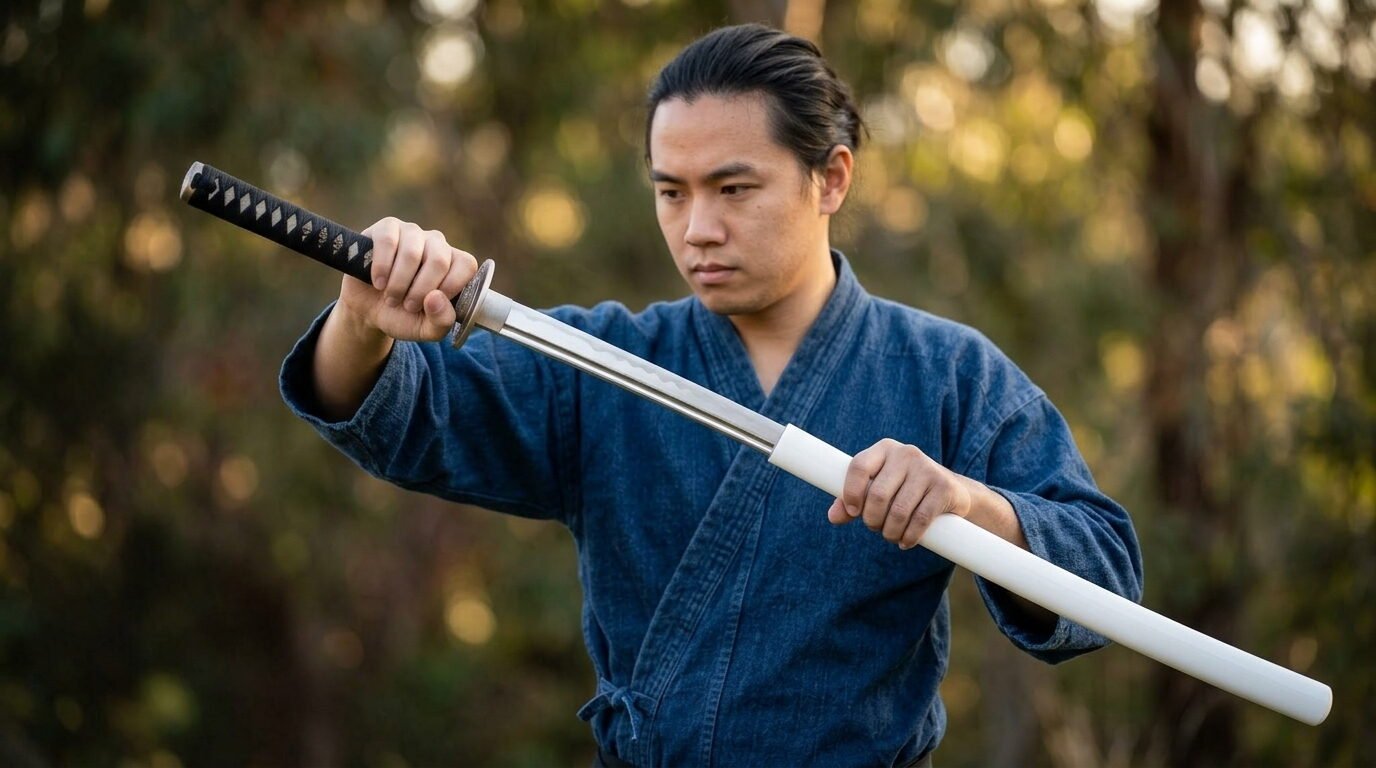
The balance point sits about three and a half inches ahead of the tsuba. On a twenty seven inch blade that gives a sword which settles well in two hands. The ten inch tsuka takes both hands with a gap between them, which is how a katana is meant to be steered. The edge is sharpened. Snowfold is sold for collecting, display and dry handling, and we do not sell it for full contact sparring or for cutting hard targets, which would chip a differentially hardened edge.
Care
A polished hamon is the part that suffers first from neglect. Never touch the blade with bare fingers, because a fingerprint on a bright polish etches within days and the mark will sit right across the temper line. Wipe with a clean soft cloth, then a very light oil film applied thin. Do not use abrasive polish or a scouring pad, since either will haze the polish and the hamon will disappear under the scratches. The white lacquer on the saya scuffs like any gloss finish. Keep it off grit, and clean it with a damp cloth rather than solvent. Our full notes are in the guide to steel care.
A curve like this does not sharpen the way a straight edge does, and sharpening a curved blade works through the stroke.
Made in the Czech Republic
Every piece we sell is made by hand in the Czech Republic. The smiths there work the way the trade has been worked for a long time, heating and hammering the steel, taking the bevels down by eye, and fitting the handle and the leather one at a time. There is no automated line anywhere in it, so small differences from one piece to the next are normal and expected.
Ransack Viking is a United States company based in Chicago, Illinois. We bring the pieces in ourselves, inspect them on arrival and ship them from our own warehouse. If you add engraving, that is carried out here in the United States before your order goes out.
A note on handmade variation
This sword is hand made, not machine made or bulk produced, so what arrives will not be a pixel for pixel copy of the photograph. Every hamon is different, because the clay is applied by hand and cracks in its own way during the quench, so the wave pattern along your blade will not match the one in the photograph. The lacquer depth, the antiquing on the tsuba and the tension of the cord wrap all vary. The dimensions, the steel, the heat treat and the build are the same every time. The character is not.
Frequently asked questions
Is the hamon real or etched on?
It is real. The blade is clay coated and differentially hardened, so the line is a boundary between two steel structures rather than a surface mark. Tilt it under a light and you will see it move.
Why is the saya white?
Because it is built that way rather than left bare. White lacquered saya are a traditional finish in Japan, and the contrast against a black tsuka and a bright blade is the whole point of this one.
Will the white saya stay white?
It will, if you keep it off grit and wipe it with a damp cloth rather than a solvent. Gloss white shows a scuff more readily than black, which is the honest trade for how it looks.
Can I cut with it?
We sell it as a collector and display sword. A differentially hardened edge is hard at the very edge, and hard edges chip against anything solid.
Does it come with a stand?
No, the price covers the sword and the saya. Any standard katana stand will take it, resting saya down with the edge upward.
How should I hold it for photographs?
Wear cotton gloves or hold it by the tsuka only. A bare hand on a bright polished blade leaves a print that etches in within a week.
What is in the box
- Snowfold katana in differentially hardened 1095 high carbon steel
- Gloss white lacquered saya
- Care card covering handling a bright polish and protecting a hamon
- Lifetime warranty against defects in forging, grind, heat treat and fittings
- Forged and finished in the Czech Republic
Explore the range
Browse the wakizashi, the other katana and Japanese swords, the full sword range, and the guides.
Others in the same line
Sitting beside it in the catalogue is the Shadowcurve wakizashi, 28 inches overall. Another in the same line is the Trithorn wakizashi, forged from 1095. Next along the rack is the Duskcairn wakizashi.
Fitting out further, the Wolfmarch messer belongs with it. You can have this made your way instead on the design your own page.


Best sword I’ve ever owned. Edge retention has been great even after regular use. Love it.