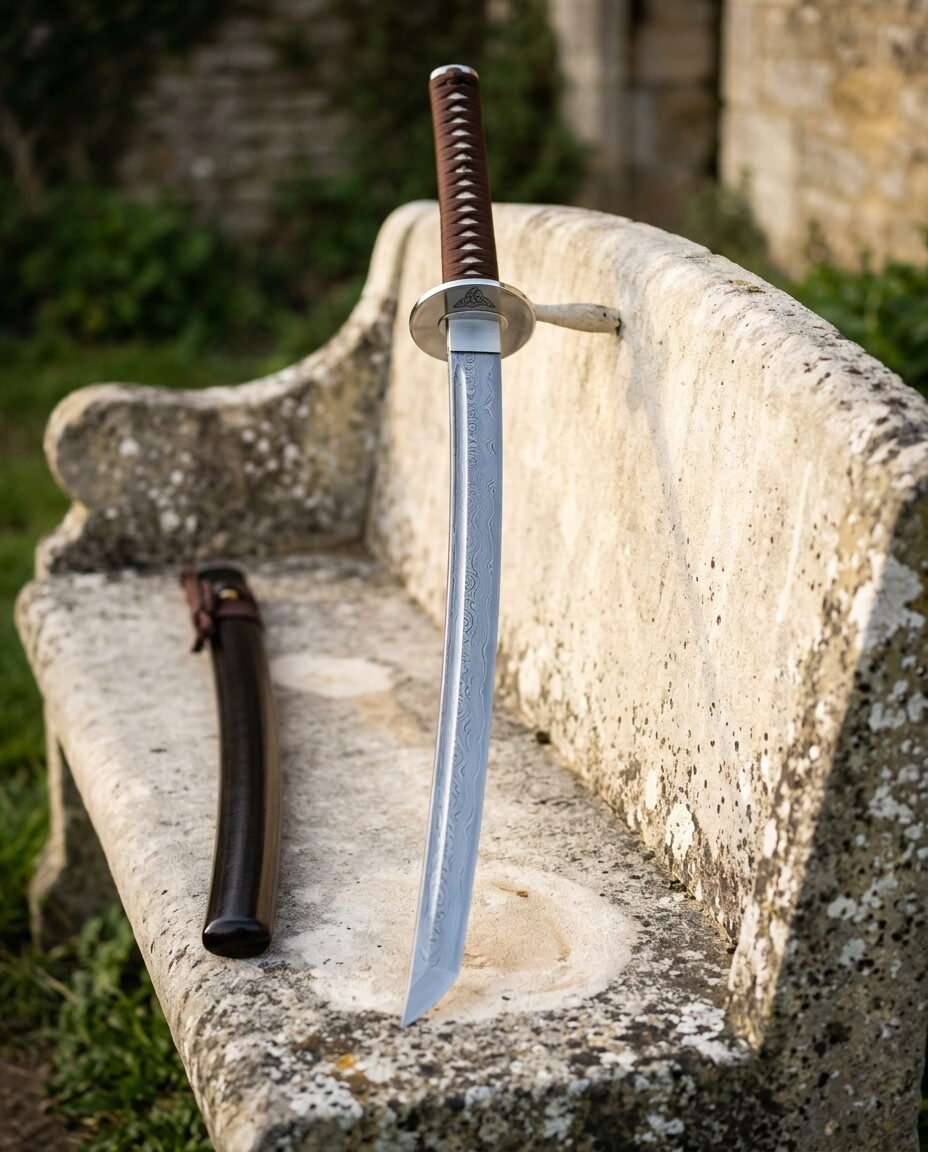
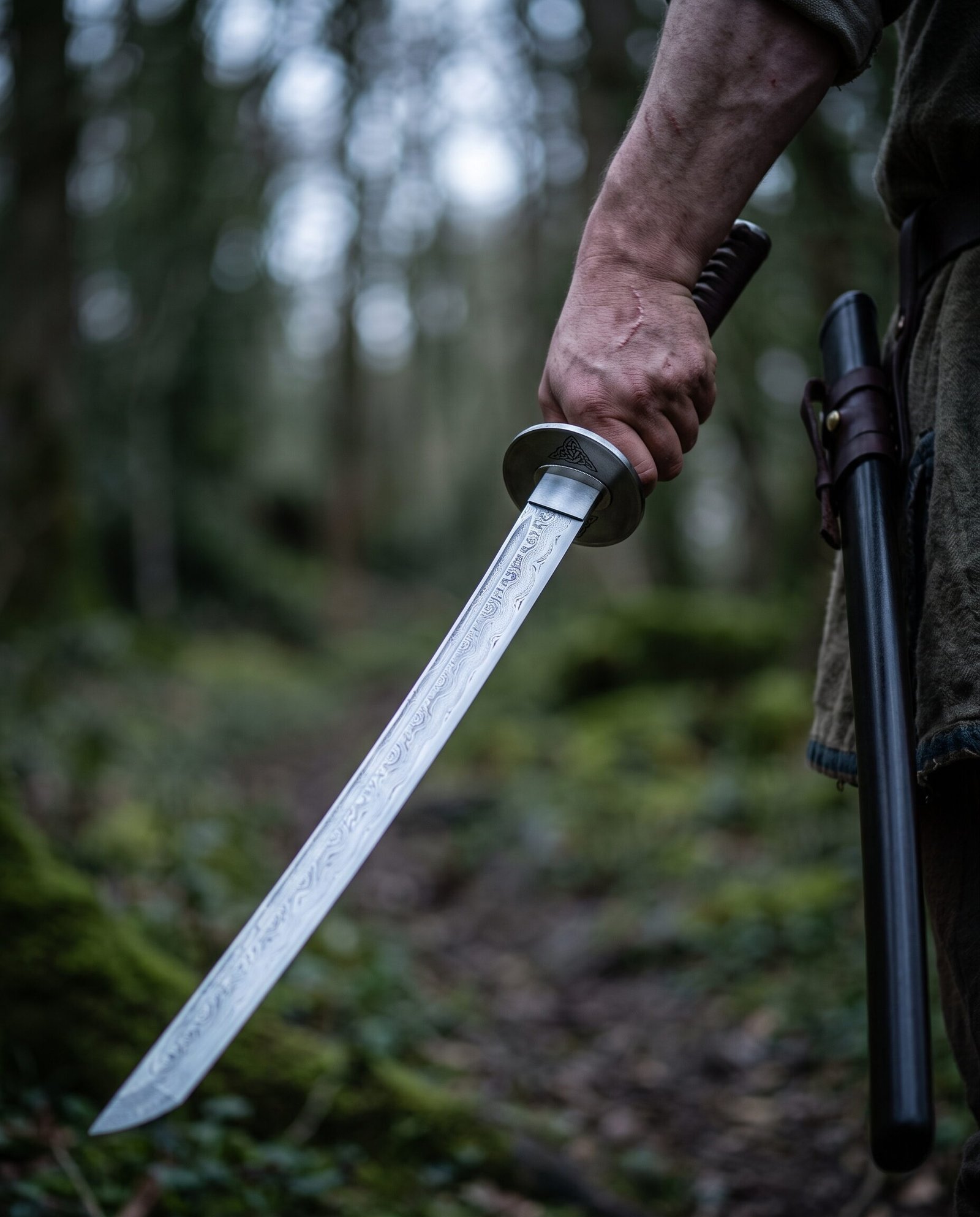
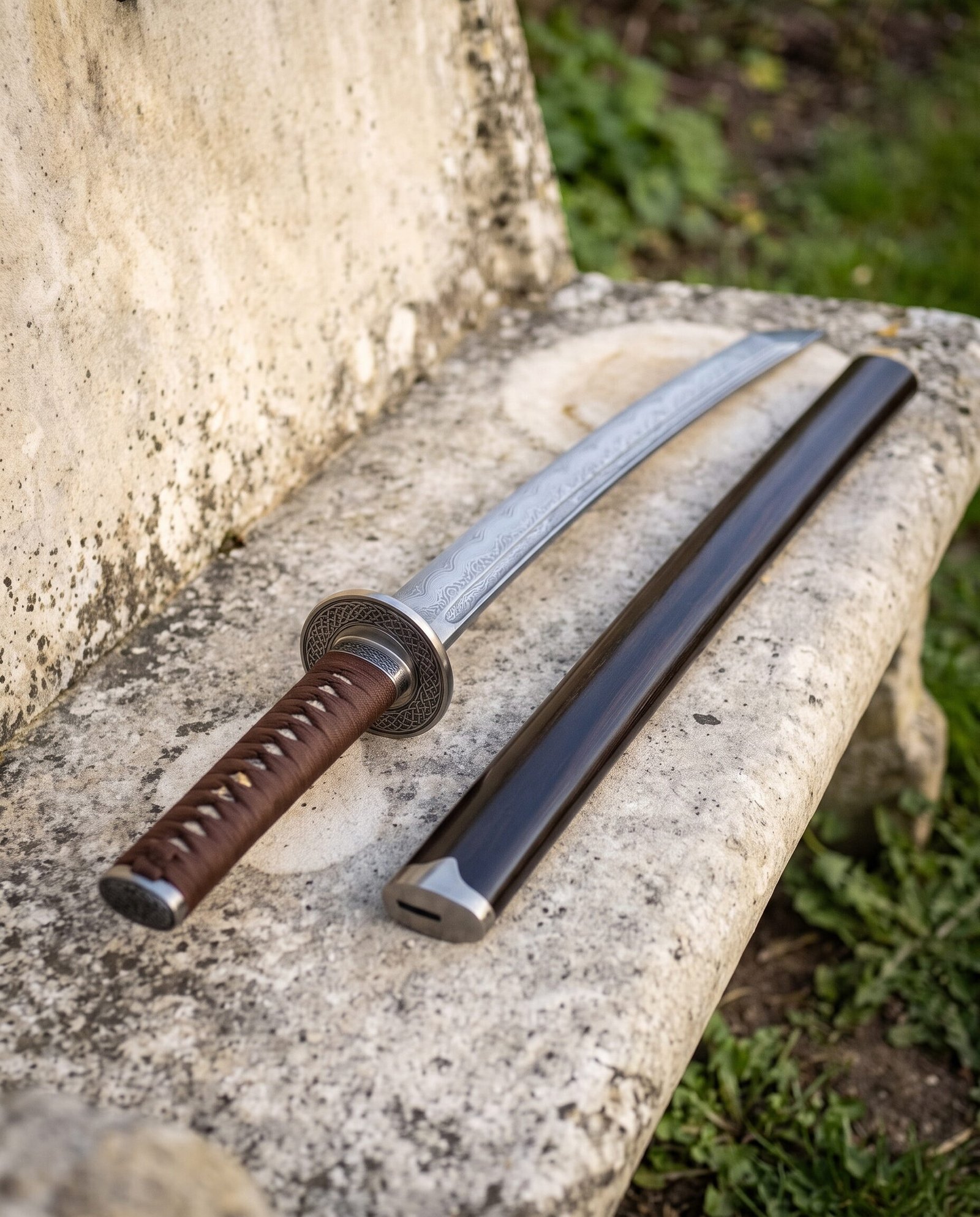
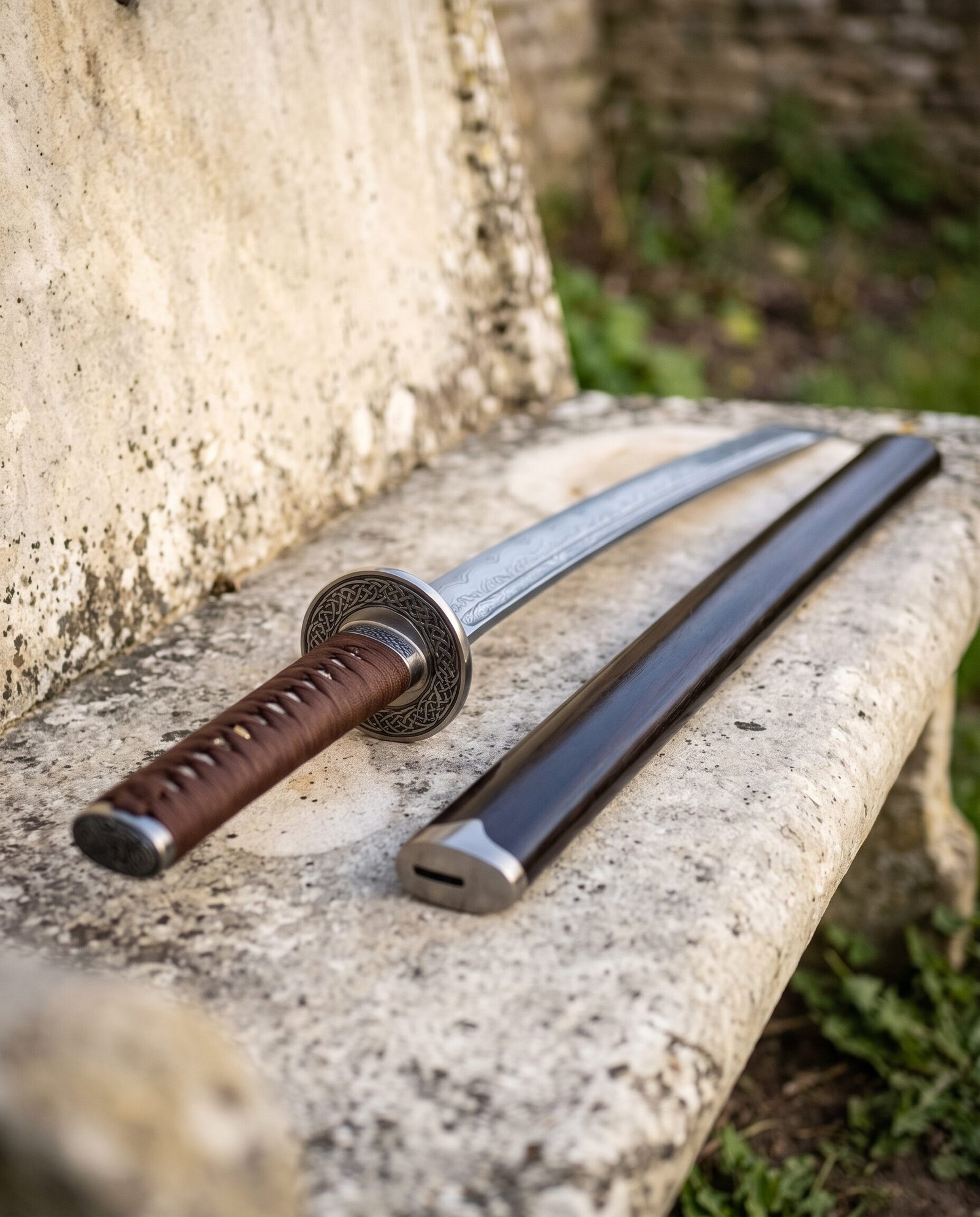
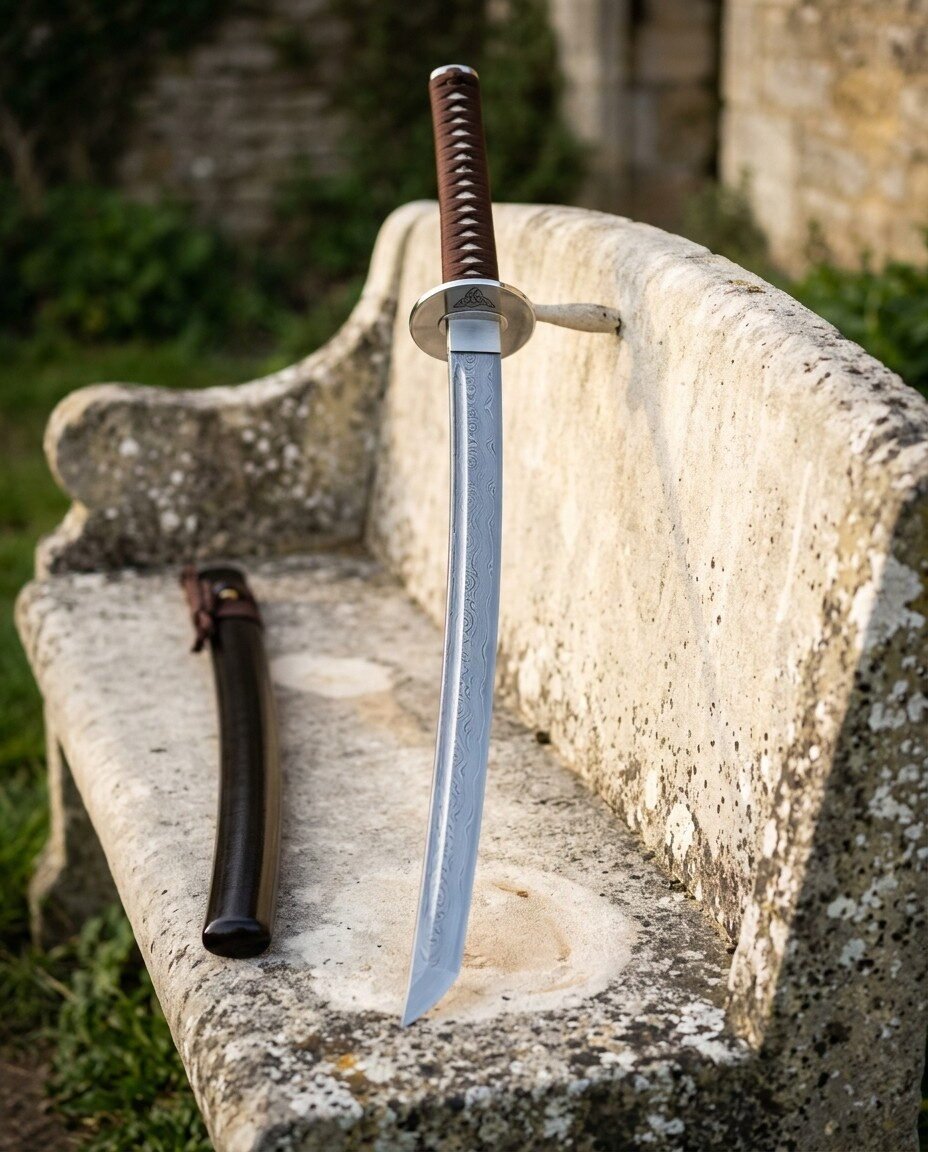
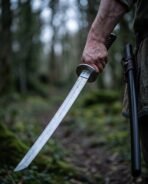
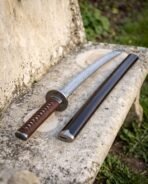
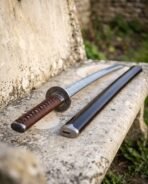
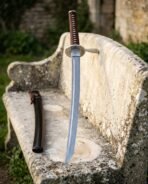
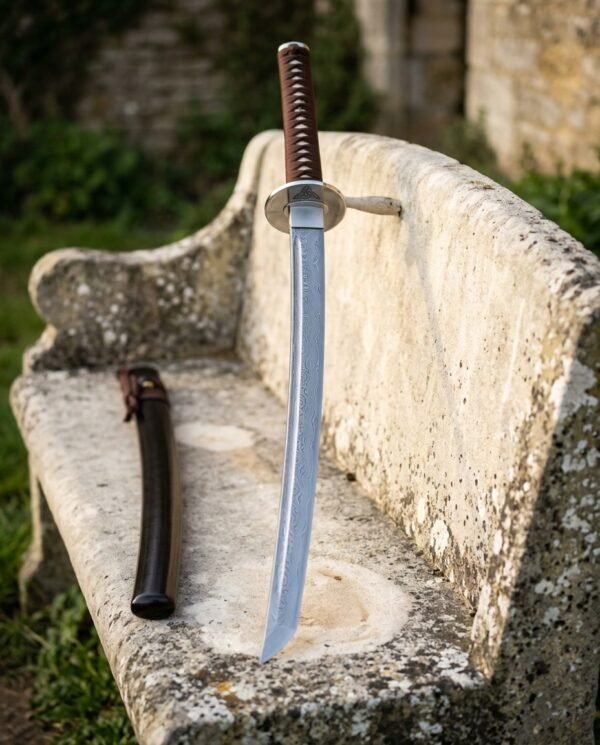
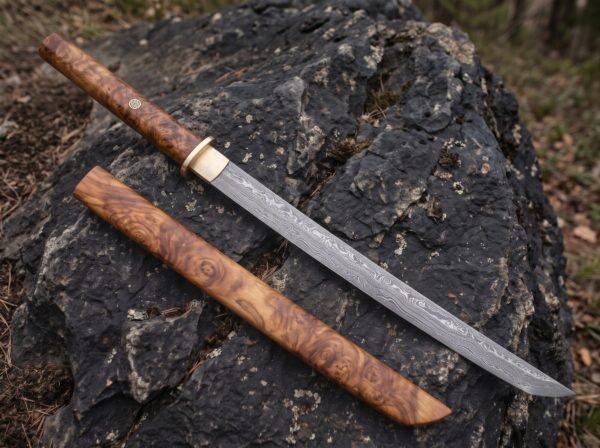
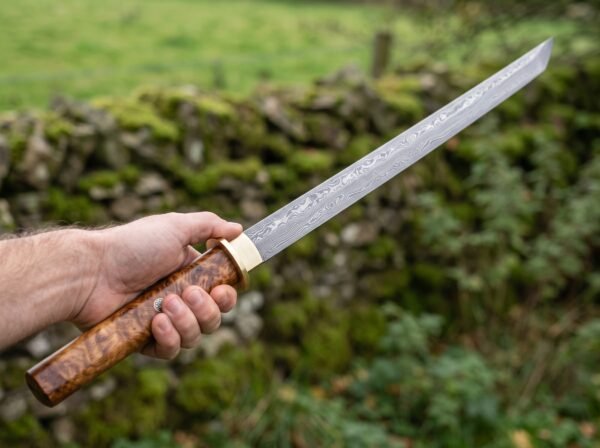
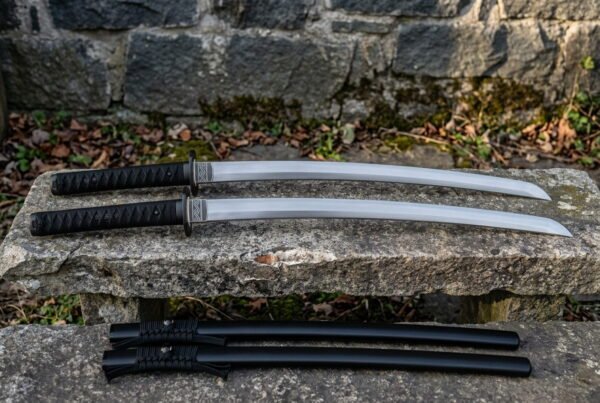
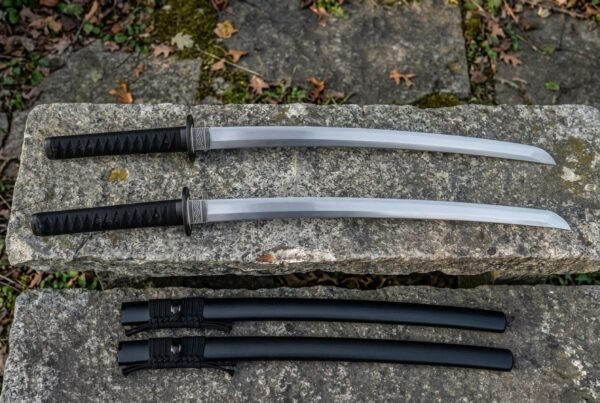
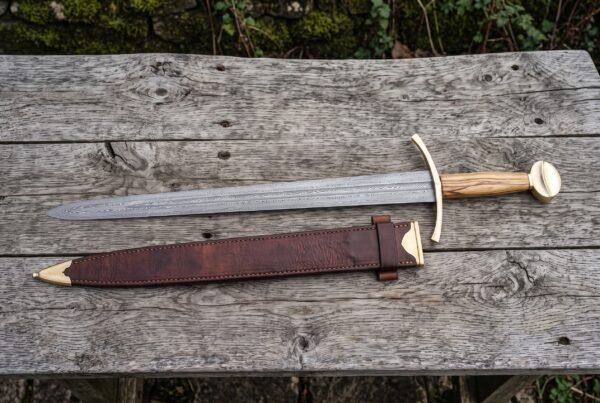
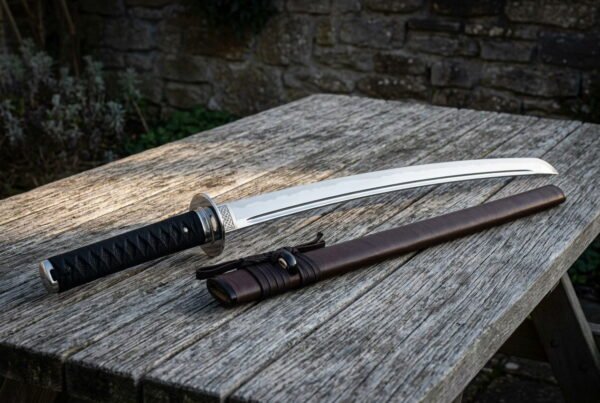
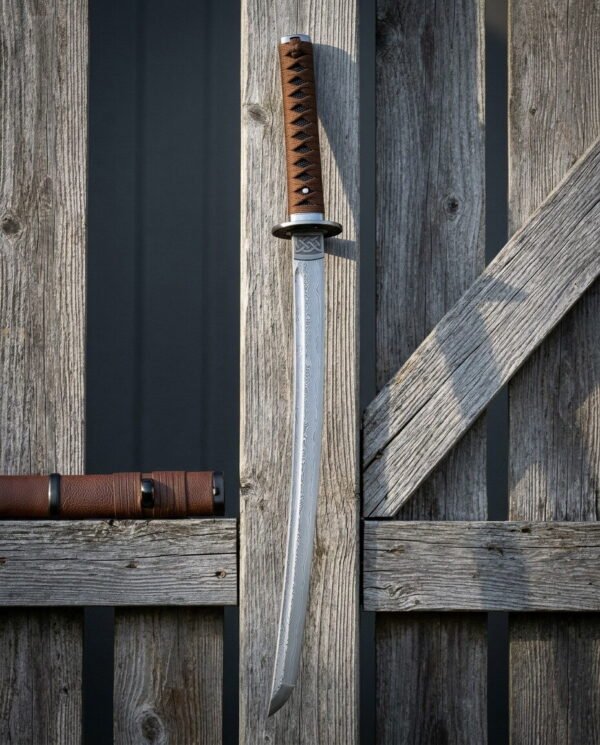
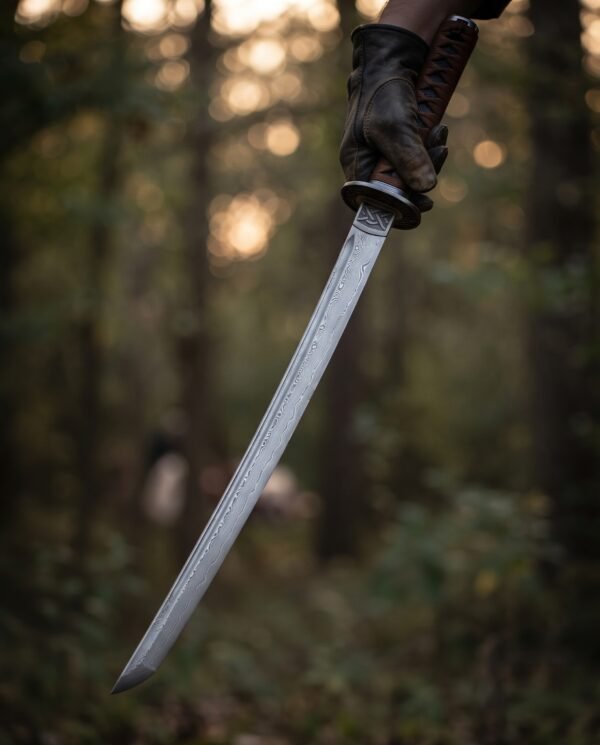
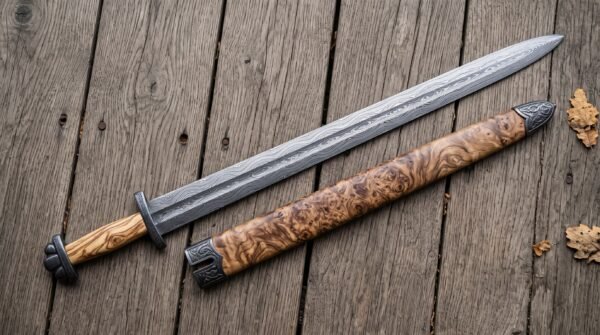
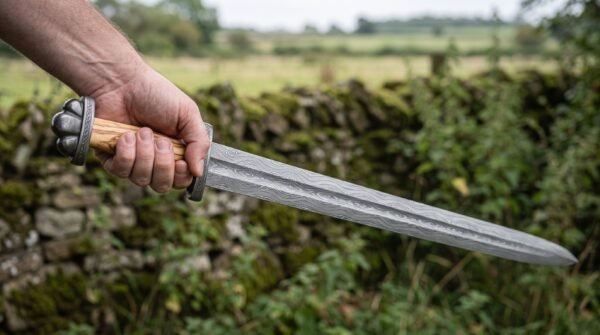
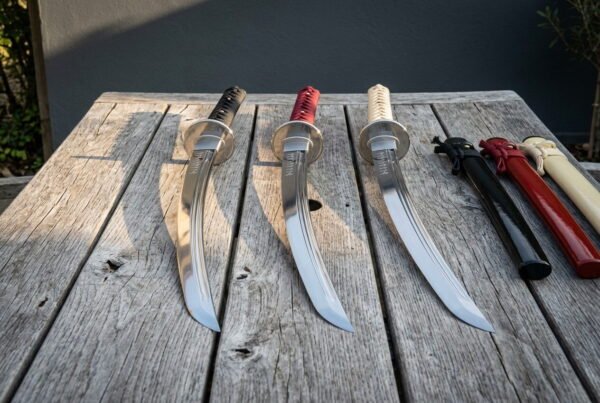
The Trinehilt is a wakizashi, the short companion sword of the Japanese pair, built here with a pattern welded Damascus blade. The curve is deep, the blade broad through the middle with a clear kissaki at the point, and the Damascus pattern flows the whole length of the flat in fine watery bands. The tsuba is a solid round in steel, engraved with a continuous Celtic knotwork band around its face, and the tsuka is wrapped in brown leather rather than silk, over white same. The saya is dark hardwood with a brown cord.
The wakizashi was the sword a samurai kept when he gave up his katana. Under Tokugawa custom the long sword was surrendered at the door of a house and left on a rack, but the short sword stayed on the belt indoors, which is why so much of the recorded indoor swordwork of the period involves this length of blade. Together the pair made the daisho, literally big and small, and wearing both was the visible legal marker of samurai status. The sumptuary edicts of the seventeenth century made that explicit: commoners and merchants of standing could carry a single short sword, but only the warrior class could wear the pair. The wakizashi was therefore the one Japanese sword most people were actually allowed to own. This one is forged and finished in the Czech Republic.
For how the three Japanese lengths differ in use, katana, wakizashi and tanto compared lays them out. Interlaced knotwork of this kind is one of several Norse and Celtic devices covered in our run through the Norse symbols. The tanto knives use the same fittings at knife length.
Specifications
| Blade | Pattern welded Damascus in 1095 and 15N20, hardened to 58 to 60 HRC |
|---|
| Blade profile | Curved single edged with a defined kissaki point |
|---|
| Blade length | Approximately 20 inches |
|---|
| Overall length | Approximately 28 inches |
|---|
| Tsuba | Solid steel round engraved with a continuous knotwork band |
|---|
| Tsuka | Brown leather wrap over white same on a shaped core |
|---|
| Fuchi and kashira | Polished steel, the kashira engraved |
|---|
| Saya | Dark hardwood with a steel kojiri end cap and a brown cord |
|---|
| Finish | Acid etched and polished Damascus, polished steel fittings |
|---|
| Included | Sword and hardwood saya |
|---|
| SKU | RK-1879 |
|---|
The knotwork band, and why it is on a Japanese blade
The tsuba carries a band of interlaced knotwork cut right around its face, strands passing over and under one another with no loose end anywhere. Interlace like this turns up on Norse and Insular work from the eighth century onward, on Swedish runestones, on Irish manuscript borders and on the hilts and brooches that travelled with them. A line with no beginning and no end was read as continuity and as things bound together, and carvers used it as a mark of protection.
It is not a Japanese motif and we are not going to pretend otherwise. This is a crossover piece: Japanese blade geometry and mounting conventions carrying a Norse and Celtic device, which is exactly what a lot of people who buy from us are looking for. If you want an authentic Japanese tsuba design instead, tell us in the order notes before you buy.
The steel and the pattern
The blade is forged from folded layers of 1095 high carbon steel and 15N20. 1095 supplies the carbon that lets the edge harden. 15N20 carries around two percent nickel, and nickel resists the acid used to finish the blade, so those layers stay bright while the 1095 layers darken. On a curved single edged blade the pattern behaves differently from a straight one: as the blade is bent and the flat is ground back, the layers get cut at a shifting angle, which is why the bands look like flowing water rather than straight stripes.
The blade is heat treated to 58 to 60 HRC. This is a pattern welded blade, not a traditionally differentially hardened Japanese blade, so it has no hamon. What you are looking at along the flat is the layer pattern, and that is the honest description of it.
Engraving, runes and your own design
Use the rune converter on this page to turn a name, a date or a short phrase into Elder Futhark and we will cut it into the steel, the leather or the wood. If you would rather have a Viking pattern than a rune line, choose your own design in the engraving option above the add to cart button and tell us where it goes. Where a piece already carries an engraved design, your chosen engraving replaces it rather than sitting alongside it. On this wakizashi that means a chosen device on the tsuba takes the place of the knotwork band. Runes can go on the flat of the blade near the habaki instead, which leaves the knotwork where it is. See the engraving page.
Handling and balance
A wakizashi is a one hand sword that can be gripped with two at a squeeze. It is short enough to bring around in a confined space, which is precisely the job it was built for, and the deep curve means it cuts on the draw with very little effort from the wrist. The steel tsuba adds useful mass right at the hand, so the balance sits near the guard and the tip feels quick.
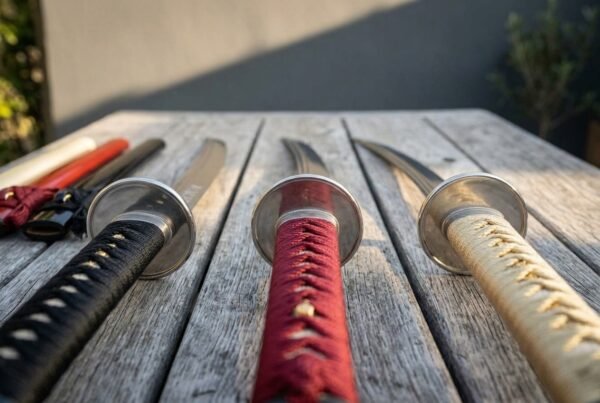
Leather ito behaves differently from silk. It grips harder when dry, it is less slippery when damp, and it does not fray. It also does not have the fine texture of a traditional silk wrap, which some collectors prefer and others do not.
This is a sharp collector and display sword. It is not a trainer and it is not certified for cutting practice, partner drills or contact work of any kind.
Care
Wipe the blade after every handling and keep a light film of oil on it. Choji oil or plain mineral oil is fine. An etched Damascus surface picks up fingerprints faster than a plain polished one, so be disciplined about it. The steel tsuba and fittings want the same light film of oil as the blade, worked into the engraving with a soft cloth so it stays clean and bright. Do not store the sword in the saya for long periods. Our steel care page covers the detail.
Damascus wants oil more than plain steel does, because the etch that shows the pattern also opens the surface, and caring for a Damascus pattern covers what to use.
Made in the Czech Republic
Every piece we sell is made by hand in the Czech Republic. The smiths there work the way the trade has been worked for a long time, heating and hammering the steel, taking the bevels down by eye, and fitting the handle and the leather one at a time. There is no automated line anywhere in it, so small differences from one piece to the next are normal and expected.
Ransack Viking is a United States company based in Chicago, Illinois. We bring the pieces in ourselves, inspect them on arrival and ship them from our own warehouse. If you add engraving, that is carried out here in the United States before your order goes out.
A note on handmade variation
This is hand made, not machine made or bulk produced, so what arrives will not be a pixel for pixel copy of the photograph. The Damascus pattern is unrepeatable, because every billet folds and draws out differently, so your blade will carry its own flow of bands. The leather on the tsuka varies in tone and grain because it comes from different hides. The hardwood saya is a natural material with its own figure and colour. The dimensions, the material and the build are the same every time. The character is not.
Frequently asked questions
Does it have a hamon
No, and anyone selling you a Damascus blade with a hamon should be asked hard questions. This blade is pattern welded, so the visible line work along the flat is the layer pattern, not a temper line.
Is it sharp when it arrives
Yes, it comes with a working edge. Ask in the order notes if you would prefer it blunt for display and we will do that at no extra cost.
Can I use it for tameshigiri or cutting practice
No. We sell this as a collector and display sword and it is not certified for cutting practice, partner training or contact work.
Do the steel fittings need care
A little. Wipe the tsuba and fittings after handling and keep a light film of oil on them, the same as the blade, and they stay bright.
Can I get a different design on the tsuba
Yes. Tell us in the order notes or use the engraving option. Bear in mind your design replaces the knotwork band rather than joining it.
How long is the wait
One to two weeks of processing, then free US shipping. If you have a date in mind, put it in the order notes before ordering and we will tell you honestly whether it is achievable.
What is in the box
- Trinehilt Damascus wakizashi with knotwork engraved steel tsuba
- Dark hardwood saya with brown cord
- Care card for pattern welded carbon steel and leather
- Lifetime warranty against defects in forging, grind, heat treat and fittings
- Forged and finished in the Czech Republic
Explore the range
See more in wakizashi, katana and Japanese swords and Damascus swords, or read the guides on pattern welded steel and blade care.
Others in the same line
If this one is not quite right, there is the Bonecrest wakizashi, 27 inches overall. Also in this group is the Duskcairn wakizashi. Sitting beside it in the catalogue is the Cinderpine wakizashi, 5 inches overall.
From the same corner of the shop, there is the Leatherspine sword. You can have this made your way instead on the design your own page.

So happy I finally pulled the trigger on this one. Shipping was fast and everything arrived well packaged.
Perfect gift. Perfect quality. No complaints. This shop clearly takes pride in their work.
My whole family was impressed when I unboxed it. This is my third order from Ransack Viking and they never disappoint. Exactly as described and clearly made with care. Highly recommend this one.
I collect stuff like this and this piece is on another level. Packaging was excellent and it arrived in perfect condition. Exactly as described and clearly made with care. Highly recommend this one.
No regrets on this purchase at all. Exactly as described and clearly made with care. Already telling my friends to check this out.