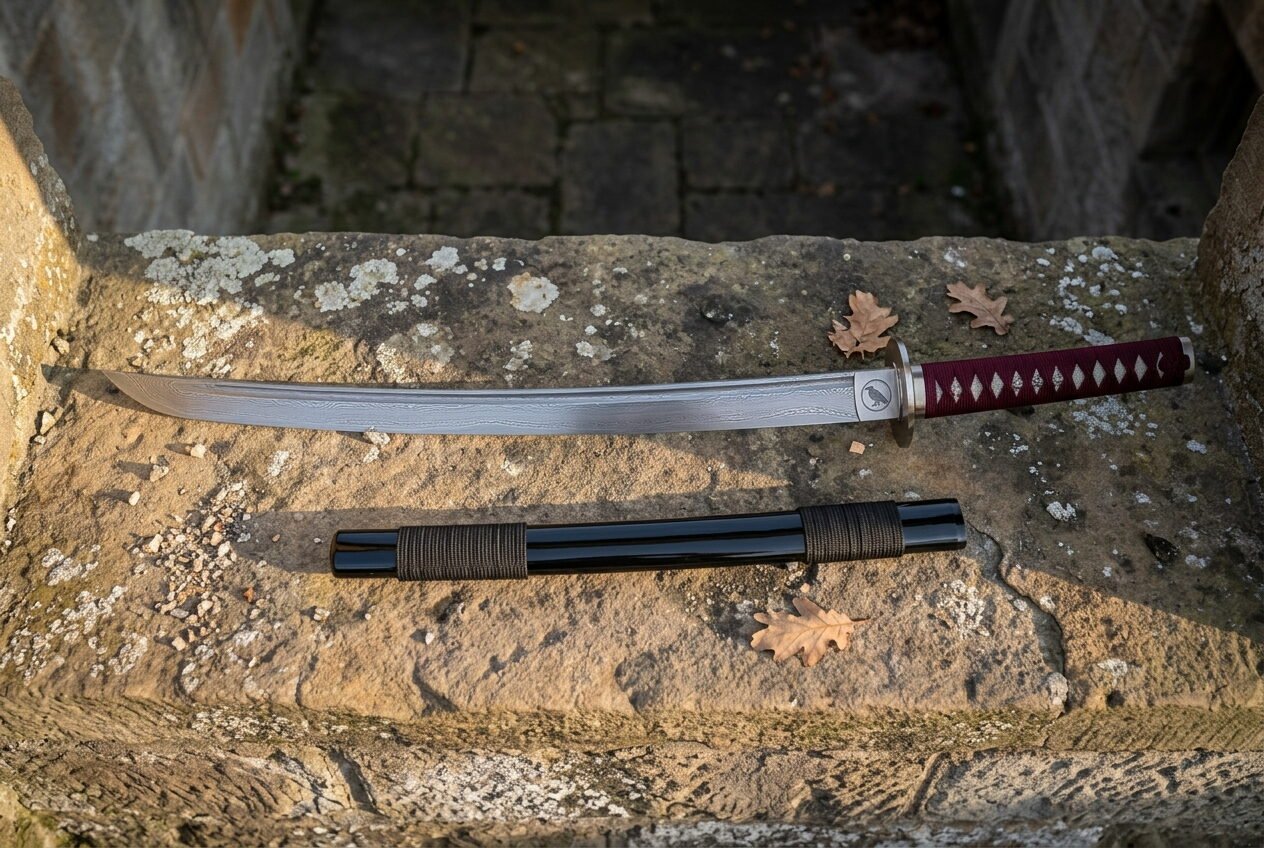
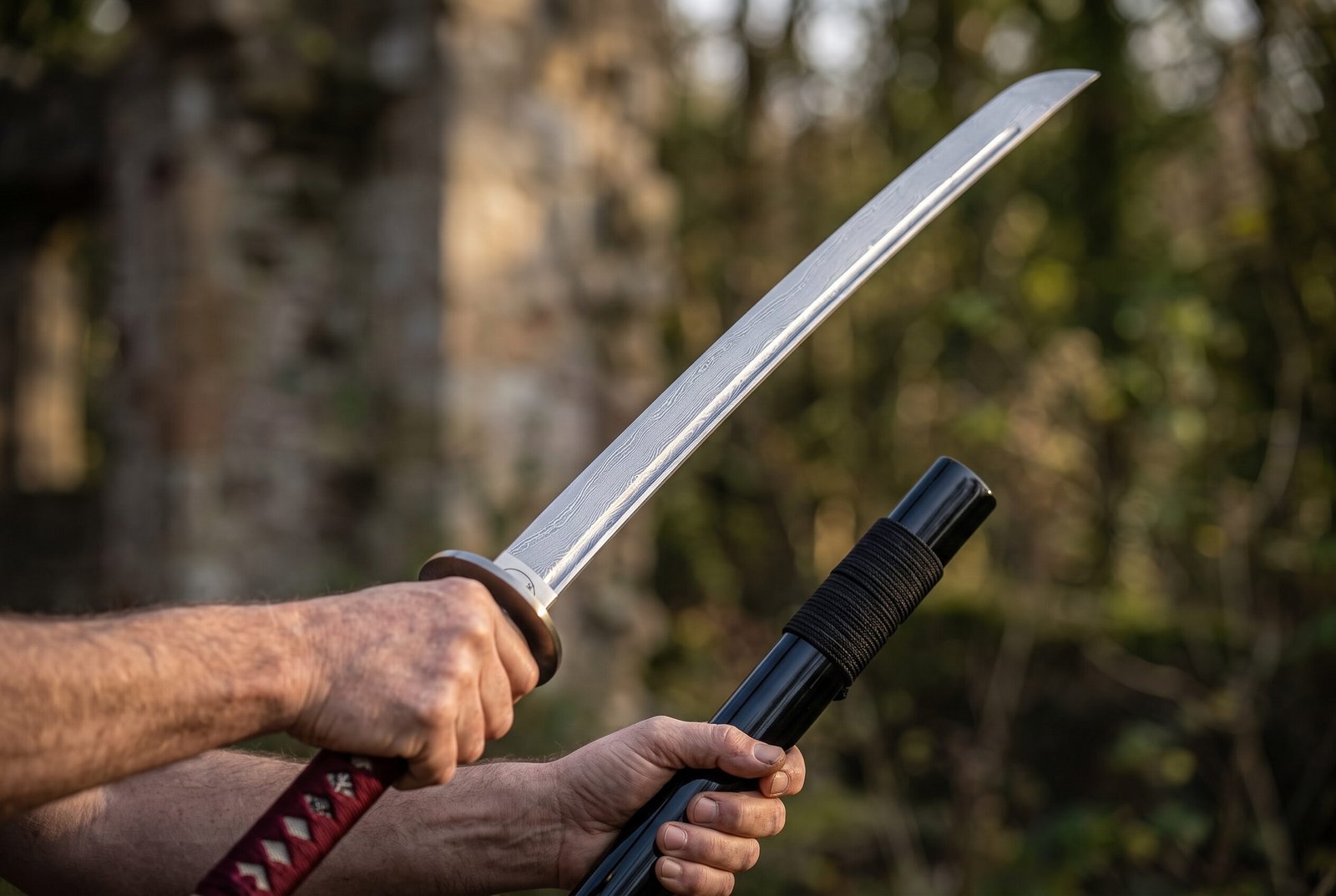
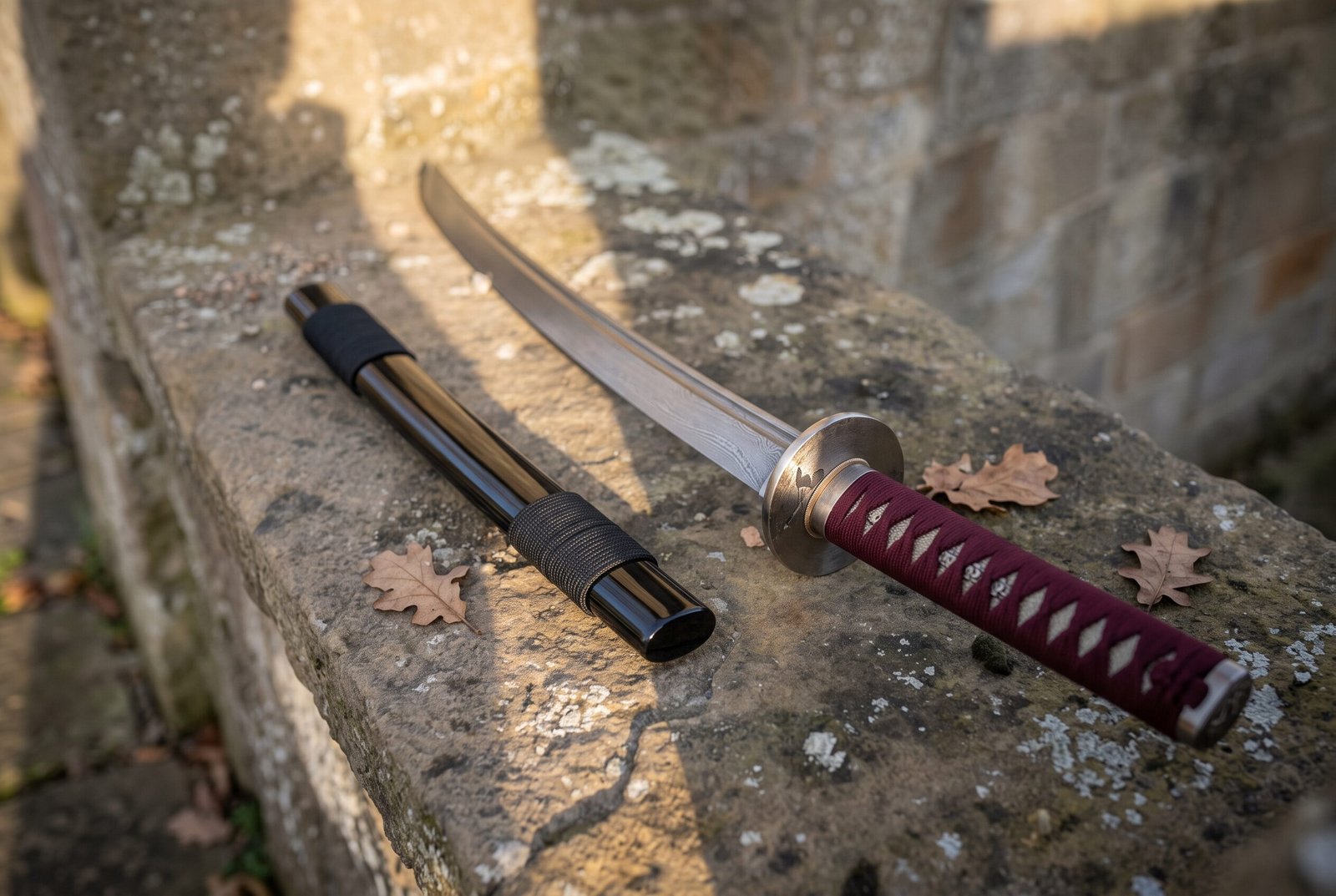
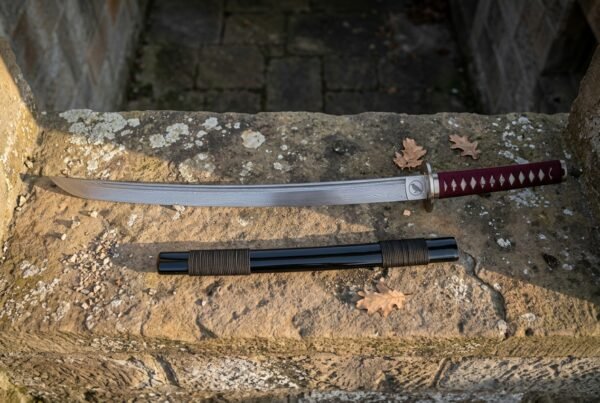
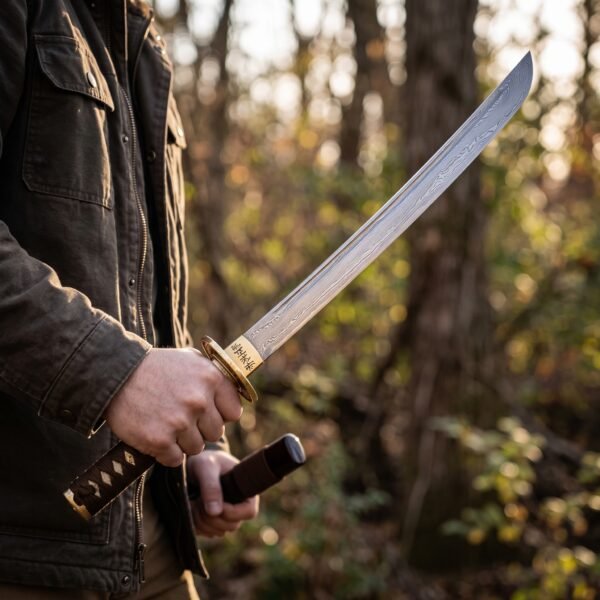
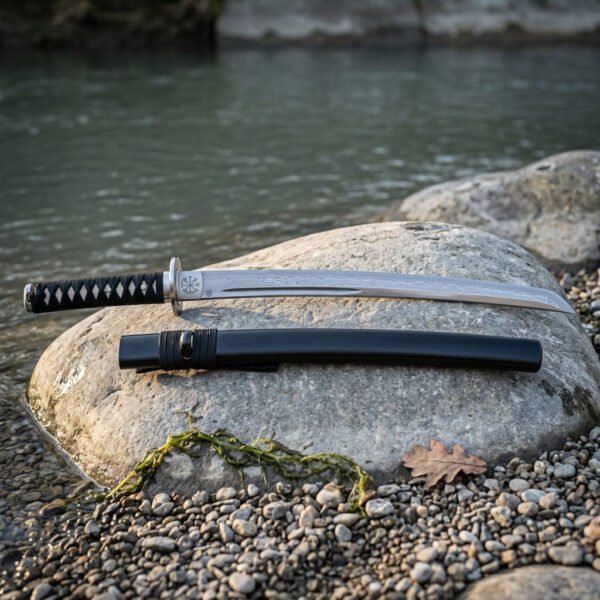
The cord wrap on a Japanese sword handle looks decorative and it is not. Each turn of the ito crosses the one before it at an angle and traps it, so the whole wrap is a chain of interlocking knots rather than a bandage. Cut it anywhere and the wrap holds either side of the cut. That is why a tsukamaki done properly does not unravel when it wears, and why the alternating diamonds are the same on a plain training sword and on a museum piece. The diamonds also leave a regular series of ridges and hollows under the fingers, so a hand finds the same position on the handle in the dark, in gloves, or in a hurry. Cinderpine is wrapped that way in deep red cord over pale same, on a 20 inch blade of 1095 and 15N20 Damascus hardened to 58 to 60 HRC. Which of the three to start with is answered in the three lengths compared.
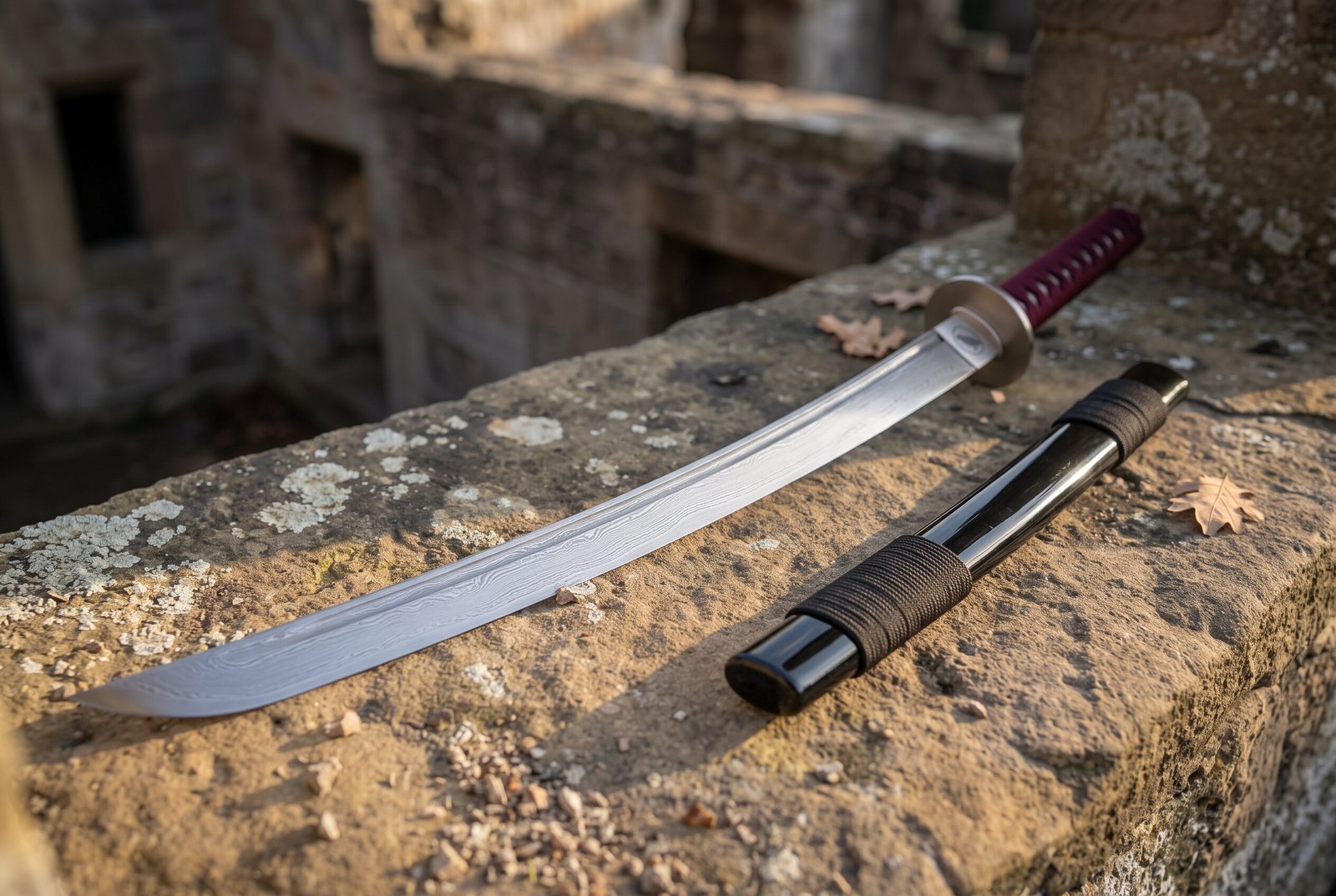
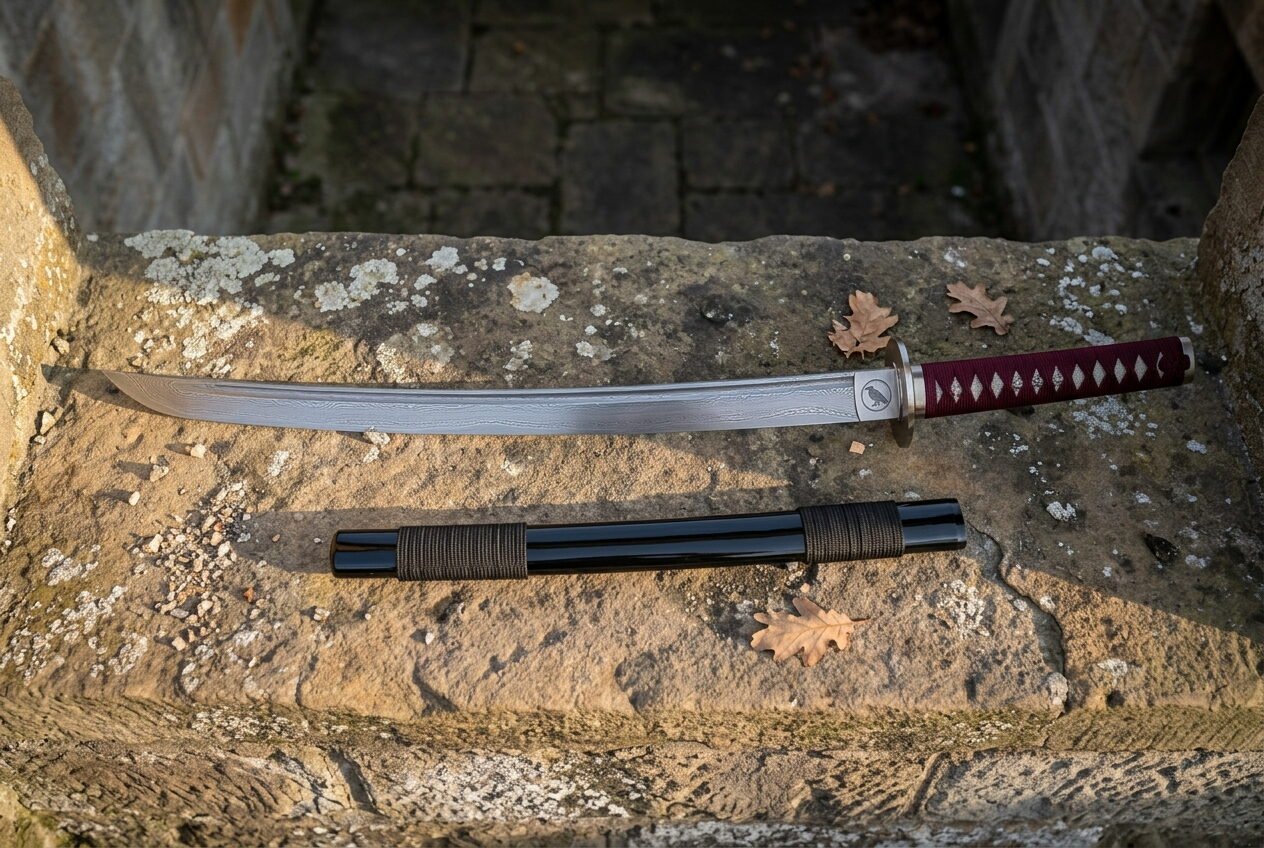
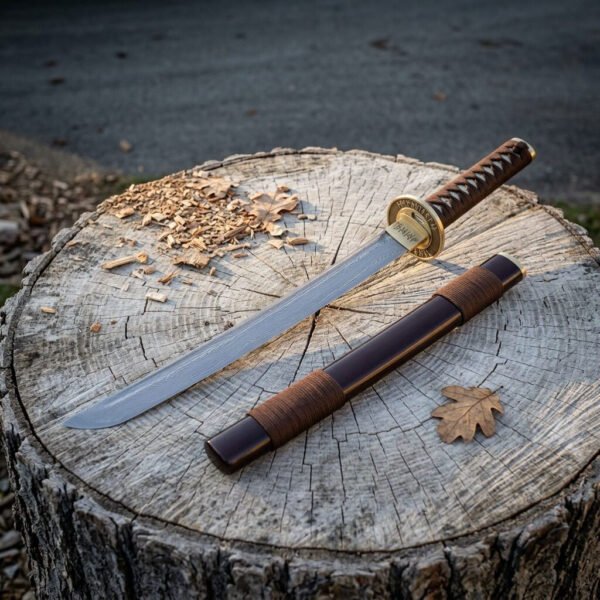
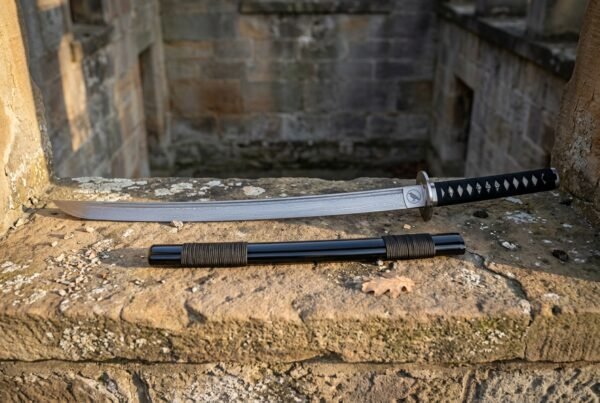
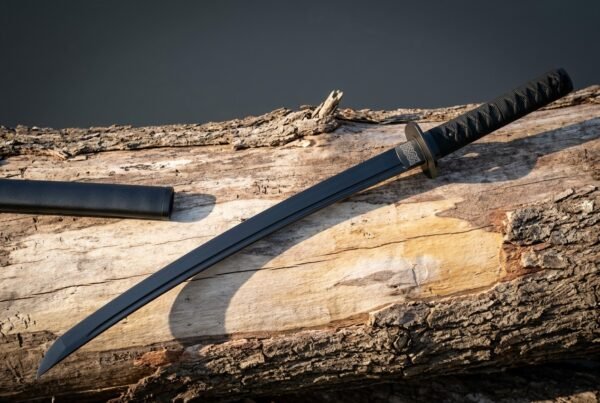
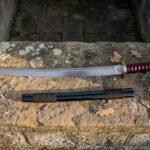
Forged, ground, heat treated and mounted by hand in the Czech Republic. It ships with the black saya shown in the photographs, with two brown cord wrapped bands and a matching sageo, and a protective coat of oil on the blade. Shipping inside the United States is free.
Specifications
| Steel | 1095 and 15N20 Damascus |
|---|
| Hardness | 58 to 60 HRC |
|---|
| Overall length | 28.5 inches |
|---|
| Blade length | 20 inches |
|---|
| Blade profile | Shinogi zukuri with a shallow curve and a broad point, Damascus pattern along the full length |
|---|
| Handle | 8 inch hardwood tsuka wrapped in deep red cord over pale same, menuki under the wrap |
|---|
| Fittings | Silver tone fuchi and kashira |
|---|
| Guard | Round steel tsuba with an engraved motif, brass seppa and a polished habaki |
|---|
| Scabbard | Glossy black wooden saya with two brown cord wrapped bands |
|---|
| Weight | Approximately 1.7 pounds bare, 2.3 pounds in the saya |
|---|
| SKU | RK-1276 |
|---|
Menuki, and the reason the handle is not smooth
Under the cord on a Japanese handle sit two small metal ornaments called menuki, one on each side, tucked beneath the wrap where it crosses. They read as decoration and collectors treat them as small sculptures, but they began as functional objects. They started life as the decorative heads of the pegs that held the handle to the tang, and when bamboo pegs took over that job the ornaments stayed because they had turned out to be useful for something else.
A menuki sits exactly where the pad at the base of the fingers falls, and it fills the natural hollow in a closed hand. The result is that the grip locks in place without the fingers having to squeeze, which matters because a tight grip on a sword is a slow grip. Japanese swordsmanship is emphatic about holding the handle loosely and tightening only at the moment of impact, and a pair of small raised lumps in the right place is what makes that possible. Take them out and the same handle feels vague. It is one of those details that survives for four hundred years because it quietly works.
Why Damascus and not stainless
The blade is pattern welded from 1095 high carbon steel and 15N20 nickel steel, forge welded, folded and drawn out, then hardened to 58 to 60 HRC. The flowing lines along the flat are the two steels taking the etch differently, so the pattern runs through the blade rather than sitting on the surface, and it sharpens back on a plain whetstone without special abrasives.
Stainless gets its corrosion resistance from chromium and pays for it in edge quality and toughness, and in a blade of any length it is more likely to break than to bend. The cost of a carbon based Damascus is that it rusts if you leave it wet or fingerprinted, which is a maintenance problem rather than a design flaw and the oil answers it. The full comparison sits in our steel and hardness notes.
The wrap, the core and the saya
The handle core is hardwood, cut in two halves to fit the full length tang closely enough that it would stay on without a peg, covered in pale same and then wrapped in deep red cord. Red ito darkens slightly with handling, which most owners like, and if it ever needs replacing a tsuka can be stripped and rewrapped without touching the blade. The saya is hollowed and finished in glossy black with two brown cord wrapped bands and a matching sageo.
Both the handle core and the scabbard are wood. Keep them out of long damp and direct sun, wipe rather than wash, and let a wet saya dry slowly and not near a heat source. What is in handle and sheath care applies to both.
Engraving, runes and your own design
Use the rune converter on this page to turn a name, a date or a short phrase into Elder Futhark and we will cut it into the steel or the handle. If you would rather have a Viking pattern than a rune line, choose your own design in the engraving option above the add to cart button and tell us whether it goes on the blade or the handle. Where a piece already carries an engraved design, your chosen engraving replaces it rather than sitting alongside it. On a wrapped handle an engraving usually goes on the blade or on the tsuba, and the engraving page covers the options.
Care and sharpening
Wipe the blade down after handling. Skin leaves salt and moisture and this steel will take a print into the polish within a day in a humid room. Light mineral oil on a cloth prevents it. Do not leave the sword sheathed for months in damp air, because wood traps humidity against steel, and keep the cord wrap dry since coloured ito can mark a blade if it is stored wet against it.
The edge takes ordinary water stones at its ground angle, worked along the curve rather than across it and finished on a fine stone and a strop. Coarse stones are for damage only. Both jobs are covered in steel care and sharpening with a whetstone.
Made in the Czech Republic
This piece is made by hand in the Czech Republic, in a workshop that still works the old way. The steel is forged, ground, heat treated and finished by smiths who learned the trade from the people before them, and the wood, horn and leather are cut and fitted by hand rather than pressed out on a line. That is also why no two pieces come out exactly the same.
Ransack Viking is a United States company. We import these pieces ourselves, check every one when it lands and ship from our warehouse in Chicago, Illinois. Engraving is done here in the United States after the piece arrives, so your runes or your own design go on before it leaves for you.
A note on handmade variation
Cinderpine is hand forged. It is not machine made and it is not bulk produced, so what arrives will not be a pixel for pixel copy of the photograph. The wrap is tied by hand so the diamonds sit where the hand put them, the red of the cord varies a shade between batches, the polish carries light in its own way, and the grain and tone of the wood in the tsuka core and the saya belong to that timber. The curve varies slightly from blade to blade because it is set in the quench. Dimensions, steel and build are the same every time. The character is not.
Frequently asked questions
Will the red cord fade?
It darkens rather than fades, going deeper and slightly browner with handling over a few years. Keep it out of long direct sunlight, which is what actually bleaches dyed cord.
Does it arrive sharp?
Yes, sharpened and ready to use. Ask in the order notes if you want it blunt for display or for a venue that requires it, at no extra cost.
Can it be used for cutting practice?
On soft targets. Rolled mats, water bottles and light bamboo suit a 20 inch blade well and the short length makes it easy to control. Keep it away from hard targets, metal and wood, and never strike another blade with it.
Can I have runes engraved on it?
Yes. Use the rune converter on this page for Elder Futhark, or choose a Viking pattern in the engraving option above the add to cart button. On a wrapped handle the blade or the tsuba is the usual place for it.
Can the handle be rewrapped later?
Yes. A tsuka can be stripped and rewrapped in a different colour without disturbing the blade or the fittings, which is one of the practical advantages of a cord wrap over a solid handle.
How long does shipping take?
Free within the United States. One to two weeks in the shop, longer with engraving, then two to five days in transit.
What is in the box
- Cinderpine hand forged 1095 and 15N20 Damascus wakizashi
- Black wooden saya with brown cord wrap and matching sageo
- Spare bamboo mekugi peg
- Protective oil coat on the blade
- Care and sharpening card
- Elder Futhark rune engraving where selected
- Forged and finished in the Czech Republic
Explore the range
See the rest of the wakizashi, the matching katana and Japanese swords, every sword we carry, or read the guides.
Close to this one
In the same category sits the Shadowcurve wakizashi, 28 inches overall. A near match for this one is the Inkfold wakizashi, 28 inches overall. Closest to this in the range is the Duskmere wakizashi, pattern welded Damascus.
Fitting out further, the Stormcrane Japanese sword belongs with it. Nothing here exactly right, build one to your own spec on the design your own page.

No regrets on this purchase at all. The craftsmanship really shows in the small details. Packaging was excellent and it arrived in perfect condition. Feels way more premium in person than the listing photos. Shipping was fast and everything arrived well packaged.
This piece beat every expectation I had.
This piece is a genuine work of art. Feels way more premium in person than the listing photos. Already telling my friends to check this out.
Knew this piece was special the second I opened the box. Feels way more premium in person than the listing photos. So worth it.
Absolutely blown away by this piece. It’s handmade in the Czech Republic but ships from a US warehouse so it arrived quicker than I expected. Feels way more premium in person than the listing photos. Already planning my next purchase from this shop.
This piece is a genuine work of art. Highly recommend this one.
Feels way more premium than the price suggests. Exactly as described and clearly made with care. Already telling my friends to check this out.
Does the job but I wasn’t blown away. It’s fine for the price. Nothing that stood out. Not bad, not amazing either.
Perfect gift. Perfect quality. No complaints. Exactly as described and clearly made with care. The craftsmanship really shows in the small details. Packaging was excellent and it arrived in perfect condition. Love it.
This one was a letdown compared to the listing. Arrived with noticeable defects. Quality felt well below what was shown in the listing. Doubt I’ll be ordering from here again.