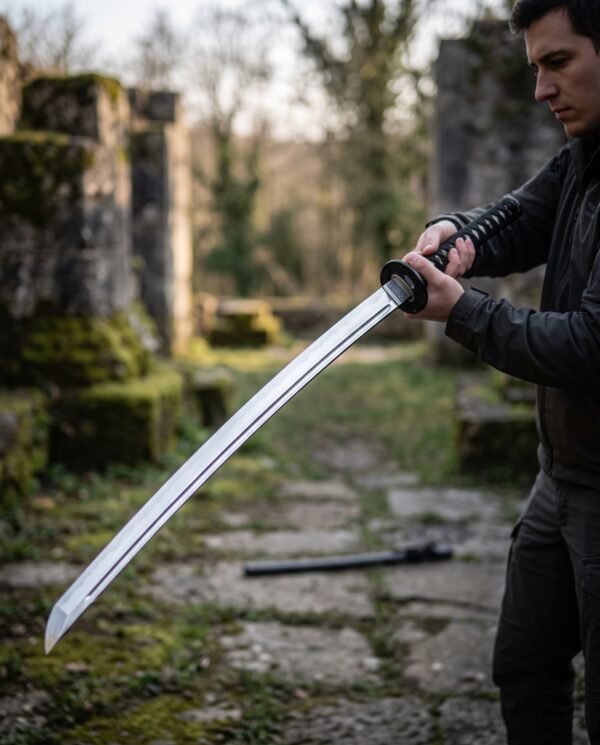
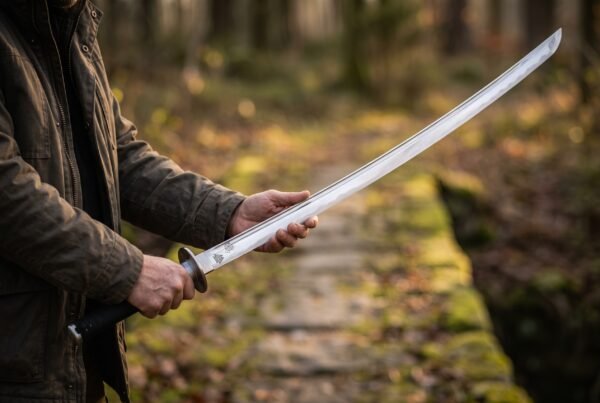
A katana is worn edge up, and almost everything about the sword follows from that one decision. Earlier Japanese swords, the tachi, hung edge down from cords at the hip, which meant drawing was one motion and cutting was a second. Turning the blade over and thrusting it through the belt collapsed those two motions into one. The sword leaves the scabbard already travelling along the line of the cut, and the draw itself becomes the strike. That is the whole basis of iaido, and it is why the curve, the length of the handle and the position of the balance point on a katana are what they are. Stormcrane is built to those proportions in 1095 high carbon steel, hardened to 54 to 58 HRC, with a 29 inch blade and a pronounced sori. For what makes a katana a katana, read how a katana is built.
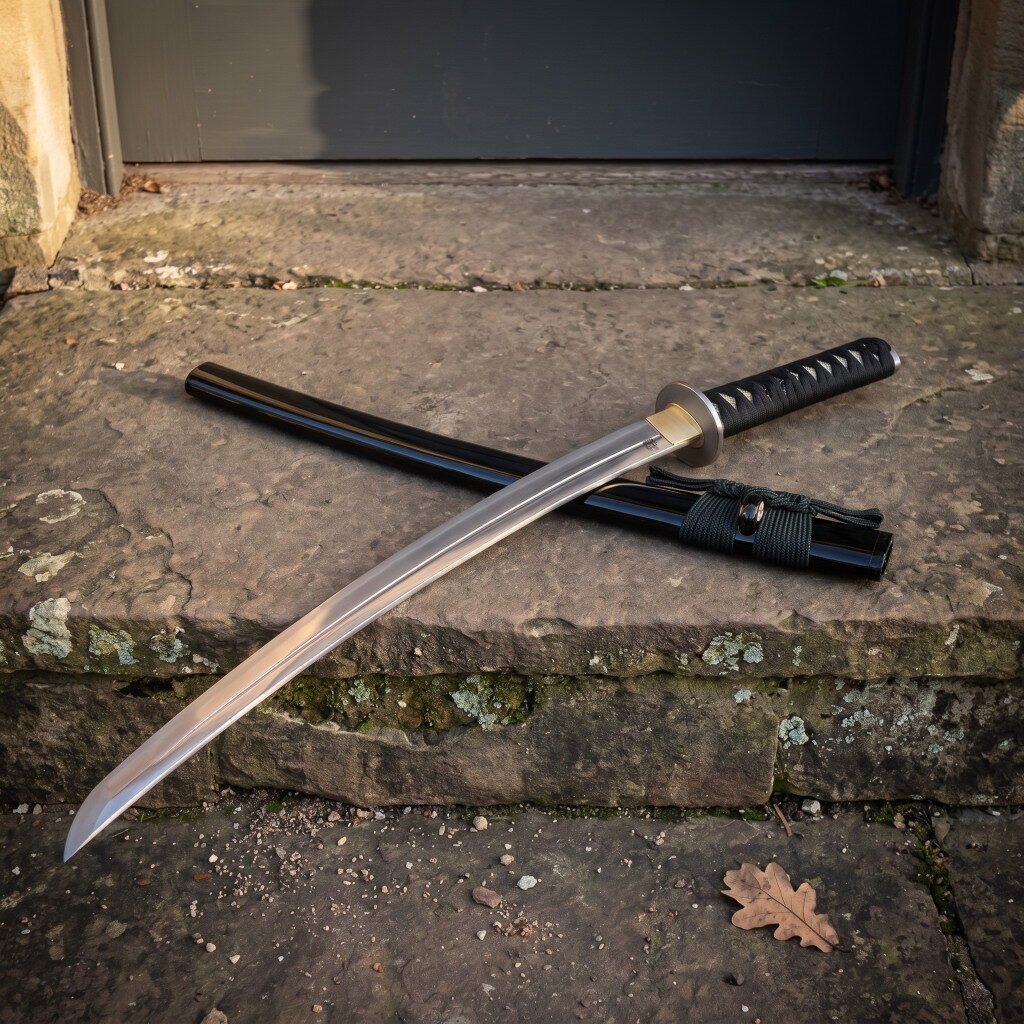
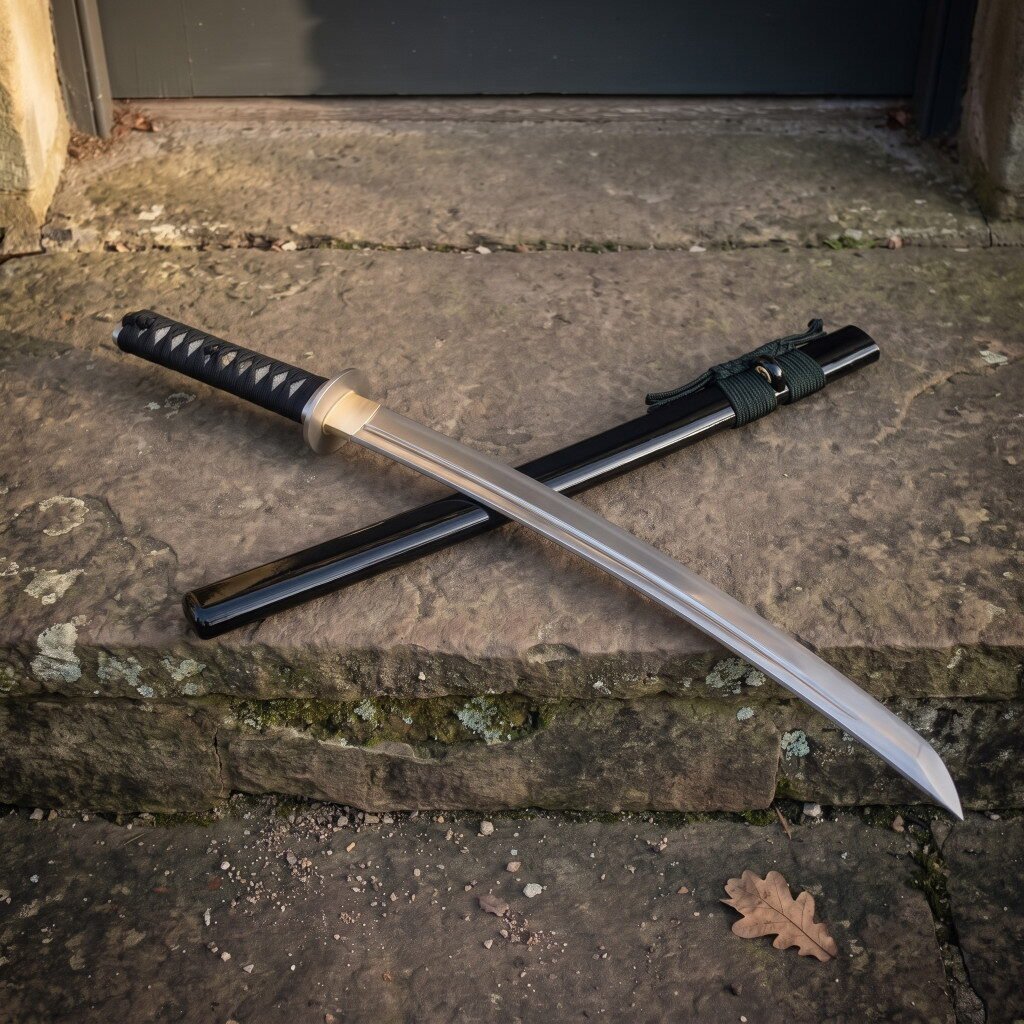
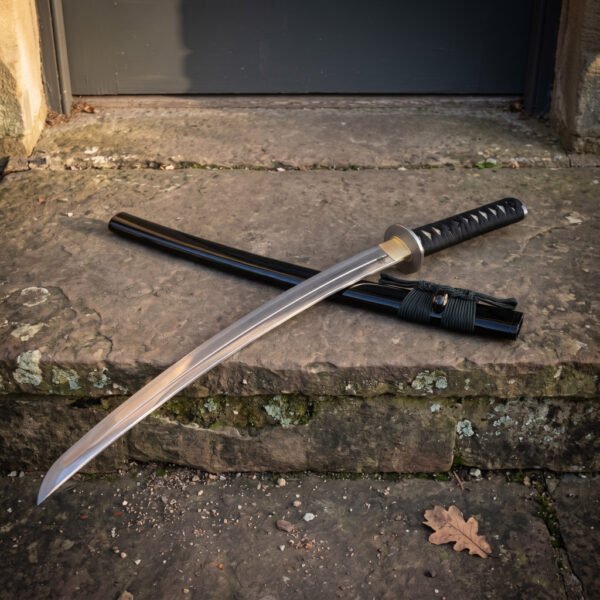
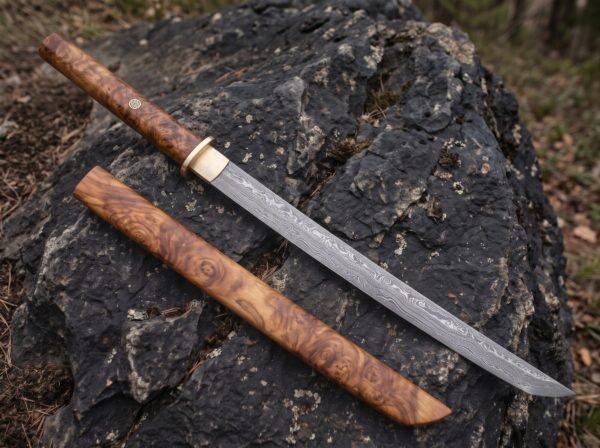
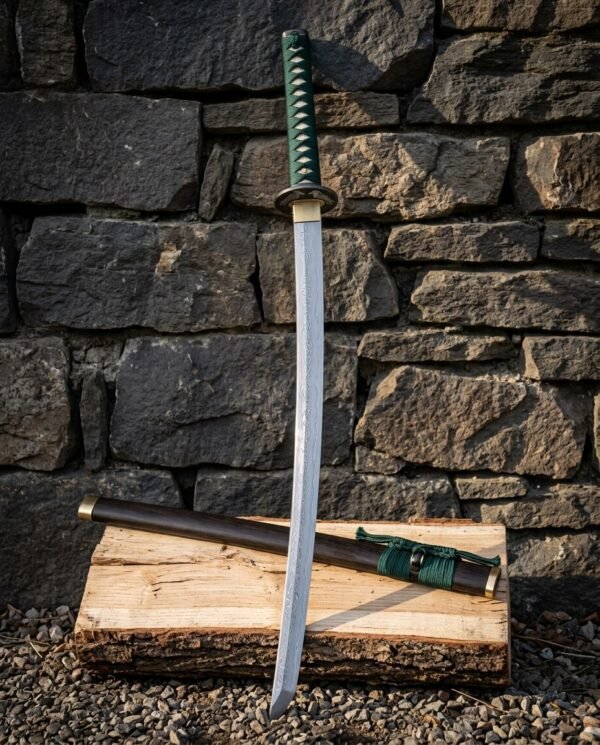
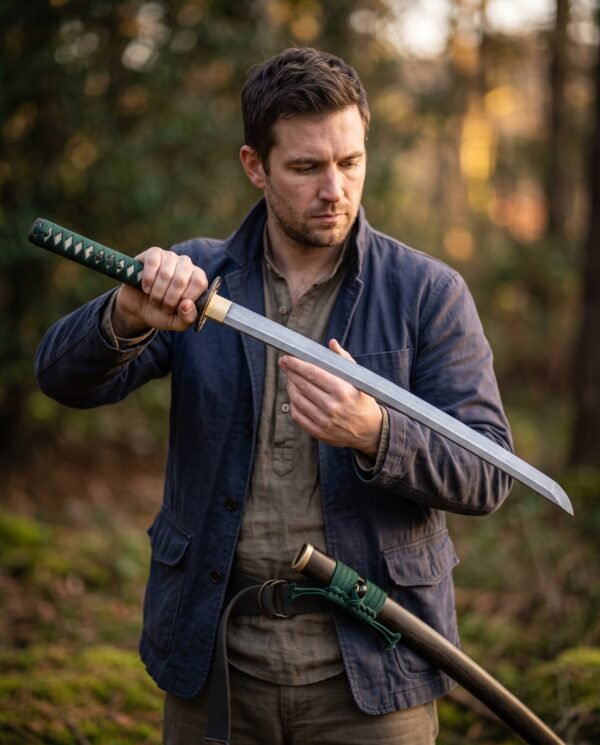
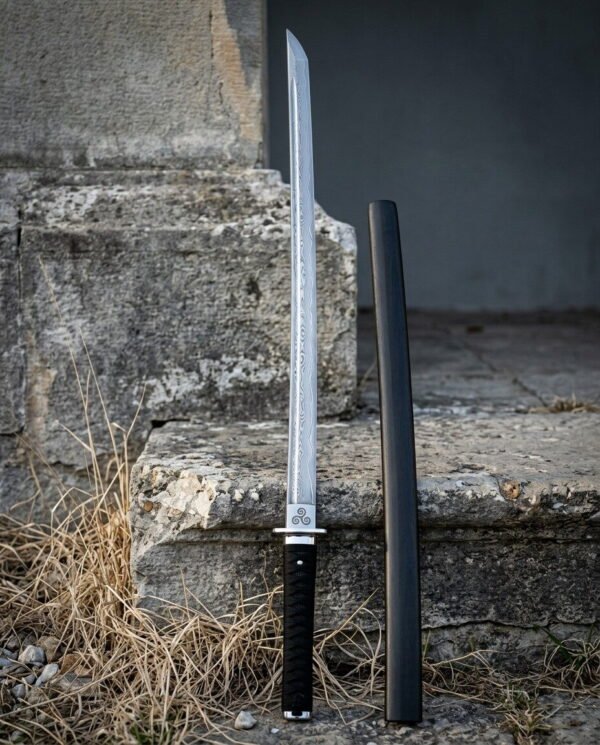
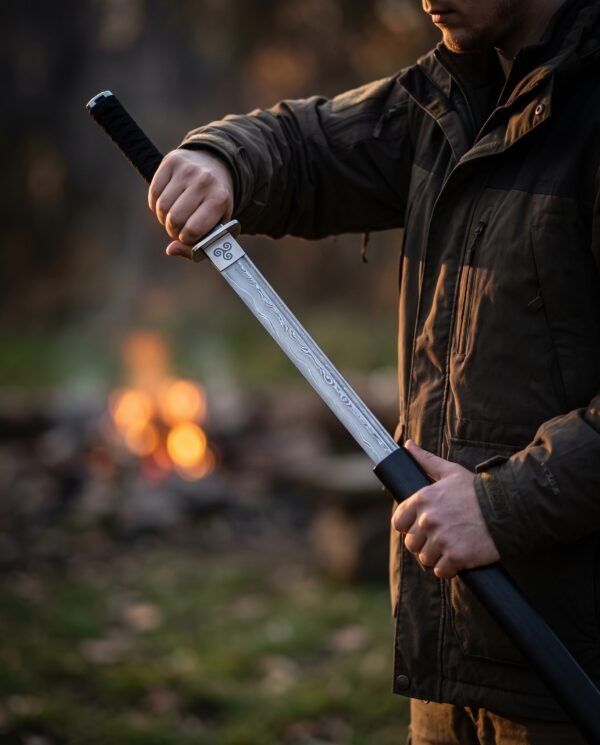
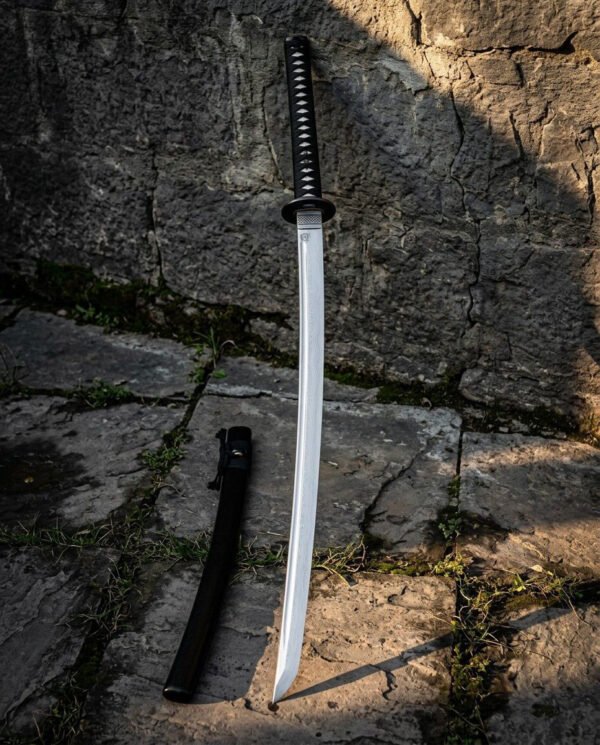
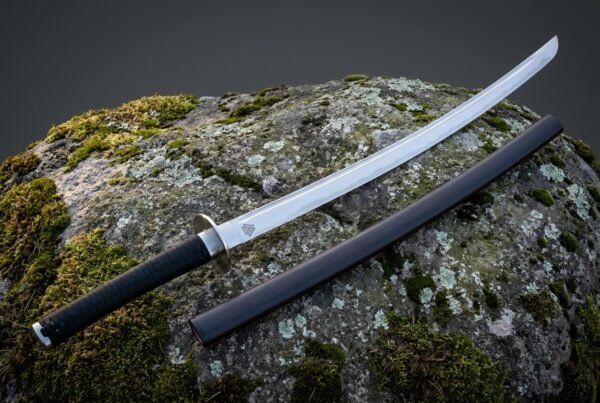
Forged, ground, heat treated, polished and mounted by hand by hand in the Czech Republic. It ships with the black lacquered wooden saya shown in the photographs, a cord sageo, and a light coat of protective oil. Shipping within the United States is free.
Specifications
| Steel | 1095 high carbon steel |
|---|
| Hardness | 54 to 58 HRC |
|---|
| Overall length | 41.5 inches |
|---|
| Blade length | 29 inches |
|---|
| Blade profile | Shinogi zukuri with pronounced sori and a hand polished satin finish |
|---|
| Handle | 11 inch hardwood tsuka wrapped in black cord over black same |
|---|
| Guard | Brass toned tsuba with matching seppa and habaki |
|---|
| Scabbard | Black lacquered wooden saya with cord sageo |
|---|
| Weight | Approximately 2.7 pounds bare, 3.5 pounds in the saya |
|---|
| SKU | RK-1272 |
|---|
Why the handle is as long as it is
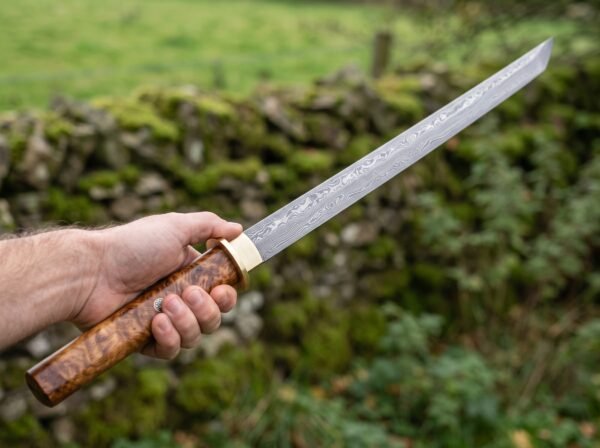
An 11 inch tsuka on a 29 inch blade looks disproportionate next to a European sword, and people often assume the extra length is there to fit a second hand comfortably. It is there for leverage. The two hands on a katana do not pull in the same direction. The leading hand near the guard acts as a pivot and the trailing hand at the pommel end pulls back and down, so the two work as a couple across the length of the handle. The longer the handle, the greater the mechanical advantage, and the less raw arm strength it takes to accelerate the blade and then stop it dead at the end of a cut.
Stopping is the harder half. A cut that is not arrested cleanly wanders off line and the edge rolls in the target. That is why so much of Japanese swordsmanship is about the trailing hand, and why a katana handle that feels excessively long in a shop feels exactly right once the sword is moving. It also explains the balance point on this piece, roughly four inches forward of the tsuba, which is far enough out to carry weight into the cut and close enough in to let the sword change direction.
Why 1095 high carbon steel and not stainless
1095 is plain iron with just under one percent carbon. There is nothing else of consequence in it, and that simplicity is what makes it a good sword steel. Without chromium competing for the carbon, the carbon is free to form fine hard structures rather than coarse carbides, so the edge can be taken genuinely keen and brought back to keen on a normal whetstone. It also behaves predictably in a quench, which matters on a blade this long.
Stainless buys corrosion resistance with chromium and pays for it twice, once in edge fineness and once in toughness. At sword length stainless tends to snap rather than take a set, and a long blade ought to bend before it breaks. The cost of choosing 1095 is that it will rust if you leave it wet or fingerprinted, which is what the oil is for. The longer argument is in our steel and hardness notes.
The tsuka and the saya
The handle core is hardwood, shaped in two halves around the full length tang, covered in black same for texture and wrapped in black cord in alternating diamonds. Bamboo mekugi hold it to the tang. The saya is turned and hollowed from wood, lacquered black and fitted so the habaki alone carries the sword, which is why a well made scabbard holds the blade with a light click and lets it go with a thumb push rather than a wrestle.
Both handle and scabbard are wood and both want the same care. Keep them out of prolonged damp, out of direct sun and away from radiators, wipe rather than soak, and let a wet saya dry slowly. The advice in handle and sheath care applies to a sword mount as much as to a knife scale.
Engraving, runes and your own design
Use the rune converter on this page to turn a name, a date or a short phrase into Elder Futhark and we will cut it into the steel or the handle. If you would rather have a Viking pattern than a rune line, choose your own design in the engraving option above the add to cart button and tell us whether it goes on the blade or the handle. Where a piece already carries an engraved design, your chosen engraving replaces it rather than sitting alongside it. See the engraving page for placement and depth.
Care and sharpening
Wipe the blade down after handling and before it goes away. Salt and moisture from skin will print on a polish inside a day in a humid room, and once a print etches in it has to be polished out rather than wiped off. A cloth with light mineral oil takes care of it. Do not leave the sword sheathed for months in damp air.
Sharpening is ordinary whetstone work. Follow the existing bevel angle, work along the curve so the sori is not flattened at the middle, and finish fine and strop. A coarse stone is only for real damage. Both jobs are covered in steel care and sharpening with a whetstone.
Made in the Czech Republic
This piece is made by hand in the Czech Republic, in a workshop that still works the old way. The steel is forged, ground, heat treated and finished by smiths who learned the trade from the people before them, and the wood, horn and leather are cut and fitted by hand rather than pressed out on a line. That is also why no two pieces come out exactly the same.
Ransack Viking is a United States company. We import these pieces ourselves, check every one when it lands and ship from our warehouse in Chicago, Illinois. Engraving is done here in the United States after the piece arrives, so your runes or your own design go on before it leaves for you.
A note on handmade variation
Stormcrane is hand forged. It is not machine made and it is not bulk produced, so what arrives will not be a pixel for pixel copy of the photograph. The temper line runs where the clay took it, the polish holds the light in its own way, the grain and tone of the wood in the handle and the scabbard are their own, and the exact profile of the curve varies a little because it is set in the quench and not stamped. Dimensions, steel and build are the same on every one. The character is not, and that is what hand work from natural materials means.
Frequently asked questions
Is this long enough for iaido practice?
Yes. At 41.5 inches overall with an 11 inch handle it sits in the normal range for an adult practitioner. If your dojo requires a blunt iaito rather than a sharpened shinken, say so in the order notes and we will supply it unsharpened at no extra cost.
Does it arrive sharp?
Sharpened and ready to cut unless you ask otherwise. It is a real blade, so treat the edge as you would any sharp tool.
Can I do test cutting with it?
On soft targets, yes. Rolled tatami, water bottles and light green bamboo are within its range. Hard targets, wood, metal, sand cores and blade to blade contact are not. Steel on steel takes chips out of hardened edges and no sword recovers from that without a regrind.
Can I have runes engraved on it?
Yes. Elder Futhark through the rune converter on this page, or your own pattern from the engraving option above the add to cart button. Tell us whether it belongs on the blade or the handle.
How is this different from the shorter Japanese blades you sell?
Reach and grip. This is a two handed sword at 41.5 inches. A wakizashi is around 28 inches and one handed, a tanto is a knife length blade. Historically a katana and a wakizashi were worn together as a daisho pair, and many buyers build the pair over two orders.
How long does shipping take?
Free within the United States. One to two weeks in the shop, a few days more with engraving, then two to five days in transit.
What is in the box
- Stormcrane hand forged 1095 high carbon steel katana
- Black lacquered wooden saya with cord sageo
- Spare bamboo mekugi peg
- Protective oil coat on the blade
- Care and sharpening card
- Elder Futhark rune engraving where selected
- Forged and finished in the Czech Republic
Explore the range
See the full katana and Japanese sword range, pair it with a wakizashi, browse every sword we carry, or read the guides.
Other pieces in this group
Closest to this in the range is the Jadecord Japanese sword, 40 inches overall. If this one is not quite right, there is the Inkwake Japanese sword, 36 inches overall. Also in this group is the Valkgleam Japanese sword, forged from 1095.
If you are putting a set together, the Wolfmark Viking sword sits alongside it. Nothing here exactly right, build one to your own spec on the design your own page.

Got this as a birthday gift and the reaction was priceless. High Carbon Steel blade holds a razor edge right out of the box. Couldn’t be happier with this. You can tell it’s real Czech blacksmith work and shipping from the States made delivery painless.