The tanto is the oldest shape in the Japanese sword family and it was designed to solve a problem the long swords could not. Against a man in lamellar armour, a cut lands on lacquered plates and cords and does very little. What works is a stiff, thick, short blade driven into the gaps, at the armpit, the neck, the inside of the thigh, and that is what a tanto is. It is thick in section for its width, it does not flex, and the point carries far more steel behind it than a knife of the same length would need for any ordinary purpose. When you pick one up the weight is the surprise. It is much heavier than it looks, and every bit of that mass is behind the point. Shadowreed is forged to those proportions in 1095 and 15N20 Damascus steel hardened to 58 to 60 HRC, with a 12.5 inch blade. The Japanese short blade and its modern point are explained in what a tanto is.
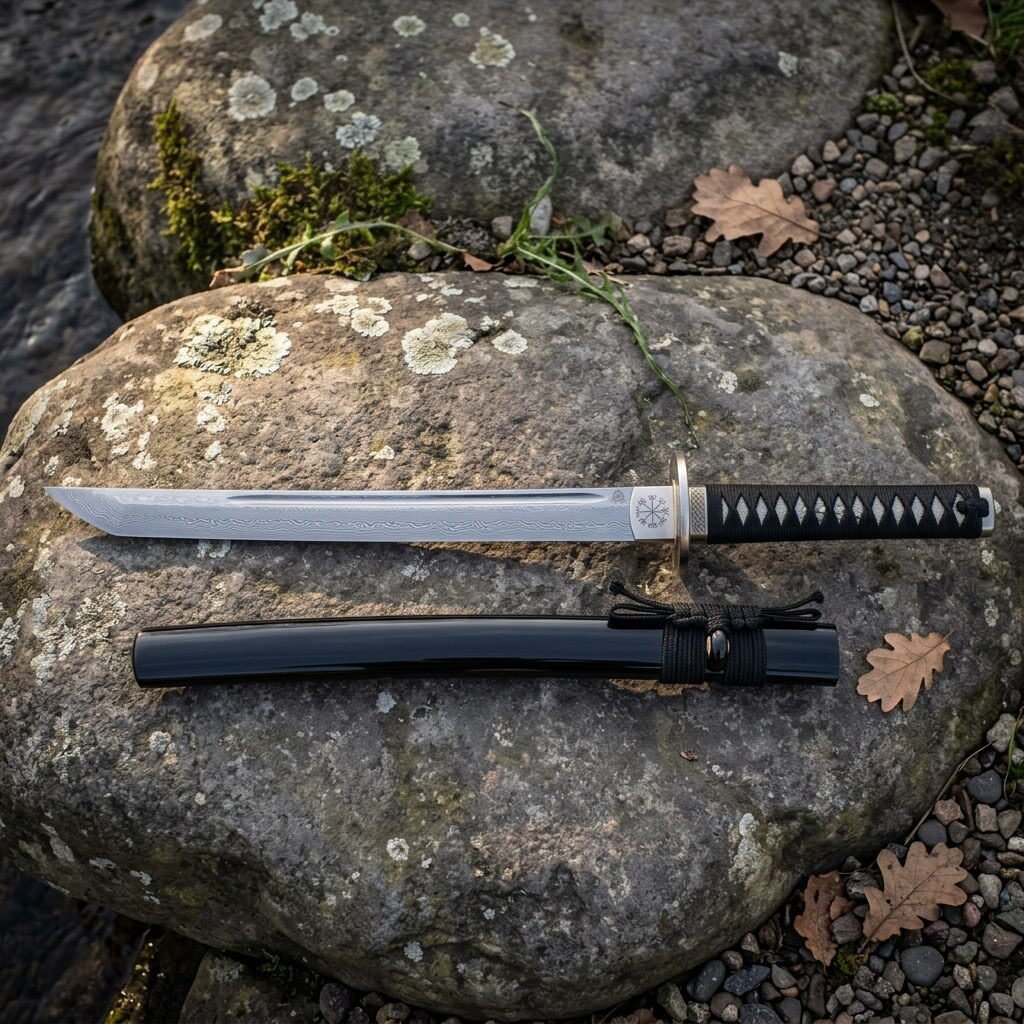
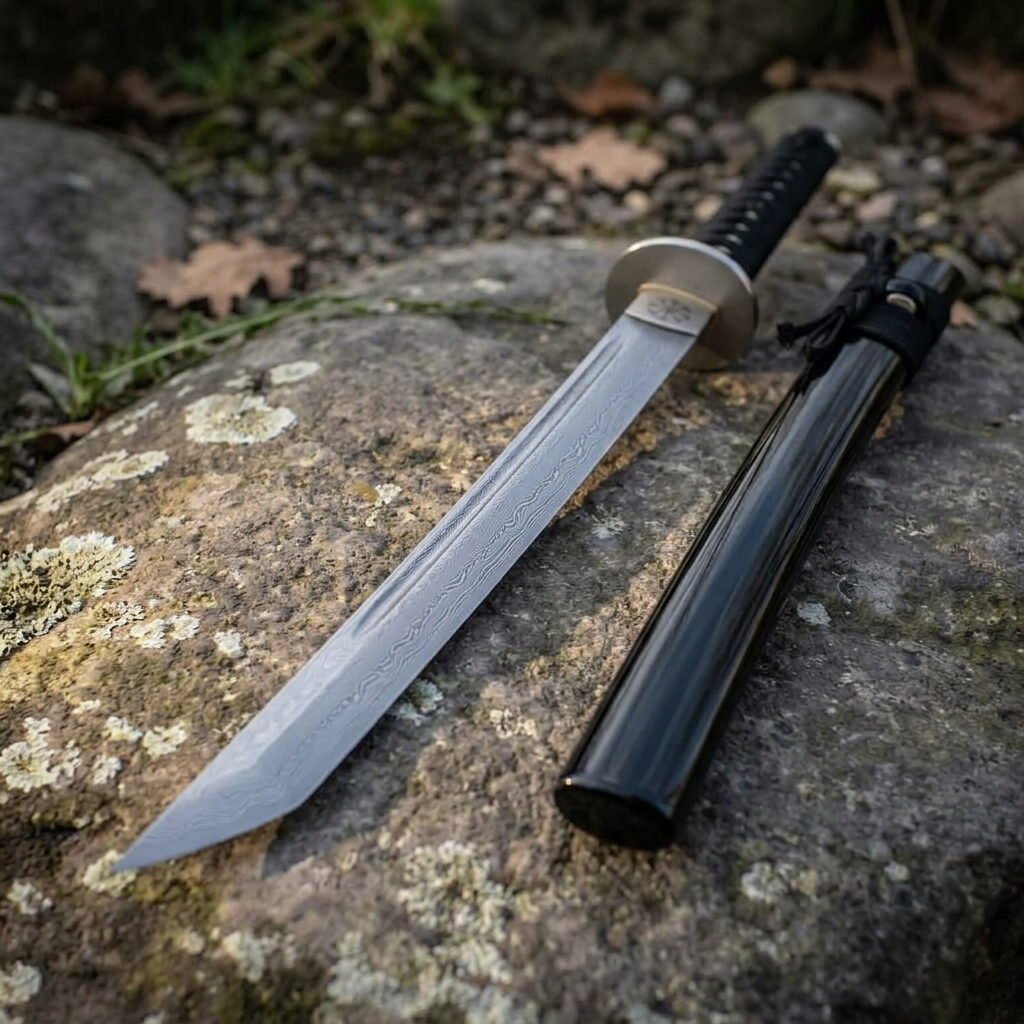
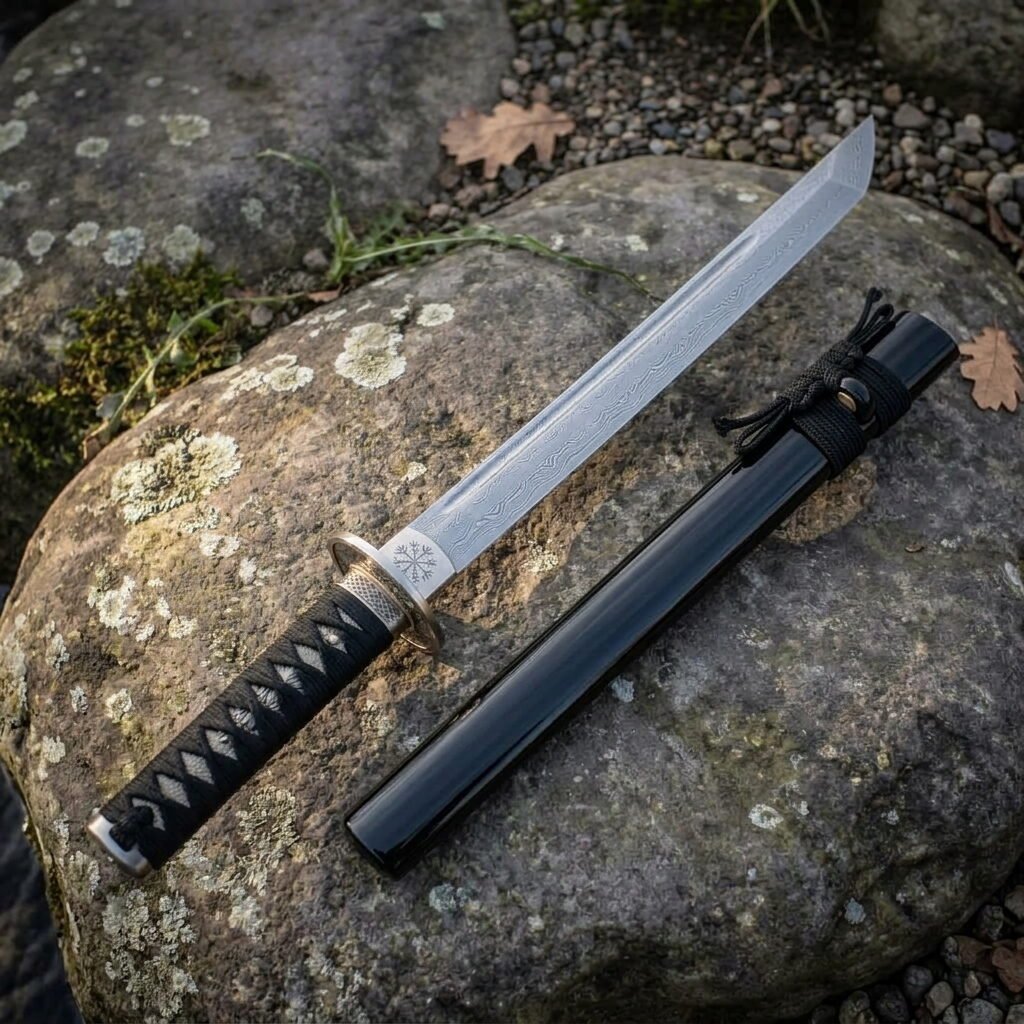
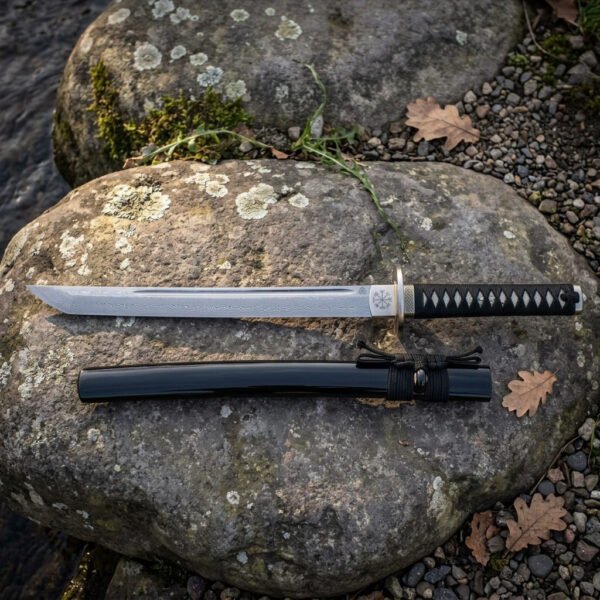
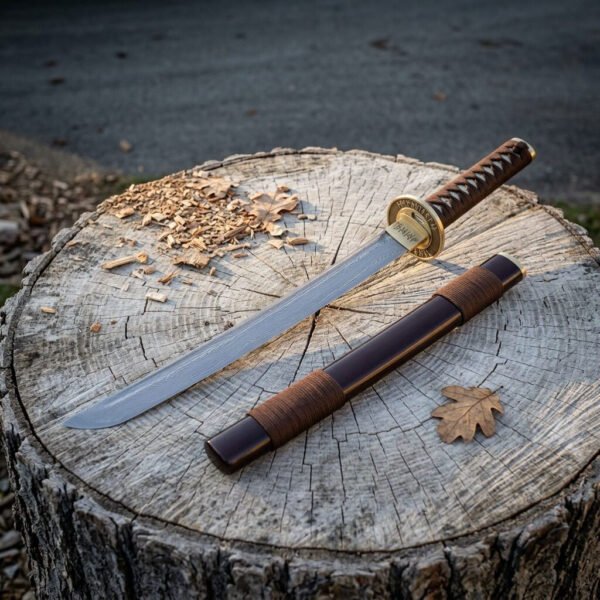
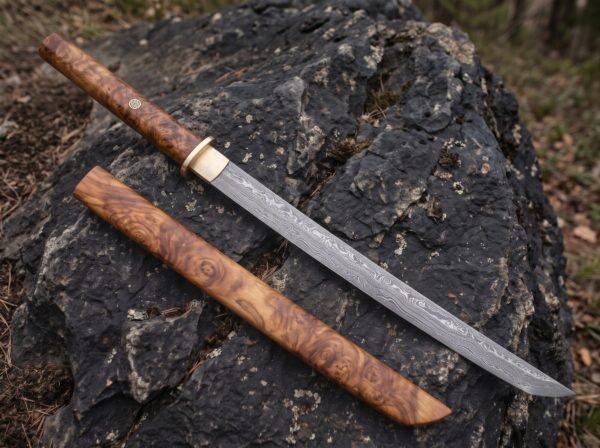
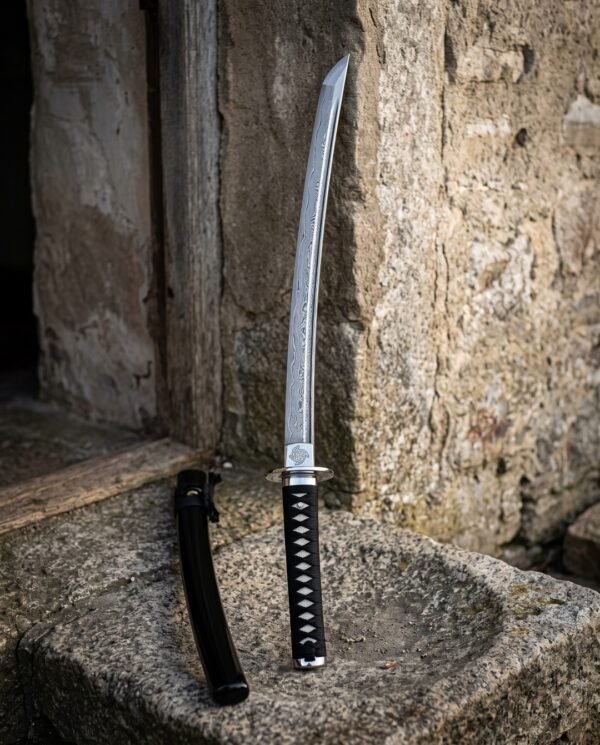
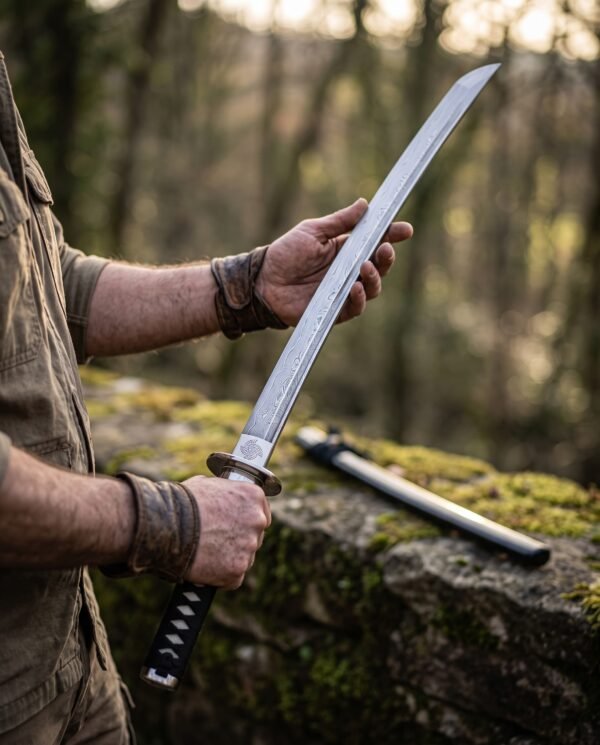
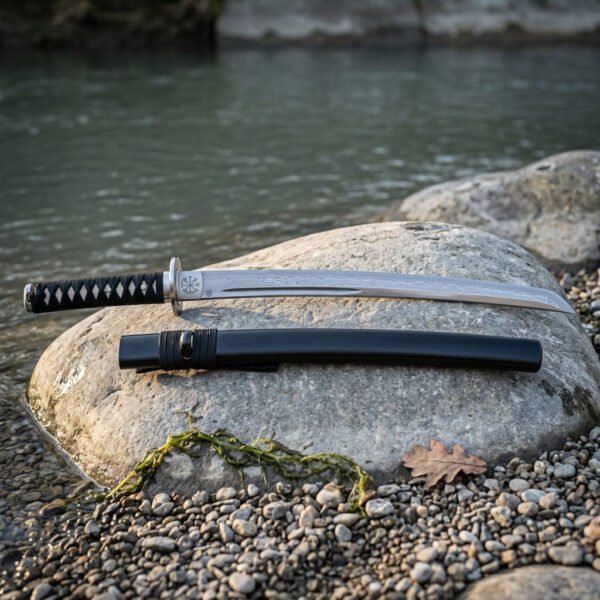
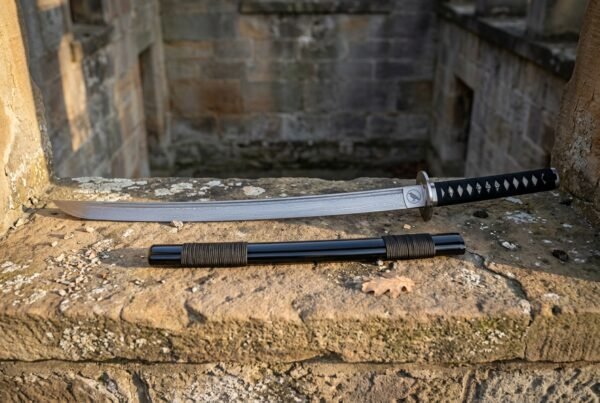
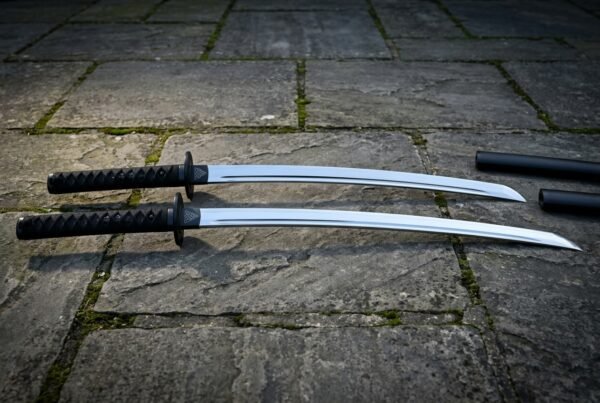
Forged, ground, heat treated and mounted by hand in the Czech Republic. It ships with the black lacquered wooden saya shown in the photographs, a cord tie, and a protective coat of oil on the blade. Shipping inside the United States is free.
Specifications
| Steel | 1095 and 15N20 Damascus steel |
|---|
| Hardness | 58 to 60 HRC |
|---|
| Overall length | 19 inches |
|---|
| Blade length | 12.5 inches |
|---|
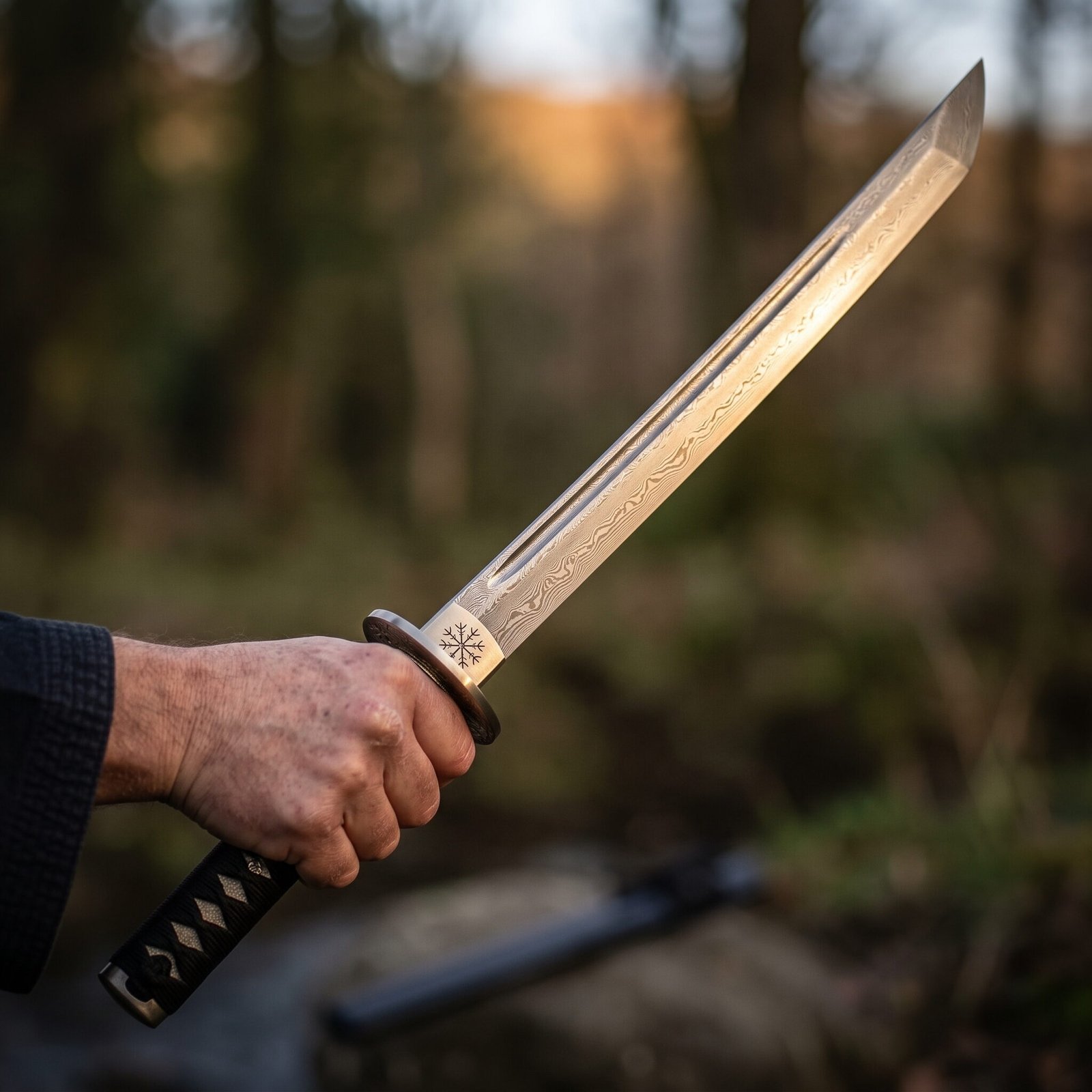
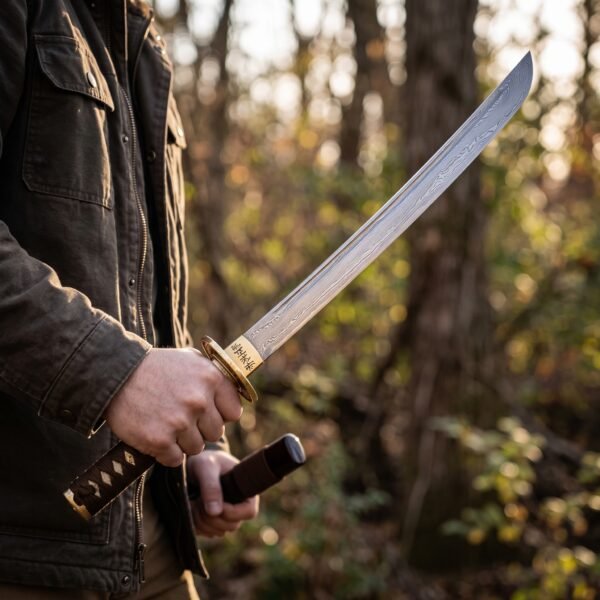
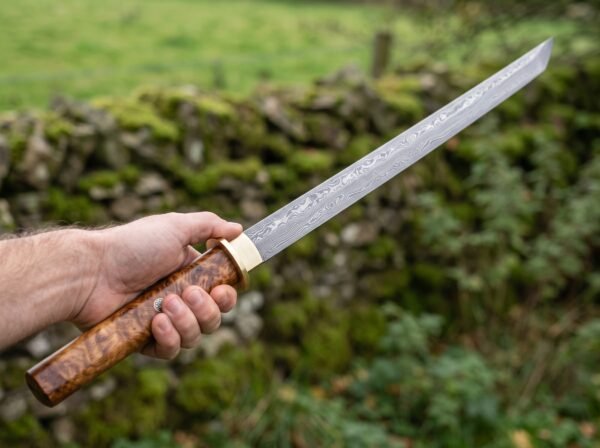
| Blade profile | Straight edged tanto with a long angled kissaki, a narrow fuller and an etched Damascus pattern |
|---|
| Engraving | Vegvisir stave etched on the blade just above the guard |
|---|
| Handle | 6 inch hardwood tsuka wrapped in black cord over pale same, brass fuchi and kashira |
|---|
| Guard | Small oval brass tsuba with a fitted habaki |
|---|
| Scabbard | Black lacquered wooden saya with black cord tie |
|---|
| Weight | Approximately 1 pound bare, 1.4 pounds in the saya |
|---|
| SKU | RK-1278 |
|---|
Why the point is shaped the way it is
Look at the tip of this blade and you will see the edge run straight for most of its length and then turn up sharply into a long angled point rather than curving gently to a needle. That geometry is doing two jobs at once and they normally fight each other.
A needle point penetrates easily because it starts with almost no cross section, but it has almost no steel behind it and it bends or snaps against anything hard. A thick point survives but resists going in. The Japanese answer was to keep the point itself relatively acute while backing it immediately with a full thickness spine that runs almost all the way to the tip. The angled transition is what makes that possible. Instead of the blade tapering away over the last four inches, it steps up, so the section behind the point stays deep and the whole tip acts as a short, stiff wedge rather than a long thin one.
The practical consequence for an owner today is a blade that will take a hard thrust into a resistant target without deforming, and a long straight cutting edge that behaves like a very capable utility knife. It is the most useful shape in the family and the least dramatic looking, which is roughly the opposite of how these things usually go.
Why Damascus steel and not stainless
The blade is forge welded from 1095 and 15N20, then etched so the two steels show as the flowing grey and silver pattern along the flats. The 1095 layers carry the carbon for a keen edge and the 15N20 layers add toughness. On a short blade this matters more than on a long one, because a tanto is used for cutting jobs where the difference between sharp and very sharp is obvious in the hand.
Stainless buys corrosion resistance with chromium and pays in edge fineness. It is a reasonable trade for a kitchen or a boat and a poor one here. The price of carbon Damascus is honest rust if you leave it wet or fingerprinted, which is what the oil is for and why there is a care card in the box. The comparison is set out in full in our steel and hardness notes.
The handle and the saya
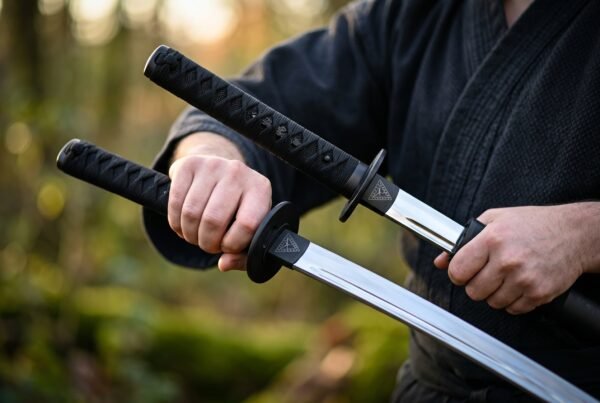
The tsuka is a hardwood core cut in two halves around the full length tang, covered in pale same and wrapped in black cord in alternating diamonds. On a short blade the handle is proportionally shorter, six inches here, which is enough for a full hand and a thumb along the spine. A bamboo mekugi holds handle to tang and can be replaced in a minute.
The saya is hollowed from wood and lacquered black, fitted so the habaki carries the sword and nothing touches the polish. Both the handle core and the scabbard are wood, so keep them out of long damp and direct sun and wipe rather than soak. See handle and sheath care for the details.
Engraving, runes and your own design
Use the rune converter on this page to turn a name, a date or a short phrase into Elder Futhark and we will cut it into the steel or the handle. If you would rather have a Viking pattern than a rune line, choose your own design in the engraving option above the add to cart button and tell us whether it goes on the blade or the handle. Where a piece already carries an engraved design, your chosen engraving replaces it rather than sitting alongside it. A tanto blade has a broad flat above the ridge that takes a short line of runes particularly well, and the engraving page covers placement.
Care and sharpening
Wipe it after handling, including around the habaki where moisture sits between brass and steel. A cloth with light mineral oil is enough. Because a tanto is small enough to be carried and used rather than displayed, it will pick up more contact than a sword will, so make the wipe a habit rather than an occasional job.
The edge is short and mostly straight, which makes it the easiest blade in the range to sharpen. Match the ground angle, work the length in even passes, finish on a fine stone and strop it. The guides are steel care and sharpening with a whetstone.
Made in the Czech Republic
The work behind this piece happens in a Czech Republic workshop that has kept to the old methods. Steel is forged and heat treated by hand, the grind is taken down by eye rather than by machine, and the handle, fittings and sheath are cut and finished one at a time. Because of that, every piece carries small marks of the hand that made it.
Ransack Viking is a United States company. We import direct, check each piece when it reaches us, and ship from our Chicago, Illinois warehouse. Engraving is added here in the United States after arrival, so the piece you receive is finished to your order.
A note on handmade variation
Shadowreed is hand forged. It is not machine made and it is not bulk produced, so what arrives will not be a pixel for pixel copy of the photograph. The polish carries light in its own way, the Damascus pattern runs its own way along the blade, the wrap sits where the hand tied it, and the grain and tone of the wood in the tsuka core and the saya belong to that timber. Even the exact angle of the kissaki varies a little because it is ground by eye. Dimensions, steel and build are the same every time. The character is not.
Frequently asked questions
Is a tanto a knife or a sword?
Legally and practically it sits between them. At 12.5 inches of blade it is longer than any pocket knife and shorter than a sword, and in most of the United States it is treated as a fixed blade knife. Check your own state and city rules before carrying one outside the house.
Does it arrive sharp?
Yes, sharpened and ready to use. Ask in the order notes if you want it blunt for display and there is no extra charge.
Can I actually use it?
Yes. This is the most usable piece in the Japanese range. It will handle heavy cutting jobs, camp work and soft target practice. It is not a pry bar and it is not for throwing, and hard contact against metal or stone will chip a hardened edge.
Can I have runes engraved on it?
Yes. Use the rune converter on this page for an Elder Futhark line or choose your own Viking pattern in the engraving option above the add to cart button. The flat of a tanto blade suits a short line well.
What is the difference between this and a wakizashi?
Length and intent. A wakizashi is around 20 inches of blade and is a short sword. A tanto is 12.5 inches, thicker in section for its width, and built around the point rather than the edge. A tanto is far easier to keep and display in a normal house.
How long does shipping take?
Free within the United States. One to two weeks in the shop, longer with engraving, then two to five days in transit.
What is in the box
- Shadowreed hand forged Damascus steel tanto
- Black lacquered wooden saya with cord tie
- Spare bamboo mekugi peg
- Protective oil coat on the blade
- Care and sharpening card
- Elder Futhark rune engraving where selected
- Forged and finished in the Czech Republic
Explore the range
See the longer wakizashi, the full katana and Japanese sword range, the straight bladed short swords, or read the guides.
If this one is not it
Also in this group is the Knotguard tanto knife, high carbon steel. Sitting beside it in the catalogue is the Gildsaya tanto knife. Another in the same line is the Amberoak tanto knife, 5 inches overall.
For a different piece from the same family, look at the Thornflight throwing knife. Pick the steel, the length and the fittings yourself on the custom hunting knife page.

Reviews
There are no reviews yet