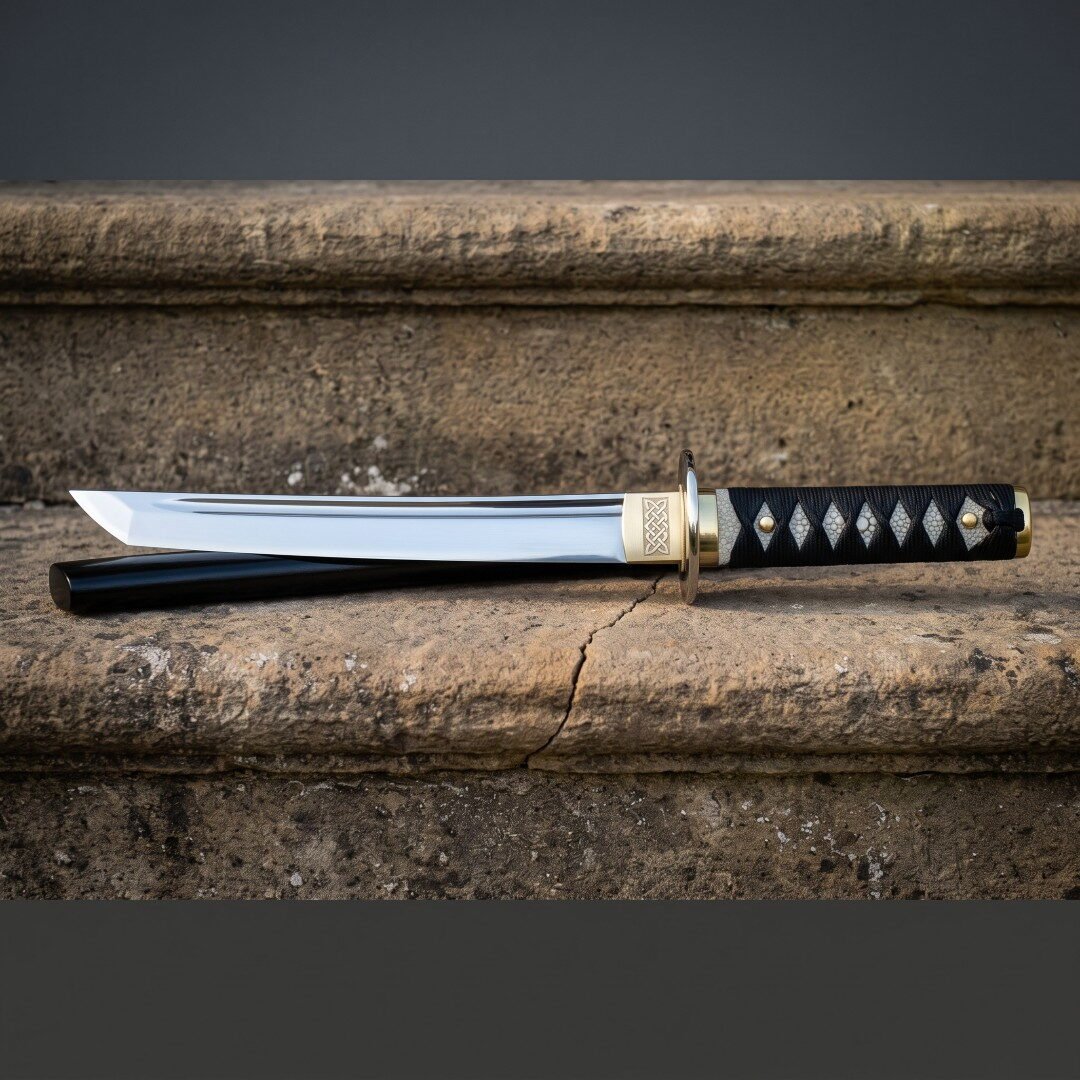
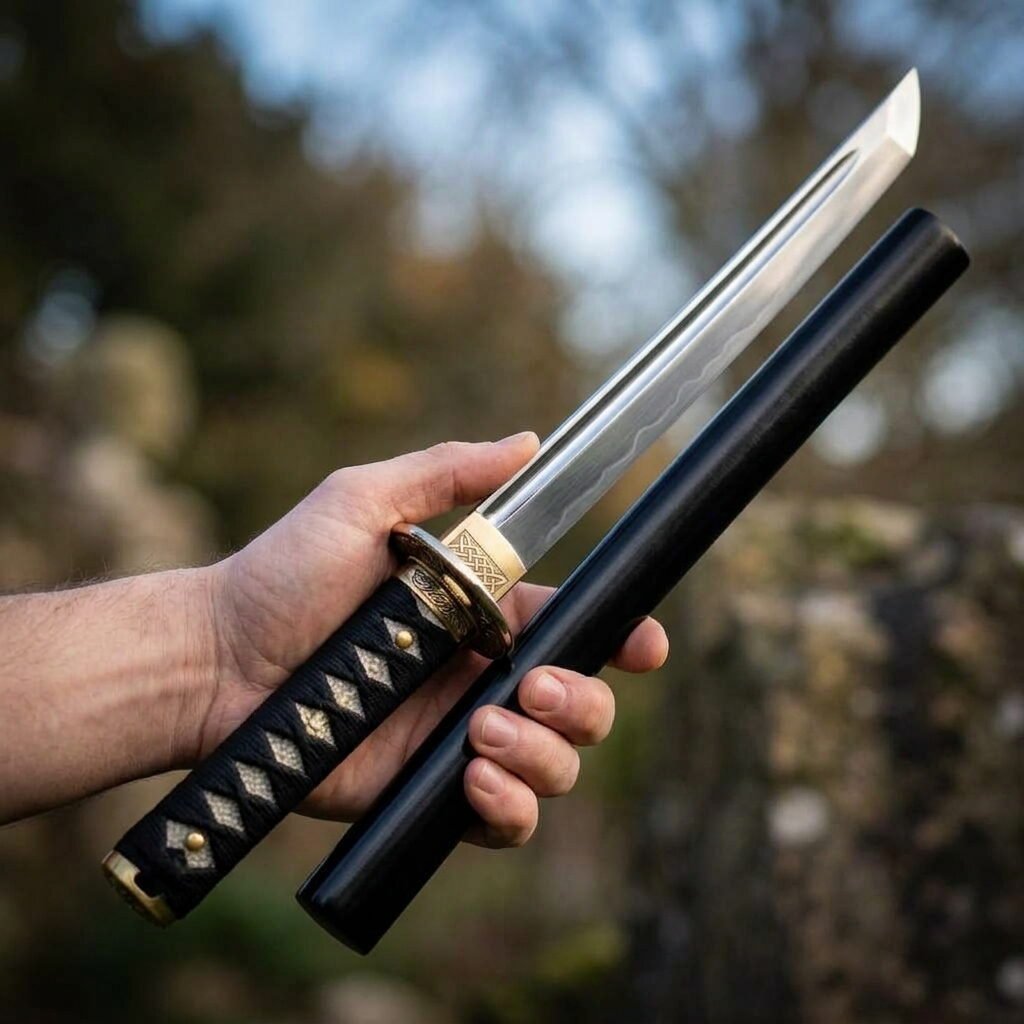
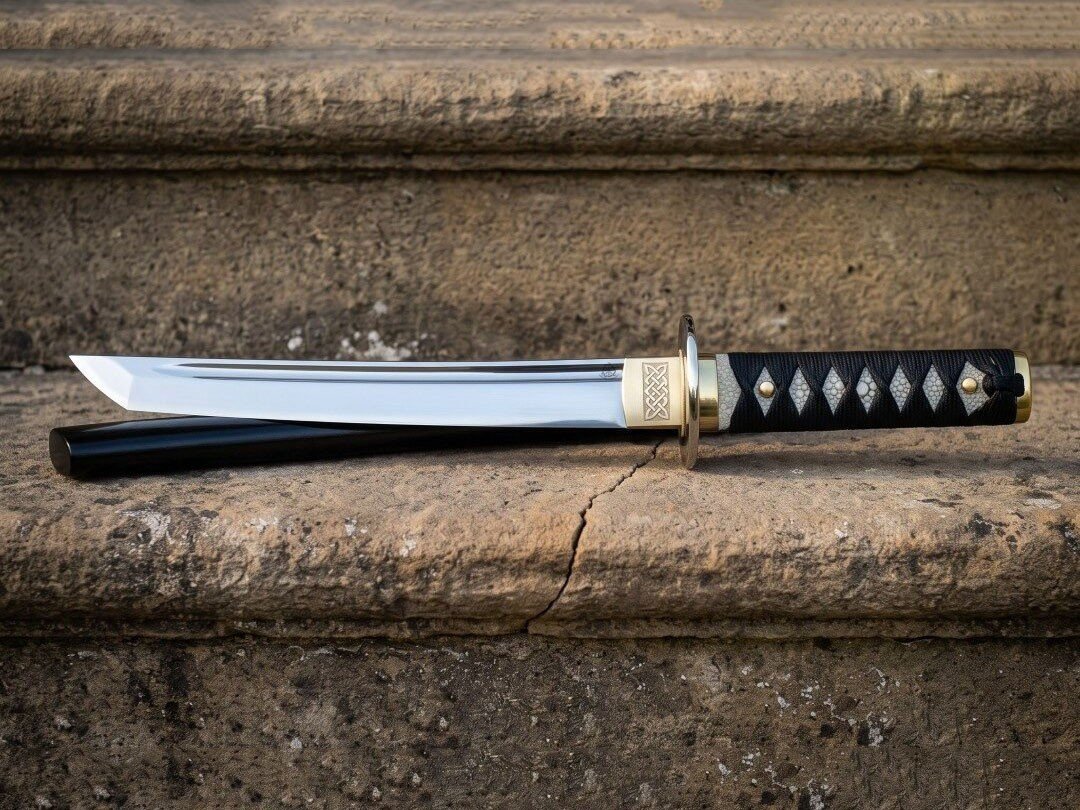
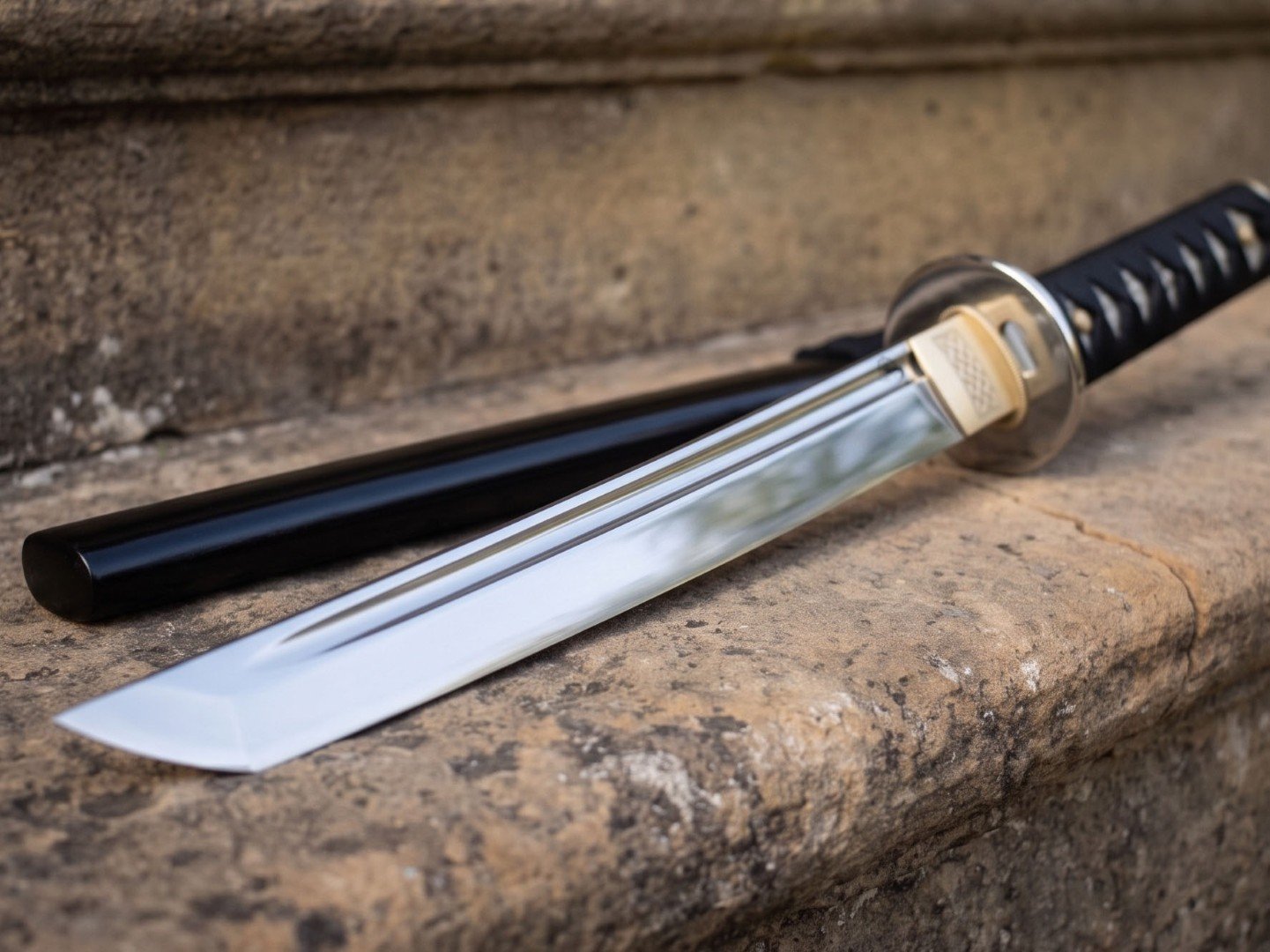
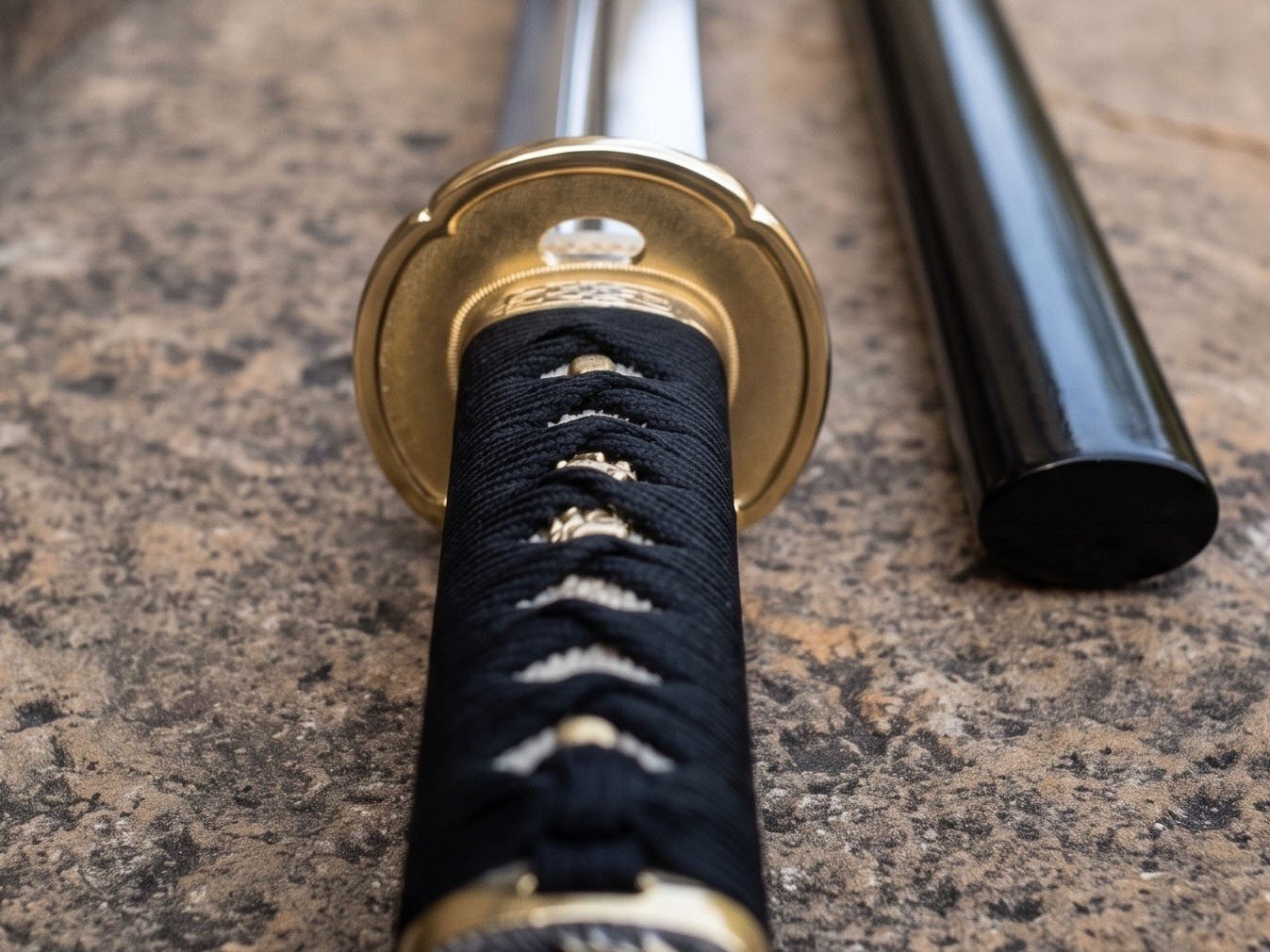
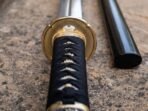
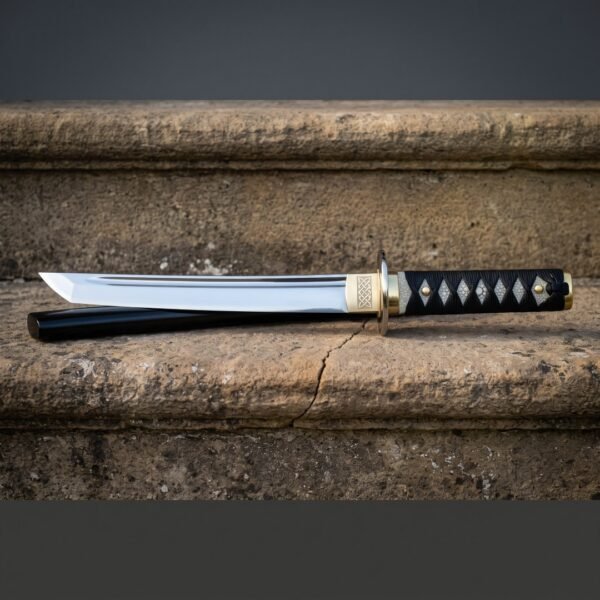
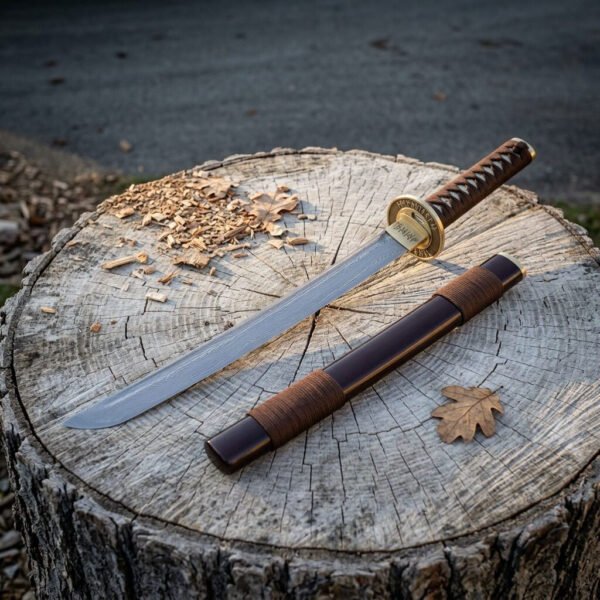
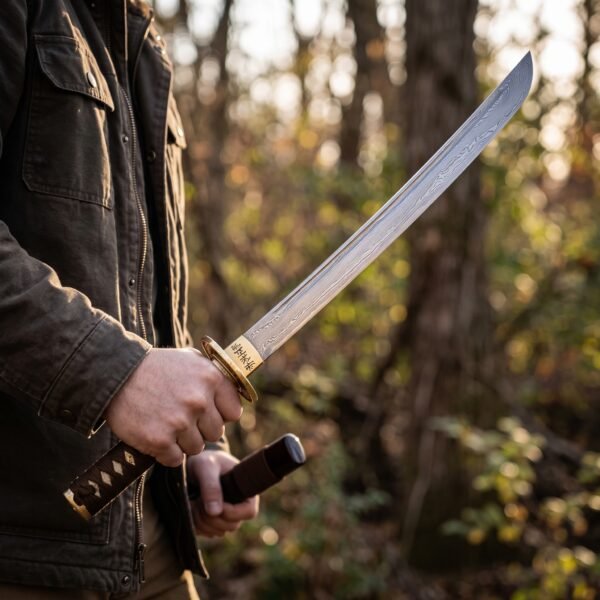
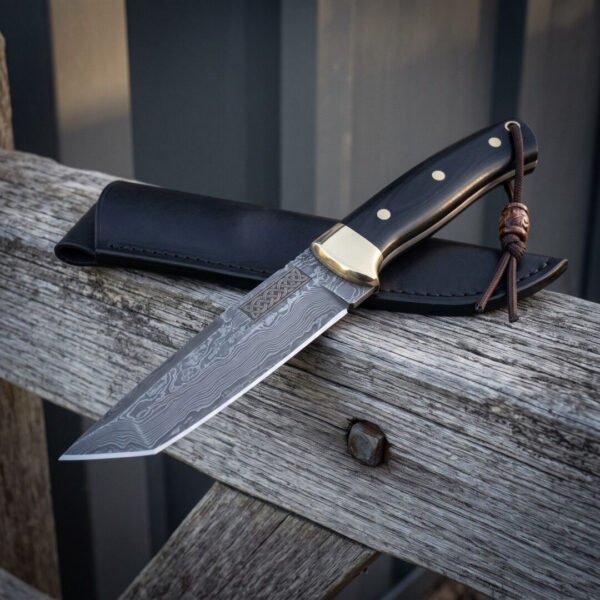
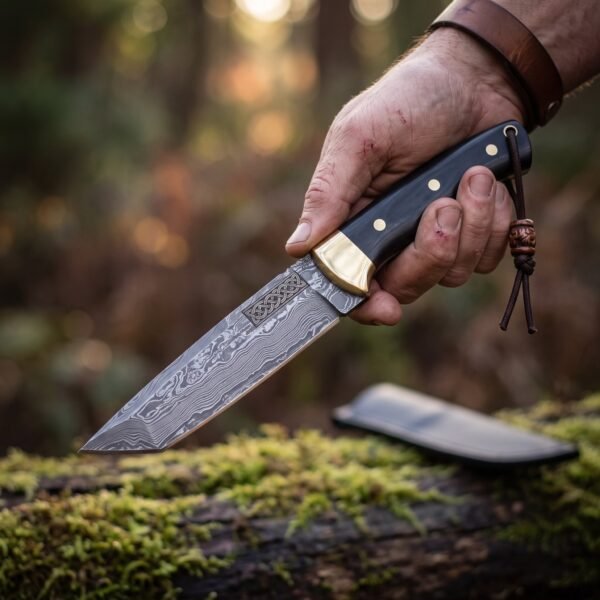
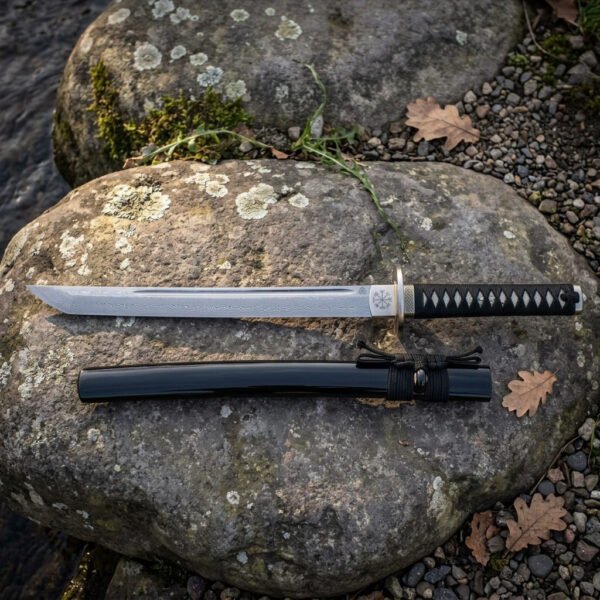
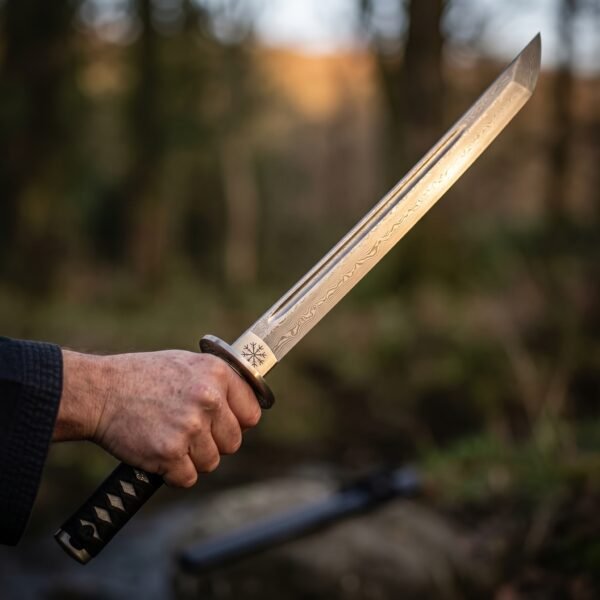
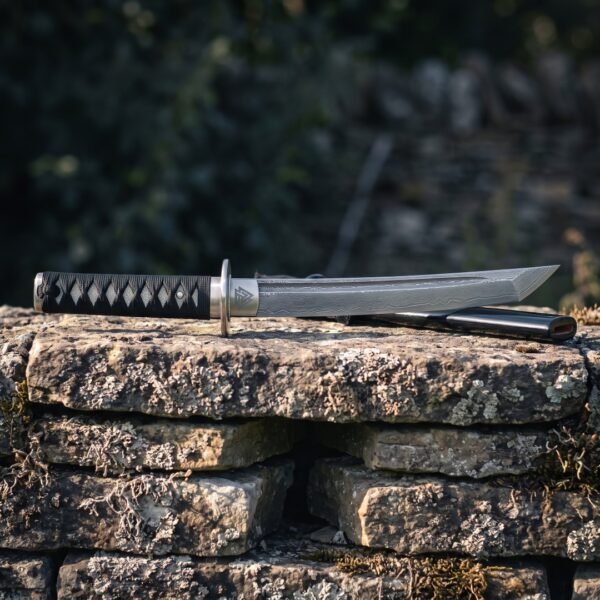
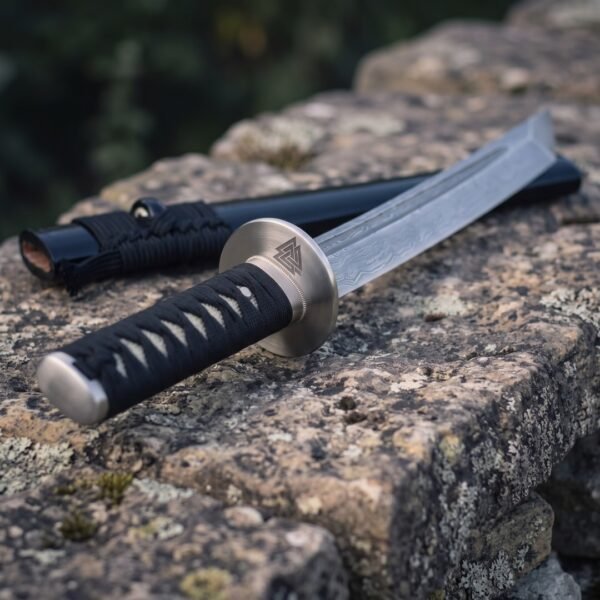
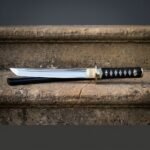
The Gildsaya is a tanto finished the traditional way, with a mirror polished plain carbon blade rather than a pattern welded one, and dressed in brass instead of steel. The blade collar carries a panel of interlaced knotwork cut into the brass, the round tsuba is brass, and the fuchi and kashira at either end of the handle match. Under the black cord wrap you can see the pale pebbled ray skin running down the sides in diamonds, which is the traditional underlay and the reason a cord wrapped handle grips the way it does.
Brass mounts on a Japanese style blade are a deliberately warm choice. Classical Japanese fittings were usually iron or the dark copper alloys shakudo and shibuichi, and brass reads as brighter and more decorative than any of them. Paired with a bright polished blade and a gloss black scabbard it gives a piece that is far less severe than the same tanto in steel. The Gildsaya is made by hand in the Czech Republic, imported and checked by Ransack Viking, and shipped from our Chicago, Illinois warehouse. It comes with the fitted black scabbard shown in the photograph.
The flat grind and the angled point are what make this a tanto, and what a tanto is covers the older form and the modern one. Interlace of this kind was the standard decorative language of the period, and the symbols guide covers the patterns that keep coming back. At sword length the same lines turn up in the short swords.
Specifications
| Type | Tanto, Japanese short blade form |
|---|
| Blade | 1095 high carbon steel, 54 to 58 HRC, mirror polished |
|---|
| Blade profile | Straight single edge with an angled tanto point, visible shinogi ridge |
|---|
| Habaki | Brass blade collar engraved with an interlaced knotwork panel |
|---|
| Tsuba | Round brass guard with brass spacers |
|---|
| Handle | Black cord wrapped over pale ray skin in the alternating diamond pattern |
|---|
| Fittings | Brass fuchi and kashira, small brass ornaments showing in the diamonds of the wrap |
|---|
| Scabbard | Gloss black fitted scabbard |
|---|
| Finish | Mirror polished blade, bright brass furniture |
|---|
| Included | Tanto and fitted black scabbard |
|---|
| SKU | RK-2075 |
|---|
The habaki, and why it is the cleverest part of a Japanese mounting
The small collar wrapped around the base of the blade is a habaki, and it does more work than anything else in the mounting. Most people take it for a decorative ferrule. It is not.
Its first job is to hold the blade in the scabbard. A Japanese scabbard is not a friction fit along its whole length. The interior is cut slightly oversized so that the polished blade never touches the walls at all, and the entire retention happens in the last inch at the mouth, where the habaki wedges against the throat. That single contact point is what stops the tanto falling out when it is carried edge up, and it is why a well fitted piece comes free with a firm push of the thumb and then slides the rest of the way with no resistance.
Its second job is to protect the edge. Because the habaki holds the blade centred and suspended, the sharpened edge never drags on wood or lacquer going in or coming out. A blade sheathed a thousand times in a properly fitted scabbard comes out as sharp as it went in. Compare that with a western knife sheath, where the edge rubs the leather every single time.
Its third job is structural. The habaki spreads the load from the guard back onto the blade so the tsuba is not bearing directly on the shoulders of the steel. That is why traditional habaki are made of a soft metal, usually copper or brass, that will deform slightly rather than cutting into the harder blade. The knotwork panel cut into this one is decoration added to a component that would have been there anyway.
Bright polished steel and ray skin
The blade is plain 1095 high carbon steel at 54 to 58 HRC, ground with a clear shinogi ridge and polished bright. There is no pattern welding and no Damascus figure here, and there is no hamon. The line you can see running the length of the flat is the ridge where the two grinding planes meet, not a differential hardening line, and we will not call it one.
The pale panels showing through the cord wrap are ray skin, known as samegawa, the traditional underlay on Japanese handles. Ray skin is covered in hard calcified nodules which make it behave less like leather and more like a fine natural sandpaper. Wrapped over the wooden core and then cord bound over the top, it gives the cord something aggressive to bite against so the wrap cannot creep or rotate under load. It is the reason a properly built cord handle stays tight for decades while a cord wrap over bare wood loosens in a season.
Brass will darken over time. That is normal and most collectors prefer it, since a slightly toned brass habaki looks far better against a bright blade than a freshly buffed one. If you want it bright, a wadding polish brings it straight back.
Engraving, runes and your own design
Use the rune converter on this page to turn a name, a date or a short phrase into Elder Futhark and we will cut it into the steel, the leather or the wood. If you would rather have a Viking pattern than a rune line, choose your own design in the engraving option above the add to cart button and tell us where it goes. Where a piece already carries an engraved design, your chosen engraving replaces it rather than sitting alongside it. On the Gildsaya the blade flat is bare, so a rune line can go there without disturbing anything. If you would rather have your engraving on the brass habaki, say so, and it will take the place of the knotwork panel already cut there. It is all explained on the engraving page.
Handling and balance
A tanto this size is a one handed piece and it balances close to the guard, which keeps the point light and quick. The cord wrap sits comfortably in either a normal or a reversed hold, and the raised diamonds of the wrap give the fingers something positive to close on. The kashira at the butt is shaped so the little finger locks behind it.
Drawing is a two part movement: a firm push of the thumb against the guard to break the habaki free of the scabbard mouth, then a smooth pull. If you try to pull straight out without breaking the seat first you will simply pick up the scabbard as well. That is a sign of a good fit rather than a fault.
This is a hand made collector and display piece with a real edge. It is not a sparring item and is not intended for contact use of any kind.
Care
A mirror polished carbon blade needs wiping after every handling. Fingerprints will etch a permanent shadow into a bright polish within days, and no amount of oil afterwards will remove a mark that has already bitten in. Wipe with a clean dry cloth, then a light film of camellia oil or any thin blade oil, wiped almost dry.
Never sheath the blade damp and do not store it in the scabbard for long stretches. Keep the cord wrap and the ray skin dry, and away from prolonged direct sunlight. Brass takes a metal polish well but keep the polish off the blade and off the cord. There is more detail in our steel care guide.
When the edge goes dull, sharpening on a whetstone covers the angle and the pressure.
Made in the Czech Republic
This tanto is made by hand in the Czech Republic. Ransack Viking imports it, checks the polish, the habaki fit, the tsuba seating, the wrap tension and how the blade seats in the scabbard, and ships it from our Chicago, Illinois warehouse. Nothing here is drop shipped from an importer catalogue to a customer without being handled first. Shipping in the United States is free. Processing usually takes one to two weeks, with engraving adding to that. Returns are accepted within seven days. The lifetime warranty against defects in forging, grind, heat treat and fittings has no end date and needs no receipt.
A note on handmade variation
This piece is hand made rather than machine made or bulk produced, so what arrives will not be a pixel for pixel copy of the photograph. Ray skin is a natural material and the size and spacing of the nodules differ on every panel, so the pale diamonds under the wrap will not match the photograph exactly. The brass will vary a little in tone, the cord wrap will differ in the pitch of its diamonds, and the polish carries its own faint working marks. The dimensions, the material and the build are the same every time. The character is not.
Frequently asked questions
Is the blade Damascus
No. This one is plain 1095 high carbon steel with a bright mirror polish. If you want the layered pattern, look at our Damascus tanto instead, where the figure runs through the whole blade.
Is that a real hamon on the blade
No. The line along the flat is the shinogi ridge between the two grinding planes. This is a through hardened blade, not a clay tempered one, and we will not describe a grinding line as a temper line.
Is the handle covering real ray skin
The pale panels under the cord are ray skin, the traditional samegawa underlay, with its characteristic hard pebbled nodules. That texture is what locks the cord wrap in place.
Will the brass tarnish
Yes, slowly, and most people leave it. Toned brass sits better against a bright blade than mirror bright brass does. If you prefer it bright, a wadding metal polish restores it in a minute.
Why does the tanto stick slightly when I draw it
Because the habaki is wedging correctly at the scabbard mouth, which is what holds the blade in. Push the guard forward with the thumb to break it free, then draw. A tanto that slides out with no resistance is a badly fitted one.
How quickly does it ship
Processing is one to two weeks from our Chicago warehouse, then free standard shipping across the United States. If you add engraving it is cut here before it goes out, so allow a little longer.
What is in the box
- Gildsaya polished steel tanto with engraved brass habaki
- Fitted gloss black scabbard
- Light protective oil film on the blade
- Hand made in the Czech Republic, shipped from our Chicago, Illinois warehouse
Explore the range
More in tanto knives, katana and Japanese swords, wakizashi and engraved and personalised pieces, or read the guides.
Close to this one
For a straight comparison, see the Trinesaya tanto knife, pattern welded Damascus. Worth putting side by side with this is the Pitchpoint tanto knife. In the same category sits the Tantoguard tanto knife.
From the same corner of the shop, there is the Olivekeen chef knife. Nothing here exactly right, build one to your own spec on the custom hunting knife page.


Photos don’t do this sword justice at all. Edge retention has been great even after regular use. Love it.
Knew this sword was special the second I opened the box. I keep coming back to Ransack Viking because it’s always this good. If you’re on the fence just get it. You won’t regret it.
This sword is fine. Just didn’t wow me. It’s okay for the price.