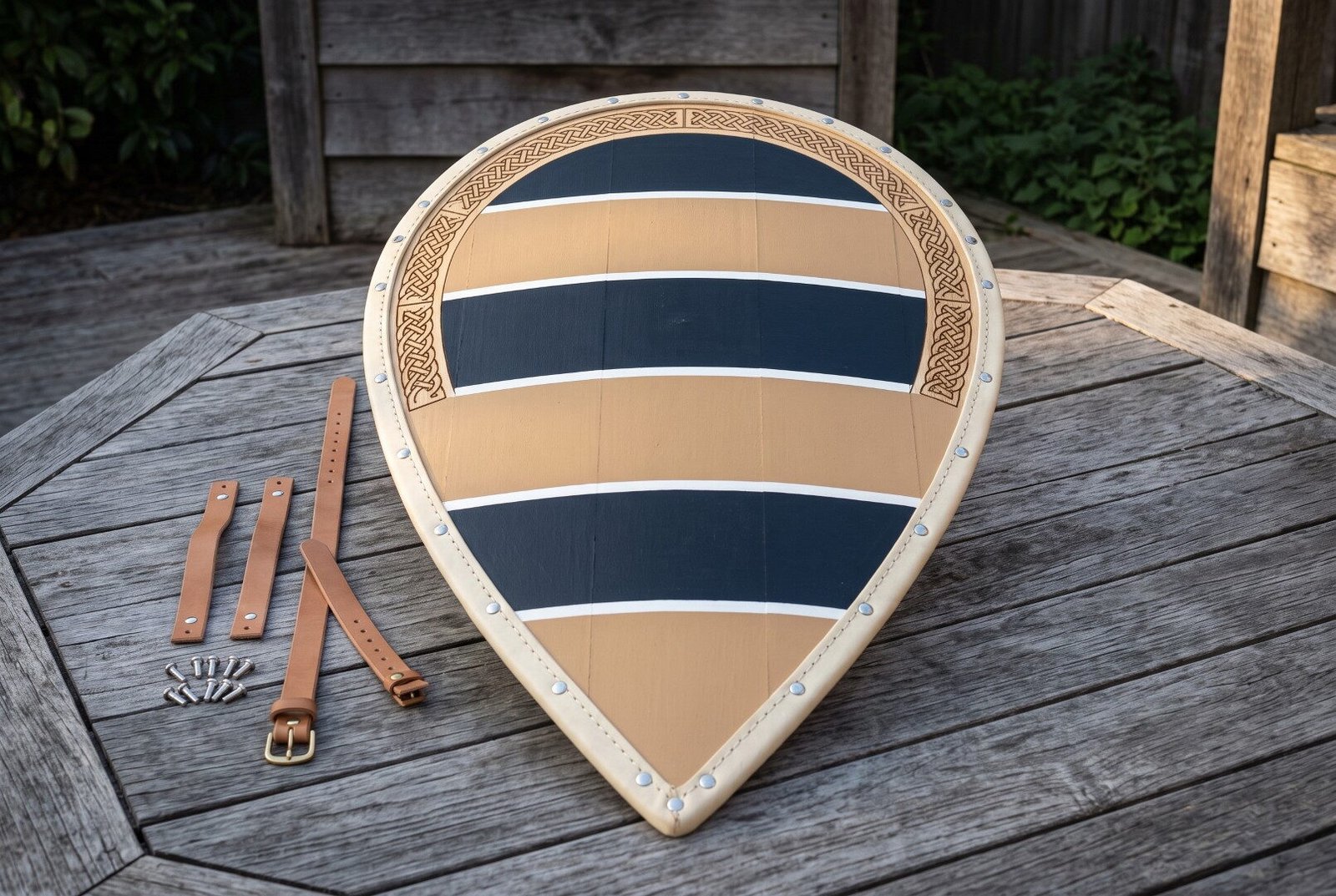
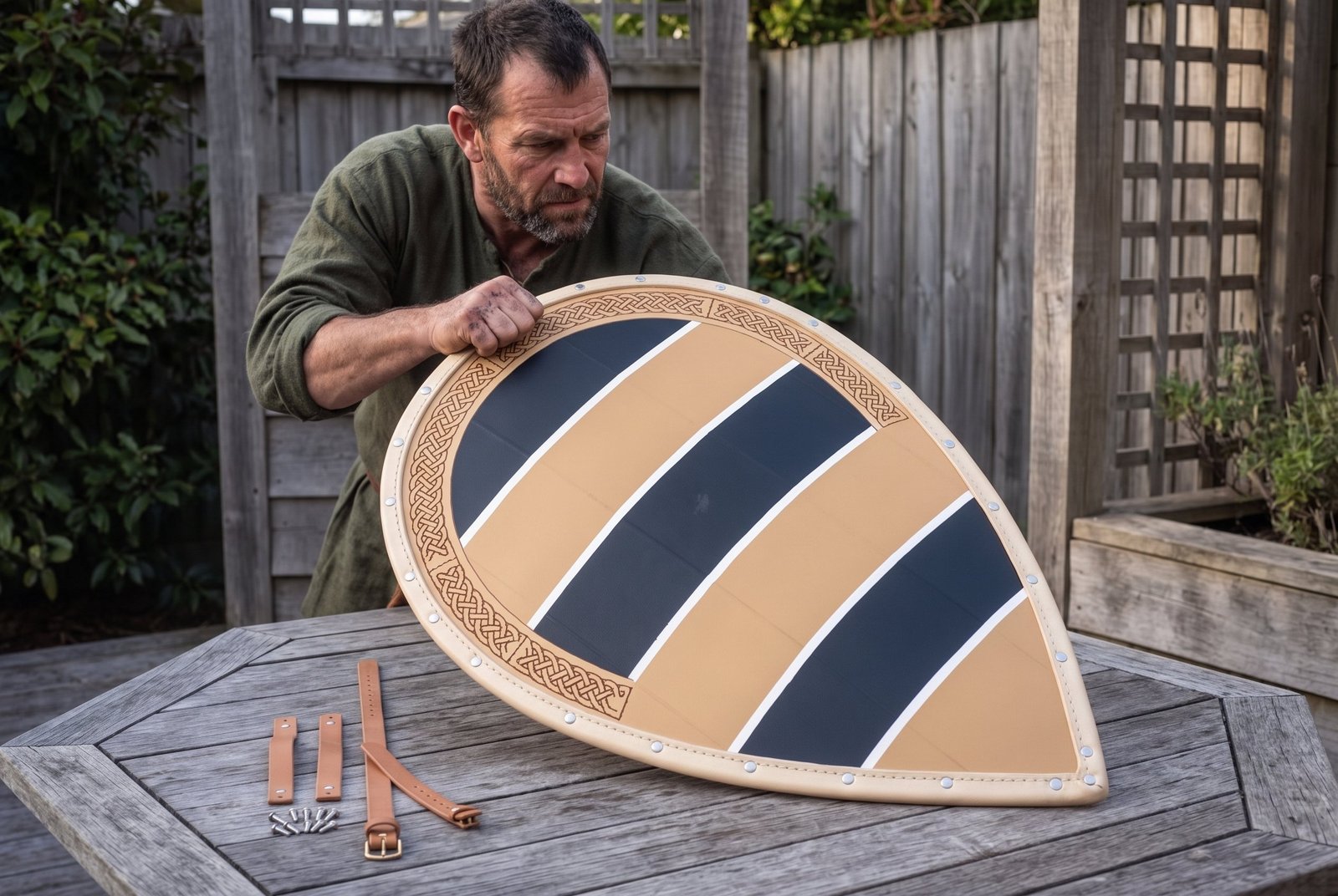
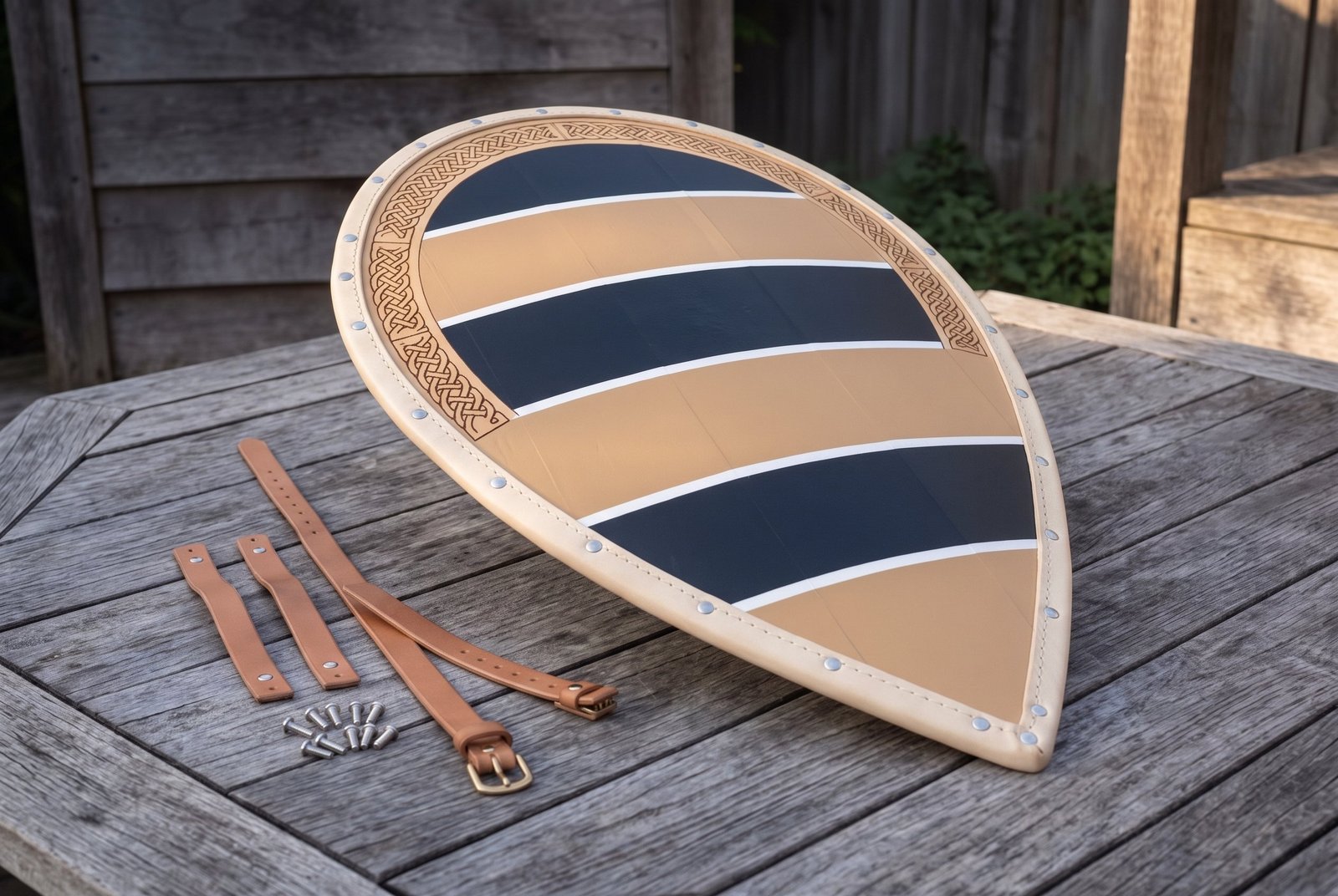
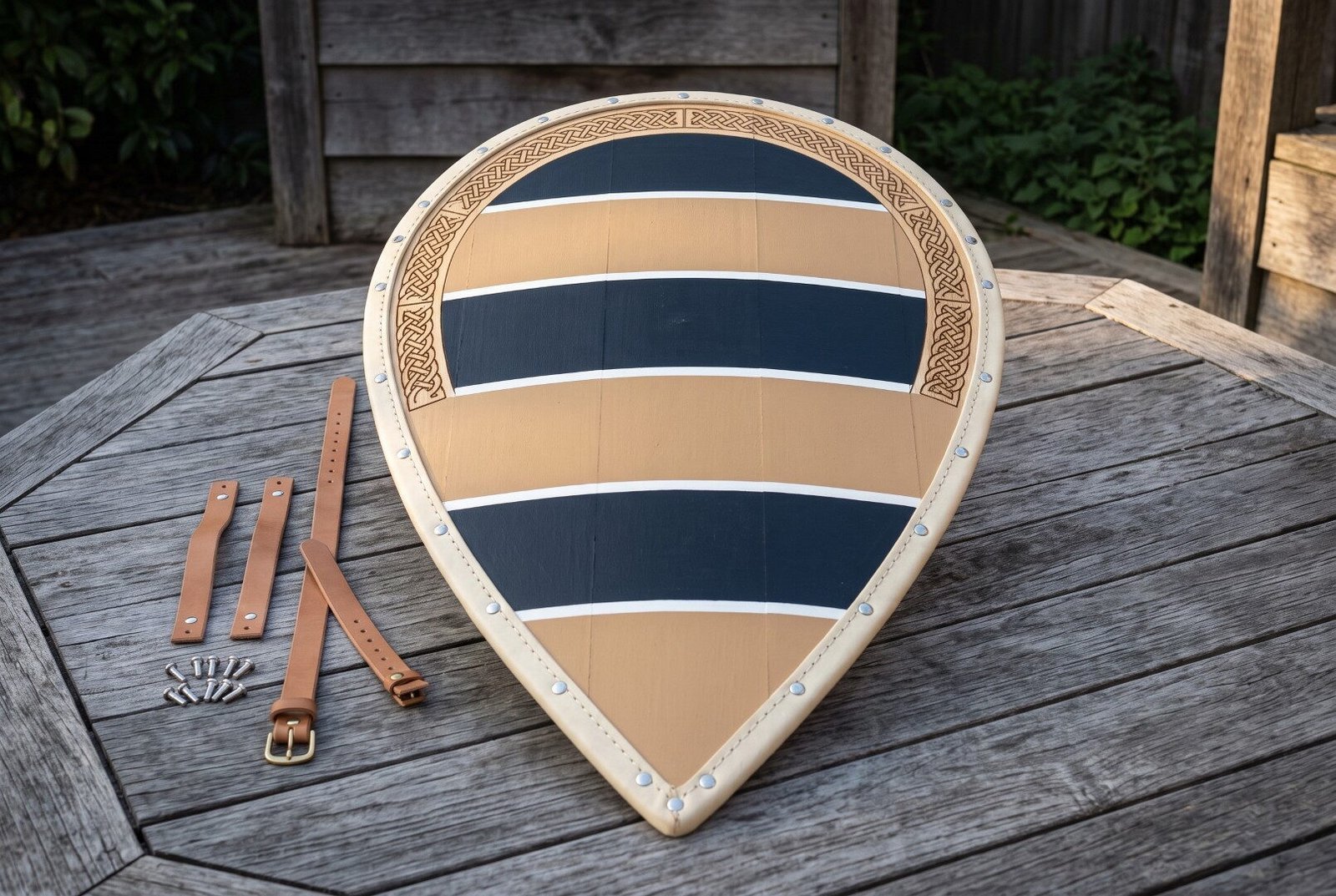
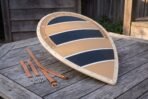
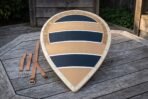
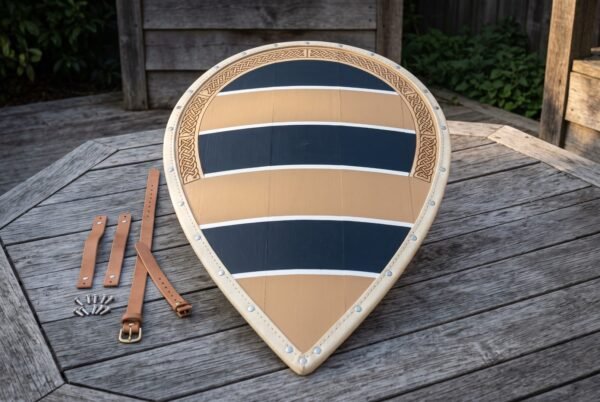
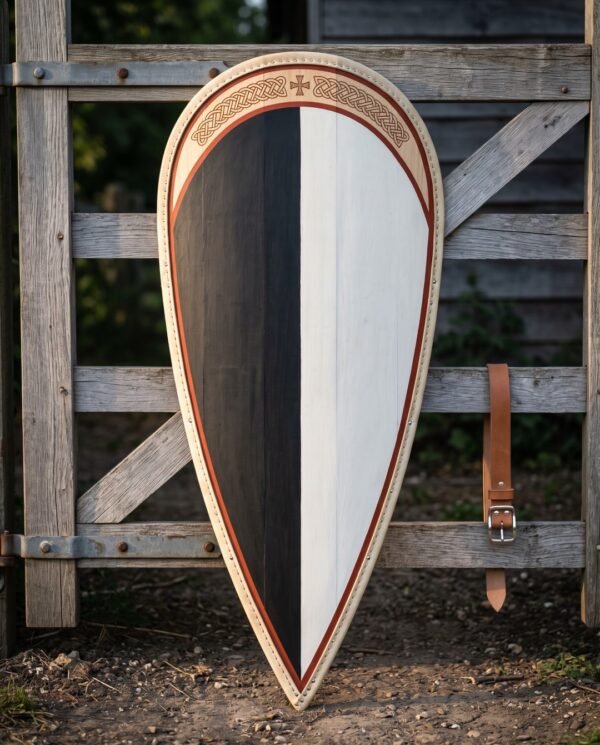
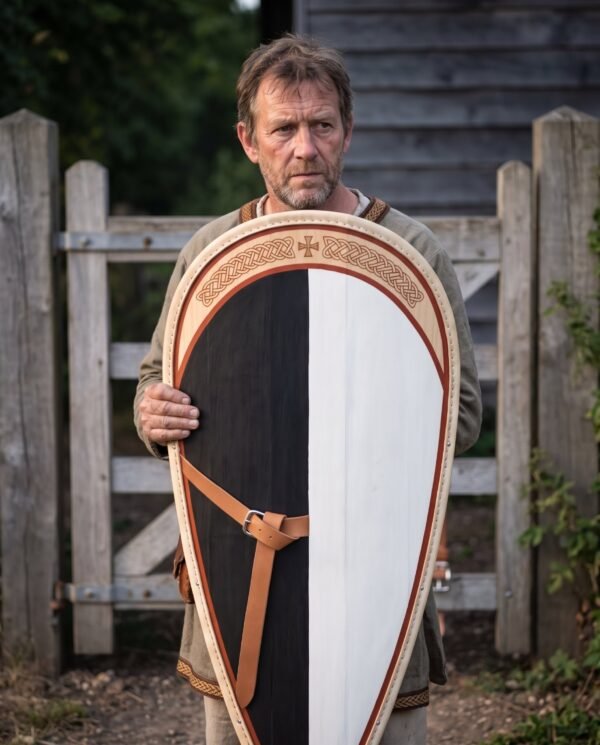
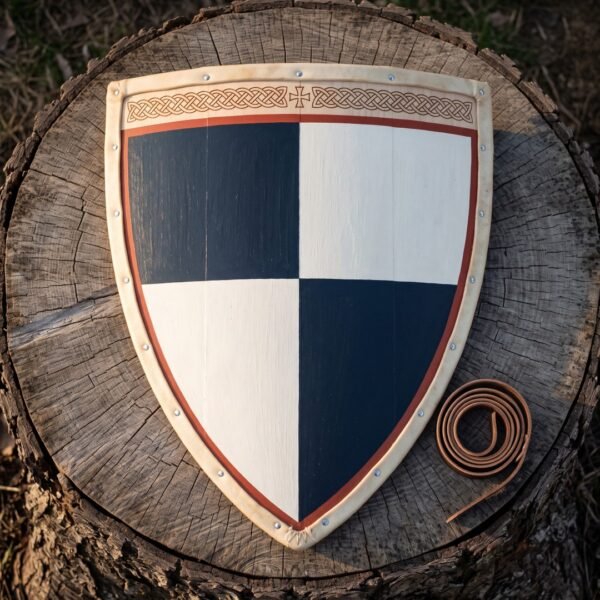
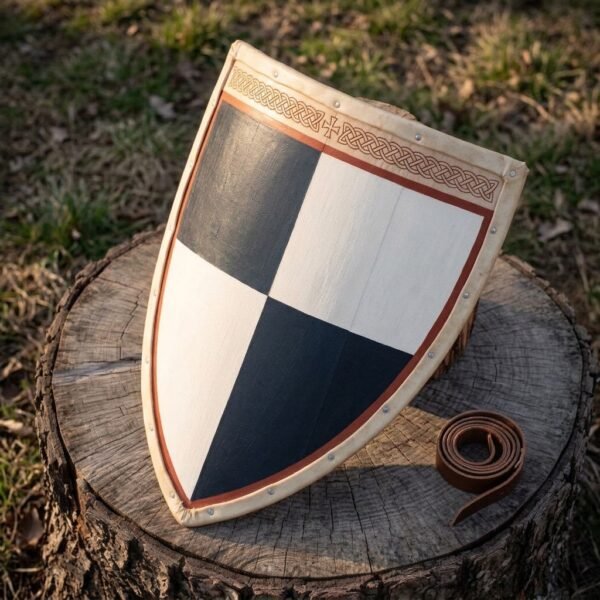
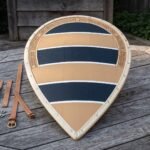
A plank built teardrop board, painted in three deep navy bands with thin white lines across a warm sand coloured ground, bordered around the upper curve with a tooled knotwork band, edged all the way round in rawhide and nailed down with tinned rivets. This is a kite shield, and it exists because of the horse. Look at the Bayeux Tapestry, stitched in the 1070s, and you can watch the shape doing its job: Norman riders carry these long boards down the left side of the animal, and the reason the shield tapers to a point is that a round shield leaves the rider left leg and the horse flank completely bare. Stretch the bottom of the board into a tail and that gap closes without adding weight up top where the arm has to hold it.
The same tapestry shows English infantry in the shield wall carrying kite shields too, so it was never a purely cavalry piece. What killed the shape was better armour. Once mail chausses covered the leg properly in the thirteenth century the long tail was carrying weight for nothing, so the board was cut down at the bottom and turned into the flat topped heater shield. This one is built in a Czech Republic workshop from glued and pegged planks, faced, painted, tooled and edged by hand. It ships with the full leather strap set and the fixing screws, supplied loose so you can set the arm loops to your own forearm and the guige to your own body, which is the only way a shield ever fits properly. Why the shape changed from round to kite is set out in round shield versus kite shield.
Specifications
| Material | Glued and pegged solid wood planks, canvas faced, hand painted |
|---|
| Thickness | Approximately 12 mm at the centre, tapering toward the rim |
|---|
| Size | Approximately 34 inches tall by 24 inches across the shoulder |
|---|
| Weight | Approximately 9 lb complete with straps fitted |
|---|
| Edging | Pale rawhide rim binding, nailed and riveted all the way round with silver coloured rivets |
|---|
| Decoration | Three navy bands edged with thin white lines on a sand coloured ground |
|---|
| Border | Tooled leather knotwork band following the upper curve of the board |
|---|
| Fittings | Two leather forearm loops, one long buckled guige strap with brass buckle, fixing screws and washers, supplied loose |
|---|
| Intended use | Display, living history, film and light reenactment. Not rated for full contact steel combat |
|---|
| SKU | RK-1573 |
|---|
Why the rawhide rim is the most important part
Everybody looks at the paint. The part that decides whether a wooden shield survives is the rim. A plank board takes hits on the edge more than anywhere else, and unprotected end grain splits, so every serious shield in history has had something wrapped around the outside. Rawhide is the classic answer. It goes on wet, it shrinks as it dries and it grips the board like a steel band, pulling the planks together rather than just covering them. It is also tough in a way that surprises people, because a blade skidding off the face tends to catch the rim, and dry rawhide will turn that edge or at least slow it down instead of letting it bite into the wood.
The construction underneath matters too. This board is planks, glued and pegged, faced with canvas and then painted, which is exactly how the archaeology reads. The Gokstad ship burial in Norway gave up sixty four shields, all of them plank built from thin boards, and thin is the point. A shield that is too thick is a shield nobody can hold up for twenty minutes. The canvas facing is not decoration either. Glued cloth across the grain stops a split running the length of the board, which is the difference between a shield that cracks and a shield that comes apart.
Setting up the straps
The strap set arrives loose and that is deliberate. A kite shield is carried on the forearm through two loops with the long strap over the shoulder taking the weight, and the spacing of those loops has to match your arm or the shield hangs wrong and tires you out in minutes. Hold the board against your left arm in the position you actually want it, mark where your forearm sits behind the widest part, and set the two loops there so the shield rides at about forty five degrees with the point down and inward. The long buckled strap is the guige. Over the right shoulder it takes the load off the arm when you are standing about, and lengthened out it lets the shield hang across the back on a march. The screws and washers included are sized for the board thickness, so drill a pilot, do not overdrive them, and check them after the first outing.
Wood, paint and leather
The board is solid wood plank rather than plywood, which is why it has the slight variation in surface you can see under the paint. It is faced with canvas, primed and painted by hand in three bands, and the paint is a hard wearing enamel rather than an acrylic craft finish, so it takes handling and it can be touched up. The knotwork band around the upper curve is tooled into vegetable tanned leather, damp formed and set, then fixed to the face. The rim is rawhide. The straps and loops are vegetable tanned harness leather, thick enough to take a buckle without stretching out of shape.
Engraving, runes and your own design
Use the rune converter on this page to turn a name, a date or a short phrase into Elder Futhark and we will cut it into the steel or the leather. If you would rather have a Viking pattern than a rune line, choose your own design in the engraving option above the add to cart button and tell us where it goes. Where a piece already carries an engraved design, your chosen engraving replaces it rather than sitting alongside it. On this shield the tooled leather border panel at the shoulder is where custom work goes, and a name or a house device there replaces the standard knotwork. Placement options are on the engraving page.
Mounting and display
Off the arm, a kite shield hangs beautifully. Two simple hooks or a French cleat behind the upper third will carry it flat against a wall with the point down, which is how it was stored and how it looks right. Do not hang it from the strap loops alone, because that puts a long term pull on the screws in one small area of board. Keep it off an exterior wall that gets cold enough to sweat, and out of direct sunlight, since strong sun will fade the navy and dry the rawhide rim. If it lives outdoors at events, bring it inside to dry rather than leaving it in a car boot or a damp tent.
Care
Wood and leather want to be dry and fed. Wipe the face down after wet events and let the board dry flat rather than propped in a corner, which encourages a warp. Feed the rawhide rim and the straps with a leather conditioner once or twice a year, particularly if they have been rained on, because rawhide that dries out hard will eventually crack at the fold over the rim. The painted face can be wiped with a damp cloth. Scuffs and chips on a used shield are honest wear and most owners leave them, but the enamel will take a touch up if you want it clean. Steel fittings and screws take a wipe of light oil. General guidance on caring for our steel is on the steel care page. If it is going on a wall rather than into a line, choosing a shield for display covers size and mounting.
Made in the Czech Republic
The work behind this piece happens in a Czech Republic workshop that has kept to the old methods. Steel is forged and heat treated by hand, the grind is taken down by eye rather than by machine, and the handle, fittings and sheath are cut and finished one at a time. Because of that, every piece carries small marks of the hand that made it.
Ransack Viking is a United States company. We import direct, check each piece when it reaches us, and ship from our Chicago, Illinois warehouse. Engraving is added here in the United States after arrival, so the piece you receive is finished to your order.
A note on handmade variation
This shield is hand made, not machine made and not bulk produced, so what arrives will not be a pixel for pixel copy of the photograph. The plank seams fall in slightly different places, the grain shows through the paint differently, the brush edges of the bands are never identical and the rawhide rim dries with its own texture and tone. The dimensions, the material and the build are the same every time. The character is not, and a shield that looks machine perfect is a shield nobody made by hand.
Frequently asked questions
Do the straps come fitted?
No, and that is on purpose. The loops and the long guige strap are supplied loose with the screws and washers so you can set them to your own forearm and body. Fitting them yourself takes about fifteen minutes and it is the only way the shield hangs correctly.
Can I use this for full contact reenactment?
It is built for display, living history, film work and light reenactment. Full contact steel combat groups have their own construction and thickness rules and you should check this board against your own group standard before taking it into a bout. We would rather you asked than assumed.
Is it plywood?
No. It is solid wood planks, glued and pegged, then faced with canvas before painting. Plank construction is what the excavated shields show and it is why the board flexes slightly and absorbs a hit rather than transmitting all of it into your arm.
Why is it shaped like that?
The long tail covered a rider left leg and the horse flank, which a round shield could not do. Once leg armour improved in the thirteenth century the tail became dead weight and the shape was cut down into the heater shield.
Can I have my own device painted on it?
Custom work goes on the tooled leather panel at the shoulder as standard. If you want a full painted device across the face instead of the banded design, contact us before ordering so we can talk through the design and quote it.
How long does it take to ship?
One to two weeks of processing, because the board is built, faced, painted and rimmed to order and the rawhide needs time to dry on the rim. Shipping is free inside the United States and returns are accepted within seven days.
What is in the box
- One plank built kite shield, canvas faced, hand painted and rawhide rimmed
- Tooled leather knotwork border band fitted around the upper curve
- Two leather forearm loops and one long adjustable buckled guige strap, supplied loose
- Fixing screws and washers sized for the board
- Care card covering leather feeding, rawhide and storage
- Forged and finished in the Czech Republic
Explore the range
The rest of the long boards are in kite shields and bucklers, the Norse boards are in round shields, the hardware that goes on them is in shield bosses, and the body armour is in Viking armor. Shield construction, strapping and rim care are covered in the guides.
Compare it with these
Also in this group is the Lionward buckler. Sitting beside it in the catalogue is the Stormwing buckler. Another in the same line is the Silverward buckler.
For a different piece from the same family, look at the Cobaltward Viking shield. Pick the steel, the length and the fittings yourself on the design your own page.


This shield fell a little short for me.