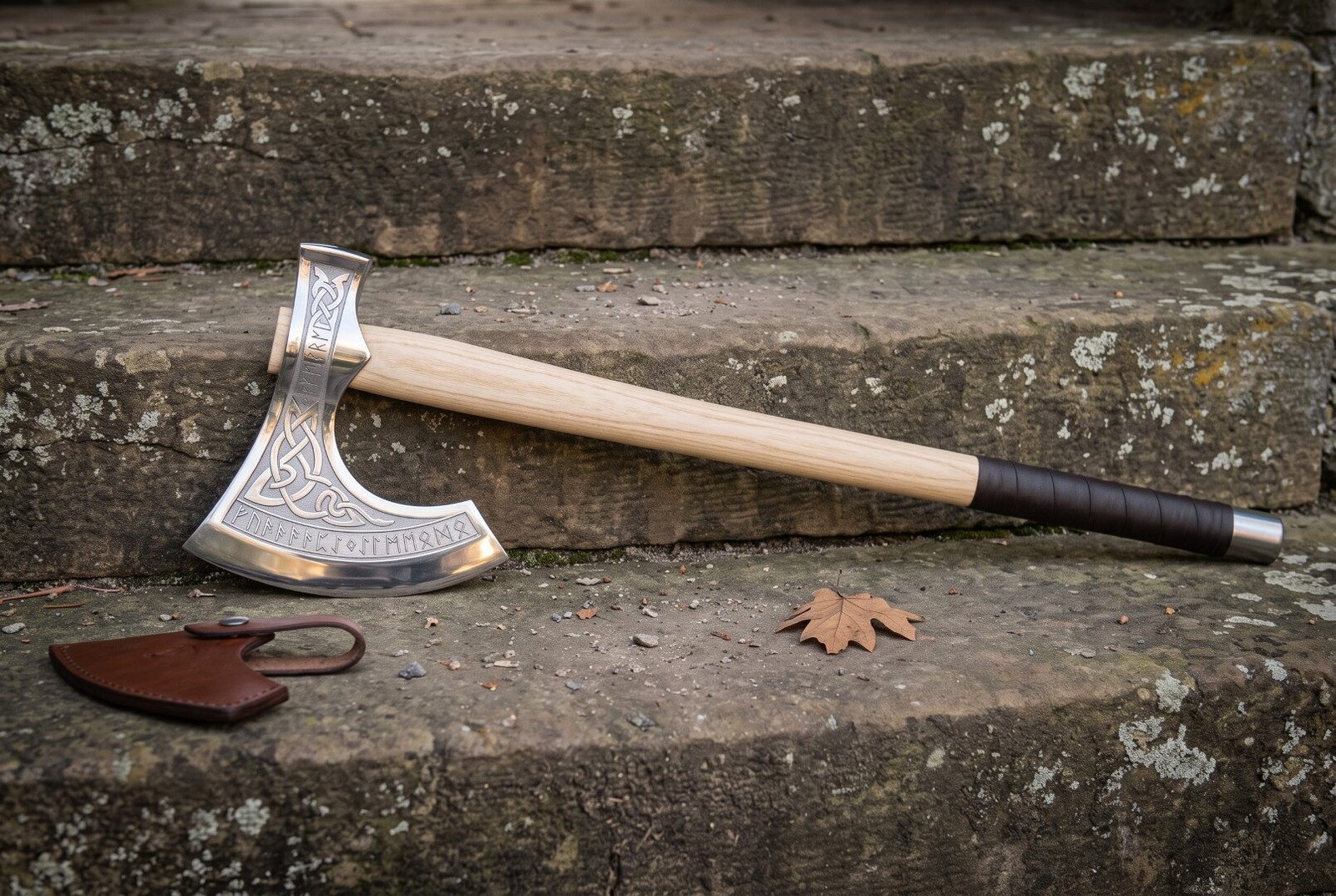
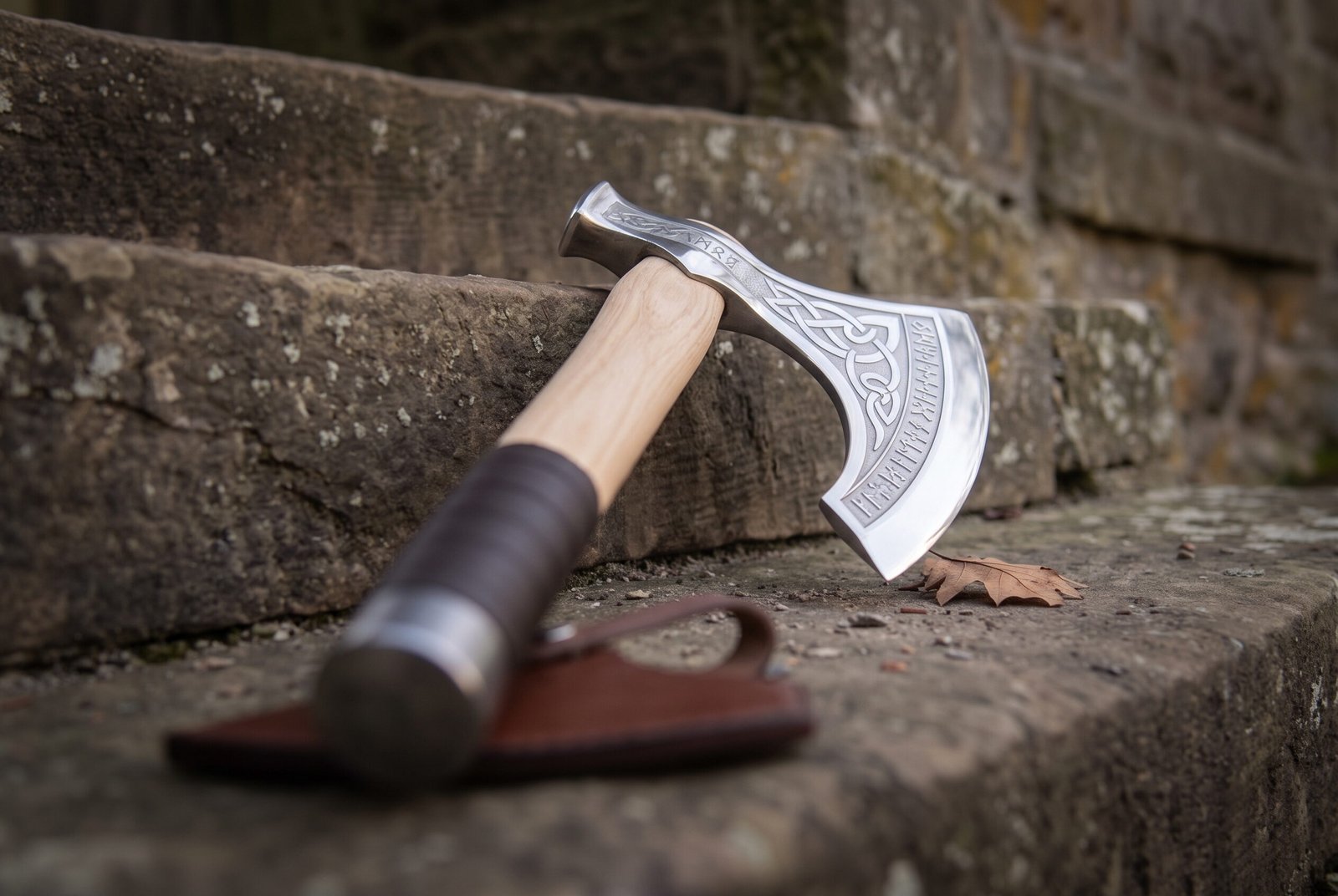
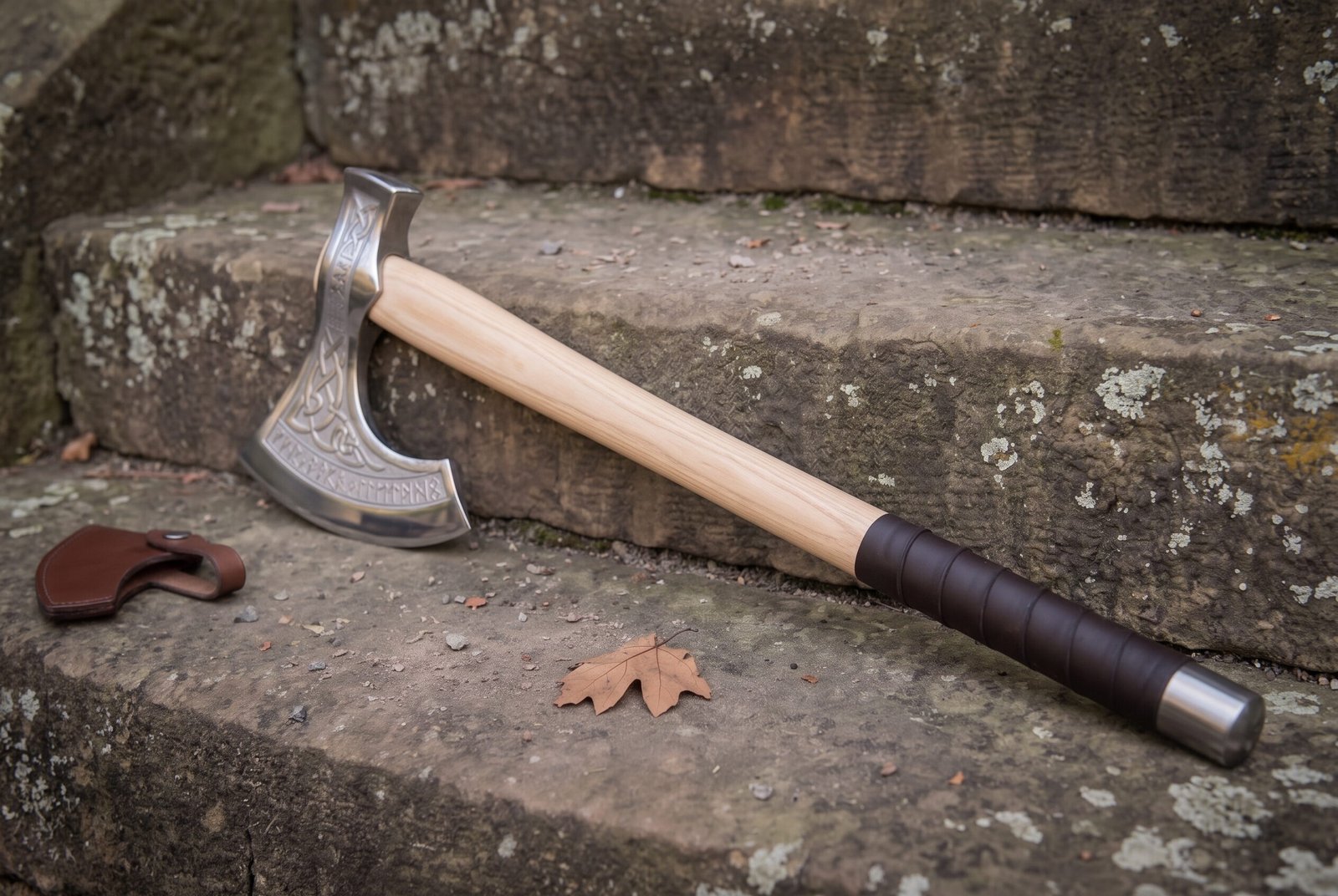
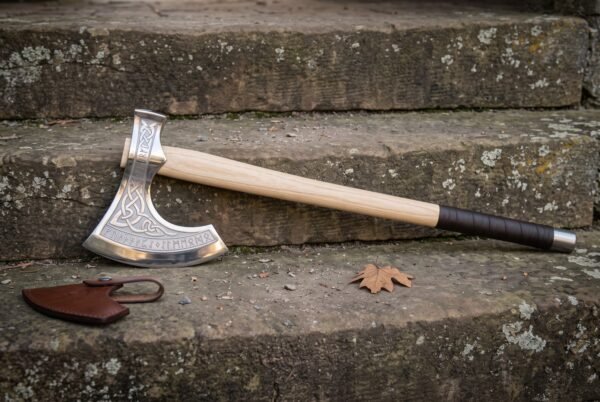
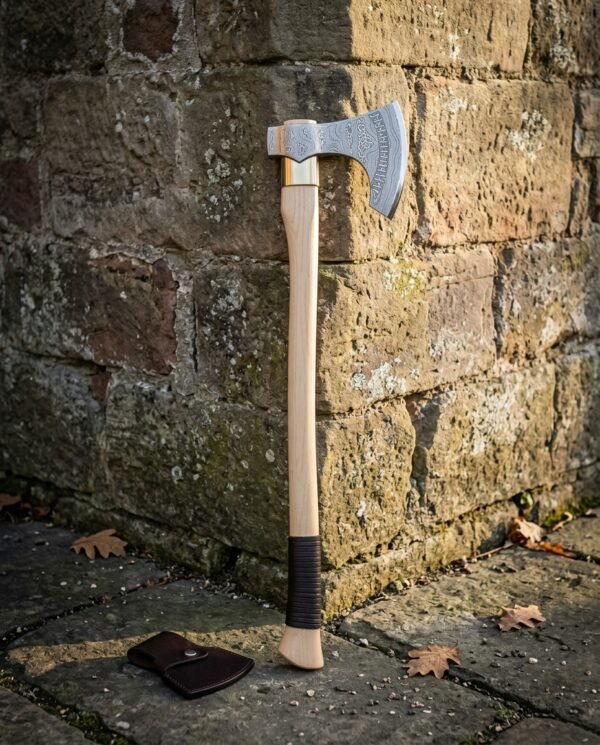
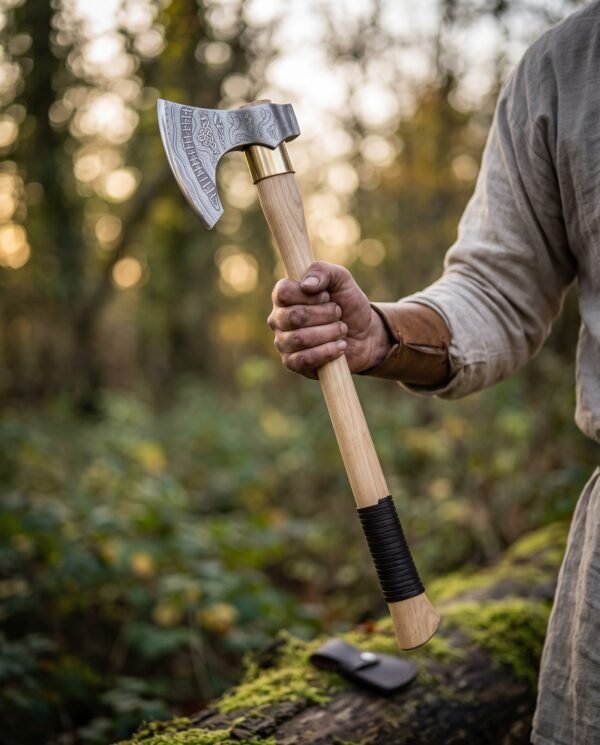
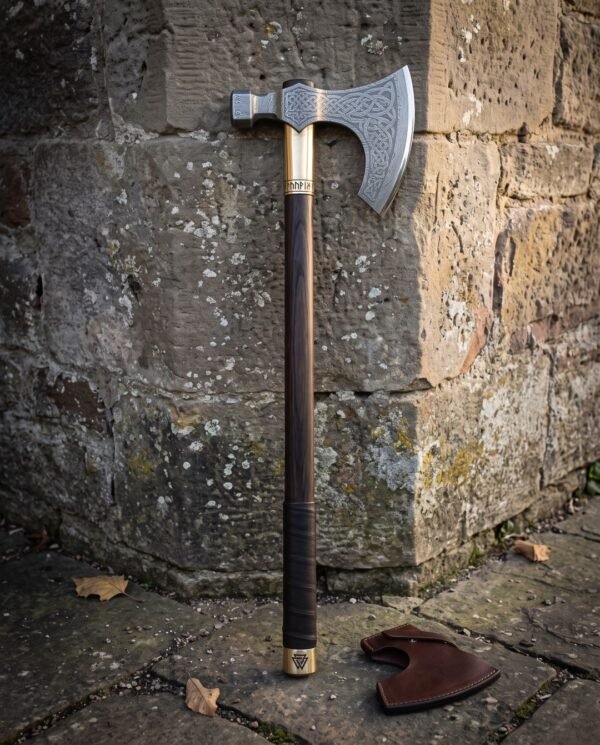
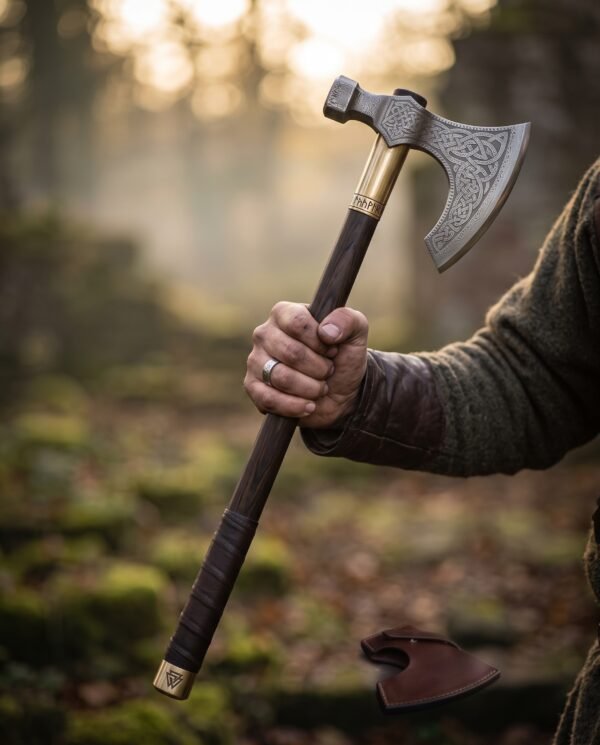
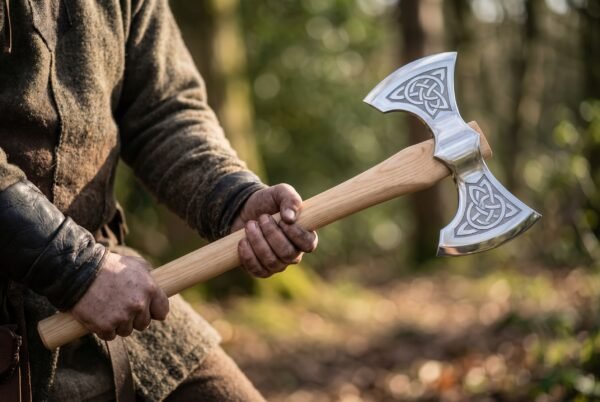
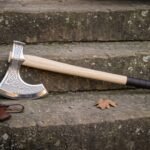
A bearded head in bright 1095 steel, etched with knotwork across both cheeks and a rune band running the length of the lower edge, hung on a pale ash haft with a dark leather wrapped grip and a steel butt collar. The Old Norse name for this shape is skeggox, literally bearded axe, and the beard is the long downward hook of the cutting edge below the eye. It is the single most useful feature ever put on an axe, and it is doing three separate jobs at once.
It also happens to be the most common battlefield tool of the Viking Age by a very wide margin. Swords turn up in the richest graves. Axes turn up everywhere, because an axe was already on every farm, splitting firewood and shaping timber, and turning a working tool into a fighting axe cost nothing. That practicality is the whole character of the type. This one is forged, ground, etched and hung in a Czech Republic workshop, and it ships with a stitched leather blade cover. The dry leaves and the stone steps in the photograph are the location, not the product. Why the beard is cut out of the blade at all is explained in what is a bearded axe.
Specifications
| Steel | 1095 high carbon steel, polished bright |
|---|
| Hardness | 54 to 58 HRC at the edge |
|---|
| Head | Bearded head with a raised polished border around an etched panel on each cheek |
|---|
| Decoration | Acid etched knotwork on both cheeks with an Elder Futhark rune band running along the edge. An etched surface pattern, not Damascus |
|---|
| Edge length | Approximately 6 inches along the curve of the bit |
|---|
| Overall length | Approximately 26 inches |
|---|
| Weight | Approximately 2 lb 10 oz complete |
|---|
| Haft | Straight grained ash |
|---|
| Grip | Dark brown leather wrap at the butt end |
|---|
| Butt | Polished steel butt collar |
|---|
| Mounting | Drifted eye, head wedged on the haft |
|---|
| Cover | Brown leather blade cover with a strap and stud closure |
|---|
| Intended use | Camp and woodland work, display and photography. Sharp, so not for contact reenactment |
|---|
| SKU | RK-1578 |
|---|
What the beard is for
First, cutting edge. Hooking the edge downward gives you six inches of blade on a head that weighs what a four inch head would weigh, because all that extra length is thin sheet steel hanging below the eye rather than mass around it. More edge means more chance of a clean cut on a moving target or an awkward log, and it means you can rock the axe along the cut rather than chopping in one spot.
Second, hooking. That downward point catches things. In the shield wall it caught the rim of an opponent shield and pulled it aside so the man behind you could put a spear through the gap, and it caught ankles below the shield line. It is the reason the shape survives in sagas as a distinctly nasty axe rather than just a farm tool.
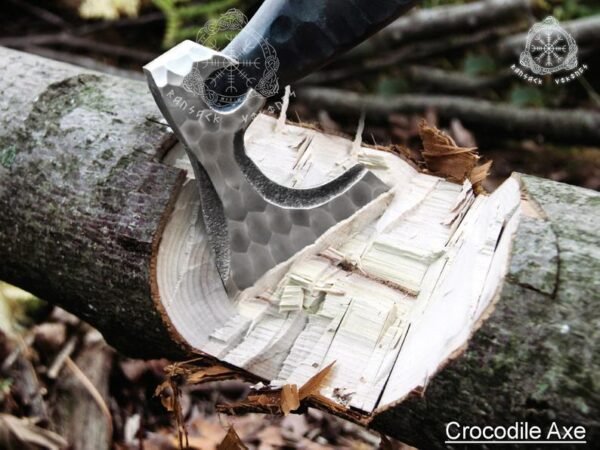
Third, and the reason woodworkers still buy this pattern, the beard creates an open space directly behind the bit. Choke your hand right up under the head and your fingers sit in that hollow instead of against the edge, which turns the axe into a controlled carving tool for shaping a tenon, hewing a face flat or trimming a spoon blank. No other axe geometry lets you get your hand that close to the work.
1095 steel and the etch
The head is 1095 high carbon steel and it is heat treated to land between 54 and 58 HRC at the edge. That is deliberately softer than a knife. An axe edge meets knots, grit and the occasional buried nail, and steel taken to knife hardness chips when it does. At mid fifties hardness the edge rolls instead, and a rolled edge comes straight back with a file and a stone in the field while a chipped one needs regrinding. The body of the head is left softer still so it absorbs shock rather than transmitting it.
The knotwork on the cheeks and the rune band along the beard are acid etched into the surface of the steel. Say it plainly: this is not Damascus. The head is one homogeneous piece of 1095 and the decoration is an etch cut into its face. It sits below the surface and it will not wear off, but it is a pattern on solid steel rather than layers running through it. The forge welded pieces we carry are listed separately and the difference is obvious side by side.
The haft is ash. Straight grain running the full length of the handle is what makes an axe haft flex under shock rather than snap, and ash has been the standard for this reason for as long as people have been hanging axes. The leather wrap at the butt gives the rear hand grip when the axe is swung one handed on a long stroke.
Engraving, runes and your own design
Use the rune converter on this page to turn a name, a date or a short phrase into Elder Futhark and we will cut it into the steel or the leather. If you would rather have a Viking pattern than a rune line, choose your own design in the engraving option above the add to cart button and tell us where it goes. Where a piece already carries an engraved design, your chosen engraving replaces it rather than sitting alongside it. On this axe the rune band along the beard is the obvious line, and the leather blade cover will also take a name or a date. Details are on the engraving page.
Handling and display
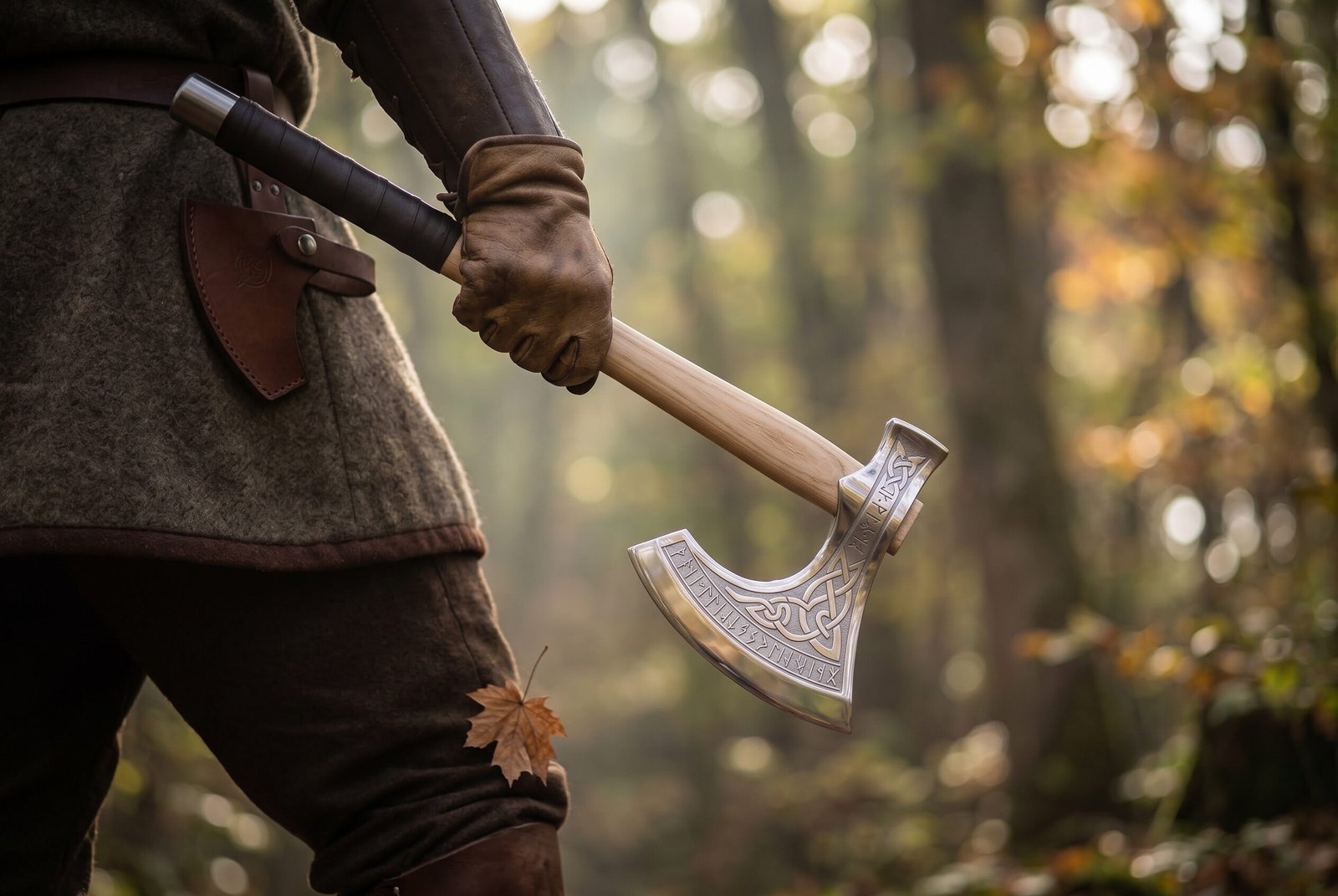
At around 26 inches this is a one handed axe with enough haft to get real speed into the head. It is long enough for camp work standing over a round and short enough to carry on a belt loop with the cover on. On a wall it sits well on two pegs with the beard hanging free so the etched cheeks catch light across the face. Keep the leather cover on whenever it is not in your hand. A bearded head presents a downward point that catches on everything, including people walking past a table, which is exactly what it was designed to do.
Care
1095 is carbon steel and it will rust if it is left damp. Wipe the head after use, particularly after cutting green wood, since sap is acidic and will stain bare steel overnight. A thin film of light oil across the head two or three times a year is enough indoors. Sharpen with a file for heavy repair and finish on a stone, following the existing convex bevel rather than flattening it, because a convex edge on an axe is what stops it wedging in the cut. Feed the leather cover and the grip wrap with conditioner occasionally, and never store the axe wet inside the cover, because leather traps moisture against steel and will etch a shadow into the bit. Full guidance is on the steel care page. Sharpening starts with a file, and how to sharpen an axe takes it through to the strop.
Made in the Czech Republic
This is a handmade piece from the Czech Republic, made in a workshop that still forges, grinds and finishes by hand instead of stamping parts out. The smiths there have kept the older way of working, and the wood, horn and leather are shaped and fitted by hand as well. Two pieces of the same design will never be identical, and that is part of what you are buying.
Ransack Viking is a United States company. We handle the import ourselves, look over every piece when it lands and ship from our warehouse in Chicago, Illinois. Engraving is done in the United States after the piece arrives, so your design goes on before we send it out.
A note on handmade variation
This axe is hand made, not machine made and not bulk produced, so what arrives will not be a pixel for pixel copy of the photograph. The hammer texture on the cheeks, the exact sweep of the beard, the depth and contrast of the etch and the grain and colour of the ash all vary because every one is forged and hung by hand. The dimensions, the material and the build are the same every time. The character is not, and two of these standing side by side will always be visibly different axes.
Frequently asked questions
Why is it called a bearded axe?
Because of the long downward hook of the cutting edge below the eye, which is called the beard. The Old Norse name is skeggox. The shape gives you a longer edge for the same weight, it hooks shields and limbs, and it lets you choke your hand right up behind the bit for carving.
Is the pattern on the head Damascus?
No. It is an acid etched surface pattern on solid 1095 steel. Genuine pattern welded Damascus has layers running through the metal and the pattern carries across every ground surface. We always say which one a piece is.
Can I use it for reenactment combat?
No. It ships sharp and it is a working edge. Contact reenactment requires blunted axes made to a group standard. Use this for camp and woodland work, for carving, for display and for photography.
Is it good for carving and bushcraft?
Yes, and that is one of the best reasons to own this shape. The hollow behind the beard lets you grip the head directly for fine control, which makes it far better at hewing and shaping than a conventional axe of the same size.
Can I put my own runes on it?
Yes. Use the rune converter on this page for Elder Futhark or choose your own design in the engraving option. Your line replaces the standard rune band along the beard rather than sitting alongside it.
How long does it take to ship?
Processing is one to two weeks because every head is forged, hardened, tempered, etched and hung to order, and the leather cover is cut and stitched to that head. Engraving adds a few days. Shipping is free inside the United States and returns are accepted within seven days.
What is in the box
- One bearded axe head in 1095 steel, etched, hung and wedged
- Approximately 26 inch ash haft with a leather wrapped grip and steel butt collar
- Stitched leather blade cover
- Care card covering oiling, convex sharpening and leather
- Forged and finished in the Czech Republic
Explore the range
More heads are in Viking axes, the war shapes are in battle axes, the heavier working patterns are in splitting and felling axes, and the rest of the edged work is in Norse arms. Steel, hardness and sharpening are covered in the guides.
Worth a look beside this
Worth putting side by side with this is the Grainwhorl battle axe, pattern welded Damascus. In the same category sits the Twinbite battle axe, forged from 1095. A near match for this one is the Ashwarden battle axe, 21 inches overall.
For a different piece from the same family, look at the Haftmask haft. Or start from a blank sheet on the custom Viking axe page.


Been eyeing this axe for months and it did not disappoint. Came in a nice gift box which made it feel even more special. Fit and finish is museum quality. You can tell real craftsmen made this by hand. Weight and balance make it feel like a real functional piece not some cheap replica. This will be a family heirloom for sure.
Five stars isn’t even enough honestly. The wood handle feels amazing and the balance is perfect. Leather sheath is thick and well stitched. Not the cheap stuff you usually get. Fit and finish is museum quality. You can tell real craftsmen made this by hand. Already planning my next purchase from this shop.
This axe is a genuine work of art. Weight and balance make it feel like a real functional piece not some cheap replica. So worth it.
My husband was speechless when he opened this. Weight and balance make it feel like a real functional piece not some cheap replica. Already planning my next purchase from this shop.
This axe beat every expectation I had. This is my third order from Ransack Viking and they never disappoint.
My husband was speechless when he opened this. 1095 Steel blade holds a razor edge right out of the box. Nice touch that it ships from within the US even though it’s crafted in the Czech Republic. Weight and balance make it feel like a real functional piece not some cheap replica. Love it.
Perfect gift. Perfect quality. No complaints. Weight and balance make it feel like a real functional piece not some cheap replica. Love it.
Absolutely blown away by this axe. Leather sheath is thick and well stitched. Not the cheap stuff you usually get. Came in a nice gift box which made it feel even more special. Can’t recommend this enough.
Nice piece for the price. Blade quality is solid. Arrived a bit less sharp than expected but a few passes on a strop fixed it. Would still tell others to give this a try.
This axe is a genuine work of art. Weight and balance make it feel like a real functional piece not some cheap replica. This shop clearly takes pride in their work.