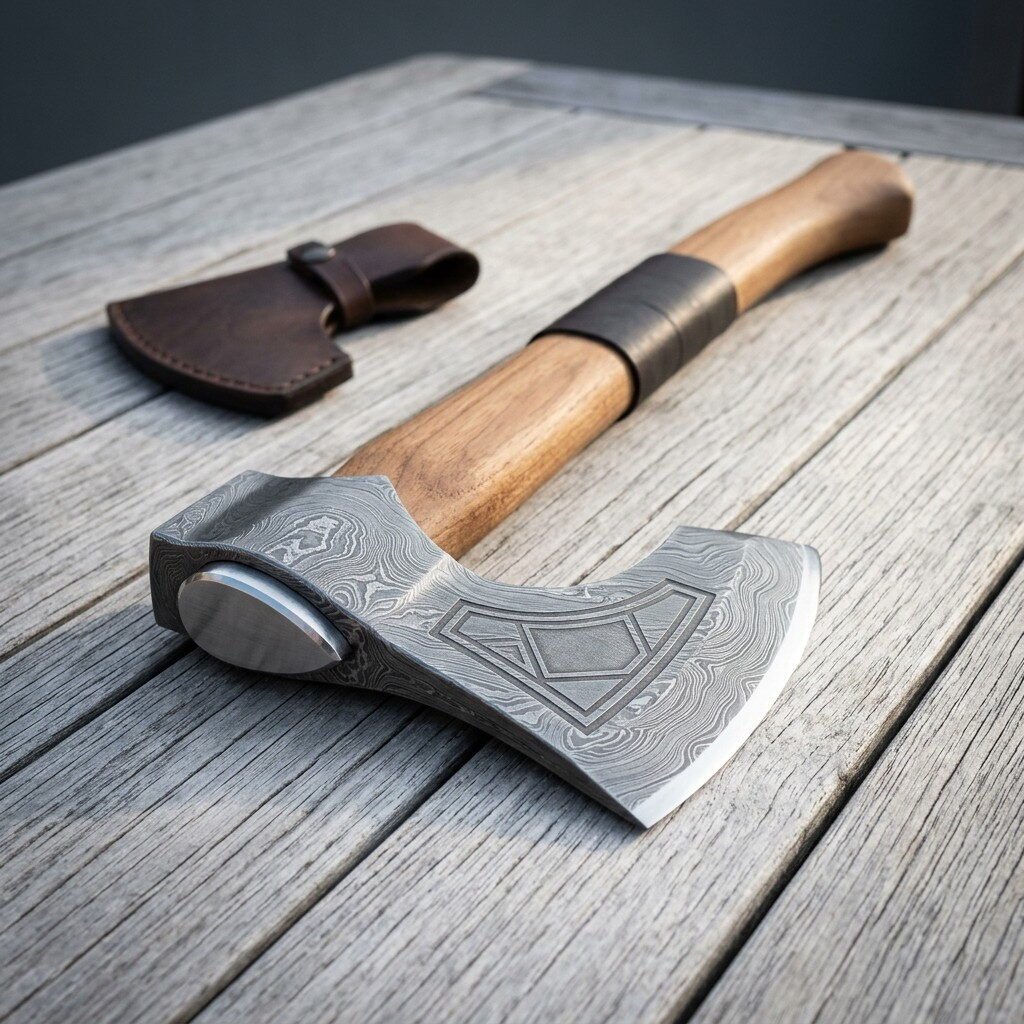
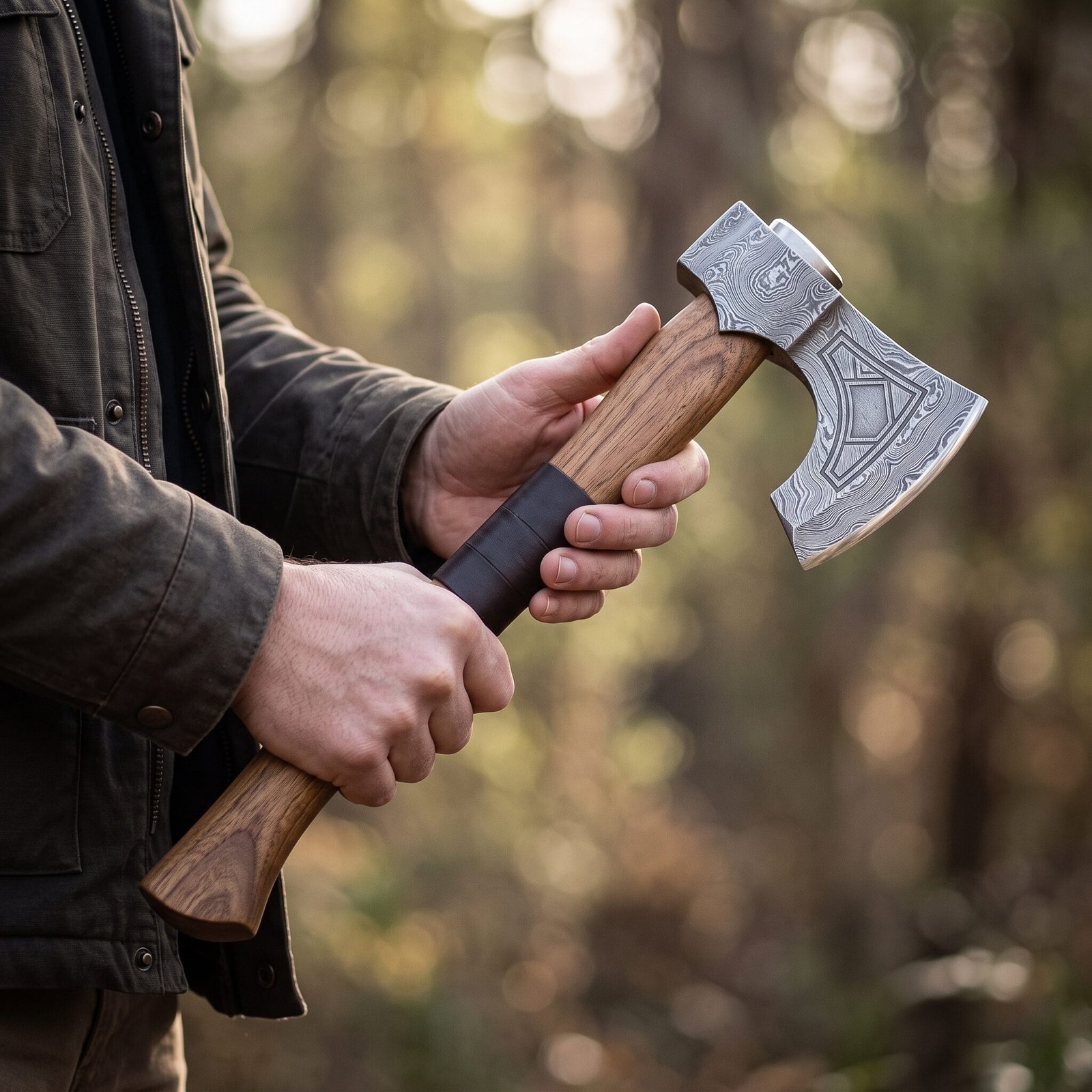
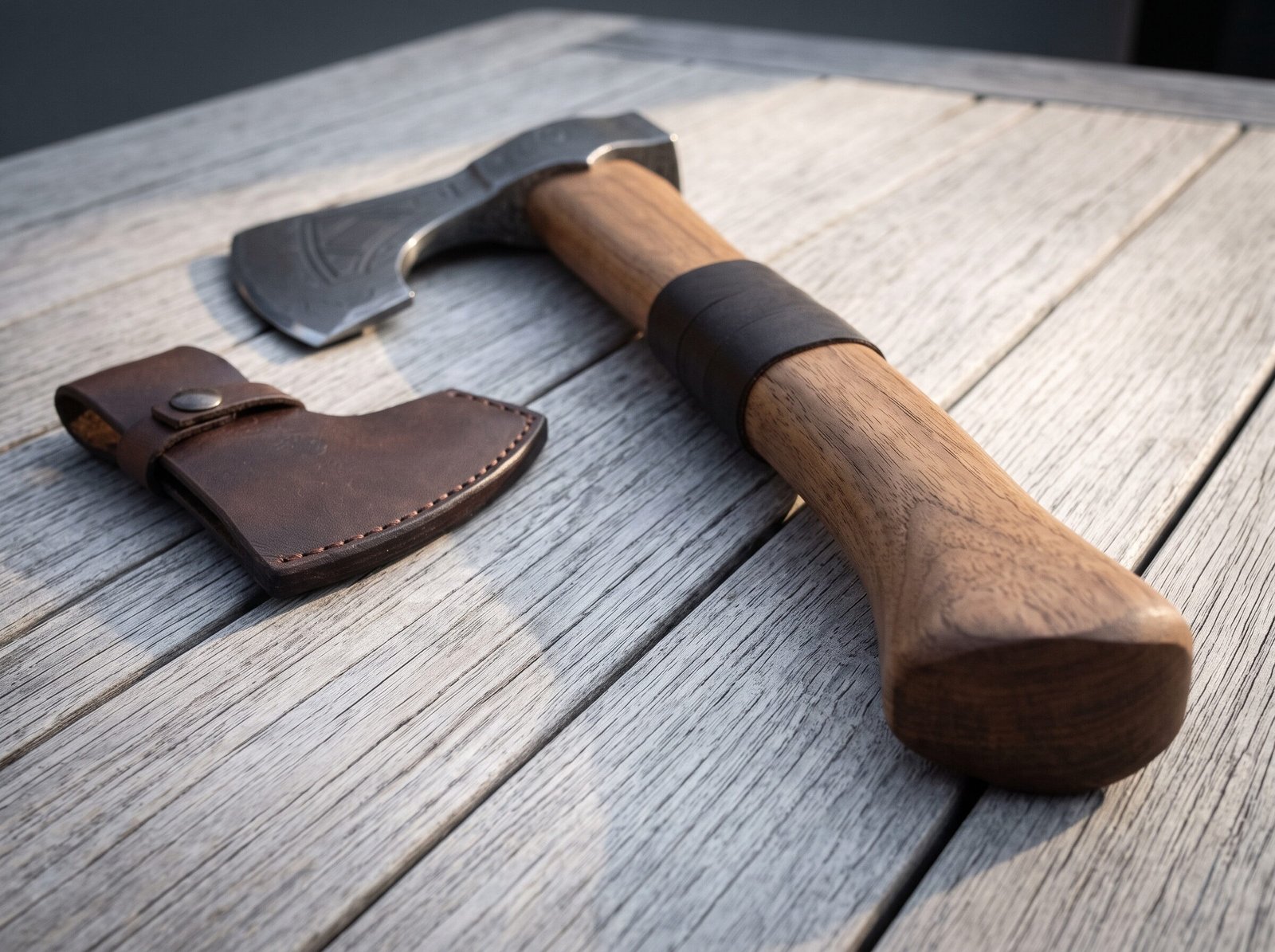
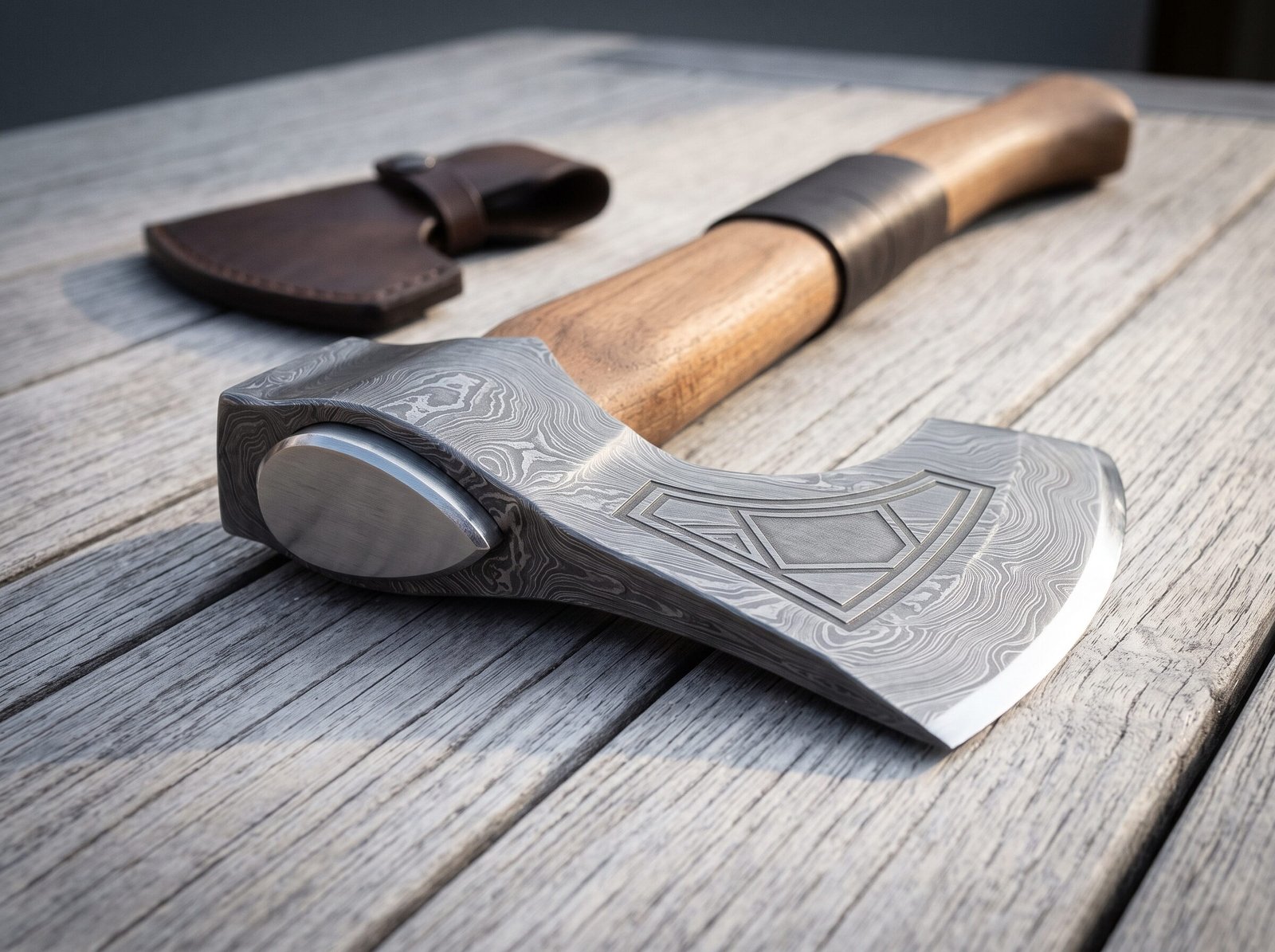
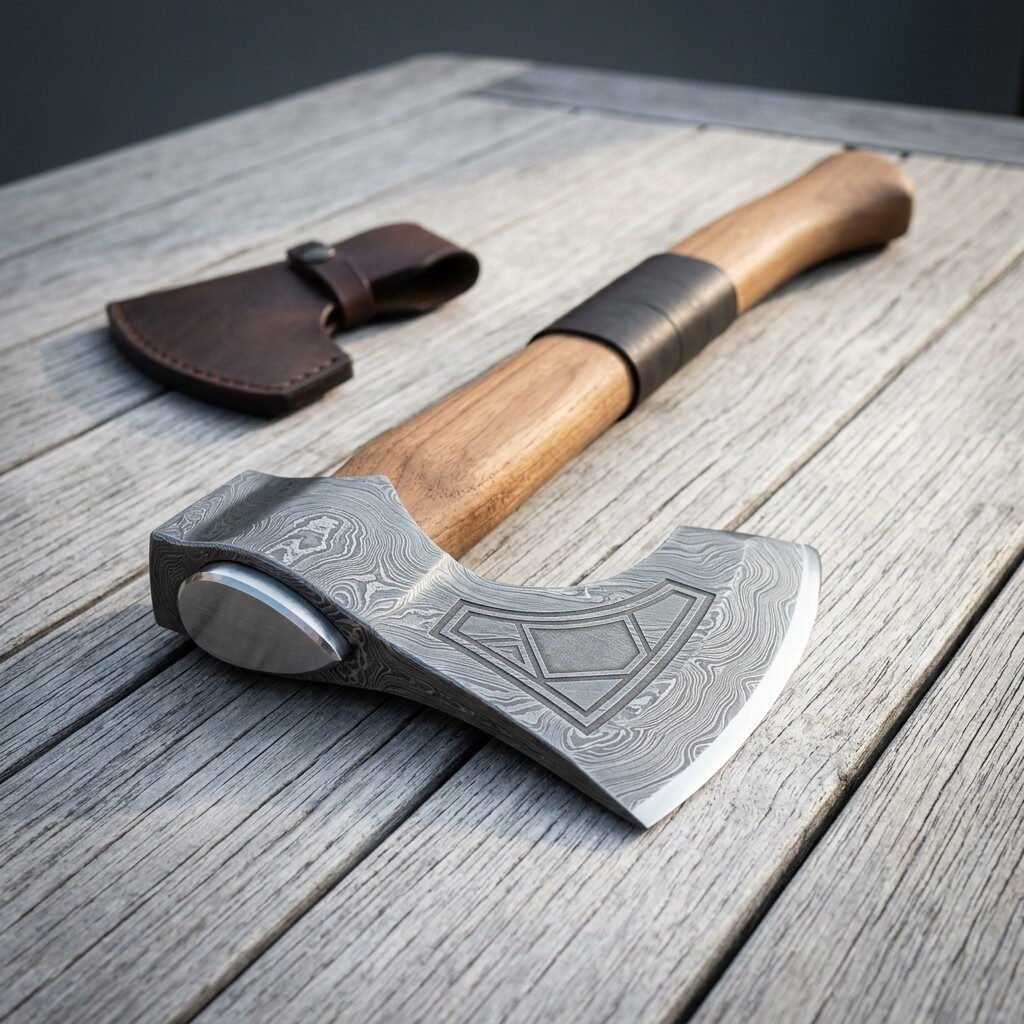
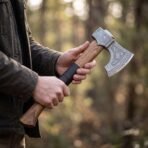
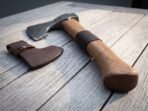
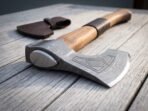
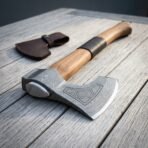
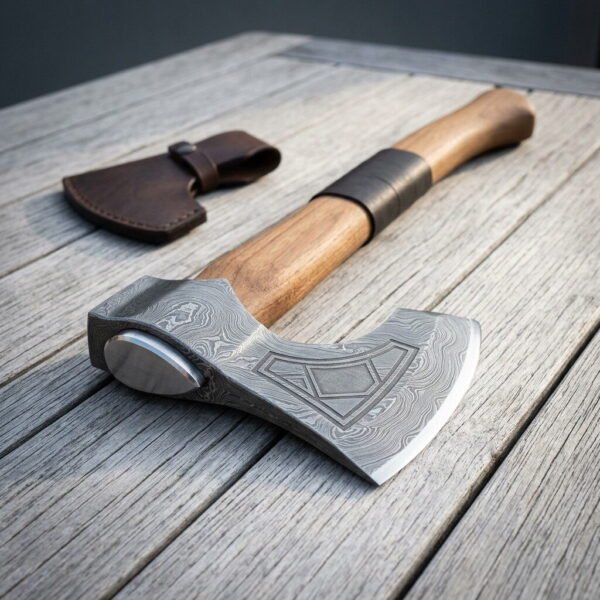
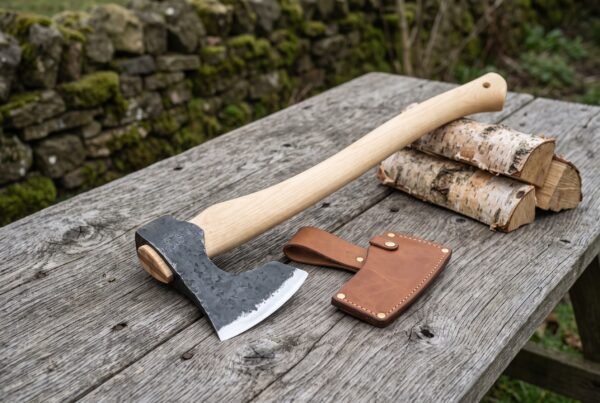
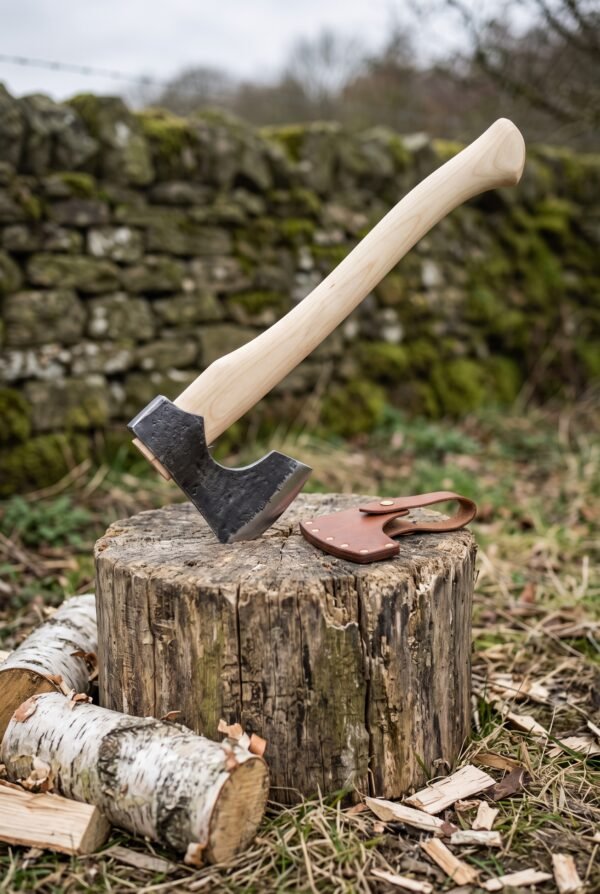
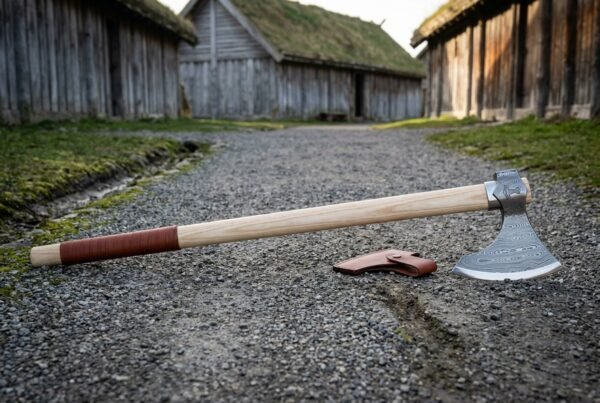
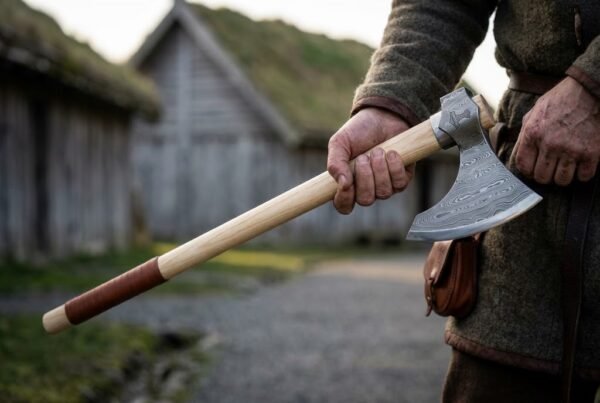
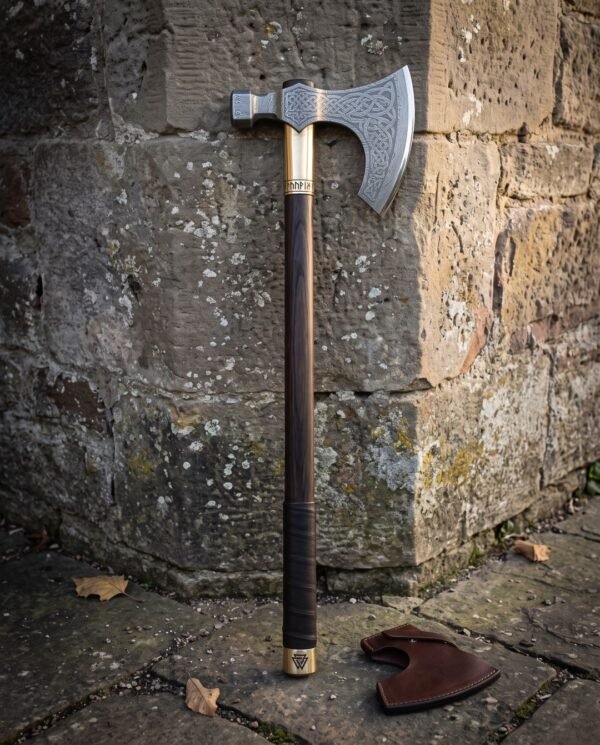
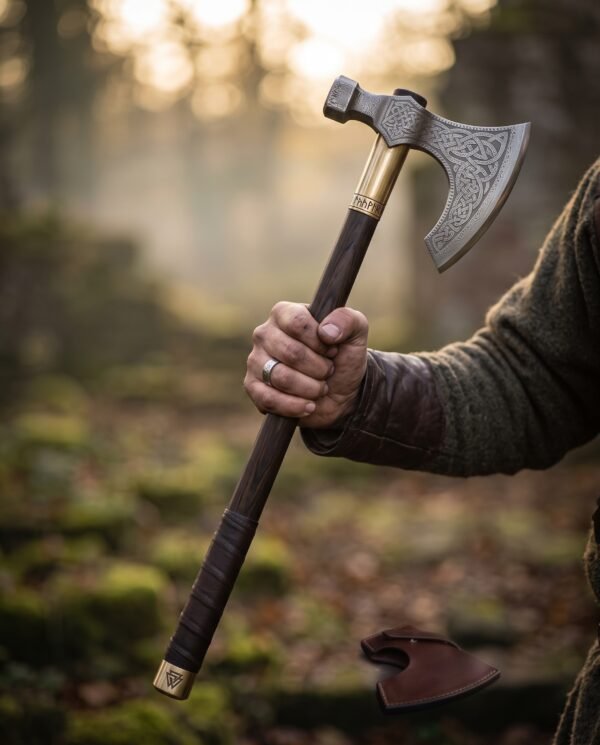
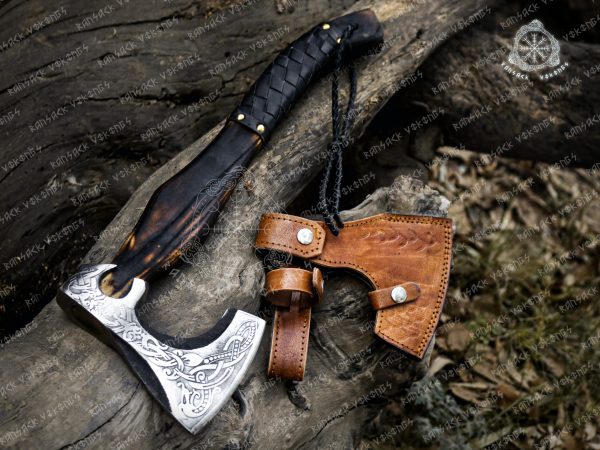
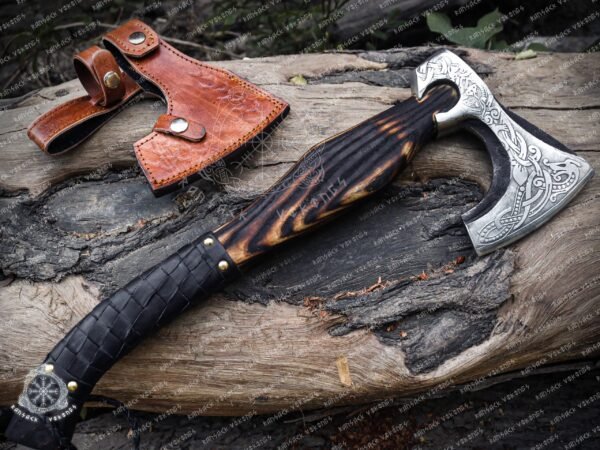
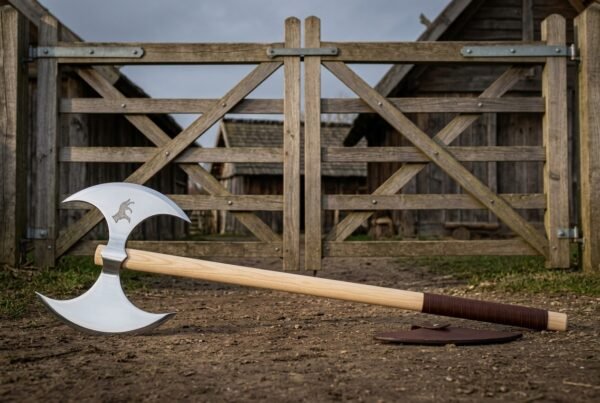
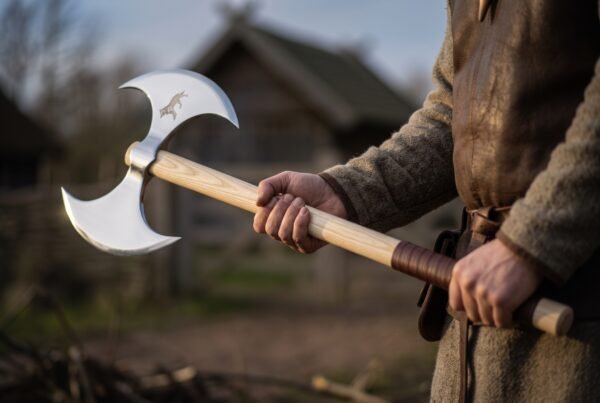
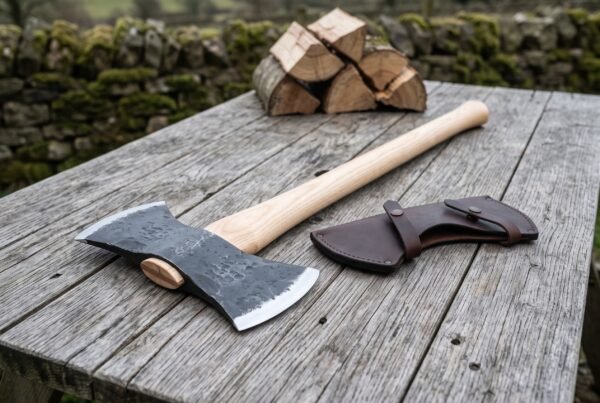
A bearded axe with a head forge welded from 1095 and 15N20 in a tight, swirling Damascus pattern that runs across the whole face and cheek. The beard, the long downward hook of the lower edge, drops well below the eye and gives the axe a deep curved cutting edge on a short compact head. Set into the poll side is a polished steel oval, and the cheek carries a hand cut geometric panel in a lozenge frame. The haft is walnut with a dark leather band wrapped around its middle, and a brown leather edge sheath snaps over the bit.
The beard is the whole point of this shape and it does two jobs at once. It extends the cutting edge without adding weight or length to the head, which means a light axe cuts like a heavier one. It also opens a gap behind the lower edge that you can put your hand into, choking right up under the head to use the axe like a drawknife for fine shaping work, then sliding back down the haft for a full swing. Norse woodworkers used that grip constantly, which is why so many excavated Scandinavian axe heads are bearded. Forged, ground, etched and hafted by hand in the Czech Republic. Filed under the bearded axes, and the war axes are the other half of that shelf.
Specifications
| Head steel | Pattern welded Damascus in 1095 and 15N20, hardened to 58 to 60 HRC |
|---|
| Head profile | Bearded axe with a lower edge that drops below the eye and a compact eye |
|---|
| Poll | Polished steel oval set into the poll side of the head |
|---|
| Engraving | Hand cut geometric panel in a lozenge frame on the cheek |
|---|
| Haft | Walnut, shaped and finished by hand, with a flared knob at the end |
|---|
| Grip band | Dark leather band wrapped around the middle of the haft |
|---|
| Sheath | Dark brown leather edge sheath with a snap strap, stitched and edge finished |
|---|
| Finish | Acid etched and hand polished Damascus, oiled walnut haft |
|---|
| SKU | RK-1803 |
|---|
Why a Viking axe head is so much smaller than people expect
Hold a genuine excavated Viking axe head and the first surprise is how little steel is in it. Many weigh well under a kilogram. That is not poverty and it is not a limitation of the technology. It is a deliberate design decision that follows from how the axe was made.
Iron was expensive and steel more so, so a smith made the body of an axe from soft wrought iron and forge welded a thin strip of hardened steel into the edge alone. The rest of the head only had to hold that edge in place and transmit force. Once you stop needing the whole head to be hard, there is no reason for it to be thick, and a thin head with a wide flared edge cuts better than a thick wedge because it does not have to push the wood as far apart. Modern axes went heavy because cheap steel made it easy, not because heavy is better. This head follows the older logic, with the mass kept low and the edge run long.
1095 and 15N20 Damascus and how the pattern got there
The head is pattern welded from two steels. 1095 is a plain high carbon steel and 15N20 carries around two percent nickel. Stacked in alternating layers, forge welded into a solid billet, then drawn out, cut, folded and welded again, the layer count climbs into the hundreds. When the finished head is etched in acid the 1095 darkens and the nickel bearing 15N20 stays bright, and the contrast reveals the entire history of how that billet was moved on the anvil.
The tight whorls on this head are what happens when a billet is manipulated rather than simply folded flat, which is why the pattern flows around the shape of the head instead of running in straight bands. It is hardened to 58 to 60 HRC. The polished steel oval on the poll is a deliberate contrast, a plain bright surface set against all that figure.
Engraving, runes and your own design
Use the rune converter on this page to turn a name, a date or a short phrase into Elder Futhark and we will cut it into the steel, the leather or the wood. If you would rather have a Viking pattern than a rune line, choose your own design in the engraving option above the add to cart button and tell us where it goes. Where a piece already carries an engraved design, your chosen engraving replaces it rather than sitting alongside it, so a custom cheek engraving takes the place of the lozenge panel. The walnut haft is the other good surface here and a rune line burned or cut into the wood reads beautifully against the grain. See the engraving page.
Handling and balance
The balance sits well forward, as it should on an axe, but the head is light enough that the axe does not feel like it is dragging your hand. Choked up under the beard it becomes a carving tool with almost no swing at all. Held at the end of the walnut haft it delivers a proper stroke with real speed, because the light head accelerates fast.
The dark leather band around the middle of the haft marks where the upper hand sits for a controlled stroke, and it gives a sure hold when the wood is wet. This is a sharpened working and collector axe. It is not sold as a throwing axe and it should not be thrown, since a Damascus head hitting stone or a hard knot can chip.
Care
Damascus needs more attention than plain steel because the acid etch leaves a slightly textured surface where rust can start in the valleys. Wipe the head after every use and keep a thin film of mineral oil on it. Never put it away wet or leave it sitting in the leather sheath after use, since vegetable tanned leather traps moisture against steel. Sharpen with a stone rather than a powered grinder, which will overheat and ruin the temper at the edge. Oil the walnut haft once or twice a year with a wiping oil, and feed the leather grip band and the sheath with a leather conditioner. Our full routine is under steel care.
Made in the Czech Republic
This piece is made by hand in the Czech Republic, in a workshop that still works the old way. The steel is forged, ground, heat treated and finished by smiths who learned the trade from the people before them, and the wood, horn and leather are cut and fitted by hand rather than pressed out on a line. That is also why no two pieces come out exactly the same.
Ransack Viking is a United States company. We import these pieces ourselves, check every one when it lands and ship from our warehouse in Chicago, Illinois. Engraving is done here in the United States after the piece arrives, so your runes or your own design go on before it leaves for you.
A note on handmade variation
This axe is hand made, not machine made or bulk produced, so what arrives will not be a pixel for pixel copy of the photograph. Damascus is the clearest case of this anywhere in our range. No two billets fold the same way, so your head will carry its own whorls, its own band density and its own etch contrast. Walnut grain differs stick to stick and can read anywhere from honey to chocolate. The lozenge panel is cut freehand. The steels, the layer construction, the hardness and the dimensions are the same every time. The figure in the steel is not, and that is the point. There is a longer piece on the history of the Viking axe, and another on sharpening an axe.
Frequently asked questions
Is the Damascus pattern real
Yes. The head is forge welded from alternating layers of 1095 and 15N20 and then etched to reveal what is already inside the steel. It is not printed, coated or laser marked, and it cannot wear off.
Is it sharp when it arrives
Yes. The bit comes with a hand put working edge under the leather sheath. Keep the sheath on until you are ready to use it.
Can I actually chop with it or is it display only
It is a working axe with a hardened edge and it will cut. It is not a throwing axe and it should not be used on stone, nails or frozen knots.
Can I throw it
No. A hardened Damascus edge chips on hard impact, and a thrown axe hits unpredictably. Use a purpose built throwing axe for that.
What is the polished oval on the back for
It is a bright polished steel poll set as a visual contrast against the patterned head. It is not a hammer face and it should not be struck.
Will my head look like the photograph
The shape, the fittings and the dimensions will match. The Damascus figure will be different, because no two billets are ever the same.
What is in the box
- Hand forged 1095 and 15N20 Damascus bearded axe head
- Hand cut geometric lozenge panel and a polished steel poll inlay
- Walnut haft with a leather grip band around the middle
- Brown leather edge sheath with a snap strap
- Care card covering oiling, sharpening and haft maintenance
- Lifetime warranty against defects in forging, grind, heat treat and fittings
- Forged and finished in the Czech Republic
Explore the range
See the rest of the bearded axes, the Viking axes, the battle axes and the guides.
Close to this one
For a straight comparison, see the Hammerpoll battle axe, pattern welded Damascus. Worth putting side by side with this is the Runehewn battle axe, pattern welded Damascus. In the same category sits the Runebeard battle axe, forged from 1095.
From the same corner of the shop, there is the Wyrmskegg bearded axe. Nothing here exactly right, build one to your own spec on the custom Viking axe page.


This axe beat every expectation I had. Nice touch that it ships from within the US even though it’s crafted in the Czech Republic. Highly recommend this one.
It’s okay. Not great not bad. It’s Czech made and US shipped. Packaging was just okay though.
This thing is a beast in the best way. Edge retention has been great even after regular use. Great buy overall.