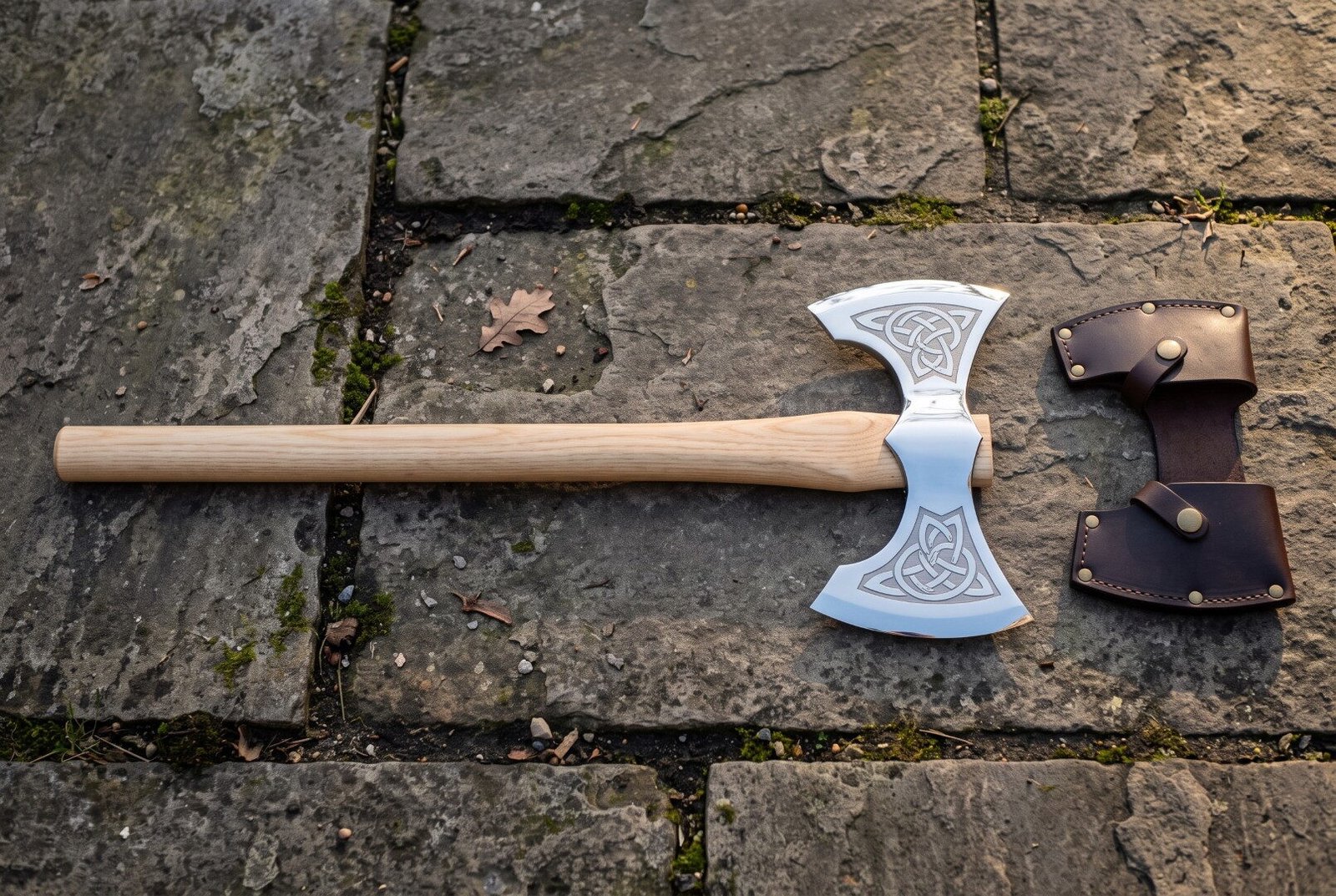
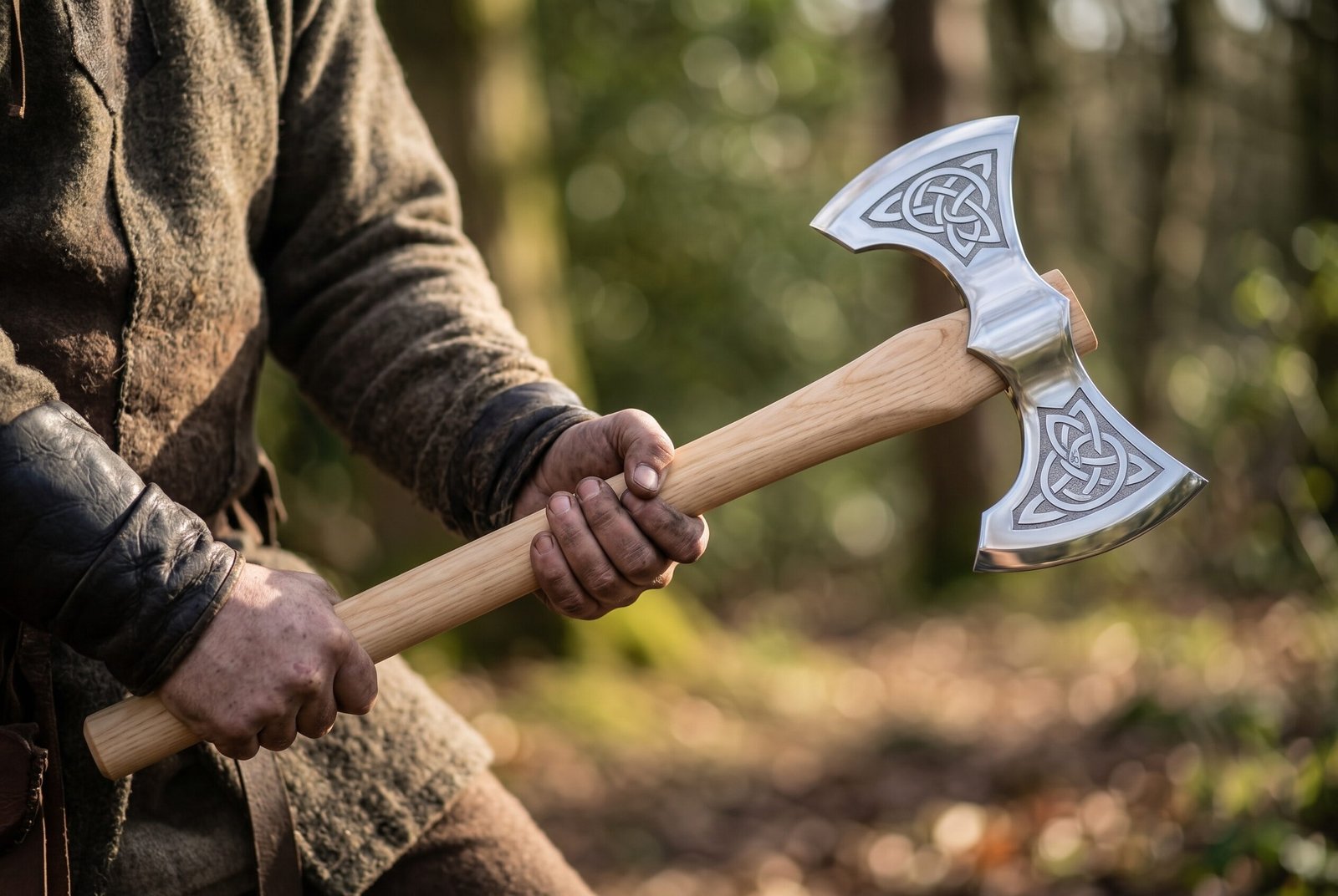
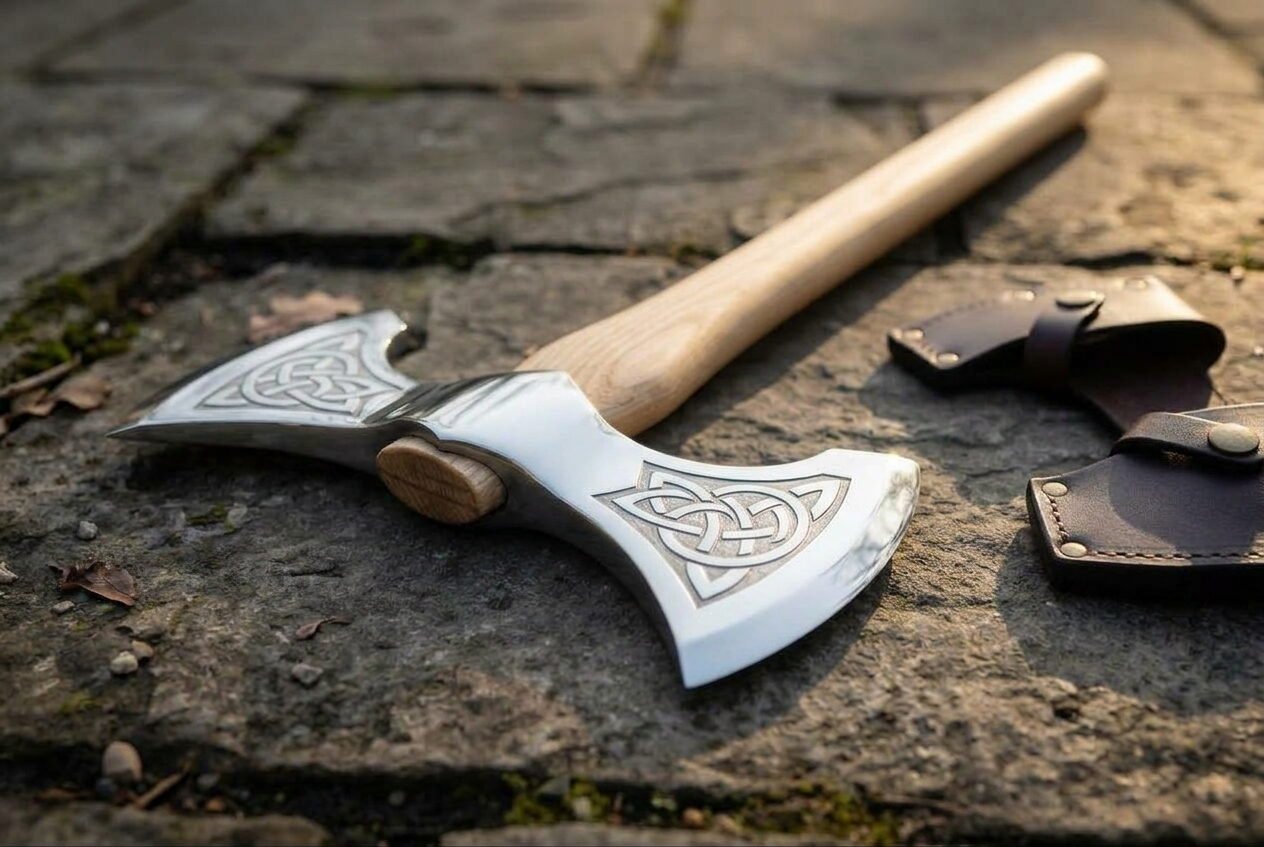
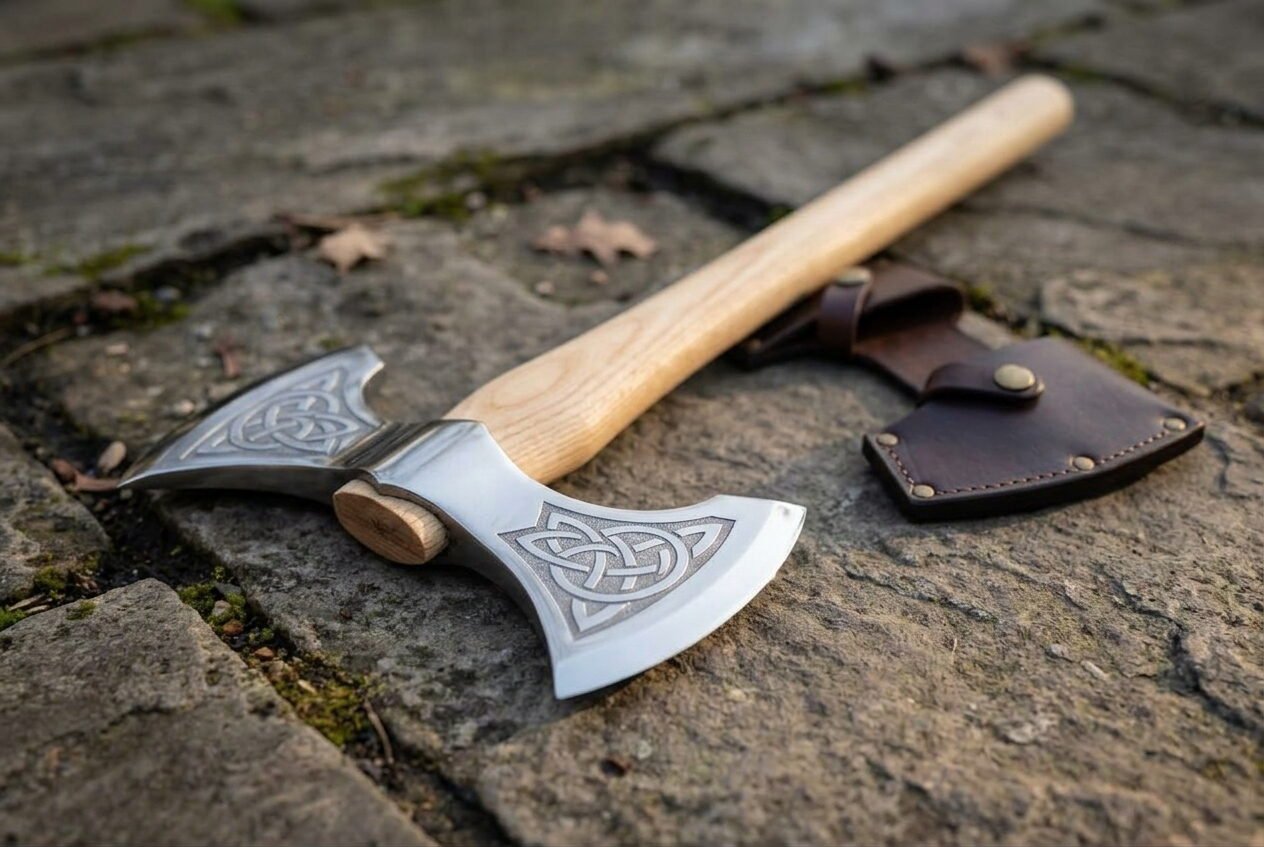
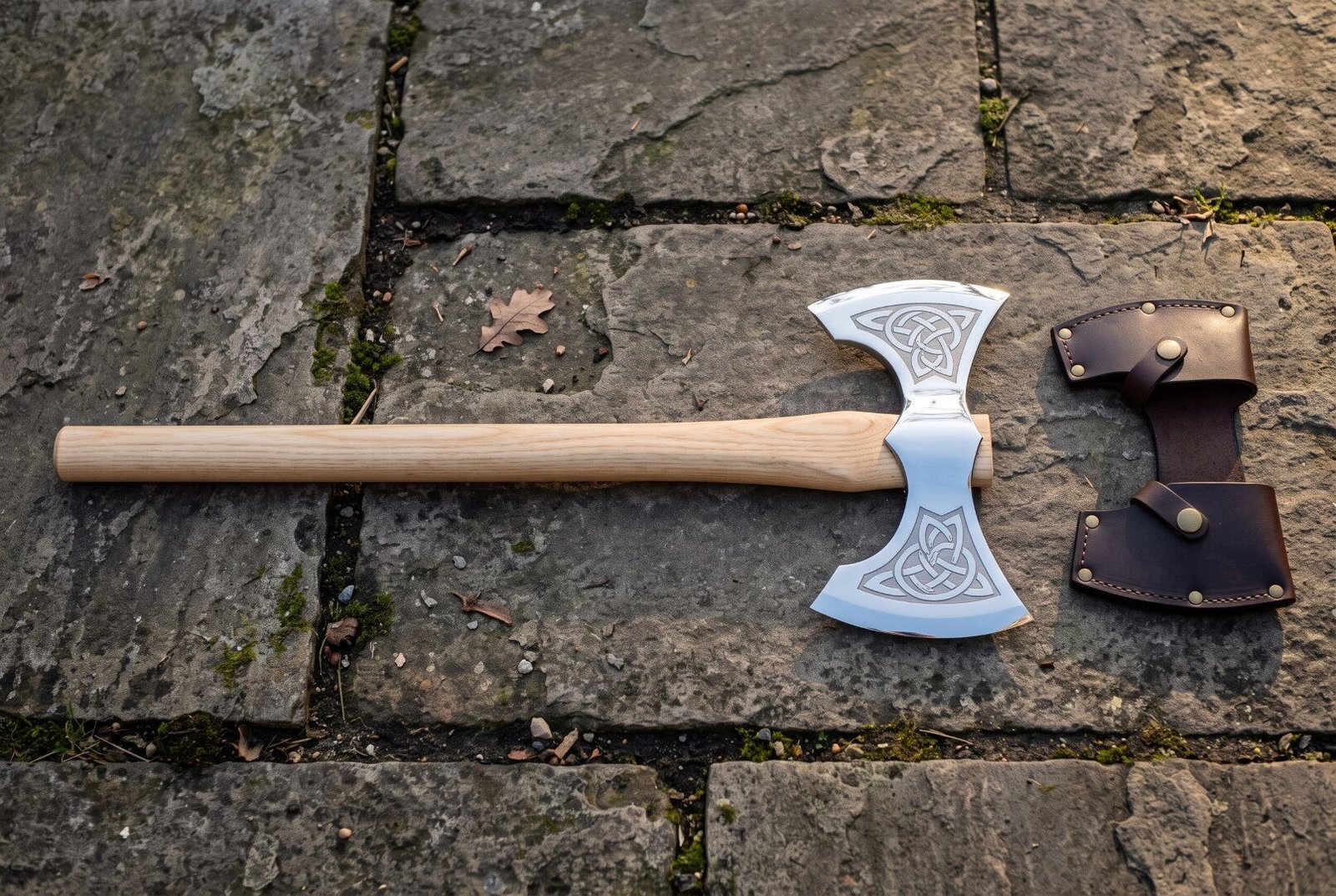
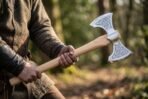
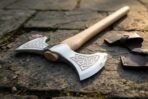
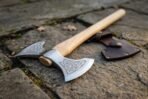
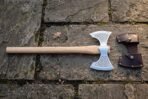
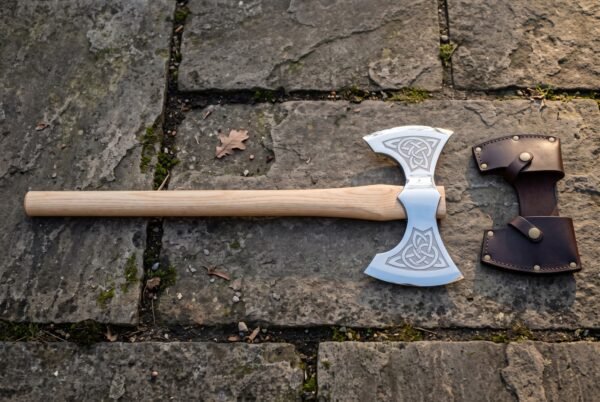
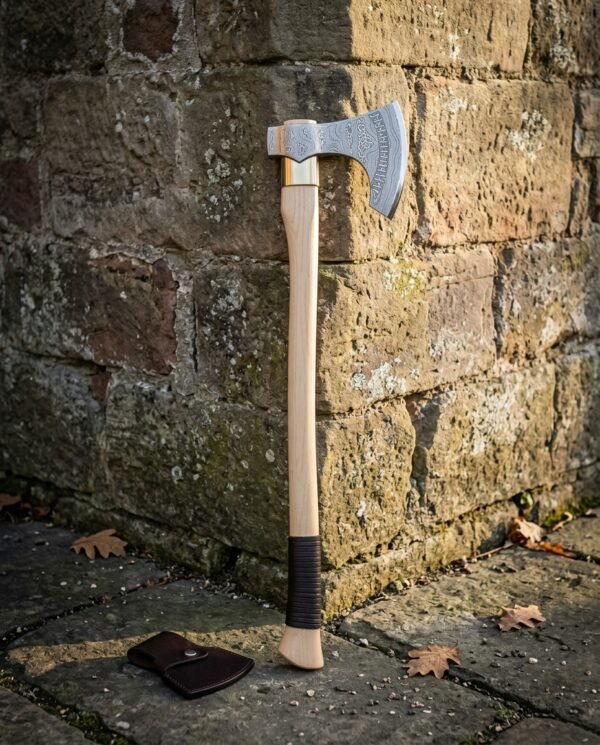
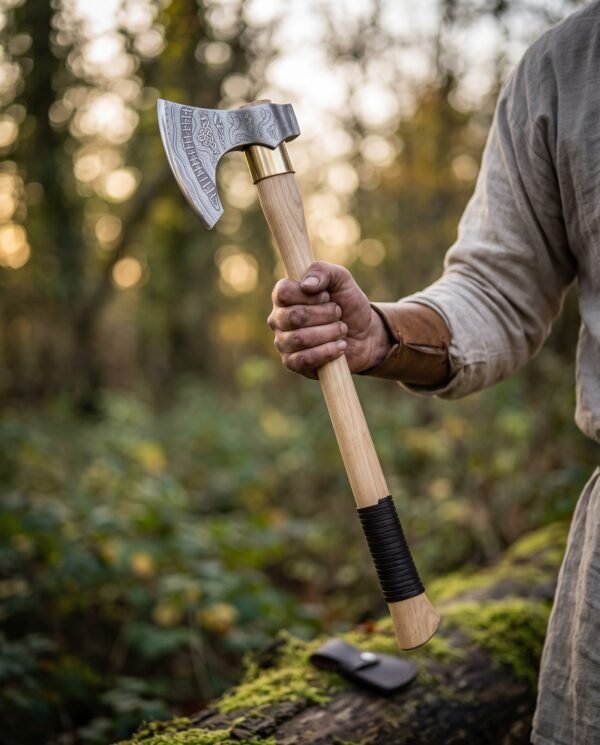
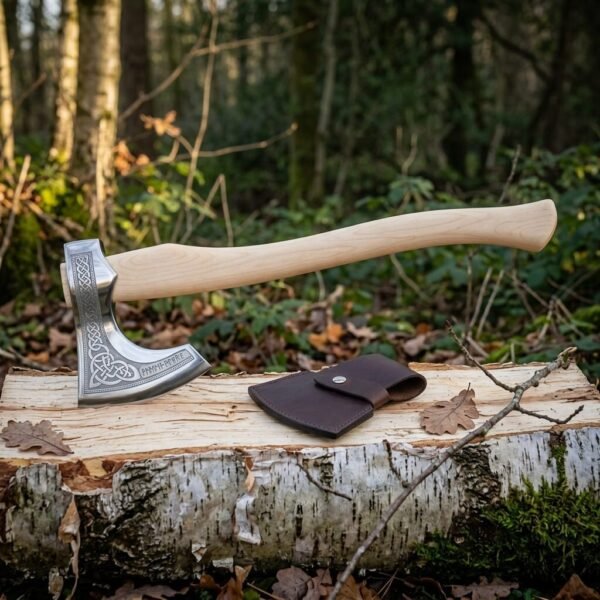
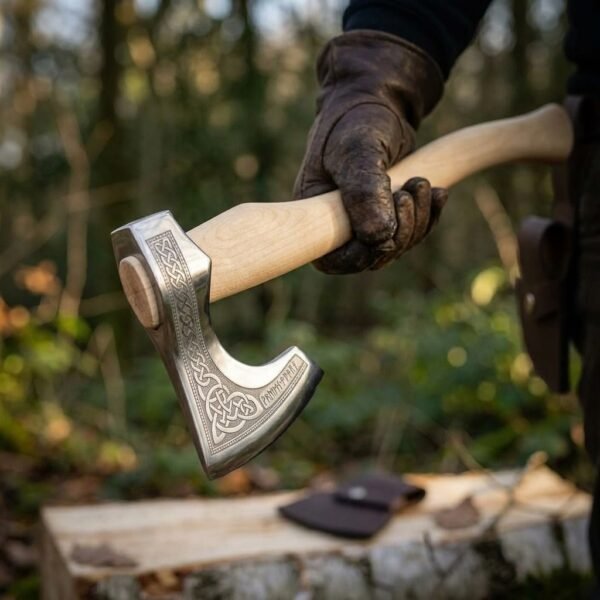
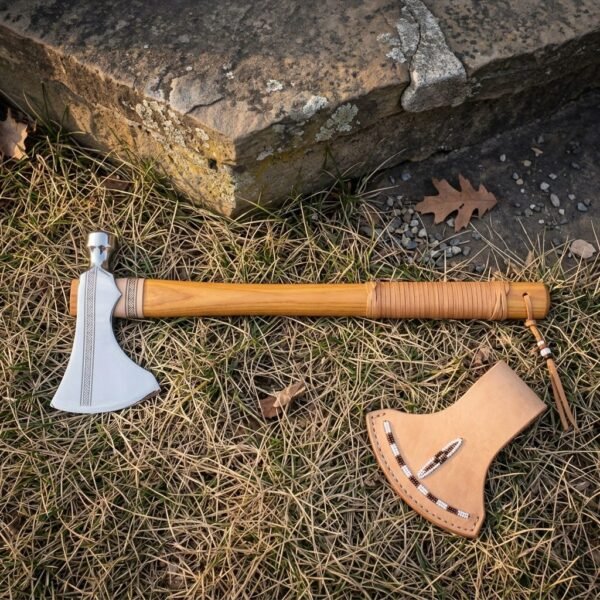
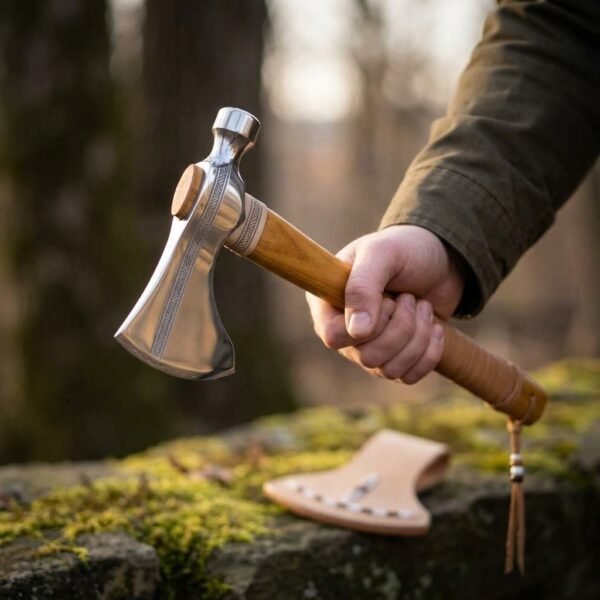
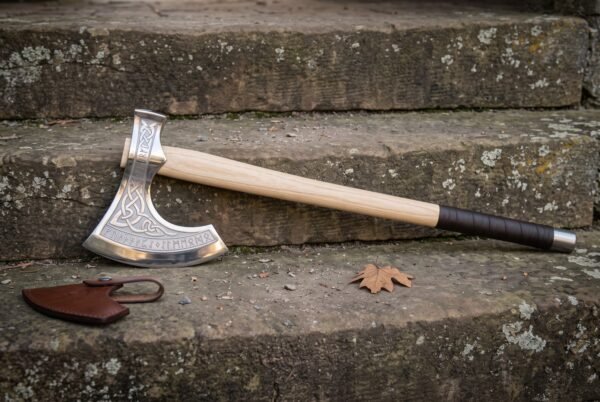
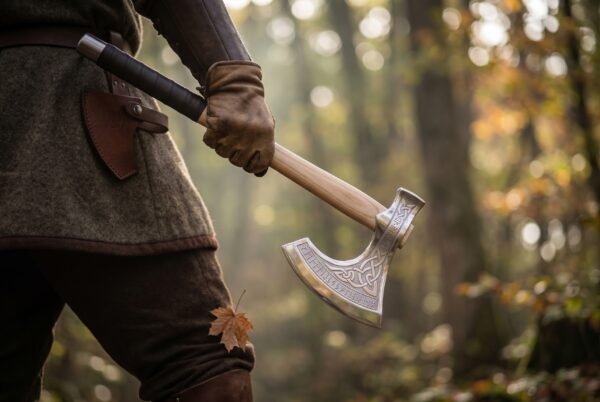
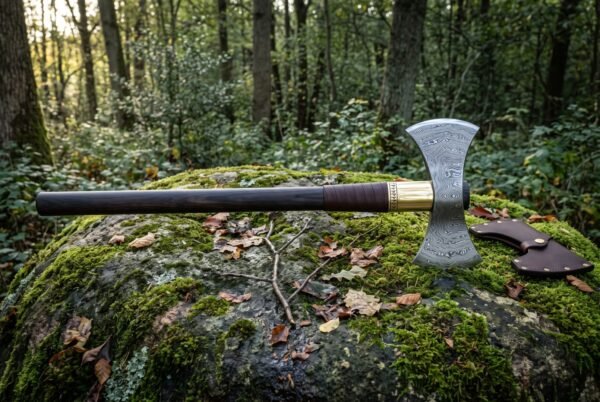
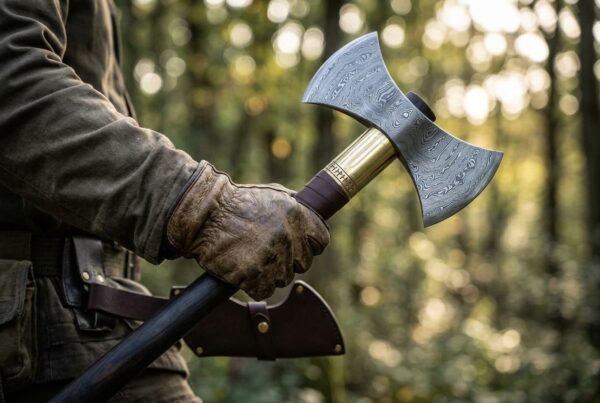
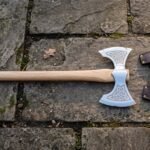
A double bit axe with two symmetrical flared bits, a bright polished finish, and a deep etched Celtic knot set into the flat of each side. The head is hung on a pale straight grain ash haft and it comes with a dark brown leather head cover that closes over both edges with a strap and brass snap. It is a striking object and it photographs beautifully, and it is built as a display and light reenactment piece rather than as a working timber tool.
The honest bit of history is this: no double bit axe has ever come out of a Viking grave, a bog deposit or a ship burial. Norse fighting axes were single bit, often bearded, and usually surprisingly light. The double bit is an American logging pattern that appears in the middle of the nineteenth century, and the reason for the two edges was practical rather than martial. A logger kept one edge honed keen for clean cutting and the other deliberately duller for the dirty work near the ground where a stone or a nail would ruin a fine edge. This axe borrows that outline and dresses it in knotwork, and we would rather tell you that than sell you a Norse label that the archaeology does not support. It is forged, ground, etched and hung in the Czech Republic. Head weight, haft length and what each shape is for are set out in how to choose a Viking axe.
Specifications
| Head steel | 1095 high carbon, forged and differentially hardened |
|---|
| Hardness | 54 to 58 HRC at the bits, softer through the body and eye |
|---|
| Head | Symmetrical double bit with flared edges and a narrow waist at the eye |
|---|
| Head weight | Approximately 2 lb 8 oz |
|---|
| Bit width | Approximately 4 inches each side |
|---|
| Overall length | Approximately 26 inches |
|---|
| Haft | Pale straight grain ash, wedge hung |
|---|
| Finish | Bright polished steel with an acid etched Celtic knot panel on each bit |
|---|
| Cover | Dark brown leather head cover over both bits, strap with brass snap and brass rivets |
|---|
| SKU | RK-1557 |
|---|
What two bits actually change
A double bit is a balance problem before it is anything else. Put steel on both sides of the eye and the head sits dead in line with the haft, which means the axe does not want to roll in your hands the way a single bit does. That is why loggers liked them for accuracy on a long day: the edge goes where you point it because there is nothing pulling it off line. It also means you cannot use the back of the head as a hammer, which a single bit poll does perfectly well, so you give something up for that symmetry.
The flared shape here spreads the edge outward from a narrow neck. That is a genuine forging trick and it is the same one behind a Viking bearded axe: drawing the steel wide gives you cutting length without paying for it in head weight, so the axe stays fast in the hand. On a fantasy or display piece it also gives you two broad flats, which is exactly where the knotwork sits.
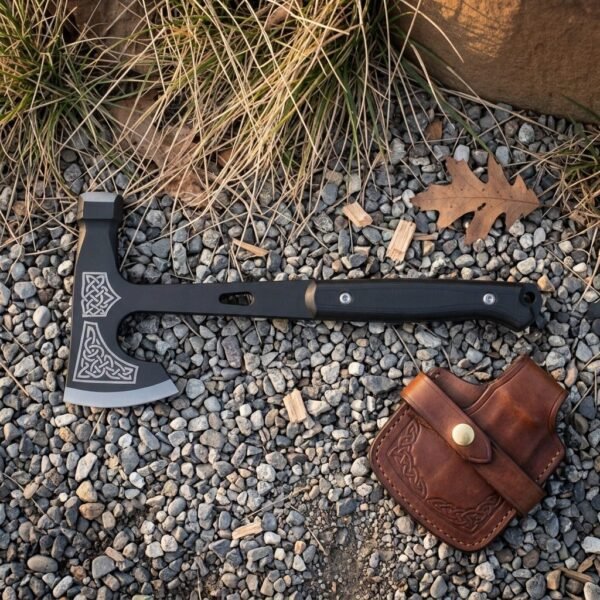
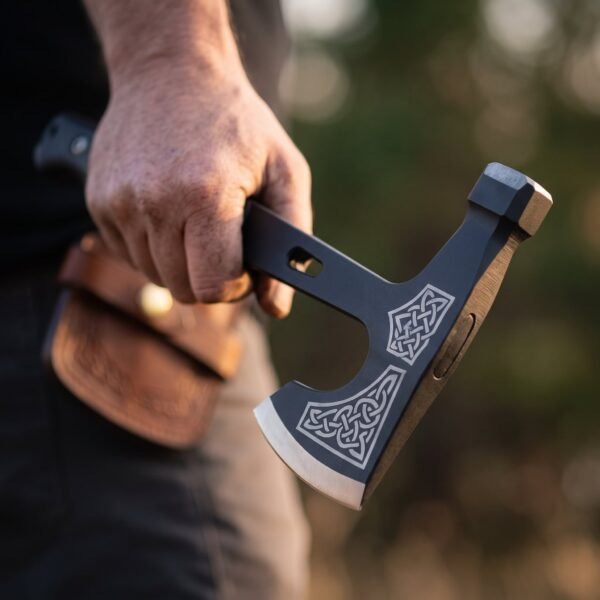
Be clear about the etch. The knot on each side is acid etched into the surface of the steel. It is not inlay, it is not engraving cut with a graver, and it is emphatically not Damascus. There is no pattern welding in this head at all. It is monosteel 1095 with a surface etch, and the pattern will soften at the high points over many years of handling, which is normal for an etch.
1095, differential hardening and the ash haft
The head is 1095 high carbon, hardened at the bits to 54 to 58 HRC and left softer through the body and eye. That difference is what keeps an axe alive. A hard edge takes and holds a bevel, and a soft core absorbs shock without cracking through the eye, which is where a through hardened head splits. It is the same reasoning behind a differentially hardened blade, applied to a tool that gets hit rather than one that cuts.
The haft is straight grain ash rather than hickory. Ash is a little lighter and a little springier, which suits an axe carried and swung for show more than one buried in oak all day, and it is what most European axe hafts were made from historically. It is hung with a wooden wedge through a kerf in the eye, so it can be re wedged if it ever loosens with the seasons.
Both bits arrive with a working edge. Treat them as sharp steel. This axe will cut, and it will cut you.
Engraving, runes and your own design
Use the rune converter on this page to turn a name, a date or a short phrase into Elder Futhark and we will cut it into the steel or the leather. If you would rather have a Viking pattern than a rune line, choose your own design in the engraving option above the add to cart button and tell us where it goes. Where a piece already carries an engraved design, your chosen engraving replaces it rather than sitting alongside it. On this axe that means your mark takes the place of the knot on one or both bits, or we can set it into the leather head cover instead. See the engraving page.
Display, mounting and honest use
On a wall this hangs best from two pegs under the head with the haft dropping free, rather than from a single hook through the haft, which puts the whole weight on one point and lets the axe swing. Keep the leather cover on when it is not on display; it protects the edges and it protects everyone else from them.
What this is not is a felling or splitting axe for serious timber work. The bits are ground for a clean profile and a good look, and a double bit in a woodpile is genuinely dangerous because the upward facing edge is right where your leg and your hand go when you reach into the cut. If you want an axe to work with, buy a single bit felling axe and keep this one for display, costume, photography and light reenactment.
Care
Wipe the head dry after handling. Bare 1095 will fingerprint and then spot, and an etched surface holds the mark of a print more visibly than a plain one. Give it a film of light machine oil or a metal wax every few weeks, and always before it goes into storage. Touch the edges up with a file and a stone rather than a powered grinder, because heat at a thin edge undoes the temper you paid for. Oil the ash haft once or twice a year with boiled linseed oil, working it into the end grain at the head. Feed the leather cover with a neutral conditioner twice a year so it does not dry and crack at the strap. More on protecting carbon steel is on the steel care page. Sharpening starts with a file, and how to sharpen an axe takes it through to the strop.
Made in the Czech Republic
This is a handmade piece from the Czech Republic, made in a workshop that still forges, grinds and finishes by hand instead of stamping parts out. The smiths there have kept the older way of working, and the wood, horn and leather are shaped and fitted by hand as well. Two pieces of the same design will never be identical, and that is part of what you are buying.
Ransack Viking is a United States company. We handle the import ourselves, look over every piece when it lands and ship from our warehouse in Chicago, Illinois. Engraving is done in the United States after the piece arrives, so your design goes on before we send it out.
A note on handmade variation
This axe is hand made, not machine made or bulk produced. What arrives will not be a pixel for pixel copy of the photograph. The flare of the two bits is drawn out under a hammer so the sweep differs slightly from head to head, the etched knot bites a little deeper on one side than the other depending on how the steel took the acid, and ash varies in colour and figure from tree to tree. The weight, the steel and the geometry are the same every time. The character is not.
Frequently asked questions
Is a double bit axe historically Viking?
No. Norse fighting axes were single bit and often bearded. The double bit is a nineteenth century American logging pattern. This piece borrows that outline and adds Celtic knotwork, and we would rather be straight about it.
Are both edges sharp?
Yes, both arrive with a working edge. Handle it accordingly, keep the leather cover on in storage and in transit, and be aware that the upward facing bit is exactly where your hand wants to go.
Can I chop firewood with it?
We would rather you did not. It is ground and finished as a display and light reenactment piece, and a double bit in a woodpile puts a live edge where your leg is. Use a single bit felling axe for real timber work.
Is the pattern on the bits Damascus?
No. The head is monosteel 1095 and the knotwork is an acid etch on the surface. There is no pattern welding in it. We say that plainly because the photograph could easily suggest otherwise.
Is it safe for full contact reenactment?
No. It is sharp steel with real mass and it has no combat rating of any kind. Non contact display, drill and photography only.
How long before it ships?
Processing is one to two weeks because each head is forged, etched and hung to order. Shipping is free inside the United States and returns are accepted within seven days.
What is in the box
- One hand forged 1095 double bit axe head, differentially hardened
- Acid etched Celtic knotwork panel on each bit
- Straight grain ash haft, wedge hung
- Dark brown leather head cover with strap and brass snap
- Care and warranty card
- Forged and finished in the Czech Republic
Explore the range
See the rest of the battle axes, the Viking axes, the Norse arms, and the guides.
Worth a look beside this
Next along the rack is the Knotbeard battle axe. For a straight comparison, see the Runebeard battle axe, forged from 1095. Worth putting side by side with this is the Runehewn battle axe, pattern welded Damascus.
If you are putting a set together, the Moonpoll Medieval axe sits alongside it. Or start from a blank sheet on the custom Viking axe page.

Not quite what I was hoping for. Expected more from Ransack Viking honestly. My last order was better than this. Just an average purchase. Wouldn’t rush to buy again.
My whole family was impressed when I unboxed it. Fit and finish is museum quality. You can tell real craftsmen made this by hand. Can’t recommend this enough.
Got this as a birthday gift and the reaction was priceless. Edge retention has been great even after regular use. So worth it.
This thing is a beast in the best way. The wood handle feels amazing and the balance is perfect. It’s handmade in the Czech Republic but ships from a US warehouse so it arrived quicker than I expected. Great buy overall.
Did not expect this level of quality for the price. Highly recommend this one.