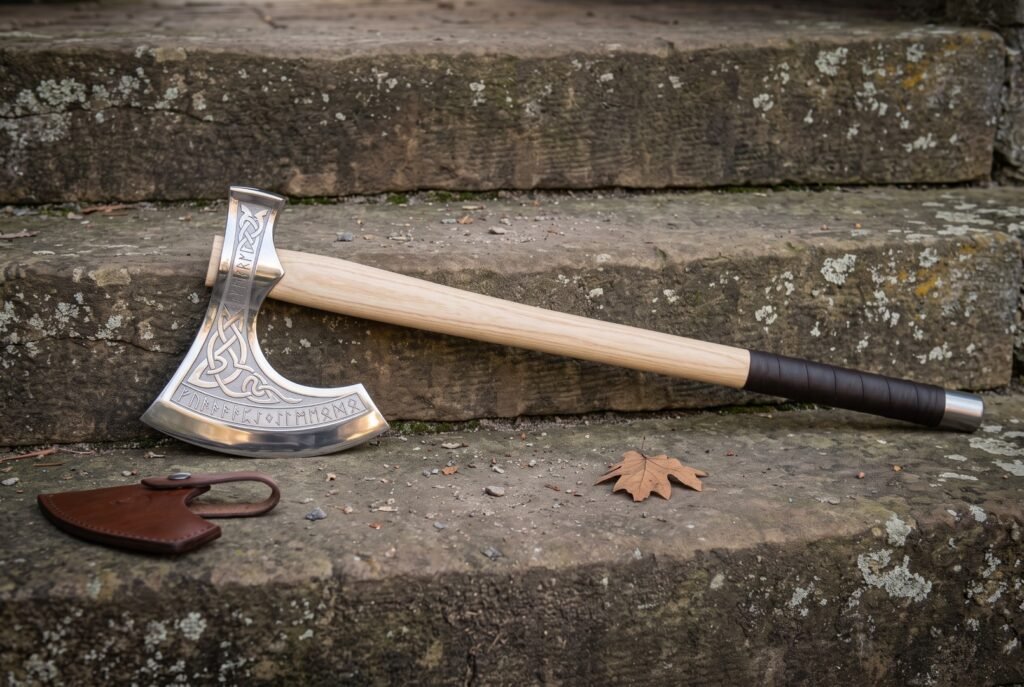
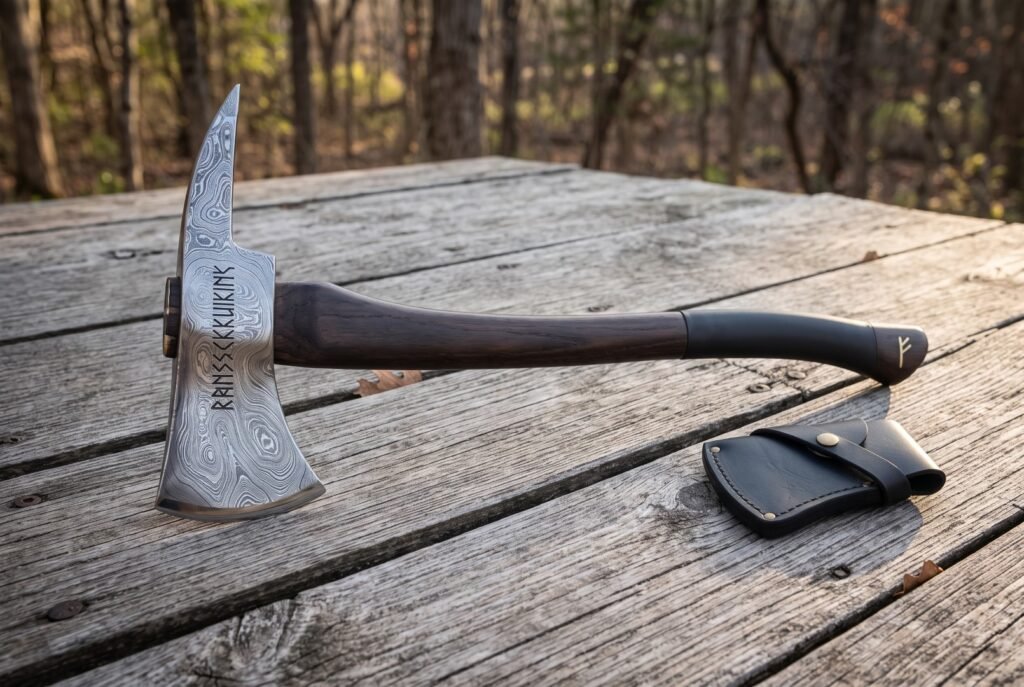
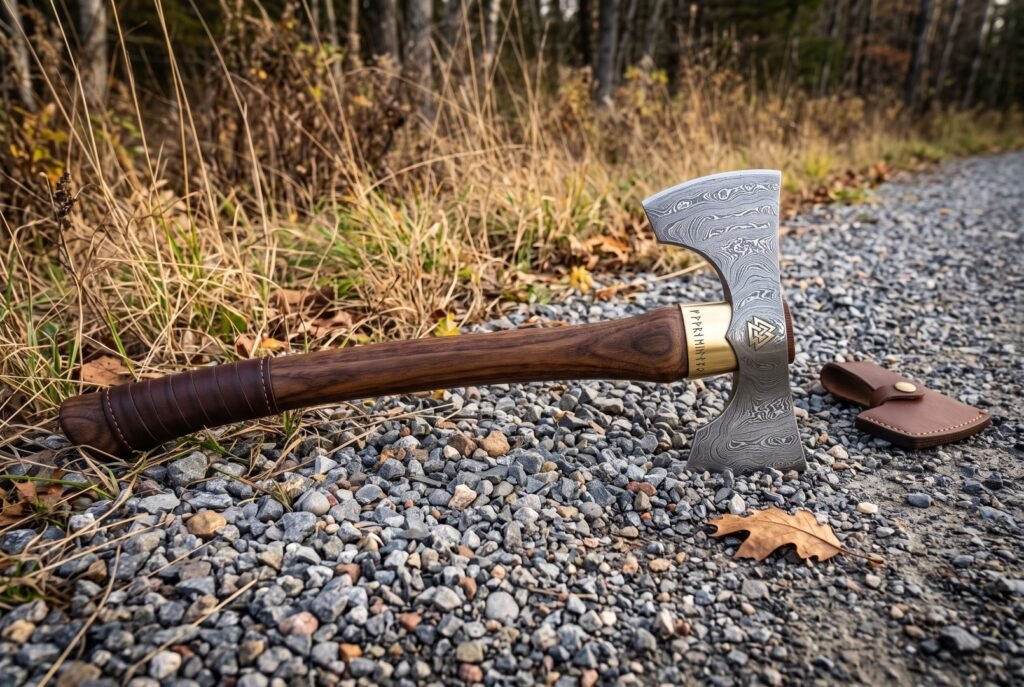
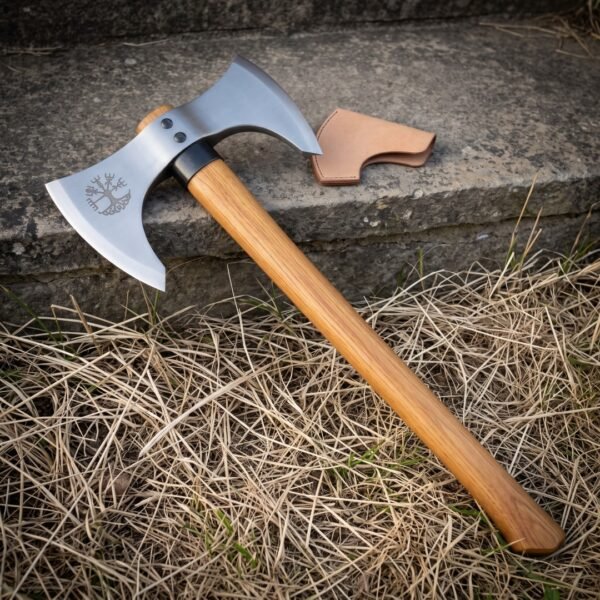
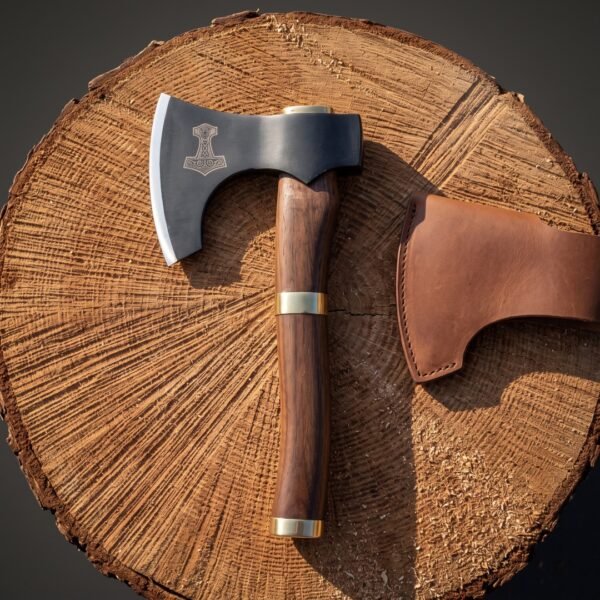
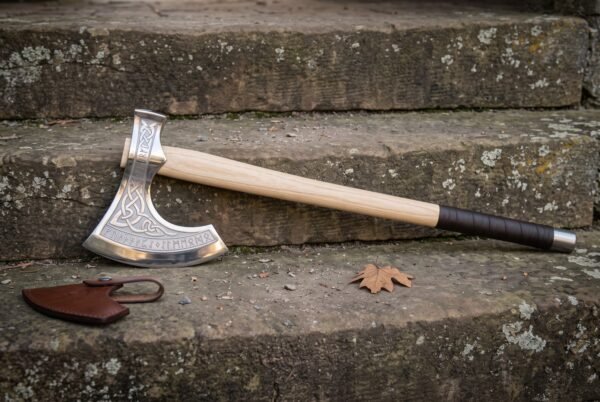
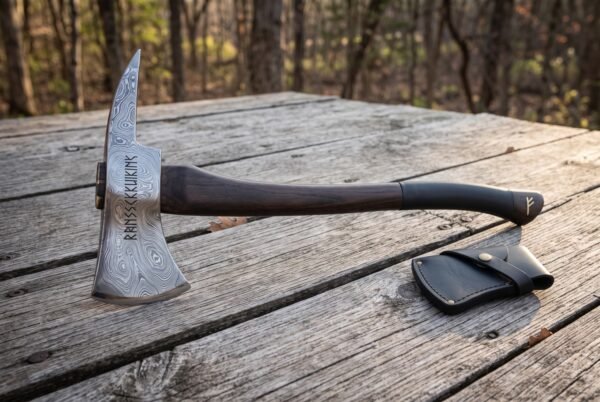
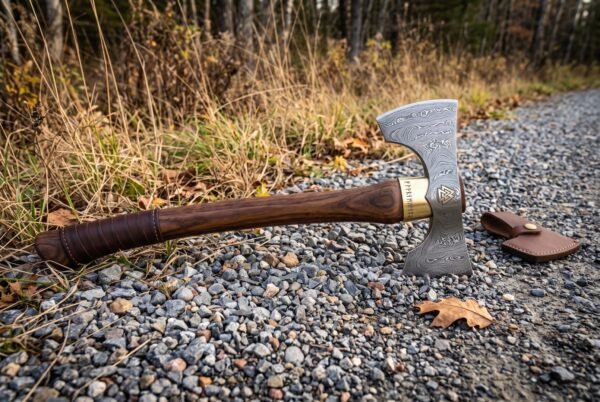
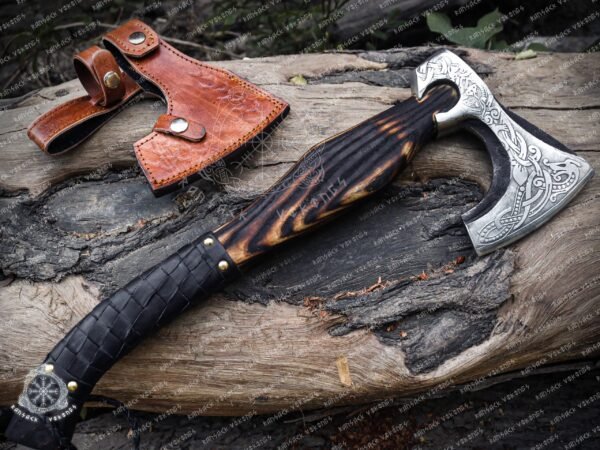
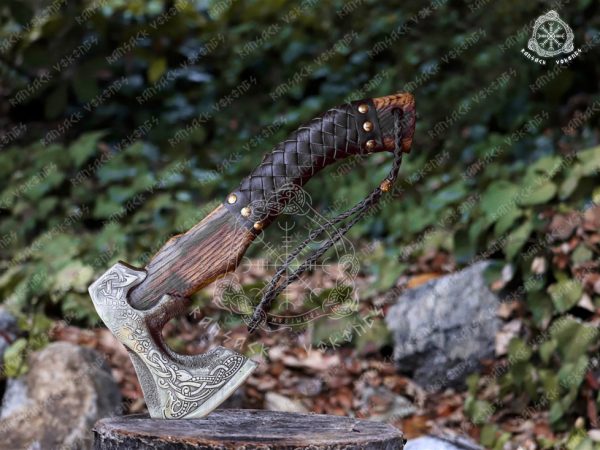
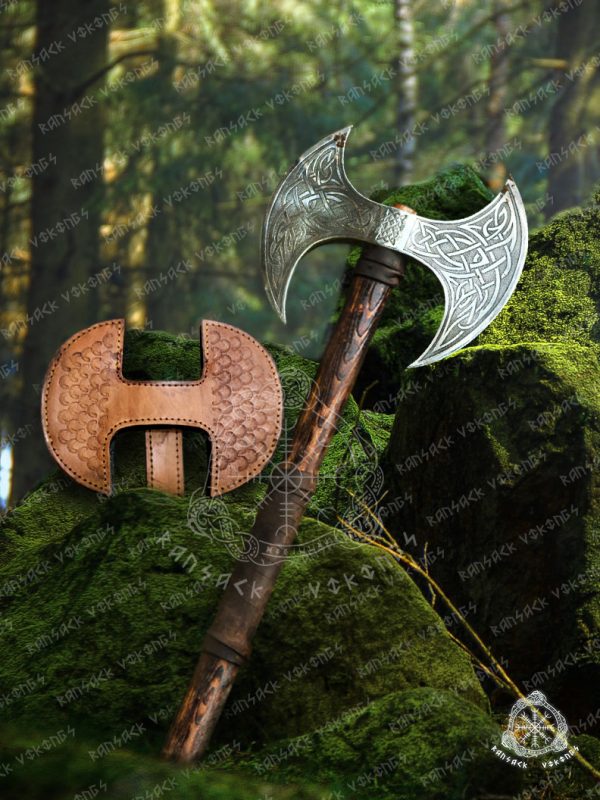
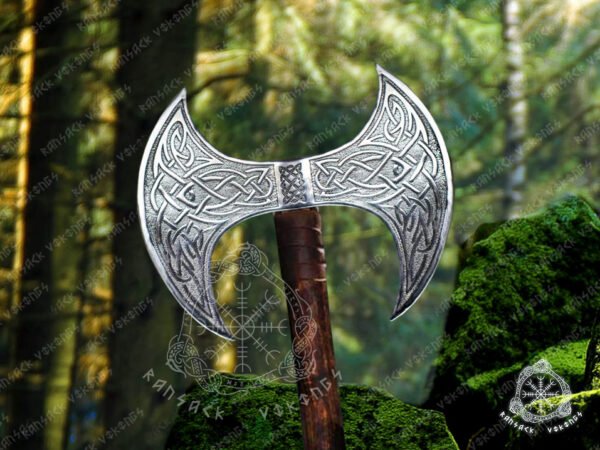
Twenty two inches of handle and nine inches of cutting edge make the Bloodoak the broadest axe in this part of the range. The head is forge welded Damascus in 1095 and 15N20, the haft is rosewood, and the finished piece weighs 1.23 kilograms. It ships with a leather blade cover and a gift box. If you want the background rather than the sales copy, the history of the Norse axe has it.
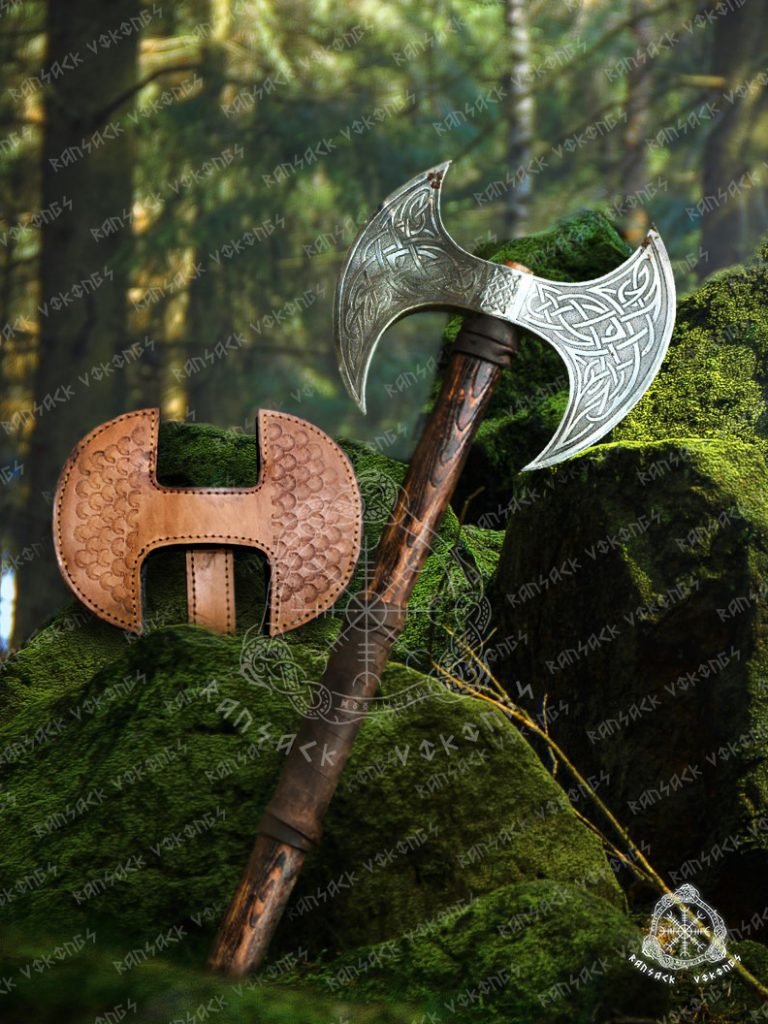
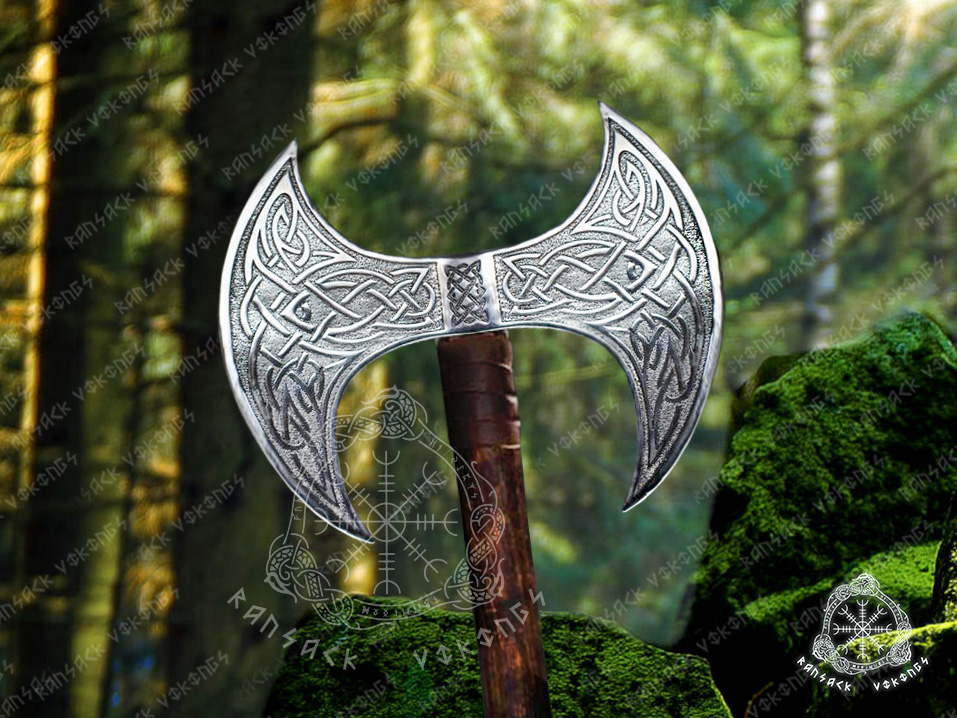
An edge that wide puts this in the family the Norse called the breidox, the broad axe, and it is the shape that produced the single most famous Viking axe in existence. In 1868 a rich chamber grave was opened at Mammen in Jutland, and among the grave goods was an iron axe head inlaid with silver across both faces. Dendrochronology later dated the timbers of the burial chamber to the winter of 970 to 971, which is about as precise as Viking Age dating ever gets. One face of the Mammen axe carries a bird among tendrils, the other a great foliate tree that is usually read as Yggdrasil or a tree of life. The decoration was so distinctive that art historians named an entire late Viking Age style after it. That axe was never meant to cut wood. It was a statement of who its owner was, carried on the same broad bit shape you are looking at here.
Every Bloodoak is forge welded, drawn out, heat treated, hung and finished in the Czech Republic, then packed with its leather cover and gift box. Shipping in the United States is free, processing takes one to two weeks, and returns are accepted within seven days.
Specifications
| Steel | Hand forged Damascus, 1095 and 15N20 |
|---|
| Hardness | 58 to 60 HRC |
|---|
| Overall length | 22 inches |
|---|
| Cutting edge | 9 inches |
|---|
| Weight | 1.23 kg |
|---|
| Handle | Rosewood |
|---|
| Included | Leather blade cover and gift box |
|---|
| SKU | RK-633 |
|---|
What a nine inch bit actually does
The width of the edge is the defining measurement on any axe, far more than the weight or the length, and nine inches is a lot of edge. It changes the tool in three specific ways.
First, it spreads the force of the swing over a longer line of contact. A narrow splitting axe concentrates everything into two or three inches and drives a wedge deep. A broad bit does the opposite. It bites shallow and wide, which is what you want for shaping and hewing rather than splitting, and it is the reason broad axes were the tool used to square logs into beams before sawmills existed.
Second, it puts a long sweep of edge in front of the hand, which is why axes of this shape were feared in a shield wall. A wide arc catches at almost any point along its travel, and the top corner of the bit, the toe, hooks around a shield rim and pulls it aside. Norse sagas are full of that manoeuvre for a reason.
Third, and less romantically, a wide thin bit is a harder thing to forge properly. The steel has to be drawn out sideways without thinning to the point of weakness, and the edge has to stay in plane. A cast head cannot do it convincingly, which is why so many decorative Viking axes have small stubby heads.
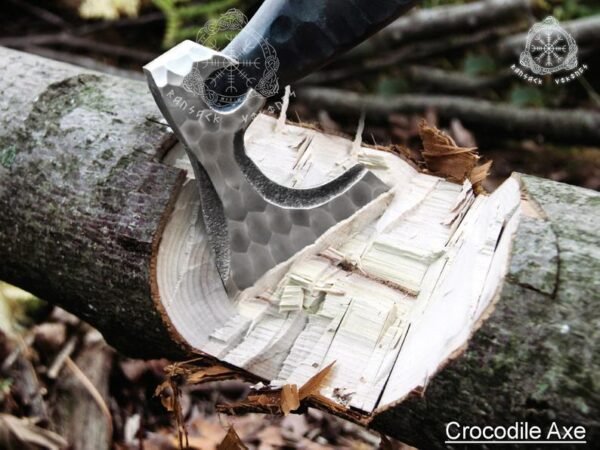
In practical use today this handles camp wood, kindling, shelter poles and target boards. Nine inches of edge is also a lot of forgiveness on a thrown axe, since a wider bit means more of the head can find the board.
Why Damascus and not stainless
This head is genuine pattern welded Damascus. Alternating layers of 1095 high carbon steel and 15N20, a nickel bearing alloy, are stacked, brought to welding heat and hammered into one solid billet, then folded and drawn out repeatedly. Because the layers run all the way through the steel, grinding the bevel exposes them rather than removing them. Etching afterwards makes the difference visible, since the two steels resist the acid at different rates.
The pairing is not arbitrary. 1095 brings hardness and edge retention, 15N20 brings toughness and the bright contrast, and the resulting billet heat treats to 58 to 60 HRC. On an axe that matters more than it does on a knife, because an axe edge takes impact rather than pressure. A blade that is hard all the way through will chip on a knot. Layered steel distributes that shock across the boundaries between layers.
Stainless would be the wrong choice here on every count. Its chromium carbides make it more brittle in the thin section of an axe bit, it is difficult to forge weld, and it is markedly harder to bring back with a file in the field. Damascus asks for a wipe and a film of oil in return for a better edge. Read the full comparison in Damascus versus stainless.
The rosewood haft
Rosewood is a dense tropical hardwood with a dark red brown to near purple colour and dramatic darker figuring running through it. It is heavy, which is exactly what you want at the back end of an axe, because mass in the haft counterbalances the head and stops the tool feeling like it is trying to escape from your hands at the top of the swing.
Rosewood also carries a high natural oil content. That makes it more water resistant than most timbers and gives it a deep lustre straight off the sanding block, but it also means it does not soak up finishes greedily. Use a light wipe of oil once or twice a year rather than trying to flood it, and let it dry properly between coats. A dry haft shrinks, and a shrunk haft loosens at the eye, which is the single most common failure on any axe. Method in wooden handle care.
Engraving, runes and your own design
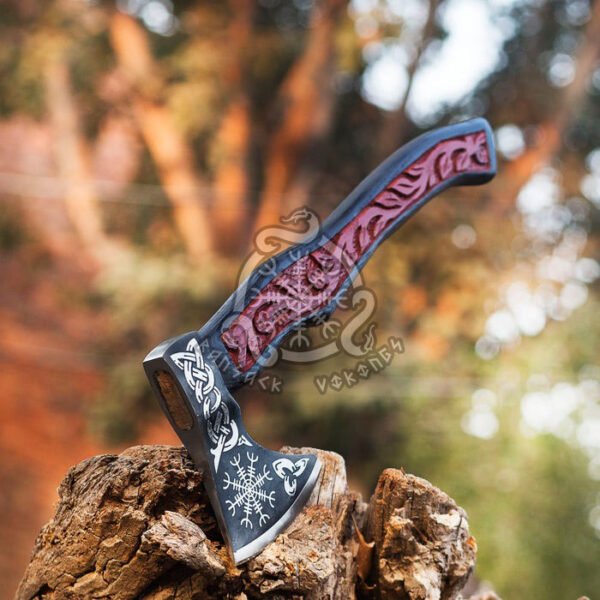
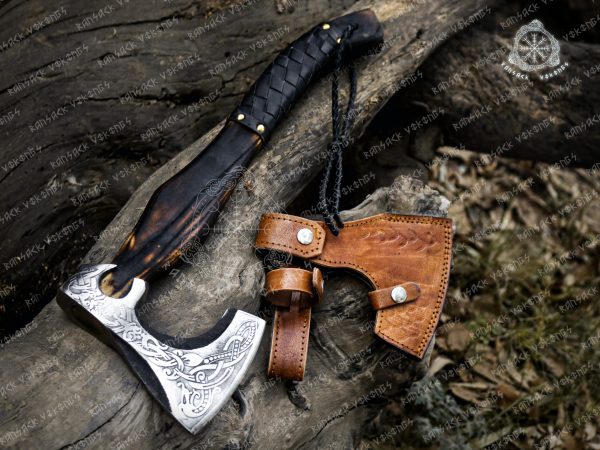
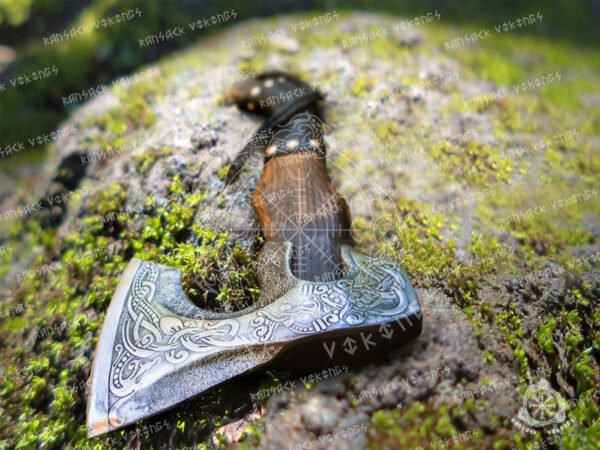
Use the rune converter on this page to turn a name, a date or a short phrase into Elder Futhark and we will cut it into the steel or the handle. If you would rather have a Viking pattern than a rune line, choose your own design in the engraving option above the add to cart button and tell us whether it goes on the blade or the handle. Where a piece already carries an engraved design, your chosen engraving replaces it rather than sitting alongside it. The broad flat cheek of this head is the best canvas in the whole range for a rune line or a knotwork panel, which is exactly the surface the Mammen smith used. See the engraving page.
Care and sharpening
Dry the head after use and put a thin film of oil on the steel before it goes away. Keep the leather cover on the bit in storage but do not store the axe long term with damp leather pressed against the steel. Etched Damascus keeps its contrast best if you avoid harsh scouring. The routine is in steel care.
An axe edge is reset with a file rather than a stone. Work the file into the edge in short strokes following the existing bevel, then move to a coarse stone, then a fine one, then a strop. The same angle discipline that applies to a knife applies here, and the whetstone stage is described step by step in sharpening with a whetstone. Never take an axe to a bench grinder. The heat will draw the temper out of the thin bit faster than you can see it happen.
Made in the Czech Republic
Every piece we sell is made by hand in the Czech Republic. The smiths there work the way the trade has been worked for a long time, heating and hammering the steel, taking the bevels down by eye, and fitting the handle and the leather one at a time. There is no automated line anywhere in it, so small differences from one piece to the next are normal and expected.
Ransack Viking is a United States company based in Memphis, Tennessee. We bring the pieces in ourselves, inspect them on arrival and ship them from our own warehouse. If you add engraving, that is carried out here in the United States before your order goes out.
A note on handmade variation
The Bloodoak is hand forged. It is not machine made and it is not bulk produced, so what arrives will not be a pixel for pixel copy of the photograph. The Damascus pattern depends on how the billet moved under the hammer, the rosewood has its own grain and colour, and the etch takes slightly differently on every head. Pattern, tone, figure and exact profile vary from one axe to the next because each is worked by hand from natural materials. The dimensions, the steel, the hardness and the build are the same every time. The character is not.
Frequently asked questions
Is the edge sharp when it arrives?
Yes. The bit is sharpened by hand before packing and will cut on arrival. It is an axe edge rather than a razor edge, which is the correct finish for a tool that meets wood.
Can I throw it?
You can, and the wide bit is forgiving on a target. Throw into end grain boards rather than a hard backstop, check the wedge at the eye regularly, and read up on technique before you start.
Is the Damascus pattern going to wear off?
No. It is not a coating, an etch print or a laser mark. The layers are structural and run through the whole head, so sharpening exposes fresh pattern rather than removing it.
How is this different from your bearded axes?
A bearded axe has a deep hook cut out under the bit, which lets you choke up close to the head for carving work. This one has a full broad bit with no cutout, so it carries more edge and more mass and is aimed at chopping and display rather than fine shaping.
What does the leather cover do?
It protects the edge in transit and in storage, and it protects you when the axe is in a pack. Take it off when the axe is put away for a long spell so that moisture is not held against the steel.
Can I have it engraved and how long does that take?
Yes, on the cheek of the head or the haft. Engraving is cut here in the shop and does not usually extend the one to two week processing window, but tell us at checkout if you are working to a date.
What is in the box
- One Bloodoak Damascus Viking axe, 22 inches with a 9 inch edge
- Leather blade cover
- Gift box
- Forged and finished in the Czech Republic
Explore the range
Related collections: Viking Axes, Viking Hammers, Viking Seax and Swords. The steel, the sharpening and the history are written up in the guides.










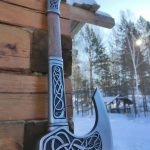
Pretty impressed. Just a couple minor things I’d tweak. Minor nitpicks aside, good quality piece. Ransack Viking usually delivers solid quality and this was no exception.